by Felicia Goodman | Nov 5, 2024 | Expert Advice
Nowadays, the operations in the healthcare sector are running at a fast pace. The medical industry is concerned about patient care. However, there are many administrative tasks such as scheduling appointments, handling billing issues, answering insurance questions, and caring for a patient’s administrative needs. Most healthcare providers are overwhelmed with many administrative jobs.
Availing healthcare call centre services, specifically designed for medical practices can ease administration tasks in one of the best ways. The main strength or the key feature of a healthcare call centre is its service which has the ability to smooth out all the hassles and troubles of modern medical practices to enhance both the medical practice and patients’ satisfaction.
However, not all call centres are created equal, and locating the right partner requires knowing what distinguishing qualities make great providers stand out from the pack below are the five qualities to look for when seeking a healthcare call centre support partner:
5 Best Qualities to Look for in a Healthcare Call Center Partner
First and foremost, a great healthcare call centre requires tender, knowledgeable care from agents genuinely committed to helping patients often, challenges can arise when patients with legitimate health concerns present symptoms outside the scope of the provider’s established protocols.
Let’s understand in detail about features and qualities of a best healthcare call center.
1. Comprehensive Knowledge of Healthcare and Medical Terminology
The first and foremost deal-breaker when choosing a partner to help with healthcare call centre support is whether or not they have experience in the healthcare space. Healthcare is complicated, regulated, jargon-heavy, and contains a certain amount of ‘medicalese’ which requires an understanding from the provider. Using a call centre that doesn’t have experience in the space can lead to misinformation shared with a patient, a miscommunication over a prescription plan, or a botched time slot for a doctor’s appointment.
A good healthcare call centre would have trained staff in medical coding, insurance verification, medical terminologies, and even the software used in healthcare practice, namely EHR and PMS.
Why it Matters:
- Correct answers: if a patient on the other end of the phone queue has a billing question, or wishes to know if a particular treatment is covered by insurance, ‘adequate’ won’t do. If a caller centre agent lacks knowledge of the healthcare lexicon or the arcana of the billing system, incomplete answers may lead to frustrated patients, not to mention frustrated healthcare providers.
- Quicker Resolution: An agent who’s well-versed in the workings of a product can handle inquiries faster, reducing back-and-forth and resolving issues more efficiently. In turn, this results in a better experience for the patient.
2. HIPAA Compliance and Data Security
Of course, one of the huge basic principles of medicine is keeping a person’s medical information private. HIPAA is clear about rules for handling patient data, and a call centre will be held accountable for violating those rules – which would mean massive fines, lawsuits and tarnished reputation.
These include detailed tracking of how particular data has been accessed by whom, strong policies for data protection, and physical or automated methods to prevent individuals or pieces of equipment from transmitting private patient information outside of a given network. Make certain that your healthcare call centre support partner has systems to protect against security breaches in HIPAA terms and other applicable data security standards.
Why it Matters:
- Trust and Safety: Healthcare providers receive patient information that is sensitive in nature; call centres must maintain data confidentiality and not mishandle that information, or patients will go elsewhere to seek care.
- Regulatory Compliance: Violations of HIPAA carry penalties of between $100 and $50,000 per violation, depending on the severity of the violation. A healthcare call centre partner needs to make sure that they comply with all regulatory requirements to mitigate the risk for the provider.
3. 24/7 Availability and Multichannel Support
Given that healthcare operates around the clock, your call centre support partner must keep those same business hours. Whether it’s a question about a medication, scheduling a visit or follow-up call, or simply a question on how to pay a bill, your patients’ needs often arise after hours. In fact, having a healthcare call centre that operates 24×7 will ensure that your patients never have their questions or an appointment go unanswered.
Furthermore, a first-class call centre that offers healthcare support is equipped to support multiple channels. Today’s consumers embrace communication through varied channels such as email, live chat, text messaging, and mobile apps. They expect their physicians and facilities to offer the same. Being health conscious nowadays, I am always up to date about primary and major diseases. A top-notch healthcare call centre should offer multichannel support.
Why it Matters:
- Enhanced patient satisfaction: Allowing patients the option to reach support multiple ways – whether via telephone, email or live chat – demonstrates a dedication to accessibility and can result in stronger patient satisfaction and retention.
- Flexibility for Providers: Using multichannel support means that every patient demographic is covered, including patients who are more likely to click instead of call. For example, if a call centre can be accessed only via phone, younger patients or tech-savvy patients could be effectively lost to distant practice call centres or outsourced call centres.
4. Scalability and Customization
As your healthcare practice grows, so will the volume of patient questions and administrative needs. Your new healthcare call centre support partner should be scalable, and able to modify its headcount or services up or down based on your healthcare organisation’s needs. For example, a large hospital network might have a greater need for higher-touch support. Or maybe you prefer something more streamlined. And, perhaps most important, one call-centre solution does not fit all. If your patients have distinctive needs, and your healthcare organisation has highly specific processes and a unique vision, your call centre partner needs to be able to customise their approach.
Whether you need an appointment-scheduling partner after regular hours or someone to add capacity to a specific billing function where you had an exceptionally high number of enquiries last month, you need a call centre partner who is an extension of you. It needs to be wholeheartedly aligned with your brand principles, working within your protocols, and responding to the unique issues your organisation faces.
Why it Matters:
- Scalability: Whether your practice is growing or the provider is offering new services, it’s important, especially in the context of clinical patient care, to find a partner that can scale your business so that you don’t experience any disruption in patient care or administrative workflows.
- Tailored services: A call centre that offers scripting, workflows and service packages that you can customise to a finer degree of detail will serve the specific needs of your practice better than one that offers only generic solutions.
5. Strong Communication and Reporting Systems
Effective communication on all levels – key performance indicators, customer satisfaction, monthly patient numbers – are vital in successful partnerships and healthcare call centre support is no exception. Your call centre should be able to keep you informed of their performance, what patients think of them, and the outcome of conversations with your patients. This may come in the form of detailed reports or key performance indicators (KPIs) with metrics like average call handling time, resolution rates, etc.
Next to reporting, consider whether your call centre provides you with an open, transparent communication line with your staff: is there an issue that needs to be escalated for swift action? Have they noticed emerging trends in patients’ enquiries that need to be part of your larger service management? Good communication forms the bricks to solidify your partnership.
Why it Matters:
- Performance Tracking: Reporting regularly from the call centre will let you know if the centre is doing more towards helping patients be satisfied with their service, bringing down the wait times or helping with billings. The data collected will assist you in making decisions on the best way to optimise the venture.
- Coordination with Your Practice: Open communication between the call centre and your practice helps to align both teams, ensuring they are in step with the values of your practice and providing the best possible service to your patients.
Get A Best Call Center Services For Your Healthcare Practices
While choosing the right partner may seem like a daunting task, finding the right mix of compatibility and expertise in a healthcare call centre support partner can dramatically impact your practice’s success. Whether it is adherence to HIPAA regulations or the ability to provide uninterrupted 24/7 call center support to your patients via phone, email and live chat, the attributes you value in a partner will dictate how effectively your practice runs, and to what degree your patients are satisfied.
A niche healthcare call centre that can absorb needed data security as well provide knowledgeable staff and deliver a customized, scalable approach will help to alleviate these administrative burdens but also can improve patient care and satisfaction as the industry continues to change.
A focus on these top 5 qualities demonstrated knowledge of a holistic range of healthcare topics, HIPAA compliance, being available 24 hours a day, seven days a week, being scalable, and a great ability to communicate effectively with others – will ensure you find the right partner who can support your call centre when you need it most in order to grow your practice to the levels and success you desire and strive for.
by Felicia Goodman | Nov 2, 2024 | Expert Advice
There is no doubt that these modern problems have created a situation in healthcare where patients and providers often want fast and efficient solutions to billing questions and insurance issues. The current system of medical billing codes, insurance benefits, and reimbursement of insurance can bog down administrative processes with bottlenecks, delayed paychecks for providers, and absent or incorrect reimbursement for family members and patients receiving medical attention. Call centers for healthcare providers can offer a solution for the following reasons.
So, let’s go into how a call center can streamline these processes as a means of reducing costs, improving the patient experience, and helping healthcare organizations thrive.
Understanding The Role of Call Centers in Healthcare
A healthcare call center is an extra set of hands answering the phones in a healthcare provider’s office and is an essential extension of its administrative staff. It can help with calls ranging from working-out patient scheduling to appointment reminders, post-care follow-up, or whatever might be required. But the most important processes these centers help manage are our billing and those necessary inquiries associated with insurance.
In a call centre setting, patients are served by agents who get specialized training in reading and making sense of healthcare terminology, the processes behind insurance, HIPAA compliance call centers, and more. If a provider can outsource the billing, coding, and other financial questions and direct patient calls to a healthcare call centre, they can smooth out a lot of the clogging of the pipeline that occurs around these sorts of financial exchanges between providers, insurers, and patients.
7 Benefits of Using Call Centers for Billing and Insurance Inquiries
1. Reducing Administrative Burden for Healthcare Providers
Medical providers such as doctors, chiropractors, or physical therapists are trained in patient care, not in the minutiae of medical billing or insurance queries; that’s exactly why a provider’s frontline call centre can offer a dedicated team to handle all the issues that arise regarding billing on behalf of its medical providers. A frontline call centre allows its provider to concentrate on its core competency, which is providing patient care.
2. Enhancing Efficiency Through Expertise
Coding of medical services – including procedural codes (CPT codes) and diagnoses (ICD codes) codes along with other types of insurance-specific billing codes – must be done correctly to ensure proper payment. It is increasingly common for healthcare call centres to include specialised agents who understand coding to answer patient questions more accurately and to reduce errors in claims submission and reimbursement time.
3. Accelerating the Payment Process
One of the biggest delays healthcare providers experience is payment by either patients or insurance companies. Call centres wield a big stick to speed up this payment process by making sure that claims are submitted correctly the first time around, thus reducing the likelihood of those claims being denied or needing to be resubmitted.
4. Improving the Patient Experience
Medical bills and insurance terms confuse patients. They may not understand their insurance coverage and co-pays, deductibles and out-of-pocket expenses. A patient service centre provides another way for patients to ask questions and understand expenses. Detailed concise patient-friendly explanations from good healthcare call centre agents can help patients have a clear understanding of the billing process, and insurance benefits and make decisions that best suit them.
5. Ensuring HIPAA Compliance and Data Security
With private information like medical records and patients’ billing data up for discussion, there are laws and regulations in place to ensure privacy (eg, the Health Insurance Portability and Accountability Act, better known by its American acronym as HIPAA). Healthcare call centres and their software and management processes must follow HIPAA regulations to provide secure services without causing violations or unlawful access to private information. An insurance billing inquiry can be a sensitive call, as it could touch on some embarrassing medical issues.
6. Handling High Volumes of Inquiries Efficiently
Questions relating to billing and insurance in a busy practice can easily monopolise the front-office staff and overwhelm their capacity. A call centre can easily take over these enquiries and answer them fast and accurately, using application-centric systems designed to deal with high call volumes and query routing. This improves patient wait times for their answers, hence enhancing the satisfaction of the provider.
7. Offering 24/7 Support for Billing and Insurance Inquiries
Another advantage of having a call centre handle the billing and insurance enquiries is that one can provide round-the-clock support. It is often seen that healthcare providers are open during usual business hours but the billing questions could arise at any point of time. At this juncture, the call centre comes to the rescue with its around-the-clock support. This would definitely help the healthcare providers to cater to the patient’s billing questions outside office hours thereby speeding up the resolution of billing issues and thus delay or confusion. That is a big thing in my opinion.
Common Billing and Insurance Challenges in Healthcare
Healthcare providers routinely receive various calls related to billing or insurance matters: Call centres are especially equipped to deal with these recurring problems.
- Claim Denials: Reimbursement claims are often requested for services provided where real-time payments were not made. Medical claims often get denied for reasons such as coding errors, missing information, or pre-authorisation issues.
- Verification of insurance coverage: Obtaining verification of a patient’s insurance coverage is tedious, complicated and time consuming, especially with different insurers and plan types, some of which are fairly esoteric. Using a call centre to obtain pre-visit verification of insurance is a huge time saver, freeing up front desk and billing staff from the tedious process of verifying benefits and reducing the risk of ‘down-coded’ claims and unpaid accounts.
- Patient Billing Confusion: If you’re a patient, the odds are that you will be confused by your medical bill. Do you have to worry about co-pays for the services of other physicians, too? How many separate services were provided? What is an ‘Other Referral’? The goal of most of the other AI medic agents up to this point was to ‘tickle’ the patients’ experience of their disease, leaving patients and providers sometimes uncertain as to why or how the AI solved the problem. The goal of this agent is to increase transparency in a system that can be arcane and impenetrable for Patient Billing Confusion.
- Multiple Insurance Plans: Some patients have coverage under more than one insurance plan, and agents assist in coordinating the interaction of benefits across multiple payers, to ensure proper and timely claims submission and reduce denials.
Key Features of an Effective Healthcare Call Center
An effective healthcare call centre must fulfil specific features and capabilities that will provide better billing and insurance inquiries, and that a general customer service centre will not be able to provide. Some of these features include:
- The Discipline of Medical Billing and Insurance: In order to provide the best service to patients and providers alike, the call centre employee must be thoroughly trained in the different medical billing codes, insurance policies and protocols that are unique to healthcare, and how to handle medical cases on the phone.
- HIPAA Compliance: patient information is one of the most critical pieces of data in any healthcare setting, and at absolutely any cost, there must be no breach in compliance with HIPAA, which includes data encryption, walled garden data transmission channels and strict perimeters protecting sensitive information.
- Being integrated with the provider’s practice management software, or electronic health records (EHR) system: An excellent healthcare call centre is integrated with the provider’s practice management software or electronic health records (EHR) system so that an agent can retrieve and process this data at their fingertips. This minimises data-entry errors and expedites claim resolution.
- Multi-lingual support: Healthcare professionals often treat patients from many different backgrounds and having a multi-lingual call centre agent ensures that everybody receives support regardless of linguistic differences.
- Customisable Scripts: Call centre agents should fully script interactions to protect the brand and provide standardised care. These scripts can cover everything from verifying insurance to explaining patient balances.
Get Call Center Support Services For Your Healthcare
In an evolving healthcare environment, processing billing and insurance inquiries can be a daunting task for healthcare providers and their patients. It’s time to streamline the process with the speciality given to healthcare call centres. When healthcare insurances continue to rise, working with a call centre can make the process easy, decrease administrative pressures, expedite payments and enhance the patient experience. When healthcare providers specialise in patient care, hiring a call centre helps reduce claim denials, 24/7 support, patient experience and education.

by Felicia Goodman | Oct 17, 2024 | Expert Advice
In today’s fast moving healthcare environment, medical offices always look for ways to work better and help patients more. An often-overlooked tool is the outsourced appointment scheduling. Having experts handle this important job allows for smoother operations.
It cuts down costs and lets staff concentrate on top-notch patient care. Here’s how it makes a medic’s practice more efficient in five different ways.
Top 5 Ways Outsourced Appointment Scheduling Transforms Medical Practices
1. Enhanced Time Management
In any healthcare setting, time remains a crucial factor. Doctors, nurses, and office staff often get swamped with setting up schedules. It eats into patient care time. By farming out appointment arrangements, they can focus more on what’s truly important.
What do outsourced services do exactly?
They’re professionals in planning appointments! They’ve honed their techniques and have advanced systems at their disposal. They have advanced scheduling programs that are ace at juggling patient appointments, callbacks, and last-minute cancelations and automating a bunch of these jobs. This means fewer scheduling mishaps and forgotten appointments, making sure everything works smoothly.
-
Reduction of Administrative Burden
Shifting appointment scheduling to a specialized service cuts down staff’s office work. It means medical staff gets more time for their patients. They can care for them and handle medical duties better. The whole medical practice becomes more efficient. It’s a win-win for everyone – the team’s spirits are lifted, and patients are happier.
2. Improved Patient Experience
A positive patient experience is crucial for any medical practice looking to thrive. Outsourced appointment scheduling can significantly enhance this aspect of healthcare delivery.
Booking appointments 24/7 allows patients to make appointments at their favoured times, thanks to outsourced scheduling services. Offering this 24/7 flexibility ramps up appointment rates as patients can plan their visits beyond standard office timings. Plus, it permits urgent bookings that are an essential feature for keeping patients happy.
Experienced agents handling scheduling helps clinics sync timelines and cut down patient waiting. More patients come back to a place that values them and respects their time. Organized booking creates an easy patient path, improving everyone’s experience, from the patient to the medical providers.
2. Cost Efficiency
Usually, the prime motivation to outsource is cost reduction. Even though some businesses question this strategy as they find it costly, the potential financial benefits can in fact be substantial.
Outsourcing appointment scheduling to experts outside can cut down the money spent on recruiting, teaching, and keeping a team within your office. Instead of hiring full-timers, offices can only pay for what they use, usually making things cheaper. Plus, these external services often have their own setup, so there’s no need for offices to buy pricey scheduling programs.
No-shows in healthcare offices are a big deal as they mean money and resources getting wasted. Scheduling is managed by outsourced companies that frequently use systems to remind patients. These reminders get sent through phone calls, text messages, or emails before the appointment happens. Fewer people miss their appointments because of these reminders. This means better earnings and reduced wastage of time.
4. Access to Advanced Technology
Healthcare practices more and more lean on technology for better efficiency. Yet, every place can’t always get the cutting-edge tools. On the other hand, companies that handle scheduling services usually invest in the latest tools and technology which brings proven advantages.
-
Integration with EHR Systems
Many outsourced scheduling providers offer systems that smoothly integrate with electronic health record (EHR) platforms. This integration facilitates the easy transfer of patient information, appointment details, and follow-up care, ensuring that everyone involved has the most up-to-date information. Everyone stays in the loop with the latest information which helps patients and cuts down on mistakes.
-
Data Analytics and Reporting
Outsourced services come with data analytics tools for examining data. These tools are handy in pinpointing patterns in booking appointments, understanding a patient’s background, and the usage of services. Analyzing this data enables clinics to make informed choices about staff, distribute resources, and plan publicity campaigns. Having this knowledge helps strategize patient care more accurately and it increases the efficiency of operations.
5. Focus on Core Competencies
By outsourcing appointment scheduling, medical practices can focus on providing quality patient care. This focus can lead to numerous positive outcomes.
When administrative burdens are minimized, healthcare providers can invest more time in patient interactions. This not only improves the quality of care but also fosters stronger relationships between providers and patients. A more engaged healthcare team can lead to better patient outcomes, as providers can focus on addressing individual patient needs without the distraction of administrative tasks.
With fewer administrative burdens, healthcare workers can spend more time with patients. This increases the care quality and strengthens the bond between the patient and provider. Plus, a healthcare team that’s more involved can result in better results for patients. Without administrative work getting in the way, they can concentrate on meeting each patient’s needs.
-
Increased Practice Growth
When doctors spend more time on patient care, they do less paperwork. This allows clinics to grow. They may offer more services, reach out to more patients, or improve their clinical services. As the clinic gets better at focusing on patients, it draws in more people. It also keeps the existing patients satisfied.
Conclusion – Benefits of Outsourced Appointment Scheduling
When doctor’s offices outsource appointments scheduling, it’s a game changer. It saves time, makes patients happier, costs less, uses better tech, and lets doctors focus on what they’re best at. These benefits help practices big and small. These outsourced services can help medical practices meet these demands and give the best patient care.
by Felicia Goodman | Oct 9, 2024 | Expert Advice
As the healthcare industry continues to evolve, patient data protection has become a paramount concern. Healthcare providers, insurance companies, and other organizations that handle sensitive patient information are bound by strict regulations to safeguard this data. One such regulation is the Health Insurance Portability and Accountability Act (HIPAA), a U.S. law designed to protect patients’ medical information. Healthcare call centers, especially those based in the U.S., must adhere to HIPAA requirements to ensure the confidentiality, integrity, and security of patient information.
In this blog, we’ll explore HIPAA compliance in healthcare call centers, focusing on why it’s critical, what it entails, and how HCC Call Center Services ensures all of its dialers are HIPAA-compliant to offer seamless, secure communication services.
What is HIPAA?
HIPAA, enacted in 1996, sets the national standard for protecting sensitive patient data in the United States. It governs how healthcare providers, insurers, and associated third parties handle, store, and transmit protected health information (PHI). PHI includes any health data that can be used to identify a patient, such as medical records, insurance details, and billing information.
HIPAA is crucial in today’s increasingly digital healthcare environment, where more information is shared and stored electronically. The law’s primary objective is to protect patients’ privacy and prevent unauthorized access to their health data.
HIPAA’s Key Rules
HIPAA compliance centers around several key rules:
- Privacy Rule: Establishes standards for the protection of PHI. It gives patients rights over their health information and sets limits on who can view and receive such data.
- Security Rule: Requires healthcare providers and their partners to safeguard electronic PHI (ePHI) with administrative, physical, and technical safeguards.
- Breach Notification Rule: Mandates that healthcare entities notify affected individuals, the Department of Health and Human Services (HHS), and, in certain cases, the media, if there’s a breach of unsecured PHI.
- Enforcement Rule: Lays out procedures for investigating potential violations and imposing penalties for non-compliance.
- Omnibus Rule: Extends HIPAA’s requirements to business associates (including call centers) that handle PHI on behalf of healthcare entities.
For healthcare call centers, adhering to these rules is essential to avoid hefty fines, legal repercussions, and reputational damage.
Why HIPAA Compliance is Critical for Healthcare Call Centers
Healthcare call centers act as a bridge between patients and healthcare providers. They handle a variety of sensitive data, including patient inquiries, appointment scheduling, insurance claims, and billing information. In many cases, call center agents have access to PHI, making it crucial that these centers operate within the framework of HIPAA.
Here’s why HIPAA compliance is non-negotiable for healthcare call centers:
-
Safeguarding Patient Trust
Patients expect their personal health information to remain private. A HIPAA-compliant call center ensures that patient data is secure, maintaining trust between the patient and the healthcare provider.
-
Avoiding Legal and Financial Penalties
HIPAA violations can lead to significant fines, ranging from $100 to $50,000 per violation, with a maximum annual penalty of $1.5 million. In cases of severe negligence, criminal charges can also be imposed. Non-compliance not only affects the bottom line but can also tarnish a healthcare organization’s reputation.
-
Meeting Industry Standards
Healthcare providers and insurers look for partners that comply with HIPAA standards. A call center that follows HIPAA regulations meets industry expectations and ensures continuity in data protection.
-
Minimizing Data Breach Risks
Call centers often handle sensitive information over the phone, making them potential targets for data breaches. HIPAA compliance minimizes these risks by enforcing strong data security measures.
HIPAA Compliance for U.S.-Based Call Centers
For U.S.-based healthcare call centers, being HIPAA-compliant is not optional—it’s required by law. Here’s how U.S. call centers can ensure they meet HIPAA standards:
1. Employee Training
All employees, especially call center agents who handle PHI, must undergo regular HIPAA training. This includes understanding HIPAA’s Privacy and Security Rules, identifying potential data breaches, and learning the correct protocols for handling sensitive data.
2. Secure Communication Channels
Call centers must implement secure channels for communication, whether it’s over the phone, email, or web chat. Encryption is a must for protecting ePHI during transmission.
3. Access Control
Only authorized personnel should have access to PHI. This can be achieved through role-based access controls, where employees can only view the information necessary for their role.
4. Audit Controls
Call centers should maintain audit logs to monitor who accessed PHI and when. This helps in identifying any unauthorized access or potential breaches.
5. Business Associate Agreements (BAAs)
Call centers that handle PHI must sign a Business Associate Agreement (BAA) with the healthcare provider or insurer. The BAA outlines the responsibilities of both parties regarding the safeguarding of PHI and ensures that the call center is aware of its obligations under HIPAA.
6. Data Retention Policies
Call centers must implement data retention policies that comply with HIPAA. This includes ensuring that PHI is stored securely and is only retained for as long as necessary for the intended purpose.
Healthcare Call Center Services: HIPAA-Compliant Solutions
When choosing a call center partner, healthcare organizations need to be confident that their service provider can meet the stringent requirements of HIPAA. HCC Call Center Services stands out as a leader in providing HIPAA-compliant solutions for the healthcare industry.
- All HCC Dialers are HIPAA-compliant
HCC ensures that all of its dialers comply with HIPAA regulations. This means that patient information is always handled securely, and the risk of data breaches is minimized. HCC uses advanced encryption technologies and secure communication channels to safeguard PHI during calls.
- Comprehensive Employee Training
At HCC, HIPAA compliance begins with rigorous employee training. All call center agents undergo thorough training on HIPAA’s Privacy and Security Rules, ensuring they understand the importance of protecting patient data and following the correct procedures when handling PHI.
- Role-Based Access Control
HCC employs role-based access control to ensure that only authorized personnel have access to PHI. Each agent is granted access only to the information necessary for their role, reducing the risk of unauthorized access.
- Audit and Monitoring Systems
HCC uses advanced monitoring systems to track access to PHI. This ensures that any unauthorized access or suspicious activity is flagged and addressed immediately.
- Secure Communication Channels
HCC’s technology ensures that all communications—phone, email, or chat—are encrypted and secure. This is essential for protecting ePHI, especially when transmitting information between patients and healthcare providers.
- Business Associate Agreement (BAA) Compliance
Hcc works closely with healthcare providers and insurers to ensure that all necessary Business Associate Agreements (BAAs) are in place. These agreements clarify the responsibilities of both parties in protecting PHI and help ensure that HCC complies with HIPAA at every step.
The Future of HIPAA Compliance in Healthcare Call Centers
As healthcare continues to become more digitized, call centers will face increasing scrutiny when it comes to data security and privacy. Artificial intelligence (AI), cloud-based systems, and telemedicine are transforming the way patient information is handled, and healthcare call centers will need to stay ahead of these trends.
Future-proofing call center operations involve ongoing employee training, investing in advanced technologies that meet HIPAA standards, and continually updating policies to address new security threats. HIPAA compliance isn’t a one-time effort but a continuous process that requires vigilance, adaptability, and a commitment to patient privacy.
Artificial Intelligence and HIPAA Compliance
Many call centers are exploring AI and automation to streamline operations and enhance customer service. While AI can improve efficiency, it also raises new questions about data security. Call centers that use AI must ensure that these systems comply with HIPAA by encrypting data, implementing secure authentication methods, and regularly auditing AI processes to ensure they protect PHI.
Cloud-Based Solutions and Data Security
Cloud-based call center solutions offer flexibility and scalability, but they also present new challenges for HIPAA compliance. Call centers must choose cloud service providers that offer robust security features, such as end-to-end encryption, and sign BAAs with these providers to ensure compliance.
Conclusion
HIPAA compliance in healthcare call centers is more than just a legal requirement; it’s a critical component of building trust with patients and ensuring the secure handling of sensitive health information. U.S.-based call centers must be diligent in adhering to HIPAA’s Privacy, Security, and Breach Notification Rules to avoid legal repercussions and protect patient privacy.
HCC Call Center Services exemplifies what it means to be a HIPAA-compliant service provider. With secure dialers, employee training, access control measures, and robust communication systems, HCC ensures that healthcare organizations can rely on them to handle PHI securely.
As technology continues to evolve, call centers must stay up to date with the latest security measures and regulatory changes to remain HIPAA-compliant. By doing so, they not only protect their clients but also contribute to the larger goal of maintaining patient trust and confidentiality in the healthcare industry.
by Felicia Goodman | Sep 26, 2024 | Expert Advice
The ever-changing world of healthcare needs clear communication. With growing patient needs and more intricate medical services, call centers have become key for medical practice management. They boost work efficiency and make patient experience better which leads to improved health results. Let us dive into the diverse role of call centers in today’s medical practice management, looking at what they do, the benefits, and the hurdles.
The Evolution of Medical Practice Management
The old way had health clinics leaning on receptionists to manage patient questions, set up appointments, and do check-ins. However, with patients asking for more services, this method is no longer working. Hence, it is a must that tech innovations and healthcare go digital. Now we are seeing a move toward more focused solutions like call centers. These healthcare call centers are specific places set up to take care of patient communication. They often use both staff members and computer systems to take care of all sorts of tasks. Call centers can be part of a healthcare clinic or come from an outside source, making it easy for health offices irrespective of their size.
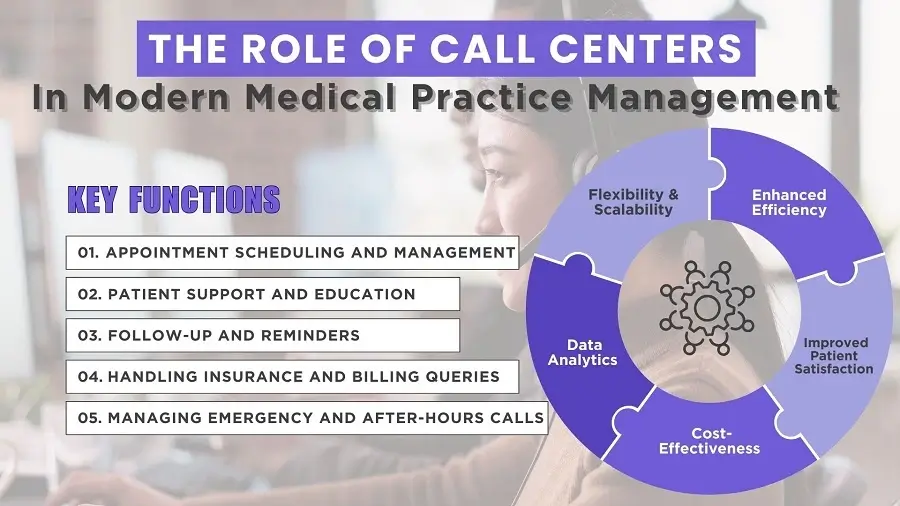
Key Functions of Call Centers in Healthcare
1. Appointment Scheduling and Management
Call centers have a crucial job in medical offices to tackle appointment scheduling. Call center agents can juggle loads of calls. They book, move, or scratch off appointments professionally. This makes a medical team’s schedule run smoother, reduces wait time, and makes the patient’s experience better.
2. Patient Support and Education
Call centers act as helpful guides for patients. They answer questions about medical procedures, treatments, and insurance. When patients understand their health conditions, they’re more likely to follow their treatment plans. Sticking to their treatment plans leads to better health. Agents giving correct information help in making stronger bonds with patients.
3. Follow-up and Reminders
It’s vital in healthcare to keep track of patients to make sure they stick to their medication routines and don’t miss check-ups. Phone services can trigger automatic reminders reducing the chance of patients failing to turn up. This active strategy keep patients healthy and allows the best use of resources.
4. Handling Insurance and Billing Queries
Insurance can seem confusing to patients. Help desks are there to clarify things like coverage details, check insurance status, and sort out payment issues. This aid helps make things easier for patients and smooth out money matters related to their care.
5. Managing Emergency and After-Hours Calls
During emergencies, patients need help right away. Call centers to bridge the gap, connecting patients to healthcare providers during off-hours. Offering round-the-clock access, patients are guaranteed speedy help. They’re guided to the right services, like urgent care or emergency rooms.
Benefits of Integrating Call Centers in Medical Practices
1. Enhanced Efficiency
When call centers take on everyday communication jobs, healthcare clinics can zero in on giving top-notch care. The work shift reduces the workload for front desk teams. This lets health professionals spend their time talking with patients, not stuck doing office tasks.
2. Improved Patient Satisfaction
Happy patients are key to healthcare services. It affects everything, from how people see them to how much they earn. Call centers make things better for patients by cutting down on waiting, getting back quickly, and giving personal help. Patients who feel good will come back and tell others about it.
3. Cost-Effectiveness
Getting an outside call center to handle the job can save money for lots of businesses. Rather than getting and teaching staff in-house, they can use the knowledge of known call centers. This means they save a lot on operating costs and keep delivering great service.
4. Data Collection and Analytics
Call centers offer key knowledge by gathering and examining data. Keeping track of calls, patient questions, and scheduling trends helps businesses spot patterns and potential upgrades. This method rooted in information boosts sound judgments and bolsters business plans.
5. Flexibility and Scalability
Call centers to provide adaptability, a boon when practices witness changes in patient numbers. Be it a surge of patients from a seasonal sickness or handling post-surgery check-up schedules, call centers can adjust operations as needed without massive modifications to the workforce.
Challenges of Implementing Call Centers
The role of call centers offers lots of perks, but medical practices face hurdles. They need careful navigation to set them upright.
1. Quality Control
It’s vital to keep service top-notch in healthcare. This means practices need their call center staff to be skilled. They should fully understand the services provided. To keep the quality high, they need frequent check-ins and constructive feedback.
2. Integration with Existing Systems
It’s crucial for call centers to gel perfectly with a clinic’s current electronic health records (EHR) and management software. This blend offers instant reach to patient data, which empowers agents to give precise and tailored help.
3. Patient Privacy Concerns
In these times, when patient privacy is in the spotlight, it’s important for call centers to follow laws like the Health Insurance Portability and Accountability Act (HIPAA). Medical practices should be detailed in picking their call center partners, making sure patient info is dealt with safely.
4. Balancing Automation and Personal Touch
Yes, automation boosts efficiency. But leaning too much on tech? It can push away folks who like talking to real people. We need a sweet spot between machines and human touch. This way, we keep patient experiences positive.
The Future of Call Centers in Medical Practice Management
In the changing world of healthcare, the role of call centers seems to do more. New things like artificial intelligence (AI) and big data could make call centers better, offering service that’s more tailored and quick. Chatbots and voice detection powered by AI could take on simple questions, letting people tackle harder problems. With more and more telehealth services, call centers could be crucial for running online meetings and talking to patients.
Conclusion – Role of Call Centers in Medical Practice
Call centers have become a key part of today’s healthcare management. They upgrade how we talk, make operations run smoothly and create happier patients. These call centers play a big role in how healthcare works. As tech gets better, so will call centers, making them a big piece in healthcare’s future success puzzle. They helps get patients involved, leading to better health. This shows the worth of this crucial aspect in modern healthcare.