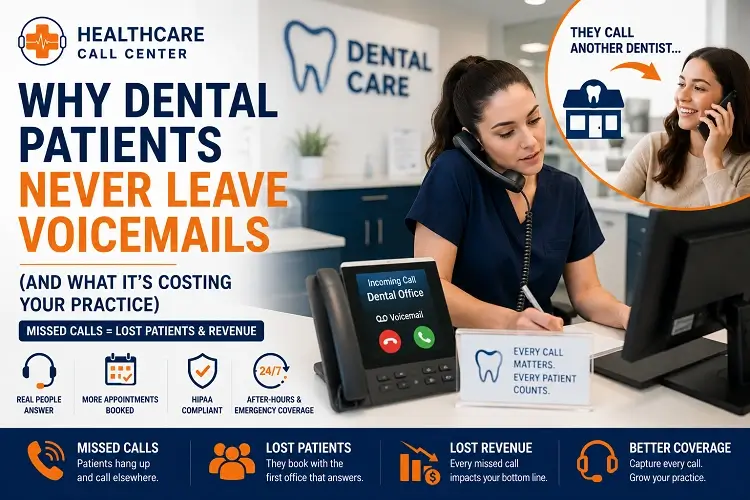
When a dental patient calls your office and hears a voicemail greeting, what do they do next?
Most practice owners assume the patient leaves a message and waits for a callback. That is rarely what happens.
According to multiple studies on consumer call behavior, up to 80% of callers who reach voicemail hang up without leaving a message. For dental practices, that statistic is even more painful because a missed call often represents a patient ready to book treatment.
They do not wait. They do not leave a message. They call the next dentist on Google Maps.
If your front desk is busy at lunch or off the clock, those calls are going to voicemail. And those patients are going somewhere else.
This blog explains why dental patients do not leave voicemails, how much revenue each missed call costs your practice, and what you can do to stop losing patients to the office down the street. This is where a 24/7 dental answering service comes in to bring your revenue back.
The Problem with Voicemail in Dental Practices
Most dental practices are not intentionally ignoring calls. The front desk is handling check-ins, insurance verification, treatment plan discussions, payments, and patient questions all at the same time. When two calls come in at once, one goes to voicemail.
After hours, the situation is worse. If your office closes at 5 PM and a patient calls at 5:47 PM because they cracked a tooth while eating dinner, that call goes to voicemail. That patient is in pain. They are not going to wait until morning.
They are going to call the next dental office that answers.
Here is the hard truth: voicemail does not capture new patients. It captures messages from existing patients who already trust you. New patients, referrals, and high-value treatment inquiries rarely leave voicemails because they have no loyalty to your practice yet.
What a missed dental call actually costs
Let us break down the math for a typical dental practice.
If your office misses 5 calls per day (a conservative estimate for a busy practice), that is 25 missed calls per week or about 100 per month.
If even 15% of those calls were new patient inquiries with treatment plans averaging $1,500 to $3,000, you are looking at $22,500 to $45,000 in potential revenue walking out the door every month.
Now consider after-hours calls. If 40% of patient calls come in before 8 AM or after 5 PM, and your office is closed, those calls hit voicemail every single time.
That is not a front desk problem. That is a coverage problem.
5 Reasons Dental Patients Will Not Leave a Voicemail
1. They are comparing offices
When a patient searches “dentist near me” on Google, they typically call 2 to 3 offices before choosing one. If you do not answer, they move to the next result. They are not invested in your practice yet. Voicemail feels like a dead end to someone comparison shopping.
2. They are in pain or anxious
Dental callers often have a specific problem. A cracked crown. A child with a toothache. A sudden tooth sensitivity that scares them. When someone is anxious or in pain, hearing a recorded message does not feel reassuring. They want to hear a human voice that says, “We can help you.”
3. They expect immediate answers
Patients today are used to instant responses from food delivery apps, retail stores, and service providers. When they call a dental office and get voicemail, their expectation shifts. If your office cannot answer the phone, they wonder how responsive you will be as their healthcare provider.
4. They assume you are too busy
A ringing phone that goes to voicemail sends a signal. Whether it is accurate or not, the patient thinks, “This office is too busy for me.” For a new patient evaluating where to spend their healthcare dollars, that perception matters.
5. They have already been told to call elsewhere
Many dental insurance directories list multiple in-network providers. If the first office does not answer, the patient simply calls the next provider on the list. Your competitor answers, books the appointment, and you never even knew the patient called.
What a Dental Answering Service Actually Does
A dental answering service is not just a call center that takes messages. It is a dedicated layer of call coverage designed specifically for dental practices.
Here is what that looks like in practice.
Answers every call, every time
When your front desk is checking in a patient and two calls come in at once, the answering service picks up immediately. No busy signal. No voicemail. The patient hears a friendly, professional voice and gets the help they need.
Captures new patient inquiries
When a new patient calls after hours to ask about Invisalign, implants, or a second opinion, the answering service captures their name, contact details, reason for calling, and insurance information. Your front desk gets the lead first thing in the morning, ready to follow up.
Handles after-hours emergencies
When a patient calls at 9 PM with a dental emergency, the answering service follows your protocol. They document the issue, reassure the patient, and route the call to your on-call dentist if needed. The patient feels cared for. Your practice protects its reputation.
Supports overflow during busy periods
During peak hours, lunch breaks, staff meetings, or hygiene checks, the answering service handles the overflow. Your in-office team can focus on the patient standing in front of them without feeling guilty about the phone ringing in the background.
Why a Generic Answering Service Does Not Work for Dental Offices
You might be thinking, “Can I just use any answering service?”
The short answer is no. Here is why.
Dental calls are different from generic business calls. Patients ask specific questions about insurance networks, treatment costs, appointment availability, post-op care, and dental anxiety. A generic answering service operator reading a script cannot handle these questions with confidence.
A specialized dental call center understands:
- Dental terminology (crowns, bridges, implants, root canals, perio charting)
- Insurance concepts (PPO, in-network, deductibles, annual maximums)
- Appointment urgency (a broken tooth is not the same as a routine cleaning)
- Patient anxiety and empathy (many dental callers are nervous)
- HIPAA-compliant information handling
When a patient calls your dental office, they should feel like they reached your team. Not a call center. Not a robot. A real person who knows what they are talking about.
How to Choose the Right Answering Service for Your Dental Practice
If you are considering an answering service for your dental practice, here are the key questions to ask.
Do they understand dental workflows?
Ask whether their agents are trained on dental-specific call flows. Can they handle new patient intake? Do they understand the difference between a hygiene recall and an emergency? Do they know what to ask when a patient calls about a broken crown?
Is it HIPAA-compliant?
Any service handling patient calls, insurance details, or appointment information must be HIPAA-compliant. Ask about their training, their data handling, and whether they sign Business Associate Agreements.
Can they follow your custom protocols?
Every dental practice handles calls differently. Some want emergencies routed to a cell phone. Others want all messages sent by email before 8 AM. Your answering service should build the workflow around your preferences, not force you into a rigid script.
Do they offer 24/7 coverage?
Dental patients call at all hours. Before work, after dinner, on weekends. If your answering service only covers business hours, you are still missing calls. Look for true 24/7 coverage, including weekends and holidays.
Are the agents real people?
Some services use AI bots or automated systems to handle calls. For dental patients, who are often anxious or in pain, talking to a robot makes the experience worse. Look for a service where real humans answer every call.
What Happens When You Stop Missing Dental Calls
When every call gets answered, three things change quickly.
- New patient numbers go up. You capture the callers who were previously going to voicemail and moving on. Even capturing 5 extra new patients per month at an average of $1,500 per treatment plan adds $7,500 in monthly revenue.
- Front desk stress goes down. Your team is no longer torn between the patient at the desk and the phone ringing. They can focus on in-office patient care knowing the phones are covered.
- Online reviews improve. Patients who reach a helpful, friendly person on the first call are more likely to leave positive reviews. Patients who hit voicemail are more likely to leave frustrated feedback or no review at all.
The Bottom Line for Dental Practices
Every missed call is a patient who wanted your help and did not get it.
Some of those patients are new. Some are existing patients with emergencies. Some are referrals from other patients who trust you.
When those calls go to voicemail, you lose the patient, the revenue, and the relationship.
A dental call center that answers every call with empathy, captures every inquiry, and follows your protocols is one of the most cost-effective ways to grow a dental practice without adding more front desk staff.
If your office is missing calls, the question is not whether you can afford an answering service. The question is: how many patients are you losing this week because nobody picked up the phone?
Book A Free Consultation
We will tell you how many patients you are losing monthly.
Frequently Asked Questions
How much does a dental answering service cost?
Pricing depends on call volume, coverage hours, and the complexity of your call workflow. Most dental practices find that recovering even 2 to 3 missed new patient calls per month covers the entire cost of the service.
Will patients know they are talking to an answering service?
No. A quality dental answering service answers with your practice name and follows your scripts. The goal is to feel like a seamless extension of your front desk.
Can the answering service schedule appointments directly?
Yes, depending on your setup. Some practices prefer the answering service to capture inquiry details and let the front desk call back. Others connect the service directly to their scheduling software for real-time booking.
What about after-hours dental emergencies?
Your answering service follows your emergency protocol. They document the issue, reassure the patient, and contact your on-call provider based on the rules you set. Patients get immediate help. You get documented, organized information.