A busy medical front desk can only handle so much at once.
One patient is checking in. Another is asking about insurance. A staff member is trying to confirm tomorrow’s appointments. A provider needs a message relayed. Then the phone rings again.
That call may be a new patient. It may be a patient trying to reschedule before they become a no-show. It may be a worried parent, a post-procedure question, a referral source, or someone ready to book after comparing practices online.
When the front desk is already overloaded, the call often waits, rolls to voicemail, or gets rushed. That is where a virtual medical receptionist can help.
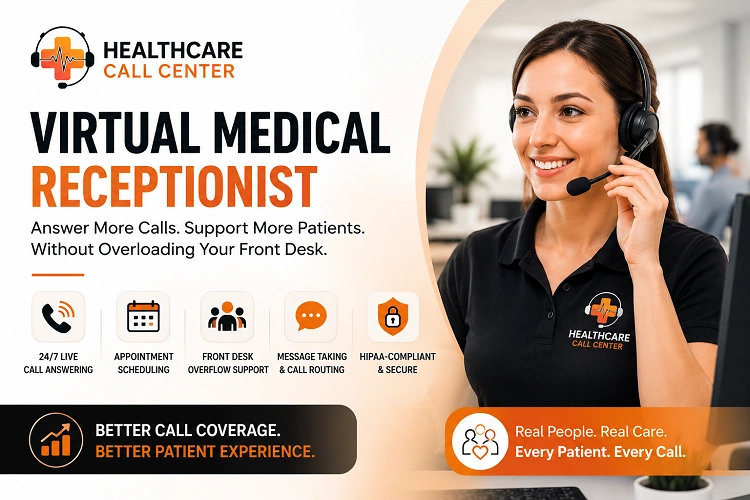
A virtual medical receptionist gives medical practices live call support without forcing the in-office team to carry every phone call, scheduling request, basic question, and overflow moment alone. For growing practices, it can be the difference between a phone system that creates friction and a patient communication process that keeps appointments moving.
What Is a Virtual Medical Receptionist?
A virtual medical receptionist is a trained remote receptionist who answers calls, supports appointment scheduling, captures patient details, routes messages, and helps medical offices manage front desk communication when the in-house team is busy, unavailable, or closed.
For practices that need broader live patient call coverage, a 24/7 medical answering service can extend this support across after-hours, overflow, appointment requests, and message routing.
Unlike a general business answering service, medical receptionist support has to understand the pace and sensitivity of healthcare calls. Patients may be anxious, confused, frustrated, or trying to make care decisions quickly. The call should feel organized, calm, and human.
For many practices, this support works alongside the existing front desk. It does not replace the practice team. It protects them from overload.
A strong virtual receptionist process can help with:
- New patient call capture
- Appointment request handling
- Front desk overflow during peak hours
- Lunch break and staff shortage coverage
- After-hours call support
- Basic routing and message intake
- Follow-up call handling when appropriate
- Reducing voicemail dependence
The goal is simple: answer more patient calls with less strain on the office team.
Why Medical Practices Are Looking for Virtual Receptionist Support
Medical practices are under pressure from both sides. Patients expect fast, helpful communication. Staff members are already stretched by check-ins, insurance questions, clinical coordination, scheduling changes, billing questions, and provider requests.
A missed call is rarely just a missed call. It can become a missed appointment, a delayed treatment plan, a frustrated patient, or a lost new-patient opportunity.
Patient access and experience are closely connected. AHRQ’s patient experience resources highlight how access to care and communication affect the way patients experience a healthcare organization. When phone access breaks down, the patient experience can decline before the visit ever happens.
The problem is not always that the front desk is doing something wrong. Often, the problem is capacity. The team is expected to handle more communication than the day realistically allows.
A virtual medical receptionist gives the practice a pressure-release valve. Calls can still be answered when the front desk is tied up. Patient information can still be captured. Scheduling requests can still move forward. Staff can focus on the patients standing in front of them without ignoring the patients calling in.
The Front Desk Overflow Problem
Front desk overflow is one of the biggest reasons practices consider virtual receptionist support.
Overflow happens when call volume exceeds what the in-office team can handle in real time. It often occurs during predictable windows: morning rush, lunch breaks, late afternoon callbacks, Monday call spikes, provider schedule changes, and post-holiday volume.
During these periods, even a well-trained front desk team may struggle to keep up. Calls stack up. Hold times increase. Voicemail fills. Staff members feel pressure to move faster, which can make the patient experience feel transactional.
This is where virtual receptionist coverage can support the existing workflow. Instead of forcing every call through the same overwhelmed desk, overflow calls can be answered by trained support that follows the practice’s instructions.
For practices dealing with this issue, dedicated front desk overflow support can help protect both staff capacity and patient access. The right setup makes the office feel more responsive without requiring the practice to immediately hire another full-time receptionist.
How a Virtual Medical Receptionist Helps Answer More Calls
The value of a virtual medical receptionist is not only that calls are answered. It is that calls are answered in a structured way that supports the practice’s goals.
For example, a new patient may call after seeing the practice on Google. If the call goes to voicemail, that patient may call the next provider on the list. If a trained receptionist answers, confirms the need, captures the right information, and guides the patient toward scheduling, the practice has a better chance of turning interest into an appointment.
A virtual receptionist can also help existing patients avoid delays. When patients need to reschedule, confirm an appointment, ask where to send documents, or leave a message for the care team, they should not feel ignored.
Common call-handling tasks include:
- Greeting callers professionally
- Capturing name, phone number, reason for call, and urgency
- Following practice-specific scripts
- Routing clinical or urgent calls based on instructions
- Supporting appointment requests when connected to the right workflow
- Sending messages to the correct office contact
- Reducing unnecessary voicemail use
For appointment-heavy practices, appointment scheduling support can be especially important. Patients who are ready to book should not be forced to wait until someone has time to return a voicemail. The closer the practice gets to live response, the more likely it is to protect demand when it appears.
Virtual Receptionist vs. Traditional Answering Service
Many practice owners hear “virtual receptionist” and “answering service” used together. They overlap, but they are not always the same.
A basic answering service may take messages and forward them. A virtual medical receptionist should feel more like an extension of the practice’s front desk. The difference is in training, scripting, call flow, tone, escalation, and how well the team understands healthcare communication.
For medical offices, the receptionist role is not only administrative. It is part of the patient journey. The person answering the phone may shape whether a patient books, waits, complains, cancels, or chooses another provider.
That is why medical practices should look for support that understands healthcare-specific needs, including patient privacy, call sensitivity, appointment intent, and proper routing.
Where Virtual Medical Receptionist Support Fits Best
Virtual receptionist support is useful for many types of medical practices, but it is especially valuable when call demand is unpredictable or when patient calls directly affect revenue.
It can fit well for:
- Primary care offices managing high daily call volume
- Specialty practices with consultation requests
- Dental offices with appointment and insurance questions
- OB-GYN and fertility practices where callers may be anxious
- Plastic surgery and med spa practices handling high-intent consultation calls
- Multi-location groups with inconsistent front desk capacity
- Practices that receive many calls during lunch, after hours, or staff transitions
The best use case is not always replacing staff. Often, the smartest use is protecting the team already in place.
How Virtual Receptionist Support Helps Staff
Front desk burnout is real. Receptionists are expected to be friendly, fast, accurate, calm, and available at all times. They handle patients in the office while also trying to answer every call. When the phone never stops ringing, even strong employees can become overwhelmed.
A virtual medical receptionist can reduce that pressure by taking overflow calls, handling routine intake, and keeping calls from piling up. This gives in-office staff more room to focus on patients who are physically present and tasks that require local knowledge.
Better support can also improve consistency. Instead of each staff member rushing through calls differently depending on how busy the day feels, calls can follow a documented process. That helps protect the patient experience and makes communication easier to manage.
HIPAA and Patient Privacy Considerations
Medical call support must be handled carefully. Any partner working with patient information needs to understand HIPAA-related responsibilities and follow privacy-conscious workflows.
HHS explains that the HIPAA Privacy Rule establishes national standards to protect individuals’ medical records and other personal health information. For practices, this means call handling cannot be treated like ordinary customer service.
Before choosing a virtual medical receptionist provider, practices should ask:
- Will the team follow HIPAA-conscious call-handling procedures?
- How are messages captured and delivered?
- Can calls be routed based on urgency and practice instructions?
- Are receptionists trained for sensitive patient conversations?
- Does the provider understand healthcare call workflows?
- Can the service support the practice without creating privacy or documentation risks?
The goal is not just answering more calls. The goal is answering calls responsibly.
Why Human Tone Still Matters
Patients do not always call medical offices at calm moments. They may be worried about symptoms, confused about next steps, nervous about a procedure, or frustrated because they could not reach someone earlier.
A rushed or robotic phone experience can make that frustration worse. A calm, human receptionist can make the practice feel more accessible and organized.
Healthcare Call Center is built around this idea. Our team is trained to bring empathy, patience, and structure to medical calls. Our stay-at-home mom agents are trained to bring empathy, patience, and structure to medical calls while following each practice’s scripts and escalation rules.
Patients do not want to feel processed. They want to feel heard.
Virtual Medical Receptionist vs. Hiring Another Full-Time Employee
Hiring another full-time receptionist can be the right move for some practices. But it is not always the first or only option.
A full-time hire brings payroll, training, management time, benefits, coverage gaps, turnover risk, and scheduling limitations. If the practice mainly needs help during peak call periods, lunch breaks, after-hours windows, or overflow spikes, virtual receptionist support may be more flexible.
The question is not simply “Should we hire or outsource?” The better question is: “Where are we losing calls, and what type of coverage solves that problem fastest?”
If the issue is in-office workflow, an internal hire may help. If the issue is missed calls, overflow, inconsistent answering, or after-hours demand, a virtual medical receptionist may give the practice faster relief.
Signs Your Practice May Need a Virtual Medical Receptionist
A practice may be ready for virtual receptionist support if any of these problems are happening regularly:
- Patients complain that they cannot reach the office
- Voicemail is being used as a default call-handling method
- Staff members are constantly interrupted by phone calls
- New patient calls are missed during busy windows
- Appointment requests are delayed
- No-shows increase because confirmations and reschedules are hard to manage
- The office is considering hiring, but only needs partial coverage
- After-hours calls are not being handled consistently
- Call volume spikes on Mondays, lunch breaks, and late afternoons
If the phone is becoming a bottleneck, virtual receptionist support may be worth evaluating.
How to Set Up Virtual Receptionist Support Correctly
The best results come from clear setup. A virtual receptionist should not be asked to “just answer calls” without direction. The more specific the workflow, the easier it is for a virtual receptionist to provide consistent support without making assumptions about clinical or scheduling decisions.
A strong setup should include:
- Call scripts for common patient scenarios
- Clear instructions for urgent vs. non-urgent calls
- Scheduling rules or routing instructions
- Message delivery preferences
- Office hours and after-hours procedures
- Names and roles of key contacts
- Instructions for new patient calls
- Fallback steps when the office is unavailable
The more specific the workflow, the better the patient experience.
How Healthcare Call Center Supports Medical Practices
Healthcare Call Center provides medical call support for practices that need more reliable patient communication without overloading the front desk. Our team helps answer calls, support scheduling workflows, manage overflow, and route messages based on each practice’s instructions.
For practices comparing different options, a dedicated medical answering service can provide broader coverage than a general receptionist solution. The goal is to help practices protect patient calls, reduce missed opportunities, and make the phone experience feel more consistent.
Healthcare Call Center also supports appointment-focused workflows, front desk overflow, after-hours needs, and specialty practices where empathy and careful communication matter.
If your practice is missing calls or your front desk is stretched too thin, the next step is to review where calls are being lost and what coverage would make the biggest difference.
Final Thoughts
A virtual medical receptionist is not just a convenience. For many practices, it is a practical way to protect patient access, support staff, and capture appointment demand that may otherwise be lost.
The front desk should not have to choose between helping the patient in front of them and answering the patient calling in. With the right support, both experiences can improve.
If your practice needs help answering more calls without overloading your team, Healthcare Call Center can help you build a call support plan around your real workflow.
Book a Free Consultation
Frequently Asked Question
What is a virtual medical receptionist?
A virtual medical receptionist is a trained remote receptionist who answers patient calls, captures information, routes messages, and supports appointment-related workflows for a medical practice. The service helps the front desk manage calls when staff are busy, unavailable, or closed.
How is a virtual medical receptionist different from a regular answering service?
A regular answering service may only take messages. A virtual medical receptionist should follow medical-office call flows, understand patient communication needs, support scheduling workflows when appropriate, and route calls based on practice instructions.
Can a virtual medical receptionist help with appointment scheduling?
Yes, if the practice sets up the right workflow. A virtual receptionist can help capture appointment requests, guide callers, route scheduling needs, and support appointment-related communication based on the practice’s process.
Is virtual receptionist support useful for front desk overflow?
Yes. Front desk overflow is one of the strongest use cases. When the in-office team is busy with check-ins, insurance questions, and patient flow, virtual receptionist support can help answer calls that might otherwise go to voicemail.
Does a medical virtual receptionist need HIPAA-aware procedures?
Yes. Medical calls may involve patient information, so call handling should follow privacy-conscious procedures. Practices should choose a provider that understands healthcare communication, message handling, escalation, and HIPAA-related responsibilities.
When should a practice consider a virtual medical receptionist?
A practice should consider virtual receptionist support when calls are being missed, voicemail is overused, staff is overloaded, appointment requests are delayed, or patient complaints about phone access are increasing.