by Erika Sanchez | Oct 2, 2026 | Healthcare Answering Services
When a patient calls your office after hours and tells an answering service their name, their date of birth, and why they are calling, protected health information has just left your four walls. Under HIPAA, that makes your answering service a business associate, and a signed Business Associate Agreement is not optional paperwork. It is the document that makes the entire arrangement legal.
Yet BAA quality varies enormously between providers. Some arrive thorough and specific. Others are two generic pages that would equally cover a landscaping company. And some providers quietly operate without one at all. This guide covers what a HIPAA-compliant answering service BAA must actually include, the five red flags that should stop a signature, and the day-to-day habits that separate genuinely compliant services from checkbox ones.
Quick Answer
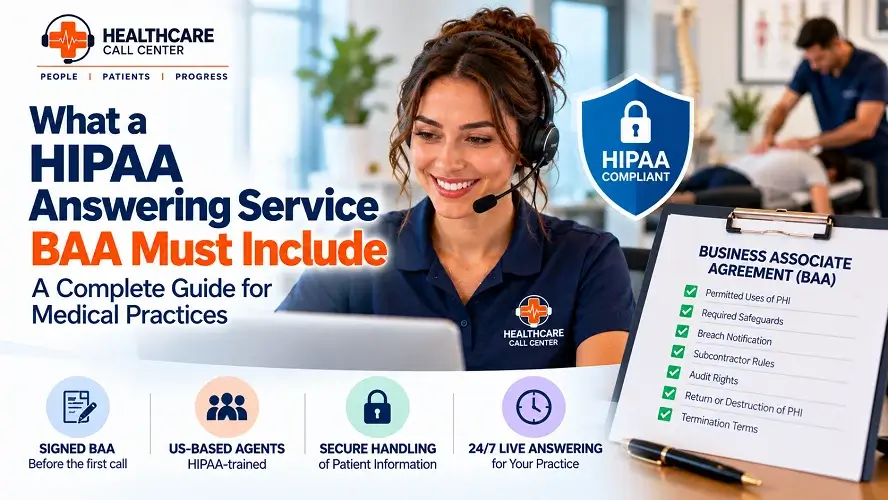
Any answering service that hears, stores, or transmits patient information on your behalf is a business associate under HIPAA and must sign a Business Associate Agreement before taking a single call. A proper BAA defines permitted uses of PHI, required safeguards, breach notification timelines, subcontractor rules, audit rights, and termination terms. If a provider hesitates on any of these, walk away.
Why Your Answering Service Needs a BAA
HIPAA’s Privacy Rule prohibits sharing protected health information with outside vendors except under a BAA. An answering service is one of the clearest business-associate cases in healthcare: agents routinely hear names, birth dates, phone numbers, symptoms, medication names, and appointment details. All of it becomes PHI the moment it connects to treatment, payment, or healthcare operations.
The obligation runs both ways. Your practice may not knowingly let a vendor handle PHI without a BAA, and the vendor may not handle it without one. A missing BAA is not a technicality. It is the exact scenario OCR enforcement actions are built around, and penalties attach to both parties.
One clarification practices often miss: the BAA obligation applies to every line that can carry PHI. After-hours lines, appointment lines, even the main number. If a new patient can call it and describe a symptom, it needs to be covered.
What Your Answering Service BAA Must Cover
A compliant BAA is specific. At minimum, it should address:
- Permitted uses of PHI. Exactly what the service may do with what it hears: answer, document, route, book, and relay. Nothing else.
- Required safeguards. Administrative (training, access controls), physical (secure facilities), and technical (encryption in transit and at rest) protections spelled out, not just promised.
- Breach notification. A binding commitment to notify you of any breach or suspected breach without unreasonable delay, with a defined timeframe.
- Subcontractor rules. Any downstream vendor (telecom, hosting, transcription) is itself bound to equivalent terms, and you are told who they are.
- Minimum necessary standard. Agents access only the PHI a task requires, and scripts are designed to avoid collecting PHI that isn’t needed.
- Audit and inspection rights. Your right, or your compliance officer’s, to review safeguards and records.
- Return or destruction of PHI. What happens to recordings and logs when the relationship ends.
- Termination trigger. A breach of the BAA is grounds for termination, not just a conversation.
A BAA light on these sections is not necessarily invalid, but it is a signal about how the provider thinks compliance works.
The 5 Red Flags When Choosing a HIPAA Answering Service
- No BAA offered, or a shrug. Some consumer-grade virtual receptionist services simply don’t sign BAAs. If the answer to “can you sign a BAA?” is anything other than an immediate yes with a document attached, the decision makes itself.
- “We’re HIPAA certified.” There is no such thing as HIPAA certification. Any provider claiming certification either misunderstands the law or is selling you a badge. Real compliance is documented, audited, and specific.
- Offshore agent ambiguity. If calls are answered outside the United States, ask exactly where, under what data-transfer protections, and how breach notification would work across borders. Offshore answering raises cost and complexity on every HIPAA question, and patients notice the difference in quality too.
- Vague breach timelines. The BAA should commit to notification within a defined window. Words like “promptly” with no definition push you to the back of the line in exactly the situation where you need to be first.
- No subcontractor transparency. If the service farms overflow to another call center or hosts recordings with an unnamed vendor, you are entitled to know, and their BAA must bind those vendors to the same terms.
Questions to Ask Before You Sign
Bring this list to the sales call:
Will you sign a BAA before the first call, and may I see the template now?
Where are calls answered, and by whom?
How are agents trained on HIPAA, and how often?
Where are recordings stored, how are they encrypted, and for how long?
What is your written breach-notification commitment?
Which subcontractors touch our PHI?
What was your last security review, and will you share the summary?
A confident provider answers these in minutes. A hesitant one answers in weeks, after you’ve already moved on.
What HIPAA Compliance Looks Like Day to Day
The BAA is the contract; compliance is the habit. On a genuinely compliant service, agents are trained on the minimum necessary standard: they collect what the protocol requires and nothing more. Scripts avoid unnecessary PHI, so a caller booking a routine appointment is not asked to recite their history.
Messages route through secure, access-controlled systems rather than personal phones or email. Recordings and logs live in encrypted storage with role-based access and defined retention. And training is repeated, documented, and dated, not a one-time video from 2022.
Common Myths That Create Real Risk
- “We’re a small practice, HIPAA doesn’t apply.” It does. Size has nothing to do with it.
- “We never leave after-hours messages, so no PHI changes hands.” The PHI changes hands the moment the caller says their name and reason for calling, voicemail or not.
- “The service said they’re HIPAA compliant, so it’s covered.” Their compliance claim does not transfer your obligation. The BAA does.
How HCC Handles It
Every HCC engagement starts with a signed BAA before the first call, and every call path is treated as in scope. Agents are 100% US-based, HIPAA-trained on medical call flows, and held to the minimum necessary standard in both scripts and systems.
Recordings and logs live in encrypted storage with defined retention; breach commitments are written into the agreement with defined timelines; and our 90%+ answer-rate guarantee comes with call logs you can audit any month you like. The same standard runs through our HIPAA-compliant medical answering service coverage.
Who Is (and Isn’t) a Business Associate
The test is whether the vendor creates, receives, maintains, or transmits PHI on your behalf. An answering service that hears patient details: yes. A transcription vendor: yes. A company that simply delivers office supplies and never touches patient data: no.
Edge cases are where practices get tripped up. A cleaning crew with after-hours access to offices where PHI is discussed is generally not a business associate (incidental access, no PHI handling on your behalf). But an IT support vendor with access to your phone system recordings is. When in doubt, the safe posture is to require a BAA. No vendor is harmed by signing one, and some will strengthen their own practices to do it.
Note that the obligation scales with access: if your healthcare answering service only takes messages with names and callback numbers, it still handles PHI in the form of appointment-related information tied to a patient’s identity. Treat every call path as in-scope.
The Cost of Getting It Wrong
Operating without a required BAA is itself a violation, separate from whatever breach might later occur. Federal civil penalties for HIPAA violations are tiered by culpability and run to roughly two million dollars per violation category per year at the top tier, and state attorneys general can pursue additional actions. Beyond fines, a disclosure event means breach notification to affected patients, potential credit monitoring obligations, and the reputational cost of telling patients their information wasn’t protected.
Set against that, the prevention is remarkably cheap: a well-drafted BAA, a provider that answers the compliance questions directly, and an annual review. It is one of the few compliance investments where the downside is catastrophic and the cost of doing it right is close to zero.
Pre-Signature Compliance Checklist
Before countersigning any answering service agreement, confirm:
- The BAA is attached to the contract, not promised for later.
- Breach notification has a defined timeframe, not adjectives.
- Subcontractors are disclosed and bound.
- Safeguards (training, encryption, access controls) are described in the document itself.
- Recordings and logs have stated storage locations and retention periods.
- Return-or-destroy terms exist for the end of the relationship.
- Audit rights are included, not negotiated away.
- The signature block includes a named entity you have verified, not a different company than the one selling to you.
One More Layer: State Privacy Laws
HIPAA is the federal floor, not the ceiling. States including Texas (with its own medical records privacy act) and Washington (with consumer health data legislation) layer additional requirements on top, and several define PHI more broadly than HIPAA does.
A BAA drafted only to federal minimums may leave gaps a state law would fill. The practical move: ask providers whether their agreements are written to federal standards alone or account for stricter state regimes, and loop your compliance officer or attorney into the review either way.
Frequently Asked Questions
Does my answering service really need a BAA?
Yes. The moment the service receives protected health information on your behalf- a patient’s name, birth date, or reason for calling- it is acting as a business associate under HIPAA, and a signed BAA is required before any PHI is shared.
Is there such a thing as HIPAA certification for answering services?
No. There is no government HIPAA certification for vendors. A provider claiming to be “HIPAA certified” is a red flag; real compliance shows up as a specific BAA, training records, and documented safeguards.
What happens if my answering service doesn’t have a BAA?
You are both exposed. Impermissible disclosure of PHI without a BAA is a violation that can attach penalties to your practice, not just the vendor, and you would bear the burden of notifying affected patients.
Can I use a regular virtual receptionist service for patient calls?
Only if they sign a BAA and can demonstrate HIPAA safeguards. Many consumer virtual-receptionist services explicitly do not sign BAAs, which rules them out for any line that can carry patient information.
How often should we review our answering service BAA?
Review it annually and whenever the service changes systems, subcontractors, or handling practices, and whenever HIPAA rules update. Your compliance officer should keep the current signed copy with your security documentation.
Next Step
HCC signs the BAA before the first call, and backs it with US-based, HIPAA-trained agents and a 90%+ answer-rate guarantee. Book a 15-minute discovery call to see the agreement and the onboarding plan, or start with the free call coverage audit.
by Erika Sanchez | Oct 1, 2026 | After-Hours Call Answering Services
Most medical practices lose patients on the two days they are closed the most. Saturday morning back pain, Sunday-night anxiety, a fever on Thanksgiving. Patients don’t schedule their symptoms around your office hours, and the practices that answer when nobody else does quietly collect those patients all year.
Weekend and holiday coverage is usually an afterthought: a voicemail greeting, an on-call rotation nobody loves, and a hope that nothing urgent happens. This playbook replaces the hope with a system: coverage models, checklists, scripts, and the handoff that makes Monday morning run. The backbone of that system is an after-hours healthcare answering service that answers every weekend call live, backed by written escalation rules your team sets once.
Quick Answer
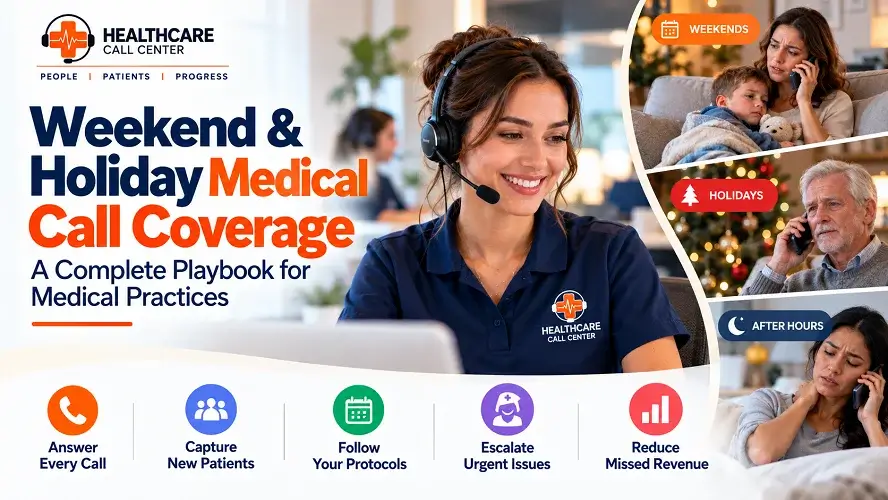
The best weekend and holiday coverage for a medical practice combines live answering (in-house or a service) with clear escalation rules and a Monday handoff. Voicemail-only coverage loses most weekend callers; they simply call the next practice. A live after-hours answering service running your protocols captures those calls at a fraction of the cost of staffing weekends in-house.
Why Weekends and Holidays Are When Practices Lose the Most Patients
Weekends concentrate exactly the kind of calls you least want to miss. Symptoms that built up during the workweek peak when patients are finally free to deal with them. Parents have time to make calls for their kids. Injuries happen: youth sports, yard work, travel. And holiday weeks stack normal demand on top of weather events, travel illness, and schedule changes.
The numbers make the stakes clear. A practice open roughly 40 weekday hours loses two full days every single week, about 30% of the week. Add holidays and the closed window approaches 35% of annual hours. If patient calls spread evenly across the week, roughly a third of all patient intent arrives when the front desk is empty.
Some of those callers are fine until Monday. Many are not. Existing patients with urgent needs will follow your after-hours instructions, but new patients- the ones who found you on Google at 9 p.m. Friday- have no loyalty yet. They call the next practice on the list. If that practice answers and yours doesn’t, the patient is gone before your team clocks in Monday.
What Patients Expect When They Call on a Saturday (or a Holiday)
Patients should also have clear instructions for what to do if a problem arises outside normal office hours, including how to contact the practice and what constitutes an emergency.
Weekend callers differ from weekday callers in one important way: their intent is hotter.
A weekday caller might be price-shopping or browsing. A Saturday caller with a sick child, a spiking symptom, or a prescription problem has a live need and limited patience.
They expect three things:
- To reach a human, or at least a clear path to one. A full voicemail box or a greeting that only states office hours reads as indifference.
- To be told when they’ll hear back. A vague leave-a-message instruction pushes weekend callers to keep dialing other offices.
- To have emergencies routed correctly. Every weekend greeting must make the emergency-versus-routine distinction obvious, without clinical advice an untrained person shouldn’t give.
Practices that meet those three expectations on a Saturday morning win patients that took months of SEO and advertising to generate.
The Four Weekend Coverage Models (and When Each One Works)
There are four realistic ways to cover weekends and holidays. Most practices use some combination.
Weekend & Holiday Coverage Models Compared
| Model |
What it looks like |
Call-handling approach |
Cost / trade-off |
Best for |
| 1. Voicemail only |
Greeting with office hours; caller calls back Monday or moves on |
No live coverage; callers must wait or seek another option |
Free |
Practices comfortable with limited weekend coverage |
| 2. On-call provider rotation |
Doctor or PA fields forwarded calls between personal time |
Provider handles calls directly; availability can vary and routine calls may interrupt clinical staff |
Staff burden and burnout risk |
Practices with clinical triage needs and spare provider capacity |
| 3. AI-only answering |
Automated agent captures messages and FAQs |
Useful for FAQs and simple tasks; may be less suitable for anxious or complex callers |
$50 to $300/mo |
After-hours backup layer |
| 4. Live answering service |
Trained humans answer in your practice’s name, 24/7 including holidays |
Live human communication for patient calls, with scheduling and escalation based on your protocols |
$200 to $800/mo typical |
Practices that want weekends covered without burning out staff |
For practices that need both patient call coverage and clinical escalation, one workable model is a combination: live answering as the first layer, the on-call provider reserved for genuine clinical escalations, and automation for appropriate administrative tasks.
How to Choose the Right Weekend Coverage Model
If you only need basic information → voicemail may be sufficient.
If calls require clinical judgment → use an on-call provider with defined escalation.
If you want automation for simple tasks → AI can support the workflow.
If you want live patient communication without putting routine calls on clinicians → consider a live answering service.
If you need both → combine live answering with a defined on-call escalation path.
How Major Holidays Change Call Patterns
Not all holidays behave the same way, and coverage should flex accordingly.
- Thanksgiving and Christmas week: routine call volume drops before the holiday, then urgent calls spike during gatherings. Family members call on behalf of aging parents, travel illness shows up, and medication problems get discovered mid-celebration. Expect more third-party callers, which makes identity verification and message detail even more important.
- New Year week: two overlapping waves. First, deductible resets push cost-conscious patients to schedule procedures and appointments. Second, post-holiday symptom catch-up, as people who quietly endured symptoms through the holidays call the moment offices reopen. Coverage through New Year’s Eve and Day feeds that Monday rush.
- Summer holiday weekends (Memorial Day, July 4th, Labor Day): injury-driven calls spike from yard work, sports, and travel accidents, alongside schedule-change questions. These weekends can create a different mix of injury-related calls, schedule changes, and travel-related questions.
The practical takeaway: review call volume from each holiday last year, then brief your answering service and on-call team on the specific pattern expected. Coverage tuned to the holiday beats coverage that treats all closures the same.
The Pre-Holiday Checklist (Run This Before Every Long Weekend)
Holiday coverage fails in the details. Before every long weekend or holiday, run this list:
- Update your voicemail greeting with the exact closure dates and the after-hours path.
- Update your Google Business Profile hours. A closed flag on an open Saturday, or the reverse, costs calls and trust.
- Brief your answering service on the holiday schedule, any changed escalation contacts, and which providers are on call.
- Test call forwarding from every line, including the appointment line and any provider direct lines.
- Schedule reminder texts to patients with appointments the day after the holiday to cut no-shows.
- Confirm emergency instructions in the greeting are current and unambiguous.
A worked example,
Memorial Day weekend: Friday afternoon, update the greeting and GBP hours, confirm the answering service has the revised on-call roster, and test-forward all four office lines. Saturday 9 a.m., a new patient with a sprained back calls; the service answers live, books her for Tuesday 8 a.m., and logs a medication question for the on-call PA, who returns it within the hour.
Monday 8:45 a.m., the front desk works the weekend log before the first appointment. That is the whole playbook working. A short Friday preparation checklist can prevent avoidable weekend coverage failures.
Fifteen minutes of prep prevents the classic holiday failure: a service answering calls for a practice that thinks it isn’t open, or worse, calls ringing into an unattended office.
The Weekend Escalation Script: Routing Calls Without Guessing
The answering agent should follow the practice’s approved protocol rather than independently deciding whether a symptom is medically urgent.
Non-clinical agents should never give medical advice, but they must sort urgent from routine fast. Your escalation protocol should define, in writing:
- What counts as urgent for your specialty: chest pain, breathing trouble, severe bleeding, medication reactions, post-procedure complications, and any phrase your providers flag.
- What gets a same-hour callback: active patients with worsening symptoms, medication questions, or post-visit concerns.
- What waits for Monday: routine scheduling, refills without symptoms, billing, general questions.
- How urgent calls reach the on-call provider: a dedicated escalation line or warm transfer, never a voicemail box.
- What the agent says verbatim when a caller describes an emergency: a short, practiced line directing them to call 911 or go to the nearest ER, documented and logged.
Review this protocol quarterly with your answering service. Weekend coverage breaks at the seams between what the practice meant and what the service understood.
When patient information is handled during after-hours communication, practices should also maintain appropriate privacy and security safeguards under their applicable HIPAA obligations.
What Weekend Coverage Costs (and What It Returns)
A live after-hours medical answering service plan typically runs a few hundred dollars per month, call it $3,000 to $7,000 per year depending on volume and hours covered. Set that against what a single recovered patient is worth.
The economics depend on your call volume, booking rate, and average patient value. For a practice where one additional weekend booking has meaningful value, recovering even a small number of otherwise missed opportunities can materially offset the cost of coverage.
Compare that with the on-call rotation alternative. Every routine call your providers absorb on personal time is a retention tax on your most expensive staff. Moving scheduling, refills, and general questions to trained non-clinical agents, with true emergencies escalated, is usually the single highest-leverage staffing change a practice can make.
Where an After-Hours Answering Service Fits the Playbook
A live after-hours answering service is the backbone that makes the rest of this playbook simple. Instead of rotating the on-call burden through your team and hoping callers leave messages, every weekend and holiday call is answered live, in your practice’s name, within a couple of rings.
The right service gives you: agents trained on medical call flows and your specific protocols; appointment booking directly into your scheduler for Monday and beyond; written escalation rules with warm transfers to your on-call provider; a signed HIPAA Business Associate Agreement; and a message log waiting for you Monday morning.
This is exactly what HCC’s after-hours healthcare answering service for physicians was built for. It runs on 100% US-based agents (trained stay-at-home moms patients find easy to talk to), carries a 90%+ answer-rate guarantee, and includes holiday coverage rather than surcharging for it. Your team gets their weekends back; your patients get a human every time they call.
Common Weekend Coverage Mistakes (and the Monday Handoff)
Watch for the five most common failures:
- A greeting that only states office hours, with no after-hours path or emergency instruction.
- Call forwarding that was never tested after a phone system change.
- Google Business Profile hours that contradict the greeting.
- On-call providers absorbing routine scheduling calls a service should handle, the fastest route to burnout.
- No Monday handoff: weekend messages sitting in a service portal nobody checked until Tuesday.
Fix the last one with a standing Monday-morning handoff checklist: review the weekend message log before 9 a.m., return every new-patient callback first, confirm urgent escalations were resolved, and flag any protocol miss with your answering service the same day. Weekend coverage isn’t only about the weekend. It is about how fast Monday catches up.
Get Your Weekends Back
Want your weekends covered without burning out your team?
Book a 15-minute discovery call with HCC, or run your practice through the free call coverage audit and see exactly where patient calls are slipping.
Frequently Asked Questions
Should my medical office answer calls on weekends?
If your practice accepts or receives patient calls on weekends, having a defined coverage plan gives callers a clear next step even when the office is closed. Depending on the practice, that may be live answering, an on-call provider, or another approved workflow.
What do patients do when the office is closed for a holiday?
With proper coverage, they reach a live agent who follows your written protocol: emergencies are directed to 911 or the ER and escalated to your on-call provider, urgent issues get a callback commitment, and routine calls are booked or logged for Monday.
How much does weekend call coverage cost?
Pricing varies based on call volume, coverage hours, scheduling needs, and escalation requirements. Ask providers for pricing based on your actual call volume and coverage windows.
Can an answering service handle holiday call surges?
A quality service staffs for surge volumes and treats holidays as standard coverage days. Ask any provider directly how they staff Thanksgiving weekend and winter holidays, and what their answer-rate guarantee is on those days.
What’s the difference between an on-call rotation and an answering service?
An on-call rotation puts your clinical staff on the phones, including for routine calls that don’t need them. An answering service answers every call live first, handles scheduling and routine questions per your protocol, and escalates only what genuinely needs the provider. Most practices pair the two: service for coverage, on-call for clinical escalation.
by Erika Sanchez | Sep 29, 2026 | Healthcare Call Center Services
A front desk staffing gap looks simple on paper.
One person is out. One role is unfilled. One location is short-staffed. One team is trying to do more with fewer people.
But inside a medical practice, that gap spreads quickly.
Patients wait longer. Calls go unanswered. Voicemails pile up. Appointment requests slow down. Staff rushes through conversations. Follow-up gets delayed. Providers feel the pressure. The practice may still look busy, but patient access begins to weaken.
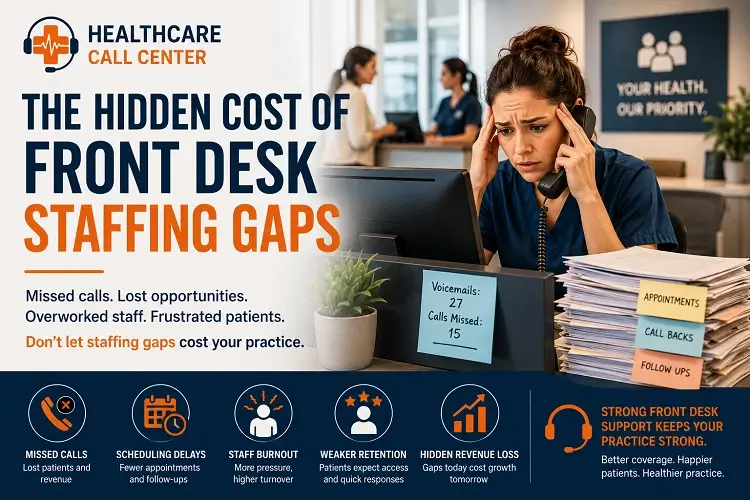
The real cost of a front desk staffing gap is not only payroll. It is missed patient calls, lost appointment opportunities, staff burnout, weaker retention, and a patient experience that feels harder than it should.
This is why medical practices should treat front desk coverage as a growth and patient access issue, not only an administrative issue.
Why the Front Desk Carries So Much Pressure
The front desk is often the busiest communication point in the practice. AMA directly discusses system inefficiencies, administrative burdens, and workplace factors associated with physician burnout.
A front desk team may handle:
- Patient check-in
- Patient check-out
- Phone calls
- Appointment scheduling
- Insurance questions
- Provider messages
- Referral questions
- Walk-in patients
- Forms and paperwork
- Cancellations and reschedules
- Billing questions
- New patient inquiries
- Follow-up calls
That is a lot of work for one team.
When staffing is stable, the team may still feel busy. When staffing is thin, the system becomes fragile.
The phone is usually the first place the pressure shows. Calls ring longer. Patients are placed on hold. Voicemail becomes the backup plan. Staff may answer quickly but sound rushed. Messages may be incomplete because the person answering is also trying to help someone standing at the desk.
This is where a front desk overflow answering service can help protect the patient experience.
Missed Calls Are the First Hidden Cost
The most obvious hidden cost of a staffing gap is the missed call.
But missed calls are often undercounted.
A practice may see voicemails and assume that number reflects the problem. It does not. Many callers do not leave voicemails. Some hang up. Some try again later. Some call a competitor. Some give up because they are already frustrated.
A missed call can represent:
- A new patient appointment
- A returning patient follow-up
- A referral inquiry
- A reschedule request
- A cancellation that could have been refilled
- A post-visit concern
- An after-hours message
- A patient who needed reassurance
The cost depends on the caller’s intent.
If the caller was ready to book, the missed call may cost revenue. If the caller was an existing patient, it may cost trust. If the caller had a concern, it may create anxiety and extra follow-up work later.
A 24/7 medical answering service helps reduce this risk by making sure more calls are answered when the front desk is overloaded.
Staffing Gaps Slow Down Scheduling
Scheduling is one of the first workflows to suffer when the front desk is short-staffed.
Patients call to book, reschedule, confirm, or ask about availability. If those calls are delayed, the schedule becomes harder to manage.
A staffing gap can cause:
- Slower new patient booking
- More missed appointment requests
- More unfilled cancellations
- Longer callback queues
- More patient frustration
- More pressure on staff later in the day
Scheduling delays are not just inconvenient. They can reduce revenue and weaken patient retention.
A patient who cannot book quickly may choose another provider. A patient who cannot reschedule easily may miss care. A cancellation that is not handled in time may leave an empty appointment slot.
This is why phone coverage and appointment access are connected.
Staff Burnout Becomes a Patient Experience Problem
Front desk staff often carry the emotional weight of the practice.
They handle frustrated patients, urgent requests, provider interruptions, insurance confusion, and constant phone volume. When staffing is thin, every interaction becomes harder.
Burnout can show up as:
- Shorter call tone
- More mistakes
- Slower callbacks
- Less patience with callers
- Lower message quality
- Higher turnover risk
- More internal stress
Patients can feel that pressure.
Even when staff is trying their best, a rushed or overwhelmed call experience can make the practice feel disorganized.
The solution is not always telling staff to work harder. In many cases, they are already working at capacity. The better solution is to reduce avoidable pressure.
A call support partner can help by answering overflow calls, collecting clear messages, and giving staff room to focus on patients in the office.
Patient Access Breaks Down at the Phone
Patient access is often discussed in terms of appointment availability, insurance acceptance, and provider schedules. But for many patients, access starts with the phone.
If a patient cannot reach the practice, the rest of the access system does not matter.
The patient may never book the appointment. They may never ask the question. They may never complete the follow-up step. They may never get routed to the right person.
A staffing gap can turn the phone into a bottleneck.
This affects:
- New patient acquisition
- Follow-up care
- Reschedules
- Medication questions
- Procedure questions
- Referral coordination
- Patient satisfaction
- Online reviews
- Retention
Strong US-based healthcare call center services help practices improve patient access by making sure calls are answered and routed more consistently.
The Cost Is Higher for Specialty Practices
Front desk staffing gaps are especially expensive for specialty practices
In specialty care, calls often carry higher value and more sensitivity. A fertility patient may be calling after a difficult update. A plastic surgery lead may be ready to book a consultation. An OB-GYN patient may be worried. A dental patient may be in pain. A chiropractic patient may want a same-day visit.
These calls should not sit unanswered.
Specialty practices often invest heavily in SEO, referrals, reviews, and paid marketing. A missed call can waste that investment.
The practice may never know exactly which caller was lost. But over time, the pattern becomes visible: fewer booked consultations, lower conversion from marketing, more patient complaints, and more pressure on the team.
After-Hours Gaps Add Another Layer
Staffing gaps during the day are one problem. After-hours coverage is another.
Patients do not only call during office hours. They call after work, during evenings, on weekends, and when they remember something important. Some calls can wait. Some need clear routing. Some simply need to be answered and documented correctly.
If after-hours calls go to voicemail without a clear process, the practice may create more work for the next business day.
An after-hours medical answering service helps make sure calls are answered, captured, and routed according to the practice’s rules.
This can reduce patient frustration and give the front desk a cleaner starting point in the morning.
Hiring More Staff Is Not Always Enough
Hiring may be necessary, but it is not always the complete answer.
A new staff member cannot solve every call spike. They cannot cover every lunch break, sick day, after-hours call, or campaign-driven surge. They also require training, management, payroll, and time before they become fully effective.
Practices should ask whether the problem is permanent workload, predictable peak-hour pressure, or variable call volume.
If call pressure comes in waves, overflow support may be more efficient than adding another full-time role.
The goal is not to automate every patient interaction. It is to match the right type of call support to the workload your front desk is actually experiencing.
A blended model often works best:
- The front desk handles in-office patients and core workflows.
- Overflow support answers calls when staff is busy.
- After-hours support covers calls when the office is closed.
- Clear routing rules keep messages organized.
This creates coverage without overloading the team.
How to Identify the Real Cost of a Staffing Gap
Practices should audit the impact of front desk staffing gaps, not just the staffing schedule.
Review:
- Missed calls by day and time
- Voicemail volume
- Callback delays
- New patient call conversion
- Empty schedule slots
- Patient complaints about phone access
- Staff overtime or stress patterns
- Calls missed during lunch or check-in rushes
- Calls from paid campaigns or SEO pages
- After-hours call volume
This helps the practice understand whether the staffing gap is affecting growth and retention and whether the solution is additional staff, overflow coverage, after-hours support, or a combination of the three.
Practices can also use a missed call revenue calculator to estimate the potential financial impact of unanswered patient calls.
The goal is not to blame the front desk. The goal is to find where the system needs support.
What Better Front Desk Support Looks Like
Better front desk support does not have to be complicated.
It should help the practice:
- Answer more calls
- Reduce voicemail dependency
- Capture appointment requests
- Route messages clearly
- Support after-hours callers
- Reduce staff pressure
- Improve patient access
- Protect marketing ROI
- Keep the patient experience consistent
The best support model should feel like an extension of the practice’s workflow, with practice-specific scripts, routing rules, escalation instructions, and secure message handling. It should follow practice-specific instructions, protect patient information, and help callers feel heard.
This is the strongest primary authority for your healthcare privacy point. HHS explains that the Privacy Rule establishes national standards for protecting medical records and individually identifiable health information.
That is the difference between basic message-taking and healthcare-aware call handling.
Why This Problem Can Grow Quietly
Front desk staffing gaps do not always create an obvious crisis at first. The practice may still be seeing patients. The schedule may still look full. Staff may still be answering many calls each day.
But the missed opportunities often happen quietly.
A new patient does not book. A caller does not leave a voicemail. A follow-up gets delayed. A cancellation is not filled. A patient feels the practice is hard to reach and starts comparing other options.
Because these losses are scattered across many small moments, they can be easy to ignore. That is what makes them dangerous.
By the time the problem shows up in lower conversion, weaker retention, or staff turnover, the practice may have been leaking opportunities for months.
This is why practices should review front desk coverage before the problem becomes visible in revenue. The phone is often the earliest warning sign that the team needs support.
Final Takeaway
Front desk staffing gaps cost medical practices more than payroll.
They create missed calls, slower scheduling, patient frustration, staff burnout, and lost appointment opportunities. They also weaken the patient experience before the patient ever sees a provider.
Medical practices do not need to choose between overloading the front desk and sending callers to voicemail. With the right call handling support, they can protect patient access, support staff, and answer more calls during the moments that matter.
Healthcare Call Center helps medical practices reduce front desk overload, answer more patient calls, support after-hours communication, and protect appointment opportunities.
Book a Free Consultation to review your front desk call volume, staffing gaps, overflow needs, and after-hours coverage.
Front Desk Staffing Gap FAQs
1. What is a front desk staffing gap in a medical practice?
A front desk staffing gap happens when the practice does not have enough available staff to manage patient calls, check-ins, scheduling, insurance questions, and administrative work without delays or missed calls.
2. How do front desk staffing gaps affect patient calls?
Staffing gaps can cause longer hold times, missed calls, voicemail dependency, delayed callbacks, incomplete messages, and frustrated patients who cannot reach the practice quickly.
3. Can a medical answering service help with staffing gaps?
Yes. A medical answering service can help by covering overflow calls, after-hours calls, appointment requests, and message capture when the front desk is overloaded or unavailable.
4. When should a medical practice use front desk overflow support?
A practice should consider front desk overflow support when calls are regularly missed during peak hours, lunch breaks, check-in periods, staffing shortages, or other high-volume windows.
5. Is overflow call support better than hiring more staff?
It depends on the problem. If call volume spikes during specific times, overflow support may be more efficient. If the practice has constant workload growth, hiring may also be needed.
6. How can practices measure the cost of front desk staffing gaps?
Practices can review missed calls, voicemail volume, callback delays, new patient conversion, schedule gaps, patient complaints, and call volume during peak times or after-hours windows.
by Erika Sanchez | Sep 28, 2026 | AI Practice Agent
Your front desk team starts most days with a pile of work that has nothing to do with patients. Insurance paperwork is missing for three visits this week. Four follow-up calls from last week are still unscheduled. Two new patient inquiries that came in overnight are sitting in voicemail. By the time the phones get busy, half the morning is already gone, and the pile has grown.
A Healthcare AI practice agent exists to eat that pile. Not the patient care, not the judgment calls, and not the human conversations your team is great at. The repetitive back-office work that quietly consumes hours of staff time every week.
Quick Summary
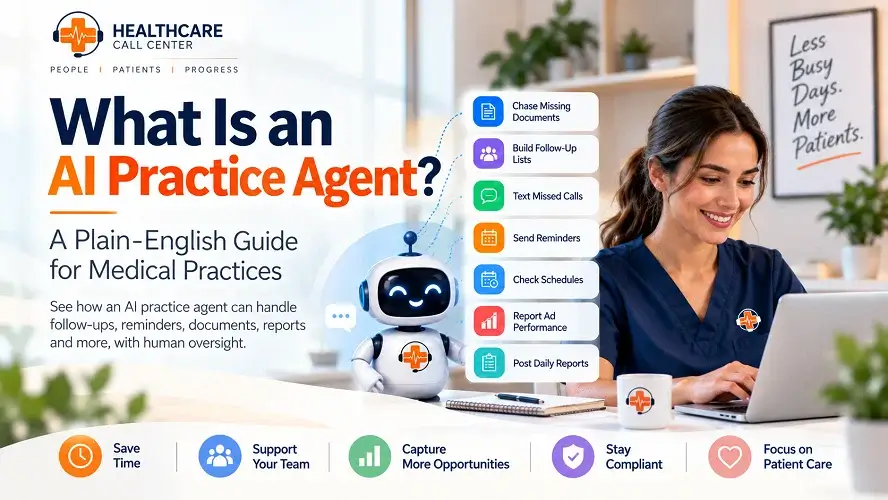
An AI practice agent is a chat-based assistant that runs recurring back-office work for a medical practice from one shared chat window. It chases missing documents, builds daily follow-up lists, texts back missed calls within 30 seconds, sends appointment reminders, checks schedules, and posts daily reports, while trained humans review anything sensitive before it reaches a patient. Unlike a traditional chatbot, an AI practice agent is designed to execute recurring workflows, not simply respond to individual questions.
What Is an AI Practice Agent?
An AI practice agent is a software assistant that performs ongoing operational tasks for a medical practice instead of just answering questions about them. That distinction matters. A chatbot reacts when a patient types a question into a widget, while an AI medical receptionist is designed for patient-facing communication and phone-related workflows. An AI practice agent is given standing instructions, connects to the tools your practice already uses, and does the work on a schedule or on request.
The whole team uses the same agent through a chat app most staff already have on their phones, Telegram or Slack. Front office, billing, and the practice manager see the same thread. Someone asks, the agent acts, and the result lands where everyone can see it.
The category is new, which is why the definition varies from vendor to vendor. At Healthcare Call Center, the AI Practice Agent combines automation with human oversight: the agent does the legwork, and trained operators review anything sensitive, especially anything that touches protected health information.
How is an AI Practice Agent Different From a Chatbot?
A chatbot primarily responds when someone asks a question. An AI practice agent is designed to carry out recurring workflows based on instructions, schedules, and connected practice systems.
For example, a chatbot might answer, “What are your office hours?” An AI practice agent might generate the morning follow-up list, identify missing documents, send approved reminders, and report which tasks still need human attention.
The difference is simple: a chatbot answers; an AI practice agent helps execute the workflow.
What Does an AI Practice Agent Actually Do?
The honest answer is: the boring work that never feels urgent until it piles up. Here are the seven tasks practices hand over first.
Every practice is a little different, but after mapping dozens of workflows, the same tasks come up again and again. If your week contains any of the following, this section is for you.
1. Chasing Missing Documents
Lab results, referral letters, insurance forms, and intake paperwork go missing constantly. The agent tracks what is outstanding for each patient, follows up automatically, and keeps one running list of what is still missing, so nobody scrolls through old group chats to figure it out.
2. Building the Morning Follow-Up List
Every morning, the agent posts a short list of the follow-ups due that day in your shared chat. Your team starts with a plan instead of reconstructing one from memory and sticky notes.
3. Texting Back Missed Calls in 30 Seconds
When a call goes unanswered, the agent sends missed-call users a text within 30 seconds, so a ready-to-book patient gets a response instead of silence. The callbacks land in one queue for your team to finish personally.
4. Sending Appointment Reminders and Confirmations
Reminder batches go out on schedule, confirmations come back into one thread, and no-show-prone slots get flagged early enough to refill.
5. Checking Tomorrow’s Schedule
Ask who is in tomorrow, where the open slots are, or which patients need a reminder, and you get a straight answer pulled from your practice calendar.
6. Watching Ad Performance
For practices running Meta ads, the agent reports overnight spend, lead counts, and which ad needs attention, and can pause an underperforming ad for human approval.
7. Posting the Daily Report
Spend, leads, reminders completed, and open follow-ups are posted in your thread every morning while the numbers are still actionable.
What an AI Practice Agent Will Not Do
The limits are the point. A well-run AI practice agent does not give medical advice, does not make clinical decisions, and does not message a patient without your rules in place. Anything sensitive, such as insurance changes or anything touching protected health information, is flagged and reviewed by trained human operators before it goes out.
That human oversight layer is what separates a practice agent from a raw automation script. The bot handles legwork at machine speed. People stay responsible for judgment.
Tasks That Should Stay With Humans
An AI practice agent can support administrative workflows, but practices should define clear boundaries for tasks involving:
- Medical advice or clinical interpretation
- Symptoms and diagnosis
- Medication decisions
- Urgent or emergency concerns
- Complex insurance or billing disputes
- Sensitive patient communications
- Anything requiring professional judgment
The agent should route these situations according to the practice’s escalation rules rather than attempting to make the decision itself.
AI Practice Agent vs Chatbot vs Virtual Receptionist vs Answering Service
These four get mixed up constantly, so here is the plain-English version.
| Option |
What it does |
Best for |
| Chatbot |
Answers website questions |
Basic site inquiries |
| AI Practice Agent |
Runs back-office tasks in your team chat, on your rules |
Document chases, follow-ups, reminders, reports |
| Virtual Receptionist |
Remote human handles calls and admin |
Business-hours call coverage |
| Answering Service |
Live humans answer patient calls 24/7 |
After-hours and overflow phone coverage |
| Primary Interaction |
Where the service primarily interacts |
Website, internal team chat, or patient phone calls depending on the option |
Notice that an AI practice agent and an answering service are not competitors. One runs the back office in chat. The other answers the phones. Practices with steady call volume usually need both, which is how Healthcare Call Center packages them: live US-based agents cover patient calls around the clock, and the agent runs everything else in the thread.
Who Benefits Most From an AI Practice Agent?
Multi-location groups use it to keep every site’s follow-ups in one thread instead of five separate inboxes. Solo and two-provider practices use it as the ops person they have not hired yet, covering document chases, reminders, and daily reports without adding payroll.
Practices running Meta ads use the daily spend and lead reporting to catch a failing ad in hours instead of weeks. And growing specialty practices, from med spas to fertility clinics, use it to protect the high-value bookings that sit at the bottom of a bloated task list. The common thread is simple: if the work repeats, follows a rule, and lives in a tool you already use, the agent can probably take it.
A Day With an AI Practice Agent
Here is what a normal morning looks like in the shared window.
7:58 am. The daily report lands: ad spend from yesterday, 19 new leads, 14 reminder confirmations, and 2 missing-document follow-ups flagged for review.
8:04 am. Your front desk asks: “Send today’s reminder batch.” The agent sends it and reports back: 18 sent, 3 phone numbers failed validation.
9:30 am. A team member asks about tomorrow. The agent answers: 18 appointments, 2 openings, 3 patients flagged for confirmation calls.
Total time spent in the chat: a few minutes. No tab hopping, no sticky notes, no end-of-month surprises.
Is an AI Practice Agent HIPAA-aware?
Whether an AI practice agent needs to operate under HIPAA depends on how it is used and whether it creates, receives, maintains, or transmits protected health information on behalf of a covered entity. Practices should verify the vendor’s data flows, security controls, access management, and Business Associate Agreement requirements before connecting systems containing PHI.
For HCC’s implementation, the agent is designed around HIPAA-conscious workflows, data minimization, human oversight, and the appropriate contractual safeguards for workflows involving PHI.
Practices using AI in patient-facing workflows should also understand emerging AI disclosure requirements and how those rules may affect patient communication.
How Fast Can a Practice Start?
Faster than most practices expect. The process starts with a $49 working session, where you watch the agent handle your biggest chore live on sample data and leave with a written plan you keep either way. Full setup, including workflow mapping, tool connections, training, and launch, typically finishes within 2 business days. Operation runs 499 dollars per month, with no long-term contracts.
Do You Still Need a Live Answering Service?
Yes, if your phones ring. An AI practice agent works in text, inside your team chat. It cannot comfort an anxious patient calling about a procedure at 9 pm, and it cannot have the warm, human conversation that turns a first-time caller into a booked consultation.
That is live answering’s job. US-based agents answer in your practice name around the clock, which is where the after-hours coverage gap hurts most practices first. The agent and the healthcare answering service cover different lanes: the bot runs the back office while live humans handle the phones. If you want to size the phone problem at your practice, start with the missed call revenue calculator, then read our breakdown of how much revenue medical practices lose from after-hours missed calls.
Frequently Asked Questions
What is an AI practice agent in simple terms?
It is a chat-based assistant that does recurring administrative work for your practice, such as chasing documents, sending reminders, and posting daily reports, following your rules and escalating anything sensitive to a human.
Does an AI practice agent replace front desk staff?
No. It removes the repetitive chores, so your team can focus on patients and judgment calls. Your team reviews everything important before it goes out.
Is patient information safe with an AI agent?
Yes, when it is set up correctly: HIPAA-compliant infrastructure, a signed Business Associate Agreement, data minimization, and human review on sensitive messages.
How long does setup take?
Most practices are live within 2 business days of full setup. The 49 dollar session happens first, and you keep the written plan either way.
How much does an AI practice agent cost?
At Healthcare Call Center: a 49 dollar one-hour working session to start, 5,000 dollars one-time for full setup, and 499 dollars per month to operate. No long-term contracts.
The Bottom Line
An AI practice agent is not a robot replacing your team. It is the reliable back-office helper that chases what everyone forgets, reports what everyone guesses at, and gives your front desk its mornings back. Pair it with live human phone coverage and your practice stops leaking time and patients in two different places.
The practices that see the biggest gains treat the agent like a new hire, not a magic button: they map their workflows honestly, set clear escalation rules, and review the first two weeks of output. Do that, and the 4-8 hours a week is not a marketing promise. It is arithmetic.
Book a free consultation with Healthcare Call Center, and we will show you the agent working on sample data from a practice like yours.
by Erika Sanchez | Sep 25, 2026 | Med Spa Answering Services
Your front desk is mid-consultation, the phone rings twice, and the caller hangs up. She was ready to book lip filler for Friday. No voicemail was left, no callback number exists, and by the time your team notices the missed call, she has already dialed the next med spa on Google. This happens every single day at injectable and laser practices across the country.
In this article, we break down what missed calls actually cost a med spa, why they happen, and how to capture those calls without hiring another full-time receptionist.
Quick answer: A med spa loses money every time a treatment call hits voicemail, because cosmetic callers book with whoever answers first. Practices stop the leak with 24/7 live answering, where trained agents answer in your practice name, capture the caller’s treatment interest, and book the appointment directly into your calendar, including evenings and weekends when most inquiries happen.
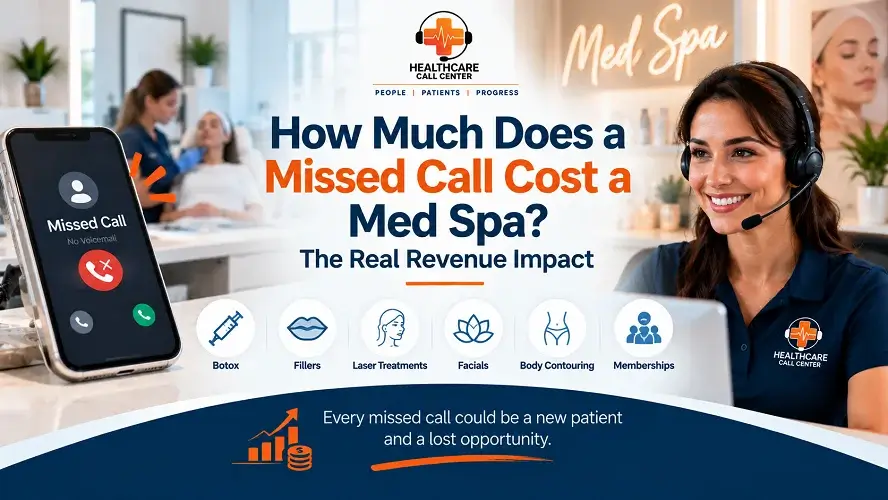
What Does One Missed Call Cost A Med Spa?
A missed high-intent treatment call can represent hundreds of dollars in potential revenue, depending on the treatment, booking rate, and patient value. Unlike a medical office where a missed call might be rescheduled by a loyal patient, a cosmetic caller is usually comparing options right now and simply moves to the next name on the list.
The math is not complicated:
- 25 treatment-line calls per day × 46% arriving during busy windows or after hours = 5 calls at risk per day
- 5 × 22 working days = 253 calls at risk per month
- 253 × 30% potential booking rate = 76 potential bookings
- 76 × $500 average visit = $38,000 in potential treatment revenue exposure
- But importantly, call this potential revenue exposure, not guaranteed lost revenue.
Run your own numbers with our free Missed Call Revenue Calculator.
Why Do Med Spa Calls Go Unanswered?
Most med spa calls go unanswered because the same small team that performs treatments also answers the phone, so calls collide with consultations, check-ins, lunch windows, and evening inquiry spikes. Using a 46% illustrative benchmark for calls arriving during busy windows or after hours, a practice can estimate how many calls may need live coverage.
The pattern looks like this:
- An injector is mid-treatment, so the coordinator handles check-in and retail sales.
- The phone rings during a 12:30 pm lunch rush or at 8:00 pm when patients research on their phones.
- The call goes to voicemail, and a first-time cosmetic caller leaves no message.
Patients who are anxious about a first-time Botox or laser treatment often judge the practice by that first phone experience. A warm, informed voice builds confidence before they ever walk in, which is the same principle we cover in our guide to empathetic patient communication.
What Do Med Spa Callers Actually Ask For?
Most med spa callers want to book a treatment, ask about price ranges, or check whether they are a candidate for a procedure such as Botox, filler, or laser hair removal. These are high-intent shopping calls, not routine admin calls, and each one is worth a real treatment dollar amount.
| What the caller asks |
What they need |
What happens if no one answers |
| How much is Botox per unit? |
A price range plus a booking |
They call the next med spa on Google |
| Can I get in this week? |
An appointment slot |
They book somewhere that answers |
| Do I need a consultation first? |
Guidance plus a booking |
They lose confidence and delay |
| When do my membership points post? |
Account help |
They feel unvalued and churn |
Notice that three of the four requests end in a booking. That is why practices that answer live convert callers at a much higher rate than practices that rely on callbacks. If you want a deeper comparison, read our breakdown of voicemail vs. live answering for medical practices.
How Should A Med Spa Handle After-Hours Calls?
After-hours med spa calls should be answered live by a trained agent who uses your practice name, captures the treatment request, and books directly into your scheduling system, with clinical questions escalated by your protocol.
Voicemail converts almost nothing after 6:00 pm, and an automated menu frustrates exactly the anxious first-time callers you most want to convert. Some practices try software instead of people, but the tradeoffs matter.
A live answering setup for a med spa typically includes:
- Agents trained on your service menu, from neurotoxin and filler to lasers and skincare
- Direct booking into your calendar with intake notes attached
- Your escalation rules for clinical or refund questions
- Coverage on evenings, weekends, and holidays, which is where the benefits of after-hours medical answering show up first
You can see the full workflow on our med spa answering services page, and the same scheduling approach we use for surgical consults is detailed on our plastic surgery appointment scheduling page.
What About Memberships, Packages, And Repeat Treatments?
Med spa revenue depends on repeat visits, so every unanswered membership or rebooking call compounds: one missed call can quietly cancel a year of renewals. Neurotoxin patients rebook every 8 to 12 weeks, laser packages run six or more sessions, and membership programs only retain when patients feel remembered.
The American Med Spa Association (AmSpa) publishes industry research showing that repeat treatments and memberships drive the majority of med spa revenue, which makes the phone the single most valuable retention tool in the building.
When a member calls about points, a package balance, or a rebooking and reaches a warm human who resolves it in one call, the renewal continues. When that call hits voicemail, the patient drifts toward whatever discount email lands next. Retention calls deserve the same 24/7 coverage as new booking calls, and practices that want broader scheduling coverage also review our medical answering appointment scheduling service.
Stop Losing Botox And Filler Bookings To Voicemail
Every evening your phones go to voicemail, a line of ready-to-book cosmetic callers is calling the next med spa on Google. Our US-based, stay-at-home mom agents answer with empathy, capture the treatment request, and book it into your calendar, with a 90%+ answer rate and HIPAA-conscious call handling.
Book a free consultation, and we will show you exactly how many treatment calls you are losing each month.
Med Spa Missed Call FAQs
Can an answering service really book med spa appointments?
Yes. Agents work from your service menu, consultation rules, and live calendar access, so the caller hangs up with a confirmed date and time. Bookings flow into the same scheduling workflow your front desk already uses.
Will patients know they are talking to a service?
No. Agents answer with your practice name, match your tone, and follow your call handling instructions. Most callers experience it as a seamless extension of your front desk.
How much does 24/7 med spa call coverage cost?
Most practices invest $300 to $900 per month depending on call volume and coverage hours, month-to-month with 30-day notice. A free consultation reviews your call data and average treatment value to size the right plan.
Answering-service pricing varies by call volume, coverage hours, scheduling requirements, and service level. Some plans may start in the hundreds of dollars per month, but practices should compare pricing against their actual call volume and potential revenue exposure.