by Erika Sanchez | Aug 31, 2026 | dentist call center services
Dental practices lose some of their best new patient opportunities on Saturdays. Weekend callers often have dental pain, an urgent concern, or free time to finally book treatment, and most reach voicemail because the front desk is closed.
A dental answering service with weekend coverage answers those calls live, captures the appointment request, and turns Saturday phone time into scheduled production instead of Monday mystery voicemails.
For many dental practices, the weekend is a gap between when patients need help and when the front desk is available. That gap can mean missed appointment requests, unanswered questions, and patients choosing another practice simply because someone answered their call.
With the right weekend coverage, practices can stay accessible when their team is away while giving every caller a clear path to the next step.
Why Do Patients Call Dental Offices On Weekends?
Weekend calls are not random. They follow the rhythm of real life. People notice a cracked molar on Saturday morning. A parent spots a swollen gum after a Friday soccer game. Someone with a toothache finally has a day off to deal with it. Insurance questions and second opinions pile up on the days patients actually have time to make them.
These callers share one trait. They are ready to act now. A person who calls a dental office on a Saturday is not browsing. They have a need and a phone, and they are usually working down a short list of nearby practices. Patient expectations have shifted as well. As the American Dental Association and public health groups publish clearer guidance on what counts as a dental emergency, more patients know that a knocked-out tooth or uncontrolled bleeding should not wait until Monday, and they expect whoever answers to take it seriously.
Weekend callers also tend to be higher intent than weekday callers. A Tuesday call can be a shopper price-checking three offices between meetings. A Saturday call with pain attached is usually someone who wants this handled now, by the first competent practice that picks up. The willingness to call on a weekend is itself a signal of readiness to book, which is exactly why the voicemail default is so expensive.
What Kind Of Calls Come In On Saturday?
- Dental pain and swelling that cannot wait until Monday. Severe toothaches, facial swelling, and post-op complications dominate weekend lines, and patients often check emergency guidance through resources like MouthHealthy by the American Dental Association before they call.
- Broken or knocked-out teeth from weekend sports and accidents. Kids and weekend athletes supply a steady stream of fractures, and a fast response can decide whether a tooth is saved.
- New patient inquiries from people who finally have time to call. Saturday is when the nine-to-five workforce does its homework, compares practices, and books.
- Reschedule and confirmation requests ahead of Monday. Patients planning their week adjust appointments when they have a minute, and a missed reschedule quietly becomes a no-show.
- Insurance and treatment cost questions from patients planning care. Weekend planners price out crowns, implants, and cleanings before committing.
Appointment availability questions. Some patients are ready to schedule but want to know whether the practice has an appointment available before deciding whether to call again on Monday.
Notice how many of those lead directly to chair time. Emergency visits become same-day or Monday morning slots. New patient inquiries convert at their highest rate because the caller chose you. Even a reschedule is production protected. None of them can be handled by a voicemail box.
What Happens When A Weekend Caller Hears Voicemail?
Most callers do not leave a message. They hang up and dial the next practice on the list, which is exactly where your weekend new patient calls go. When a patient needs help on a Saturday, reaching a live person gives an available practice an important opportunity to schedule the dental patient appointment before the caller contacts another office.
The caller who reaches a warm live voice feels reassured before the appointment is even booked. The caller who reaches a dental practice’s voicemail feels dismissed at the exact moment they needed help, and that dismissal is what they remember when a friend asks for a dentist recommendation next month. Weekend call handling is not just missed production. It is reputation, quietly compounding in either direction.
Voicemail Versus Live Weekend Coverage
You do not have to guess at the difference. Put the two options side by side for the same Saturday call.
| What the caller experiences |
Voicemail only |
Live weekend coverage |
| First contact |
Recorded message and voicemail prompt |
Live person answers the call |
| New patient capture |
Only if the caller leaves a message |
Name, callback number, reason for calling, and preferred appointment times can be captured |
| Emergency handling |
Caller hears instructions and may call another office |
Urgent calls follow your defined protocol |
| Caller feeling |
May feel dismissed or left without help |
Reassured and assisted by a live person |
| Monday workload |
Voicemail backlog to untangle |
Organized weekend call information |
| Missed opportunity |
Caller may contact another practice |
Practice has an opportunity to capture the caller |
The pattern is consistent. Voicemail loses the patients who are most ready to book, and it loses them silently, because a caller who hangs up leaves no record that the call ever happened.
The Monday Morning Voicemail Problem
There is a second, quieter loss on Monday morning. When weekend calls pile into voicemail, the front desk starts the week in recovery mode. Messages are vague, numbers are garbled, and half the callers left no callback at all. Staff spend the first hours chasing ghosts instead of confirming appointments.
By the time they reach the messages that matter, the Monday schedule is already behind, and the Saturday caller with the cracked molar may have booked elsewhere out of simple impatience. Live weekend coverage removes that entire recovery phase. Monday begins with complete intake notes and a call list that converts, because the capture already happened while the patient was on the line.
How Can A Dental Answering Service Cover Weekends?
Weekend coverage works the same way practices already trust for evenings. A trained agent answers with your practice name, follows your protocols, and treats the caller with calm, friendly attention. Emergency calls follow your urgent path and reach the right person, whether that is your on-call dentist or a designated clinical contact. Appointment requests, including new patient details and reason for visit, are captured completely and delivered to your scheduling system or Monday morning queue.
Because agents work from your instructions, weekend coverage fits the practice rather than forcing a generic script. A pediatric office can route a knocked-out baby tooth differently than a prosthodontist would route a broken crown on an implant. That flexibility is the difference between a partner delivering dental call center service provider and a generic answering pool reading from a card.
Practices that struggle to return Monday calls often combine weekend coverage with an after-hours dental answering service so nothing falls through between Friday evening and Monday morning. The handoff between the two is invisible to patients, who simply reach a knowledgeable human every time they call.
What Should Weekend Coverage Include?
- Live answer within a few rings, every Saturday and Sunday, with no menus to navigate.
- Your practice greeting and tone, so callers trust they reached the right office.
- Emergency triage to your on-call dentist or urgent protocol, using your rules, not the service’s.
- Full new patient capture, including name, callback number, concern, insurance, and preferred times.
- Clear delivery to your team before the Monday morning huddle, in the format your scheduler actually uses.
Is Weekend Dental Answering Worth It?
For practices that receive meaningful weekend call volume, live answering can help capture appointment requests, urgent calls, and new-patient inquiries that would otherwise reach voicemail. The best way to determine whether it is worthwhile is to compare your weekend call volume, appointments booked, and patient value with the cost of coverage.
How Weekend Coverage Feeds Your Monday Schedule
The real payoff of Saturday coverage shows up Monday at 8 AM. Instead of an empty schedule with a voicemail backlog, your front desk opens a prepared queue. New patient requests are already documented with callback numbers and insurance details. Emergencies from the weekend are triaged into the first open chairs. Reschedules are logged, so the schedule you see is the schedule that is real.
A prepared Monday changes the whole week. Chairs fill earlier. The team starts in execution mode instead of triage mode. Production that used to leak out through the weekend now arrives pre-captured, and the only task left is confirmation calls that take seconds because the patient already expects them.
What Is One Saturday Of Missed Calls Actually Worth?
Run the numbers for your own chairs. A single new patient crown and hygiene visit often carries four figures of production. A root canal case carries more. Implant consultations run higher still. These are not hypothetical cases. They are the exact calls that come in on Saturdays from patients with pain or free time to plan treatment.
Now consider what those missed calls could mean over an entire year. If two weekend callers each month choose another practice, that represents 24 potential new-patient opportunities that your practice never had the chance to convert. The actual revenue impact will depend on your average patient value, treatment mix, and conversion rate, but even a small number of missed opportunities can add up.
Practices that answer weekends do not just recover calls. They recover treatment plans that would have quietly belonged to someone else.
Is Weekend Coverage Right For Every Practice?
Solo practices benefit fastest, because one missed emergency can define the whole month. When a single Saturday caller with a broken tooth becomes a crown, an overlay, and two recall visits. For some practices, even a small number of recovered weekend calls can make the cost of coverage worth considering.
Multi-location and group practices gain something different, which is consistency. Every branch answers with the same greeting, the same protocols, and the same message format, so weekend performance no longer depends on which location the caller dialed. And for practices that already offer extended hours, weekend coverage closes the final gap: the phones are live whenever a patient in pain needs them, without asking anyone on the team to give up a Saturday.
Weekend coverage is easier to launch than most practices expect. You approve the greeting, the urgent protocol, and the message format. The service handles the phones starting the next Saturday. Nothing about your weekday operations changes, and you can review message quality in the first weeks to fine-tune the script.
Your chairs do not need to sit empty on Monday. Book a free consultation and see how weekend call coverage would work for your practice.
Frequently Asked Questions
1. Do Dental Patients Really Call On Weekends?
Yes. Weekends bring dental emergencies, sports injuries, and new patient inquiries from people who cannot call during work hours. Many practices see steady weekend call volume even with no one there to answer.
2. What Happens To Weekend Calls We Miss?
Most callers hang up and call another practice. A small number leave voicemails that staff return Monday, when the caller may already be booked elsewhere.
3. Can A Weekend Answering Service Reach Our On-Call Dentist?
Yes. Emergency calls follow the urgent protocol you define, which can include reaching your on-call dentist or following specific after-hours instructions.
4. Will The Answering Service Know Dental Terminology?
Agents trained for dental practices understand common concerns like broken teeth, swelling, pain levels, and post-op questions, and they follow your scripts for anything clinical.
5. How Do We Get Weekend Messages?
Messages and new patient details are delivered your way, by email, SMS, or directly into your scheduling workflow, so Monday morning starts with everything organized.
6. Can Weekend Coverage Start With Just Saturdays?
Yes. Many practices begin with Saturday-only coverage and add Sundays or evenings once they see call volume and message quality. Coverage scales with your schedule, not a package.
by Erika Sanchez | Aug 12, 2026 | dentist call center services
Dental practices run on appointments. When the schedule is full, the practice thrives. When chairs sit empty because of missed calls, no-shows, and last-minute cancellations, revenue disappears quietly.
The problem is not that patients stop calling. They call during lunch, after hours, while your front desk is checking in a patient, or while someone else is on hold. Those calls go unanswered, and unanswered calls do not come back.
Dental call center services can fix your missed call issues and book more appointments for you. A trained team answers every patient call, schedules appointments directly into your system, handles rescheduling, and captures emergency inquiries before they walk to the competitor down the street.
This article explains what dental call center services do, why your practice needs them, and how they directly impact your bottom line.
What Are Dental Call Center Services?
Dental Answering services are specialized patient communication solutions built for dental practices. Unlike a generic answering service that takes messages, a dental-focused call center team understands how dental practices operate.
They know the difference between a routine cleaning and a dental emergency. They understand insurance pre-authorizations, financing questions, and new patient intake. They can follow your scheduling rules, manage cancellations, and route urgent clinical questions to the right person.
Every call is handled by a real person who treats patients with empathy and professionalism. No automated menus. No hold music for five minutes. No voicemail that patients hang up on.
According to the American Dental Association, patient communication is one of the top factors influencing case acceptance and retention. Practices that respond quickly to patient inquiries consistently outperform those that do not.
Why Dental Practices Lose Patients to Missed Calls
Many dental practices miss calls when front-desk staff are handling patients, insurance, payments, and scheduling simultaneously.
Your front desk is pulled in multiple directions. They check patients in, collect payments, verify insurance, manage the schedule, and assist the clinical team. When two patients are at the front desk and the phone rings, the call goes unanswered.
Lunch breaks create gaps. Many practices stagger lunch coverage poorly. Calls during the lunch hour often go to voicemail, and lunch hour is prime time for patient inquiries.
After-hours dental calls go nowhere. Dental offices typically close between 5 and 6 PM. Patients who experience tooth pain in the evening or think about scheduling an appointment after work cannot reach anyone. They either wait and forget, or they call a competitor who advertises 24/7 availability. In this case, only a dedicated After-Hours Dental Answering Service can help you book more appointments.
Emergency calls get lost. A patient with a cracked tooth at 8 PM does not want to leave a voicemail. A trained agent documents the concern, follows the practice’s approved emergency protocol, and routes or escalates the call to the appropriate dental team member.
Each missed call represents a patient who wanted your services and could not reach you. That is revenue walking out the door.
Core Services a Dental Call Center Provides
A dental call center functions as a seamless extension of your front desk. Here is what the service covers.
24/7 Live Answering
Every call is answered by a trained agent. Day, night, weekends, holidays. Patients always reach a real person who can help them.
The agent follows your practice protocols for call handling, message taking, emergency triage, and scheduling. Patients experience the same level of care they would get from your best front desk team member.
Appointment Scheduling
Agents book appointments directly into your practice management system. They use your dental appointment scheduling rules, operator preferences, hygiene recare intervals, and new patient protocols.
A patient who calls at 10 PM with a toothache can leave the call with a confirmed emergency appointment for 8 AM the next morning. No callback delay. No lost lead.
Emergency Call Triage
Dental emergencies do not follow business hours. A trained agent can assess whether the call requires immediate attention, schedule a same-day emergency slot, or provide home care guidance until the office opens.
This is where practices differentiate themselves. Patients remember the practice that answered at midnight during a dental emergency. They become loyal, long-term patients.
New Patient Intake
First-time callers have questions about insurance, financing, office location, parking, and the dentist’s experience with specific procedures. Agents walk through these questions using practice-approved information.
They do not give clinical advice. They provide the details patients need to feel confident booking their first appointment.
Insurance and Billing Assistance
Agents can answer basic insurance questions, verify coverage details using your provided scripts, and direct complex billing questions to your billing team. This reduces the number of calls pulled away from your in-office staff.
How Dental Call Center Services Differ from a Generic Answering Service
Many dental practices already have an answering service and think the problem is solved. It is not.
- Generic Answering Service: Takes a name and number. Sends a message. Patient waits. Patient books elsewhere.
- Dental Call Center Service: Engages the patient. Answers questions. Schedules the appointment. Patient leaves the call with confirmation.
The difference is conversion. A message-taking service captures data. A dental call center captures patients.
Think about the patient journey. Someone searching for a dentist calls three practices. The first goes to voicemail. The second answers but says they will call back. The third answers, answers the patient’s questions, and books the appointment on the spot. That third practice wins the patient every time.
Who Needs Dental Call Center Services?
These services are built for practices that want to grow without adding overhead.
Solo practitioners who cannot afford to miss a single new patient call. Every missed call is a patient who goes to the practice down the street.
Multi-doctor practices with high call volume that overwhelms front desk staff during peak hours.
DSOs and multi-location groups that need consistent call handling across all locations with unified protocols and reporting.
Specialty practices such as oral surgery, orthodontics, periodontics, and endodontics where calls involve complex scheduling, referrals, and insurance verification.
Emergency-focused practices that need after-hours coverage for urgent patient concerns.
If your practice misses more than two or three calls per day, the revenue lost from those calls exceeds the cost of a dental call center service.
What to Look for in Dental Call Center Services
Not all call centers understand dental. When evaluating providers, check for these essentials.
Dental Specialty Training
Agents should understand dental terminology, common procedures, insurance basics, and the difference between a hygiene recare and a comprehensive exam. Generic call centers confuse patients and create scheduling errors.
HIPAA Compliance
All patient information must be handled with strict HIPAA-compliant protocols. Encrypted messaging, secure access to your scheduling system, documented compliance training, and signed business associate agreements are non-negotiable.
Custom Practice Protocols
Your practice has specific scheduling rules, fee schedules, insurance plans, and communication preferences. The call center must follow your scripts, not theirs.
Bilingual Agents
Dental practices serve diverse communities. Bilingual agents ensure every patient receives clear communication regardless of language preference.
Reporting and Analytics
You should receive detailed call reports showing volume, outcome, appointment conversion rate, after-hours activity, and emergency call frequency. Data drives better decisions.
What Dental Practices Can Improve With Call Center Support
Practices that implement dental call center services see consistent improvements:
More new patient appointments booked. When every call is answered, new patient acquisition increases. Patients who would have gone to voicemail now have confirmed appointments.
Reduced no-show impact. When agents follow up with appointment reminders and handle rescheduling, no-show rates drop. Open slots get filled faster.
Higher patient satisfaction. Patients reach a helpful person every time. That positive first interaction builds trust before the patient ever sits in the chair.
Increased emergency capture. After-hours emergency calls that previously went to voicemail now convert to scheduled appointments. These are often high-value cases.
Better front desk efficiency. With the phone handled, your in-office team can focus on patients standing in front of them instead of juggling calls.
Stronger online reputation. Patients who have positive phone experiences are more likely to leave reviews. Your phone answering quality directly affects your star rating.
The Connection Between Call Answering and Revenue
Every dental practice owner knows the math. A missed new patient call represents the lifetime value of that patient, not just one appointment.
Want to estimate what missed calls could be costing your practice? Use our Missed Call Revenue Calculator to estimate the potential appointment and revenue impact.
A new patient who comes in for a cleaning and exam may return twice a year for decades. They may refer family members. They may accept treatment plans for crowns, implants, or orthodontics.
When that first call goes unanswered, all of that future revenue disappears. The patient simply calls the next dentist on Google Maps.
Dental call center services exist to make sure that first call is answered. Every time. By someone who can help.
Why Now Is the Right Time
The dental industry is competitive. Patients have more choices than ever. Online directories, insurance provider lists, and Google Maps make it easy for patients to call multiple practices in minutes.
The practice that answers first wins. The practice that sends patients to voicemail loses.
If your competitors are missing calls, you have an opportunity to capture their patients. If you are the one missing calls, you are feeding them patients every day.
Every week without a dental call center is a week of missed revenue. The cost of the service is recovered many times over by the appointments it captures.
Ready to Fill Every Chair in Your Practice?
Our HIPAA-compliant healthcare call center services provides specialized dental call center services that keep your schedule full and your patients cared for. From 24/7 live answering to emergency triage and appointment scheduling, we handle every patient communication with professionalism and empathy.
Our dental answering service is built specifically for dental practices. We understand your workflow, your patients, and your goals.
Frequently Asked Questions
What are dental call center services?
Dental call center services are specialized patient communication solutions for dental practices. Trained agents answer calls, schedule appointments, handle emergency triage, and provide after-hours coverage using the practice’s own protocols.
How much do dental call center services cost?
Costs vary based on call volume and service level. Most dental practices find that the revenue recovered from previously missed calls far exceeds the monthly cost. Contact us for a custom quote.
Can the call center schedule appointments directly into our system?
Yes. Agents book appointments directly into your practice management software using your scheduling rules, provider availability, and appointment type protocols.
What happens with after-hours emergency calls?
Trained agents assess the urgency of the situation using your protocols. They can schedule emergency appointments, provide home care guidance, or escalate to the on-call dentist when necessary.
Is the service HIPAA-compliant?
Yes. All patient information is handled with strict HIPAA-compliant protocols, including encrypted communication, secure system access, and documented staff training.
Can the service handle multi-location dental practices?
Yes. Our service supports multi-location groups with unified protocols, location-specific scheduling, and consolidated reporting across all offices.
by Erika Sanchez | Aug 4, 2026 | dentist call center services
A single no-show costs a dental practice between $200 and $600 in lost production. A patient who skips a crown prep, a root canal, or an implant consultation does not just waste a chair. They waste the time your team spent scheduling, confirming, preparing the operatory, and pulling records. When that happens three or four times a week, the annual revenue loss easily exceeds $30,000 to $60,000.
Dental practices across the country are dealing with rising no-show rates. Many dental practices continue to experience higher no-show rates as patients increasingly rely on online booking and digital communication.
People book appointments online, forget about them, and do not feel obligated to show up. Traditional reminder calls and postcard mailers are no longer enough. The practices that are winning have built systems that combine communication, scheduling psychology, and technology to keep chairs full.
The good news is that most dental no-shows are preventable. The seven strategies below help practices reduce missed appointments, recover lost production, and keep more chairs full without adding more front desk staff.
Practices that use a dental call answering service can answer more patient calls before they become missed appointment opportunities.
Key Takeaways
- Dental no-shows cost thousands in lost production every month.
- Multi-channel reminders reduce missed appointments.
- Live answering helps patients confirm or reschedule before they become no-shows.
- Same-day waitlists recover lost chair time.
- Tracking repeat no-shows improves scheduling efficiency.
According to the CDC Oral Health program, regular dental visits play an important role in maintaining oral health and preventing disease.
How Much Do Dental No-Shows Actually Cost?
Before fixing the problem, you need to understand the scale. The average no-show rate in dental practices ranges from 10 to 20 percent depending on specialty, location, and patient demographics.
For a practice with 200 appointments per week and an average production value of $350 per slot, a 15 percent no-show rate means 30 missed appointments weekly. That is $10,500 in lost weekly production or over $500,000 annually.
The example below shows how even a moderate no-show rate can affect monthly production across different types of dental practices.
Here is what no-shows cost at different practice sizes:
| Practice Type |
Avg Production/Slot |
No-Show Rate |
Monthly Revenue Lost |
| General Dentistry |
$300-$400 |
12-18% |
$3,600-$7,200 |
| Orthodontics |
$250-$350 |
15-20% |
$3,000-$7,000 |
| Oral Surgery |
$500-$1,200 |
8-12% |
$4,000-$12,000 |
| Cosmetic/Implants |
$800-$2,500 |
10-15% |
$8,000-$18,750 |
These numbers assume one operatory and one provider. Multi-provider practices multiply the loss. The point is not to make you feel bad about the math. It is to show that even a small reduction in no-show rate produces real, recoverable revenue.
7 Strategies to Reduce Dental No-Shows
Reducing dental no-shows starts with improving how patients communicate with your practice before their appointment. The seven strategies below can help you recover more appointments without increasing front desk workload.
1. Use Multi-Channel Appointment Reminders
A single phone call reminder two days before the appointment is the industry standard. It is also exactly what every other dental practice does, and patients have learned to ignore it. The practices seeing the lowest no-show rates use a combination of text, email, and phone reminders sent at strategic intervals.
An effective reminder sequence looks like this:
- 7 days before: Email reminder with appointment details and a confirmation link
- 3 days before: SMS reminder with a reply-to-confirm prompt
- 1 day before: SMS reminder with the specific time, provider name, and parking instructions
- 2 hours before: Optional SMS for high-value procedures or new patients
Text messages have a 98 percent open rate compared to 20 percent for email and 6 percent for phone calls. Patients are far more likely to text back to confirm or reschedule than to answer a phone call from an unknown number. Automated reminder systems through your practice management software can handle this without adding front desk workload.
2. Require Deposits for High-Value Procedures
Implant consultations, full-mouth reconstruction cases, sedation dentistry, and cosmetic procedures represent significant chair time and preparation. When a patient no-shows for a $2,500 procedure, the loss is not just the production value. It is the laboratory work, materials reserved, and the operatory that could have served another patient.
Charging a refundable deposit of $50 to $200 for high-value appointments dramatically reduces no-shows. The deposit is applied to the patient’s treatment cost at the visit. If they no-show, the deposit is forfeited. Most patients who are serious about treatment will not object. The patients who do object are often the ones most likely to skip.
Frame the policy as protecting the patient’s appointment time, not as a penalty. Say: ‘We reserve two hours of Dr. Smith’s schedule and prepare materials specifically for your visit. A $100 deposit holds your appointment and is applied directly to your treatment.’
3. Build a Same-Day Waitlist
Even with great reminders, some patients will cancel last minute or simply not show. A same-day waitlist turns that empty chair into revenue. Maintain a list of 8 to 15 patients who want earlier appointments. When a cancellation comes in at 8 AM, your front desk texts the waitlist: ‘We have an opening today at 10 AM with Dr. Smith. Reply YES to claim this slot.’
Most practice management software supports waitlists, but many practices do not use the feature actively. The key is having a trained front desk person who knows to check the waitlist the moment a cancellation comes in, not at the end of the day. Every filled same-day slot is recovered revenue that would have been lost.
4. Make Confirmation Frictionless
If confirming an appointment requires calling the office during business hours, waiting on hold, and speaking to a staff member, patients will not do it. Confirmation needs to be a one-tap action from a text message. Reply Y to confirm. Reply R to reschedule. That is it.
When confirmation requires effort, patients put it off. By the time they remember, the appointment has passed. Every reminder you send should include a single action the patient can take in under five seconds. This is where most practices lose the battle. They send reminders that require the patient to call back, which is the exact friction that causes no-shows.
5. Answer Every Patient Call, Even After Hours
Patients who call to confirm, reschedule, or ask about their appointment and reach voicemail are more likely to skip the visit entirely. They think: ‘If they did not answer, maybe it is not important.’ Or they call another dentist who does answer and book there instead.
Patients often call to confirm, reschedule, or cancel. A dental appointment scheduling service helps capture these calls before they turn into empty chairs.
Every missed confirmation call is another opportunity for a patient to cancel silently or book with another dental office.
About 30 to 40 percent of patient calls come in outside of typical office hours. Lunch breaks, evenings, and weekends are prime times for patients to manage personal appointments. If your front desk cannot answer every call, a dental answering service that is trained on your scheduling system ensures no patient call goes to voicemail.
The agent can confirm appointments, reschedule, answer basic questions, and even book new patient consultations directly into your calendar. This alone can cut no-shows significantly because patients who speak to a live person are more likely to feel accountable for the appointment.
6. Use Pre-Appointment Engagement for New Patients
New patients have the highest no-show rates across all dental specialties. They have no relationship with your practice, no history with your team, and no emotional investment in showing up. The fix is building engagement between the booking and the visit.
Send new patients a welcome sequence:
- Immediately after booking: Welcome email with provider photo, office photo, and what to expect
- 3 days before: Text with parking instructions, insurance information request, and confirmation link
- Day before: Text reminder with provider name and appointment time
When a patient sees your team’s faces, knows where to park, and understands what to expect, they are psychologically committed to showing up. Practices that implement welcome sequences report cutting new patient no-shows by 25 to 40 percent.
7. Track No-Show Data and Flag Repeat Offenders
You cannot fix what you do not measure. Your practice management software tracks no-shows per patient, but most practices never look at the report. Run a monthly no-show report and identify patients who have missed two or more appointments in the past 12 months.
For repeat offenders:
- Require deposits for all future appointments, not just high-value ones
- Schedule them into last-minute or same-day slots only, not prime morning slots
- Send additional reminder touches (day-of phone call, not just text)
- After three no-shows, dismiss the patient from the practice per your policy
This sounds harsh, but a patient who no-shows four times in a year is costing your practice $1,000 to $2,500 in lost production. That chair should go to a patient who will show up.
Patients who call after business hours should still reach a real person. An after-hours medical answering service helps capture appointment requests before the next business day.
The Connection Between Live Answering and No-Show Reduction
Most no-show reduction strategies focus on reminders and scheduling. But the moment that matters most is when a patient calls your office. If they reach voicemail, they hang up. If they reach a rushed front desk person who sounds annoyed, they feel like an inconvenience. If they reach a calm, friendly voice that helps them with their question and confirms their appointment, they show up.
This is why practices that use a dental answering service see lower no-show rates. Every patient call is answered by a trained agent who can confirm appointments, reschedule without friction, answer questions about insurance or preparation, and make the patient feel valued. The appointment becomes a commitment to a person, not just a line on a calendar.
When patients know that a real person is available every time they call, including evenings and weekends, they treat the practice with more respect. They call to cancel instead of ghosting. They reschedule instead of disappearing. And they show up because the practice has demonstrated that their time matters.
What to Do When a Patient No-Shows Anyway
Even with every strategy in place, no-shows will still happen. How you handle them determines whether that patient comes back or disappears forever. The first 24 hours after a missed appointment are critical. Most patients feel guilty about missing. They expect a frustrated phone call from the front desk. What they do not expect is a caring message that asks if everything is okay.
Follow this no-show recovery sequence:
- Within 2 Hours: Send a friendly text: ‘Hi [Name], we noticed you missed your appointment today. Is everything okay? We have openings this week if you would like to reschedule.’
- Same day: If no response to text, call. Do not leave a stern voicemail. Say: ‘We were worried when we did not see you today. Please call us when you have a moment.’
- Next day: Send an email with a direct rescheduling link. Remove all friction. One click to pick a new time.
- After 7 days: Send a final message. If still no response, move the patient to an inactive list and require deposits for future bookings.
The tone matters more than the timing. Patients who receive a caring, judgment-free outreach are 60 percent more likely to reschedule than those who receive a standard missed-appointment notice. Your goal is not to scold. It is to recover the patient and the revenue.
The American Dental Association (ADA) also emphasizes effective appointment management and patient communication as important operational best practices for dental practices.
Signs Your Practice Has a No-Show Problem
- Patients frequently miss morning appointments
- New patient appointments have the highest no-show rate
- Your team spends hours returning missed calls
- Last-minute cancellations leave empty chair time
- Patients often reach voicemail when trying to confirm appointments
Start With the Strategy That Has the Biggest Impact
You do not need to implement all seven strategies at once. Start with the one that addresses your biggest leak. If most of your no-shows are new patients, focus on pre-appointment engagement. If your problem is last-minute cancellations, build a same-day waitlist. If patients frequently complain they cannot reach your office, invest in live answering support.
Every practice is different, but the math is the same. Reducing your no-show rate by even 3 to 5 percentage points can add $30,000 to $80,000 in annual production without adding a single new patient to your base. The patients are already booked. You just need them to show up.
Reduce Dental No-Shows by Answering Every Patient Call
Healthcare Call Center helps dental practices capture appointment requests, confirm visits, answer after-hours calls, and reduce missed opportunities before they become empty chairs. Schedule a free consultation to review your current call flow.
Frequently Asked Questions
Q: What is the average no-show rate for dental practices?
The average no-show rate for dental practices ranges from 10 to 20 percent. General dentistry typically sees 12 to 18 percent, orthodontics 15 to 20 percent, and oral surgery 8 to 12 percent. High-value procedures like implants and cosmetic cases tend to have lower no-show rates when deposits are required.
Q: How much does a dental no-show cost?
A single dental no-show costs between $200 and $600 in lost production depending on the procedure. For a practice with 200 weekly appointments and a 15 percent no-show rate, the monthly revenue loss ranges from $3,600 to $10,800. Over a year, this adds up to $40,000 to $130,000 in lost production.
Q: Do text message reminders reduce dental no-shows?
Yes. Text message reminders reduce no-show rates by 20 to 35 percent on average. SMS has a 98 percent open rate compared to 20 percent for email. The most effective approach is a multi-channel sequence: email 7 days before, SMS 3 days before, SMS 1 day before, and optionally SMS 2 hours before for high-value appointments.
Q: Should dental practices charge no-show fees?
No-show fees are effective for repeat offenders but can damage patient relationships if applied too aggressively. A better approach is requiring refundable deposits for high-value procedures like implants, sedation, and cosmetic consultations. Charge the deposit to hold the appointment and apply it to treatment at the visit.
Q: How does live answering reduce dental no-shows?
Patients who reach voicemail when calling to confirm or reschedule are more likely to skip the appointment entirely. Live answering ensures every patient call is answered by a trained agent who can confirm appointments, reschedule without friction, and make patients feel valued. This accountability reduces no-shows by 15 to 25 percent.
by Erika Sanchez | Jul 21, 2026 | dentist call center services
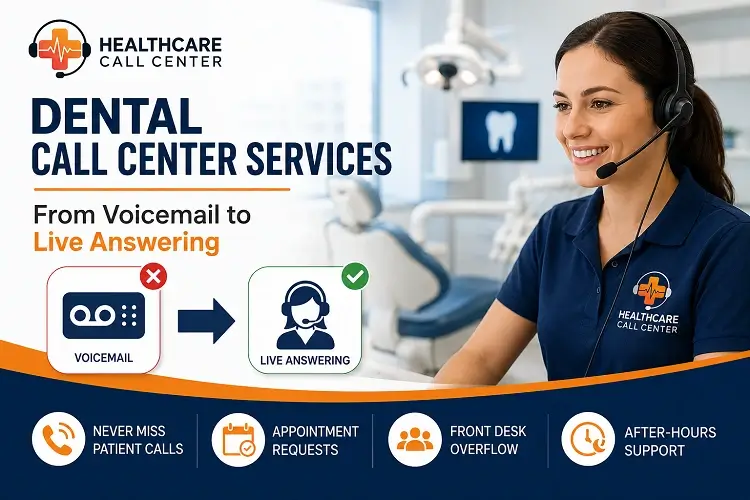
Dental practices do not lose patient trust only inside the operatory. They can lose it before a patient ever sits in the chair. A parent calling about a child with tooth pain, a working adult trying to book a crown consultation during lunch, or a new patient comparing offices after moving to the area is usually looking for one simple thing: a real person who can answer the phone, understand the request, and help them take the next step.
That is why 24-hour dental call center services are becoming more important for practices that still depend on voicemail, callbacks, or overloaded front desk teams. Voicemail may feel like a safety net, but patients do not always treat it that way. Many callers hang up, search for another dental office, or delay care because the first point of contact did not feel responsive. A dental answering service gives practices a more reliable way to answer live calls, capture appointment requests, route urgent messages, and support patient communication when the front desk is busy or the office is closed.
This article explains why dental practices are moving from voicemail to live answering, what dental call center services should actually include, and how to choose a support model that improves patient experience without making the practice feel impersonal.
Why voicemail is weak for dental patient calls
Voicemail works when a caller is patient, comfortable leaving details, and confident someone will respond quickly. Dental callers often do not fit that pattern. They may be anxious, in pain, price-shopping, embarrassed about a dental issue, or trying to coordinate a visit around work and school schedules. If they reach voicemail, the question is not just whether they leave a message. The bigger question is whether they still feel confident in the practice.
Dental care is personal. Patients want to know that someone heard them. A live answering experience can immediately acknowledge the concern, collect the right information, explain the next step, and help the caller feel that the practice is organized. Voicemail cannot reassure a patient. It cannot clarify whether the concern is urgent. It cannot capture a preferred appointment window. It cannot answer basic location or scheduling questions. It simply asks the patient to wait.
That delay matters most when the patient is new. Existing patients may leave a message because they already trust the office. New patients have no reason to wait if another dental office answers live. For practices investing in SEO, Google Ads, referrals, or local visibility, the call experience after the click is just as important as the traffic source itself.
Voicemail Vs Live Dental Call Answering
| Voicemail |
Live Dental Answering |
| Patient waits |
Patient speaks to a live person |
| Missed appointment requests |
Appointment requests captured |
| Limited information |
Structured intake |
| No urgency assessment |
Practice-approved escalation |
| No reassurance |
Immediate human interaction |
What Dental Call Center Services Should Include
A good dental call center service is not just a generic receptionist script with the word dental added. Dental callers have specific needs, and the answering process should reflect that. At minimum, dental call center services should support live call answering, new patient intake, appointment request capture, after-hours message handling, emergency routing, insurance question routing, and front desk overflow during busy hours.
The goal is not to replace the dental team. It is to make sure every patient call is acknowledged while giving in-office staff more time to focus on patients already in the practice. At the same time, it protects the front desk from call overload and helps ensure patients are not left waiting while staff assists patients in the office.
The best dental answering service for Texas or any city should also understand the difference between routine and time-sensitive requests. A chipped tooth, severe pain, swelling, post-procedure concern, or question after oral surgery needs a different workflow than a cleaning request. The call center does not diagnose, but it can follow practice-approved escalation rules so the right message reaches the right person.
A Quality Dental Call Center Should Include
- Live U.S.-based answering
- New patient intake
- Appointment request capture
- After-hours support
- Front desk overflow
- Emergency message routing
- Practice-specific scripts
- HIPAA-conscious workflows
- Follow guidelines of ADA (American Dental Association)
When Dental Practices Benefit Most from Live Answering
Live answering can improve several moments in the patient journey. The first is new patient acquisition. A caller who reaches a person is easier to convert into a scheduled visit than a caller who reaches voicemail. The second is front desk overflow. Dental front desks are asked to greet patients, verify details, collect forms, explain next steps, coordinate providers, and answer phones at the same time. During peak hours, even a strong team can miss calls.
The third moment is after-hours coverage. Dental concerns do not always happen between 9 and 5. A patient may call after work, over the weekend, or after a procedure. An after-hours dental answering service can capture the message and route urgent issues according to the practice’s protocol. The fourth moment is lunch breaks and staffing gaps. If the entire patient experience depends on one or two people being available at all times, missed calls become predictable.
Dental practices should think of live answering as capacity support. It gives the front desk more room to focus on patients already in the office while still protecting calls from patients trying to get in.
How Live Answering Supports SEO And Paid Traffic
Ranking for dental call center services, dental answering service, or call center for dentists is useful only if the practice can turn interest into conversations. The same principle applies to a dental office trying to rank locally for treatment terms. A search visitor who clicks, calls, and reaches voicemail may never become a patient. That makes call handling a conversion factor, even though it does not appear directly inside a keyword report.
For practices running Google Ads or investing in local SEO, every call should be treated like a conversion opportunity. Live answering helps protect that investment by making sure the call is acknowledged quickly. It also creates cleaner intake data for the practice. Instead of a voicemail that says, “Hi, call me back,” the team can receive a structured message with the caller’s reason, preferred time, and urgency.
How to Choose the Right Dental Answering Service
Before choosing a dental answering service, practice leaders should ask how the provider handles training, scripting, escalation, secure message delivery, appointment request capture, and after-hours workflows. The provider should be able to work from practice-approved instructions rather than improvising clinical answers. Dental answering should be empathetic, but it must also stay within safe boundaries.
Ask whether humans answer calls, whether the team can follow specialty-specific scripts, how urgent messages are identified, how messages are delivered, and how changes to scripts are managed. If the service will collect patient information, ask how patient privacy is protected and whether the workflow aligns with HIPAA-conscious communication standards. The right provider should make the practice feel more organized, not less in control.
Also ask how the service works during high-volume times. A practice may not need the same support all day. Some offices need help during lunch, early morning, late afternoon, evenings, weekends, campaign periods, or staff shortages. Flexible coverage matters because the goal is to support the practice’s real call patterns.
Signs Your Practice May Need a Dental Call Center
- Calls frequently go to voicemail
- Staff struggle during peak hours
- New patient calls are missed
- Patients complain about callbacks
- After-hours messages pile up
Why Dental Practices Choose Healthcare Call Center (HCC)
Healthcare Call Center (HCC) is a HIPAA-compliant medical call center that specializes in healthcare communication, helping dental practices answer patient calls, capture appointment requests, manage front desk overflow, and support after-hours communication with trained live agents.
The strongest use case is not simply answering every phone call. It is supporting the moments when the dental office is most vulnerable to missed opportunities: new patient calls, overflow during busy front desk hours, after-hours concerns, and appointment requests that need a fast response. When live answering is set up with the right scripts and escalation rules, it becomes an extension of the practice’s patient communication system.
Dental practices do not need more voicemail. They need a call experience that feels professional, calm, and responsive. That is the real reason more practices are switching from voicemail to live answering.
Ready to Improve Your Dental Patient Call Experience?
Missed calls can quickly become missed appointments and lost revenue. If your practice is struggling with voicemail, front desk overload, or after-hours patient calls, Healthcare Call Center can help.
Book a free consultation to see how our dental call center services can support your practice.
Final Takeaway For Practice Leaders
The right dental call center services strategy is not about adding another vendor for the sake of it. It is about protecting patient access at the exact moments when communication usually breaks down. Healthcare practices work hard to earn patient trust through clinical care, but that trust can weaken when callers cannot reach anyone, cannot explain what they need, or do not know what happens next.
A better call experience gives the practice more control. Patients reach a person. Messages arrive with context. Staff can focus on the patients in front of them. After-hours and overflow calls do not disappear into voicemail. The practice can create a calmer, more reliable communication system without asking the in-office team to do everything at once.
Frequently Asked Questions
What are dental call center services?
Dental call center services help dental practices answer patient calls, capture appointment requests, route urgent messages, support after-hours communication, and reduce front desk overload.
Is a dental answering service different from regular voicemail?
Yes. Voicemail records a message and makes the patient wait. A dental answering service gives callers a live human response, collects structured information, and routes messages based on the practice’s workflow.
Are dental call center services HIPAA compliant?
They can be, but it depends on the provider and how the service is managed. Dental practices should choose a call center that follows healthcare communication workflows, protects patient information, and uses practice-approved procedures for handling calls and messages.
Can a dental call center schedule appointments?
Some dental call center services can support appointment requests or scheduling workflows, depending on the practice’s systems and permissions. At minimum, they should capture preferred appointment times and call reasons clearly.
When should a dental practice use live answering?
Live answering is useful during office hours, lunch breaks, staff shortages, after-hours periods, weekends, and any time the front desk cannot reliably answer every call.
Does a dental answering service replace the front desk?
No. The best model supports the front desk by handling overflow, after-hours calls, and structured intake so in-office staff can focus on patients in the practice.
by Erika Sanchez | Jul 7, 2026 | After-Hours Call Answering Services, dentist call center services
Your dental practice has a problem that is costing you more than you realize. Patients are calling during lunch, after hours, while your front desk is chairside, and on weekends. And most of those calls are going to voicemail or worse, going unanswered entirely.
A dental answering service solves this problem by ensuring every patient call is answered by a trained, empathetic human who can book appointments, handle urgent calls, and capture new patient inquiries 24 hours a day, 7 days a week.
This blog explains everything you need to know about how a dental answering service works, what it costs, and how much revenue it recovers for your practice.
The Real Cost of Missed Dental Calls
Dental patients do not call during convenient hours. They call during their lunch break between 11 AM and 1 PM when your front desk is at peak capacity. They call after work between 5 PM and 8 PM when your office is closed. They call on weekends when dental emergencies happen, and scheduling decisions are made. And they call while your team is chairside, helping a patient in the operatory, and unable to pick up.
When those calls hit voicemail, 72% of callers hang up without leaving a message. Of those who hang up, roughly 60% call the next dentist on their Google search results. Many of them book with that competitor, and you never even knew the call happened.
Here is what that looks like in numbers. A typical dental practice receives 30 to 50 calls per day. The missed call rate ranges from 20% to 30%, meaning 10 to 15 calls go unanswered every week. Of those missed calls, approximately 4 to 6 are from new patients. With an average new patient lifetime value of $1,500 to $3,000, that represents $6,000 to $18,000 in lost revenue every month. Over the course of a year, you could be losing $72,000 to $216,000 simply because no one answered the phone.
You can plug your own practice numbers into a revenue calculator to see your exact gap and understand how quickly this adds up.
What a Dental Answering Service Actually Does
A specialized dental answering service is not a generic call center that takes messages. It is a trained team that handles dental-specific call flows designed to protect your practice’s revenue and improve patient experience.
When a new patient calls, the agent captures their name, insurance information, reason for visit, referral source, and preferred appointment times. Then they book the appointment directly in your scheduling system. No phone tag. No lost slots. Your calendar stays full and synced.
Agents also book, reschedule, and cancel appointments in real time. If a patient calls to move their Tuesday morning cleaning to Thursday afternoon, the agent handles it on the call. Your front desk walks in the next morning to an updated calendar instead of a pile of voicemail messages to return.
When a patient calls with a dental emergency like severe pain, a broken tooth, or facial swelling, the agent follows your specific escalation protocol to route the call to the right provider immediately. This is not a message taken and passed along hours later. This is real-time triage that protects your patient’s health and your practice’s reputation.
Agents also handle prescription and refill routing. Pharmacy callbacks and refill requests are captured accurately and routed to the right provider, freeing your front desk from administrative phone traffic during patient hours. Basic insurance questions can be handled using scripts you approve, capturing information for your billing team to follow up on.
And critically, your office closes at 5 or 6 PM, but your patients’ needs do not. A 24/7 dental answering service ensures every after-hours call is answered by a real human who can help, whether that means booking a Monday morning appointment for a weekend caller or connecting a patient with dental pain to your on-call dentist.
Why Dental Practices Need Specialized Answering
A generic answering service creates serious problems for dental practices. Most generic agents have no understanding of dental terminology. They confuse a crown with a cleaning, a root canal with a filling, or a periodontal deep cleaning with a routine prophylaxis. They have no triage skills, so every call becomes a message, even emergencies. They have no scheduling capability, meaning they take a name and number and your front desk plays phone tag the next morning. And they bring no empathy to the interaction. Anxious dental patients get a cold, scripted response and lose confidence in your practice.
A dental-specific answering service trains agents on dental specialties including general dentistry, orthodontics, oral surgery, periodontics, and endodontics. Agents understand common patient concerns like pain, swelling, broken teeth, post-operative questions, and sensitivity. They know insurance and financing terminology like PPO, HMO, in-network, out-of-network, and payment plans. They follow emergency triage protocols that you define. And they work within scheduling workflows specific to dental practices.
The Patient Experience: With vs Without
Consider what happens without an answering service. A patient calls at 6:30 PM on a Tuesday with throbbing tooth pain. The call goes to voicemail. The patient hangs up, opens Google, and calls the next dentist on the list. That dentist uses an answering service. A live agent picks up on the second ring, listens to the patient describe the pain, follows the practice’s emergency protocol, and books a same-day or next-morning appointment.
The patient arrives for treatment and becomes a long-term patient of that practice. You lost a patient worth $2,000 to $5,000 in lifetime value and never knew the call happened.
Now consider the same scenario with a dental answering service in place. The patient calls at 6:30 PM. A trained agent answers on ring two. The agent follows your emergency protocol and either connects the patient to your on-call dentist or books an emergency appointment for the next morning.
The patient feels cared for from the first ring. They arrive for treatment, refer their family, and leave a five-star review. Revenue captured: $400 to $3,000 or more, depending on the treatment needed.
How a Dental Answering Service Boosts Your SEO
Here is something most dentists do not think about. An answering service directly supports your local SEO strategy.
Google ranks dental practices based on several factors that are influenced by how you handle phone calls. Your Google Business Profile engagement matters. When more calls are answered rather than missed, your profile shows higher activity signals. Patient reviews are critical. Happy patients who reach a human leave positive reviews. Frustrated patients who hit voicemail do not leave reviews, or worse, they leave negative ones.
Website traffic signals also play a role. When agents direct callers to your website for forms, directions, or online scheduling, it creates engagement signals that Google interprets as a sign of a healthy, active practice. And NAP consistency, meaning your practice name, address, and phone number, is maintained consistently across every interaction.
A practice that answers every call generates more reviews, more profile engagement, and more website visits. All of these feed directly into local search rankings. This is why investing in a healthcare answering service is not just an operational decision. It is a marketing and SEO investment that compounds over time.
Dental Answering Service Pricing
Most dental answering services charge using one of three models. Per-call pricing typically ranges from $0.75 to $1.50 per call and works best for practices with low call volume but high-value calls. Per-minute pricing ranges from $0.75 to $1.25 per minute and suits practices with short, straightforward calls like prescription refills and appointment confirmations. Flat monthly pricing ranges from $200 to $800 per month and provides predictable budgeting without surprises.
When comparing costs, always factor in the revenue recovery. Suppose the service costs $500 per month but captures just 5 new patients worth $1,500 each; the return on investment is $7,000 per month. That is a 14x return. The question is never whether you can afford an answering service. The question is whether you can afford to keep losing patients without one.
Questions to Ask Before Choosing
Before you choose a dental answering service, ask whether they have agents trained specifically in dental call handling. Ask whether they can integrate with your scheduling software, whether that is Dentrix, Eaglesoft, Open Dental, or another platform.
Ask if they will follow your emergency triage protocols and whether they are fully HIPAA-compliant with a signed BAA. Find out their average answer speed. Ask to see a dashboard that shows calls, bookings, and outcomes. Confirm they handle after-hours and weekend coverage. And make sure they understand dentistry, not just phone answering.
If the answer to any of these questions is no, keep looking. Your dental practice deserves a partner who understands the difference between a routine cleaning and a dental emergency.
The Bottom Line
Every dental practice loses patients to missed calls. The question is not whether it is happening. The question is how much revenue you are willing to let walk away before you fix it.
A 24/7 medical answering service staffed by trained, empathetic humans is the simplest, highest-ROI investment a dental practice can make. It captures revenue that is currently disappearing into voicemail. It improves patient satisfaction by ensuring every caller reaches a real person. It supports your local SEO by generating more reviews and more engagement signals. And it lets your front desk team focus on the patients in the office instead of the phone that keeps ringing.
If you are ready to see exactly how many patients your dental practice is losing to missed calls, book a free consultation with Healthcare Call Center and get a custom call audit in 48 hours.
by Erika Sanchez | Jun 30, 2026 | dentist call center services
When a dental patient calls your office and hears a voicemail greeting, what do they do next?
Most practice owners assume the patient leaves a message and waits for a callback. That is rarely what happens.
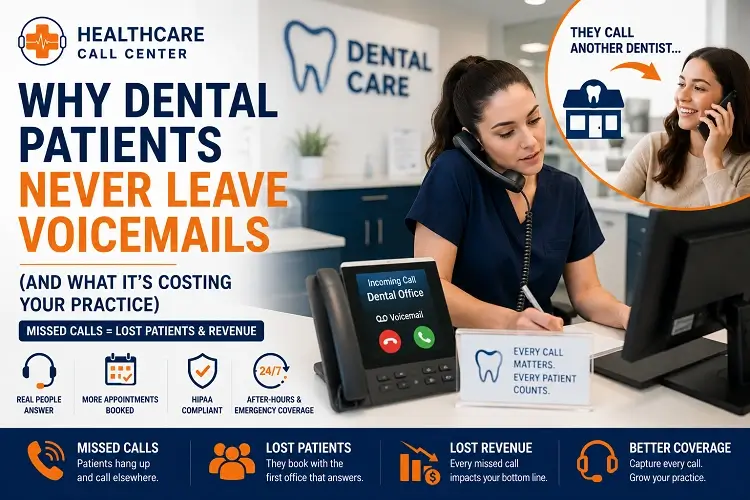
According to multiple studies on consumer call behavior, up to 80% of callers who reach voicemail hang up without leaving a message. For dental practices, that statistic is even more painful because a missed call often represents a patient ready to book treatment.
They do not wait. They do not leave a message. They call the next dentist on Google Maps.
If your front desk is busy at lunch or off the clock, those calls are going to voicemail. And those patients are going somewhere else.
This blog explains why dental patients do not leave voicemails, how much revenue each missed call costs your practice, and what you can do to stop losing patients to the office down the street. This is where a 24/7 dental answering service comes in to bring your revenue back.
The Problem with Voicemail in Dental Practices
Most dental practices are not intentionally ignoring calls. The front desk is handling check-ins, insurance verification, treatment plan discussions, payments, and patient questions all at the same time. When two calls come in at once, one goes to voicemail.
After hours, the situation is worse. If your office closes at 5 PM and a patient calls at 5:47 PM because they cracked a tooth while eating dinner, that call goes to voicemail. That patient is in pain. They are not going to wait until morning.
They are going to call the next dental office that answers.
Here is the hard truth: voicemail does not capture new patients. It captures messages from existing patients who already trust you. New patients, referrals, and high-value treatment inquiries rarely leave voicemails because they have no loyalty to your practice yet.
What a missed dental call actually costs
Let us break down the math for a typical dental practice.
If your office misses 5 calls per day (a conservative estimate for a busy practice), that is 25 missed calls per week or about 100 per month.
If even 15% of those calls were new patient inquiries with treatment plans averaging $1,500 to $3,000, you are looking at $22,500 to $45,000 in potential revenue walking out the door every month.
Now consider after-hours calls. If 40% of patient calls come in before 8 AM or after 5 PM, and your office is closed, those calls hit voicemail every single time.
That is not a front desk problem. That is a coverage problem.
5 Reasons Dental Patients Will Not Leave a Voicemail
1. They are comparing offices
When a patient searches “dentist near me” on Google, they typically call 2 to 3 offices before choosing one. If you do not answer, they move to the next result. They are not invested in your practice yet. Voicemail feels like a dead end to someone comparison shopping.
2. They are in pain or anxious
Dental callers often have a specific problem. A cracked crown. A child with a toothache. A sudden tooth sensitivity that scares them. When someone is anxious or in pain, hearing a recorded message does not feel reassuring. They want to hear a human voice that says, “We can help you.”
3. They expect immediate answers
Patients today are used to instant responses from food delivery apps, retail stores, and service providers. When they call a dental office and get voicemail, their expectation shifts. If your office cannot answer the phone, they wonder how responsive you will be as their healthcare provider.
4. They assume you are too busy
A ringing phone that goes to voicemail sends a signal. Whether it is accurate or not, the patient thinks, “This office is too busy for me.” For a new patient evaluating where to spend their healthcare dollars, that perception matters.
5. They have already been told to call elsewhere
Many dental insurance directories list multiple in-network providers. If the first office does not answer, the patient simply calls the next provider on the list. Your competitor answers, books the appointment, and you never even knew the patient called.
What a Dental Answering Service Actually Does
A dental answering service is not just a call center that takes messages. It is a dedicated layer of call coverage designed specifically for dental practices.
Here is what that looks like in practice.
Answers every call, every time
When your front desk is checking in a patient and two calls come in at once, the answering service picks up immediately. No busy signal. No voicemail. The patient hears a friendly, professional voice and gets the help they need.
Captures new patient inquiries
When a new patient calls after hours to ask about Invisalign, implants, or a second opinion, the answering service captures their name, contact details, reason for calling, and insurance information. Your front desk gets the lead first thing in the morning, ready to follow up.
Handles after-hours emergencies
When a patient calls at 9 PM with a dental emergency, the answering service follows your protocol. They document the issue, reassure the patient, and route the call to your on-call dentist if needed. The patient feels cared for. Your practice protects its reputation.
Supports overflow during busy periods
During peak hours, lunch breaks, staff meetings, or hygiene checks, the answering service handles the overflow. Your in-office team can focus on the patient standing in front of them without feeling guilty about the phone ringing in the background.
Why a Generic Answering Service Does Not Work for Dental Offices
You might be thinking, “Can I just use any answering service?”
The short answer is no. Here is why.
Dental calls are different from generic business calls. Patients ask specific questions about insurance networks, treatment costs, appointment availability, post-op care, and dental anxiety. A generic answering service operator reading a script cannot handle these questions with confidence.
A specialized dental call center understands:
- Dental terminology (crowns, bridges, implants, root canals, perio charting)
- Insurance concepts (PPO, in-network, deductibles, annual maximums)
- Appointment urgency (a broken tooth is not the same as a routine cleaning)
- Patient anxiety and empathy (many dental callers are nervous)
- HIPAA-compliant information handling
When a patient calls your dental office, they should feel like they reached your team. Not a call center. Not a robot. A real person who knows what they are talking about.
How to Choose the Right Answering Service for Your Dental Practice
If you are considering an answering service for your dental practice, here are the key questions to ask.
Do they understand dental workflows?
Ask whether their agents are trained on dental-specific call flows. Can they handle new patient intake? Do they understand the difference between a hygiene recall and an emergency? Do they know what to ask when a patient calls about a broken crown?
Is it HIPAA-compliant?
Any service handling patient calls, insurance details, or appointment information must be HIPAA-compliant. Ask about their training, their data handling, and whether they sign Business Associate Agreements.
Can they follow your custom protocols?
Every dental practice handles calls differently. Some want emergencies routed to a cell phone. Others want all messages sent by email before 8 AM. Your answering service should build the workflow around your preferences, not force you into a rigid script.
Do they offer 24/7 coverage?
Dental patients call at all hours. Before work, after dinner, on weekends. If your answering service only covers business hours, you are still missing calls. Look for true 24/7 coverage, including weekends and holidays.
Are the agents real people?
Some services use AI bots or automated systems to handle calls. For dental patients, who are often anxious or in pain, talking to a robot makes the experience worse. Look for a service where real humans answer every call.
What Happens When You Stop Missing Dental Calls
When every call gets answered, three things change quickly.
- New patient numbers go up. You capture the callers who were previously going to voicemail and moving on. Even capturing 5 extra new patients per month at an average of $1,500 per treatment plan adds $7,500 in monthly revenue.
- Front desk stress goes down. Your team is no longer torn between the patient at the desk and the phone ringing. They can focus on in-office patient care knowing the phones are covered.
- Online reviews improve. Patients who reach a helpful, friendly person on the first call are more likely to leave positive reviews. Patients who hit voicemail are more likely to leave frustrated feedback or no review at all.
The Bottom Line for Dental Practices
Every missed call is a patient who wanted your help and did not get it.
Some of those patients are new. Some are existing patients with emergencies. Some are referrals from other patients who trust you.
When those calls go to voicemail, you lose the patient, the revenue, and the relationship.
A dental call center that answers every call with empathy, captures every inquiry, and follows your protocols is one of the most cost-effective ways to grow a dental practice without adding more front desk staff.
If your office is missing calls, the question is not whether you can afford an answering service. The question is: how many patients are you losing this week because nobody picked up the phone?
We will tell you how many patients you are losing monthly.
Frequently Asked Questions
How much does a dental answering service cost?
Pricing depends on call volume, coverage hours, and the complexity of your call workflow. Most dental practices find that recovering even 2 to 3 missed new patient calls per month covers the entire cost of the service.
Will patients know they are talking to an answering service?
No. A quality dental answering service answers with your practice name and follows your scripts. The goal is to feel like a seamless extension of your front desk.
Can the answering service schedule appointments directly?
Yes, depending on your setup. Some practices prefer the answering service to capture inquiry details and let the front desk call back. Others connect the service directly to their scheduling software for real-time booking.
What about after-hours dental emergencies?
Your answering service follows your emergency protocol. They document the issue, reassure the patient, and contact your on-call provider based on the rules you set. Patients get immediate help. You get documented, organized information.