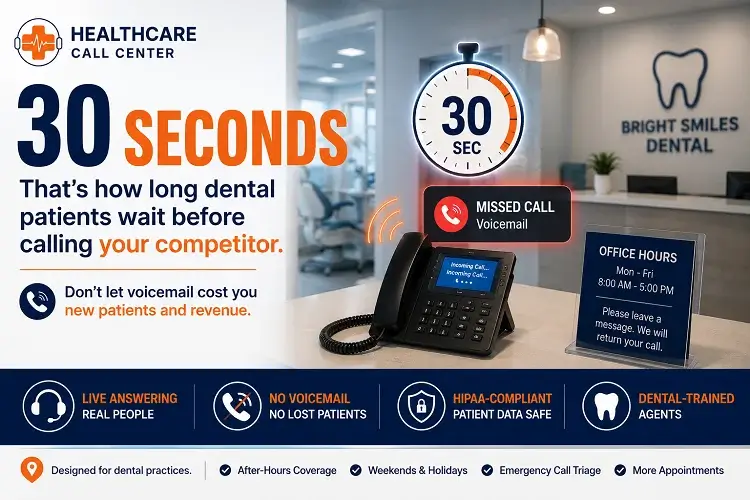
You have about 30 seconds. That is how long a dental patient will stay on the line after hearing your voicemail greeting before they hang up and call the next practice on Google.
Most dental practice owners think voicemail is a reasonable backup. They record a professional greeting, mention their office hours, and ask patients to leave a name and number. They assume patients will wait for a callback the next morning.
They will not. And the data proves it.
The 30-Second Drop-Off
According to guidance from the American Dental Association (ADA), when a dental patient calls and hears a voicemail greeting, their behavior follows a remarkably consistent pattern. Within the first 5 seconds, they process that nobody is going to answer. By the second 10, they start scanning Google for another dentist. By the second 20, they have already tapped the next phone number on the search results. By the second 30, the call is over, and you have lost them.
This is not speculation. Patient communication research consistently shows that the vast majority of callers who reach voicemail will not leave a message. They hang up. The reasons are simple and human:
Patients in pain do not want to describe their symptoms to a machine. A cracked tooth, a swollen jaw, or a child crying from a toothache creates urgency. That urgency demands a human response, not a recorded greeting asking them to speak after the beep.
Patients comparing providers move fast. When someone searches ‘dentist near me’ and gets three results, they call all three in sequence. The first practice that answers wins. If your voicemail greeting is still playing when they are already dialing your competitor, you have already lost.
Patients assume nobody will call back. In an era where people expect instant responses from food delivery apps, rideshare drivers, and customer service chatbots, the idea of waiting 12 to 14 hours for a dental office to return a call feels archaic. Patients do not trust that the callback will happen, so they do not even bother leaving a message.
Why Your Dental Voicemail Greeting Makes Things Worse
Here is something most practice owners do not realize. A long voicemail greeting actually increases the chance that the patient hangs up before the beep.
Think about your current voicemail greeting.
How long is it?
If it includes your office hours, your address, a reminder to call 911 for emergencies, instructions for prescription refills, and a request to leave a detailed message, it is probably 30 to 15 seconds long. That is 30 to 15 seconds of a patient listening to information they did not call about while their tooth throbs.
Every additional second your greeting runs, the more likely the patient is to hang up. They called to talk to a person. Instead, they got a monologue. So they leave.
Even worse, many dental practices use generic voicemail greetings that sound clinical and cold. ‘You have reached the office of Dr. Smith. Our hours are Monday through Thursday, 8 AM to 5 PM. If this is an emergency, please hang up and dial 911.’ That greeting tells the patient two things: nobody is available, and their problem is not important enough to interrupt the dentist’s evening.
The patient’s reaction is immediate. They hang up, go back to Google, and call the next result. Your competitor answers. Your competitor books the appointment. Your competitor earns a new patient who could have been yours.
What Happens in the First 30 Seconds of a Live Answer
Now imagine the same patient calls, and instead of voicemail, a warm voice picks up on the second ring.
“Thank you for calling Bright Dental. This is Sarah. How can I help you today?”
In those first 5 seconds, the patient feels relief. A real person is on the line. Their problem matters. Someone is listening.
By the second 10, the patient is explaining their situation. A cracked molar from chewing ice. A child who fell on the playground. A crown that came loose during dinner. The agent listens, asks a clarifying question, and shows genuine concern.
By the second 20, the agent is already moving toward a solution. ‘I understand how uncomfortable that must be. Let me check what availability we have this afternoon.
Can you come in at 3 PM?’
By the second 30, the appointment is booked. The patient is off the phone, relieved, and confident that their problem is being handled. They are not calling any other practice. They are yours.
This is the 30-second window in action. The difference between voicemail and live answer is not incremental. It is the difference between losing a patient forever and gaining one for life.
The Revenue Cost of Missed Dental Calls
Let us put real numbers on this. Say your dental practice misses 10 after-hours calls per week. That is a conservative number for most offices.
If each new dental patient is worth $1,500 on average (exam, X-rays, cleaning, and one restoration), and 5 of those 10 missed calls are new patient inquiries, you are losing $7,500 per week in potential revenue.
This is exactly how missed patient calls quietly drain practice revenue. All because nobody answered within the 30-second window.
Now compare that to the cost of a dental answering service. A 24/7 HIPAA-compliant dental answering service that captures every after-hours call costs a fraction of what you are losing to voicemail. The return on investment is not theoretical. It is measurable from the first week.
Why Weekend Calls Matter Even More
If you think weekday evenings are bad, look at your weekends. Most dental offices are closed Saturday and Sunday. That means every single patient call on a Saturday or Sunday goes to voicemail.
This is especially true for large, competitive markets like Texas and California, where patients often call multiple practices before booking. Nobody calls a dentist on a Saturday afternoon for a routine cleaning reminder. They call because something hurts, something broke, or something fell out. These are high-intent, high-value patients who are ready to book immediately.
When they get voicemail on a Saturday, they do not wait until Monday. They call an emergency dental clinic or an urgent care dentist who is open on weekends. Or they call the next practice on Google that promises 24/7 availability. Either way, you lose the patient and the revenue.
A 24/7 medical answering service solves the weekend problem completely. Every Saturday and Sunday, the call gets a live answer. Every weekend, emergencies get triaged and either booked or routed to your on-call dentist. No patient is left listening to a voicemail greeting while they are in pain.
What to Look for in a Dental Answering Service
If you are going to fix the 30-second problem, you need the right partner. Here is what matters:
Speed of answer. The service should answer within the first few rings. Not 5 minutes. Not after a queue. Immediately. The whole point is winning the 30-second window.
Dental-specific training. Generic answering services do not understand dental emergencies, insurance terminology, or the difference between a routine cleaning question and a genuine urgent situation. Your service should train agents specifically on dental patient communication.
HIPAA compliance. Patient information must be handled with strict security protocols. Signed Business Associate Agreements, encrypted systems, and trained staff are non-negotiable.
Direct scheduling. The service should integrate with your practice management software so appointments are booked in real time. No message pads, no transcriptions, no delays.
Custom escalation. Your practice handles emergencies differently from every other practice. The service should follow your exact protocol for when to call the on-call dentist, when to book a next-day appointment, and when to direct patients elsewhere.
Setup takes up to 2 weeks with the right partner. That includes call flow configuration, agent training, system integration, and testing before you go live.
The Bottom Line: 30 Seconds Can Cost You a Patient
Every time a dental patient hears your voicemail, you have about 30 seconds before they are gone forever. They will not leave a message. They will not wait for a callback. They will call your competitor, and your competitor will answer.
The practices that are growing right now are not the ones with the best location or the newest equipment. They are the ones that answer every call with a live person, every time, day or night. They understand that the 30-second window is the difference between a booked appointment and an empty chair.
If your dental practice is still sending after-hours calls to voicemail, you are losing patients every single night. A dental answering service fixes that. Permanently.
Book a free practice audit today. We will show you exactly how many calls you are missing and build a plan to capture them.
Book Your Free 15-Minute Practice Audit
Stop losing dental patients to voicemail. See how many after-hours calls your practice is missing and get a custom recovery plan.
Book An Free Appointment
Frequently Asked Questions
Q: How quickly should a dental practice answer patient calls?
A: Research shows patients expect an answer within the first few rings. After 30 seconds on hold or listening to voicemail, the majority hang up and call another practice. Speed of answer is the single biggest factor in converting phone inquiries into booked appointments.
Q: Will patients leave a voicemail if nobody answers?
A: Most will not. Studies show that the majority of callers who reach voicemail hang up without leaving a message, especially when they are in pain or comparing providers. They simply move on to the next practice that answers.
Q: Can a dental answering service handle weekend emergencies?
A: Yes. A 24/7 dental answering service answers every weekend call with a live agent. Urgent calls are routed to your on-call dentist. Non-urgent calls are scheduled for the next available appointment.
Q: Is a dental answering service HIPAA compliant?
A: A reputable dental answering service is fully HIPAA compliant with signed Business Associate Agreements, encrypted systems, and agents trained on patient privacy protocols.
Q: How long does it take to set up a dental answering service?
A: Setup takes up to 2 weeks. This includes configuring your call flows, training agents on your practice protocols, integrating with your scheduling system, and testing before going live.
Q: Do dental patients prefer talking to a live person?
A: Absolutely. Dental patients who call with pain, anxiety, or urgent questions want immediate reassurance from a real human. A recorded voicemail greeting makes them feel ignored, while a live answer builds trust from the first second.