Patients do not stop calling when the front desk closes. They call after work, on weekends, during holidays, when symptoms feel urgent, when they need to cancel or reschedule, and when they are finally ready to book an appointment but cannot reach a real person.
For medical offices, those after-hours calls can quickly turn into voicemail backlogs, missed appointment opportunities, unclear urgent messages, frustrated patients, and extra pressure on the front desk the next morning.
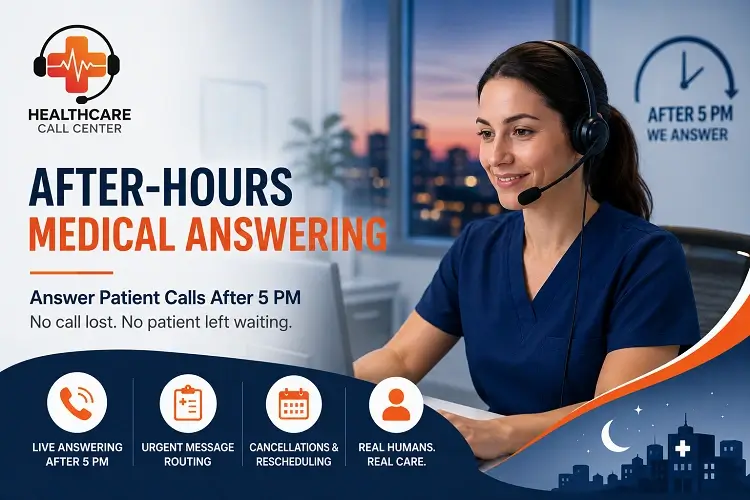
An after-hours medical answering service helps practices answer patient calls after 5 PM, collect the right details, route urgent messages based on practice-approved rules, and organize routine requests for follow-up.
If your practice is missing patient calls after hours, book a free consultation to review your call flow, after-hours coverage, missed-call risk, and patient scheduling needs.
Why After-Hours Patient Calls Matter for Medical Offices
After-hours calls matter because they often come from patients who are already worried, busy, or ready to take action. Some patients cannot call during normal business hours because of work, childcare, transportation, or caregiver responsibilities. Others call in the evening because a symptom changed, a medication question came up, or they need to know whether a message should wait until morning.
When those calls go to voicemail, the patient experience becomes uncertain. The caller may wonder whether anyone received the message, when they will hear back, or whether they should look for help somewhere else. For a medical practice, that delay can affect patient confidence, scheduling efficiency, and the workload waiting for the team the next day.
A dedicated after-hours medical answering service gives the practice a cleaner process for handling calls that come in after the office closes.
How After-Hours Answering Helps Route Urgent Patient Messages
One of the most important reasons to improve after-hours coverage is message routing. Patients may call about symptoms, post-procedure questions, medication concerns, test-related questions, or other situations that feel urgent to them.
A trained answering team should not diagnose, give medical advice, or replace a licensed clinician. Instead, agents collect the caller’s information, follow the practice’s approved script, and route urgent messages according to the provider’s escalation rules. Non-urgent messages can be documented clearly for review during business hours.
This gives the practice a safer and more consistent process than an unmanaged voicemail box. It also helps patients feel heard instead of abandoned after the front desk closes.
For practices that need coverage that follows privacy-aware procedures, our HIPAA-compliant medical answering service page explains how healthcare call workflows should be handled.
After-Hours Calls Often Include Cancellations, Reschedules, and Appointment Requests
Not every after-hours call is urgent. Many calls are operational. Patients call after hours to cancel, reschedule, ask about appointment times, request a callback, or leave details for the office team.
If those messages sit in voicemail until morning, the practice may start the day with avoidable scheduling problems. A Monday morning cancellation left on Sunday night can turn into an empty slot. A new patient inquiry left unanswered can become a lost opportunity if the patient contacts another provider first.
This is where a
This is where a medical answering service can support the front desk by capturing details, documenting the reason for the call, and helping the team follow up more efficiently.
The Human and Financial Cost of Missed After-Hours Patient Calls
A missed after-hours call is not always just one missed message. It can create a chain reaction.
A patient with a concern may feel ignored. A cancellation may not be seen until the appointment slot is already wasted. A new patient may keep searching and call another practice. A caregiver may leave an incomplete voicemail that forces the front desk to make multiple follow-up calls the next morning.
Here is a simple way to think about it: if a practice receives 20 after-hours calls per week and even 30% are delayed, missed, or poorly documented, that is 6 calls per week at risk. Over a month, that becomes 24 patient calls that could have been handled more clearly.
Some of those calls may be routine. Some may involve appointments. Some may involve patient concerns. The operational value comes from having a consistent system so the practice knows what came in, who needs follow-up, and which messages require faster routing.
If response time is already a concern, use the patient lead response time calculator to estimate how delays may affect patient inquiry follow-up.
In-House After-Hours Coverage vs. an Outsourced Medical Answering Service
Some practices try to manage after-hours calls internally. That can work for small call volumes, but it often creates staffing pressure, on-call fatigue, inconsistent documentation, and unclear escalation habits. Outsourcing can give the practice a more structured model without asking the in-office team to remain available at all hours.
An in-house approach also means the practice depends on one or two people. If they are sick, on vacation, or simply unavailable, coverage breaks. A service provides redundancy so calls are always answered, regardless of individual staff availability.
For practices with high daytime call volume, pairing after-hours coverage with
For practices with high daytime call volume, pairing after-hours coverage with front desk overflow support can reduce pressure during both shifts.
Why Medical Offices Outsource After-Hours Call Answering
Medical offices outsource after-hours call answering because patient access expectations have changed while staffing remains difficult. Patients expect faster responses. Front-desk teams are already busy during the day. Providers do not want every routine call interrupting them after hours, but they also do not want important messages buried in voicemail.
A healthcare-focused answering team can help bridge that gap. The goal is not to replace the practice team. The goal is to support the practice’s call flow when the office is closed, busy, or unavailable.
For practices that need broader coverage, a medical virtual receptionist can handle both daytime overflow and after-hours patient communication.
What a Good After-Hours Medical Answering Service Should Include
A good after-hours medical answering service should include more than basic message-taking. Medical practices should look for a system that can support both patient experience and office workflow.
- Live answer of every call, no voicemail trees
- Practice-specific greeting and scripts
- Urgent message routing based on provider escalation rules
- Non-urgent message documentation for next-day follow-up
- Appointment request capture (cancellations, reschedules, new bookings)
- HIPAA-conscious message handling and documentation
- Secure message delivery to the practice
- Call documentation and reporting for review
- Coverage for evenings, weekends, holidays, and lunch breaks
- Scalable support for single-location and multi-location practices
Practices should also ask about reporting. A good provider will share call summaries, response times, and message accuracy metrics so the practice can evaluate performance over time. This data helps identify patterns such as recurring patient questions, peak after-hours call times, and opportunities to improve front-desk workflows during the day.
The onboarding process matters as much as the features. A strong provider will spend time learning the practice’s greeting, common patient questions, provider preferences, escalation paths, and message delivery format before going live. Without this setup, even a feature-rich service can create confusion for patients and staff.
How After-Hours Call Coverage Improves the Patient Experience
Patients often remember how a practice responds when they are anxious, confused, or trying to get help outside normal hours. A live answer can provide reassurance even when the final follow-up happens the next business day.
Good after-hours coverage helps patients understand that their message was received, their details were captured, and the practice has a process for routing calls. That experience feels very different from leaving a voicemail and hoping someone hears it later.
For practices that depend on trust, reviews, referrals, and repeat appointments, the after-hours experience can influence how patients feel about the entire office.
The after-hours experience also affects online reviews. Patients who feel ignored after hours are more likely to share negative feedback. Patients who feel supported are more likely to leave positive reviews and recommend the practice to others.
Patients who reach a live person after hours are more likely to feel that the practice values their time. This is especially true for new patients who are comparing providers. If a prospective patient calls three practices after work and only one answers, that practice has a significant advantage in winning the appointment.
Practices in competitive local markets may also need a medical answering service in Florida to cover after-hours calls, overflow, and appointment requests.
Operational Benefits for Medical Practices
After-hours answering can also improve the next business day. Instead of starting the morning with a long voicemail queue, the team can receive organized call notes and understand which patients need follow-up first.
This helps reduce front-desk pressure, especially for practices that already deal with appointment calls, insurance questions, patient callbacks, referrals, and new patient inquiries during business hours.
For specialty practices, after-hours coverage also protects high-value appointment slots. A fertility clinic patient calling about a treatment question, a plastic surgery patient with a post-procedure concern, or a dental patient in pain all benefit from reaching a live person instead of voicemail.
See how specialty call support works with our 24/7 medical call center coverage.
Voicemail vs. Live After-Hours Answering (Comparison Table)
Many practices still rely on voicemail after hours. Voicemail may be simple, but it often creates delays and incomplete information.
Live answering gives the practice a more organized way to capture and route patient calls.
| Situation | Voicemail Only | Live After-Hours Answering |
| New patient calls after 5 PM | Voicemail. Patient may call competitor. | Live answer. Patient details captured. |
| Existing patient rescheduling | Waits until next business day. | Call answered. Request documented. |
| Urgent but non-emergency question | Voicemail, callback next day. | Message routed per practice urgency rules. |
| Weekend appointment inquiry | Not handled until Monday. | Call answered. Patient gets response path. |
| Patient calling from a referral | May not leave a message. | Live answer increases trust and captures lead. |
| Incomplete or unclear message | Front desk must call back to clarify. | Agent asks clarifying questions in real time. |
How to Choose the Right After-Hours Medical Answering Service
Before choosing a provider, medical offices should make sure the service understands healthcare workflows and can match the practice’s call-handling requirements.
- Does the team have healthcare call experience?
- Will they follow practice-specific scripts?
- Can they route urgent calls based on your escalation instructions?
- Do they use HIPAA-conscious procedures?
- Can they capture appointment requests?
- Do they offer both after-hours and daytime overflow coverage?
- Is there a review period to fine-tune scripts and call handling?
- Can the service scale as the practice grows?
Finally, ask about trial periods or review windows. A provider that is confident in its service should offer a way to evaluate call quality, message accuracy, and patient experience before committing to a long-term agreement.
It is also worth asking how the provider handles message delivery. Some practices prefer text or email delivery, while others want messages integrated into their practice management system. The provider should be able to match the practice’s preferred workflow rather than forcing a one-size-fits-all approach.
After-Hours Calls Should Not Become Morning Voicemail Backlogs
After-hours calls are part of the patient experience. They can include urgent concerns, routine questions, cancellations, reschedules, new patient inquiries, and messages that need clear follow-up.
When those calls are left unmanaged, the practice starts the next day behind. When they are answered and documented properly, the team has a clearer picture of what happened after hours and what needs attention next.
If your medical office is relying on voicemail after 5 PM, book a free consultation to review where patient calls may be slipping through and how after-hours call coverage can support your front desk.
Frequently Asked Questions
What is an after-hours medical answering service?
An after-hours medical answering service answers patient calls when a medical office is closed or unavailable. It can collect caller details, follow practice-approved scripts, route urgent messages, document non-urgent calls, and support appointment-related requests.
Why do medical offices need after-hours answering?
Medical offices need after-hours answering because patients often call after work, on weekends, or outside normal office hours with scheduling needs, symptoms, cancellations, and follow-up questions. Live answering helps reduce voicemail gaps and improves patient access.
How are urgent after-hours calls handled?
An after-hours answering service can collect details and route urgent messages according to the practice’s approved escalation rules. Agents should not diagnose or provide medical advice unless the service includes licensed clinical triage.
Can the service capture appointment requests after hours?
Yes. Depending on the practice workflow, agents can document appointment requests, cancellation notices, rescheduling needs, and callback details so the office can follow up clearly.
Is an after-hours answering service HIPAA compliant?
A healthcare answering service should use HIPAA-conscious workflows for patient information, secure message handling, access controls, and practice-approved routing. Practices should confirm compliance requirements before launch.
What should I look for when choosing an after-hours medical answering service?
Look for healthcare experience, custom scripts, secure message routing, escalation workflows, appointment request support, weekend coverage, reporting, and a setup process that matches your practice’s call flow.