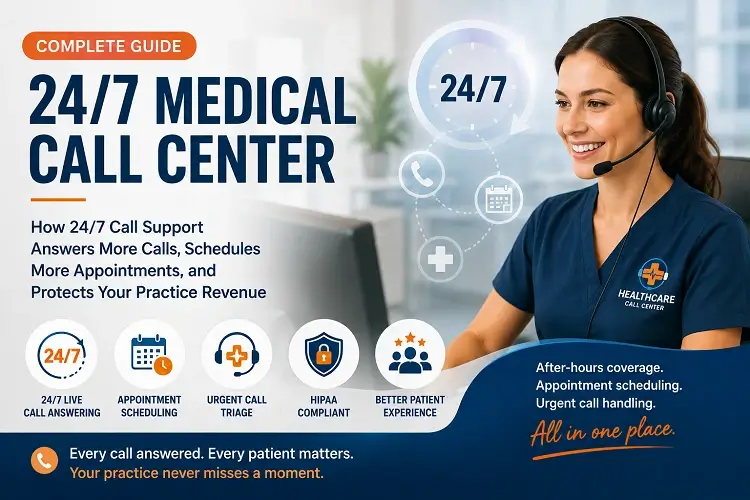
Every missed patient call costs your practice money. When a patient calls after hours and reaches voicemail, they do not leave a message. They call the next provider on the list. A 24/7 medical call center makes sure every call is answered by a trained professional who can schedule appointments, handle urgent inquiries, and protect your revenue around the clock.
Healthcare Call Center provides medical call center services designed for medical practices that cannot afford to miss calls. This guide breaks down what a 24/7 medical call center does, why it matters, and how it transforms patient communication for practices of every size.
What Is a 24/7 Medical Call Center?
A 24/7 medical call center is a dedicated communication service that answers patient calls for healthcare practices at all hours, including nights, weekends, and holidays. Unlike a basic answering service that simply takes messages, a medical call center staffed by trained agents can schedule appointments, triage urgent calls, answer patient questions, and route critical situations to the right provider.
The difference between a standard answering service and a medical call center comes down to training and capability. Medical call center agents understand healthcare workflows. They know how to handle sensitive patient information, follow HIPAA guidelines, and provide the kind of empathetic communication that patients expect from their healthcare providers.
Think of it as an extension of your front desk, one that never clocks out. When your in-house staff goes home, the call center takes over seamlessly. Patients hear a live, knowledgeable voice representing your practice, not a recording asking them to leave a message that might not be returned until the next business day.
Why Your Practice Needs 24/7 Call Coverage
Patient calls do not follow business hours. They come in during lunch breaks, after work, on weekends, and in the middle of the night. If your front desk closes at 5 PM, every call after that goes to voicemail or, worse, to a competitor who answers.
- Consider what happens when calls go unanswered:
- New patients needing immediate appointments call the next available provider
- Referrals from other physicians go unanswered after hours
- Patients with urgent post-procedure questions turn to emergency rooms unnecessarily
- Schedule gaps appear when cancellation calls are not captured in real time
- Existing patients frustrated by voicemail start researching other providers
A 24/7 medical answering service eliminates these gaps. Every call gets answered. Every patient gets directed to the right resource. Every revenue opportunity gets captured, whether it arrives at noon or midnight.
Key Benefits of a 24/7 Medical Call Center
1. Capture Every Revenue Opportunity
New patient calls are the most valuable calls your practice receives. Each one represents a potential long-term patient with recurring revenue over months or years. When those calls go to voicemail after hours, the patient moves on. A 24/7 call center ensures that every new patient inquiry is answered and converted into a booked appointment, maximizing your patient acquisition without adding internal staff.
Consider the math: if your practice misses just two new patient calls per week after hours, and each patient represents an average of $800 in lifetime value, that is over $80,000 in lost revenue every year. A [medical call center](https://healthcarecallcenter.com/medical-answering-service/) captures those calls for a fraction of what they are worth.
2. Reduce No-Shows and Same-Day Cancellations
When patients need to cancel or reschedule, they often call outside business hours. If no one answers, they either skip the appointment entirely or leave a message that staff does not process until the next day. By then, the schedule gap is already lost. A 24/7 call center captures cancellations in real time, giving your team the opportunity to fill the slot from a waitlist or standby patients who want earlier appointments.
3. Improve Patient Satisfaction and Retention
Patients expect accessibility from their healthcare providers. When they call with a question or concern and reach a live, knowledgeable person instead of a recording, their confidence in your practice grows. That confidence translates into loyalty, positive online reviews, and referrals to friends and family members who are looking for a provider who actually picks up the phone.
4. After-Hours Coverage Without Staffing Overhead
Hiring additional front desk staff for evening and weekend coverage is expensive. Between salaries, benefits, training, and management overhead, the cost quickly outweighs the value for most practices. A medical answering service provides full after-hours coverage at a fraction of the cost, with trained agents who already understand medical communication protocols and can start representing your practice on day one.
5. HIPAA-Compliant Communication
Every patient interaction through a 24/7 medical call center must meet HIPAA requirements. Trained agents follow strict protocols for handling protected health information, ensuring that every call, message, and scheduling note meets compliance standards. This protects your practice from costly violations and gives patients confidence that their personal health information is handled with the same care they would expect from your in-house team. Learn more about HIPAA-compliant healthcare call center standards and what to look for in a partner.
6. Consistent Patient Experience Across All Hours
When patients call your practice, they expect the same level of service whether it is 10 AM or 10 PM. A medical call center ensures that every caller receives the same professional, empathetic response regardless of when they call. Scripts are customized to match your practice voice. Protocols align with your clinical workflows. The experience feels seamless, not outsourced.
How a 24/7 Medical Call Center Works
The process is designed to integrate seamlessly with your existing practice workflow. There is no complicated setup, no new phone system to install, and no disruption to your current operations.
Step 1: Call Forwarding Setup
Your practice forwards calls to a dedicated medical call center number during after hours, lunch breaks, overflow periods, or any time you choose. Setup takes minutes and requires no technical changes to your existing phone system. You control exactly when calls route to the call center and when they stay in-house.
Step 2: Live Answering by Trained Agents
Every call is answered by a trained agent who identifies themselves as representing your practice. Agents follow customized scripts and protocols designed specifically for your specialty, whether you run an OB-GYN office, a dental practice, a fertility clinic, or a multi-location medical group. Callers never feel like they have reached a generic call center. They feel like they have reached your practice.
Step 3: Appointment Scheduling and Triage
Agents can schedule appointments directly into your practice management system, handle prescription refill requests, answer common patient questions, and follow triage protocols to determine which calls require immediate provider attention. This is not message-taking. It is active patient communication that keeps your schedule full and your patients cared for.
Step 4: Message Delivery and Follow-Up
Non-urgent messages are delivered to your team through secure channels at the start of each business day. Urgent calls are escalated immediately based on protocols you define, with agents contacting the on-call provider directly. Your morning starts with organized, prioritized messages instead of a backlog of voicemails to sort through.
24/7 Medical Call Center vs Traditional Answering Service
Not all answering services are created equal. Understanding the difference helps you choose the right partner for your practice and avoid paying for a service that does not actually serve your patients.
| Feature | Traditional Answering Service | 24/7 Medical Call Center |
| Call Answering | Takes messages only | Answers, triages, and schedules |
| After-Hours Coverage | Limited or extra fees | Included as standard |
| Appointment Scheduling | Not available | Real-time scheduling into your system |
| Medical Training | Generic operators | Healthcare-trained agents |
| HIPAA Compliance | Often not covered | Built into every interaction |
| Triage Protocols | None | Custom protocols per specialty |
| Patient Experience | Impersonal, transactional | Empathetic, specialty-aware |
| Cost Structure | Per-message pricing | Predictable monthly pricing |
Who Benefits Most from 24/7 Call Coverage?
Certain specialties see especially strong returns from round-the-clock call coverage, particularly practices where patient anxiety, urgency, or high out-of-pocket costs make every call critical.
OB-GYN and Pregnancy Clinics: Expectant mothers call at all hours with concerns, questions, and scheduling needs. An OB-GYN answering service ensures every call is handled with the sensitivity and urgency that obstetric care demands. Patients experiencing pregnancy symptoms at midnight need reassurance from a real person, not a voicemail system.
2. Fertility and IVF Clinics: Fertility patients are highly emotionally invested in every step of their treatment journey. A [fertility clinic answering service](https://healthcarecallcenter.com/fertility-clinic-answering-service/) provides the compassionate communication these patients need, even at 2 AM when anxiety peaks and questions about medication timing or symptoms cannot wait until morning.
3. Dental Practices: Dental emergencies do not wait for office hours. A dental call center captures emergency calls, provides initial guidance, and directs urgent cases to the on-call dentist, protecting both the patient and the practice relationship.
4. Plastic Surgery Practices: Pre-op and post-op questions arise around the clock after procedures. A plastic surgery call center ensures patients feel supported throughout their surgical journey, reducing unnecessary ER visits and strengthening the provider-patient relationship during recovery.
5. Multi-Location Medical Groups: Practices with multiple locations face complex call routing challenges. A centralized medical call center streamlines communication across all sites, ensuring no call slips through regardless of which location the patient is trying to reach.
What to Look for in a 24/7 Medical Call Center Partner
Choosing the right call center partner is critical. The wrong choice can damage patient relationships and create compliance risks. Here are the factors that matter most:
Healthcare Specialization
Generic call centers do not understand medical workflows. Look for a partner that specializes in healthcare communication, with agents trained on HIPAA protocols, medical terminology, and the specific needs of your specialty. A physician answering service requires different protocols than a dental or fertility practice.
Customizable Protocols
Your call center should adapt to your practice, not the other way around. Look for a partner that builds custom scripts, triage protocols, and escalation paths based on your specific requirements. You define what constitutes an urgent call, how prescriptions are handled, and which messages require immediate provider notification.
Technology Integration
The best call centers integrate directly with your practice management software. This means real-time appointment scheduling, secure message delivery, and detailed call logging that feeds into your patient records system. Ask about integration capabilities before committing.
Transparent Reporting
You should never have to guess how your calls are being handled. Look for a partner that provides detailed reporting on call volume, answer times, message delivery, and patient outcomes. Regular reporting helps you identify trends, optimize protocols, and measure the return on your investment. Understanding medical answering service pricing structures helps you evaluate whether you are getting value for your investment.
If your practice is losing patients to missed calls, it is time to close the gap.
Book a free consultation
with Healthcare Call Center today and discover how 24/7 coverage transforms your practice communication, fills your schedule, and keeps your patients loyal.
The Bottom Line
A 24/7 medical call center is not a luxury. It is a revenue protection strategy, a patient satisfaction tool, and a competitive advantage all in one. Every call answered is a patient retained, an appointment booked, and a relationship strengthened. Every call missed is an opportunity handed to the practice down the street.
Common Questions About 24/7 Medical Call Centers
How much does a 24/7 medical call center cost?
Pricing varies based on call volume, specialty requirements, and service scope. Most practices find that the cost of a medical call center is significantly lower than hiring additional staff, and the revenue recovered from captured calls typically covers the cost several times over. The right pricing model depends on your call patterns and the level of service you need.
Can agents schedule appointments directly into my system?
Yes. Medical call center agents integrate directly with your practice management software, allowing them to schedule, reschedule, and cancel appointments in real time. This eliminates the delay of message-taking and keeps your calendar accurate without manual data entry from your front desk team.
What happens with urgent after-hours calls?
Every practice defines its own escalation protocols. Urgent calls are routed to the on-call provider immediately, based on criteria you set. Non-urgent calls are logged and delivered to your team the next business morning with full context so your staff can follow up efficiently.
Is my patient data secure?
Reputable medical call centers operate under strict HIPAA-compliant healthcare call center protocols. All agents are trained on privacy requirements, and systems are designed to protect protected health information at every touchpoint, from the initial call to final message delivery.
Can a call center handle calls for my specific specialty?
Yes. Medical call centers customize their service based on your specialty, from physician answering services to dental, fertility, and plastic surgery practices. Scripts, triage protocols, and agent training are tailored to your specific patient population and clinical workflows.
How quickly are calls answered?
Most medical call centers target answer times under 30 seconds. Fast answer rates are critical because patients who wait too long often hang up and call another provider. Look for a partner that guarantees answer-time performance and provides reporting to verify it.