Every missed call at a medical practice costs between $500 and $2,000 in lost revenue, depending on practice specialty. A missed new patient inquiry can represent significant lost revenue over time. Every unanswered after-hours patient question erodes trust. Every rushed, scripted interaction pushes a patient one step closer to finding another provider.
Yet most medical answering service comparisons online today read like marketing brochures. They list features, mention HIPAA compliance, and move on, without ever asking the question that matters most: how does this service actually make patients feel?
Throughout this blog, we’ll compare leading providers and explain what separates a medical answering service built for healthcare from a general answering service.
We evaluated the top medical answering services based on what actually drives patient satisfaction and practice growth: the human touch behind every call, HIPAA-compliant infrastructure, specialty knowledge, and a genuine understanding of what patients go through when they pick up the phone to call a medical office.
How We Evaluated Medical Answering Services
These are the criteria we have followed while evaluatign these list of answering services:
- HIPAA compliance and willingness to sign a BAA
- 24/7 availability
- Healthcare specialization
- Specialty-specific training
- Patient communication approach
- Public reviews and reputation
- Transparency about pricing and answer rates
- Integration capabilities
- Features relevant to medical practices
This comparison is based on publicly available information, provider documentation, customer reviews where available, and healthcare communication best practices. Practices should independently verify features and pricing before making a decision.
Short on time?
Here’s a quick comparison before diving into each provider.
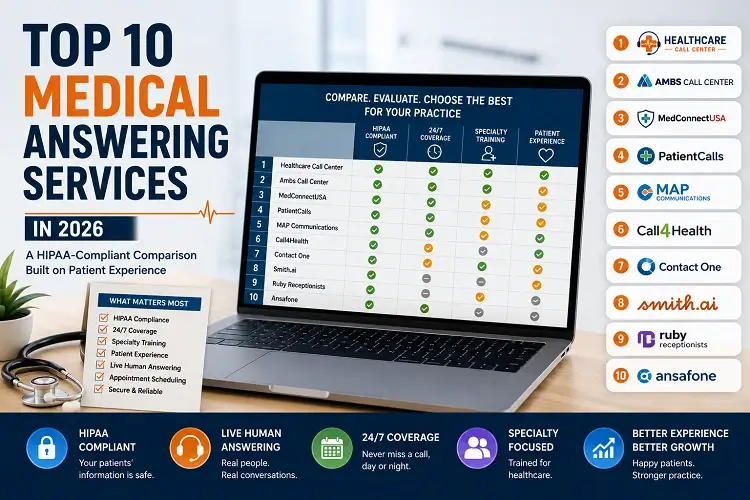
Quick Comparison: Top 10 Medical Answering Services
| Provider | Best For | HIPAA Compliant | 24/7 Coverage | Specialty Training |
| 1. Healthcare Call Center | Specialty practices wanting empathy-driven patient communication | ✅ Yes | ✅ Yes | ✅ Per-vertical (OB-GYN, fertility, plastic surgery, dental, chiropractic) |
| 2. Ambs Call Center | Large healthcare systems needing reliable 24/7 triage | ✅ Yes | ✅ Yes | ⚠️ General healthcare |
| 3. MedConnectUSA | Plastic surgery and specialty practices after hours | ✅ Yes | ✅ Yes | ⚠️ Some specialties |
| 4. PatientCalls | Hospitals and homecare/hospice organizations | ✅ Yes | ✅ Yes | ⚠️ General medical |
| 5. MAP Communications | Small practices wanting affordable live answering | ✅ Yes | ✅ Yes | ❌ Generalist |
| 6. Call4Health | Practices needing nurse triage and clinical escalation | ✅ Yes | ✅ Yes | ✅ Clinical (nurse-staffed) |
| 7. Contact One | Small-to-mid practices focused on compliance | ✅ Yes | ✅ Yes | ❌ Generalist |
| 8. Smith.ai | Practices wanting tech-forward virtual receptionists | ✅ Yes | ⚠️ Business hours + after-hours | ❌ Generalist |
| 9. Ruby Receptionists | Small practices wanting friendly, brand-matched receptionists | ⚠️ Partial | ⚠️ Limited after-hours | ❌ Generalist |
| 10. Ansafone | Enterprise practices and health systems with high volume | ✅ Yes | ✅ Yes | ⚠️ General healthcare |
Now let’s break down each provider in detail: what they do well, where they fall short, and what type of practice they fit best.
1. Healthcare Call Center
Best for: Specialty practices that want every patient call answered with genuine empathy, clinical awareness, and conversion-focused professionalism
Healthcare Call Center (HCC) represents a fundamentally different approach to medical answering services. While most providers build their service around call routing and message delivery, HCC builds theirs around patient experience specifically- the experience of speaking to someone who sounds like they genuinely care.
What Makes Healthcare Call Center Different
The “stay-at-home moms” model. HCC’s agents are stay-at-home mothers who are specially trained in HIPAA-compliant patient communication. Healthcare Call Center staffs its agents with trained stay-at-home moms who specialize in compassionate patient communication. The goal is to create a calm, reassuring experience for patients while following practice-specific workflows.
Specialty-specific training. Unlike generalist services where one agent handles everything from plumbing calls to prescription refills, HCC trains agents per vertical. An agent handling OB-GYN calls understands the urgency of third-trimester bleeding. An agent handling fertility calls knows that a patient awaiting IVF results is in one of the most emotionally charged moments of their life.
90%+ answer rate guarantee. HCC is one of the few medical answering services for after-hours that publicly commits to a specific answer rate. Healthcare Call Center publicly states a 90%+ answer rate, helping practices reduce missed patient opportunities during business hours and after-hours.
HIPAA-compliant enterprise infrastructure. Behind the empathetic phone presence, HCC maintains a HIPAA-compliant infrastructure that meets enterprise standards. Secure messaging, call recording, appointment scheduling, and integration with practice management systems are all built in. Compliance isn’t an afterthought — it’s woven into the workflow.
What HCC Does Exceptionally Well
- Patient empathy that converts: Agents don’t just take messages, but they also make patients feel heard, understood, and cared for. This is particularly valuable for high-anxiety specialties (fertility, OB-GYN, plastic surgery) where the first phone interaction sets the tone for the entire patient relationship.
- Vertical-specific agent training: OB-GYN, fertility, plastic surgery, dental, and chiropractic practices each get agents trained on that specialty’s terminology, patient concerns, and common scenarios.
- Conversion-focused intake: For elective specialties, HCC treats every new patient call as a revenue opportunity, gathering the right information and supporting medical appointment scheduling whenever practices allow direct booking rather than just forwarding a message.
- 1,200+ calls handled daily: Scale that proves the model works in production, not just in theory.
Where HCC Could Improve
To be transparent: HCC is not the cheapest option on this list, and they’re not the right fit for every practice. Organizations that need nurse-staffed clinical triage (like Call4Health offers) will need to supplement. Practices with extremely high call volume and complex EMR integration needs may find Ambs’ larger integration ecosystem more immediately compatible. And HCC’s model is optimized for specialty practices. A general family medicine clinic may not see the same differentiation in patient experience.
But for practices where every patient call matters, where the phone interaction is the difference between a booked consultation and a lost patient. Healthcare Call Center delivers something no other provider on this list offers: genuine human empathy, backed by specialty training, delivered at scale.
Here’s HCC Pros & Cons
Pros
- Specialty-trained agents
- Stay-at-home mom model
- 90%+ answer rate
- Healthcare only
Cons
- No nurse triage
- Custom pricing
2. Ambs Call Center
Best for: Large healthcare systems and multi-location practices needing enterprise-grade 24/7 support
Ambs Call Center has been answering phones for medical offices since 1932, nearly a century of healthcare communication experience. They serve major institutions including University of Michigan Medicine, Henry Ford Health, and Baylor College of Medicine. Their infrastructure is robust: HIPAA-compliant secure texting, EMR integrations, API access, and a proprietary portal for call management.
What they do well
Ambs is the gold standard for operational excellence in medical answering services. Their third-party HIPAA audits, CAM-X Award of Excellence, and deep integration ecosystem (TigerConnect, pMD, Symplr, OnPage) make them ideal for practices that need everything wired into existing systems.
Where they fall short
Ambs is built for volume and reliability, not intimacy. Their agents are professional and well-trained, but the experience can feel institutional. For practices where the phone call is the first step in converting a prospective patient, especially in high-value specialties like fertility or plastic surgery, Ambs’ approach may not maximize conversion.
3. MedConnectUSA
Best for: Plastic surgery and specialty practices needing dedicated after-hours support
MedConnectUSA has been a medical-only answering service since 1991, and it shows. They’ve received the Association of TeleServices International Award of Excellence 22 times, including 19 consecutive years. Their focus on healthcare gives them a depth that generalist services can’t match.
What they do well
MedConnectUSA understands specialty practices. Their plastic surgery answering service is genuinely well-built. They handle consultation screening, post-operative care calls, and sensitive inquiries with appropriate discretion.
Where they fall short
MedConnectUSA’s service model is traditional. They excel at message-taking and call routing but lack the modern patient experience layer, things like empathy-driven call handling, conversion-focused intake, or specialty-specific agent training that goes beyond scripts.
4. PatientCalls
Best for: Hospitals, homecare agencies, and multi-provider organizations
PatientCalls is a healthcare-exclusive answering service that focuses on high-volume, mission-critical call handling. They’re trusted by organizations like Providence Health, Einstein Health, and Kaiser Permanente names that signal their enterprise-grade reliability.
What they do well
PatientCalls excels at infrastructure. Their EMR integration, secure messaging platform, and ability to handle high call volumes make them a natural fit for hospitals and large group practices.
Where they fall short
PatientCalls is built for institutional clients, not individual specialty practices. The experience for a patient calling a small fertility clinic or a solo plastic surgeon may feel impersonal, more like calling a hospital switchboard than a caring extension of the practice.
5. MAP Communications
Best for: Small practices wanting affordable, dependable live answering
MAP Communications has been in the answering service business for decades. They offer 24/7 live operator coverage with HIPAA-trained agents, customizable scripts, and on-call scheduling. Their agents are U.S.-based, and they provide BAA agreements for medical clients.
What they do well
MAP is reliable and affordable. For a small practice that simply needs someone to answer the phone professionally after hours, take messages, and route urgent calls, MAP delivers consistently.
Where they fall short
MAP is a generalist answering service that serves many industries. Their healthcare training covers HIPAA basics but doesn’t extend to specialty knowledge. Agents won’t know the difference between a BBL consultation and a rhinoplasty follow-up.
6. Call4Health
Best for: Practices that need nurse triage and clinical escalation capabilities
Call4Health has been serving the healthcare industry for over 22 years, and their distinguishing feature is nurse-staffed triage. They don’t just answer phones; they have licensed nurses who can assess symptoms and escalate clinically.
What they do well
Their nursing staff sets them apart. For practices where patients frequently call with medical questions (not just scheduling), having a registered nurse on the line provides real clinical value. Their tenure in healthcare is also impressive, with over two decades of focused experience.
Where they fall short
Call4Health’s model is built around clinical triage, not patient experience. Calls can feel clinical rather than warm. For elective specialties like plastic surgery or fertility where patient anxiety, empathy, and conversion are critical the clinical tone.
7. Contact One
Best for: Small-to-mid practices that prioritize HIPAA compliance above all else
Contact One is a healthcare-focused answering service that emphasizes security and compliance. They offer 24/7 live answering, secure messaging, and appointment scheduling, with HIPAA compliance woven into every layer of their operation.
What they do well
Contact One takes compliance seriously. Their secure messaging, encrypted communications, and staff training around PHI are solid. For practices in highly regulated environments or those that have been burned by compliance gaps in the past, Contact One provides peace of mind.
Where they fall short
Their service feels transactional. Agents are courteous and professional but tend to follow scripts closely. There’s little evidence of specialty-specific training or an emphasis on patient empathy. The experience feels like speaking to a trained operator rather than someone who genuinely understands what the patient is going through.
8. Smith.ai
Best for: Tech-forward practices wanting AI-assisted virtual receptionist services
Smith.ai has built a modern virtual receptionist platform that blends live agents with AI-powered intake, scheduling, and lead capture. They integrate well with practice management software and CRMs, making them a strong fit for practices that want everything digitized and tracked.
What they do well
Smith.ai’s technology is genuinely impressive. Their platform captures detailed call notes, routes leads intelligently, and syncs with your existing tools. The agent quality is solid, and their Clutch reviews reflect high satisfaction rates.
Where they fall short
Like Ruby Receptionists, Smith.ai serves multiple industries: legal, financial, home services, and healthcare. Their agents are not specifically trained in medical patient communication, and their HIPAA compliance setup requires careful configuration.
9. Ruby Receptionists
Best for: Small practices wanting friendly, brand-matched virtual receptionists
Ruby is one of the most recognizable names in virtual receptionist services. Their receptionists are known for being warm, engaging, and good at making callers feel valued. They train their team extensively on customer service and phone etiquette.
What they do well
Ruby excels at the “first impression” game. Their receptionists are friendly, professional, and skilled at building rapport quickly. For small practices, especially in cash-pay specialties, Ruby’s polished phone presence can elevate the brand.
Where they fall short
Ruby is not a healthcare-exclusive service, and their HIPAA compliance coverage has limitations depending on the plan you choose. Their after-hours answering services coverage is limited compared to dedicated medical answering services, and their agents lack specialty-specific training.
10. Ansafone
Best for: Large healthcare systems and enterprise practices with high call volume
Ansafone is a well-established call center that serves multiple industries, with healthcare being one of their stronger verticals. They offer 24/7 live call answering, patient intake services, and bilingual support, all backed by robust call routing technology.
What they do well
Ansafone handles scale well. If your practice receives hundreds of calls per day across multiple locations, their infrastructure can absorb the volume. Their customizable scripts and bilingual agents are a plus for diverse patient populations.
Where they fall short
Ansafone is a multi-industry call center, not a healthcare-exclusive provider. Agents handle calls for telecom companies, e-commerce brands, and financial services in the same facility.
Features Every Medical Answering Service Should Offer
✔ HIPAA compliance
✔ Signed Business Associate Agreement (BAA)
✔ Live answering
✔ After-hours coverage
✔ Appointment scheduling
✔ Secure message delivery
✔ Escalation workflows
✔ Detailed reporting
✔ Specialty-specific scripts
How to Choose the Right Medical Answering Service for Your Practice
After reviewing all 10 providers, here’s a framework for making the right decision for your specific practice:
1. Start With Your Patient Journey
Effective communication is widely recognized as a key component of safer, higher-quality healthcare.
Think about what happens when a patient calls your office.
Are they scheduling a routine appointment?
Asking about test results?
Experiencing anxiety about a procedure?
Emergencies aside, most patient calls are emotional before they are logistical. The right answering service should match the emotional temperature of your patients.
- High-anxiety specialties (fertility, OB-GYN, oncology): Prioritize empathy, specialty training, and human warmth. Look for Healthcare Call Center or MedConnectUSA.
- High-volume general practices: If your biggest challenge is peak-hour call volume rather than after-hours coverage, a front desk overflow answering service may be a better solution than full-time live answering.
- Elective/cash-pay specialties (plastic surgery, med-spa, dental): Prioritize conversion-focused intake and patient experience. Healthcare Call Center and MedConnectUSA excel here.
- Clinical triage needs: If patients frequently call with medical questions requiring clinical judgment, Call4Health’s nurse triage model is the strongest.
2. Ask These Questions Before Signing
- Are your agents trained specifically for my specialty, or do they handle all industries?
- What is your guaranteed answer rate? (If they can’t answer this, that’s a red flag.)
- Do you provide a BAA (Business Associate Agreement) as part of the standard contract?
- How are after-hours urgent calls escalated to my on-call provider?
- What secure messaging and EMR integration options do you support?
- Do you offer bilingual agents? Are they trained in medical terminology in both languages?
- How does your pricing scale as our call volume grows?
If you’re narrowing down your options, our Medical Answering Service Checklist can help you compare providers based on HIPAA compliance, patient experience, scheduling capabilities, reporting, integrations, and after-hours support.
You can also estimate how delayed patient response times and missed calls may affect appointments and potential revenue using our free Patient Lead Response Time Calculator.
3. Watch for These Red Flags
- “HIPAA compliant” without a BAA: A service can claim HIPAA compliance, but if they won’t sign a Business Associate Agreement, they’re not actually compliant for your practice.
- Per-minute pricing without a cap: A seemingly affordable monthly plan can multiply quickly if your call volume spikes during flu season or a marketing push. Always ask how pricing scales.
- Generalist agents handling medical calls: If the same agents who handle plumbing and real estate calls are also answering your patients’ medical questions, the patient experience will suffer.
- No published answer rate: If a service won’t commit to a specific answer rate or response time, they’re likely not measuring it — which means they don’t know how many calls they’re missing.
What Most Medical Answering Services Won’t Tell You
After reviewing these 10 providers, a few patterns emerged that most services don’t advertise:
The “HIPAA Compliant” Label Is Often Just a Label
Almost every service on this list claims HIPAA compliance. But true compliance means: signed BAA, encrypted message delivery, access controls, staff training programs, and regular third-party audits. Several providers mention HIPAA compliance in their marketing but don’t publicly describe their audit process.
Script-Reading Kills Patient Trust
Most traditional answering services train agents to follow scripts closely. This ensures consistency but comes at a cost: patients can tell when someone is reading from a screen. The call feels transactional, not personal. Services like Healthcare Call Center and Ruby Receptionists buck this trend by prioritizing natural conversation, but for different reasons. Ruby focuses on brand polish; HCC focuses on patient empathy.
The Per-Minute Pricing Trap
Many services advertise attractive monthly rates, but the fine print often includes per-minute or per-call overage charges that kick in after a modest base allowance. A practice that averages 50 calls per month in January can easily spike to 150 calls per month during cold and flu season.
Offshore Agents and the Empathy Gap
Some services use offshore agents to keep costs down. While these agents are often well-trained and professional, there’s a measurable empathy gap when the person answering the phone doesn’t share the cultural context of the patient calling.
Note: Information in this comparison is based on publicly available sources at the time of writing. Features, pricing, integrations, and service offerings may change over time, so practices should verify details directly with each provider before making a final decision.
Medical Answering Service Comparison Summary
Choosing a medical answering service is one of the most consequential operational decisions a practice can make. Every missed call is a patient who may go elsewhere. Every rushed interaction is a patient experience that could have been better. And every after-hours emergency handled poorly is a liability clinical, reputational, and emotional.
But if your practice depends on patient experience, if every call represents a relationship, a conversion, or a moment of patient anxiety that needs to be met with genuine human care, then Healthcare Call Center’s model of empathy-driven, specialty-trained, stay-at-home mom agents offers something no other provider on this list can replicate.
The right medical answering service should combine secure patient communication, reliable availability, and a patient experience that reflects the quality of your practice.
Ready to see how Healthcare Call Center handles your patient calls?
Get a free consultation or call (307) 333-9968 to learn how our stay-at-home mom agents can transform your patient communication day or night.
Frequently Asked Questions About Medical Answering Services
What is a medical answering service?
A medical answering service is a professional service that handles phone calls for medical practices, including appointment scheduling, message taking, urgent call triage, after-hours coverage, and patient intake.
How much does a medical answering service cost?
Pricing varies widely based on call volume, specialty, features, and level of integration required. Most services offer custom quotes after a brief consultation. The key is to understand not just the monthly rate but how pricing scales as your practice grows.
Is HIPAA compliance required for medical answering services?
Yes. If a service handles any patient health information (PHI) even just taking messages that contain patient names and callback numbers. They must be HIPAA compliant and sign a Business Associate Agreement (BAA). The U.S. Department of Health and Human Services Office for Civil Rights oversees HIPAA enforcement.
What’s the difference between a medical answering service and a regular answering service?
A regular answering service handles calls for any industry: plumbers, real estate agents, lawyers, e-commerce brands. Their agents are generalists. A medical answering service focuses exclusively (or primarily) on healthcare, with agents trained in HIPAA compliance.
Can medical answering services schedule appointments?
Yes, most medical answering services offer appointment scheduling as part of their service. However, the depth of integration varies. Some services simply take a message and forward it to your staff.
What makes Healthcare Call Center different from other medical answering services?
Healthcare Call Center differentiates through its staffing model: agents are stay-at-home moms specially trained in HIPAA-compliant patient communication and assigned to specific medical specialties.
How often should I review my answering service?
At least once each year or whenever your practice experiences significant growth, adds locations, changes specialties, or notices changes in patient call volume.
Can I switch medical answering services without changing my phone number?
Yes. Most medical answering service providers can work with your existing business phone number by updating call forwarding or routing rules, allowing practices to switch providers with minimal disruption.
Do medical answering services support multi-location practices?
Many providers support multiple office locations with customized greetings, routing rules, provider schedules, and reporting for each location.