Running one medical practice is hard enough. Running three, five, or ten locations multiplies every operational challenge – especially when it comes to patient communication.
Location A has a front desk that answers every call within two rings. Location B struggles with a single receptionist handling a high volume of calls. Location C just opened, and the staff is still learning the scheduling system. Meanwhile, patients are calling different locations, getting different answers, experiencing different levels of service, and forming inconsistent impressions of your brand.
This is the multi-location communication problem, and it is one of the most common reasons growing practice groups seek out a centralized healthcare call center.
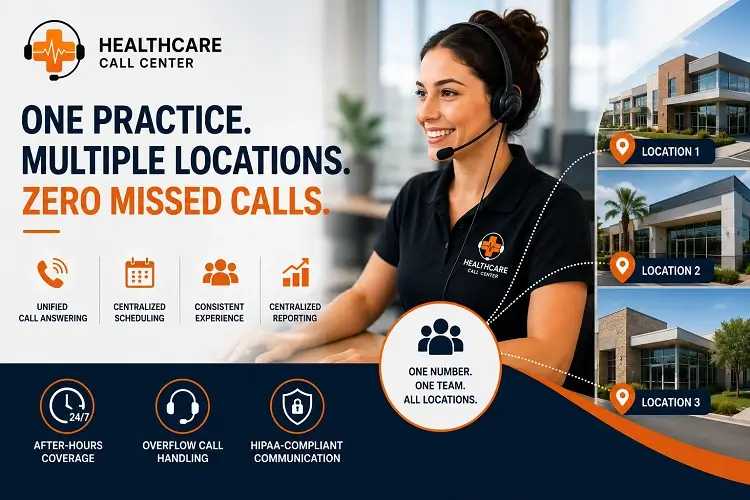
A healthcare call center for multi-location practices solves this by creating a single, consistent point of contact for every patient call – regardless of which location they are trying to reach. Calls are answered the same way, scheduling is handled in the same system, and the patient experience is identical whether they call your flagship location or your newest satellite office.
The Multi-Location Communication Problem
When practices expand to multiple locations, phone communication tends to fragment. Each location hires its own front desk staff, sets its own call handling procedures, and manages its own scheduling. On paper, this looks like independence. In practice, it creates chaos.
The most common problems include:
Inconsistent Patient Experience
A patient who had a great phone experience at Location A calls Location B and gets a rushed, put-on-hold, unhelpful interaction. They wonder if it is the same practice. Brand trust erodes.
Missed Calls at High-Volume Locations
The busiest location inevitably has the most missed calls. While Location C is underutilized, Location A is turning away patients because the phone goes unanswered. There is no system to route overflow calls to available staff.
No Centralized Visibility
Each location reports its own call metrics (if they track them at all). There is no unified dashboard showing total call volume, answer rates, booking rates, or patient satisfaction across all sites. Leadership cannot see which locations are performing and which are struggling.
Scheduling Complexity
Providers rotate between locations. New patients do not know which location to call. Referrals get sent to the wrong site. Without centralized scheduling, appointments are missed or double-booked.
After-Hours Gaps
If each location handles its own after-hours patient calls, coverage is inconsistent. One location might have a shared on-call phone. Another might send everything to voicemail. Patients have no idea what to expect when they call after 5 PM.
Staff Burnout at Busy Locations
The front desk at the highest-volume location is perpetually overwhelmed. Turnover is high. New hires take months to train. And the cycle repeats.
How a Centralized Healthcare Call Center Solves These Problems
A healthcare call center designed for multi-location practices addresses each of these challenges with a single, coordinated system.
Unified Call Answering
All patient calls – whether to Location A, B, or C – route through the central call center. Agents answer with the appropriate location name, follow practice-wide protocols, and handle each call to the same standard. The patient experience is consistent across every site.
Overflow and Load Balancing
When Location A is overwhelmed, calls automatically roll to the call center. No patient waits on hold for more than a few rings. The call center acts as an extension of your front desk, absorbing volume spikes during busy periods.
Centralized Scheduling
Agents have access to a unified scheduling system that shows availability across all locations and providers. When a patient calls, the agent can find the earliest available appointment at any convenient location – maximizing booking efficiency and distributing patient load.
Multi-Location Provider Management
Providers who work at multiple locations are tracked in the scheduling system. Agents know exactly where each provider is on each day and can book accordingly. Patients are directed to the right location for their preferred provider without confusion.
After-Hours Coverage for All Locations
A single call center handles after-hours calls for every location. Patients calling any of your offices after business hours reach the same trained agents, follow the same urgent message protocols, and can book appointments for the next business day. Consistent, reliable, professional – every location, every hour.
Centralized Reporting and Analytics
Practice leadership receives a single dashboard showing call metrics across all locations: total calls, answer rates, booking rates, after-hours activity, peak call times, and new patient inquiries by location. This data reveals which locations need additional front desk support, which providers are in highest demand, and where marketing efforts are generating the most calls.
What Multi-Location Practices Should Look for in a Call Center Partner
Not every call center can handle the complexity of multi-location medical practices. When evaluating partners, prioritize:
Multi-Location Scheduling Experience
The call center must have experience managing schedules across multiple sites, provider rotations, and location-specific rules. Ask for case studies or references from other multi-location medical groups.
Scalable Infrastructure
If you plan to add more locations, the call center should be able to onboard new sites quickly – adding phone numbers, call flows, and scheduling rules without major disruption.
Location-Specific Call Flows
Each location may have different providers, services, hours, and patient demographics. The call center should be able to configure location-specific greetings, call routing, and scheduling rules while maintaining a consistent overall brand experience.
HIPAA Compliance Across All Sites
A single BAA should cover all your locations. The call center must maintain compliance standards uniformly – no exceptions for smaller or newer sites.
Bilingual Agents
Multi-location practices often serve diverse communities. A call center with bilingual agents ensures every patient at every location can communicate effectively.
CRM and Practice Management Integration
The call center should integrate with your practice management software across all locations. Whether you use a single instance of Athena or different systems at different sites, the integration must be seamless.
Real-World Impact: What Changes When You Centralize
Before Centralization:
- 3 locations, each with its own front desk handling calls
- Location 1: 92% answer rate, patients happy
- Location 2: 71% answer rate, patients frustrated
- Location 3: 84% answer rate, inconsistent experience
- After-hours: all locations go to voicemail
- New patient inquiries: 30% captured, 70% lost to voicemail or long hold times
- Monthly booked appointments from phone calls: 180
After Centralization:
- All calls answered by a central healthcare call center plus location-based front desk
- Consistent 95%+ answer rate across all locations
- After-hours calls answered live by trained agents
- New patient inquiries: 85% captured and booked on the call
- Monthly booked appointments from phone calls: 310 (a 72% increase)
- Front desk staff at all locations focused on in-person patient care
- Leadership has a single dashboard showing performance across all sites
The centralization does not replace your front desk. It supplements them – handling overflow, after-hours, and new patient inquiries so your in-house team can focus on patients who are physically present.
Specialties That Benefit Most from Multi-Location Call Centers
Plastic Surgery Networks
Multiple locations often share surgeons who rotate between offices. A centralized call center manages the complexity of provider schedules across sites and ensures consultation requests are booked at the right location with the right surgeon.
Dental Groups
Dental service organizations (DSOs) and multi-location dental practices face high call volume and frequent emergency requests. A centralized call center handles overflow, emergency triage, and new patient booking across all locations.
Fertility Clinic Networks
Fertility patients often need to reach their clinic urgently – medication questions, cycle timing, test results. A centralized call center ensures patients at every location get the same responsive, empathetic care regardless of which clinic they are calling.
OB-GYN Groups
Pregnancy-related calls are time-sensitive and emotional. A centralized call center standardizes how these calls are handled, ensuring every patient at every location receives consistent, compassionate support.
Primary Care and Multi-Specialty Groups
Large medical groups with multiple specialties and locations benefit from a call center that can route calls, schedule across departments, and handle the complexity of multi-provider, multi-site operations.
Implementation: How to Roll Out a Centralized Call Center
Phase 1: Assessment – Audit current call volume, answer rates, and scheduling systems across all locations. Identify the biggest pain points and quick wins.
Phase 2: Integration – Connect the call center to your scheduling systems. Configure call flows, provider rules, and location-specific protocols.
Phase 3: Pilot – Launch at one or two locations first. Monitor call quality, booking accuracy, and patient feedback. Refine before expanding.
Phase 4: Full Rollout – Extend to all locations. Train front desk staff on how to work with the call center (overflow, after-hours handoff, new patient routing).
Phase 5: Optimization – Review monthly reports, adjust staffing, refine call flows, and expand service as needed.
The entire process typically takes 3 to 6 weeks for a practice with 3 to 10 locations, assuming cloud-based scheduling systems are already in place.
The Bottom Line for Multi-Location Practices
Every location you add increases call volume, scheduling complexity, and the risk of inconsistent patient experiences. A centralized healthcare call center absorbs that complexity, ensuring that whether a patient calls your newest satellite office or your flagship location, they get the same fast, professional, empathetic response.
For multi-location practice groups, centralization is not a luxury. It is the operational infrastructure that makes growth sustainable.
Book a free consultation to see how Healthcare Call Center can centralize patient communication across all your practice locations.
FAQs
1. How does a centralized call center handle calls for multiple practice locations?
Each location has a unique phone number that routes to the central call center. Agents answer with the specific location name, follow location-specific call flows, and access a unified scheduling system that shows availability across all sites and providers.
2. Can a multi-location call center integrate with different scheduling systems at each site?
Yes. If your locations use different practice management software, the call center can integrate with each system separately or work through a unified scheduling platform that syncs across all sites.
3. How much does a centralized healthcare call center cost for multi-location practices?
Pricing depends on the number of locations, total call volume, and service level. Most multi-location practices spend $800 to $3,000 per month, with costs offset by increased booking rates and recovered missed-call revenue.
4. Will the call center replace our front desk staff?
No. The call center supplements your front desk by handling overflow calls, after-hours coverage, and new patient inquiries. Your in-house team focuses on patients in the office while the call center ensures no phone-based patient is missed.
5. How long does it take to implement a centralized call center for multiple locations?
Typical implementation takes 3 to 6 weeks for practices with 3 to 10 locations, assuming cloud-based scheduling systems are in place. Larger networks may require 6 to 12 weeks depending on complexity.