by Erika Sanchez | Sep 29, 2026 | Healthcare Call Center Services
A front desk staffing gap looks simple on paper.
One person is out. One role is unfilled. One location is short-staffed. One team is trying to do more with fewer people.
But inside a medical practice, that gap spreads quickly.
Patients wait longer. Calls go unanswered. Voicemails pile up. Appointment requests slow down. Staff rushes through conversations. Follow-up gets delayed. Providers feel the pressure. The practice may still look busy, but patient access begins to weaken.
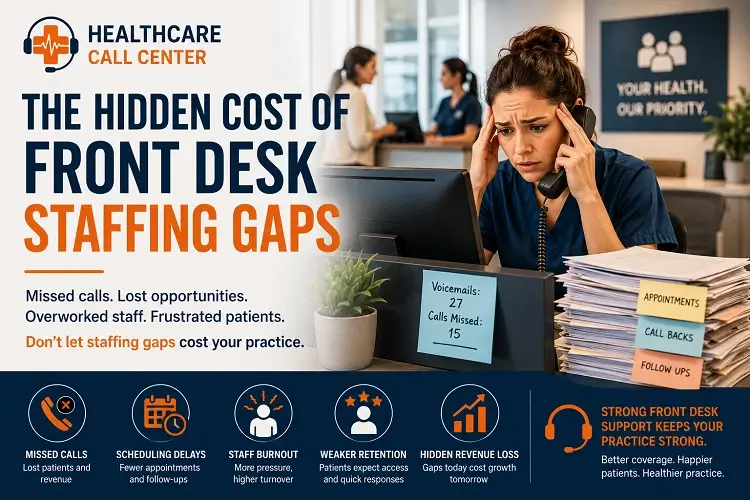
The real cost of a front desk staffing gap is not only payroll. It is missed patient calls, lost appointment opportunities, staff burnout, weaker retention, and a patient experience that feels harder than it should.
This is why medical practices should treat front desk coverage as a growth and patient access issue, not only an administrative issue.
Why the Front Desk Carries So Much Pressure
The front desk is often the busiest communication point in the practice. AMA directly discusses system inefficiencies, administrative burdens, and workplace factors associated with physician burnout.
A front desk team may handle:
- Patient check-in
- Patient check-out
- Phone calls
- Appointment scheduling
- Insurance questions
- Provider messages
- Referral questions
- Walk-in patients
- Forms and paperwork
- Cancellations and reschedules
- Billing questions
- New patient inquiries
- Follow-up calls
That is a lot of work for one team.
When staffing is stable, the team may still feel busy. When staffing is thin, the system becomes fragile.
The phone is usually the first place the pressure shows. Calls ring longer. Patients are placed on hold. Voicemail becomes the backup plan. Staff may answer quickly but sound rushed. Messages may be incomplete because the person answering is also trying to help someone standing at the desk.
This is where a front desk overflow answering service can help protect the patient experience.
Missed Calls Are the First Hidden Cost
The most obvious hidden cost of a staffing gap is the missed call.
But missed calls are often undercounted.
A practice may see voicemails and assume that number reflects the problem. It does not. Many callers do not leave voicemails. Some hang up. Some try again later. Some call a competitor. Some give up because they are already frustrated.
A missed call can represent:
- A new patient appointment
- A returning patient follow-up
- A referral inquiry
- A reschedule request
- A cancellation that could have been refilled
- A post-visit concern
- An after-hours message
- A patient who needed reassurance
The cost depends on the caller’s intent.
If the caller was ready to book, the missed call may cost revenue. If the caller was an existing patient, it may cost trust. If the caller had a concern, it may create anxiety and extra follow-up work later.
A 24/7 medical answering service helps reduce this risk by making sure more calls are answered when the front desk is overloaded.
Staffing Gaps Slow Down Scheduling
Scheduling is one of the first workflows to suffer when the front desk is short-staffed.
Patients call to book, reschedule, confirm, or ask about availability. If those calls are delayed, the schedule becomes harder to manage.
A staffing gap can cause:
- Slower new patient booking
- More missed appointment requests
- More unfilled cancellations
- Longer callback queues
- More patient frustration
- More pressure on staff later in the day
Scheduling delays are not just inconvenient. They can reduce revenue and weaken patient retention.
A patient who cannot book quickly may choose another provider. A patient who cannot reschedule easily may miss care. A cancellation that is not handled in time may leave an empty appointment slot.
This is why phone coverage and appointment access are connected.
Staff Burnout Becomes a Patient Experience Problem
Front desk staff often carry the emotional weight of the practice.
They handle frustrated patients, urgent requests, provider interruptions, insurance confusion, and constant phone volume. When staffing is thin, every interaction becomes harder.
Burnout can show up as:
- Shorter call tone
- More mistakes
- Slower callbacks
- Less patience with callers
- Lower message quality
- Higher turnover risk
- More internal stress
Patients can feel that pressure.
Even when staff is trying their best, a rushed or overwhelmed call experience can make the practice feel disorganized.
The solution is not always telling staff to work harder. In many cases, they are already working at capacity. The better solution is to reduce avoidable pressure.
A call support partner can help by answering overflow calls, collecting clear messages, and giving staff room to focus on patients in the office.
Patient Access Breaks Down at the Phone
Patient access is often discussed in terms of appointment availability, insurance acceptance, and provider schedules. But for many patients, access starts with the phone.
If a patient cannot reach the practice, the rest of the access system does not matter.
The patient may never book the appointment. They may never ask the question. They may never complete the follow-up step. They may never get routed to the right person.
A staffing gap can turn the phone into a bottleneck.
This affects:
- New patient acquisition
- Follow-up care
- Reschedules
- Medication questions
- Procedure questions
- Referral coordination
- Patient satisfaction
- Online reviews
- Retention
Strong US-based healthcare call center services help practices improve patient access by making sure calls are answered and routed more consistently.
The Cost Is Higher for Specialty Practices
Front desk staffing gaps are especially expensive for specialty practices
In specialty care, calls often carry higher value and more sensitivity. A fertility patient may be calling after a difficult update. A plastic surgery lead may be ready to book a consultation. An OB-GYN patient may be worried. A dental patient may be in pain. A chiropractic patient may want a same-day visit.
These calls should not sit unanswered.
Specialty practices often invest heavily in SEO, referrals, reviews, and paid marketing. A missed call can waste that investment.
The practice may never know exactly which caller was lost. But over time, the pattern becomes visible: fewer booked consultations, lower conversion from marketing, more patient complaints, and more pressure on the team.
After-Hours Gaps Add Another Layer
Staffing gaps during the day are one problem. After-hours coverage is another.
Patients do not only call during office hours. They call after work, during evenings, on weekends, and when they remember something important. Some calls can wait. Some need clear routing. Some simply need to be answered and documented correctly.
If after-hours calls go to voicemail without a clear process, the practice may create more work for the next business day.
An after-hours medical answering service helps make sure calls are answered, captured, and routed according to the practice’s rules.
This can reduce patient frustration and give the front desk a cleaner starting point in the morning.
Hiring More Staff Is Not Always Enough
Hiring may be necessary, but it is not always the complete answer.
A new staff member cannot solve every call spike. They cannot cover every lunch break, sick day, after-hours call, or campaign-driven surge. They also require training, management, payroll, and time before they become fully effective.
Practices should ask whether the problem is permanent workload, predictable peak-hour pressure, or variable call volume.
If call pressure comes in waves, overflow support may be more efficient than adding another full-time role.
The goal is not to automate every patient interaction. It is to match the right type of call support to the workload your front desk is actually experiencing.
A blended model often works best:
- The front desk handles in-office patients and core workflows.
- Overflow support answers calls when staff is busy.
- After-hours support covers calls when the office is closed.
- Clear routing rules keep messages organized.
This creates coverage without overloading the team.
How to Identify the Real Cost of a Staffing Gap
Practices should audit the impact of front desk staffing gaps, not just the staffing schedule.
Review:
- Missed calls by day and time
- Voicemail volume
- Callback delays
- New patient call conversion
- Empty schedule slots
- Patient complaints about phone access
- Staff overtime or stress patterns
- Calls missed during lunch or check-in rushes
- Calls from paid campaigns or SEO pages
- After-hours call volume
This helps the practice understand whether the staffing gap is affecting growth and retention and whether the solution is additional staff, overflow coverage, after-hours support, or a combination of the three.
Practices can also use a missed call revenue calculator to estimate the potential financial impact of unanswered patient calls.
The goal is not to blame the front desk. The goal is to find where the system needs support.
What Better Front Desk Support Looks Like
Better front desk support does not have to be complicated.
It should help the practice:
- Answer more calls
- Reduce voicemail dependency
- Capture appointment requests
- Route messages clearly
- Support after-hours callers
- Reduce staff pressure
- Improve patient access
- Protect marketing ROI
- Keep the patient experience consistent
The best support model should feel like an extension of the practice’s workflow, with practice-specific scripts, routing rules, escalation instructions, and secure message handling. It should follow practice-specific instructions, protect patient information, and help callers feel heard.
This is the strongest primary authority for your healthcare privacy point. HHS explains that the Privacy Rule establishes national standards for protecting medical records and individually identifiable health information.
That is the difference between basic message-taking and healthcare-aware call handling.
Why This Problem Can Grow Quietly
Front desk staffing gaps do not always create an obvious crisis at first. The practice may still be seeing patients. The schedule may still look full. Staff may still be answering many calls each day.
But the missed opportunities often happen quietly.
A new patient does not book. A caller does not leave a voicemail. A follow-up gets delayed. A cancellation is not filled. A patient feels the practice is hard to reach and starts comparing other options.
Because these losses are scattered across many small moments, they can be easy to ignore. That is what makes them dangerous.
By the time the problem shows up in lower conversion, weaker retention, or staff turnover, the practice may have been leaking opportunities for months.
This is why practices should review front desk coverage before the problem becomes visible in revenue. The phone is often the earliest warning sign that the team needs support.
Final Takeaway
Front desk staffing gaps cost medical practices more than payroll.
They create missed calls, slower scheduling, patient frustration, staff burnout, and lost appointment opportunities. They also weaken the patient experience before the patient ever sees a provider.
Medical practices do not need to choose between overloading the front desk and sending callers to voicemail. With the right call handling support, they can protect patient access, support staff, and answer more calls during the moments that matter.
Healthcare Call Center helps medical practices reduce front desk overload, answer more patient calls, support after-hours communication, and protect appointment opportunities.
Book a Free Consultation to review your front desk call volume, staffing gaps, overflow needs, and after-hours coverage.
Front Desk Staffing Gap FAQs
1. What is a front desk staffing gap in a medical practice?
A front desk staffing gap happens when the practice does not have enough available staff to manage patient calls, check-ins, scheduling, insurance questions, and administrative work without delays or missed calls.
2. How do front desk staffing gaps affect patient calls?
Staffing gaps can cause longer hold times, missed calls, voicemail dependency, delayed callbacks, incomplete messages, and frustrated patients who cannot reach the practice quickly.
3. Can a medical answering service help with staffing gaps?
Yes. A medical answering service can help by covering overflow calls, after-hours calls, appointment requests, and message capture when the front desk is overloaded or unavailable.
4. When should a medical practice use front desk overflow support?
A practice should consider front desk overflow support when calls are regularly missed during peak hours, lunch breaks, check-in periods, staffing shortages, or other high-volume windows.
5. Is overflow call support better than hiring more staff?
It depends on the problem. If call volume spikes during specific times, overflow support may be more efficient. If the practice has constant workload growth, hiring may also be needed.
6. How can practices measure the cost of front desk staffing gaps?
Practices can review missed calls, voicemail volume, callback delays, new patient conversion, schedule gaps, patient complaints, and call volume during peak times or after-hours windows.

by Felicia Goodman | Sep 1, 2026 | Call Center For Psychiatrist
Every unreturned call in a psychiatry practice is more than a missed message. It can be a patient in distress who cannot reach help, a new client who calls the next clinic on the list, or a medication question that turns into a crisis over the weekend. For mental health practices, the phone is often the first point of care, and when nobody answers, care stops before it starts.
A mental health answering service built for psychiatric practices solves this. Trained agents answer after-hours patient calls, schedule appointments, take accurate medication messages, and escalate true emergencies by your protocol, every hour of the day. And when your practice needs a dedicated specialty solution, our psychiatrist answering service page explains exactly how we handle mental health calls end to end.
Key Takeaways
- A mental health answering service gives psychiatric practices 24/7 live call coverage without hiring more front desk staff.
- Trained agents triage urgent calls, handle medication messages, and escalate psychiatric emergencies by your documented protocol.
- HIPAA compliance requires a signed Business Associate Agreement, encrypted message delivery, and PHI-trained agents.
- Most practices pay 150 to 600 dollars per month, and recovering one or two new patient calls usually covers the cost.
- Practices using a specialized answering service report up to 30 percent fewer missed appointments.
What Is a Mental Health Answering Service?
A mental health answering service is a live call handling solution specialized for psychiatric, therapy, and behavioral health practices. Trained agents answer patient calls around the clock in your practice name, follow your custom scripts, triage urgent situations, take secure messages, schedule appointments, and escalate emergencies according to your documented protocol.
It is not a generic call center and not an answering machine. The difference shows up in the details: agents who understand what an intake call for depression or anxiety sounds like, who stay calm with an agitated caller, who know that a medication question for a psychiatric patient is often more urgent than the same question in a general practice, and who never make a distressed caller repeat their story twice. Some providers, including our
It is not a generic call center and not an answering machine. The difference shows up in the details: agents who understand what an intake call for depression or anxiety sounds like, who stay calm with an agitated caller, who know that a medication question for a psychiatric patient is often more urgent than the same question in a general practice, and who never make a distressed caller repeat their story twice. Some practices start with a general medical answering service and later move to a specialty team as call volume grows, while practices that live in high acuity situations prefer a specialty coverage setup from day one.
Why Do Psychiatry Clinics Lose Patients to Missed Calls?
Psychiatry clinics lose patients to missed calls because mental health callers are unusually time-sensitive and emotionally vulnerable. A caller who reaches voicemail during a moment of distress rarely calls back; they simply move to the next provider on the list. Below are the four ways unanswered calls quietly damage a practice.
Disrupted Continuity of Care
Treatment works when it is continuous. Missed calls delay medication adjustments, postpone therapy sessions, and leave clinical questions unresolved until the next available appointment, sometimes weeks later. In psychiatric care, that gap is not an inconvenience. It can be the difference between a patient who stabilizes and a patient who decompensates.
Higher No-Show Rates
Patients who cannot confirm, reschedule, or prepare for appointments are more likely to skip them entirely. Every empty slot is lost revenue and shorter access for patients waiting for care. Use our missed-call revenue calculator to estimate what unanswered calls cost your practice each month.
Patient Attrition
New patients calling a psychiatric clinic are often seeking help for the first time. If nobody answers, most never call back. Existing patients who repeatedly hit voicemail start looking for a provider who is reachable, and in mental health care, feeling heard starts with the very first phone contact.
Staff Burnout
When calls pile up, voicemail queues, callbacks, and scheduling chaos land on your front desk. A reactive front desk is a burning-out front desk, and burnout in a psychiatric practice compounds fast because every interaction carries emotional weight. Protecting your team from phone chaos is a retention strategy, not a luxury.
What Happens When a Patient Calls After Hours?
When a patient calls after hours, a trained agent answers within three rings, identifies the reason for the call, and routes it by your protocol: emergencies go to the on-call provider or crisis resources, urgent medication issues go to your secure message queue, and routine requests are scheduled for the next business day. The caller always reaches a calm human voice instead of voicemail.
A typical after-hours flow for a psychiatry practice looks like this:
- The agent answers with your practice name and custom greeting.
- The agent asks screening questions you define and classifies the call: emergency, urgent, or routine.
- Emergency calls are warm transferred to the on-call provider, or directed to 988 or 911 when you specify it.
- Urgent medication messages are captured with drug name, dosage, and pharmacy details, then delivered through an encrypted channel.
- Routine requests are logged for morning follow-up or booked directly into your schedule.
- Every interaction is time stamped and summarized in your morning report.
How Does a HIPAA-Compliant Answering Service Protect Patient Privacy?
A HIPAA-compliant healthcare answering service protects patient privacy by signing a Business Associate Agreement, transmitting every message through encrypted channels, training all agents on PHI handling rules, and maintaining audit trails for each interaction. Mental health information carries extra sensitivity, so these controls are not optional extras; they are the baseline.
Mental health information is among the most protected categories of PHI. Under HIPAA, a covering service that handles patient information on your behalf is your Business Associate, which means the service must safeguard that data with the same rigor your practice does. Ask any provider you evaluate for a signed BAA, their encryption standards for SMS and email delivery, and their agent training documentation. If any of the three are missing, keep looking.
What Services Are Included in a Mental Health Answering Service?
A mental health answering service typically includes 24/7 live answering, call triage by your protocol, medication and prescription message handling, appointment scheduling, crisis call escalation, and secure message delivery to your team. The exact mix is configured around your practice workflows.
24/7 Live Answering
Every call is answered by a trained agent, nights, weekends, and holidays included. Agents greet callers with your practice name and your custom script, so patients experience your practice, not a third party. For psychiatric practices, the goal is simple: no patient should ever hear a dial tone or a voicemail greeting during a moment of need.
Triage by Your Protocol
Agents follow the triage rules you define: what counts as urgent, when to escalate to the on-call provider, what goes to a crisis line, and what can wait for morning. In mental health practices, this judgment matters more than in almost any other specialty, which is why the protocol is documented, tested with live scenarios before launch, and reviewed quarterly.
Medication and Prescription Message Handling
Agents capture medication questions accurately, including drug names, dosages, and pharmacy callbacks, and route them through your approved workflow. They never give medical advice; they make sure the right message reaches the right person, securely, the first time. This one service removes most of the interruptive phone traffic that fragments a psychiatrist’s day.
Appointment Scheduling
New patient bookings, reschedules, cancellations, and reminder calls are handled in real time, directly in your scheduling tool or practice management system. For practices offering telepsychiatry, agents can distinguish in-person from virtual visit requests and book each in the correct calendar, which protects your time blocks and reduces coordinator workload.
Crisis Call Handling
Crisis-aware agents recognize the signs of a psychiatric emergency and follow your documented crisis protocol, connecting the caller to the on-call provider or crisis resources immediately rather than leaving a message. Many practices direct agents to reference the 988 Suicide and Crisis Lifeline for callers who need support outside the practice’s on-call structure. The agent’s job in a crisis is not diagnosis, it is connection: keep the caller calm, keep them on the line, and hand them to the right resource fast.
In-House Receptionist vs Mental Health Answering Service
An in-house receptionist offers personal familiarity but covers only business hours, while a mental health answering service covers all 168 hours of the week, costs a fraction of a salary, and includes crisis-trained agents, HIPAA infrastructure, and overflow protection. The two work best together: staff handle the day, the service handles nights, weekends, and overflow.
| Factor |
In-House Receptionist |
Mental Health Answering Service |
| Coverage |
Business hours only |
24/7 including weekends and holidays |
| Cost per month |
3,000 to 4,500 dollars salary and benefits |
150 to 600 dollars based on volume |
| Crisis training |
Varies by individual |
Documented protocols and trained agents |
| HIPAA BAA |
Not typically provided |
Signed BAA with encrypted delivery |
| Absence coverage |
None if the receptionist is out |
Always on, with backup agents |
| Scalability |
Hire and train more staff |
Absorbs volume spikes automatically |
| Missed call risk |
High after hours and during peaks |
Near zero with 90 percent plus answer rates |
Most psychiatric practices keep their front desk and add the answering service for nights, weekends, lunch breaks, and overflow. The result is a single point of failure removed: no more hours of the week when the practice is effectively closed to new and existing patients.
How Much Does a Mental Health Answering Service Cost?
Most psychiatric practices pay between 150 and 600 dollars per month for a mental health answering service, depending on call volume, protocol complexity, and integrations. Recovering one or two new patient calls a month typically covers the entire cost, which is why the question is rarely whether the service pays for itself, but how quickly.
Pricing models vary. Per-minute plans fit low-volume practices, per-call plans fit predictable schedules, and dedicated lines fit high-intake practices. Ask every provider for a written breakdown of overage charges, holiday surcharges, and setup fees, because the cheapest base rate is often not the cheapest annual cost.
How to Choose a Mental Health Answering Service Provider
Choose a provider by verifying five things before signing: behavioral health experience, a signed BAA with encrypted delivery, custom triage documentation, fast answer times, and transparent monthly reporting. A provider that cannot show all five for a psychiatric practice is the wrong provider.
- Behavioral health experience. Ask how many psychiatric or therapy practices they serve and how agents are trained for crisis calls. Behavioral health calls are not general medical calls.
- A signed BAA and encrypted messaging. Get both in writing before the first call. A provider that hesitates on either one is telling you something.
- Custom triage and escalation protocols. Generic scripts are dangerous in psychiatry. Your intake nuances, medication rules, and crisis steps must be documented and tested.
- Fast answer times. Calls should be answered within three rings, around the clock. Ask for their answer rate and hold time statistics.
- Transparent reporting. You should see call volumes, response times, escalation logs, and message accuracy monthly, in a format you can audit.
- US-based agents. Cultural fluency and empathy are hard to audit offshore. For mental health callers, accent friction and cultural distance measurably hurt outcomes.
Why Practices Choose HCC for Mental Health Calls
Healthcare Call Center works exclusively with medical and behavioral health practices, and every agent is a US-based professional trained for sensitive conversations. Practices choose HCC because the phone experience matches the standard of care inside the practice itself.
- Empathy-first agents. Our agents are trained to stay calm, warm, and non-judgmental with callers in distress. Patients should feel they reached a caring extension of your practice, not a call center.
- Custom scripts and call flows. We build your greeting, triage rules, and escalation paths with you, then follow them on every call.
- Integration with your systems. We connect with your EHR, scheduling platform, and internal workflows so messages and bookings land where your team already works.
- Proven results. Practices working with HCC report up to 30 percent fewer missed appointments and measurable gains in new patient conversion, backed by a 90 percent plus answer rate guarantee.
For practices that want full specialty coverage, our psychiatric answering service details the exact protocols, integrations, and coverage options for mental health clinics.
Stop Losing Patients to Voicemail
Every unanswered call in a mental health practice is a person who asked for help and heard silence.
Book a free 15-minute discovery call and we will map your after-hours coverage in one conversation.
Frequently Asked Questions
Q: What is a mental health answering service?
A: It is a live call handling service specialized for psychiatric and therapy practices. Trained agents answer patient calls 24/7, triage urgent issues, take medication messages, schedule appointments, and escalate emergencies by your protocol.
Q: Is a mental health answering service HIPAA compliant?
A: A compliant provider signs a Business Associate Agreement, uses encrypted message delivery, trains agents on PHI handling, and keeps audit trails. Always verify all four before onboarding.
Q: Can it handle after-hours psychiatric emergencies?
A: Yes. Crisis-aware agents follow your documented escalation protocol, connecting urgent callers to the on-call provider or crisis resources immediately instead of taking a message.
Q: Will agents answer medication questions?
A: No. Agents never give clinical advice. They capture the question accurately, including drug name and dosage details, and route it securely to the right person in your practice.
Q: How much does a psychiatric answering service cost?
A: Most practices pay between 150 and 600 dollars per month depending on call volume and protocol complexity. Recovering one or two new patient calls a month typically covers the cost.
Q: Does it work with telepsychiatry practices?
A: Yes. Agents can book virtual and in-person visits in separate calendars, follow telehealth screening questions, and route patient portal issues to your coordinator.
by Erika Sanchez | Aug 21, 2026 | Healthcare Call Center Services
Multi-location practices often focus on growth metrics first.
They track new patient volume, referral sources, ad spend, provider utilization, appointment availability, and revenue by location. Those numbers matter. But one of the biggest patient retention problems often starts with something much simpler.
A phone call that never gets answered.
For a single-location practice, missed calls are already expensive. For a multi-location practice, the problem multiplies. More locations mean more front desks, more schedules, more providers, more call flows, more patient questions, and more chances for callers to fall through the cracks.
When patients cannot reach the office, they do not always complain. They may simply call another location, choose another provider, skip a follow-up, delay care, or stop trusting the practice to respond when they need help.
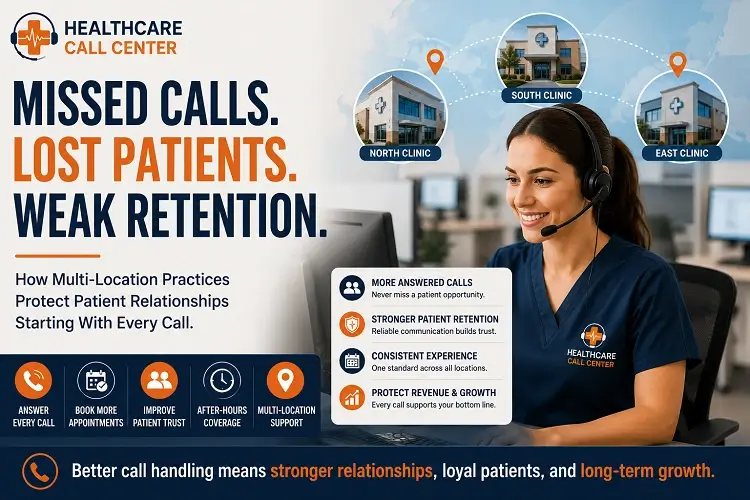
That is why missed calls are not only a lead problem. They are a patient retention problem.
For growing medical groups, better call handling is not just an operational fix. It is a way to protect patient relationships across every location.
Why Missed Calls Matter More in Multi-Location Practices
A multi-location practice has more moving parts than a single office.
Patients may call one location to ask about another. A provider may rotate between offices. Scheduling rules may vary by location. Some offices may be busier than others. One front desk may be fully staffed while another is stretched thin.
From the patient’s point of view, none of that should matter.
They expect the practice to answer, understand the request, and route them to the right next step. If the call is missed, the patient does not think about staffing patterns or operational complexity. They feel ignored.
That feeling can damage retention.
A patient who cannot reach the practice may wonder:
- Will anyone call me back?
- Is this office too busy for me?
- Should I find a provider that is easier to reach?
- Will follow-up care be this frustrating?
- Can I trust this group with something important?
For multi-location practices, consistency matters. A patient should not receive a great call experience at one location and a poor one at another. Missed calls create inconsistency, and inconsistency weakens trust.
Missed Calls Create a Weak First Impression
Patient retention starts earlier than many practices realize.
It does not begin after the first visit. It begins when the patient first tries to contact the practice.
If a caller is a new patient, that first call may decide whether they book. If a caller is an existing patient, that first failed attempt may decide whether they stay loyal. This is when a dedicated medical virtual receptionist helps to recover your missed-call patient and convert it as booked patient.
A missed call can create several problems at once:
- The patient may not leave a voicemail.
- The patient may call a competitor.
- The patient may delay scheduling.
- The patient may lose confidence in the practice.
- The front desk may spend time chasing callbacks later.
- The marketing team may not know the lead was lost.
This is why a US-based healthcare call center for patient retention matters for practices that are trying to grow. The phone experience is part of the patient experience.
If the first call feels unreliable, the practice starts the relationship from behind.
Retention Is Not Just About Clinical Care
Patients stay with a practice for more than clinical outcomes.
They stay because the experience feels reliable. They stay because communication is clear. They stay because scheduling is easy. They stay because they know how to reach someone when they need help.
Clinical care may be excellent, but poor access can still push patients away.
A multi-location practice can invest in strong providers, updated technology, a polished website, and strong reviews. But if patients cannot get through by phone, the practice still feels hard to work with.
Retention is built through repeated moments of confidence.
A patient books easily. A question gets answered. A callback happens when expected. A follow-up appointment is scheduled without friction. An after-hours message is routed properly. A billing or referral question does not disappear.
Missed calls break those moments.
Multi-Location Practices Often Do Not See the Full Missed Call Problem
One of the hardest parts of missed call management is visibility.
A practice may know how many appointments were booked. It may know how many calls were returned. It may even know how many voicemails were received.
But many practices do not clearly know how many patient calls were missed, which location missed them, why they were missed, and what happened afterward.
This creates a dangerous blind spot.
A location may look healthy because the schedule is full, but it may still be losing future growth through unanswered calls. Another location may appear underperforming, but the real issue may be call coverage during peak hours.
Common missed call blind spots include:
- Lunch-hour call gaps
- Monday morning call spikes
- End-of-day overflow
- Staff meeting coverage gaps
- Multi-location transfer confusion
- High-volume campaign days
- Calls missed while checking in patients
- Calls missed because staff are handling insurance or billing questions
Without better visibility, the practice may blame demand, marketing, or provider availability when the phone process is the real issue.
Missed Calls Create Follow-Up Delays
A missed call is rarely solved by voicemail alone.
Even when a patient leaves a message, the front desk still has to return the call. That callback may happen hours later or the next business day. By then, the patient may be unavailable, frustrated, or already booked somewhere else.
For multi-location practices, callback delays can grow quickly because teams are already managing in-office patients and daily administrative work.
The process often looks like this:
- Patient calls during a busy time.
- The call goes unanswered.
- The patient leaves a voicemail, or does not.
- Staff reviews voicemail later.
- Staff call back when the patient is unavailable.
- The patient calls again.
- The cycle repeats.
This creates more work for the staff and more friction for the patient.
A better medical answering service can reduce that cycle by answering the call earlier, capturing the request, and routing it according to the practice’s instructions.
Patient Retention Drops When Access Feels Unreliable
Patients are more likely to stay with a practice when they believe access is dependable.
Access does not only mean appointment availability. It also means communication access.
Can they reach the practice when they call? Can they ask a question? Can they reschedule? Can they confirm instructions? Can they get routed to the right team?
When access feels unreliable, patients may start looking elsewhere.
This is especially true for:
- Patients managing ongoing care
- Patients with repeated follow-up needs
- Patients comparing specialty providers
- Parents calling on behalf of children
- Patients with anxiety around symptoms or procedures
- Patients who need help outside standard office hours
For multi-location practices, the risk is higher because patients often have choices. If one location is hard to reach, they may switch locations. If the whole group feels hard to reach, they may switch providers entirely.
Missed Calls Hurt Marketing ROI
Multi-location groups often spend heavily on growth.
They invest in SEO, local search, Google Business Profiles, paid ads, referral relationships, reputation management, and patient reactivation campaigns.
All of that effort is designed to create action.
The patient sees the practice, feels interested, and calls.
If that call is missed, the marketing investment loses power. The campaign may still generate traffic. The website may still rank. The ad may still receive clicks. But the conversion fails at the phone.
This is why missed calls should be measured as part of marketing performance, not only front desk performance.
For example:
- A location page may rank well, but calls may go unanswered.
- A paid ad may generate high-intent calls, but staff may be overloaded.
- A referral campaign may work, but patients may not reach the right location.
- A new specialty page may drive interest, but intake may be inconsistent.
Growth does not end at the click. It continues through the call.
Staff Burnout Makes the Retention Problem Worse
Front desk teams are often blamed for missed calls, but the issue is usually capacity.
A front desk person cannot check in a patient, answer a provider question, verify insurance, manage a schedule change, handle a walk-in, and answer every phone call at the same time.
In multi-location groups, this pressure can vary by office. One location may be stable. Another may be short-staffed. Another may have a sudden call spike because of a local campaign or provider schedule change.
When staff is overloaded, call quality drops.
Patients may hear rushed answers. Calls may be placed on hold. Messages may be incomplete. Follow-up may be delayed. Staff may become frustrated with callers who simply need help.
A front desk overflow answering service helps reduce pressure by covering calls when the in-office team cannot answer quickly.
This protects both patients and staff.
After-Hours Coverage Also Affects Retention
Many patient relationships are tested outside normal business hours.
A patient may remember the practice not because everything went perfectly during the day, but because someone answered when they were worried after hours.
For multi-location practices, after-hours call handling can become complicated. Different providers may cover different locations. Different specialties may have different escalation rules. Some calls can wait. Some should be routed sooner.
If after-hours communication is inconsistent, patients may lose confidence.
An after-hours medical answering service helps create a clear process for calls after the office closes. The goal is not to replace clinical decision-making. The goal is to make sure calls are answered, documented, and routed based on the practice’s rules.
For retention, that reliability matters.
Multi-Location Practices Need Standardized Call Handling
A growing practice cannot rely on each location making its own call handling process.
That may work for a while, but it becomes harder to manage as the group expands.
Standardized call handling helps create consistency across the organization.
A strong process should define:
- How new patient calls are answered
- How existing patient calls are routed
- How appointment requests are captured
- How urgent messages are escalated
- How after-hours calls are documented
- How overflow coverage works
- How location-specific details are handled
- How staff know which calls need priority
This does not mean every location loses flexibility. It means every patient gets a consistent baseline experience.
For multi-location groups, consistency is a retention advantage.
Which Calls Should Multi-Location Practices Prioritize?
Not every call has the same urgency or business impact.
Practices should pay special attention to calls that directly affect retention and revenue, including:
New Patient Appointment Requests
These calls should be answered quickly because caller intent is high. A delay can send the patient to another provider.
Follow-Up Scheduling Calls
Follow-up visits protect care continuity and future revenue. Missed follow-up calls can weaken retention.
Reschedule and Cancellation Calls
If these calls are not handled quickly, schedule gaps can increase, and patients may not rebook.
Post-Visit Questions
Patients who feel unsupported after the visit may become less loyal.
After-Hours Messages
These calls often carry more anxiety and require clear routing rules.
Location Transfer Calls
Patients should not feel stuck between offices. A multi-location group needs clear routing support.
How Better Call Handling Supports Patient Retention
Better call handling improves retention because it reduces friction.
It helps patients feel that the practice is reachable, organized, and responsive.
It also helps staff work from clearer information instead of chasing incomplete voicemails.
A stronger call handling process can support retention by:
- Answering more calls during peak hours
- Reducing voicemail dependency
- Capturing complete patient details
- Routing calls to the right location or team
- Supporting appointment requests
- Reducing callback delays
- Improving after-hours message handling
- Helping staff focus on in-office patients
- Creating a consistent experience across locations
For multi-location practices, that consistency is essential.
How to Audit Missed Calls Across Multiple Locations
Before a practice can fix missed calls, it needs to understand where the problem is happening.
A simple audit should review:
- Which locations miss the most calls
- Which days and times have the highest missed call volume
- How many missed callers leave voicemail
- How quickly callbacks happen
- How many missed calls come from new patients
- How many missed calls happen after marketing campaigns
- How after-hours calls are routed
- Whether locations follow the same call handling process
- Which pages or campaigns generate calls that are not answered
This audit can reveal whether the problem is staffing, call flow, scheduling complexity, or lack of overflow support.
It can also show which locations need support first.
What Multi-Location Practices Should Do Next
The best next step is not always hiring more staff.
Hiring can help, but it may not solve call spikes, lunch coverage, after-hours gaps, or inconsistent location processes.
Multi-location practices should first ask:
- Are we missing calls during predictable busy times?
- Are new patient calls getting answered quickly?
- Are callbacks happening fast enough?
- Do all locations follow the same call flow?
- Do patients reach the right location or team?
- Do we have after-hours coverage rules?
- Do we know which missed calls cost us appointments?
If the answer is unclear, the phone process needs attention.
A structured call handling partner can help provide coverage where the practice needs it most, whether that is overflow, after-hours, appointment requests, or multi-location routing support.
Final Takeaway
Missed calls are not only missed conversations.
For multi-location practices, they can become missed appointments, lost follow-ups, weaker patient trust, lower marketing ROI, and higher staff pressure.
Patient retention depends on reliability. If patients cannot reach the practice when they need help, they may not stay loyal, even if the clinical care is strong.
The solution starts with visibility and consistency. Practices need to know where calls are being missed, which locations need support, and how patient calls should be answered and routed.
Healthcare Call Center helps medical practices answer more calls, reduce front desk overload, support after-hours communication, and protect patient relationships across locations.
Frequently Asked Questions
1. How do missed calls affect patient retention?
Missed calls affect patient retention by making the practice feel hard to reach. Patients may delay care, miss follow-ups, lose trust, or choose another provider if they cannot get help when they call.
2. Why are missed calls a bigger problem for multi-location practices?
Multi-location practices have more schedules, providers, front desks, routing rules, and patient call paths. Without consistent call handling, patients can experience different service levels depending on which location they call.
3. Can a medical answering service help multi-location practices?
Yes. A medical answering service can help answer overflow calls, capture appointment requests, support after-hours communication, and route messages according to each location’s instructions.
4. What calls should multi-location practices prioritize?
Multi-location practices should prioritize new patient calls, follow-up scheduling, reschedule requests, post-visit questions, after-hours messages, and calls that need location-specific routing.
5. How can practices reduce missed calls without hiring more staff?
Practices can reduce missed calls by using front desk overflow coverage, after-hours answering support, clearer routing rules, call tracking, and standardized call handling across locations.
by Erika Sanchez | Jul 31, 2026 | Healthcare Call Center Services
Running one medical practice is hard enough. Running three, five, or ten locations multiplies every operational challenge – especially when it comes to patient communication.
Location A has a front desk that answers every call within two rings. Location B struggles with a single receptionist handling a high volume of calls. Location C just opened, and the staff is still learning the scheduling system. Meanwhile, patients are calling different locations, getting different answers, experiencing different levels of service, and forming inconsistent impressions of your brand.
This is the multi-location communication problem, and it is one of the most common reasons growing practice groups seek out a centralized healthcare call center.
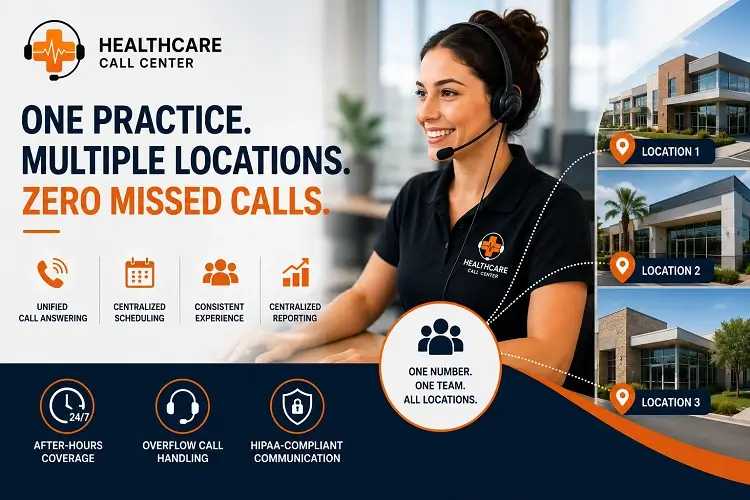
A healthcare call center for multi-location practices solves this by creating a single, consistent point of contact for every patient call – regardless of which location they are trying to reach. Calls are answered the same way, scheduling is handled in the same system, and the patient experience is identical whether they call your flagship location or your newest satellite office.
The Multi-Location Communication Problem
When practices expand to multiple locations, phone communication tends to fragment. Each location hires its own front desk staff, sets its own call handling procedures, and manages its own scheduling. On paper, this looks like independence. In practice, it creates chaos.
The most common problems include:
Inconsistent Patient Experience
A patient who had a great phone experience at Location A calls Location B and gets a rushed, put-on-hold, unhelpful interaction. They wonder if it is the same practice. Brand trust erodes.
Missed Calls at High-Volume Locations
The busiest location inevitably has the most missed calls. While Location C is underutilized, Location A is turning away patients because the phone goes unanswered. There is no system to route overflow calls to available staff.
No Centralized Visibility
Each location reports its own call metrics (if they track them at all). There is no unified dashboard showing total call volume, answer rates, booking rates, or patient satisfaction across all sites. Leadership cannot see which locations are performing and which are struggling.
Scheduling Complexity
Providers rotate between locations. New patients do not know which location to call. Referrals get sent to the wrong site. Without centralized scheduling, appointments are missed or double-booked.
After-Hours Gaps
If each location handles its own after-hours patient calls, coverage is inconsistent. One location might have a shared on-call phone. Another might send everything to voicemail. Patients have no idea what to expect when they call after 5 PM.
Staff Burnout at Busy Locations
The front desk at the highest-volume location is perpetually overwhelmed. Turnover is high. New hires take months to train. And the cycle repeats.
How a Centralized Healthcare Call Center Solves These Problems
A healthcare call center designed for multi-location practices addresses each of these challenges with a single, coordinated system.
Unified Call Answering
All patient calls – whether to Location A, B, or C – route through the central call center. Agents answer with the appropriate location name, follow practice-wide protocols, and handle each call to the same standard. The patient experience is consistent across every site.
Overflow and Load Balancing
When Location A is overwhelmed, calls automatically roll to the call center. No patient waits on hold for more than a few rings. The call center acts as an extension of your front desk, absorbing volume spikes during busy periods.
Centralized Scheduling
Agents have access to a unified scheduling system that shows availability across all locations and providers. When a patient calls, the agent can find the earliest available appointment at any convenient location – maximizing booking efficiency and distributing patient load.
Multi-Location Provider Management
Providers who work at multiple locations are tracked in the scheduling system. Agents know exactly where each provider is on each day and can book accordingly. Patients are directed to the right location for their preferred provider without confusion.
After-Hours Coverage for All Locations
A single call center handles after-hours calls for every location. Patients calling any of your offices after business hours reach the same trained agents, follow the same urgent message protocols, and can book appointments for the next business day. Consistent, reliable, professional – every location, every hour.
Centralized Reporting and Analytics
Practice leadership receives a single dashboard showing call metrics across all locations: total calls, answer rates, booking rates, after-hours activity, peak call times, and new patient inquiries by location. This data reveals which locations need additional front desk support, which providers are in highest demand, and where marketing efforts are generating the most calls.
What Multi-Location Practices Should Look for in a Call Center Partner
Not every call center can handle the complexity of multi-location medical practices. When evaluating partners, prioritize:
Multi-Location Scheduling Experience
The call center must have experience managing schedules across multiple sites, provider rotations, and location-specific rules. Ask for case studies or references from other multi-location medical groups.
Scalable Infrastructure
If you plan to add more locations, the call center should be able to onboard new sites quickly – adding phone numbers, call flows, and scheduling rules without major disruption.
Location-Specific Call Flows
Each location may have different providers, services, hours, and patient demographics. The call center should be able to configure location-specific greetings, call routing, and scheduling rules while maintaining a consistent overall brand experience.
HIPAA Compliance Across All Sites
A single BAA should cover all your locations. The call center must maintain compliance standards uniformly – no exceptions for smaller or newer sites.
Bilingual Agents
Multi-location practices often serve diverse communities. A call center with bilingual agents ensures every patient at every location can communicate effectively.
CRM and Practice Management Integration
The call center should integrate with your practice management software across all locations. Whether you use a single instance of Athena or different systems at different sites, the integration must be seamless.
Real-World Impact: What Changes When You Centralize
Before Centralization:
- 3 locations, each with its own front desk handling calls
- Location 1: 92% answer rate, patients happy
- Location 2: 71% answer rate, patients frustrated
- Location 3: 84% answer rate, inconsistent experience
- After-hours: all locations go to voicemail
- New patient inquiries: 30% captured, 70% lost to voicemail or long hold times
- Monthly booked appointments from phone calls: 180
After Centralization:
- All calls answered by a central healthcare call center plus location-based front desk
- Consistent 95%+ answer rate across all locations
- After-hours calls answered live by trained agents
- New patient inquiries: 85% captured and booked on the call
- Monthly booked appointments from phone calls: 310 (a 72% increase)
- Front desk staff at all locations focused on in-person patient care
- Leadership has a single dashboard showing performance across all sites
The centralization does not replace your front desk. It supplements them – handling overflow, after-hours, and new patient inquiries so your in-house team can focus on patients who are physically present.
Specialties That Benefit Most from Multi-Location Call Centers
Plastic Surgery Networks
Multiple locations often share surgeons who rotate between offices. A centralized call center manages the complexity of provider schedules across sites and ensures consultation requests are booked at the right location with the right surgeon.
Dental Groups
Dental service organizations (DSOs) and multi-location dental practices face high call volume and frequent emergency requests. A centralized call center handles overflow, emergency triage, and new patient booking across all locations.
Fertility Clinic Networks
Fertility patients often need to reach their clinic urgently – medication questions, cycle timing, test results. A centralized call center ensures patients at every location get the same responsive, empathetic care regardless of which clinic they are calling.
OB-GYN Groups
Pregnancy-related calls are time-sensitive and emotional. A centralized call center standardizes how these calls are handled, ensuring every patient at every location receives consistent, compassionate support.
Primary Care and Multi-Specialty Groups
Large medical groups with multiple specialties and locations benefit from a call center that can route calls, schedule across departments, and handle the complexity of multi-provider, multi-site operations.
Implementation: How to Roll Out a Centralized Call Center
Phase 1: Assessment – Audit current call volume, answer rates, and scheduling systems across all locations. Identify the biggest pain points and quick wins.
Phase 2: Integration – Connect the call center to your scheduling systems. Configure call flows, provider rules, and location-specific protocols.
Phase 3: Pilot – Launch at one or two locations first. Monitor call quality, booking accuracy, and patient feedback. Refine before expanding.
Phase 4: Full Rollout – Extend to all locations. Train front desk staff on how to work with the call center (overflow, after-hours handoff, new patient routing).
Phase 5: Optimization – Review monthly reports, adjust staffing, refine call flows, and expand service as needed.
The entire process typically takes 3 to 6 weeks for a practice with 3 to 10 locations, assuming cloud-based scheduling systems are already in place.
The Bottom Line for Multi-Location Practices
Every location you add increases call volume, scheduling complexity, and the risk of inconsistent patient experiences. A centralized healthcare call center absorbs that complexity, ensuring that whether a patient calls your newest satellite office or your flagship location, they get the same fast, professional, empathetic response.
For multi-location practice groups, centralization is not a luxury. It is the operational infrastructure that makes growth sustainable.
Book a free consultation to see how Healthcare Call Center can centralize patient communication across all your practice locations.
FAQs
1. How does a centralized call center handle calls for multiple practice locations?
Each location has a unique phone number that routes to the central call center. Agents answer with the specific location name, follow location-specific call flows, and access a unified scheduling system that shows availability across all sites and providers.
2. Can a multi-location call center integrate with different scheduling systems at each site?
Yes. If your locations use different practice management software, the call center can integrate with each system separately or work through a unified scheduling platform that syncs across all sites.
3. How much does a centralized healthcare call center cost for multi-location practices?
Pricing depends on the number of locations, total call volume, and service level. Most multi-location practices spend $800 to $3,000 per month, with costs offset by increased booking rates and recovered missed-call revenue.
4. Will the call center replace our front desk staff?
No. The call center supplements your front desk by handling overflow calls, after-hours coverage, and new patient inquiries. Your in-house team focuses on patients in the office while the call center ensures no phone-based patient is missed.
5. How long does it take to implement a centralized call center for multiple locations?
Typical implementation takes 3 to 6 weeks for practices with 3 to 10 locations, assuming cloud-based scheduling systems are in place. Larger networks may require 6 to 12 weeks depending on complexity.
by Erika Sanchez | Jul 10, 2026 | Healthcare Call Center Services
You have heard the sound a thousand times. A patient calls your practice after hours. The phone rings four times. Then they hear it. A recorded voice tells them the office is closed, lists the hours, instructs them to call 911 in an emergency, and asks them to leave a message after the beep.
What does the patient do next?
They hang up. And they call the next practice on their list.
This scenario plays out at medical practices across the country every single night. And the cost is far greater than anyone realizes.
The Voicemail Problem in Healthcare
Voicemail was designed for a world where patients had no other options. In 2026, they will have plenty. When a patient reaches voicemail, their behavior is remarkably consistent and thoroughly documented.
Approximately 72% of callers hang up without leaving a message. Of those who hang up, about 60% call a different provider within 10 minutes. Among new patient callers specifically, 85% say they would not leave a voicemail to book a first appointment. These are not statistics from a single study. They reflect consistent findings across healthcare communication research over the past decade.
This is not a patient behavior problem that you can solve by asking patients to be more patient. This is a practice revenue problem disguised as a patient behavior problem. Every call that hits voicemail is a patient who may book with a competitor, and revenue that disappears before your front desk even knows the call happened.
Why Do Patients Hang Up Instead of Leaving a Voicemail?
It is easy to assume that if a patient really needs an appointment, they will leave a message and wait for a callback. In reality, that is rarely what happens.
Today’s patients have more choices than ever before. A quick Google search usually shows several nearby practices offering the same service. If the first office sends them to voicemail, it only takes a few seconds to tap the next phone number on the screen. Smartphones have made switching providers almost effortless.
Timing also plays a big role. Many patients call after work, during lunch, or late in the evening because those are the only moments they have available. They are often hoping to book an appointment, ask about a concern, or speak to someone while the issue is fresh in their mind. Waiting until the next business day is not always an option they feel comfortable with.
There is also uncertainty. When someone leaves a voicemail, they have no idea if they will receive a callback in ten minutes, two hours, or the following day. That uncertainty creates frustration, especially when they are worried about their health or trying to schedule care quickly.
For many patients, the first phone call is also their first impression of your practice. Reaching a real medical call center service provider where a person creates confidence. Reaching a voicemail often creates doubt. And in healthcare, where trust matters from the very first interaction, that small moment can determine whether a patient books with your practice or another one.
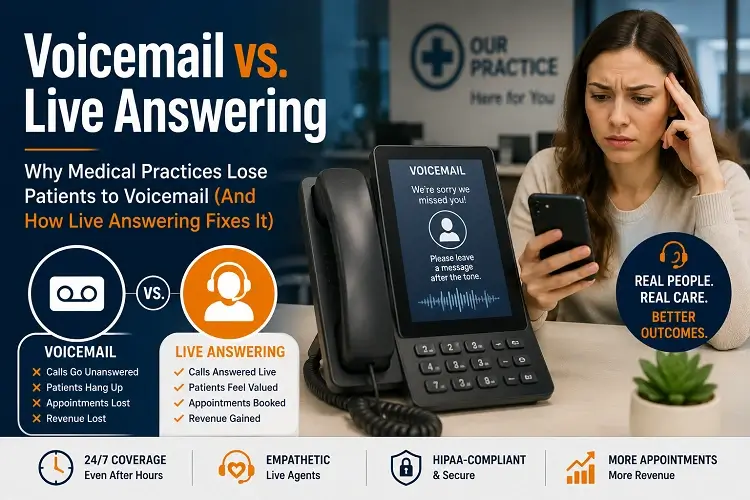
Voicemail vs. Live Answering: A Side-by-Side Comparison
The difference between voicemail and live answering is not subtle. Voicemail is a wall that stops patient engagement. Live answering is a door that invites it.
With voicemail, the patient never reaches a human. The appointment does not get booked until the next business day at the earliest. The patient feels like a transaction, not a valued patient. After-hours emergencies are handled by telling the patient to call 911, regardless of the actual clinical urgency. New patient capture rates sit below 15% because most callers simply will not leave a message for a practice they have never visited.
With live answering, the patient reaches a human within 2 to 3 rings. The appointment gets booked on the call, in real time. The patient feels valued from the first interaction. After-hours emergencies follow your triage protocol with proper escalation. New patient capture rates exceed 80% because the caller is speaking to a real person who can answer questions, provide reassurance, and guide them toward booking.
The Hidden Costs of Medical Voicemail
Most practice administrators look at voicemail as free. There is no monthly fee, no per-call charge, no vendor to manage. But the cost is real, and it hides in the revenue you never collected.
Lost new patient revenue is the highest cost. A new patient who calls after hours and reaches voicemail is unlikely to leave a message. They will call a competitor, and you will never know the call happened. Consider a plastic surgery practice that misses 3 new patient calls per week after hours. An average consultation is worth $400, and the average procedure conversion is worth $8,000. The practice is losing $24,000 per week in potential procedure value, which adds up to over $1.2 million annually.
Patient erosion is a slower but equally damaging cost. Even existing patients lose patience with voicemail over time. If they consistently reach a machine instead of a person, they start to feel like the practice does not value their time. The switching costs in healthcare are lower than most practices think, especially for specialties with high competition.
Compliance and liability risk is a hidden cost that many practices overlook. When patients leave medical information on an unsecured voicemail system, protected health information may be exposed in ways that violate HIPAA. A live, HIPAA-compliant answering service eliminates this risk entirely.
Staff burnout is the final hidden cost. Your front desk team starts every morning with a backlog of voicemails to return. They start the day behind, rushing through calls, giving each patient less attention than they deserve, and feeling overwhelmed before the first patient even arrives.
Signs Your Practice Is Losing Patients to Voicemail
Many practices do not realize voicemail has become a problem until they start looking closely at their call patterns. The warning signs are often there long before anyone notices the impact on patient growth.
One of the biggest indicators is a large number of unanswered calls outside normal office hours. If patients regularly reach voicemail in the evenings, on weekends, or during lunch breaks, there is a good chance some of those callers are choosing another provider instead of waiting for a callback.
Another common sign is a front desk that starts every morning working through dozens of voicemail messages before they can focus on patients already in the office. When staff spend the first hour returning missed calls, everything else tends to fall behind.
You may also notice fewer new patient appointments despite maintaining steady website traffic or advertising campaigns. If people are finding your practice but not booking, the patient experience may be creating an invisible bottleneck.
Even online reviews can provide clues. Comments mentioning difficulty reaching the office, delayed callbacks, or frustration with voicemail often point to communication issues rather than clinical care.
If any of these situations sound familiar, your practice may not have a marketing problem at all. It may simply have a call coverage problem that is costing it new patients every day.
What Patients Expect When They Call a Medical Practice
When patients call a healthcare practice, they want three things. They want to reach a human, not a phone tree, not a bot, not a voicemail box. They want to feel heard, meaning their concern matters even if it is routine. And they want to know the next step, whether that is a booked appointment, a scheduled callback time, or clear instructions.
Voicemail delivers none of these. An AI chatbot delivers the illusion of the first one but fails on the other two because it cannot handle nuance, emotion, or clinical judgment. A trained live agent delivers all three consistently, which is why practices that switch from voicemail to live answering see immediate improvements in patient satisfaction and revenue capture.
This is why our healthcare answering service uses stay-at-home moms. Real people who can listen, respond with empathy, and guide patients to the right next step. Whether that means booking an appointment, following a triage protocol, or simply reassuring an anxious caller that someone cares about their situation.
Voicemail vs. Live Answering: The Revenue Difference
Take a typical practice with 40 calls per day, an after-hours and missed-call rate of 25%, an average appointment value of $300, and 22 working days per month.
With voicemail, 10 calls per day reach voicemail. About 2 leave a message and 8 hang up. Of the 8 who hung up, roughly 5 would have booked an appointment. Monthly revenue lost equals $33,000.
With live answering, 10 calls per day are answered live. About 7 book an appointment on the call. Monthly revenue recovered equals $46,200.
The live answering service that costs $500 to $800 per month just generated a $33,000 monthly return on investment. That is not a marginal improvement. It is a transformational shift in how the practice captures revenue.
You can calculate your own numbers using our revenue calculator to see the exact gap for your practice.
What Changes After Switching to a Live Answering Service
Here is what changes when a practice moves from voicemail to live answering.
Monday mornings start with a clean slate instead of a voicemail backlog. The front desk team focuses on in-office patients instead of returning calls from the weekend. After-hours calls are handled by trained agents who follow your specific protocols. New patient inquiries are captured and booked in real time rather than being lost to voicemail. Patient satisfaction improves because callers feel valued from their very first interaction with your practice.
Staff productivity increases because the team is not constantly playing catch-up. Reports from the answering service provide visibility into call patterns that were previously invisible. You learn exactly how many calls come in after hours, what patients are asking about, and how many appointments are being captured.
How to Replace Voicemail with a Healthcare Answering Service
Switching is simpler than most practices expect. Start by auditing your current call flow to understand when calls are going to voicemail and how many are coming in per week. Then define your protocols for what agents should do with urgent calls, prescription refills, and appointment requests.
Choose a HIPAA-compliant partner and make sure they sign a BAA and understand your specialty. Start with after-hours coverage only, then expand to overflow during busy periods as you get comfortable with the service. Use the reporting dashboard to track call outcomes and refine your scripts over time.
Most practices go live within 2 weeks of signing up, and the impact is immediate.
The Bottom Line
Voicemail is not a patient communication strategy. It is a revenue leak that quietly drains your practice every single night. Every call that hits the beep is a patient who might book with a competitor, delay needed care, feel like your practice does not care, or never call you again.
In 2026, patients expect their healthcare providers to be accessible. Live answering is the simplest and most cost-effective way to meet that expectation while recovering revenue that voicemail has been quietly costing you.
If you are ready to stop losing patients to voicemail, book a free consultation and get a custom call audit in 48 hours.
Frequently Asked Questions
What percentage of patients actually leave a voicemail when they reach a medical practice?
Studies show approximately 72% of callers hang up without leaving a message when they reach voicemail. Among new patient callers, that number is even higher, with 85% saying they would not leave a voicemail for a first appointment. Most of those callers simply dial the next provider on their list.
Is voicemail ever acceptable for a healthcare practice?
Voicemail has a limited role for non-urgent administrative messages like prescription refill requests or appointment time changes. But for new patient inquiries, urgent medical concerns, after-hours calls, and anything involving a patient who is ready to book, voicemail directly costs the practice revenue and patient trust.
How quickly does a live answering service pick up compared to voicemail?
A dedicated healthcare answering service typically answers calls within 3 to 4 rings, often under 15 seconds. Voicemail pickup is technically instant, but it fails at the actual goal, which is connecting the patient with a helpful human who can solve their problem and schedule their appointment.
Does a live answering service cost more than voicemail?
Yes, a live answering service costs more than free voicemail. But the real comparison is about return on investment. If a practice misses even 5 calls per week from new patients, and each appointment is worth $300 to $500, the lost revenue far exceeds the monthly cost of a live answering service. Most practices recover the cost by capturing just 2 to 3 additional appointments per month.
Can a live answering service handle after-hours and weekend calls?
Yes. A healthcare answering service provides 24/7 coverage, including after-hours, weekends, and holidays. Trained agents follow your practice’s specific protocols for triage, message delivery, on-call physician routing, and appointment scheduling, so patients always reach a real person regardless of when they call.
by Erika Sanchez | Jul 9, 2026 | Healthcare Call Center Services
Every medical practice has the same problem. Patients call when your front desk cannot answer. During lunch. After hours. On weekends. At the same time, your team is with a patient in the exam room. And every one of those unanswered calls is a patient who needed something, whether that is an appointment, a prescription, reassurance about a symptom, or urgent medical guidance.
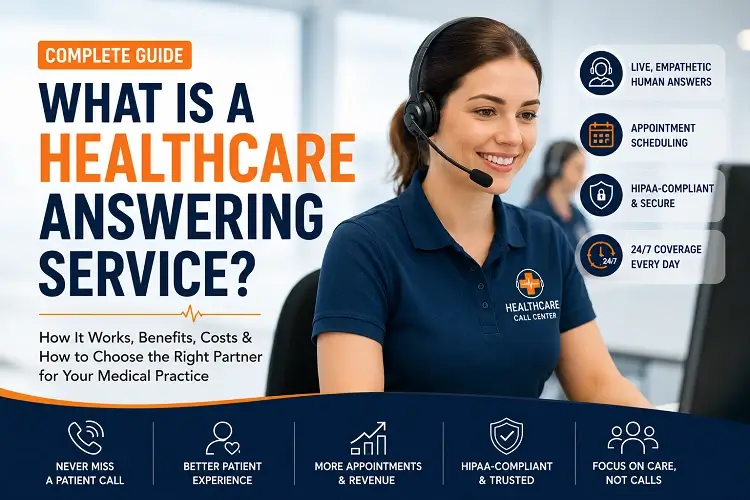
A healthcare answering service solves this problem by ensuring every patient call, 24 hours a day and 7 days a week, is answered by a trained, empathetic human who can schedule appointments, follow triage protocols, and represent your practice with warmth and professionalism.
This blog covers everything you need to know about what a healthcare answering service is, how it works, what it costs, and how to choose the right partner for your practice.
What Is a Healthcare Answering Service?
A healthcare answering service is a specialized live-call solution designed specifically for medical practices. Unlike a generic answering service that simply takes messages, a healthcare-focused service provides a comprehensive suite of capabilities designed to protect practice revenue and improve patient experience.
Live human agents are trained on healthcare communication and HIPAA compliance. They understand medical terminology, insurance basics, and the emotional dynamics of patient calls. Appointment scheduling happens directly in your EMR or practice management software, with no double entry and no missed bookings. Triage protocols are executed following your specific clinical guidelines, so urgent calls are escalated exactly the way you want them handled.
On-call physician routing goes through secure, documented channels with full audit trails. New patient intake captures insurance information, medical history, referral source, and any details your practice needs to prepare for the first appointment. Prescription refill routing reduces front desk phone traffic. Bilingual support serves diverse patient populations. And every interaction is documented in HIPAA-compliant systems with encrypted storage and detailed access controls.
In short, a dedicated healthcare front desk overflow support acts as an extension of your front desk. One that never goes home, never takes a lunch break, and never lets a patient call go to voicemail.
Why Voicemail Is Costing Medical Practices Patients and Revenue
The data on patient phone behavior is clear and consistent across multiple studies. Approximately 72% of callers who reach voicemail hang up without leaving a message. Of those who hang up, about 60% dial the next provider on their list within 10 minutes. Among new patient callers, 85% say they would not leave a voicemail for a first appointment. And patients consistently equate answered calls with quality care, meaning unanswered calls signal indifference and erode trust before the patient ever walks through your door.
When your practice sends calls to voicemail after hours, you are not just inconveniencing patients. You are actively pushing them toward competitors who simply picked up the phone.
Consider the math for a typical medical practice. If you receive 40 calls per day and miss 25% of them, that is 10 missed calls per day. Over 22 working days, that becomes 220 missed calls per month. If 30% of those would have booked an appointment, you would have lost 66 appointments per month. At an average appointment value of $300, that is $19,800 in lost revenue monthly. Annualized, your practice is losing $237,600.
You can plug your own numbers into a revenue calculator to see your practice’s exact gap.
How a Healthcare Answering Service Works
The process is designed to be simple and fast. Before going live, the service analyzes your practice’s call patterns. They look at peak hours, missed-call windows, after-hours volume, and specialty-specific needs. This analysis becomes your custom call-handling blueprint.
Then agents are trained on your specific protocols, specialty terminology, scheduling rules, and escalation procedures. They learn your practice the way a new front desk team member would, but with the structure and oversight of a professional training program. Within approximately 2 weeks, calls begin routing to your dedicated team. Your front desk gets immediate relief during busy hours, and after-hours calls are handled by trained agents who follow your exact protocols.
Monthly reports show answered call volume, new appointments booked, after-hours capture rate, and revenue recovered. You see exactly what the service delivers with no guessing about ROI.
Which Healthcare Practices Benefit Most from a Medical Answering Service?
While any medical practice can benefit, certain specialties see dramatically higher returns on investment.
OB-GYN and maternal care practices deal with pregnant patients who call at all hours with urgent concerns. A specialized OB-GYN answering service handles triage, schedules prenatal visits, and escalates true emergencies, protecting both patients and practice revenue. Patient lifetime values of $4,000 to $10,000 make every missed call expensive.
Fertility and IVF clinics handle some of the highest-value calls in healthcare. One missed fertility call can mean a lost IVF cycle worth $15,000 to $50,000. A fertility clinic answering service captures every high-value inquiry and books consultations while the patient is emotionally ready to commit.
Plastic surgery practices receive consultation leads from Google Ads, social media campaigns, and referrals. If the front desk misses a call at 8 PM, that lead calls the next surgeon on the list. A plastic surgery answering service ensures every consultation opportunity is captured regardless of when the call comes in.
Dental practices face the same challenge with patients calling during lunch, after work, and on weekends. A dental answering service captures new patient inquiries, routes emergencies, and keeps hygiene and treatment schedules full.
Primary care and multi-specialty practices handle an enormous administrative call volume. Prescription refills, referral coordination, appointment changes, and patient questions all compete for front desk time. A medical call center service absorbs this volume so your clinical team can focus on the patients in the office.
Stay-at-Home Moms vs Offshore Teams vs AI Receptionists
Not all answering services deliver the same quality. The three primary models differ significantly in patient experience quality.
Stay-at-home mom teams deliver the highest empathy and patient satisfaction. They bring lived healthcare experience, native US cultural context, low turnover, and full HIPAA compliance. They cost moderately more than offshore options but deliver substantially better results in patient retention and revenue capture.
Offshore call centers offer the lowest cost but also the lowest quality. Agents read generic scripts with limited healthcare training, have no lived understanding of American healthcare, and experience high turnover, which means your patients hear new voices constantly. Patients can tell within seconds that they are talking to someone who does not understand their situation.
AI and bot receptionists are the cheapest option but cannot handle nuanced healthcare conversations. They have no emotional intelligence, cannot triage, and cause high drop-off rates when conversations become complex. In healthcare, where anxiety and emotion drive most calls, bots fail at exactly the moment patients need the most support.
The cheapest option costs less per month but loses far more in missed patients, compliance risk, and damaged reputation over time.
Why HIPAA Compliance Matters in a Healthcare Answering Service
Any answering service handling patient calls must be fully HIPAA-compliant. This is not optional and not something to figure out after a breach. A compliant service signs a Business Associate Agreement before handling a single call. Every agent completes formal HIPAA training.
All systems use encryption for data in transit and at rest. Secure message delivery means no personal email or consumer messaging apps. Audit logs track every interaction involving protected health information.
Agents are based in the United States under US privacy jurisdiction. And a documented breach response plan exists so that if something goes wrong, everyone knows exactly what to do.
If a service cannot provide all of the above, the legal and financial risk of using it falls entirely on your practice.
How Much Does a Healthcare Answering Service Cost?
Pricing varies based on call volume, specialty, and coverage scope. Per-call pricing typically ranges from $0.75 to $1.50 per call and works best for practices with low volume but high-value individual calls. Per-minute pricing ranges from $0.75 to $1.25 per minute and suits practices with short, straightforward calls. Flat monthly pricing ranges from $200 to $900 and provides budget predictability. Multi-location enterprise practices typically negotiate custom pricing.
The real cost question is never how much the service costs. It is how much you are losing without one. For most practices, the service pays for itself by capturing just 2 to 3 additional appointments per month.
Ready to Stop Missing Patient Calls?
Book a free consultation today, and we’ll review your current call flow, identify where patient calls are being missed, and show you how much revenue your practice could recover. No pressure. Just practical insights tailored to your practice.
Frequently Asked Questions
1. What is a healthcare answering service?
A healthcare answering service provides live, HIPAA-compliant call handling for medical practices. Trained agents answer patient calls, schedule appointments, take messages, follow your call-handling protocols, and provide after-hours support so patients always reach a real person instead of voicemail.
2. Is a healthcare answering service HIPAA-compliant?
Yes. A healthcare answering service should operate under strict HIPAA-compliant procedures, including secure message handling, encrypted systems, trained agents, and a signed Business Associate Agreement (BAA) to help protect patient information.
3. Can a healthcare answering service schedule appointments?
Yes. Many healthcare answering services can schedule, reschedule, and cancel appointments based on your practice’s workflow. Depending on your setup, agents may work directly within your scheduling software or follow your approved booking process.
4. What types of medical practices benefit from a healthcare answering service?
Healthcare answering services support a wide range of practices, including primary care, OB-GYN, fertility clinics, plastic surgery practices, dental offices, orthopedic clinics, behavioral health providers, urgent care centers, and multi-specialty medical groups.
5. How much does a healthcare answering service cost?
Pricing depends on factors such as monthly call volume, coverage hours, specialty requirements, and workflow complexity. Many practices find the service pays for itself by capturing just a few additional appointments each month while improving patient satisfaction and reducing missed calls.
How to Choose the Best Healthcare Answering Service
Before signing with any provider, ask whether they have agents trained for your specific specialty. Confirm they will sign a BAA. Find out if they can integrate with your EMR and scheduling system.
Ask about their average answer speed. Request to see a dashboard with call outcomes and ROI metrics. Ask where their agents are based and whether you can customize triage protocols. Confirm coverage for after-hours, weekends, and holidays. Ask about onboarding timeline and contract terms.
If you are ready to see how much your practice is losing to missed calls, book a free consultation with Healthcare Call Center and get a custom call audit in 48 hours. No pressure, no obligation. Just the numbers.