by Erika Sanchez | Jun 10, 2026 | Healthcare Call Center Services
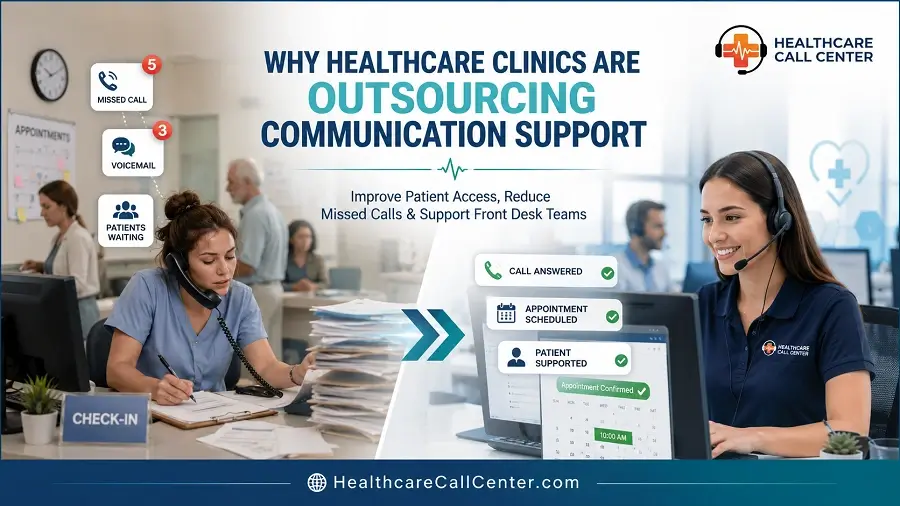
Clinic managers often find themselves responsible for patient care and the ongoing demands of running their clinic. Due to the high volume of patients coming through the clinic’s front desk, it has the added responsibility of handling all types of telephone calls (checking in and out of the clinic; scheduling appointments) and constantly answering questions from patients who are checking in and out or making appointments. In addition, even if the clinic is functioning normally, there may be times when it’s hard to communicate with the patient due to the high volume of other patients at peak times.
As a result, clinic owners are noticing a common trend over time. Staff members are constantly interrupted while checking patients in; they are also receiving phone calls during patient consultations, and patients have difficulty reaching their clinics because calls go unanswered at lunchtime or after hours (patients may choose to go to another provider after multiple unsuccessful attempts).
This is why many clinics are choosing to partner with a third-party HIPAA-compliant healthcare call center to take all or some of the “burden” off their on-site staff, alleviating the need for all staff to handle (i.e., answer) patient calls equitably, regardless of whether it is peak hours. The overall focus for most clinics that have made this decision is not necessarily to replace staff, but to maximize the effectiveness of their communication by properly handling it throughout the day.
Why Front Desk Communication Has Become More Difficult for Clinics
Patient expectations around healthcare communication have changed significantly in recent years. Patients expect quick responses and firm appointment times and dates; when they call a clinic, they want reliable assistance. If a clinic doesn’t provide timely return calls or answer incoming calls, it only adds to the patient’s frustration.
At the same time, clinics’ front desk responsibilities have grown. Reception teams at many clinics are now doing the following:
- Appointment Scheduling and Rescheduling
- Insurance Verification
- Referral Coordination
- Billing Related Inquiries
- Intake Documentation for New Patients
- EHR Documentation Updates and Admin Follow-Ups
This results in the front desk team struggling to handle all incoming calls without delays when they are busy.
With smaller clinics feeling the pressure more than ever, this becomes even more difficult for a single receptionist to successfully handle all communication points (including in-person patient care), given the large volume of incoming calls they also manage and how quickly the call volume will increase as soon as they turn their back on a phone.
Clinics that provide specialty care solutions can frequently see additional complexity added to their operation, thus resulting in many of them having some sort of urgent patient calls received by psychiatry; dental clinics receiving emergency appointment requests; and primary care offices needing to maintain strict organization to avoid missing contacts related to someone needing to reschedule or follow up during the day.
As communication demands continue to increase, many clinics are realizing that traditional front desk systems alone are no longer enough to manage patient communication efficiently.
How Missed Calls Affect Patient Experience
Unanswered calls are no longer viewed as small operational issues. For many clinics, they directly impact patient trust, appointment conversions, and overall satisfaction. Patients will generally contact a healthcare provider when something important is going on (e.g., discomfort or pain), to clarify their treatment plan, or to get in quickly for an appointment.
When a patient attempts to reach a clinic by phone but is unable to get anyone on the line, it feels as though the clinic is not present and/or does not care.
Missed calls do not just affect patient experience. They can also reduce appointment conversion opportunities and impact long-term practice growth.
Over time, repeated communication issues can reduce patient confidence in the clinic.
For example, a patient attempting to book an appointment during their work schedule may not have the opportunity to call back later. Additionally, someone needing urgent care information may choose not to return to the clinic and instead search for different options, or a current patient may become frustrated if they cannot easily contact someone at the office for follow-up questions.
Furthermore, missed calls create many additional hidden administrative issues that occur, including:
- Appointment confirmation delays
- Increased backlog of voicemails
- Increased staff members’ workload due to call-backs
- Lost patient inquiries
- Lower overall patient satisfaction.
Many health care practices have found that communication bottlenecks decrease patient satisfaction before quality of care becomes an issue. Patient satisfaction often depends on how patients feel during their first interaction with a clinic, which is one reason why communication style and empathy play such an important role in healthcare call handling.
The Administrative Pressure on In-House Staff
One of the main reasons clinics outsource communications support is that staff get tired or “burned out.”
The frontline team (the front desk staff) works in a very fast-paced, busy, and interruption-filled workplace. It is common for a receptionist to be helping a patient at the reception counter while managing two ringing phone lines and scheduling an appointment. Over time, the cumulative effect of juggling all these activities may lead to fatigue and increase the likelihood of being inaccurate in either scheduling or the accuracy of communication (because of fatigue). As a result, high turnover is seen in front desk positions in healthcare settings.
Additionally, retraining administrative staff creates operational inefficiencies. New staff need time to learn scheduling systems, patient communication protocols, insurance processes, and the clinic’s operational procedures. The quality of service during periods when new staff are being trained can be negatively affected.
By outsourcing communications support to an external team, clinics reduce the ongoing daily burden of managing phone call volume (e.g., overflow, after-hours, and scheduling requests) for their in-house teams.
By outsourcing communications support, clinics create a manageable workload for their on-site employees while also providing patients with a more consistent level of service.
The Practical Benefits of Outsourcing Communication Support
Outsourcing front desk communications helps clinical facilities resolve their operational challenges rather than expecting lower labor expenses.
Improving call coverage is an immediately apparent benefit. When a healthcare call center receives incoming communications from patients, the likelihood that a patient will encounter a voicemail system during business hours is greatly reduced. Calls will be handled continuously, even during peak periods for appointments, staff lunches and breaks, and any unexpected schedule disruptions.
By providing real-time access to call centers, the logistics of scheduling patient appointments can also be made much more efficient. Many of the outsourced teams have been trained on the clinical facility’s scheduling system to help minimize scheduling errors and avoid double-booking patients.
Improving operational efficiencies can lead to many of the following benefits:
- Quicker appointment management
- Faster response times to patient communications
- Fewer missed calls
- More consistent call handling during busy times
- Additional time and attention for clinical staff working with patients in the clinic
Another benefit of outsourcing to call center service provider is increased effectiveness of follow-up communication efforts. Many facilities use missed-call retrieval services to reach prospective patients who might otherwise be lost. In a highly competitive healthcare environment, responding promptly to patient communications can ultimately determine whether the prospect actually schedules an appointment.
Outsourcing also increases workflow stability as practices and clinics expand. As a clinic expands to more providers or locations, maintaining internal communication systems will become more difficult. External support teams provide the necessary continuity without requiring immediate staffing increases for front desk agents.
Why 24-Hour Patient Response Is Becoming More Important
Despite what many may think, healthcare communication continues beyond the closing of clinics each evening. Patients continue to call health care providers’ offices after hours (between 5 pm and 8 am) because that is usually the only time they have to manage appointment requests or health questions. Many of these after-hours calls are made for scheduling issues, to request medication clarification, or to cancel or reschedule appointments the next day, which can complicate the clinic’s operations if missed.
Without structured after-hours support, most after-hours calls to the clinic office are sent to voicemail and typically go unaddressed until the next morning. Specially when you have a healthcare call center.
A 24/7 healthcare call center enables clinics to keep their phone line(s) open to patients after standard business hours. This doesn’t mean every clinic requires full overnight scheduling support, but it does allow patients to speak live with a representative whenever they need assistance.
Clinics benefit from several operational advantages with the addition of a 24/7 healthcare call center:
- After-hours appointment requests can still be captured.
- Urgent calls can be escalated as appropriate.
- Patient response outside business hours can be expedited.
- The number of scheduling gaps caused by missed after-hours calls can be reduced.
- The clinic’s administrative teams will start each day with fewer unanswered messages.
In addition to the operational advantages for the clinic, patients appreciate knowing they have access to someone who will assist them after hours, even for just two or three minutes. Everyone who has used any after-hours healthcare service agrees that a brief exposure to a trained representative is much more reassuring to the caller than leaving a voicemail and not knowing when the call will be returned.
With the trend toward greater patient retention and overall experience excellence, the availability of after-hours healthcare services has become increasingly important to patients.
Why HIPAA Compliance Matters in Outsourced Communication
Patient confidentiality in healthcare communication is critical when deciding whether to use outsourced communication services. Therefore, it is essential for clinics to carefully consider how they will comply with HIPAA regulations when selecting a company for outsourced communications.
A HIPAA-compliant health care call center allows each organization to have access to Protected Health Information, as well as utilize established communication protocols within the Health Care System for the handling of that information; therefore, all agents are trained in patient confidentiality, proper ways to document each conversation or note, as well as the proper process for communicating and handling any Protected Health Information.
Without proper safeguards in place, a clinic could be subject to Operational Liability by outsourcing its telephone communications, thereby exposing it to potential Privacy and Operational Liability.
As a result of HIPAA requirements, the technology systems used by the outsourced call center must support the handicapping of patients’ data and include: secure call handling; encrypted communications; limited access to patients’ data; and documented processes for the storage and maintenance of patients’ data.
Ultimately, clinics should never sacrifice their commitment to client confidentiality for the convenience of outsourcing their communications; the best value is derived from a partnership built on clearly defined communication and compliance processes.
How Healthcare Call Centers Improve Operational Efficiency
Healthcare operational efficiency is very often a direct reflection of the quality of your communications. It is a given that when your calls are handled equally, your front desk turnaround will become more uniform. This will result in fewer interruptions for all employees, a more organized scheduling system, and reduced potential last-minute scheduling gaps for providers due to uncompleted or unanswered confirming calls.
In conjunction with your clinic’s call center, your clinic can develop and maintain uniform, efficient communication processes across departments or locations. Patients will also benefit from receiving more uniform responses from all administrative teams, and staff will have less work to do on their own to manage call overflow.
Over time, your clinic may see these additional benefits:
- Front desk staff can dedicate more time to working with patients in person
- Providers will have fewer interruptions with scheduled appointments
- Administrative team will have less time spent returning voicemail messages
- Patient communication records will be in a more organized and accessible manner
- Your clinic operations will feel less reactive during any part of the day
Although the improvement in your clinic operations will likely be gradual rather than dramatic, it will create a more predictable, manageable day-to-day workload for your entire practice.
The reason this is important is that the inefficiency experienced by your clinic is not due to one single issue, but rather many small communication breakdowns, every day, repeatedly over time.
Outsourcing is Becoming Part of Modern Clinic Operations
Not all clinics will use outsourcing for communications in the same way. Some clinics only need support for after-hours calls. In contrast, others rely on backup teams to complete appointment scheduling, handle overflow calls, and assist with patient follow-up and record keeping.
In general, all clinics are feeling the strain of operations
The ongoing increase in patient expectations makes it clear to clinics that their communication with patients must align with the level of clinical care provided. While front desk staff is still required, more clinics today no longer expect their in-house staff to manage all patient communication.
Using a healthcare call center enables clinics to provide more consistent access to their patients while reducing pressure on their in-house staff. Using an outsourced communication service staffed by trained personnel, secured with safety measures, and compliant with HIPAA policies and procedures is no longer just a way to fill a position; it is becoming an operational support strategy for clinics.
For clinic owners trying to improve responsiveness to patients without overburdening their staff, achieving this balance is becoming increasingly valuable.

by Erika Sanchez | May 18, 2026 | Healthcare Call Center Services
A patient may forget exact words from a phone call. People tend to remember the emotions they felt during a conversation more than the details of what was said.
This is especially true in fields like plastic surgery and dentistry, where people often feel nervous, self-conscious, or intimidated before they even start their treatment.
A nervous cosmetic surgery patient asking about a consultation is not simply booking an appointment.
A dental patient calling after severe tooth pain is not just checking availability. These conversations carry emotion and in healthcare communication, emotion changes everything.
This is one reason empathy has become one of the most important and most overlooked parts of patient experience.
In cosmetic clinics and dental offices, communication is not just operational support. It is part of patient care itself, especially for practices that rely on a professional plastic surgery call answering services to support patient interactions.
Why Empathy Matters in Patient Communication
Empathy improves patient communication by helping patients feel understood, respected, and emotionally supported during vulnerable healthcare interactions. In plastic surgery and dental care, compassionate communication often influences trust, patient comfort, and appointment conversion.
Why Communication Feels More Emotional in Plastic Surgery and Dental Care
Patients often feel emotionally vulnerable before contacting a healthcare provider. Some healthcare conversations are very private and personal, such as those around plastic surgery and dental procedures. Before making the initial contact with a healthcare provider, patients often feel vulnerable for a number of reasons.
All these emotions have an impact on the initial interactions between the patient and the practice; as a result, the communication on the front desk cannot be sterile, fast, or robotic.
The initial conversation regarding appointment scheduling can have an impact on how patients perceive the practice from that point on.
Empathy Starts Before the Consultation
Many health care providers believe the experience with patients begins in the exam room (the treatment room). However, the average consumer will start their evaluation of the practice long before the patient is handed a chart. A caller will generally develop their first impression with their initial phone call.
During that initial phone call, a patient will readily identify:
- Voice inflection
- Patience
- Warmth
- Listening skills
- Professionalism
- The speed at which the call is being handled
An interaction that exhibits empathy creates rapport during the call.
Conversely, a conversation that lacks empathy creates immediate emotional distance between the caller and the practice.
Empathy is an important factor in reducing emotional barriers, and without empathy, it is likely that the patient will contact another provider for information and/or treatment.
Why Patients Remember Emotional Interactions
Patients tend to have stronger memories of their emotional moments than factual and administrative items. This suggests that the quality of communication can affect patient loyalty and retention just as much as the clinical skills of their provider.
Patients may not fully understand all the technical aspects of their treatment. However, they will recall:
- If the staff sounded concerned
- If they felt they were being hurried or rushed
- If their questions were welcomed
- If the communications provided them with less anxiety
- If the staff communicated with them patiently
The emotional memories impact:
- Online review ratings
- Whether the patient refers others to the practice
- The patient’s retention in the practice
- Whether patients show up for their scheduled appointments
- The trust patients have in the practice
At times, practices will underestimate how much the communication occurring in the front office impacts their reputation; however, for many patients, the reception and communication provided to them are part of the plan for care.
Cosmetic Surgery Patients Need Emotional Reassurance
Cosmetic surgery conversations are often deeply personal and emotionally sensitive.
Your patient may have:
- appearance concerns
- insecurity due to age
- low body confidence
- concern about scarring
- concern over body weight
questions regarding sensitive procedures
These are all topics that demand compassion & sensitivity.
When patients contact our clinics, they’re usually experiencing some anxiety or apprehension. Many patients worry about being judged when discussing cosmetic procedures or asking sensitive questions during the scheduling process. Many feel like they have asked “too many questions.” Many patients compare various clinics/physicians before booking an actual procedure time.
Having empathy at this point is critical.
Providing a warm, friendly conversation helps to make the patient feel:
- Secure
- Comfortable
- Valued
- connected to the physician
That emotional connection directly correlates to whether or not a consultation occurs.
This is why practice-based communication and a reliable call center for cosmetic surgery clinics can be very effective for cosmetic surgeon offices.
Most patients are not only looking for procedural information they also want to feel comfortable with the clinic and the people handling their care.
Dental Patients Often Carry Fear and Anxiety
Many people have dental anxiety. Many patients put off going to the dentist for months or even years because of;
- Pain
- Embarrassment
- Trauma from previous dental visits
- Financial Constraints
- Fear of judgement
Some patients get anxiety when they are just making the call to schedule their appointment.
This highlights how important calm, supportive communication can be in reducing patient anxiety even before the appointment begins.
An empathetic conversation can help to calm someone nervous before they arrive for their appointment.
Simple ways you can communicate show a greater level of consideration and respect for the needs of your patients:
- Speaking in a calm tone of voice
- Taking your time and listening to your patient
- Not answering in a hurried manner
- Reassuring nervous patients
- Explaining processes step by step
- Showing empathy
Patients tend to base their comfort level in a dental or cosmetic office during their initial contact, which is why many practices invest in quality dental call center services.
Human Communication Builds Trust Faster
Trust is one of the most valuable assets in healthcare.
Patients feel more at ease when their experience with you is a genuine encounter, not a scripted one.
This is where using humans to answer incoming calls through a trusted call center for dental clinics can help greatly in plastic surgery and dentist offices.
At Healthcare Call Center (HCC), we have designed your communication around making a real connection with patients, not just quickly answering a call.
Patients who are calling to look for services provided by aesthetic medical clinics or dentist offices will typically need:
- Reassurance
- Patience
- Emotional understanding
- Human warmth
You cannot replicate these feelings through automated services/auto systems.
Technology can support workflows, but emotional reassurance still depends heavily on human interaction.
Why Patients Still Value Real Human Interaction
Communication in healthcare has evolved.
Patients want:
- Quick responses
- Immediate assistance
- Clear answers
- Personalised communication
Meanwhile, many practices have started to automate more of their communication.
Patients notice and will differentiate when communication is too transactional.
In many cases, this is very true when dealing with patients in trauma/emotional distress.
Therefore, the majority of practices today are focusing on:
- Live support to answer questions
- Empathy and compassion when communicating with patients
- Providing service based on patient needs/preferences
- Providing real-time conversations with patients
The practices that successfully combine efficiency with empathy will generally cultivate long-term patient loyalty.
Caring Communication Improves Appointment Conversions
Empathy isn’t only great for patient experience; it’s also a natural enhancement to business performance.
When patients feel comfortable and emotionally supported during early interactions, they are naturally more likely to move forward with consultations, return for follow-up care, and recommend the practice to others.
This can be especially important for:
- Cosmetic Surgery Clinics
- Dentists’ Offices
- Medical Spas
- Orthodontists’ Offices
- Oral Surgeons’ Offices
- Aesthetic Medicine Practices
Almost every patient will contact several different health care providers before making a decision about their treatment.
The practice with the greatest degree of warmth, patience, and professionalism will almost certainly be at the top of the patient’s list from the outset.
The quality of a practice’s communication has more impact on the patient’s choice than many practices realize.
The Qualities That Make Patient Communication More Compassionate
One reason why Healthcare Call Centers place an emphasis on caring communication is due to the fact that empathy cannot be completely scripted.
Many of the best patient communication specialists already possess certain characteristics or traits that will elicit a positive response from patients:
- Patience
- Warmth
- Good Listening Skills
- Ability to be Aware of Emotions
- Ability to Communicate Calmly
- Nurturing Conversational Style
Stay-at-home moms with strong emotional intelligence and caregiving experience often perform exceptionally well in patient communication roles.
- Managing Emotional Situations
- Calming Multitasking
- Compassionate Communication
- Helping People Feel Comfortable
- Attentive Listening
The above qualities are very important in the field of healthcare communication.
When a patient has a caring conversation with an employee, they tend to be much more receptive to the conversation than the patient who has a transactional type of conversation with an employee.
By approaching the conversation first with a human point of view, patients have a better experience whether the practice is a dental office or cosmetic practice.
Balancing Technology With Human Patient Support
Automation plays an integral role in the communication of health care.
AI and automation systems, as well as scheduling assistance, can provide increased:
However, health care communications are fundamentally emotional.
Patients not only remember the speed of a response to their inquiry. They recall how the individual who answered their call cared for them.
Technology can improve efficiency, but genuine human interaction is what makes patients feel cared for.
The best health care communication systems incorporate both.
Patient Experience Plays a Major Role in Practice Reputation
The dental and plastic surgery industries are very competitive.
Patients often compare ratings, website experience, pricing, before-and-after results, and the overall quality of communication before choosing a provider.
When patients have similar experiences, they will use the patient experience to differentiate between them.
Empathy establishes long-lasting memories.
Patients who receive emotional support are far more likely to:
- Provide positive reviews
- Refer family & friends.
- Remain loyal for long periods.
- Trust their provider more.
This is why the communication quality aspect of patient experience also represents a part of modern healthcare branding.
Patients Respond Better to Personalised Communication
Today’s patients struggle with being treated like a person rather than being just another number on the processing line. Healthcare communication strengthens when a patient feels:
- Personally acknowledged
- Emotional support
- Comfortable asking questions
- Respected in their vulnerable states.
Using empathy is how practices can consistently provide those feelings for the patient.
In addition, in healthcare, emotional trust plays a major role in how patients choose and stay loyal to a healthcare provider.
Frequently Asked Question!
Q. Why is empathy important in patient communication?
Empathy helps patients feel understood, respected, and emotionally supported, which improves trust and overall patient experience.
Q. Why do cosmetic surgery patients need empathetic communication?
Cosmetic surgery patients often discuss sensitive appearance-related concerns and may feel emotionally vulnerable during early conversations.
Q. How does empathy improve dental patient communication?
Empathy helps reduce dental anxiety, improves patient comfort, and creates more positive experiences before treatment begins.
Q. Can better communication improve patient retention?
Yes. Patients who feel supported and respected are more likely to return, follow treatment plans, and recommend the practice.
Q. What makes patient communication feel more human?
Warm tone, active listening, patience, emotional understanding, and personalized responses help communication feel more human.
Q. Why do patients prefer human communication over automation?
Human conversations provide emotional reassurance, flexibility, and empathy that fully automated systems often struggle to deliver.
Q. How does communication affect healthcare reviews?
Patients frequently mention communication quality in online reviews because it shapes their overall perception of care.
Q. What is human-first healthcare communication?
Human-first communication focuses on empathy, emotional intelligence, patient comfort, and genuine interaction rather than purely transactional communication.
Why Human-Centered Communication Matters in Modern Healthcare
As healthcare communication becomes more automated, patients increasingly value practices that still provide empathy, reassurance, and genuine human interaction during stressful or emotional situations.
Schedule An Appointment With Our Expert!
Conclusion
The way we communicate with people in the fields of cosmetic and dental care can be very significant because it tends to be more than just an administrative matter, it is an emotional matter.
Patients often reach out many times over the course of their relationship with a practice, sometimes even long before they have received any treatment. How a practice communicates with its patients during these early interactions helps to establish their level of trust and enhances that trust very quickly after they have made contact.
When a practice is able to demonstrate empathy towards each patient, they will feel safe to proceed with their treatment.
In healthcare, communication often shapes patient trust before treatment even begins.
At Healthcare Call Centers, patient conversations are conducted by real, live persons who are trained on how to communicate with warmth, professionalism and empathy. Practices that prioritize empathetic and human-centered communication often create stronger patient trust and long-term loyalty.
While technology improves operational efficiency, empathetic communication is what makes patients feel genuinely supported throughout their experience.
For cosmetic and dental practices, the emotional connection between the patient and the practice is frequently what patients will remember most.
by Felicia Goodman | Apr 6, 2026 | Call Center for Plastic Surgeons
Cosmetic practices can lose $200,000+ per year due to missed after-hours calls, especially from high-intent patients who never call back.
If you asked most cosmetic practice owners where their biggest revenue leak is, they’d point to marketing spend, procedure pricing, or staff turnover.
Almost none of them would say: “After 5pm on a Tuesday.”
But that’s where it’s happening. Quietly, consistently, and at a scale that would make most practitioners deeply uncomfortable if they actually ran the numbers.
This piece is about the after-hours problem in cosmetic practices. What it is, why it’s worse in aesthetics than almost any other specialty, and what the financial impact actually looks like when you do the math.
In this article, we break down how missed after-hours calls center services for plastic surgery impact cosmetic practice revenue and how better patient communication can significantly improve conversions.
Why Cosmetic Patients Are Different (And Why It Makes This Problem Worse)
Cosmetic and plastic surgery patients are not like other healthcare patients. They’re not calling because they’re sick. They’re calling because they’ve made a proactive, aspirational decision often after weeks or months of research, browsing before-and-after content, comparing practices, and building up the courage to take the next step.
This is important because of what it means for timing.
That research happens in the evening. The deliberation happens at night. The moment when a prospective rhinoplasty patient finally tips from “thinking about it” to “I’m going to call”. That moment happens disproportionately in the hours when most cosmetic practices are closed.
Multiple studies of inbound healthcare inquiry patterns show that 28–35% of all inbound contacts arrive outside standard business hours. For aesthetics-adjacent specialties where the purchase is elective and research-intensive, this number trends toward the higher end.
At a practice receiving 200 inquiries per month, that’s 60-70 high-intent prospects making contact when no one is there to receive them.
Many cosmetic practices are now using a cosmetic surgery medical answering service to ensure these after-hours inquiries are never missed.
What Happens When No One Answers After Hours
There are three paths a patient takes when they hit a closed office:
Path 1 – They leave a voicemail
This is the best-case scenario, and it represents a minority of callers. Most people, especially younger demographics and high-income earners accustomed to immediate response, don’t leave voicemails for practices they haven’t established relationships with. They simply hang up.
Path 2 – They call the next practice on their list
The cosmetic surgery market in most major metros is competitive. Patients who do their research have typically identified two or three practices they’re considering. When Practice A doesn’t answer, Practice B gets the call and often the booking.
Path 3 – They submit a web form and expect a rapid response
Many practices have invested in well-designed websites with consultation request forms. The patient submits their information at 9:30pm, fully expecting to hear back.
If they don’t receive a response by mid-morning the next day, their intent has cooled and the competition has had 12+ hours to contact them first.
In all three paths, the practice has generated the lead through SEO, paid advertising, social content, or word of mouth and then failed to capture it at the critical moment of action.
The $200,000 Calculation
Let’s build the number conservatively.
Practice Profile:
- 180 inbound inquiries per month
- 33% arrive after hours (evenings, weekends) = 60 after-hours contacts
Conversion Breakdown:
- Of those 60: assume 15% would have booked consultations if reached promptly = 9 consults
- Consult-to-procedure rate: 40%
- Lost procedures per month: 3.6
Revenue Impact:
- Average procedure revenue: $9,000 (conservative for a mixed cosmetic practice)
- Lost revenue per month: $32,400
- Lost revenue per year: $388,800
Even if you cut that number in half for conservative modeling even if you assume only half of those after-hours contacts would have converted. You’re still looking at $194,400 in annual lost revenue.
That’s the $200K number. And it’s a floor, not a ceiling.
The Compounding Factor: You’re Also Wasting Your Marketing Budget
Cosmetic practices are often sophisticated advertisers. Many runs Google Ads, Meta campaigns targeting their local market, and invest meaningfully in Instagram content designed to drive consultation requests.
Every dollar of that marketing budget has one job: generate inbound inquiries.
When 33% of those inquiries arrive after hours and receive no response, a proportional share of the marketing budget generated them. That spend didn’t fail, it delivered the lead. The lead just wasn’t there when it arrived.
A practice spending $6,000/month on paid advertising, with 33% of inquiries going unanswered after hours, is effectively losing ~$2,000/month in marketing ROI due purely to a response gap not ad performance, not landing page quality, not offer positioning.
Over a year: $24,000 in ad spend generating leads that converted nowhere.
Why This Problem Is Harder to Solve Than It Looks
The obvious answer is: “just hire someone to answer phones after hours.”
In practice, this is harder than it sounds.
Option 1 – Extend front desk hours
Adding coverage until 8pm and on Saturdays sounds manageable until you price it.
An additional 20 hours per week at $22/hour = $440/week, or roughly $23,000/year per employee before benefits, payroll taxes, and operational limitations.
Option 2 – Use an answering service
Traditional medical answering services take messages but often fail to convert high-intent patient inquiries. They don’t convert.
When a high-intent patient calls at 8pm and hears:
“We’ll pass along your message and someone will call you back tomorrow”
they don’t feel handled. They feel deferred.
👉 And deferral kills intent.
Option 3 – Use an automated system
Automation works for basic scheduling, but cosmetic patients have detailed questions about procedures, recovery, financing, and credentials.
A chatbot or IVR at this stage often leads to abandonment.
The Real Solution
Many practices are turning to healthcare call center services to handle after-hours patient inquiries effectively.
The real solution is trained human coverage people who understand cosmetic surgery conversations, build rapport, and move patients toward booking consultations.
Many practices are turning to healthcare call center services to provide 24/7 patient communication and capture every inbound lead.
Available when patients are actually ready.
This shift toward 24/7 patient communication is becoming essential for modern healthcare practices.
What After-Hours Coverage Changes
When a practice implements proper after-hours coverage, the impact shows across multiple metrics:
- Inquiry capture rate increases
- Speed-to-response improves dramatically
- Consultation booking rates increase (15–30%)
- No-show rates decrease
Patients who feel engaged early are more likely to convert and show up.
The Competitive Reality
Cosmetic surgery is a competitive, discretionary market.
Patients have choices.
In most metros, a patient may have 5-15 practices to choose from.
The practice that answers first wins. The one that doesn’t lose.
After-hours coverage isn’t just operational.
It’s a patient acquisition advantage.
What to Evaluate
For practices looking to fix this:
- 24/7 availability
- Cosmetic patient familiarity
- HIPAA compliance
- CRM integration
- Conversion-focused process
- Follow-up systems
FAQs
How many healthcare calls happen after hours?
Studies show that 28–35% of patient inquiries occur outside standard business hours.
Do after-hours missed calls affect revenue?
Yes, these are often high-intent patients, and missing them can result in significant revenue loss.
What is the best way to handle after-hours calls?
Using a 24/7 healthcare call center ensures every patient inquiry is answered and converted.
The Math Is Simple
Your practice is already generating leads through SEO, ads, reputation, and content.
But many of those leads are calling after hours.
And right now, they’re not being answered.
Each one represents:
- A consultation
- A procedure
- Thousands in revenue
At scale, that becomes $200,000+ per year.
That revenue doesn’t require more marketing.
It doesn’t require more surgeons.
It requires being available when patients are ready.
The revenue is already there. The only question is whether your practice is positioned to receive it.
by Erika Sanchez | Mar 23, 2026 | Healthcare Call Center Services
Patient communication plays a critical role in how clinics are perceived. For many patients, a phone call is their first interaction with a healthcare call center. This first impression directly impacts trust, professionalism, and overall patient experience.
Patients usually call to book appointments, ask treatment-related questions, or request updates. How these calls are handled shapes their perception of your clinic.
Communication in a healthcare call center goes beyond simply answering phone calls. This requires a system that will allow for efficient, secure, and compassionate responses to every patient who calls. Poor communication results in missed appointments and other lost revenue opportunities, gaps in the scheduling process, and unhappy patients. Conversely, effective communication enhances operational stability and helps to build and maintain trust between patients and clinics while also providing a recurring stream of appointments.
This blog has been prepared for business owners of healthcare businesses that are interested in improving their communication systems. Several communication best practices are listed below, which can help reduce inefficiencies and provide a better experience for patients while also supporting long-term business growth through compliance and financial success.
Healthcare Call Center Best Practices for Effective Patient Communication
1. Improve First-Call Resolution for Faster Patient Support
One of the biggest impacts a clinic can have on its communication process is through improving first-call resolution for patient concerns. Patients calling in expect to have their questions answered quickly and receive clear directions on what to do next. If they are transferred multiple times or asked to call back later, it builds a great deal of frustration and diminishes the level of trust in the clinic.
When an emphasis is placed on resolving patient concerns the first time they call, the number of repeat calls is decreased, and operational chaos is reduced. Staff will be able to manage more inquiries efficiently without necessarily increasing their workload. As this system of resolving concerns develops, workflow improvements will occur, there will be greater patient satisfaction, and increased appointment conversion rates.
2. Ensure HIPAA Compliance in Every Patient Interaction
Establishing and maintaining credibility and trust are dependent on maintaining the confidentiality of patient records. All methods used to transmit or communicate about patients need to ensure that sensitive patient information is protected and that all applicable healthcare regulations are adhered to.
To keep patient data secure:
- Use secure electronic platforms when processing all patient records
- Provide staff with continual education regarding confidentiality and privacy
- Before providing any patient information, verify the patient’s identity
BBy using HIPAA-compliant healthcare call center services, clinics can ensure compliance while maintaining patient trust. Every time a patient calls or visits, the facilities can ensure compliance every time a patient calls or visits their practice or facility. In doing so, they will provide a belief that their practice or facility conducts itself professionally and dependably, thereby enhancing the confidence that all patients have in the ability of the services provided.
3. Train Staff for Empathy and Patient-Centered Communication
Although efficiency promotes speed, empathy builds connection. There are many times when patients call about uncertainty, concern, or need for reassurance. An impersonal response can feel cold and discouraging
By training staff to actively listen to and calmly respond to incoming caller concerns, they will foster a supportive environment for patients to communicate with them. Empathy makes it easier for patients to feel understood, which increases the level of trust they have in you as a provider, in turn increasing the odds of them confirming their appointments. Over time, this will create a stronger foundation between the two parties, thereby improving patient loyalty.
4. Standardize Call Handling for Consistent Patient Experience
Confusion, mistakes and unprofessionalism can occur when people do not communicate with each other consistently. Service quality can vary depending on how staff respond to patient calls, thus creating different levels of customer response from each employee who answers the phone.
A set of standardised communication protocols gives every patient interaction a predetermined format, regardless of who answers their call. This includes all aspects of patient interactions, such as greetings, collecting personal data about health history, and making appointments with doctors. Standardising communication helps improve efficiency, reduce mistakes made by employees while providing care, and provide a consistent level of customer service to patients.
5. Reduce Missed Calls to Capture More Patient Opportunities
Missed calls are one of the biggest causes of lost revenue for healthcare practices.
- Answering calls during busy periods will minimize missed calls
- Do not overload your front desk
- Respond to every patient’s inquiries efficiently and effectively
If a patient misses a call from your practice, they may look at another practice for their care. By using dedicated call handling systems, practices can help increase the booking rate of patients as well as improve how engaged patients feel with their providers.
6. Integrate Call Handling with Appointment Scheduling
Ineffective and inefficient processes are created by a lack of connection between systems. When call handling and scheduling systems are not integrated, staff must manually check availability for availability, and then there is room for error.
In a well-structured call center for healthcare, an integrated solution allows appointments to be booked instantly during the call. The speed with which the appointment is confirmed provides accuracy and therefore eliminates confusion, as well as allowing for improved patient satisfaction when using an integrated solution. Having an organized appointment schedule helps to facilitate better daily operations as well as improved time management.
7. Use Call Data to Improve Patient Communication
To enhance communications systems, data-driven decision-making is critical.
- You should keep track of things like response time and your company’s misses daily.
- Measure your call-to-appointment ratio.
- Identify your busiest hours as well as your staffing requirements.
By reviewing these metrics, the clinics can eliminate wasted efforts by finding specific improvements needed. With the use of data-driven strategies, improvements in the performance of all employees, the satisfaction of patients, and the stability of your operations will likely improve over time.
8. Offer 24/7 Call Support for Better Patient Access
Patients want to be able to contact their healthcare provider whenever it fits their schedule. If a clinic only accepts calls during office hours, patients with an urgent need for a medical professional may miss the chance to see the doctor/healthcare provider (HCP).
By extending the availability of the practice by providing extended communication hours, clinics ensure there is someone available to take every call. Not only does this improve access, but it will also provide clinics with better appointment bookings and support scalable business models.
Clinics that consistently maintain (i.e., twice a week for evenings/weekends) availability to patients typically experience increased patient engagement as well as fewer missed calls.
9. Personalize Patient Interactions to Build Trust
personalized communication brings deeper meaning to otherwise routine conversations. Patients who feel valued and recognised are more likely to place trust in the clinic, resulting in their doing business there in the future.
By mentioning the patient’s name, making reference to their last visit and providing information in a way that meets each patient’s individual requirements, creates an increase in the level of personalized care provided to each patient. This enhanced care fosters stronger patient-clinic relationships and retention for years/decades into the future.
10. Implement Smart Call Routing for Faster Resolutions
To increase resolution speeds and reduce delays, utilize an efficient call routing method by:
- routing based upon inquiry type;
- minimizing unnecessary transfers;
- Providing prompt access to the correct department.
A well-planned call routing system will help increase efficiency, which will also create a better overall patient experience by ensuring that each call is handled quickly and accurately.
11. Reduce Patient Wait Times to Improve Experience
Long wait times can lead to unsatisfied patients and cause them to cancel their calls. Patients have an expectation to receive prompt responses when they are looking for medical assistance.
Clinics can significantly decrease wait time by better matching staff to patient volumes, improving the efficiency of their business practices, and modifying their communication systems to improve responsiveness. By responding more quickly and increasing the number of patients satisfied with their response time, clinics have a greater opportunity to convert inquiries into appointments.
12. Ensure Consistent Follow-Ups to Recover Missed Appointments
Maintaining patient engagement through ongoing communication is crucial in the recovery of missed appointments
There are several ways to accomplish this:
- Returning missed phone calls promptly
- Sending out reminders for upcoming appointments
- Re-establishing relationships with patients who have expressed an interest in your practice.
Establishing yourself as a reliable and caring resource by consistently following up results in increased patient trust and greater success in communicating effectively.
13. Align Patient Communication with Revenue Growth
When communicating with patients, the financial impact of that communication can be significant: each interaction has the potential to create revenue or lose an opportunity. The structure of communication is key in improving appointment conversions, reducing appointment cancellations, and improving patient retention.
Therefore, clinics that ensure their communication processes are aligned with their revenue goals provide for a more predictable and stable financial result without the need for additional marketing.
14. Build Scalable Communication Systems for Growing Clinics
With growth in clinics, there is an increase in communication complexity. Solutions that worked in smaller settings may not scale to the same level of effectiveness as the practice grows.
The development of scalable communication systems allows for the consistency of service delivery regardless of increases in patient volume. This can provide support for long-term growth, improve the ability to keep employees from burning out, and improve overall operation efficiency.
15. Create a Seamless Patient Communication Journey
A seamless patient journey ensures that every interaction feels connected and consistent. From the first call to post-visit follow-up, communication should flow smoothly without gaps or confusion.
When patients experience clear and consistent communication, they are more likely to trust the clinic and return for future care. A seamless journey also enhances the clinic’s reputation and encourages positive word-of-mouth referrals.
Key Benefits of Healthcare Call Center Best Practices
- Reduced missed calls and higher appointment conversions
- Improved patient satisfaction and trust
- Lower administrative workload
- Better compliance and data security
- Scalable communication for growing clinics
Conclusion
A structured system for communicating with patients allows clinics to gain a competitive edge and will allow them to develop relationships with their patients based on trust and consistent and predictable revenue growth.
A properly managed call center within the healthcare industry allows each patient interaction to occur professionally and efficiently. Structured call handling, appointment scheduling and missed call recovery are three key areas of a call center’s operations that focus on improving operational performance, which in turn result in direct measurable revenue growth.
By utilizing best practices when implementing their communication system, clinic owners or managers can implement a communications process that provides opportunities for growth, improves provider/patient experience, and fosters long-term success for the business.

by Erika Sanchez | Mar 12, 2026 | Healthcare Call Center Services
Communication with patients is a critical part of running an efficient healthcare practice. Every time a patient calls, they expect assistance with scheduling, support during their course of treatment, or some assurance about their care. If calls are missed or handled inconsistently, the impact quickly spreads across the entire clinic. Delayed or unanswered phone calls often lead to missed appointments, overwhelmed front desk staff, and patients choosing another practice.
Many healthcare organizations now rely on healthcare call center services to ensure patient calls are answered promptly and communication workflows remain consistent.
Choosing the right communication partner requires careful evaluation. Healthcare practices operate in a highly regulated environment and rely on complex scheduling workflows. Selecting a provider without asking the right questions can create operational challenges and compliance risks.
This guide outlines 10 critical questions that clinic owners and practice managers should ask when evaluating a healthcare call center that will manage patient communication and scheduling support. The ultimate objective is to have a company that answers calls, support the financial viability of the practice, keeps patient information safe, and improves its overall long-term operational success.
Why Communication Infrastructure Matters for Modern Clinics
Smooth clinic operations depend heavily on efficient communication systems. Reliable call answering and accurate documentation of patient requests help maintain consistency in daily clinic operations. However, when communication becomes inconsistent, the clinic’s ability to operate smoothly and efficiently can quickly become compromised.
The signs of clinics having communication-related issues and potential problems are usually first identified by operational indicators. Patients report issues reaching the office. Front desk staff begin each day by sorting through a large number of voicemail messages. Appointment gaps begin appearing because patients cannot easily reach the clinic to confirm or schedule visits.
Several operational indicators generally indicate when a clinic’s ancillary communication capabilities may be approaching their maximum allowable limits:
- Patients use voicemail to contact the clinic, often leading to voicemail messages during peak periods
- Front desk staff have trouble balancing administrative work with taking phone calls
- New patient inquiries are being delayed or missed altogether
- Appointment schedule gaps appear because patients cannot easily reach the clinic.
Any continuous occurrence of these patterns has a direct, tangible and measurable impact on the financial performance of the clinic. Every missed call represents a potential patient who intended to schedule an appointment. When these opportunities are lost, clinics may experience fewer booked appointments and reduced revenue.
10 Key Questions to Ask Before Hiring a Healthcare Call Center
Before selecting a healthcare call center provider, clinics should evaluate several critical factors related to compliance, technology integration, and patient communication standards.
1. How Does the Provider Handle HIPAA Compliance?
Because healthcare communication involves sensitive patient information, ensuring privacy of that information is a mandatory requirement. Clinics need to verify that all external communication partners are following the required HIPAA compliance procedures.
Providers should also clearly explain to patients how their information will be protected from the beginning of all communications. Examples of these protections are the use of secure call management systems, controlled access to patient information, encrypted storage of patient information and structured ongoing employee training related to healthcare privacy.
Clinics should confirm that the provider offers all the compliance safeguards listed below before signing a communication partnership agreement with the provider:
- Secure systems used to access or transfer protected health information
- Staff training related to HIPAA regulations
- Signed Business Associate Agreements outlining responsibility for compliance
- Documented protocols for the handling of sensitive patient information
If a clinic fails to verify any of these items, the clinic could face decreased reimbursement from the federal government and reputational harm. HIPAA compliance should be the foundation of any healthcare communication partnership.
2. Are Agents Trained for Healthcare-Specific Communication?
Healthcare calls are very different from normal customer service calls. People who are calling about their health may have questions about their signs and symptoms, how they should prepare for an appointment, questions about their health insurance or how to follow-up after a procedure. Conversations with patients require a higher level of patience, clarity and knowledge of healthcare vocabulary than traditional customer service.
Healthcare professionals must be trained in medical communication practices. These communication skills include knowledge of patient confidentiality, scheduling appointments, and recognizing when to refer callers to clinical staff.
When healthcare agents understand what it means to have a conversation in a healthcare context, the interactions between agents and patients will seem more professional and reassuring to the patient. Clinics also benefit from agents being able to accurately address patient issues, thereby reducing the amount of time that will be spent on follow-up calls by the clinic.
3. How Are Missed Calls Recovered?
Missed phone calls indicate potential missed opportunities in medical communications. An unanswered phone call may indicate a prospective patient seeking a consultation or an existing patient trying to schedule a follow-up visit.
Developing a structured recovery process will allow for missed phone calls to not become permanently lost. Providers who demonstrate excellent follow-up should establish systems to identify missed calls and initiate appropriate follow-up in a timely fashion.
Common options for recovering missed phone calls include:
- Automated notifications to providers when calls were missed
- Outbound follow-up calls made to connect with patients
- Documenting all missed phone call inquiries to clinic management for review
When clinics consistently implement these processes, there tends to be a measurable increase in appointment bookings and an increase in patient retention rates.
4. Can the Service Integrate with Our Scheduling or EHR Systems?
For communication services to work efficiently, they must integrate with clinic systems. If an agent does not have access to a scheduling system or patient management system within their clinic, they would only be able to take a message and not actually schedule an appointment.
Having a direct integration between a clinic’s scheduling software and a scheduling service allows agents to confirm what time slots are available, schedule appointments immediately, and enter notes for clinic staff. This eliminates unnecessary work for the clinic and helps to make sure that patient requests can be completed on the initial call whenever possible.
Clinics should verify that the call center can integrate with their existing scheduling or EHR system before selecting a provider.
5. What Is the Call Handling Process?
Call handling procedures assure patient experience consistency. Clinics should understand exactly how calls are received, routed, documented, and escalated.
This ensures patients receive a smooth and professional experience that reflects the clinic’s standards of care.
Structured call handling will provide an easy way for all urgent callers to receive immediate assistance, while all routine requests will be processed efficiently.
6. Is the Service Available 24/7?
Patients may have questions for their doctor or provider at any time. Many of these questions may occur during evenings, weekends or through other forms of communication (such as urgent messages).
Without reliable after-hours call support, patients may become frustrated and are less likely to follow through with appointments or treatment recommendations.
Clinics should carefully evaluate how providers manage after-hours calls and urgent patient messages. Once you determine the process for routing after-hour calls and urgent messages to clinical staff, you will be in a much better position to select the right provider for your needs.
7. How Is Call Center Performance Measured?
With operational transparency, clinics can assess if their communications services are producing quantifiable outcomes. Providers can enable clinics to track their success over time using reporting tools.
Metrics such as call answer rate, scheduled appointments, and missed calls returned represent some important measures to consider when trying to assess how effective clinic communications impact the level of patient engagement and appointment volumes.
Reliable reporting can also assist with operational decisions by highlighting trends in patient inquiries and overall communication demand.
8. How Does the Provider Protect Patient Trust?
Through outstanding service and consistent, respectful communication with their patients, a clinic builds trusting relationships. Unfortunately, even one negative experience can affect a patient’s impression of the clinic.
Quality assurance programs can assist clinics in ensuring that communication with patients is consistent with regard to standards of conduct and quality of communication. Inquire concerning whether or not calls are monitored for quality control, how progress is made from the feedback received to improve individual agents’ performance, and how agents are coached on professionalism while dealing with patients.
Consistency and care taken in communication with patients positively impact a clinic’s reputation in the community.
9. Can the Service Scale as the Practice Grows?
Most clinics start to evaluate their communication support during their growth periods. When the number of patients being seen increases, the number of phone calls received can also increase quite rapidly.
A communication partner should be able to add on services without interrupting the clinic’s workflow. Scalability provides the clinic with the ability to support higher volumes of calls, add new departments, and modify its workflow to accommodate its growing practice.
This type of flexibility helps the clinic maintain operational stability during periods of development.
10. Are the Call Center Agents Located in the United States?
Communication quality can be influenced by agent location in many medical practices. Agents who know the U.S. healthcare system, insurance terminology, and patient expectations often have a smoother interaction with the patients they support.
Therefore, many clinics prefer working with a healthcare call center in the USA, where agents are familiar with U.S. healthcare systems, insurance terminology, and patient expectations. This familiarity often improves communication clarity and helps reduce patient anxiety during sensitive healthcare discussions.
A US based healthcare call center is also more likely to train agents on the regulations, communication standards, and privacy requirements that govern healthcare interactions in the United States.
Conclusion
The use of a communication partner has many impacts on a medical practice. It can affect any area of the practice, from how patients set appointments to how the clinic completes all operations. Patient calls can impact scheduling, coordination of clinical workflow and provide patients with their first impression of the clinic.
When evaluating potential providers, owners should consider much more than just the ability to answer calls. Several other factors contribute to the success of a communication partnership, including compliance, degree of integration with the clinic’s systems, agent training and degree of operational transparency.
By asking certain questions during the selection process, clinics can determine whether potential communication partners are able to improve efficiency and provide the necessary level of patient trust and safety, and create a communication system that benefits both the daily operation of the clinic and its long-term growth.
by Erika Sanchez | Mar 10, 2026 | Call Center for Chiropractors
Chiropractors rely heavily on phone communication to connect with patients and manage daily clinic operations. Missed calls or delayed responses often prevent patients from reaching the clinic, leading to lost appointment opportunities.
Communication gaps between office staff and clinic owners can place additional stress on daily operations and impact clinic revenue. Front office employees often have many different responsibilities, and they are very busy when there are a lot of patients at one time. Consequently, many times the front office employee will not be able to answer every phone call during peak volume.
By using a medical answering service, chiropractors gain access to trained agents who specialize in handling patient calls, setting appointments, and addressing after-hour inquiries while still complying with HIPAA regulations. This allows chiropractic clinics to provide consistent patient communication, including appointment follow-ups and after-hours assistance, without placing additional pressure on front office staff.
This article explains the most common communication challenges chiropractic clinics face and how a medical call center can help solve them. A structured communication system can improve patient accessibility, maintain patient confidence, and support more stable clinic operations.
Why Communication Challenges Are Common in Chiropractic Clinics
Direct patient communication is critical to chiropractic clinics. Most of the interaction with patients starts with a phone call, either from new patients looking for care or current patients requesting to change their appointment.
During operating hours, clinic reception teams handle multiple responsibilities at once, which is why some practices consider using a call center for chiropractic clinics to help manage patient calls. They greet arriving patients, coordinate provider schedules, process payments, and respond to administrative questions while also managing incoming phone calls. Front desk staff will have to answer both the telephone and assist patients walking in for services simultaneously throughout the day.
Common Communication Challenges Chiropractic Clinics Face
Chiropractic clinics depend heavily on timely and clear communication with patients. However, busy clinic environments often make it difficult for front desk teams to manage every call, message, and appointment request efficiently. These challenges can create communication gaps that affect patient access and clinic operations.
1. Missed Patient Calls During Busy Clinic Hours
The sheer volume of patient traffic during busy treatment hours often creates the initial communication challenge for front desk staff. Front desk staff at the clinics need to assist patients who are physically present and at the same time respond to incoming telephone calls.
The majority of these responsibilities happen all at once during peak periods:
- Checking in arriving patients
- Processing patient payments
- Coordinating appointment schedules
- Responding to administrative questions
When multiple tasks are competing for attention, incoming phone calls will often be directed to voicemail. Patients unable to reach the clinic via telephone may decide to seek out other providers.
Consistently answering patient calls helps maintain access to care while also protecting clinic revenue, which is why some clinics use a medical call center service to ensure calls are not missed.
2. Limited Patient Access After Clinic Hours
Many patients reach out to their local chiropractic clinic after hours. Patients with busy work schedules often only have time to call outside normal clinic hours.
Without a structured communication system, many of these calls are typically directed to either voicemail or a general mailbox. Because of this, the patient is often left uncertain as to whether or not their request has been received or when they can expect to receive a response from the clinic.
Establishing a dependable method of managing calls during non-business hours is useful in increasing patient accessibility and helping to avoid delays in scheduling appointments.
3. Managing Complex Patient Appointment Scheduling
Chiropractors frequently have patients who come in for appointments regularly as prescribed in their treatment plans. Some patients may need adjustments only once every few weeks, while others may have to receive adjustments once a week for multiple weeks, depending on how they are responding to treatment.
To manage this care effectively, clinics must balance provider availability with patient scheduling preferences.
When a patient misses or is delayed in calling to schedule an appointment, it can disrupt a clinic’s schedule by:
- Adding gaps in between patient appointments (open spots).
- Causing double-booked or incorrectly scheduled appointments to occur.
- Creating an increased amount of administrative burden related to scheduling adjustments after the fact.
Timely and consistent communication about scheduling requests allows clinics to provide accurate and timely booking of appointments.
4. Managing New Patient Inquiries Effectively
For chiropractic clinics, new patient calls represent a major opportunity for clinics to gain new patients. The very first phone call is often where the person decides whether they will become a patient and make their first appointment.
While on the phone, callers typically ask about treatments, when clinicians are available and if their insurance will cover them. If your staff is busy taking care of patients in your practice while handling the phones as well, they may feel rushed when answering the questions from a call.
Using a dedicated call support service allows a new patient to have complete attention with their questions, so they are encouraged to schedule their first appointment and become a patient.
5. High Volume of Administrative and Insurance Calls
Chiropractic clinics receive many phone calls that are not directly related to treatment. Most calls relate to billing issues, insurance verification, and appointment confirmation.
For example, administrative calls might inquire as to whether the chiropractic doctor participates in the insurance network, need clarification on how to bill a patient, request documentation/receipt for services rendered or confirm that the patient will come for their appointment.
The process of answering these types of calls while still supporting patient care adds significant time pressure for administrative staff. In implementing structured communication support systems, these calls can be handled in such a manner that the clinic’s operation is not disrupted.
6. Handling Appointment Rescheduling and Cancellations
Chiropractic clinics frequently deal with appointment rescheduling and cancellations. A patient can have a need to reschedule due to work conflicts, travel obligations, or health issues.
If these calls are not addressed in a timely manner, there may be open time slots on the schedule, and these no-show appointments will ultimately affect the revenue of the clinic over time.
Timely communication is critical to fill the open time slots and maintain a consistent flow of patients in the clinic.
7. Maintaining Patient Privacy and HIPAA Compliance
It is essential that healthcare communications at all times uphold patient confidentiality. Chiropractic clinics deal routinely with sensitive patient-related data, including information on treatment histories, insurance, and medical records.
This is why HIPAA-compliant medical answering services are critical for chiropractic practices. Healthcare call center services train their representatives to comply with privacy laws in healthcare in handling patient information securely during phone calls.
By maintaining the privacy standards of HIPAA, patients will build trust in the clinic while maintaining compliance with the regulations of the healthcare industry.
8. Answering Chiropractic-Specific Patient Questions
Chiropractic clinics receive many phone calls from patients inquiring about their plan for treatment and questions about treatment expectations or appointment preparation.
Those phone calls require clear and dependable communication to facilitate the dialogue between patients and the practice.
Chiropractic-specific call center service will support all of the needed communications between the representative and the patient by educating agents on typical workflows related to patient care in chiropractic.
Patients will feel secure in knowing that they can get a statement about their treatment from the practice as well as from the call center, and this will build trust in the clinic.
How Reliable Communication Supports Chiropractic Clinic Operations
Reliable communication systems improve both the patient experience and overall clinic operations. Each time a patient calls, it is an opportunity for the clinic to schedule care, respond to any concerns, or continue to engage with their current patients.
Reliable communication systems also help clinics to improve:
- Improved patient trust
- Better appointment scheduling
- Greater operational stability
For chiropractic clinic owners and practice managers, upgrading the communication infrastructure leads to a more consistent and efficient environment for the practice.
Conclusion
Chiropractic clinics rely heavily on phone communication as a primary channel for patient interaction. Missed phone calls, delayed call backs, and unfilled patient appointments can all cause issues that will impact both patient satisfaction and revenue generation for the clinic.
Chiropractic offices that improve their processes for managing incoming patient calls will promote the prompt handling of patient inquiries, organization of the clinic’s schedule, and compliance with patient privacy standards.
For chiropractic clinics planning to grow, reliable patient communication is essential. When every call is handled efficiently and patients can easily reach the clinic, practices can maintain trust, protect revenue, and create a stronger operational foundation for long-term growth.