by Erika Sanchez | Oct 1, 2026 | After-Hours Call Answering Services
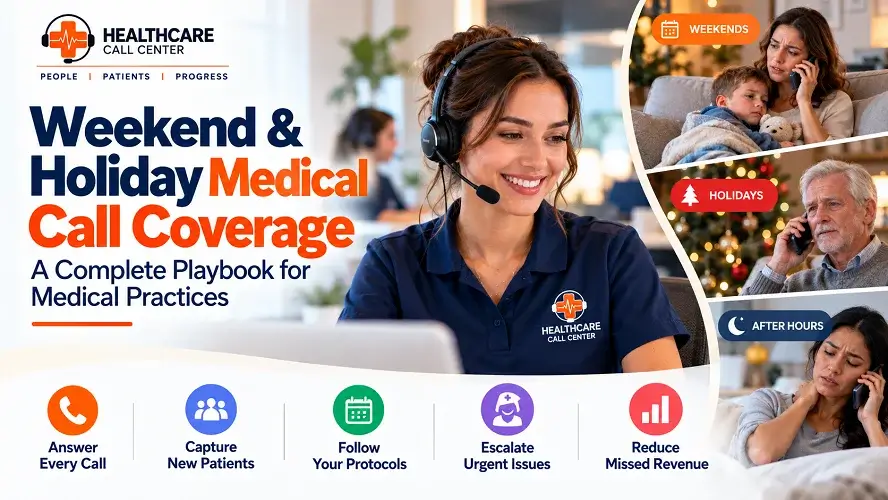
Most medical practices lose patients on the two days they are closed the most. Saturday morning back pain, Sunday-night anxiety, a fever on Thanksgiving. Patients don’t schedule their symptoms around your office hours, and the practices that answer when nobody else does quietly collect those patients all year.
Weekend and holiday coverage is usually an afterthought: a voicemail greeting, an on-call rotation nobody loves, and a hope that nothing urgent happens. This playbook replaces the hope with a system: coverage models, checklists, scripts, and the handoff that makes Monday morning run. The backbone of that system is an after-hours healthcare answering service that answers every weekend call live, backed by written escalation rules your team sets once.
Quick Answer
The best weekend and holiday coverage for a medical practice combines live answering (in-house or a service) with clear escalation rules and a Monday handoff. Voicemail-only coverage loses most weekend callers; they simply call the next practice. A live after-hours answering service running your protocols captures those calls at a fraction of the cost of staffing weekends in-house.
Why Weekends and Holidays Are When Practices Lose the Most Patients
Weekends concentrate exactly the kind of calls you least want to miss. Symptoms that built up during the workweek peak when patients are finally free to deal with them. Parents have time to make calls for their kids. Injuries happen: youth sports, yard work, travel. And holiday weeks stack normal demand on top of weather events, travel illness, and schedule changes.
The numbers make the stakes clear. A practice open roughly 40 weekday hours loses two full days every single week, about 30% of the week. Add holidays and the closed window approaches 35% of annual hours. If patient calls spread evenly across the week, roughly a third of all patient intent arrives when the front desk is empty.
Some of those callers are fine until Monday. Many are not. Existing patients with urgent needs will follow your after-hours instructions, but new patients- the ones who found you on Google at 9 p.m. Friday- have no loyalty yet. They call the next practice on the list. If that practice answers and yours doesn’t, the patient is gone before your team clocks in Monday.
What Patients Expect When They Call on a Saturday (or a Holiday)
Patients should also have clear instructions for what to do if a problem arises outside normal office hours, including how to contact the practice and what constitutes an emergency.
Weekend callers differ from weekday callers in one important way: their intent is hotter.
A weekday caller might be price-shopping or browsing. A Saturday caller with a sick child, a spiking symptom, or a prescription problem has a live need and limited patience.
They expect three things:
- To reach a human, or at least a clear path to one. A full voicemail box or a greeting that only states office hours reads as indifference.
- To be told when they’ll hear back. A vague leave-a-message instruction pushes weekend callers to keep dialing other offices.
- To have emergencies routed correctly. Every weekend greeting must make the emergency-versus-routine distinction obvious, without clinical advice an untrained person shouldn’t give.
Practices that meet those three expectations on a Saturday morning win patients that took months of SEO and advertising to generate.
The Four Weekend Coverage Models (and When Each One Works)
There are four realistic ways to cover weekends and holidays. Most practices use some combination.
Weekend & Holiday Coverage Models Compared
| Model |
What it looks like |
Call-handling approach |
Cost / trade-off |
Best for |
| 1. Voicemail only |
Greeting with office hours; caller calls back Monday or moves on |
No live coverage; callers must wait or seek another option |
Free |
Practices comfortable with limited weekend coverage |
| 2. On-call provider rotation |
Doctor or PA fields forwarded calls between personal time |
Provider handles calls directly; availability can vary and routine calls may interrupt clinical staff |
Staff burden and burnout risk |
Practices with clinical triage needs and spare provider capacity |
| 3. AI-only answering |
Automated agent captures messages and FAQs |
Useful for FAQs and simple tasks; may be less suitable for anxious or complex callers |
$50 to $300/mo |
After-hours backup layer |
| 4. Live answering service |
Trained humans answer in your practice’s name, 24/7 including holidays |
Live human communication for patient calls, with scheduling and escalation based on your protocols |
$200 to $800/mo typical |
Practices that want weekends covered without burning out staff |
For practices that need both patient call coverage and clinical escalation, one workable model is a combination: live answering as the first layer, the on-call provider reserved for genuine clinical escalations, and automation for appropriate administrative tasks.
How to Choose the Right Weekend Coverage Model
If you only need basic information → voicemail may be sufficient.
If calls require clinical judgment → use an on-call provider with defined escalation.
If you want automation for simple tasks → AI can support the workflow.
If you want live patient communication without putting routine calls on clinicians → consider a live answering service.
If you need both → combine live answering with a defined on-call escalation path.
How Major Holidays Change Call Patterns
Not all holidays behave the same way, and coverage should flex accordingly.
- Thanksgiving and Christmas week: routine call volume drops before the holiday, then urgent calls spike during gatherings. Family members call on behalf of aging parents, travel illness shows up, and medication problems get discovered mid-celebration. Expect more third-party callers, which makes identity verification and message detail even more important.
- New Year week: two overlapping waves. First, deductible resets push cost-conscious patients to schedule procedures and appointments. Second, post-holiday symptom catch-up, as people who quietly endured symptoms through the holidays call the moment offices reopen. Coverage through New Year’s Eve and Day feeds that Monday rush.
- Summer holiday weekends (Memorial Day, July 4th, Labor Day): injury-driven calls spike from yard work, sports, and travel accidents, alongside schedule-change questions. These weekends can create a different mix of injury-related calls, schedule changes, and travel-related questions.
The practical takeaway: review call volume from each holiday last year, then brief your answering service and on-call team on the specific pattern expected. Coverage tuned to the holiday beats coverage that treats all closures the same.
The Pre-Holiday Checklist (Run This Before Every Long Weekend)
Holiday coverage fails in the details. Before every long weekend or holiday, run this list:
- Update your voicemail greeting with the exact closure dates and the after-hours path.
- Update your Google Business Profile hours. A closed flag on an open Saturday, or the reverse, costs calls and trust.
- Brief your answering service on the holiday schedule, any changed escalation contacts, and which providers are on call.
- Test call forwarding from every line, including the appointment line and any provider direct lines.
- Schedule reminder texts to patients with appointments the day after the holiday to cut no-shows.
- Confirm emergency instructions in the greeting are current and unambiguous.
A worked example,
Memorial Day weekend: Friday afternoon, update the greeting and GBP hours, confirm the answering service has the revised on-call roster, and test-forward all four office lines. Saturday 9 a.m., a new patient with a sprained back calls; the service answers live, books her for Tuesday 8 a.m., and logs a medication question for the on-call PA, who returns it within the hour.
Monday 8:45 a.m., the front desk works the weekend log before the first appointment. That is the whole playbook working. A short Friday preparation checklist can prevent avoidable weekend coverage failures.
Fifteen minutes of prep prevents the classic holiday failure: a service answering calls for a practice that thinks it isn’t open, or worse, calls ringing into an unattended office.
The Weekend Escalation Script: Routing Calls Without Guessing
The answering agent should follow the practice’s approved protocol rather than independently deciding whether a symptom is medically urgent.
Non-clinical agents should never give medical advice, but they must sort urgent from routine fast. Your escalation protocol should define, in writing:
- What counts as urgent for your specialty: chest pain, breathing trouble, severe bleeding, medication reactions, post-procedure complications, and any phrase your providers flag.
- What gets a same-hour callback: active patients with worsening symptoms, medication questions, or post-visit concerns.
- What waits for Monday: routine scheduling, refills without symptoms, billing, general questions.
- How urgent calls reach the on-call provider: a dedicated escalation line or warm transfer, never a voicemail box.
- What the agent says verbatim when a caller describes an emergency: a short, practiced line directing them to call 911 or go to the nearest ER, documented and logged.
Review this protocol quarterly with your answering service. Weekend coverage breaks at the seams between what the practice meant and what the service understood.
When patient information is handled during after-hours communication, practices should also maintain appropriate privacy and security safeguards under their applicable HIPAA obligations.
What Weekend Coverage Costs (and What It Returns)
A live after-hours medical answering service plan typically runs a few hundred dollars per month, call it $3,000 to $7,000 per year depending on volume and hours covered. Set that against what a single recovered patient is worth.
The economics depend on your call volume, booking rate, and average patient value. For a practice where one additional weekend booking has meaningful value, recovering even a small number of otherwise missed opportunities can materially offset the cost of coverage.
Compare that with the on-call rotation alternative. Every routine call your providers absorb on personal time is a retention tax on your most expensive staff. Moving scheduling, refills, and general questions to trained non-clinical agents, with true emergencies escalated, is usually the single highest-leverage staffing change a practice can make.
Where an After-Hours Answering Service Fits the Playbook
A live after-hours answering service is the backbone that makes the rest of this playbook simple. Instead of rotating the on-call burden through your team and hoping callers leave messages, every weekend and holiday call is answered live, in your practice’s name, within a couple of rings.
The right service gives you: agents trained on medical call flows and your specific protocols; appointment booking directly into your scheduler for Monday and beyond; written escalation rules with warm transfers to your on-call provider; a signed HIPAA Business Associate Agreement; and a message log waiting for you Monday morning.
This is exactly what HCC’s after-hours healthcare answering service for physicians was built for. It runs on 100% US-based agents (trained stay-at-home moms patients find easy to talk to), carries a 90%+ answer-rate guarantee, and includes holiday coverage rather than surcharging for it. Your team gets their weekends back; your patients get a human every time they call.
Common Weekend Coverage Mistakes (and the Monday Handoff)
Watch for the five most common failures:
- A greeting that only states office hours, with no after-hours path or emergency instruction.
- Call forwarding that was never tested after a phone system change.
- Google Business Profile hours that contradict the greeting.
- On-call providers absorbing routine scheduling calls a service should handle, the fastest route to burnout.
- No Monday handoff: weekend messages sitting in a service portal nobody checked until Tuesday.
Fix the last one with a standing Monday-morning handoff checklist: review the weekend message log before 9 a.m., return every new-patient callback first, confirm urgent escalations were resolved, and flag any protocol miss with your answering service the same day. Weekend coverage isn’t only about the weekend. It is about how fast Monday catches up.
Get Your Weekends Back
Want your weekends covered without burning out your team?
Book a 15-minute discovery call with HCC, or run your practice through the free call coverage audit and see exactly where patient calls are slipping.
Frequently Asked Questions
Should my medical office answer calls on weekends?
If your practice accepts or receives patient calls on weekends, having a defined coverage plan gives callers a clear next step even when the office is closed. Depending on the practice, that may be live answering, an on-call provider, or another approved workflow.
What do patients do when the office is closed for a holiday?
With proper coverage, they reach a live agent who follows your written protocol: emergencies are directed to 911 or the ER and escalated to your on-call provider, urgent issues get a callback commitment, and routine calls are booked or logged for Monday.
How much does weekend call coverage cost?
Pricing varies based on call volume, coverage hours, scheduling needs, and escalation requirements. Ask providers for pricing based on your actual call volume and coverage windows.
Can an answering service handle holiday call surges?
A quality service staffs for surge volumes and treats holidays as standard coverage days. Ask any provider directly how they staff Thanksgiving weekend and winter holidays, and what their answer-rate guarantee is on those days.
What’s the difference between an on-call rotation and an answering service?
An on-call rotation puts your clinical staff on the phones, including for routine calls that don’t need them. An answering service answers every call live first, handles scheduling and routine questions per your protocol, and escalates only what genuinely needs the provider. Most practices pair the two: service for coverage, on-call for clinical escalation.
by Erika Sanchez | Sep 23, 2026 | After-Hours Call Answering Services
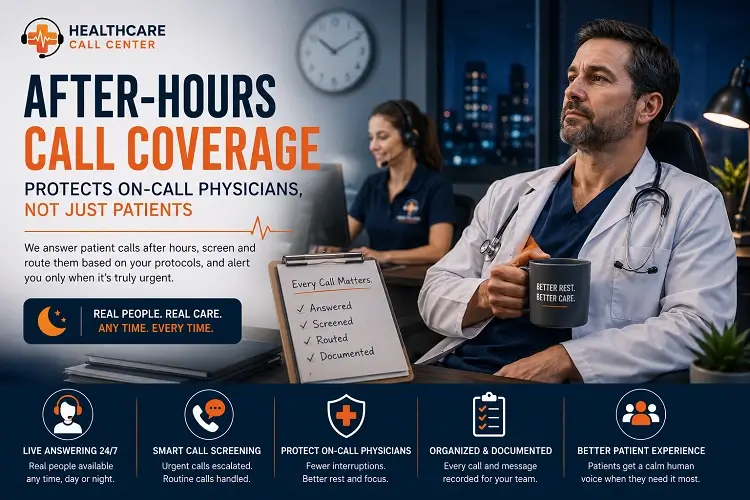
When a medical practice closes for the evening, someone still has to answer the phone. In many practices, that responsibility eventually falls to the on-call physician. An after-hours healthcare answering service takes that weight off the doctor by screening patient calls, collecting details, and escalating calls to the physician according to the practice’s approved urgency and escalation rules.
The problem is that not every call that comes in after hours actually needs a physician. Patients may be calling to request an appointment, reschedule a visit, ask about office hours, leave a routine message, or report a concern that needs follow-up the next business day. Without a reliable call-handling layer, those calls can interrupt physician sleep just as easily as genuinely urgent situations.
A well-designed after-hours answering workflow creates a buffer between the patient and the on-call physician. Patients get a calm human voice at any hour, routine requests can be documented for follow-up, and calls that meet the practice’s escalation criteria can reach the appropriate person. The physician gets fewer unnecessary interruptions, while the practice gets a clearer record of what happened overnight.
The goal is not to keep physicians away from patients who genuinely need them. It is to make sure they are contacted when their involvement is actually required a good physician answering service.
What Really Happens To On-Call Physicians After 5 PM?
The on-call doctor is not a backup receptionist. Yet that is how many practices treat the role. Every unanswered evening call becomes the physician’s problem. A refill question. A billing dispute. A parent asking whether a mild fever needs attention tomorrow. Each one lands on a doctor who was already seeing patients all day.
Picture a typical Tuesday. The physician finishes clinic at 5:30, eats dinner with family, and gets paged at 9:15 about a prescription question that could have waited for the office. At 11:40 there is a second page, this time a billing dispute from an upset patient. At 2:50 in the morning comes a third, a genuine concern that truly needed a doctor. By morning, the physician has slept in fragments, and the first appointment is at 8:00.
The interruptions add up fast. A physician paged three or four times a night for non-urgent matters arrives the next morning already drained. Over weeks, that pattern erodes focus, patience, and job satisfaction. The World Health Organization classifies burnout as an occupational phenomenon driven by unmanaged workplace stress, and interrupted rest is one of its most familiar forms in medicine.
Why Do Non-Urgent Calls Reach The Doctor At Night?
It is almost never the fault of the caller. Patients call at night because that is when they have time, when a symptom worries them, or when a child gets sick after school. Work schedules, childcare, and plain anxiety push calls into the evening hours, and the practice feels it in the pager log.
The problem is what happens next. Without trained call handling, there is no filter between a worried caller and a sleeping physician. Voicemail cannot triage. A generic answering service without medical training either passes everything through, which protects no one, or takes messages nobody reads until morning, which protects no patient. So the call escalates to the on-call doctor by default. Not because it needs a doctor, but because there is no trained call-handling layer to follow the practice’s instructions and route the call appropriately.
The Real Cost of Interrupted Sleep
Sleep broken by pages is not the same as shorter sleep. Research on sleep fragmentation shows that even brief interruptions prevent the deep stages of rest that restore judgment and emotional control. For a physician, that shows up the next morning as slower decisions, shorter patience with staff, and less mental room for complex cases.
The costs reach patients too. A doctor who was awake at 2 AM reviewing a message about medication dosing is making that decision on degraded rest. Most on-call physicians manage this fine for a night. The danger is the rotation that repeats weekly, month after month, until burnout or resignation ends it for you.
Practices pay in hard currency as well. Recruiting a replacement physician takes months and real money. Losing an experienced provider over something as fixable as nighttime phone noise is one of the most preventable staffing losses in medicine.
How An After-Hours Healthcare Answering Service Protects on-call Physicians
The fix is structured call screening built for healthcare. When a patient calls after hours, a trained agent from a healthcare answering service answers with the practice greeting, listens, and follows the call protocol the practice approved in advance. The agent asks the right questions, stays calm with anxious callers, and sorts the call into one of three lanes.
- True Emergency: chest pain, postoperative bleeding, an infant in distress, or anything else the practice defines as urgent. The agent follows the escalation protocol and reaches the on-call physician immediately, with a clear written summary of who is calling, what happened, and what has been done so far.
- Urgent But Morning-Safe: calls that feel urgent to the patient but are clinically safe to wait, such as a worsening but stable symptom or a medication question that is not time critical. The agent captures full details and routes the message to the practice queue for first-thing handling.
- Routine: refills, directions, paperwork, insurance questions, and general inquiries get logged completely without disturbing anyone.
That middle lane is where practices win. Many calls feel urgent to the caller but do not need a physician at 1 AM. A trained agent working from the practice’s own script knows the difference, because the practice defines it in advance. The result is simple. Doctors hear about real emergencies. Everything else waits where it belongs, fully documented and ready for the morning team.
What Does Good After-Hours Call Routing Look Like?
Practices evaluating coverage should look for a few concrete behaviors.
- Calls answered within a few rings by a live person, not a menu tree.
- Warm, plain language instead of scripted stiffness.
- Accurate message capture with names, callback numbers, and the reason for the call.
- Clear escalation rules the practice controls, written down and approved by the physicians who carry the pager.
- Documentation the team can read at 8 AM without decoding it.
For practices that want after-hours callers to move directly into a scheduling workflow, appointment-scheduling support can help capture appointment details and next steps.
It also matters how the service handles gray areas. A good agent knows how to de-escalate an anxious caller, when to involve the on-call nurse line if the practice has one, and how to log a call so the morning team can act on it in one read. Ask to see sample messages before you sign anything.
Handled this way, an after-hours patient call stops being an interruption and becomes information. The morning team arrives to organized messages instead of a voicemail backlog, and the front desk starts the day responding rather than sorting. Practices that also struggle with daytime call volume often pair this with front desk overflow support so the phone is covered at both ends of the day.
A Night With Coverage Versus A Night Without
Consider two versions of the same Wednesday night at a busy family practice.
Without coverage: the office phone rolls to the on-call physician at 5 PM. Fourteen calls come in overnight. The physician personally handles a refill question at 9 PM, a form request at 10:30, an anxious parent at 1 AM whose child has a low-grade fever, and one genuine urgent call at 4 AM. Morning arrives with a voicemail backlog of nine more messages, and the staff spends the first hour of clinic sorting them.
With coverage: the same fourteen calls reach a trained agent. The urgent 4 AM call is escalated to the physician with a written summary, and the doctor calls back prepared. The other thirteen are documented, sorted, and waiting in the morning queue. The physician sleeps. The front desk starts Thursday with a worklist instead of a mess.
Same night. Same patients. Radically different morning for everyone involved.
What To Ask When Evaluating After-Hours Coverage
Bring these questions to any vendor conversation.
- Who actually answers the phone, where are they located, and what training do they receive for medical calls?
- Can protocols be customized by specialty and approved by our physicians?
- How fast do urgent calls reach the on-call provider, and what does the escalation message look like?
- How are messages delivered, and can they flow into our EHR or practice management system?
- Is the service HIPAA-compliant end-to-end, including text and email delivery?
- What is the average speed to answer, and what happens during call spikes?
A service that answers these questions plainly, with examples, is showing you what your callers will experience. One that answers with vague assurances is telling you the same thing.
What This Means For Physician Burnout And Retention
Protecting the on-call physician is not a luxury perk. It is a staffing strategy. Physicians who sleep through the night see more clearly, decide more carefully, and stay longer. In a market where recruiting and onboarding experienced providers can take months and significant resources, keeping the ones you have is the cheapest retention program available. The American Medical Association tracks physician burnout as a leading workforce risk, and unmanaged after-hours demands are a known contributor.
There is a patient-side benefit that matters just as much. When the doctor is only woken for genuine emergencies, the 2 AM call that does reach them gets full attention. Coverage that protects physicians also protects the quality of the care decision being made at that moment. Partners notice. Staff notice. Patients, who no longer reach a harried doctor at midnight, notice most of all.
Who Should Set This Up First?
Any practice where physicians carry a pager or forwarding phone overnight: primary care, OB-GYN, internal medicine, pediatrics, surgical groups, and specialty clinics. It matters most where call volume is heavy, and the on-call rotation is tight, because those are the schedules where night pages compound fastest into burnout.
If your doctors describe on-call weeks as something they dread, the phone system is the first place to look. A healthcare answering service built for after-hours coverage can usually go live quickly, with protocols your physicians approve before the first call.
Your physicians went to school to practice medicine. Let them. Book a free consultation to see what after-hours call coverage would look like for your practice.
Frequently Asked Questions
Do after-hours answering services give medical advice?
No. Agents never advise patients on care. They follow the call protocol your practice sets, capture details, and route calls based on urgency. Anything clinical goes to your on-call team or the instruction sheet you approve.
Will our on-call physician still get emergencies right away?
Yes. True urgent calls follow an escalation path that reaches your on-call physician immediately, usually with a short written summary so the doctor knows the situation before calling back.
What happens to routine calls that come in overnight?
Routine calls like refill requests, scheduling changes, and paperwork questions are logged with full details and delivered to your practice queue for morning follow-up. Nobody is disturbed.
How is this different from voicemail?
Voicemail cannot ask questions, calm a worried patient, or tell an emergency from a routine matter. A trained after-hours agent can, which means fewer callbacks for your staff and faster help for patients.
Can call protocols match our specialty?
Yes. OB-GYN, primary care, pediatric, and surgical practices each get protocols built around their triage rules and provider preferences, approved by the practice before launch.
How quickly can after-hours coverage go live?
Most practices launch within days. The setup work is agreeing on protocols, escalation rules, and message delivery, and a good service walks your team through every step. Nothing changes for patients until you say it is live.
Can an after-hours answering service handle routine calls without waking the physician?
Yes. Routine calls can be documented and routed for next-business-day follow-up according to the practice’s approved workflow. Calls requiring physician involvement can follow the appropriate escalation path.
by Erika Sanchez | Aug 26, 2026 | After-Hours Call Answering Services
Patients do not only call medical practices between 9 AM and 5 PM.
They call after work. They call during lunch breaks. They call in the evening after talking with a spouse. They call on weekends after finally deciding to schedule. They call when they are anxious, comparing providers, or trying to understand the next step in their care.
For a healthcare practice, those after-hours calls matter.
Some calls are routine. Some are appointment requests. Some need careful message routing. Some need clear next steps based on the practice’s approved workflow. But when every after-hours caller reaches voicemail, the practice creates a gap between patient intent and patient response.
That gap can affect appointment volume, patient trust, referral follow-through, and the value of every marketing channel that sends people to the phone.
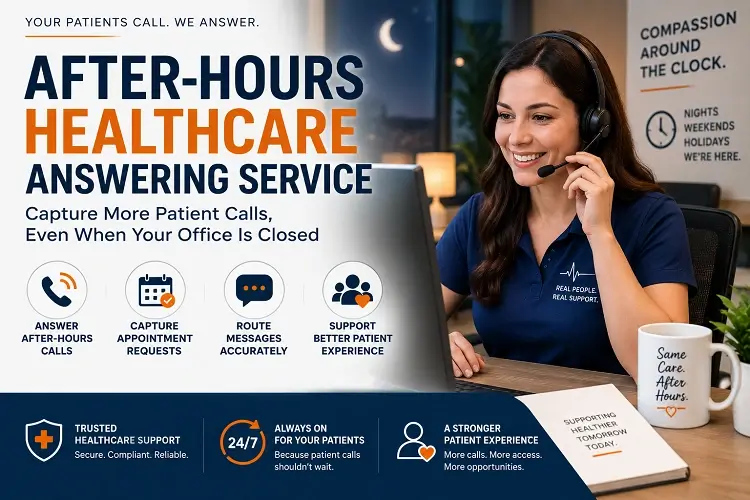
An after-hours healthcare answering service helps medical practices protect patient calls when the office is closed, the front desk is unavailable, or the team needs structured support outside regular business hours.
The goal is simple: make sure important patient calls are answered, captured, documented, and routed instead of disappearing into voicemail.
Why After-Hours Calls Matter for Healthcare Practices
After-hours patient calls often come from people who are already motivated to act.
A patient may have spent the day researching providers and finally decides to call in the evening. A parent may remember to schedule an appointment after the workday ends. A referral patient may call when they find the paperwork. A cosmetic or fertility patient may call after discussing the decision at home.
By the time they call, they may already be close to booking or taking the next step.
If that call reaches voicemail, the practice may still get the message. But the momentum changes. The patient has to wait. The practice has to call back. The caller may miss the return call. The conversation may stretch into another day.
That delay creates friction.
In a competitive healthcare market, friction matters. Patients often compare multiple providers, especially for specialty care, dental services, fertility clinics, plastic surgery, and chiropractic care. If one practice answers and another sends the caller to voicemail, the answering practice creates the stronger first impression.
Medical practice after-hours calls are often the highest-intent calls of the day, because the caller chose that exact moment to act. Reliable after-hours patient call support helps protect that moment.
The Problem With Relying Only on Voicemail
Voicemail is easy to set up, but it is not always a strong patient experience.
When a patient reaches voicemail, several things can happen:
- The patient may hang up without leaving a message.
- The message may be incomplete.
- The caller may not explain the real reason for the call.
- The practice may not know whether the call was urgent, appointment-related, or routine.
- The patient may call another provider before the office reopens.
- The front desk may start the next day with a backlog of unclear messages.
- Staff may spend time calling patients back without enough context.
Voicemail does not guide the patient. It does not ask follow-up questions. It does not capture appointment intent clearly. It does not support patient message routing by urgency or department. It simply asks the caller to leave a message and wait.
For some practices, that may be enough for low-priority calls. But for practices that depend on timely scheduling, patient trust, and clear communication, voicemail alone can create too much leakage.
A strong healthcare answering service gives practices a better option for patient calls that happen outside normal office hours.
What an After-Hours Healthcare Answering Service Does
An after-hours healthcare answering service provides live healthcare call answering support when the practice is closed or unavailable.
Depending on the practice’s workflow, after-hours answering can help with:
- New patient inquiries
- Appointment request capture
- Callback requests
- Reschedule requests
- Cancellation messages
- Referral-related calls
- Provider or department routing
- Location-specific messages
- After-hours message documentation
- Urgent message escalation based on practice-approved rules
This does not mean agents replace clinical staff or make medical decisions. They do not diagnose, advise, or decide what is urgent on their own. Instead, they follow the practice’s instructions.
The practice defines the call flow. The answering team follows it.
That structure matters because healthcare calls need more care than generic business calls. A patient may be anxious, frustrated, worried, or ready to schedule. The person answering needs to be calm, clear, and aligned with the practice’s process.
After-Hours Answering vs Front Desk Overflow
After-hours answering and front desk overflow are related, but they solve different problems.
After-hours answering supports the practice when the office is closed. This includes evenings, weekends, holidays, early mornings, lunch closures, or any time the front desk is not available.
Front desk overflow support supports the practice when the office is open, but the team is too busy to answer every call.
Many practices need both.
For example, a practice may miss calls:
- At 8:15 AM before the team is fully ready
- At 11:30 AM during a scheduling rush
- At 12:45 PM during lunch
- At 4:55 PM when staff are closing out the day
- At 6:30 PM when patients call after work
- On Saturday when someone is finally ready to schedule
If the practice only solves after-hours calls, it may still miss daytime overflow. If it only solves overflow, it may still lose evening and weekend opportunities.
A complete patient call coverage strategy looks at the full call journey, and a patient call answering service can cover both windows when the practice needs it.
Why Appointment Request Capture Is So Important After Hours
Not every after-hours call is urgent. Many are appointment-related.
Patients often call after hours because that is when they finally have time. They may be asking about availability, trying to schedule a consultation, following up on a referral, or checking whether the practice is the right fit.
If those calls go to voicemail, the practice may still get the message. But the appointment intent can weaken.
A live answering workflow can capture details such as:
- Patient name
- Best callback number
- New or existing patient status
- Reason for visit
- Preferred appointment type
- Preferred provider or location
- Best time to call back
- Referral or insurance note if approved by the practice
- Whether the message needs routine follow-up or faster routing
This makes next-day follow-up easier.
Instead of listening to vague voicemail messages, the front desk receives structured information. That helps the team prioritize callbacks, protect appointment requests, and reduce the chance of missing the patient again.
For practices that need more structured scheduling workflows, appointment scheduling support can help connect call answering with appointment request handling.
What Types of Practices Need After-Hours Healthcare Answering?
After-hours call support can help many medical practices, but it is especially useful for practices where patient calls carry high intent or sensitive context.
Strong fits include:
- OB-GYN practices
- Fertility and IVF clinics
- Plastic surgery practices
- Dental offices
- Chiropractic clinics
- Primary care offices
- Specialty practices
- Multi-location healthcare groups
- Practices investing in SEO or paid ads
- Practices with limited front desk capacity
- Practices with high voicemail volume
The common thread is simple: patients are calling because they need a response.
For specialty practices, the first call may shape trust before the patient ever walks in. A fertility patient, plastic surgery lead, OB-GYN patient, or pain-related chiropractic caller may need a more patient, human response than a voicemail greeting can provide.
After-hours support helps protect that first impression.
How After-Hours Call Coverage Supports Marketing ROI
Many practices think of call answering as an operations function. But it also affects marketing performance.
If a practice invests in SEO, Google Business Profile optimization, local service pages, referral partnerships, or content marketing, the phone becomes one of the most important conversion points.
A patient may read a page, check reviews, compare services, and then call. If that call happens after hours and goes unanswered, the practice may lose part of the value created by its marketing.
This is why after-hours call coverage should be part of conversion planning.
Better call coverage can help practices:
- Capture more appointment requests
- Reduce voicemail gaps
- Improve the patient response experience
- Support front desk teams
- Protect referral follow-through
- Improve next-day callback quality
- Reduce missed opportunities from marketing traffic
The goal is not just to answer more calls. The goal is to make sure patient demand does not leak at the phone.
What a Good After-Hours Healthcare Answering Workflow Should Include
A strong after-hours workflow should be clear, simple, and specific to the practice.
1. A Practice-Specific Greeting
Patients should feel like they reached the right place. A generic greeting can create confusion. A practice-specific greeting helps callers understand that their message will be handled through the practice’s process.
2. Clear Call Categories
The answering team should know how to categorize calls. For example:
- Appointment request
- Cancellation
- Reschedule
- Referral question
- Existing patient message
- New patient inquiry
- Location question
- Provider-specific message
- After-hours concern
This helps the practice receive better information.
3. Approved Message Capture Rules
The practice should define what information agents should collect. This prevents incomplete messages and reduces unnecessary back-and-forth the next day.
4. Routing Instructions
Messages should go to the right place. That may be a front desk inbox, scheduling team, provider team, on-call contact, location manager, or secure message workflow.
5. Escalation Rules
If certain types of calls need faster routing, the practice should define that clearly. Agents should not guess. They should follow the escalation instructions approved by the practice.
6. HIPAA-Conscious Handling
Healthcare calls require careful handling. Practices should use workflows that protect patient privacy and avoid unnecessary exposure of sensitive details.
7. Next-Day Follow-Up Process
After-hours answering is only useful if the practice has a follow-up process. Messages should be easy to review, prioritize, and respond to when the office reopens.
A good after-hours setup helps the practice start the next day with organized information instead of a voicemail backlog.
Common After-Hours Call Scenarios
Here are examples of calls an after-hours answering workflow may help capture.
New Patient Inquiry
A patient finds the practice online at night and calls to ask about becoming a new patient. A live answering team can capture the caller’s name, number, reason for calling, and preferred callback time.
Appointment Request
A patient wants to schedule but cannot call during office hours. The answering team can document the request so the scheduling team can follow up with context.
Reschedule or Cancellation
A patient realizes they cannot make an appointment. A live message helps the practice see the change sooner and protect the schedule.
Referral Follow-Up
A referred patient calls after receiving a recommendation. The answering team can capture the referral context and route the message properly.
Location or Provider Question
A caller may need help identifying the right office or provider. The answering team can document the question and direct the next step based on the approved workflow.
After-Hours Concern
Some callers need a message routed according to practice rules. The answering team should follow the practice’s escalation process without giving medical advice.
These situations show why after-hours answering needs structure. The call is not just a name and number. It often carries patient intent.
How After-Hours Support Helps the Front Desk
After-hours calls do not disappear when the office opens. They become next-day workload.
If the practice relies only on voicemail, the front desk may start the day by sorting through unclear messages, returning missed calls, trying to understand urgency, and chasing patients who may not answer.
After-hours answering can reduce that friction.
When messages are captured clearly, the team can see:
- Who called
- Why they called
- Whether they are a new or existing patient
- What they need next
- Which location or provider the message relates to
- When they prefer a callback
- Whether the message should be prioritized
This makes follow-up easier and helps the front desk start the day with better organization.
It also protects patients. Instead of wondering whether anyone heard their voicemail, they spoke with a real person and know the practice has their message.
When Practices Should Consider After-Hours Answering
A practice should consider after-hours answering if it notices any of these patterns:
- Voicemails pile up overnight or over weekends
- New patient calls come in after closing
- Patients say they had trouble reaching the office
- Marketing campaigns generate calls outside business hours
- Referral patients call after work
- The front desk starts the morning behind
- Appointment requests are delayed
- Staff spend too much time returning incomplete messages
- Multi-location messages are hard to route
- The practice wants better patient access without overloading staff
A practice does not need to hand off every call to start. Many begin with evening, weekend, lunch-break, or overflow windows, then expand based on call volume.
For example, a practice in a competitive local market may start with broader coverage through a medical answering service in Florida if patient demand is coming from search, referrals, or multiple service areas.
The best setup depends on the practice’s actual call patterns.
How Healthcare Call Center Helps With After-Hours Call Coverage
Healthcare Call Center helps practices answer more patient calls when the front desk is closed, busy, or unavailable.
Support can include:
- Live patient call answering
- After-hours message capture
- Appointment request capture
- Front desk overflow support
- Custom greetings and scripts
- Message routing by provider, location, or department
- Escalation based on practice-approved rules
- HIPAA-conscious documentation workflows
- Call-flow recommendations before launch
The goal is not to replace the front desk. The goal is to protect the patient call journey around the front desk.
When after-hours coverage is built correctly, patients get a live response, staff get better messages, and the practice reduces the risk of losing appointment intent to voicemail.
Practices that already handle daytime overflow can add structured evening and weekend coverage through an after-hours medical answering service built for medical offices.
For practices that want to review their call flow, book a free consultation and identify where patient calls may be leaking after hours, during overflow, or between front desk coverage windows.
Final Takeaway
After-hours patient calls are easy to underestimate.
A practice may assume most important calls happen during business hours. But patients often call when they have time, when they are anxious, when they are comparing providers, or when they are finally ready to schedule.
If those calls go to voicemail, the practice may still receive a message. But it may lose urgency, context, and appointment momentum.
An after-hours healthcare answering service helps solve that problem by giving patients a live response when the office is closed. It helps capture appointment requests, route messages, reduce voicemail gaps, and support the front desk before the next business day begins.
For growing healthcare practices, after-hours call coverage is not just a convenience.
It is part of patient access, retention, and conversion.
Frequently Asked Questions
What is an after-hours healthcare answering service?
An after-hours healthcare answering service answers patient calls when a medical practice is closed or unavailable. It can help capture appointment requests, document messages, route calls, and follow the practice’s approved after-hours workflow.
How does after-hours answering help medical practices?
After-hours answering helps practices reduce voicemail gaps, capture patient messages, support appointment requests, and organize follow-up before the next business day.
Is after-hours healthcare answering only for urgent calls?
No. Many after-hours calls are appointment requests, callbacks, reschedules, referral questions, or routine patient messages. The answering workflow should route each call based on the practice’s instructions.
Can an after-hours answering service capture appointment requests?
Yes. Agents can capture appointment intent, patient contact information, reason for calling, preferred callback time, provider preference, location needs, and other approved details.
Does after-hours answering replace the front desk?
No. It supports the front desk by covering calls when the team is closed, busy, or unavailable. The practice still controls the workflow, follow-up process, and routing rules.

by Erika Sanchez | Jul 16, 2026 | After-Hours Call Answering Services
A fertility patient may not call during normal office hours. She may call after work, after an injection, during the two-week wait, or on a weekend when anxiety is high and the clinic is closed. If that call goes to voicemail, the patient may feel unsupported at the exact moment she needs a calm next step.
An after-hours fertility clinic answering service gives IVF clinics live call coverage outside normal business hours. It helps answer patient calls, collect the right information, route messages, follow clinic escalation rules, and protect new patient inquiries that would otherwise be lost to voicemail.
This article explains why after-hours calls matter so much in fertility care, what types of calls happen outside office hours, how a trained answering team should handle them, and how clinics can use after-hours support without creating clinical risk or confusing patients.
For fertility clinics, every patient interaction matters. Whether someone is starting IVF treatment, managing an active cycle, or calling with a time-sensitive concern, delayed communication can increase anxiety and reduce confidence in the practice. An after-hours fertility clinic answering service helps ensure every call receives a professional response while following your clinic’s approved workflows and escalation protocols.
Quick Answer: What Is an After-Hours Fertility Clinic Answering Service?
An after-hours fertility clinic answering service is a live call-handling team that answers fertility and IVF patient calls when the clinic is closed, busy, or unavailable. The service does not diagnose, change medication instructions, or provide clinical advice. Instead, agents follow the clinic’s approved scripts, document the call, collect key details, and escalate urgent concerns according to the clinic’s rules.
For clinics, the goal is simple: fewer missed after-hours fertility calls, better patient communication, and clearer routing for new patient inquiries, scheduling requests, and time-sensitive messages.
Why Fertility Patients Call After Hours
Fertility care does not feel like a normal appointment journey for patients. IVF cycles are emotional, time-sensitive, and filled with moments where patients may need reassurance or clear routing. Even when the clinic gives strong instructions during the day, questions can come up later when the patient is home and thinking through every detail.
Common reasons fertility patients call after hours include:
- Questions after hormone injections
- IVF medication timing concerns
- Anxiety during the two-week wait
- New patient consultation inquiries
- Appointment rescheduling
- Post-procedure questions
- Weekend or evening scheduling requests
- Questions about next steps after monitoring appointments
This is why an after-hours IVF clinic answering service is not just a convenience. It supports the patient experience during the moments when fertility patients are most likely to feel uncertain.
What Happens When Fertility Calls Go to Voicemail
Voicemail creates a gap between the patient’s concern and the clinic’s response. Sometimes that gap is harmless. Other times, it creates stress, delays, or lost new patient opportunities.
When a fertility patient reaches voicemail after hours, several things can happen:
- The patient does not leave a message because the concern feels too private.
- The patient searches online or asks strangers in IVF forums.
- A prospective patient calls another clinic that answers live.
- A scheduling issue waits until the next day and creates more front desk pressure.
- The clinic loses visibility into what patients are asking after hours.
The issue is not that every after-hours call is urgent. The issue is that every after-hours call needs the right next step. A trained answering team helps create that path.
Why Response Time Matters for Fertility Clinics
Fertility patients often compare several clinics before scheduling a consultation. When one clinic answers quickly and another sends callers to voicemail, the first interaction can influence where the patient decides to begin treatment. Fast, compassionate communication helps build trust before the first appointment.
Many fertility patients research clinics outside normal office hours, making evenings and weekends an important time to capture consultation inquiries and provide reassurance when patients are ready to reach out.
Common After-Hours IVF and Fertility Calls
Every clinic has its own protocols, but after-hours fertility calls usually fall into a few common categories.
| Call Type |
What the Patient Needs |
How an Answering Service Helps |
| Medication or injection concern |
Clear routing, reassurance, and next-step guidance based on clinic protocol |
Collects information and escalates if required by clinic rules |
| Two-week wait anxiety |
A calm response and appropriate message routing |
Documents the concern and routes it for follow-up |
| New patient IVF inquiry |
Consultation information and scheduling next steps |
Captures details and can schedule if the clinic allows it |
| Appointment change |
Rescheduling or callback support |
Document the request or book according to scheduling access |
| Post-procedure concern |
Escalation based on clinic policy |
Routes urgent concerns to the on-call provider when required |
This table is important because it shows the difference between answering a phone and managing a fertility call safely. The answering service should never guess. It should follow the clinic’s written rules.
What an After-Hours Fertility Answering Service Should Not Do
This is where many clinics need to be careful. A healthcare-specific medical answering service should support communication, not replace clinical judgment.
An after-hours answering team should not:
- Promise treatment outcomes
- Estimate IVF success rates
- Recommend medications
- Change appointment instructions without clinic approval
Instead, the team should collect the patient’s name, callback number, concern, timing, and relevant non-clinical details requested by the clinic. Then the call should be documented, routed, or escalated based on the clinic’s approved workflow.
Patients experiencing medical emergencies should immediately contact their healthcare provider or emergency services rather than rely on an answering service.
How a 24/7 IVF Clinic Answering Service Supports New Patient Growth
Not every after-hours call comes from an existing patient. Many are prospective patients who are researching fertility clinics after work, on weekends, or during private moments when they finally feel ready to ask questions.
For a fertility clinic, one missed new patient inquiry can be expensive. IVF patients often represent a high-value treatment journey, but they are also emotionally cautious. If they call and nobody answers, they may not wait until morning.
A 24/7 IVF clinic answering service can help with:
- New patient inquiry capture
- Medical Consultation scheduling support
- Insurance or financing information collection for the clinic team
- Callback requests
- Location and service questions
- Routing inquiries to the right team member
- Protecting SEO and paid campaign leads after hours
This is where after-hours coverage connects directly to marketing ROI. If your clinic spends money on SEO, Google Ads, referrals, and website content, the phone must be covered when patients are ready to act. You can estimate the impact of slower response times using our Patient Lead Response Time Calculator.
How After-Hours Coverage Protects Patient Trust
Fertility patients are not only evaluating clinical expertise. They are also evaluating responsiveness, empathy, privacy, and emotional safety. The first phone interaction can shape how supported a patient feels.
A positive first phone experience can also improve:
- Consultation conversion
- Patient satisfaction
- Online reviews
- Referral opportunities
- Trust in the clinic
- Overall patient experience
That matters because fertility patients often talk with partners, friends, online communities, and support groups about their clinic experience. A clinic that feels responsive and organized can earn trust before the first consultation even happens.
What Happens When a Fertility Patient Calls After Hours?
Setup should be based on the fertility clinic’s actual workflows, not a generic answering script.
A proper after-hours fertility call coverage setup usually includes:
- Clinic-approved greeting and call script
- Call categories for new patients, existing patients, scheduling, and urgent concerns
- Escalation rules for on-call providers
- Message routing rules for next-business-day follow-up
- Scheduling access if the clinic allows direct booking
- Training on fertility terminology and patient sensitivity
- HIPAA-conscious handling and secure documentation
- Reporting on call volume, call type, response patterns, and missed-call recovery
For many clinics, setup can happen within up to 2 weeks, depending on scripts, scheduling access, routing rules, and training requirements.
What to Look for in an After-Hours Fertility Call Partner
Fertility clinics should not choose a generic call center that only takes messages. The partner needs to understand healthcare workflows, privacy expectations, and the emotional weight of fertility communication.
If you’re evaluating providers, our comprehensive Medical Answering Service Checklist walks through the questions healthcare practices should ask before choosing an answering service partner.
Look for a partner that offers:
- Healthcare-specific call handling experience
- HIPAA-conscious processes and BAA readiness when required
- Custom fertility scripts
- Clear escalation protocols
- Scheduling support when approved by the clinic
- Call documentation and reporting
- Quality monitoring
- Empathy-focused agent training
- Coverage for evenings, weekends, holidays, and overflow periods
If you are comparing providers, this checklist should be more important than price alone. The wrong answering service can create confusion. The right one feels like an extension of your clinic.
If you’re still researching providers, our comparison of the best medical answering services explains the differences between healthcare-focused answering services and general call centers.
After-Hours Fertility Calls vs General Medical Calls
Fertility calls require a different communication style from many general medical calls. Patients may be nervous about timing, privacy, cost, treatment steps, or what their body is doing. Even when a call is not clinically urgent, it can feel urgent to the patient.
That is why after-hours fertility coverage should combine three things:
- Live answer speed
- Strict protocol following
- Empathetic communication
A general answering service may be able to take a message. A fertility-aware answering service should help protect the patient relationship while routing the call correctly.
When Should a Fertility Clinic Add After-Hours Coverage?
A fertility clinic should consider after-hours coverage if any of these problems are happening:
- Patients complain that calls are not answered after hours.
- New patient inquiries arrive outside office hours.
- The front desk starts every morning with a backlog of voicemails.
- Patients ask cycle-related questions through untracked channels.
- Marketing campaigns are generating leads outside business hours.
- Staff is overwhelmed by Monday morning callbacks.
- The clinic does not know how many calls it misses after 5 PM.
The best first step is to pull the last 30 days of phone records. Count evening, weekend, holiday, lunch-hour, and abandoned calls. Then compare that volume against booked consultations, response time, and patient value.
Final Takeaway
After-hours fertility calls are not random interruptions. They are often the moments when patients are most anxious, most private, or most ready to take the next step.
An after-hours fertility clinic answering service helps IVF clinics answer those calls with structure, empathy, and clear routing. It does not replace clinical staff. It supports the clinic by making sure patients are not left with voicemail when they need a next step.
If your fertility clinic is missing calls after hours, you may be losing both patient trust and new consultation opportunities. Healthcare Call Center can help you build after-hours call coverage around your clinic’s scripts, escalation rules, and scheduling workflow.
Ready to improve after-hours IVF call coverage?
FAQs About After-Hours Fertility Clinic Answering Service
What is an after-hours fertility clinic answering service?
An after-hours fertility clinic answering service is a live call-handling service that answers fertility and IVF patient calls when the clinic is closed, busy, or unavailable. Agents follow clinic-approved scripts, document calls, and route or escalate messages based on the clinic’s rules.
Can an answering service handle IVF medication or injection calls?
An answering service can collect information and route the call according to clinic protocol, but it should not give medical advice, change medication instructions, or interpret symptoms. Clinical questions should be escalated to the appropriate clinic team member when required.
Why do fertility patients call after hours?
Fertility patients often call after hours because they finally have privacy, feel anxious during the IVF process, need help with scheduling, or have questions after leaving the clinic. Many new patient inquiries also happen after work or on weekends.
Can after-hours coverage help fertility clinics book more consultations?
Yes. If the clinic allows scheduling access, trained agents can capture new patient inquiries, collect contact details, answer approved process questions, and book or route consultation requests before the patient calls another clinic.
How long does setup take for fertility clinic call coverage?
Setup can take up to 2 weeks depending on call scripts, scheduling access, escalation rules, phone routing, and agent training. The process should be customized around the clinic’s workflow.
by Erika Sanchez | Jul 15, 2026 | After-Hours Call Answering Services
A prospective patient finds your practice on Google at 7 PM. She has been researching rhinoplasty for three weeks. She has reviewed your before-and-after photos, checked your reputation, and is ready to book a consultation. She calls your office.
She gets voicemail.
She does not leave a message. She calls the next plastic surgeon in the search results. That practice answers. She books with them.
This happens every night at plastic surgery practices across the country. The frustrating part is that most practices never see the loss clearly because after-hours calls are rarely tracked with the same discipline as website leads, form fills, or ad clicks.
Every missed consultation call represents more than a missed phone call; it is a patient who was ready to take the next step. An after-hours plastic surgery answering service helps practices answer consultation inquiries, qualify new leads, schedule appointments, and route urgent post-operative concerns even when the office is closed. For practices investing in SEO, Google Ads, and referrals, protecting these high-intent calls is just as important as generating them.
What Is an After-Hours Plastic Surgery Answering Service?
An after-hours plastic surgery answering service is a live call answering team that handles patient calls when your office is closed, busy, or unavailable. For plastic surgery practices, it helps capture new consultation inquiries, qualify leads, schedule appointments, and route urgent post-operative calls based on your escalation rules.
The goal is not just to answer the phone. The goal is to protect high-value consult opportunities at the exact moment a patient is motivated enough to call.
Why Plastic Surgery Calls Are Different After Hours
Plastic surgery calls are not routine scheduling calls. They are high-intent, high-value inquiries from patients who have often been researching for weeks or months. When they finally pick up the phone, they are usually ready to take the next step toward a consultation.
But these calls do not only happen during business hours. They come in the evenings when patients are off work, on Saturdays when they have time to research, and during lunch breaks when they finally have a private moment to call.
The patient who calls at 8 PM is not casually browsing. She is comparing options. If she reaches voicemail, she may continue down the search results and contact another practice. Plastic surgery is competitive. Patients have options. The practice that responds first often wins the consultation.
Common Plastic Surgery Calls That Come In After Hours
After-hours consult calls are often more valuable than they look. These are not always simple questions. Many are buying-intent conversations that need a calm, professional response.
Patients commonly call after hours asking:
- How much does rhinoplasty cost?
- Can I book a breast augmentation consultation?
- Do you offer financing options?
- How soon can I schedule a mommy makeover consultation?
- Is liposuction right for me?
- Can I reschedule my consultation?
- Is swelling after surgery normal?
- I think something isn’t right after surgery. Who should I speak to?
A trained plastic surgery answering service gives each caller a real response instead of letting that intent disappear into voicemail.
What Happens When You Miss After-Hours Calls
The math is straightforward. If your practice receives 50 calls per day and 46% come during after-hours or busy windows, that is 23 calls at risk every single day.
Not all of those calls would become patients. But even if only 10% would have scheduled a consultation, that is 2 to 3 lost consultation opportunities per day. At an average plastic surgery patient value of $5,000 to $12,000 or more, the revenue adds up fast.
Over a month, that can mean 50 to 60 lost consultation opportunities. Over a year, it can mean 600 to 700 missed chances to speak with patients who were actively considering a procedure.
The loss is not only revenue. Patients who get voicemail or no timely callback often share that experience with friends, in local groups, or in online review spaces. A missed first impression can create a ripple effect beyond the original call.
Beyond Lost Revenue: Other Hidden Costs
Missed after-hours calls affect more than revenue.
- Lower consultation booking rates
- Reduced return on Google Ads spend
- Lost SEO-generated leads
- Poor first impressions
- Increased pressure on front-desk staff
- Delayed response times
- Lower patient satisfaction
- More missed referral opportunities
Practices spend thousands generating patient inquiries. Every unanswered call reduces the return on that investment.
After-Hours Plastic Surgery Answering Service vs Voicemail
Voicemail is passive. A trained answering service is active. That difference matters when a patient is ready to book.
| Patient Call Scenario |
Voicemail |
After-Hours Answering Service |
| New consult call at 8 PM |
Patient may hang up |
Live agent answers |
| Price or procedure question |
No response until next day |
Lead is qualified immediately |
| Ready-to-book patient |
May call another surgeon |
Consultation can be scheduled |
| Post-op concern |
Patient waits or panics |
Call follows escalation protocol |
| Practice visibility |
Hard to track |
Calls recorded and reported |
What an After-Hours Answering Service Does for Plastic Surgery Practices
An after-hours medical answering service that specializes in healthcare does not just pick up the phone. It acts as a seamless extension of your front desk and protects the patient experience when your in-office team is unavailable.
Captures Every Call
When a patient calls after hours, a live agent answers using your practice name. The patient does not feel abandoned or pushed into voicemail. They experience a warm, professional interaction that matches your brand.
Qualifies the Lead
The agent follows your custom script to qualify the inquiry. What procedure is the patient interested in? What is their timeline? Are they self-pay or considering financing? Have they had a consultation before? That information is captured and routed to your team.
Books the Consultation
If your practice allows direct booking, the agent can schedule the consultation directly into your system. The patient hangs up with a confirmed date and time. No callback queue. No lost lead sitting on a message pad.
Handles Urgent Post-Op Calls
Post-operative patients sometimes call after hours with concerns. The agent follows your escalation protocol. Non-urgent calls are documented for morning follow-up. Urgent calls are warm-transferred to your on-call provider.
Follows Up
The service can handle pre-consult reminders, rescheduling, and no-show follow-ups. Your consultation show rate improves because every inquiry has a next step.
Why Response Time Matters for Plastic Surgery Consult Calls
Plastic surgery leads are high-intent, but they are not always loyal. When a patient calls after hours and reaches voicemail, they often continue researching and contact another practice. A live response within minutes can be the difference between a booked consultation and a lost opportunity.
Research consistently shows that patients are significantly more likely to choose the first practice that responds to their inquiry. For plastic surgery practices competing for consultation appointments, even a short delay can mean losing a motivated patient to another provider.
If you want to estimate the revenue impact of slow response times, use the Patient Lead Response Time Calculator. It shows how delayed responses affect booked appointments and revenue by specialty.
Which Plastic Surgery Practices Need After-Hours Call Coverage Most?
Not every practice needs the same level of coverage, but certain plastic surgery practices are at higher risk of losing consult calls after hours.
- Practices running Google Ads or SEO campaigns
- Practices offering high-value procedures like rhinoplasty, breast augmentation, mommy makeover, liposuction, and facial surgery
- Multi-location plastic surgery groups
- Practices with overwhelmed front desks
- Practices receiving calls after 5 PM, during lunch, or on weekends
- Practices with post-operative patient calls that require escalation rules
If your marketing is working but your phones are not fully covered, you may be paying to generate leads that never become consultations.
How It Works: Setup in Up to 2 Weeks
You do not need to overhaul your phone system. Setup typically takes up to 2 weeks and includes:
- Custom script built from your practice call-handling policies
- Procedure-specific training for rhinoplasty, breast augmentation, body contouring, facial procedures, and other high-value services
- Call routing is configured for your phone system
- Scheduling integration with your practice management software when available
- Escalation protocols mapped to your on-call providers
- Agent training on your practice tone, greeting, and patient communication style
What to Look for in an After-Hours Service
Not every answering service is qualified to handle plastic surgery calls. Before signing, verify the service can support both consult capture and patient safety.
- HIPAA compliance with a signed BAA
- Specialty training so agents understand plastic surgery terminology
- Scheduling integration so consults can be booked when your practice allows it
- Escalation protocols for urgent post-op concerns
- Bilingual support if your patient population needs it
- Call recording and reporting so you can review quality
- Month-to-month terms if you want flexibility before scaling coverage
For a complete evaluation framework, read our checklist for choosing a medical answering service.
Is an After-Hours Answering Service Worth It for Plastic Surgery Practices?
Yes, for most plastic surgery practices, an after-hours answering service is worth it if even one additional consultation per month converts into a paid procedure. With average plastic surgery patient values often ranging from $3,000 to $12,000 or more, recovering a small number of missed calls can cover the monthly cost of call coverage.
The key is to measure the right numbers: after-hours call volume, missed-call rate, consultation booking rate, consultation show rate, and average patient value. Once those numbers are visible, the decision becomes much clearer.
The Hidden Cost of Missing After-Hours Plastic Surgery Calls
If your practice is not tracking after-hours calls, you are flying blind. Start by pulling your phone records for the last 30 days. Count how many calls came in after 5 PM, on weekends, and during lunch. Then calculate what those calls are worth using the Missed Call Revenue Calculator.
For many plastic surgery practices, the revenue at risk from missed after-hours calls is 10 to 20 times the monthly cost of an answering service. The question is not whether you can afford call coverage. The question is whether you can afford to keep losing consultations to voicemail.
An after-hours plastic surgery answering service is not simply about answering phones. It helps protect your marketing investment, improve patient experience, and convert more consultation opportunities into scheduled appointments.
to see how after-hours coverage fits your plastic surgery practice. We will review your call data and show you where consult calls may be slipping away.
Frequently Asked Questions
What happens when a patient calls my plastic surgery practice after hours?
Without an answering service, the call usually goes to voicemail. Most prospective patients do not wait. With an after-hours answering service, a live agent answers using your practice name, follows your custom script, qualifies the lead, and can book the consultation directly into your schedule if your practice allows it.
Can the answering service handle post-operative patient calls?
Yes. Agents follow your escalation protocols for post-operative concerns. Non-urgent calls are documented for morning follow-up. Urgent calls are warm-transferred to your on-call provider immediately.
How much does an after-hours answering service cost for a plastic surgery practice?
Most plastic surgery practices invest $300 to $900 per month, depending on call volume and coverage scope. Compared to the revenue lost from missed consultation calls, the service can often pay for itself when it helps recover even one additional booked procedure.
Will patients know they are talking to an outside service?
No. Agents answer using your practice name and follow your greeting and call-handling policies. Most patients experience it as a seamless extension of your front desk.
Can the service book consultations into my scheduling system?
Yes, if your practice allows direct booking. The service can integrate with many practice management and scheduling systems. Confirm compatibility with your specific system during setup.
How long does setup take?
Setup typically takes up to 2 weeks. This includes script building, agent training on plastic surgery terminology, call routing configuration, scheduling integration, escalation mapping, and testing before going live.
What is the best answering service for plastic surgery practices?
The best answering service for plastic surgery practices is one that offers HIPAA-compliant call handling, procedure-specific scripts, consultation scheduling, post-op escalation protocols, call recording, reporting, and trained agents who understand high-value consult calls.
Do plastic surgery practices need 24/7 call answering?
Not every practice needs full 24/7 coverage, but most plastic surgery practices benefit from evening, weekend, lunch-hour, and overflow call support because high-intent consult calls often happen outside normal office hours.
Can an answering service help book more plastic surgery consultations?
Yes. A trained answering service can capture consultation inquiries when your office is closed, qualify the lead, answer basic intake questions, and schedule the consultation directly if your practice allows booking access.
Can an after-hours answering service answer financing questions?
Yes. Agents can follow your approved scripts to answer common financing questions, collect patient details, and route more complex inquiries to your office according to your workflow.
by Erika Sanchez | Jul 7, 2026 | After-Hours Call Answering Services, dentist call center services
Your dental practice has a problem that is costing you more than you realize. Patients are calling during lunch, after hours, while your front desk is chairside, and on weekends. And most of those calls are going to voicemail or worse, going unanswered entirely.
A dental answering service solves this problem by ensuring every patient call is answered by a trained, empathetic human who can book appointments, handle urgent calls, and capture new patient inquiries 24 hours a day, 7 days a week.
This blog explains everything you need to know about how a dental answering service works, what it costs, and how much revenue it recovers for your practice.
The Real Cost of Missed Dental Calls
Dental patients do not call during convenient hours. They call during their lunch break between 11 AM and 1 PM when your front desk is at peak capacity. They call after work between 5 PM and 8 PM when your office is closed. They call on weekends when dental emergencies happen, and scheduling decisions are made. And they call while your team is chairside, helping a patient in the operatory, and unable to pick up.
When those calls hit voicemail, 72% of callers hang up without leaving a message. Of those who hang up, roughly 60% call the next dentist on their Google search results. Many of them book with that competitor, and you never even knew the call happened.
Here is what that looks like in numbers. A typical dental practice receives 30 to 50 calls per day. The missed call rate ranges from 20% to 30%, meaning 10 to 15 calls go unanswered every week. Of those missed calls, approximately 4 to 6 are from new patients. With an average new patient lifetime value of $1,500 to $3,000, that represents $6,000 to $18,000 in lost revenue every month. Over the course of a year, you could be losing $72,000 to $216,000 simply because no one answered the phone.
You can plug your own practice numbers into a revenue calculator to see your exact gap and understand how quickly this adds up.
What a Dental Answering Service Actually Does
A specialized dental answering service is not a generic call center that takes messages. It is a trained team that handles dental-specific call flows designed to protect your practice’s revenue and improve patient experience.
When a new patient calls, the agent captures their name, insurance information, reason for visit, referral source, and preferred appointment times. Then they book the appointment directly in your scheduling system. No phone tag. No lost slots. Your calendar stays full and synced.
Agents also book, reschedule, and cancel appointments in real time. If a patient calls to move their Tuesday morning cleaning to Thursday afternoon, the agent handles it on the call. Your front desk walks in the next morning to an updated calendar instead of a pile of voicemail messages to return.
When a patient calls with a dental emergency like severe pain, a broken tooth, or facial swelling, the agent follows your specific escalation protocol to route the call to the right provider immediately. This is not a message taken and passed along hours later. This is real-time triage that protects your patient’s health and your practice’s reputation.
Agents also handle prescription and refill routing. Pharmacy callbacks and refill requests are captured accurately and routed to the right provider, freeing your front desk from administrative phone traffic during patient hours. Basic insurance questions can be handled using scripts you approve, capturing information for your billing team to follow up on.
And critically, your office closes at 5 or 6 PM, but your patients’ needs do not. A 24/7 dental answering service ensures every after-hours call is answered by a real human who can help, whether that means booking a Monday morning appointment for a weekend caller or connecting a patient with dental pain to your on-call dentist.
Why Dental Practices Need Specialized Answering
A generic answering service creates serious problems for dental practices. Most generic agents have no understanding of dental terminology. They confuse a crown with a cleaning, a root canal with a filling, or a periodontal deep cleaning with a routine prophylaxis. They have no triage skills, so every call becomes a message, even emergencies. They have no scheduling capability, meaning they take a name and number and your front desk plays phone tag the next morning. And they bring no empathy to the interaction. Anxious dental patients get a cold, scripted response and lose confidence in your practice.
A dental-specific answering service trains agents on dental specialties including general dentistry, orthodontics, oral surgery, periodontics, and endodontics. Agents understand common patient concerns like pain, swelling, broken teeth, post-operative questions, and sensitivity. They know insurance and financing terminology like PPO, HMO, in-network, out-of-network, and payment plans. They follow emergency triage protocols that you define. And they work within scheduling workflows specific to dental practices.
The Patient Experience: With vs Without
Consider what happens without an answering service. A patient calls at 6:30 PM on a Tuesday with throbbing tooth pain. The call goes to voicemail. The patient hangs up, opens Google, and calls the next dentist on the list. That dentist uses an answering service. A live agent picks up on the second ring, listens to the patient describe the pain, follows the practice’s emergency protocol, and books a same-day or next-morning appointment.
The patient arrives for treatment and becomes a long-term patient of that practice. You lost a patient worth $2,000 to $5,000 in lifetime value and never knew the call happened.
Now consider the same scenario with a dental answering service in place. The patient calls at 6:30 PM. A trained agent answers on ring two. The agent follows your emergency protocol and either connects the patient to your on-call dentist or books an emergency appointment for the next morning.
The patient feels cared for from the first ring. They arrive for treatment, refer their family, and leave a five-star review. Revenue captured: $400 to $3,000 or more, depending on the treatment needed.
How a Dental Answering Service Boosts Your SEO
Here is something most dentists do not think about. An answering service directly supports your local SEO strategy.
Google ranks dental practices based on several factors that are influenced by how you handle phone calls. Your Google Business Profile engagement matters. When more calls are answered rather than missed, your profile shows higher activity signals. Patient reviews are critical. Happy patients who reach a human leave positive reviews. Frustrated patients who hit voicemail do not leave reviews, or worse, they leave negative ones.
Website traffic signals also play a role. When agents direct callers to your website for forms, directions, or online scheduling, it creates engagement signals that Google interprets as a sign of a healthy, active practice. And NAP consistency, meaning your practice name, address, and phone number, is maintained consistently across every interaction.
A practice that answers every call generates more reviews, more profile engagement, and more website visits. All of these feed directly into local search rankings. This is why investing in a healthcare answering service is not just an operational decision. It is a marketing and SEO investment that compounds over time.
Dental Answering Service Pricing
Most dental answering services charge using one of three models. Per-call pricing typically ranges from $0.75 to $1.50 per call and works best for practices with low call volume but high-value calls. Per-minute pricing ranges from $0.75 to $1.25 per minute and suits practices with short, straightforward calls like prescription refills and appointment confirmations. Flat monthly pricing ranges from $200 to $800 per month and provides predictable budgeting without surprises.
When comparing costs, always factor in the revenue recovery. Suppose the service costs $500 per month but captures just 5 new patients worth $1,500 each; the return on investment is $7,000 per month. That is a 14x return. The question is never whether you can afford an answering service. The question is whether you can afford to keep losing patients without one.
Questions to Ask Before Choosing
Before you choose a dental answering service, ask whether they have agents trained specifically in dental call handling. Ask whether they can integrate with your scheduling software, whether that is Dentrix, Eaglesoft, Open Dental, or another platform.
Ask if they will follow your emergency triage protocols and whether they are fully HIPAA-compliant with a signed BAA. Find out their average answer speed. Ask to see a dashboard that shows calls, bookings, and outcomes. Confirm they handle after-hours and weekend coverage. And make sure they understand dentistry, not just phone answering.
If the answer to any of these questions is no, keep looking. Your dental practice deserves a partner who understands the difference between a routine cleaning and a dental emergency.
The Bottom Line
Every dental practice loses patients to missed calls. The question is not whether it is happening. The question is how much revenue you are willing to let walk away before you fix it.
A 24/7 medical answering service staffed by trained, empathetic humans is the simplest, highest-ROI investment a dental practice can make. It captures revenue that is currently disappearing into voicemail. It improves patient satisfaction by ensuring every caller reaches a real person. It supports your local SEO by generating more reviews and more engagement signals. And it lets your front desk team focus on the patients in the office instead of the phone that keeps ringing.
If you are ready to see exactly how many patients your dental practice is losing to missed calls, book a free consultation with Healthcare Call Center and get a custom call audit in 48 hours.