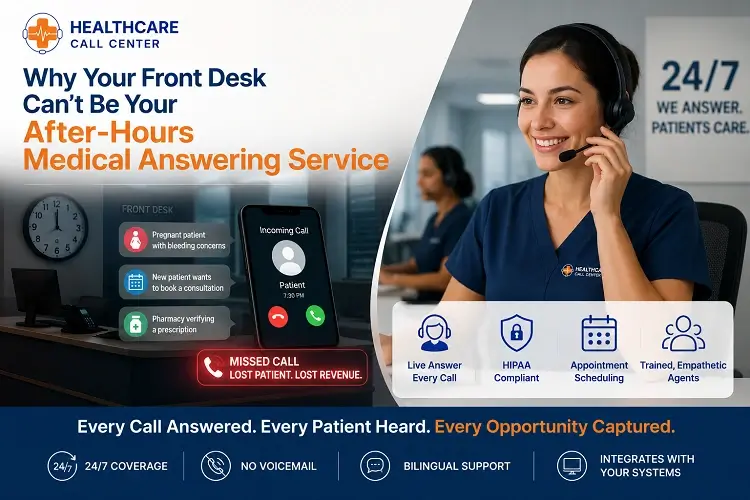
It is 7:30 PM on a Tuesday. Your front desk went home at 5. A pregnant patient is calling with bleeding concerns. A new patient wants to book a consultation. A pharmacy is trying to verify a prescription.
Nobody answers.
These calls go to voicemail. And most of them never call back.
If you run a healthcare practice, your front desk team is probably excellent during business hours. They check patients in, manage schedules, handle insurance questions, and keep things moving. But expecting them to also serve as your after-hours medical answering service is one of the most expensive assumptions a practice can make.
Here is why.
Your Front Desk Is Not Trained for After-Hours Triage
During the day, your front desk operates in a structured environment. They have your providers nearby, your EHR system open, and your office protocols to follow. After hours, none of that infrastructure exists.
When a patient calls at 9 PM with a clinical question, the person on the other end of the line needs to make a quick decision.
Is this an emergency that requires a 911 redirect?
Is this something that can wait until morning?
Should they page the on-call physician?
Your front desk staff are administrative professionals, not clinical triage experts. A proper medical answering service trains its agents on HIPAA-compliant intake, message prioritization, and escalation protocols. They know how to separate a true emergency from a non-urgent question, and they know how to route each call type to the right place.
The difference matters. A mishandled after-hours patient call can lead to patient harm, liability exposure, and lost trust that takes months to rebuild.
46% of Patient Calls Come In After Hours
If you think after-hours calls are rare, consider this: nearly half of patient leads come in outside of standard business hours. Evenings, early mornings, weekends, and holidays.
These are not just casual inquiries. Many of them are high-intent calls from patients who are ready to book. They found your practice online, picked up the phone, and wanted to schedule an appointment. When nobody answers, they do not leave a voicemail and wait. They call the next practice on Google.
Every missed after-hours call is revenue walking out the door
For a plastic surgery practice, losing one consultation, that could be $8,000 in procedure revenue. For a fertility clinic, a single missed IVF inquiry can mean $15,000 or more in lost treatment revenue.
A 24/7 medical answering service captures those calls. Every time. Day or night.
Voicemail Is Where Patient Leads Go to Another Practice
Some practices try to solve the after-hours problem with a voicemail box. The message says something like: “If this is a medical emergency, hang up and call 911. Otherwise, leave a message, and we will return your call on the next business day.”
Patients hate this. And they act on that hatred by calling someone else.
Think about your own behavior. When you call a business after hours and get voicemail, do you leave a detailed message and wait? Or do you hang up and try the next option? Your patients do the same thing.
A live answering service eliminates the voicemail problem entirely. Patients speak to a real person who listens, captures their information, and either schedules the appointment, routes the message, or escalates the call. No waiting. No frustration. No lost leads.
The Real Cost of Using Front Desk for After-Hours Coverage
Some practices try to stretch their front desk into evening coverage. They ask someone to stay late, forward calls to a personal cell phone, or rotate after-hours duty among staff.
Here is what that actually costs:
- Overtime pay: Adding 3-4 hours of overtime per day for even one staff member adds up to $2,000+ per month.
- Burnout and turnover: Staff who are expected to be available around the clock burn out fast. Replacing a medical front desk employee costs $5,000-$10,000 in recruiting and training.
- Inconsistent coverage: Sick days, vacations, and personal emergencies create gaps. Your patients never know when someone will answer.
- Liability risk: An untrained staff member giving after-hours medical advice creates serious liability exposure for your practice.
- Lost opportunities: Every missed call from a new patient is a lifetime value loss. For OB-GYN, that patient could be worth $4,000-$10,000. For fertility, $15,000-$50,000.
Compare that to a dedicated medical answering service. For a fraction of what you would pay a single full-time employee, you get 24/7 coverage, trained agents, HIPAA-compliant protocols, and zero gaps.
What a Proper After-Hours Medical Answering Service Actually Does
A true after-hours medical answering service is not just someone who picks up the phone. It is a trained extension of your practice. Here is what it handles:
- Live answer on every call, 24/7 – No voicemail. No hold music. A real person answers within seconds.
- HIPAA-compliant message capture – Patient information is collected and transmitted securely, with full audit trails.
- Appointment scheduling – Agents can book, modify, and cancel appointments directly in your scheduling system.
- Clinical escalation protocols – Urgent calls are identified and routed to your on-call provider immediately. Non-urgent messages are queued for the next business day.
- Bilingual support – Spanish-speaking patients get the same quality of service as English-speaking patients.
- Call documentation and reporting – Every call is logged with timestamps, caller information, and outcome. You get full visibility into what happened overnight.
But What About AI Chatbots and Automated Systems?
AI is improving fast. Chatbots can handle simple tasks like appointment confirmations and FAQ responses. But when a patient calls at 10 PM with a concern that feels urgent to them, they do not want to navigate a phone tree or chat with a bot.
They want a human voice. Someone who listens, reassures them, and takes action.
The healthcare practices winning right now are not the ones replacing humans with AI. They are the ones using AI for routine tasks while keeping real people on the phones for the conversations that matter. That is the model we follow at Healthcare Call Center. Our team of trained agents handles the complex, emotional, and time-sensitive calls that AI simply cannot manage.
Because a fertility patient calling in tears at 8 PM does not need a chatbot. She needs a person.
How to Transition from Front Desk to 24/7 Coverage
Moving from front-desk-only coverage to a full after-hours medical answering service is simpler than most practice managers expect. Here is what the process typically looks like:
- Step 1: Audit your current call flow. Track how many after-hours calls you receive, what types of calls they are, and how many are currently going to voicemail.
- Step 2: Define your escalation protocol. Decide which call types are urgent, which can wait, and how you want messages delivered (text, email, secure portal).
- Step 3: Choose a HIPAA-compliant answering service. Look for a provider with healthcare-specific experience, bilingual agents, and scheduling integration.
- Step 4: Train and onboard. A good service will learn your practice protocols, scheduling preferences, and common patient questions. This typically takes up to 2 weeks.
- Step 5: Go live and monitor. Once launched, review call logs weekly for the first month. Adjust scripts and protocols based on real call data.
The Bottom Line
Your front desk team is good at their job. But their job is not to be an after-hours medical answering service.
When you rely on stretched-thin staff to handle after-hours calls, you lose patients. You lose revenue. And you create unnecessary stress for everyone involved.
A dedicated medical answering service gives your practice 24/7 coverage without the overhead of additional full-time staff. Every call gets answered. Every patient gets heard. And every high-value lead gets captured.
If you are ready to stop losing after-hours patients to voicemail, schedule a consultation with Healthcare Call Center today. Our team of trained, empathetic agents is ready to become the after-hours voice of your practice.
Book a Free Consultation
Frequently Asked Questions
Q: What is an after-hours medical answering service?
A: An after-hours medical answering service is a live call-handling solution that answers patient calls outside of regular business hours. It provides HIPAA-compliant message capture, appointment scheduling, and clinical escalation so healthcare practices never miss urgent or high-value patient calls.
Q: How much does a medical answering service cost?
A: Medical answering service pricing varies based on call volume and features. Most healthcare practices pay a monthly rate based on per-minute or per-call usage. A quality service is significantly cheaper than paying overtime to front desk staff or losing patients to voicemail.
Q: Can a medical answering service schedule appointments?
A: Yes. A proper medical answering service integrates with your scheduling system to book, modify, and cancel appointments directly. This means after-hours callers can secure their appointment without waiting for the front desk to open.
Q: Is an after-hours answering service HIPAA compliant?
A: A legitimate medical answering service operates under full HIPAA compliance. This includes secure message transmission, trained agents, signed Business Associate Agreements, and audit trails for every call interaction.
Q: What happens to urgent after-hours calls?
A: Trained agents follow your custom escalation protocol. Urgent calls are immediately routed to your on-call physician. Non-urgent messages are securely queued for the front desk to review the next morning.
Q: How long does it take to set up a medical answering service?
A: Onboarding typically takes up to 2 weeks. This includes training agents on your practice protocols, integrating with your scheduling system, and testing call flows before going live.