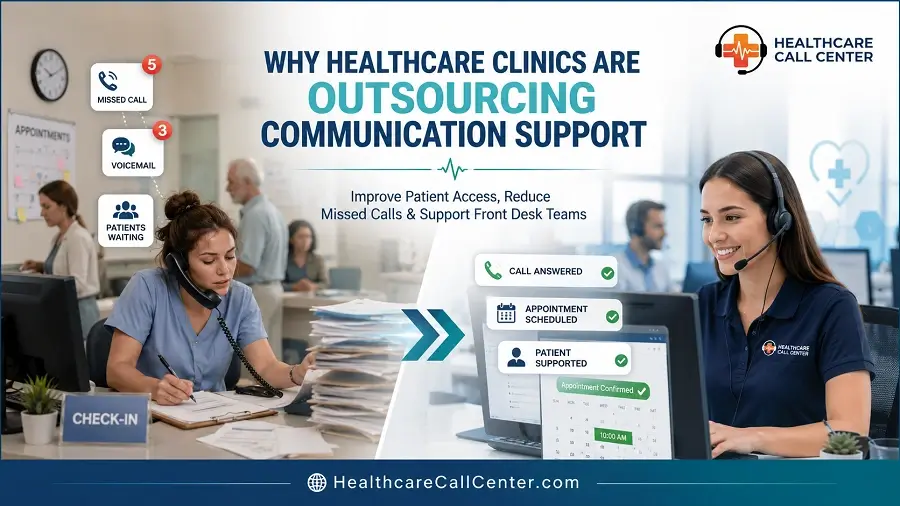
Clinic managers often find themselves responsible for patient care and the ongoing demands of running their clinic. Due to the high volume of patients coming through the clinic’s front desk, it has the added responsibility of handling all types of telephone calls (checking in and out of the clinic; scheduling appointments) and constantly answering questions from patients who are checking in and out or making appointments. In addition, even if the clinic is functioning normally, there may be times when it’s hard to communicate with the patient due to the high volume of other patients at peak times.
As a result, clinic owners are noticing a common trend over time. Staff members are constantly interrupted while checking patients in; they are also receiving phone calls during patient consultations, and patients have difficulty reaching their clinics because calls go unanswered at lunchtime or after hours (patients may choose to go to another provider after multiple unsuccessful attempts).
This is why many clinics are choosing to partner with a third-party HIPAA-compliant healthcare call center to take all or some of the “burden” off their on-site staff, alleviating the need for all staff to handle (i.e., answer) patient calls equitably, regardless of whether it is peak hours. The overall focus for most clinics that have made this decision is not necessarily to replace staff, but to maximize the effectiveness of their communication by properly handling it throughout the day.
Why Front Desk Communication Has Become More Difficult for Clinics
Patient expectations around healthcare communication have changed significantly in recent years. Patients expect quick responses and firm appointment times and dates; when they call a clinic, they want reliable assistance. If a clinic doesn’t provide timely return calls or answer incoming calls, it only adds to the patient’s frustration.
At the same time, clinics’ front desk responsibilities have grown. Reception teams at many clinics are now doing the following:
- Appointment Scheduling and Rescheduling
- Insurance Verification
- Referral Coordination
- Billing Related Inquiries
- Intake Documentation for New Patients
- EHR Documentation Updates and Admin Follow-Ups
This results in the front desk team struggling to handle all incoming calls without delays when they are busy.
With smaller clinics feeling the pressure more than ever, this becomes even more difficult for a single receptionist to successfully handle all communication points (including in-person patient care), given the large volume of incoming calls they also manage and how quickly the call volume will increase as soon as they turn their back on a phone.
Clinics that provide specialty care solutions can frequently see additional complexity added to their operation, thus resulting in many of them having some sort of urgent patient calls received by psychiatry; dental clinics receiving emergency appointment requests; and primary care offices needing to maintain strict organization to avoid missing contacts related to someone needing to reschedule or follow up during the day.
As communication demands continue to increase, many clinics are realizing that traditional front desk systems alone are no longer enough to manage patient communication efficiently.
How Missed Calls Affect Patient Experience
Unanswered calls are no longer viewed as small operational issues. For many clinics, they directly impact patient trust, appointment conversions, and overall satisfaction. Patients will generally contact a healthcare provider when something important is going on (e.g., discomfort or pain), to clarify their treatment plan, or to get in quickly for an appointment.
When a patient attempts to reach a clinic by phone but is unable to get anyone on the line, it feels as though the clinic is not present and/or does not care.
Missed calls do not just affect patient experience. They can also reduce appointment conversion opportunities and impact long-term practice growth.
Over time, repeated communication issues can reduce patient confidence in the clinic.
For example, a patient attempting to book an appointment during their work schedule may not have the opportunity to call back later. Additionally, someone needing urgent care information may choose not to return to the clinic and instead search for different options, or a current patient may become frustrated if they cannot easily contact someone at the office for follow-up questions.
Furthermore, missed calls create many additional hidden administrative issues that occur, including:
- Appointment confirmation delays
- Increased backlog of voicemails
- Increased staff members’ workload due to call-backs
- Lost patient inquiries
- Lower overall patient satisfaction.
Many health care practices have found that communication bottlenecks decrease patient satisfaction before quality of care becomes an issue. Patient satisfaction often depends on how patients feel during their first interaction with a clinic, which is one reason why communication style and empathy play such an important role in healthcare call handling.
The Administrative Pressure on In-House Staff
One of the main reasons clinics outsource communications support is that staff get tired or “burned out.”
The frontline team (the front desk staff) works in a very fast-paced, busy, and interruption-filled workplace. It is common for a receptionist to be helping a patient at the reception counter while managing two ringing phone lines and scheduling an appointment. Over time, the cumulative effect of juggling all these activities may lead to fatigue and increase the likelihood of being inaccurate in either scheduling or the accuracy of communication (because of fatigue). As a result, high turnover is seen in front desk positions in healthcare settings.
Additionally, retraining administrative staff creates operational inefficiencies. New staff need time to learn scheduling systems, patient communication protocols, insurance processes, and the clinic’s operational procedures. The quality of service during periods when new staff are being trained can be negatively affected.
By outsourcing communications support to an external team, clinics reduce the ongoing daily burden of managing phone call volume (e.g., overflow, after-hours, and scheduling requests) for their in-house teams.
By outsourcing communications support, clinics create a manageable workload for their on-site employees while also providing patients with a more consistent level of service.
The Practical Benefits of Outsourcing Communication Support
Outsourcing front desk communications helps clinical facilities resolve their operational challenges rather than expecting lower labor expenses.
Improving call coverage is an immediately apparent benefit. When a healthcare call center receives incoming communications from patients, the likelihood that a patient will encounter a voicemail system during business hours is greatly reduced. Calls will be handled continuously, even during peak periods for appointments, staff lunches and breaks, and any unexpected schedule disruptions.
By providing real-time access to call centers, the logistics of scheduling patient appointments can also be made much more efficient. Many of the outsourced teams have been trained on the clinical facility’s scheduling system to help minimize scheduling errors and avoid double-booking patients.
Improving operational efficiencies can lead to many of the following benefits:
- Quicker appointment management
- Faster response times to patient communications
- Fewer missed calls
- More consistent call handling during busy times
- Additional time and attention for clinical staff working with patients in the clinic
Another benefit of outsourcing to call center service provider is increased effectiveness of follow-up communication efforts. Many facilities use missed-call retrieval services to reach prospective patients who might otherwise be lost. In a highly competitive healthcare environment, responding promptly to patient communications can ultimately determine whether the prospect actually schedules an appointment.
Outsourcing also increases workflow stability as practices and clinics expand. As a clinic expands to more providers or locations, maintaining internal communication systems will become more difficult. External support teams provide the necessary continuity without requiring immediate staffing increases for front desk agents.
Why 24-Hour Patient Response Is Becoming More Important
Despite what many may think, healthcare communication continues beyond the closing of clinics each evening. Patients continue to call health care providers’ offices after hours (between 5 pm and 8 am) because that is usually the only time they have to manage appointment requests or health questions. Many of these after-hours calls are made for scheduling issues, to request medication clarification, or to cancel or reschedule appointments the next day, which can complicate the clinic’s operations if missed.
Without structured after-hours support, most after-hours calls to the clinic office are sent to voicemail and typically go unaddressed until the next morning. Specially when you have a healthcare call center.
A 24/7 healthcare call center enables clinics to keep their phone line(s) open to patients after standard business hours. This doesn’t mean every clinic requires full overnight scheduling support, but it does allow patients to speak live with a representative whenever they need assistance.
Clinics benefit from several operational advantages with the addition of a 24/7 healthcare call center:
- After-hours appointment requests can still be captured.
- Urgent calls can be escalated as appropriate.
- Patient response outside business hours can be expedited.
- The number of scheduling gaps caused by missed after-hours calls can be reduced.
- The clinic’s administrative teams will start each day with fewer unanswered messages.
In addition to the operational advantages for the clinic, patients appreciate knowing they have access to someone who will assist them after hours, even for just two or three minutes. Everyone who has used any after-hours healthcare service agrees that a brief exposure to a trained representative is much more reassuring to the caller than leaving a voicemail and not knowing when the call will be returned.
With the trend toward greater patient retention and overall experience excellence, the availability of after-hours healthcare services has become increasingly important to patients.
Why HIPAA Compliance Matters in Outsourced Communication
Patient confidentiality in healthcare communication is critical when deciding whether to use outsourced communication services. Therefore, it is essential for clinics to carefully consider how they will comply with HIPAA regulations when selecting a company for outsourced communications.
A HIPAA-compliant health care call center allows each organization to have access to Protected Health Information, as well as utilize established communication protocols within the Health Care System for the handling of that information; therefore, all agents are trained in patient confidentiality, proper ways to document each conversation or note, as well as the proper process for communicating and handling any Protected Health Information.
Without proper safeguards in place, a clinic could be subject to Operational Liability by outsourcing its telephone communications, thereby exposing it to potential Privacy and Operational Liability.
As a result of HIPAA requirements, the technology systems used by the outsourced call center must support the handicapping of patients’ data and include: secure call handling; encrypted communications; limited access to patients’ data; and documented processes for the storage and maintenance of patients’ data.
Ultimately, clinics should never sacrifice their commitment to client confidentiality for the convenience of outsourcing their communications; the best value is derived from a partnership built on clearly defined communication and compliance processes.
How Healthcare Call Centers Improve Operational Efficiency
Healthcare operational efficiency is very often a direct reflection of the quality of your communications. It is a given that when your calls are handled equally, your front desk turnaround will become more uniform. This will result in fewer interruptions for all employees, a more organized scheduling system, and reduced potential last-minute scheduling gaps for providers due to uncompleted or unanswered confirming calls.
In conjunction with your clinic’s call center, your clinic can develop and maintain uniform, efficient communication processes across departments or locations. Patients will also benefit from receiving more uniform responses from all administrative teams, and staff will have less work to do on their own to manage call overflow.
Over time, your clinic may see these additional benefits:
- Front desk staff can dedicate more time to working with patients in person
- Providers will have fewer interruptions with scheduled appointments
- Administrative team will have less time spent returning voicemail messages
- Patient communication records will be in a more organized and accessible manner
- Your clinic operations will feel less reactive during any part of the day
Although the improvement in your clinic operations will likely be gradual rather than dramatic, it will create a more predictable, manageable day-to-day workload for your entire practice.
The reason this is important is that the inefficiency experienced by your clinic is not due to one single issue, but rather many small communication breakdowns, every day, repeatedly over time.
Outsourcing is Becoming Part of Modern Clinic Operations
Not all clinics will use outsourcing for communications in the same way. Some clinics only need support for after-hours calls. In contrast, others rely on backup teams to complete appointment scheduling, handle overflow calls, and assist with patient follow-up and record keeping.
In general, all clinics are feeling the strain of operations
The ongoing increase in patient expectations makes it clear to clinics that their communication with patients must align with the level of clinical care provided. While front desk staff is still required, more clinics today no longer expect their in-house staff to manage all patient communication.
Using a healthcare call center enables clinics to provide more consistent access to their patients while reducing pressure on their in-house staff. Using an outsourced communication service staffed by trained personnel, secured with safety measures, and compliant with HIPAA policies and procedures is no longer just a way to fill a position; it is becoming an operational support strategy for clinics.
For clinic owners trying to improve responsiveness to patients without overburdening their staff, achieving this balance is becoming increasingly valuable.