It is 7:15 PM on a Wednesday. Your front desk went home three hours ago. A patient is calling your practice because they have been dealing with a painful tooth for two days, and they cannot wait until Monday. The phone rings. No one answers. Then voicemail picks up. The patient hangs up, opens Google, and calls the next practice on the list. Someone answers. That practice books the appointment. You just lost a patient. And you will never even know it happened.
This scenario plays out at medical practices across the country every single night. The revenue lost from missed after-hours calls is staggering, yet most practice owners have no idea how much money is slipping through their fingers. A medical call center service provider exists to stop that revenue leak by ensuring every patient call gets answered by a trained human.
The Hidden Revenue Drain Nobody Talks About
Most practice owners track their patient acquisition cost, their show rate, their lifetime patient value, and their marketing ROI. But almost none of them track the calls they miss.
Here is what that looks like in real numbers. A practice receiving 40 calls per day misses roughly 10 of those calls during lunch breaks, peak busy hours, and after the office closes. That is 220 missed patient calls every month. If even 30 percent of those calls had booked an appointment at an average value of $300 each, the practice is losing $19,800 in revenue every month. Over a full year, that is $237,600 in appointments that went to a competitor.
The worst part is that most practices never see these numbers. The calls disappear into voicemail. The patients never leave messages. The practice has no idea those calls ever happened.
This is where a dedicated and 24/7 medical answering service changes the game. Instead of sending those calls to voicemail, every single patient call gets answered by a real human who can schedule appointments, answer questions, and route urgent matters to the right person.
Why Patients Call After Hours (And Why It Costs You Revenue)
Patient calls do not follow a 9-to-5 schedule. People get sick at night. They get anxious on weekends. They remember to call about a prescription refill at 9 PM after putting their kids to bed. They search for a new doctor after work because that is when they have time to make personal calls.
The Biggest Missed-Call Windows
- Early mornings (6 AM to 8 AM): Patients call before work with questions about medication, symptoms, or appointment changes. Your office does not open until 8 or 9.
- Lunch hours (12 PM to 2 PM): Your front desk is steps away, and calls pile up. A new patient calling during their own lunch break gets voicemail.
- Evenings (5 PM to 10 PM): This is the biggest gap. Patients get off work, process their symptoms, and call healthcare practices. Almost every one of these calls goes unanswered.
- Weekends: Saturday and Sunday generate a steady stream of patient calls that go completely unhandled at most practices.
Each of these calls represents a patient who needs help right now. When they reach voicemail, they do not wait. They call the next practice on Google. In healthcare, availability is a competitive advantage. The practice that answers the phone wins the patient.
What a Medical Call Center Actually Does for Your Practice
A medical call center is not the same as a generic answering service. Generic services read scripts, take messages, and forward calls. They cannot schedule appointments. They do not understand healthcare workflows. They have never dealt with a panicked parent calling about a child at 10 PM.
Core Services Included
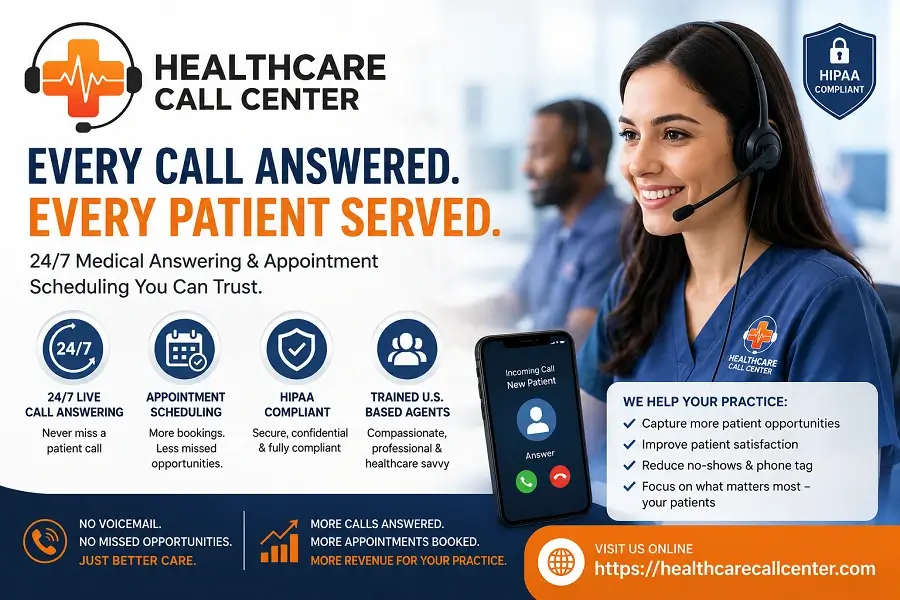
- 24/7 Live Call Answering: Every call is answered by a real person, day or night. Patients never hear voicemail.
- Appointment Scheduling: Agents book, reschedule, and manage appointments directly in your existing EMR or scheduling software.
- Physician On-Call Triage: Agents follow your specific escalation rules for urgent calls. They know what an emergency is and what can wait.
- New Patient Intake: Capture every new patient lead with structured intake. Collect insurance, reason for visit, and referral source.
- Prescription Refill Routing: Agents collect refill requests accurately and route them to the right provider.
- HIPAA-Compliant Documentation: Every call is documented under strict HIPAA protocols with encrypted storage and access controls.
- Bilingual Support: Spanish-speaking patients get the same quality of care with bilingual agents who handle calls in either language.
The key difference is that a medical call center functions as an extension of your front desk. Your patients should not be able to tell that the person answering the phone does not sit in your office. That is the standard.
Generic Answering Services vs Medical Call Centers
Many practices try to save money by using a cheap answering service that charges a few dollars per call. This is a false economy. The savings on call handling are wiped out instantly by the patients who hang up on a confused agent and call your competitor.
What Happens With a Generic Answering Service
Here is what happens with a generic answering service. A patient calls at 8 PM with an urgent question about their medication. The agent reads from a script, cannot answer the question, takes a message, and promises someone will call back in the morning. The patient is frustrated. They feel unheard. They start looking for a new provider.
What Happens With a Dedicated Medical Call Center
Now compare that to a trained medical call center agent. The patient calls at 8 PM. The agent answers warmly, understands the urgency, follows the practice triage protocol, and either routes the call to the on-call physician or schedules a same-day appointment. The patient feels cared for. They stay with your practice. That is the difference between losing a patient and keeping one for life.
How Fast Can a Medical Answering Service Go Live?
One of the most common questions practice owners ask is how long it takes to get a medical call center up and running. The answer is up to 2 weeks from the time you sign on.
During that time, the call center team reviews 30 days of your call data to understand your peak hours and missed-call patterns. They load your practice information, scheduling rules, and escalation protocols into their system. They train dedicated agents on your specialty, your call policies, and your patient communication style. When you go live, every call is handled by someone who knows your practice inside and out.
Specialty-Specific Medical Call Handling
Every medical specialty has different call patterns, patient needs, and revenue at stake. A medical call center that treats all calls the same is not going to capture the nuance that each specialty requires.
OB-GYN Practices
For OB-GYN practices, pregnant patients call at all hours with urgent symptoms and test results. An OB-GYN answering service with triage-trained agents can identify true emergencies and follow your escalation protocol.
Dental Practices
For dental practices, new patient leads often call during lunch or after work. A dental call center captures those leads, books the appointments, and keeps your hygiene schedule full.
Fertility Clinics
For fertility clinics, patients are calling with emotionally charged questions about IVF cycles, medication timing, and test results. A fertility clinic answering service understands that these calls require empathy and urgency.
The point is simple. Your specialty matters. Your call center should understand it.
Measuring ROI From Your Medical Call Center
The beauty of working with a medical call center is that the ROI is measurable. You do not have to guess whether it is working. The numbers tell you.
Key Metrics to Track
- Answered call volume per month: How many calls that previously went to voicemail are now being answered?
- New appointments booked: How many appointments do the call center agents schedule on your behalf?
- After-hours capture rate: What percentage of your total calls come in outside office hours?
- Revenue per recovered call: Average appointment value multiplied by booked appointments from calls that would have been missed.
- Patient satisfaction: Are your patients reporting a better experience when they call?
When you track these metrics monthly, the ROI becomes obvious. If a medical call center recovers even 30 appointments per month at an average value of $300 each, that is $9,000 in recovered revenue. For higher-value specialties like fertility or plastic surgery, a single recovered patient can represent $15,000 to $50,000.
What to Look for in a Medical Call Center
Not all medical call centers are created equal. When you are evaluating providers, here are the non-negotiables:
- HIPAA compliance on every call. Every agent is trained. BAA signed for every client.
- Real humans answering phones. No AI bots, no automated menus, no voicemail loops.
- EMR and scheduling integration. Agents should book directly into your system.
- Specialty-specific training. Generic scripts do not work in healthcare.
- Low agent turnover. You want consistent voices, not new people every month.
- Transparent reporting. You should see every call, every appointment, and every message in real time.
- Month-to-month plans. No long-term contracts. If the service is good, you will stay.
The Bottom Line: Every Missed Call Is Lost Revenue
Every night your office is closed, patients are calling. They are calling because they need help, and they are calling the first practice that picks up. When your calls go to voicemail, those patients become someone else’s patients. The revenue goes to the competitor who answered first, and you never see it.
A medical call center stops that leak. It answers every call, captures every appointment, and makes sure no patient ever hears voicemail again.
Your patients deserve to feel heard before they ever walk into your clinic. Make sure someone is there to answer when they call.
How Much Revenue Are You Losing to Missed Calls?
Every missed call is a patient who needed your practice.
Book a free practice audit and discover exactly how many calls and appointments – your front desk may be losing each month.
Frequently Asked Questions
Q: How quickly can we get a medical call center up and running?
A: Your custom call script and onboarding plan are built within 2 weeks. During that time, the team loads your practice information and trains dedicated agents on your specific call handling policies.
Q: Will patients know they are talking to a call center and not our front desk?
A: No. A quality medical call center trains agents specifically on your practice protocols, greeting, and communication style. Patients should feel like they are talking to your office.
Q: Can a medical call center schedule appointments in our EMR?
A: Yes. The right medical call center integrates directly with your existing EMR and scheduling software so appointments stay synced in real time.
Q: What happens if a patient has an emergency after hours?
A: Agents follow your specific escalation protocol. They identify true emergencies and route urgent calls to the appropriate on-call physician through secure channels immediately.
Q: How much does a medical call center cost?
A: Pricing is based on your call volume and specialty. Most practices find that the revenue recovered from missed calls far exceeds the monthly cost. Month-to-month plans are available with a 30-day notice.