by Erika Sanchez | Oct 22, 2026 | OB-GYN Answering Service
OB-GYN practices receive some of the most sensitive calls in healthcare. A patient may be newly pregnant and anxious. Another may be calling about bleeding, pain, a medication question, a fertility concern, a postpartum issue, or a missed appointment. Some calls are routine. Some feel urgent to the patient. All of them require a calm, professional response.
The problem is that most women’s health clinics are already stretched thin. The front desk is handling check-ins, insurance questions, provider messages, prescription requests, scheduling changes, and patients standing in front of them. When the phone keeps ringing, calls slip to voicemail. When calls slip to voicemail, appointment opportunities, patient trust, and urgent messages can get delayed.
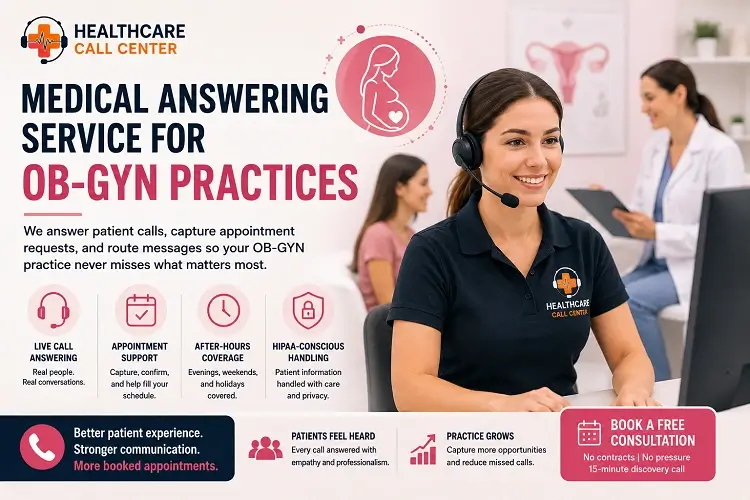
A medical answering service for OB-GYN practices gives women’s health clinics a structured way to answer more patient calls, support after-hours coverage, reduce voicemail gaps, and route messages based on practice-approved instructions. It does not replace the clinical team. It supports the patient communication workflow so the practice can stay responsive without overloading staff.
Women’s health practices often need specialty healthcare call support because patient calls can be sensitive, urgent, or appointment-related.
Why OB-GYN Patient Calls Are Different
OB-GYN calls are not the same as general business calls. The caller may be dealing with pregnancy symptoms, fertility stress, abnormal bleeding, birth control questions, prenatal scheduling, postpartum concerns, or test follow-up anxiety. The tone of the call matters. The speed of response matters. The accuracy of the message matters.
Patients in women’s health often need to know that someone has heard their concern, captured the right details, and can route the message appropriately. A voicemail box does not provide that reassurance.
This is why an OB-GYN answering service needs more than polite call handling. It needs healthcare-specific scripting, privacy-aware workflows, escalation rules, and a clear understanding that the patient experience begins before the appointment ever happens.
The Agency for Healthcare Research and Quality (AHRQ) identifies timely appointments, access to information, and communication with clinicians and staff as important parts of the patient experience.
The Front Desk Problem in Women’s Health Clinics
Most OB-GYN front desks are not missing calls because they are careless. They are missing calls because the workload is too high. A single receptionist may be expected to answer phones, greet patients, manage forms, verify insurance, communicate with providers, process appointment changes, and handle patient callbacks at the same time.
During peak hours, the phone can become impossible to manage. Calls come in before work, during lunch, after school pickup, after 5 PM, and on weekends. Patients may wait on hold, leave voicemail, or hang up and try another practice.
For a women’s health practice, this creates several risks:
- New patient inquiries may never become booked appointments
- Pregnancy-related messages may be delayed or poorly documented
- Cancellations may not be seen until the schedule has already been affected
- Front desk staff may start the day with a backlog of voicemails
- Patients may feel ignored during sensitive moments
A structured answering service reduces that pressure by giving the practice a second layer of call coverage when the front desk is busy, closed, or unavailable.
How a Medical Answering Service Supports OB-GYN Practices
A medical answering service helps OB-GYN practices by answering patient calls, documenting key details, routing urgent messages, and organizing routine requests for follow-up. The service should follow the practice’s approved workflow, not a generic script.
Common OB-GYN call types include:
- New patient appointment requests
- Pregnancy confirmation and prenatal visit questions
- Appointment cancellations and reschedules
- Medication refill routing
- Postpartum callback requests
- Fertility and cycle-related questions
- Test result callback requests
- After-hours concerns that need escalation based on practice rules
The answering team should not diagnose, give medical advice, or decide what is clinically urgent. Instead, agents gather details, follow approved scripts, and route messages according to the practice’s escalation instructions. That distinction is important for both patient safety and staff efficiency.
After-Hours OB-GYN Calls Need a Clear Process
After-hours OB-GYN calls are especially important for OB-GYN practices because patients may not know whether their concern can wait. A pregnant patient may be worried about symptoms. A postpartum patient may have a question after discharge. A patient undergoing fertility treatment may need to clarify instructions outside normal hours.
A strong after-hours OB-GYN answering service process does three things. First, it answers the call with a real person. Second, it collects the right information. Third, it routes the message based on the practice’s approved urgency rules.
Practices that want continuous coverage can pair those protocols with 24/7 OB-GYN answering coverage so no patient call lands in voicemail at any hour of the week.
This creates a better experience than voicemail. The patient knows their message was received. The practice gets a clearer call record. Providers are not interrupted by every routine question, but urgent messages are not buried in an inbox overnight.
OB-GYN Answering Service vs. Voicemail
Many women’s health clinics still rely on voicemail after hours or during busy call periods. Voicemail may seem simple, but it often creates more work for the office and more uncertainty for patients.
| Situation |
Voicemail |
OB-GYN Answering Service |
| New patient calls after work |
Patient may hang up or call another practice |
Live answer captures the inquiry and callback details |
| Pregnancy-related concern |
Patient leaves an incomplete message |
Agent follows script and routes based on practice rules |
| Cancellation or reschedule |
Office may not see it until the next day |
Request is documented clearly for follow-up |
| Front desk overloaded |
Calls stack up during clinic hours |
Overflow coverage helps answer more calls |
| After-hours patient anxiety |
Patient waits without reassurance |
Live answer confirms the message was received |
| Provider escalation |
Voicemail may delay urgent routing |
Escalation rules help route the right calls |
How Answering Support Helps Capture More Appointments
OB-GYN practices depend on timely appointment scheduling. New patient calls, prenatal appointment requests, annual exam requests, follow-up visits, fertility-related appointments, and postpartum appointments all affect revenue and patient continuity. When these calls go unanswered, the practice may lose the appointment before the team even knows the patient called.
A medical answering service helps protect these opportunities by making sure calls are answered and documented. Even when the final scheduling step happens during office hours, the inquiry is captured while the patient’s intent is fresh.
This matters because patients often search and call several providers in one session. If your practice is investing in SEO, referrals, or paid campaigns, every missed phone call weakens that investment. Call coverage helps convert patient demand into real appointments.
Want to estimate the potential impact of missed calls on your practice? Use our Missed Call Revenue Calculator to estimate appointment and revenue opportunities.
HIPAA-Conscious Call Handling Matters
OB-GYN calls can include sensitive health details. Any answering workflow must treat patient information carefully. That means secure message handling, appropriate access controls, clear documentation, and practice-approved routing procedures.
A healthcare-focused answering service should understand that privacy is not optional. Agents need to know what information to collect, what not to say, when to escalate, and how to document calls without creating unnecessary risk.
The U.S. Department of Health & Human Services (HHS) explains that the HIPAA Privacy Rule establishes national standards for protecting individually identifiable health information and requires appropriate safeguards for protected health information.
This is why OB-GYN practices should connect answering support with HIPAA-compliant medical answering service workflows instead of using a generic answering service that does not understand healthcare communication.
When OB-GYN Practices Should Consider Outsourced Call Coverage
Not every practice needs the same level of support. Some practices need after-hours answering only. Others need daytime overflow. Multi-provider women’s health groups may need both. The right setup depends on call volume, staffing pressure, appointment demand, and how often patients reach voicemail.
OB-GYN practices should consider outsourced call coverage when:
- The front desk regularly misses calls during clinic hours
- Voicemail volume is high every morning
- Patients complain about not reaching the office
- Providers receive messy or incomplete after-hours messages
- New patient demand is strong but appointments are not increasing
- The practice is expanding locations or adding providers
- The team needs better call documentation without hiring another full-time employee
Outsourcing does not mean giving up control. The practice still defines the script, escalation rules, message categories, and handoff process. The answering service simply supports that workflow when the in-house team cannot cover every call.
What to Look for in the Best OB-GYN Answering Service
Choosing the right provider matters. OB-GYN practices should avoid generic answering services that only take basic messages. Women’s health calls need a more careful process. The best OB-GYN answering service is defined by process, not price: healthcare-specific call handling, privacy-aware workflows, and a setup that learns your protocol before the first live call.
Look for a provider that offers:
- Healthcare-specific call handling experience
- Practice-specific scripts and greetings
- After-hours and overflow coverage
- Escalation rules for urgent messages
- HIPAA-conscious message handling
- Appointment request capture
- Clear call summaries for the office team
- Support for single-location and multi-location practices
- A setup process that learns your workflow before calls go live
For a fuller vetting checklist, see our guide to the questions to ask before choosing an OB-GYN answering service.
The best answering service should feel like an extension of the practice. Patients should feel heard. Staff should receive cleaner information. Providers should see fewer unnecessary interruptions and fewer delayed urgent messages.
How Healthcare Call Center Helps OB-GYN Practices
Healthcare Call Center supports women’s health practices with OB-GYN answering service support, after-hours coverage, front desk overflow support, appointment request capture, and practice-specific message routing. Our team follows your approved scripts and communication rules so patient calls are handled consistently. Practices that need additional front-desk coverage can also explore medical virtual receptionist support.
The goal is simple: help your practice answer more calls, reduce voicemail gaps, protect patient trust, and support appointment growth without adding more pressure to the front desk.
Common Mistakes OB-GYN Practices Make With Call Coverage
1. Treating All Missed Calls as Routine
In OB-GYN care, some missed calls are routine, but others may involve sensitive symptoms, medication questions, scheduling urgency, or anxiety around pregnancy. A generic voicemail process does not help the practice separate routine messages from messages that need faster routing.
2. Assuming Online Forms Replace Phone Calls
Online booking helps, but many women’s health patients still want to talk to a person before choosing a provider. This is especially true for new pregnancies, fertility concerns, insurance questions, and visits that feel emotionally sensitive.
3. Pushing More Responsibility Onto the Front Desk
If the team is already handling check-ins, forms, insurance, provider messages, and patient callbacks, telling them to “answer more calls” does not solve the problem. It creates burnout and inconsistent patient communication.
The better approach is to build a layered call coverage system: the in-house team handles the front desk experience, and the answering team supports overflow, after-hours calls, and structured message capture.
Final Thoughts
OB-GYN practices cannot treat missed calls as a small front desk issue. In women’s health, a missed call can mean a missed appointment, a delayed message, a worried patient, or a lost opportunity to build trust.
A medical answering service for OB-GYN practices gives clinics a practical way to answer more calls, support patients after hours, route messages clearly, and protect the patient experience from the first phone call.
If your women’s health practice is losing calls to voicemail, book a free consultation to review your call flow and see where answering support can help.
Frequently Asked Questions
What is a medical answering service for OB-GYN practices?
A medical answering service for OB-GYN practices answers patient calls, documents messages, routes urgent concerns based on practice rules, and supports scheduling-related communication for women’s health clinics.
What is the best OB-GYN answering service?
The best OB-GYN answering service is one built for healthcare, not generic message taking: live US-based agents, practice-specific scripts, after-hours and overflow coverage, HIPAA-conscious message handling, and a documented answer-rate standard. For women’s health, the provider should also understand sensitive call types such as pregnancy concerns, postpartum questions, and fertility-related calls, and route them by the practice’s own escalation rules.
Can an OB-GYN answering service handle after-hours calls?
Yes. An OB-GYN answering service can answer calls after hours, collect patient details, follow approved scripts, and route urgent messages according to the practice’s escalation process.
Can the answering service give medical advice?
No. Non-clinical answering agents should not diagnose or give medical advice. They collect information, follow scripts, and route calls based on the practice’s instructions.
Does an OB-GYN answering service help with appointments?
Yes. Depending on the practice workflow, agents can capture appointment requests, cancellations, reschedules, and callback details so the office can follow up efficiently.
Is OB-GYN answering service support HIPAA compliant?
A healthcare answering provider should use HIPAA-conscious workflows, secure message handling, access controls, and practice-approved routing. Practices should confirm compliance requirements before launch.
Who needs OB-GYN answering service support?
OB-GYN practices that miss calls, receive after-hours patient concerns, struggle with voicemail backlogs, or need front desk overflow support can benefit from dedicated answering service coverage.
by Erika Sanchez | Oct 8, 2026 | OB-GYN Answering Service
Choosing an OB-GYN answering service provider is not the same as hiring a basic message-taking company. OB-GYN calls are personal. They involve pregnancy concerns, postpartum anxiety, new patient questions, symptoms, insurance confusion, and sensitive women’s health needs that a generic call center simply is not trained for.
For many women, especially new and expecting patients, the first call is the first trust test. If the call goes to voicemail, feels rushed, or sounds scripted, the patient keeps searching for a practice that feels more available and reassuring.
Questions To Ask Before Hiring an OB-GYN Answering Service Provider
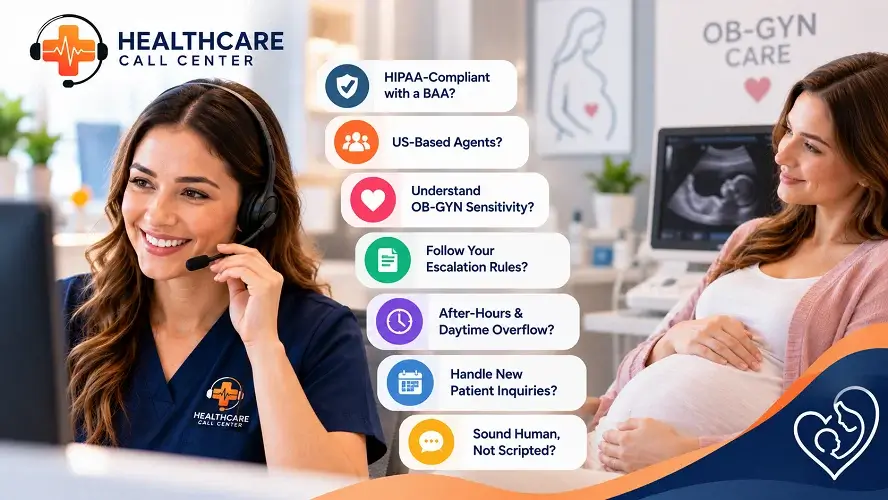
This checklist gives you the ten questions that separate a true healthcare partner from a call center reading a script. Ask every one of them before you sign.
Question 1: Is the Provider Truly HIPAA-Compliant, With a BAA?
Women’s health calls involve protected health information from the first sentence: pregnancy status, symptoms, test result questions, medication concerns. Ask how calls are documented, where information is stored, who can access it, and whether the provider will sign a Business Associate Agreements. A provider that hesitates on a BAA, or treats HIPAA as a checkbox, is telling you something. The strongest answers describe HIPAA-conscious medical answering workflows in detail: minimum-necessary information capture, secure message delivery, access controls, and agent training with annual refreshers.
Follow-up: ask to see their BAA template before signing anything.
Question 2: Are the Agents US-Based?
After-hours and overflow calls put an anxious patient on the phone with a stranger. Accent, pacing, and cultural familiarity decide in seconds whether that patient feels heard or hung up on.
Ask directly: where do your agents sit, and can you guarantee 100% US-based coverage on every shift, including weekends and holidays? Practices that switched from offshore coverage to trained US-based agents consistently report a better first-call experience, and patients notice the difference on the very first call.
At Healthcare Call Center, the agents are US-based stay-at-home moms: patient, empathetic voices that OB-GYN callers remember and trust.
Question 3: Do They Understand OB-GYN Patient Sensitivity?
Some callers are excited first-time patients. Some are worried about symptoms. Some have had a bad experience with a healthcare office and are nervous before the first ring. The tone of the call matters as much as the information collected.
Ask how agents are trained for sensitive calls. Can they reassure without giving medical advice? Can they tell the difference between a routine scheduling request and a worried patient who needs warmth first, documentation second? A service that answers with specific training examples is a service that has actually done the work.
Question 4: Can They Follow Your Escalation Rules Exactly?
Every practice has its own rules for urgent concerns, after-hours triage, and provider notifications. The answering service should never invent its own process or judge medical urgency on its own. Ask how they build escalation paths, whether they can flag different call types, and how quickly an urgent message reaches your 24/7 OB-GYN answering service on-call workflow at night or on a weekend.
The strongest providers document your rules in writing, test them before go-live, and audit them monthly. A service that cannot show you its escalation testing is guessing with your patients.
Question 5: Do They Cover After-Hours and Daytime Overflow?
Most practices think about answering services only for nights. But missed calls also happen at noon, during lunch, and when your front desk is checking in three patients while the phone rings twice. Ask whether the provider supports after-hours OB-GYN answering after-hours coverage and daytime overflow from the same team, so your callers get the same experience at 2 PM as at 2 AM.
The goal is not to replace your front desk. It is to make sure fewer patients fall into voicemail while your team does its real work.
Question 6: How Do They Handle New Patient Inquiries?
A new OB patient is comparing practices. She searched, read reviews, checked insurance, and dialed. If that call is missed or handled with a bare name-and-number message, she books elsewhere.
Ask what the service captures on a new patient call: name, callback number, new or existing status, reason for call, service needed, preferred location, insurance notes, and referral source. The intake should move the patient toward the next step, not just log the ring.
Question 7: Will Calls Sound Human, Not Scripted or Robotic?
Patients can hear a cold script instantly, and in women’s health that tone costs trust. Ask how the service balances structure with warmth: natural language, acknowledgment of concern, and a clear next step on every call.
And ask this directly: are your agents live humans, or an AI voice system? A trained human agent handles the worried, urgent, and emotionally complex calls that AI phone tools still drop. Automation belongs underneath your coverage, for reminders and routing, never as the first voice a nervous patient hears.
Question 8: Can They Reduce Voicemail Dependence?
Voicemail creates a gap between patient intent and practice response, and in that gap patients call the next practice on the list. Ask how the provider reduces that dependence: live answer during busy windows, after-hours capture, fast message routing, and reporting that shows exactly when your calls are being missed. If you want to size the gap first, run your numbers through the missed call revenue calculator in about two minutes. Most practices are surprised by the total.
Question 9: What Reporting Do You Provide?
You cannot improve what you cannot see. Ask what the reports include: call volume, reasons, after-hours patterns, missed-call trends, new patient inquiries, and routing outcomes. Good reporting shows whether your front desk is overloaded at specific hours and whether new patient demand is being captured or leaked.
Question 10: What Does It Cost, and What Are the Contract Terms?
Pricing should be based on call volume and coverage hours, quoted clearly before you sign. Ask what is included: scripts, escalation setup, reporting, and account management. Month-to-month terms with 30-day notice protect both sides. Watch for setup fees that were never mentioned on the call, and ask for the total monthly number in writing.
A provider confident in its service will put pricing and terms in front of you without pressure.
Red Flags When Choosing an OB-GYN Answering Service
Be careful if a provider cannot explain HIPAA procedures in plain language, will not sign a BAA, uses generic scripts for every practice, has no healthcare focus, or cannot walk you through its escalation testing. Guidance from the American College of Obstetricians and Gynecologists on patient communication and the Business Associate Agreements rules give you a neutral baseline for the compliance conversation.
Other red flags: unclear reporting, no after-hours flexibility, poor training around sensitive calls, and a tone that feels transactional.
What Makes Healthcare Call Center Different for OB-GYN Practices
Healthcare Call Center is built around healthcare communication, not generic answering. For OB-GYN practices, that means trained US-based mom agents, HIPAA-conscious call handling, a written 90%+ answer-rate guarantee, and workflows built around your protocols.
We help practices capture missed calls, support after-hours and overflow coverage, follow practice-approved escalation rules, and give every patient a warm first response. We are not trying to replace your front desk. We protect the calls your front desk cannot always catch.
Final Checklist Before You Choose
HIPAA-compliant with a signed BAA? Agents 100% US-based? Trained for OB-GYN sensitivity? Follows your escalation rules exactly? Covers after-hours and daytime overflow? Captures new patient inquiries completely? Sounds human, not robotic? Reduces voicemail dependence? Reports you will actually read? Clear pricing, month-to-month terms?
If any answer is unclear, keep asking. The provider you choose becomes part of your patient experience.
Conclusion: The Right OB-GYN Answering Service Protects Patient Trust
Choosing an OB-GYN answering service is a patient experience decision, not just an operations one. The right provider helps your practice respond faster, reduce missed calls, protect privacy, and make patients feel supported from the first conversation.
If your practice is leaning on voicemail after hours, or losing new patient calls during busy windows, it may be time to review your call flow. Healthcare Call Center can show you exactly where calls are leaking. Book a free consultation, and we will review your call-flow risk, missed-call patterns, and response gaps so you can see what to fix first.
Frequently Asked Questions
What is an OB-GYN answering service?
An OB-GYN answering service helps women’s health practices answer patient calls live, capture appointment requests, support after-hours communication, and route messages based on the practice’s approved workflow.
What should an OB-GYN answering service cost in 2026?
Most practices invest between a few hundred and around a thousand dollars per month depending on call volume, coverage hours, and workflow complexity. Reputable providers quote pricing in writing before you sign, with month-to-month terms and no hidden setup fees.
Is a HIPAA-compliant OB-GYN answering service required?
Yes, if the service handles patient information in any form. Your provider should sign a Business Associate Agreement, train agents on privacy handling, and use secure, access-controlled message delivery.
Will an answering service give medical advice to my patients?
No. A properly trained service collects information, follows your script, and routes concerns based on your approved escalation protocols. Agents never diagnose, triage, or advise.
Are the agents really US-based?
At Healthcare Call Center, yes: trained US-based stay-at-home mom agents answer every shift, including nights, weekends, and holidays, with a written 90%+ answer-rate guarantee.
Can an answering service handle after-hours OB-GYN calls?
Yes, when the provider follows your protocols. The agent documents the call, reassures the patient, and routes urgent concerns per your on-call rules, with every step logged.

by Erika Sanchez | Sep 7, 2026 | OB-GYN Answering Service
When pregnant patients call an OB-GYN office, they typically want a compassionate human response, clear next steps, appointment guidance, and confidence that their concerns will be handled appropriately. The first call should make it easy to understand what happens next while ensuring questions that require clinical attention are routed according to the practice’s protocols.
A positive pregnancy test starts a countdown in the patient’s head. Not a medical countdown, a social one. She wants to know what to do next, who will take care of her, and whether she can trust the practice she is about to hand the next nine months to. Long before the first ultrasound, before the intake paperwork, before she ever meets the doctor, there is a phone call.
That call is where the relationship actually begins. And in most OB-GYN offices, it is handled by an overwhelmed front desk between check-ins, or worse, by a voicemail box that gets checked whenever someone has a free minute. This is when you need the best OBGYN answering service for your pratice.
Why the First Call Matters So Much in Pregnancy Care
Pregnancy combines excitement, uncertainty, and a need for timely communication. A patient may be choosing an OB-GYN for the first time, transferring care, or looking for reassurance about what happens next. If the first call feels cold, rushed, or difficult, she may continue looking for another practice.
Many newly pregnant patients want to understand how soon they can be seen and what they should do next. A practice that answers warmly and provides a clear next step can create momentum while the patient is ready to begin care.
What Pregnant Patients Actually Ask on the First Call
After thousands of pregnancy-related calls, the questions cluster into six predictable groups. Your team should be able to handle every one of them without putting the caller on hold twice.
- Scheduling the first prenatal visit. When can I be seen? Do I need a referral? How far along should I be before the first appointment? This is the most common opening question, and it is really a buying signal. The patient is asking to become a patient.
- Confirming next steps. I just tested positive, what do I do now? Should I start prenatal vitamins? Is my current medication safe? Callers want guidance, not just a calendar slot.
- Insurance and cost. Do you take my plan? What will the first visit cost? Pregnancy billing is confusing, and patients often ask these questions with embarrassment. A private answer builds trust fast.
- Symptoms and safety. Is this cramping normal? Can I take this medication? Should I be seen sooner? These calls carry real clinical weight and need careful, protocol-driven handling.
- Records and transfers. I am switching practices mid-pregnancy; can you take me? What records do you need? These callers arrive stressed and often feel guilty about leaving their previous doctor.
- Practical logistics. Where do I park? How early should I arrive? Can my partner come to appointments? Small questions that decide whether an anxious caller feels welcome.
The Emotional State Behind a Pregnancy Call
First-time mothers call with a mixture of excitement and quiet fear. Mothers who have had a loss call bracing for something to go wrong. High-risk patients call already tired, often juggling a job, other children, and a complicated care schedule. And patients who discovered the pregnancy late call with an urgency that can feel like panic.
None of these callers respond well to being processed. What they need first is a human answering service being who sounds like this call matters. A warm greeting, an unhurried tone, and thoughtful questions can make the first interaction feel more personal and welcoming and help support the patient-acquisition work your practice is already doing.
It helps to remember who is on the other end of the line. Pregnancy callers are not comparing features the way a software buyer does. They are asking one question underneath every question: will these people take care of me? Everything your practice does on that first call answers it, starting with how quickly the phone gets picked up and how the greeting sounds.
Where Most OB-GYN Offices Fail the First Call
The failure patterns are consistent across practices of every size:
- Long holds during clinic hours, because the front desk is checking in the room full of patients standing in front of them
- Voicemail after hours, exactly when working patients finally have time to make personal calls
- Rushed or scripted answers that treat a nervous first-time mother like a scheduling task
- No defined escalation path, so a caller describing a potentially urgent concern is handled the same way as someone calling about parking or office hours.
Every one of these failures is invisible to the practice. The phone system logs a missed call; nobody logs the patient who quietly booked elsewhere. Practices are often losing maternity patients at the front desk while spending money on ads to attract them.
What a Great First Call Sounds Like
Picture three calls that arrive at 7:10 PM on a Tuesday.
The first is a 29-year-old calling about a positive test she took an hour ago. She is excited and terrified in equal measure. A trained agent greets her warmly, congratulates her without being saccharine, captures her name, due-date estimate, and insurance, books a request for the first prenatal visit, and tells her exactly what will happen next and when to expect a callback. She hangs up feeling like she already has a care team.
The second is a mother of two transferring at 24 weeks because her previous practice felt dismissive. She is apologetic and stressed. The agent takes her history notes carefully, explains which records the practice will request, and reassures her that switching is common and welcome.
The third caller describes cramping and spotting. The agent does not guess, does not reassure beyond her training, and does not put her on hold. The agent does not diagnose, provide medical advice, or make a clinical judgment. Instead, the agent follows the practice’s approved escalation protocol and routes the concern to the appropriate on-call clinical resource.
Triage Matters: Which Calls Cannot Wait
Some pregnancy-related calls may describe symptoms that require prompt clinical attention. An answering team should never diagnose the caller or decide independently whether a symptom is medically urgent. Instead, agents should follow the OB-GYN practice’s approved escalation protocol and route concerns to the designated nurse, physician, or on-call clinical resource.
Your practice defines the escalation rules. The answering team documents the caller’s concern accurately, follows those instructions, and ensures the appropriate person receives the message or call according to the workflow.
A trained answering team works from your clinical protocols. Red-flag descriptions get escalated to your on-call nurse or physician immediately. Everything else gets captured completely and routed to the right person. The point is not for the answering team to practice medicine. It is to make sure no urgent call ever waits behind a parking question.
How a Trained OB-GYN Answering Team Handles Pregnancy Calls
Our US-based, specialty-trained agents answer pregnancy calls the way your best medical assistant would on her calmest day. They lead with empathy, because they understand what the call means to the caller. They capture insurance details, estimated due dates, symptom notes, and callback preferences in full. They follow your protocols for escalation without improvising.
Our agents are trained in HIPAA-conscious call handling and use secure, HIPAA-compliant workflows designed to protect patient information.
The result your practice feels is simple: calls get answered, first appointments get booked, urgent symptoms reach the right person immediately, and your front desk stays focused on the patients in the building.
After-Hours Pregnancy Calls Matter More Than You Think
Anxiety does not keep office hours. Plenty of expecting mothers work all day, then call the practice at 7 PM with the questions they have been holding since morning. Others wake at 2 AM with a symptom that frightens them and need to talk to a human right now. Your answering workflow should give those callers a live human response and follow the practice’s approved routing and escalation instructions rather than simply sending them to voicemail.
Our OB-GYN appointment scheduling service makes sure those callers reach a live, trained voice every night, weekend, and holiday, not a voicemail prompt.
What to Capture on Every Pregnancy Call
A complete pregnancy intake call should capture:
- Caller name, best callback number, and preferred language
- Estimated due date or last menstrual period if known
- First pregnancy or subsequent, and any high-risk history she mentions
- Insurance provider and member ID when she is ready to share it
- The exact reason for the call in her own words
- Any symptoms described, quoted carefully for the clinical team
- Urgency level per your protocol, with escalation if flagged
What Happens After the Call Matters Too
Booking interest is only half the job. Every pregnancy caller should receive a confirmation of what was noted and what happens next, in whatever channel your practice prefers: text, portal message, or email. New patients who know when to expect a callback almost never call twice to check, which protects your phone volume.
A gentle reminder cadence ahead of the first prenatal visit meaningfully reduces first-appointment no-shows, which are the most expensive kind, because the patient relationship dies before it starts. A professional answering partner closes that loop for you.
How Patients Choose Between OB-GYN Practices
Expecting mothers usually shortlist two or three practices from their insurance directory, a friend’s recommendation, or a search result. Then they call. When several practices appear to meet a patient’s needs, the phone experience can become an important part of the decision. A practice that answers promptly, communicates warmly, and provides a clear next step gives the patient one more reason to continue the conversation.
That is why the phone can be one of the most important patient-acquisition touchpoints your practice controls.
A Simple Test: Call Your Own Office Today
At 8 AM, at lunch, and at 6:30 PM, call your main line the way a newly pregnant patient would. Count the rings before an answer or a hold. Listen to the tone of the greeting.
Ask what to do after a positive test and see what happens. If any of those calls would have made you book somewhere else, your future patients are already making that decision for real.
What One Pregnancy Patient Is Worth
A maternity relationship is never one patient. It is a year of visits for the mother, a lifetime of pediatric-adjacent questions and family care decisions, and in many practices the delivery plus postpartum follow-up. A positive maternity experience can also influence whether patients return for future gynecological care and whether they recommend the practice to people they know.
The First Call Also Shapes Word of Mouth
Mothers talk. In playgroups, group chats, and community forums, the story of how each practice treated them at the very beginning gets retold for years. A warm first call becomes free referrals. A cold one becomes a quiet warning. The phone answer is not an administrative detail, it is the opening line of your practice’s reputation among exactly the families you want.
Healthcare Call Center provides 24/7 answering support for OB-GYN and women’s health practices, with US-based agents trained to handle sensitive pregnancy calls with empathy, accuracy, and practice-specific routing.
Talk to a Team That Answers As You Would
Our HIPAA-compliant answering support is built for OB-GYN and women’s health practices, with US-based agents trained to handle pregnancy calls with the empathy and urgency they deserve.
Book A Free Appointment with our team to learn how we can help you schduel more after hour calls.
Frequently Asked Questions
What should an OB-GYN answering service say to a new pregnancy patient?
Confirm the positive test without alarm, capture her name, best callback number, estimated due date, and insurance details if she is ready to share them, then book the first prenatal visit or route the request to your scheduling team the same day. A warm human voice matters more than speed alone.
How fast should a pregnant patient be offered a first appointment?
Most newly pregnant callers want a first prenatal visit booked within one to two weeks. Practices that offer a slot while the caller is still on the line convert far more of these first calls than practices that promise a callback.
Can an answering service handle urgent pregnancy symptoms after hours?
Yes, when it works from your clinical protocols. Descriptions of bleeding, severe pain, or possible preterm labor are escalated immediately to your on-call nurse or physician. Agents never guess or reassure beyond their training.
Is an OB-GYN answering service HIPAA compliant?
A proper one is. Look for a signed BAA, HIPAA-trained US-based agents, secure message delivery, and documented escalation procedures. Every pregnancy call involves protected health information from the first sentence.
Do pregnant patients really choose a practice based on one phone call?
Often yes. Most callers shortlist two or three practices, and the office that answers first with warmth and a clear next step usually wins the appointment. The first call is the highest-leverage moment in maternity patient acquisition.
Can an OB-GYN answering service schedule prenatal appointments?
Yes, depending on the practice’s workflow. Agents can capture new-patient and prenatal appointment requests, collect the information your practice requires, and either schedule within an approved scheduling system or route the request to your staff for confirmation.
by Erika Sanchez | Jul 8, 2026 | OB-GYN Answering Service
When a pregnant patient calls your OB-GYN office at 11 PM with questions about bleeding, cramping, or reduced fetal movement, she is not calling for convenience. She is calling because she is scared. What happens next determines whether she feels supported by your practice or abandoned by it.
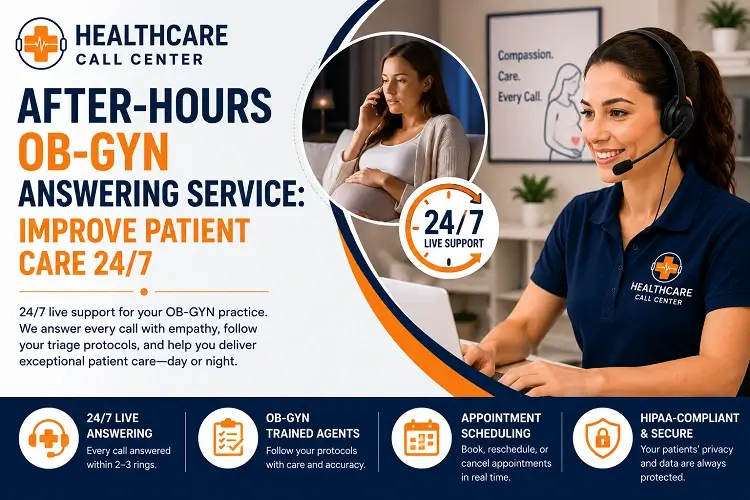
An OB-GYN answering service ensures that every patient call, day or night, is answered by a trained, empathetic human who can follow your triage protocols, schedule appointments, and escalate urgent concerns to your on-call physician immediately.
This blog explains why a 24/7 obgyn answering service for after-hours call coverage is one of the most important investments an OB-GYN practice can make, how it works, and what it means for both patient safety and practice revenue.
The After-Hours Problem in OB-GYN Practices
Most OB-GYN offices close between 5 and 6 PM. From that moment until 8 AM the next morning, a span of 14 to 15 hours every weekday, patient calls follow one of three paths. The first path is voicemail, where the patient leaves a message and waits until morning, growing more anxious with every passing hour.
The second path is an automated nurse line, where the patient navigates a phone tree and waits 30 to 45 minutes for a callback from someone who does not know their case. The third and most damaging path is no answer at all, where the patient hangs up and either goes to the emergency room unnecessarily or searches for a new provider online.
None of these outcomes is acceptable for a patient who may be 24 weeks pregnant and terrified about something happening with her pregnancy. Every missed after-hours OB-GYN call represents both a patient care failure and a revenue loss that compounds over time.
A specialized OB-GYN answering service replaces all three of these failure paths with one simple solution. A real human answers the phone.
What an OB-GYN Answering Service Does
The core of the service is simple. Every call is answered by a real person within 2 to 3 rings. No phone trees. No hold music. No voicemail. Whether the call comes in at noon during your busiest clinic hours or at 2 AM on a Sunday morning, a trained agent picks up and represents your practice with warmth and professionalism.
Agents follow your specific clinical triage protocols. You define which symptoms require immediate physician escalation and which can wait for a morning callback. The agent executes your protocol exactly as designed, every single time. This means your clinical judgment is extended beyond your office hours without you having to be the one picking up the phone at midnight.
Patients can book, reschedule, or cancel appointments directly on the call. Agents access your scheduling system and manage the calendar in real time. If a patient needs to move their Tuesday afternoon prenatal visit to Thursday morning, the agent handles it on the spot. No phone tag the next morning, no lost appointment slot, no patient frustration.
For calls that meet your escalation criteria, the agent pages or contacts the on-call physician through secure, documented channels. No personal cellphones. No missed pages. Full audit trail for every escalation decision. And when a new patient calls to inquire about prenatal care, the agent captures all intake information, including insurance details, medical history, referral source, and estimated due date, then books the first appointment while the patient is ready and motivated.
Every interaction is documented securely. Call notes, triage decisions, and patient messages are stored in encrypted systems with full access controls and audit logs, ensuring that your team has complete information when they start their morning.
Why OB-GYN Calls Are Different From Other Medical Calls
Obstetric and gynecologic calls carry unique emotional and clinical weight that a generic answering service simply cannot handle. Pregnancy anxiety is a defining feature of many OB-GYN calls. Symptoms like bleeding, cramping, or decreased fetal movement create acute fear that requires a calm, knowledgeable response. Time sensitivity is critical because delays in triage can have real clinical consequences.
Privacy expectations are heightened. Patients share deeply personal information about reproductive health, fertility concerns, and gynecologic symptoms. They expect discretion and empathy, not a transactional interaction with a stranger reading a script.
The financial stakes are significant too. A captured OB-GYN patient represents $4,000 to $10,000 or more in lifetime practice revenue, not counting referrals to friends and family. Losing even one new prenatal patient per month to a missed after-hours call means losing tens of thousands of dollars in revenue annually.
A generic medical answering service that is not trained on OB-GYN-specific protocols cannot handle these calls properly. Agents need to understand pregnancy trimester milestones and what symptoms are normal versus concerning. They need to know the postpartum depression screening language. They must understand gynecologic procedure scheduling, such as colposcopy, LEEP, and hysteroscopy. They need to be familiar with infertility referral protocols and high-risk pregnancy escalation criteria.
This is why specialty training matters so much. A stay-at-home mom who has navigated her own pregnancies, who has called her own OB-GYN office at midnight with a worrying symptom, brings a level of empathy and understanding that no offshore script reader or AI chatbot can replicate.
How Much Revenue Are OB-GYN Practices Losing?
Consider a typical single-location OB-GYN practice. The practice receives 20 to 35 after-hours calls per week. Currently, 15 to 25 of those calls reach voicemail or an automated nurse line. Of those missed calls, 3 to 5 per week are from new patients. With an average OB-GYN patient lifetime value of $4,000 to $10,000, the practice is losing $12,000 to $50,000 per month in new patient revenue alone.
Even capturing just 2 additional new patients per month from after-hours calls adds $96,000 to $240,000 annually in lifetime patient value. The math is compelling, yet most practices have never calculated it.
You can use a missed call revenue calculator to plug in your practice’s exact call volume, miss rate, and appointment value to see your specific revenue gap.
Real OB-GYN Call Scenarios
Here is how a trained OB-GYN answering service handles common after-hours situations. A patient calls at 10 PM and says she is 28 weeks pregnant and has not felt the baby move in a few hours. The agent follows your triage protocol, asking specific questions from your custom script. If the protocol indicates urgency, the on-call physician is contacted immediately through secure channels. The patient is either reassured with specific guidance or directed to go to labor and delivery. The call is documented with full details for your team’s review the next morning.
A patient calls at 7 AM to reschedule her prenatal appointment because of a work conflict. The agent accesses your scheduling system and reschedules the appointment in real time. No lost slot, no phone tag, and the patient receives an automated confirmation.
A new patient calls at 8 PM on a Sunday and says she just found out she is pregnant and wants to establish care. The agent captures complete intake information, answers basic questions about the practice, and books the first prenatal visit. Your team walks in on Monday morning to a fully prepared new patient already on the schedule.
A patient calls at midnight because she got her lab results and is worried about her glucose tolerance test. The agent follows your protocol and either schedules a follow-up appointment or escalates to the on-call provider based on your guidelines. The patient receives clear guidance instead of spending the night anxiously waiting for a callback.
Common Mistakes OB-GYN Practices Make With After-Hours Calls
Even well-run OB-GYN practices unintentionally lose patients because their after-hours communication process was never designed to handle growing call volumes.
Some of the most common mistakes include:
- Relying entirely on voicemail after office hours
- Expecting front desk staff to manage evening and weekend calls
- Using generic answering services that do not understand pregnancy-related concerns
- Delaying callbacks until the next business day
- Having inconsistent escalation protocols for urgent pregnancy symptoms
Small communication gaps can quickly become patient experience issues. A dedicated HIPAA-compliant answering service helps standardize after-hours communication so every patient receives a consistent, professional response.
How an OB-GYN Answering Service Helps Your Practice Grow
An OB-GYN answering service does more than capture calls. It directly supports your practice growth in ways you might not expect.
When patients feel supported after hours, they leave positive reviews. More answered calls mean more five-star Google reviews, which directly influence your local search ranking. Your Google Business Profile shows higher engagement through consistent call answering and response times. Better patient retention means patients who reach a human on the first call stay with your practice longer and refer more friends.
All of these factors combine to improve your practice’s visibility in local search results. A healthcare answering service is not just an operational tool. It is a growth engine that compounds patient trust, reviews, and revenue over time.
What to Look for in an OB-GYN Answering Service
Before choosing a partner, ask whether they train agents specifically on OB-GYN call flows and terminology. Ask whether they will follow your custom triage protocols exactly as designed. Find out if they can integrate with your EMR for real-time scheduling. Confirm that they are fully HIPAA-compliant with a signed BAA.
Ask about their average answer speed after hours and how they handle on-call physician escalation. Request to see reports showing triage outcomes, bookings, and escalations. And ask where their agents are located. US-based agents understand American healthcare, insurance systems, and patient communication expectations in ways that offshore agents simply cannot match.
The Bottom Line
Your OB-GYN practice provides exceptional care during business hours. But your patients need support around the clock, especially the pregnant patient who calls at midnight, frightened and needing reassurance.
An OB-GYN answering service ensures that every call is answered by a trained, empathetic human who follows your protocols, protects your patients, and captures revenue that would otherwise be lost to voicemail. The cost of the service is a fraction of what you are losing every month in missed new patient calls and eroded patient trust.
If you want to see how after-hours OB-GYN coverage would transform your practice, book a free consultation and get a custom call audit in 48 hours.
Frequently Asked Questions
Can your agents schedule prenatal appointments?
Yes. Agents can follow your scheduling workflow to book prenatal visits, follow-ups, and consultations while following your practice’s guidelines.
Do you answer calls during weekends and holidays?
Yes. Live agents provide 24/7 coverage, including evenings, weekends, and holidays, ensuring patients never reach voicemail during critical moments.
Can your service integrate with our scheduling software?
Yes. We work with practices using a variety of scheduling platforms and can follow your appointment workflow based on your preferred system.
by Erika Sanchez | Jun 15, 2026 | OB-GYN Answering Service
It’s 11:47 PM on a Tuesday.
A first-time mother in her third trimester feels reduced fetal movement. She picks up her phone and calls her OB-GYN practice the one she’s been visiting for the past seven months.
What happens next determines everything.
Does she reach a calm, trained human who follows your escalation protocol and routes her to your on-call provider?
Or does she hear a voicemail greeting, hang up, and drive to the nearest emergency room — where she’ll wait six hours, rack up thousands in unnecessary ER charges, and lose trust in your practice by morning?
This scenario plays out at OB-GYN offices across the country every single night. And most practices have no idea it’s happening.
Every missed after-hours call with 24/7 OB-GYN Answering Service is more than a logistical gap. It’s a patient relationship on the line. It’s a potential negative review. It’s revenue walking out the door to the practice down the street that happens to have live answering.
The Call You Never Knew You Missed
Pregnancy doesn’t follow business hours.
Babies don’t wait for your front desk to open at 8 AM. Concerns about cramping, bleeding, reduced movement, medication questions, and labor symptoms can hit at any hour and they do.
Research from patient communication studies consistently shows that a significant percentage of healthcare calls come in outside standard business hours or during peak busy windows when front desk staff can’t pick up.
For OB-GYN practices specifically, the stakes are uniquely high because every after-hours call involves a pregnant patient who is likely anxious, seeking reassurance, or experiencing something that may or may not be urgent.
The problem is that most OB-GYN practices have no system for these calls beyond voicemail.
Here’s What Typically Happens When a Pregnant Patient Hits Voicemail
She Calls Another Practice
If your practice was a referral or her second choice, she may call the original recommender or search for another OB-GYN who offers after-hours support.
You lose the patient entirely and you’ll never even know she called.
She Goes to the ER Unnecessarily
Emergency rooms are overloaded with non-emergency pregnancy concerns that could have been handled with a simple phone triage.
The patient incurs ER costs, waits for hours, and your practice loses credibility as her trusted provider.
She Waits and Worries
Some patients leave a voicemail and try to sleep.
By morning, the anxiety has compounded.
When your front desk calls back at 9 AM, the patient is frustrated, scared, and questioning whether your practice is the right fit for her pregnancy journey.
She Posts About It
In today’s world, a single negative experience at 2 AM becomes a Google review or a social media post by noon.
One missed call can ripple through your online reputation and cost you dozens of prospective patients who read that review and choose a different provider.
Why Voicemail Fails Pregnant Patients
Voicemail was designed for convenience.
For a pregnant patient at midnight, it feels like abandonment.
Think about what a pregnant patient experiences when she calls with a concern.
She’s already anxious.
She’s already debating whether her concern is serious enough to call.
By the time she picks up the phone, she has worked up the courage to reach out.
What she needs in that moment is a human voice, someone who acknowledges her, reassures her, and gives her direction.
When a Patient Calls With a Pregnancy Concern, She Needs Three Things
- Acknowledgment
Someone confirming her call was received and that her concern matters.
- Reassurance
A calm voice letting her know she’s being taken care of and that she called the right place.
- Direction
Clear next steps based on your practice’s protocols, not a generic “we’ll call you back” message.
What Voicemail Provides
- No acknowledgment
- No reassurance
- No direction
For routine scheduling questions, that’s tolerable.
For a pregnant patient worried about her baby, it’s unacceptable.
The emotional gap between what the patient needs and what voicemail delivers is enormous.
The Real Cost of Missed OB-GYN Calls
Let’s talk about the math.
Consider a mid-sized OB-GYN practice receiving 60 calls per day.
If a significant portion of those calls come in after hours, during lunch, or during peak busy windows when the front desk is overwhelmed, that’s potentially 25 or more calls per day going unanswered by a live person.
Over a month, that’s 500+ calls where patients either leave a voicemail, hang up, or call back later.
Some of those are existing patients with routine questions.
But some are new patient inquiries.
New Patient Calls Are the Lifeblood of Growth
A single new OB patient represents $3,000 to $5,000 in lifetime value over a pregnancy cycle.
That includes:
- Prenatal visits
- Delivery
- Postpartum care
- Long-term GYN care
When that first impression is a voicemail box, the patient frequently moves on to the next practice on her list.
Existing Patients Can Leave Too
A patient who has been with your practice for months calls at 10 PM with a postpartum concern.
She reaches voicemail.
She feels abandoned.
Even if your team calls back at 8 AM, the damage is done.
What Live After-Hours Answering Actually Looks Like
Imagine the same scenario:
11:47 PM.
First-time mother.
Reduced fetal movement.
Instead of Voicemail…
She reaches a trained OB-GYN practice answering service to reduce missed call agent within moments.
The agent answers using your practice name.
She’s calm, warm, and professional.
The agent follows your specific escalation protocol.
She collects:
- Patient name
- Symptoms
- Gestational age
- Relevant details
She reassures the patient and immediately routes the concern to the on-call provider.
Within minutes, your provider receives a detailed message.
The patient feels:
- Heard
- Supported
- Reassured
She doesn’t go to the ER unnecessarily.
She doesn’t call another practice.
She trusts your practice even more.
Why Stay-at-Home Mom Agents Are Different
Not all answering services are equal.
Generic medical answering services often:
- Use rigid scripts
- Rush callers off the phone
- Treat every specialty the same
Healthcare Call Center uses stay-at-home mom agents trained specifically for patient communication.
Our Agents Are Trained In:
- HIPAA-compliant call handling
- OB-GYN-specific workflows
- Prenatal scheduling
- Postpartum support
- GYN appointment coordination
- Empathy-first communication
- Custom practice protocols
This isn’t just about answering phones.
It’s about extending your standard of care beyond office hours.
Building Your After-Hours Coverage Plan
Week 1: Consultation
We audit your call volume and identify after-hours coverage gaps.
Step 2: Script Development
We build custom protocols for:
- Prenatal scheduling
- Symptom escalation
- Medication questions
- Postpartum concerns
- New patient intake
- Insurance inquiries
Step 3: Go Live
Within up to 2 weeks, patients calling after hours reach our team seamlessly.
Step 4: Ongoing Reporting
You’ll receive visibility into:
- Calls answered
- Escalations
- New patient inquiries
- High-volume periods
- Missed-call recovery opportunities
The Call That Changes Everything
Every OB-GYN practice will eventually receive the midnight call. The patient who calls about bleeding at 14 weeks. The patient who can’t feel her baby moving at 36 weeks. The new patient who found your practice online at 9 PM and wants to book her first prenatal visit before she loses motivation.
The question isn’t whether these calls will come. The question is who answers them.
If your answer is voicemail, you’re losing patients you’ll never know about. You’re losing revenue you’ll never trace. You’re losing trust you’ll never get back.
If your answer is a live, trained, empathetic human being one who follows your protocols, speaks with warmth, and makes every caller feel like they reached the right practice you’re building trust that lasts well beyond delivery. You’re turning your phone line into the strongest patient retention tool your practice has.
Your pregnant patients deserve better than a recording. And your practice deserves to capture every call that comes in not just the ones that happen between 8 and 5.
Stop losing patients to voicemail. Book a free practice audit and we’ll show you exactly how many calls your OB-GYN office is missing after hours.
Frequently Asked Question!
Q: What happens when a pregnant patient calls our OB-GYN office after hours?
A: Without live answering, the call typically goes to voicemail or an automated system. Studies show most pregnant patients who reach voicemail hang up without leaving a message. With a live answering service, a trained agent follows your escalation protocol, triages the concern, and routes urgent calls directly to your on-call provider.
Q: Can an answering service handle urgent pregnancy-related calls?
A: Yes. A properly trained answering service follows your practice’s specific escalation protocols. Agents collect symptoms, cross-reference your on-call directory, and connect urgent calls like reports of reduced fetal movement or bleeding to your provider immediately. Non-urgent messages are securely delivered for next-morning follow-up.
Q: How quickly are after-hours OB-GYN calls answered?
A: With Healthcare Call Center, every call is answered by a real person no phone trees, no hold music. Our agents are trained to handle OB-GYN-specific scenarios with empathy and urgency, following your exact triage and routing instructions.
Q: Is an OB-GYN answering service HIPAA-compliant?
A: A HIPAA-compliant answering service secures every patient interaction from call intake to message deliver under full HIPAA requirements. This includes encrypted messaging, trained agents who understand protected health information, and signed Business Associate Agreements with your practice.
Q: How much does an OB-GYN answering service cost compared to missed calls?
A: The cost of a live answering service is typically a fraction of what a single missed new-patient call costs your practice. One missed pregnancy consultation or new patient intake can represent thousands in lifetime patient value. Most practices find that capturing even one additional patient per month more than covers the service cost.
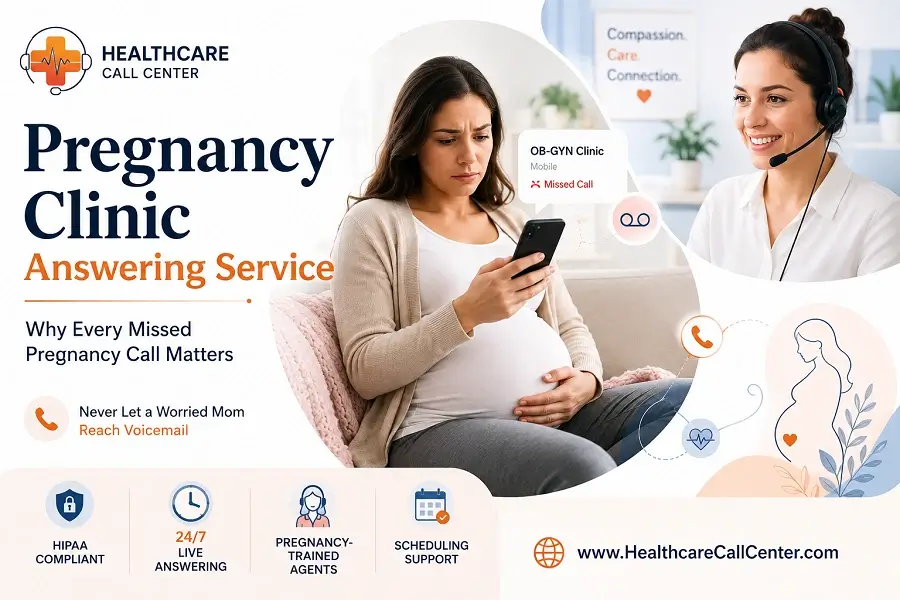
by Erika Sanchez | Jun 12, 2026 | OB-GYN Answering Service
A first-time mom at 22 weeks calls your clinic on a Tuesday afternoon. She hasn’t felt the baby move much today. She’s worried. Your front desk is on another line. Her call goes to voicemail.
She hangs up and calls the next OB-GYN on her list.
This happens every day at pregnancy clinics across the country. And the cost isn’t just one missed appointment. It’s an entire patient relationship that spans nine months of care, plus the trust that patient places in your practice when she first picks up the phone.
A dedicated pregnancy clinic answering service is built to prevent exactly this scenario.
Why Missed Calls Hit Pregnancy Clinics Harder
Most healthcare practices lose some inbound calls during busy hours. But pregnancy clinics feel the impact differently than a general practice or a dental office. Here’s why.
Pregnancy concerns don’t follow business hours
A pregnant woman who notices spotting at 11 PM on a Thursday is not going to leave a voicemail and wait until morning. She needs reassurance or direction right now. If your clinic can’t provide that, she’ll find someone who can whether that’s another practice, an urgent care, or an unnecessary ER visit.
Trust is built on the first call
When a prospective patient calls your clinic for the first time, she’s choosing you with her most vulnerable health journey. If nobody answers, the message she receives is clear: “We’re too busy for you.” She rarely calls back.
One missed call = nine months of lost revenue
A prenatal patient relationship includes weekly visits in the third trimester, lab work, ultrasounds, delivery, and postpartum care. When you miss that first call, you don’t lose a single appointment you lose the entire relationship.
What Makes a Pregnancy Clinic Answering Service Different
Not every answering service understands obstetric communication. A pregnancy clinic answering service trains its agents specifically on the calls that matter to OB-GYN and maternity practices.
Pregnancy-specific communication
Agents understand that a first-trimester spotting concern and a third-trimester bleeding report require completely different responses. They know that questions about genetic screening results need a different tone than scheduling a routine 28-week checkup.
Emotional awareness
Pregnancy patients are often anxious. Some are navigating high-risk pregnancies. Others are first-time moms who have never gone through this before. Agents trained in women’s health communication know how to de-escalate fear in real time — something voicemail can never do.
HIPAA-compliant workflows
Every pregnancy-related call involves protected health information. A dedicated healthcare answering service uses HIPAA-compliant workflows, encrypted communication, and signed business associate agreements to protect your patients’ data.
What a Pregnancy Call Center Handles Day to Day
A well-configured answering service acts as an extension of your front desk. Here’s what that looks like in practice:
- New patient inquiries – The most valuable calls your practice receives. Every one that goes to voicemail is a patient your competitor gets instead.
- Appointment scheduling support – Patients who need to reschedule often give up if they can’t get through. An answering service with scheduling support keeps those appointments on the books.
- Symptom calls and triage support – Agents follow your practice’s specific protocols to gather information and route urgent concerns to your on-call provider. Routine questions get logged for next-day follow-up.
- Prescription refill requests – Prenatal vitamins, progesterone, anti-nausea medication. Logged and forwarded per your protocol.
- Insurance and billing questions – Coverage, copays, delivery costs. Handled without tying up your clinical staff.
- Postpartum follow-up – New mothers calling about recovery, breastfeeding, or postpartum concerns. This is a critical retention moment handle it well and that family stays with your practice.
After-Hours Coverage: Where Most Clinics Lose Patients
During business hours, most pregnancy clinics do a reasonable job of answering calls. After hours is where the biggest gaps appear.
If a patient calls at 10 PM with concerns about contractions at 33 weeks and reaches voicemail, she’s going to the ER. That’s a costly visit that could have been resolved with a trained agent following your triage protocols and connecting the patient with your on-call provider.
After-hours coverage means: Every call is answered by a real person – Urgent concerns are escalated to your on-call provider with relevant details – Routine questions are logged for next business day. Your providers only get called when it matters
What to Look for in a Pregnancy Answering Service
If you’re evaluating providers, these are the questions that actually matter:
- Do you train agents specifically on obstetric and women’s health communication?
- Can you customize triage protocols for different trimesters and symptom types?
- Do you use HIPAA-compliant workflows with a signed BAA?
- Can you handle both business-hours overflow and after-hours coverage?
- Do you offer real-time call logs so I can see every call and resolution?
- Can agents support appointment scheduling workflows?
The right service should feel like adding trained team members who happen to work around the clock not like dealing with a generic vendor.
The Stay-at-Home Mom Difference
Healthcare Call Center is built around trained stay-at-home mom agents who understand the emotional weight of pregnancy calls. They’re not reading from a generic script. They’re trained to handle obstetric communication with warmth, patience, and genuine care.
When a nervous first-time mom calls at 7 AM with questions about morning sickness, she gets someone who understands not a voicemail box.
How This Fits Into Your Practice Growth
A pregnancy clinic answering service is not just about preventing missed calls. It supports the full patient journey:
- Before the first visit – Captures inquiries that would otherwise go to competitors
- During pregnancy – Provides reliable communication between visits
- After hours and weekends – Ensures patients always reach a real person
- Postpartum – Supports follow-up communication that keeps families connected to your practice
When patients know they can always reach someone, they trust your practice more. That trust leads to better retention, more referrals, and a stronger reputation in your community.
Frequently Asked Questions!
1. What is a pregnancy clinic answering service?
A pregnancy clinic answering service is a HIPAA-compliant call support solution staffed by agents trained on obstetric and women’s health communication. They answer calls in your clinic’s name, support scheduling workflows, handle routine questions, and escalate urgent concerns to your on-call providers.
2. Why can’t I use a regular medical answering service?
Pregnancy patients need agents who understand the difference between first-trimester spotting and third-trimester bleeding. A women’s health answering service handles the emotional weight of prenatal concerns with trained, empathetic communication that a generic service may not provide.
3. How does after-hours triage support work?
Trained agents answer calls, gather information using your practice’s specific protocols, and make escalation decisions. Routine questions get logged for next-day follow-up. Urgent concerns are routed immediately to your on-call provider with relevant details.
4. Is the service HIPAA-compliant?
Yes. Healthcare Call Center uses HIPAA-compliant workflows designed for healthcare practices, including pregnancy clinics and OB-GYN offices.
5. How long does onboarding take?
Onboarding can take up to 2 weeks depending on the practice workflow, call scripts, scheduling process, and setup requirements.
6. Can the service support appointment scheduling?
Yes. The service can help support scheduling workflows, route patient requests, and improve communication between callers and your practice team.
Conclusion
What are the contract terms? Month-to-month with 30-day notice. Transparent pricing with no hidden fees.
If your pregnancy clinic is missing calls, you already know the cost in patient trust, in revenue, and in care quality. A dedicated answering service ensures every patient who calls your practice hears a calm, caring voice on the other end.
Book a free consultation with Healthcare Call Center to see how our stay-at-home mom agents can support your pregnancy clinic.