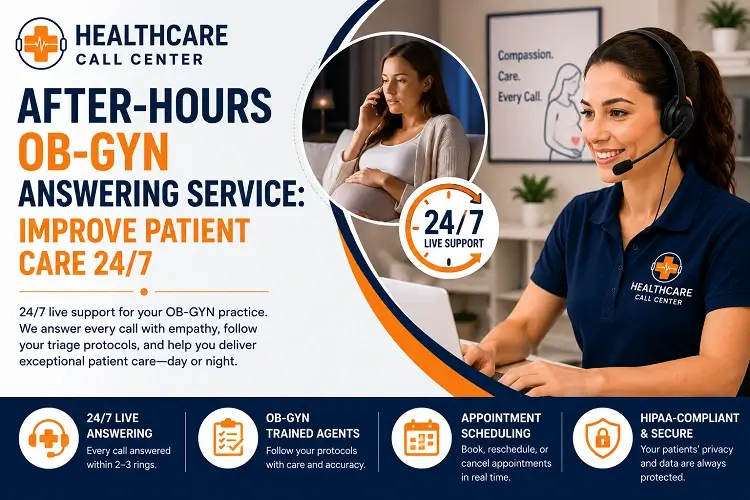
When a pregnant patient calls your OB-GYN office at 11 PM with questions about bleeding, cramping, or reduced fetal movement, she is not calling for convenience. She is calling because she is scared. What happens next determines whether she feels supported by your practice or abandoned by it.
An OB-GYN answering service ensures that every patient call, day or night, is answered by a trained, empathetic human who can follow your triage protocols, schedule appointments, and escalate urgent concerns to your on-call physician immediately.
This blog explains why a 24/7 obgyn answering service for after-hours call coverage is one of the most important investments an OB-GYN practice can make, how it works, and what it means for both patient safety and practice revenue.
The After-Hours Problem in OB-GYN Practices
Most OB-GYN offices close between 5 and 6 PM. From that moment until 8 AM the next morning, a span of 14 to 15 hours every weekday, patient calls follow one of three paths. The first path is voicemail, where the patient leaves a message and waits until morning, growing more anxious with every passing hour.
The second path is an automated nurse line, where the patient navigates a phone tree and waits 30 to 45 minutes for a callback from someone who does not know their case. The third and most damaging path is no answer at all, where the patient hangs up and either goes to the emergency room unnecessarily or searches for a new provider online.
None of these outcomes is acceptable for a patient who may be 24 weeks pregnant and terrified about something happening with her pregnancy. Every missed after-hours OB-GYN call represents both a patient care failure and a revenue loss that compounds over time.
A specialized OB-GYN answering service replaces all three of these failure paths with one simple solution. A real human answers the phone.
What an OB-GYN Answering Service Does
The core of the service is simple. Every call is answered by a real person within 2 to 3 rings. No phone trees. No hold music. No voicemail. Whether the call comes in at noon during your busiest clinic hours or at 2 AM on a Sunday morning, a trained agent picks up and represents your practice with warmth and professionalism.
Agents follow your specific clinical triage protocols. You define which symptoms require immediate physician escalation and which can wait for a morning callback. The agent executes your protocol exactly as designed, every single time. This means your clinical judgment is extended beyond your office hours without you having to be the one picking up the phone at midnight.
Patients can book, reschedule, or cancel appointments directly on the call. Agents access your scheduling system and manage the calendar in real time. If a patient needs to move their Tuesday afternoon prenatal visit to Thursday morning, the agent handles it on the spot. No phone tag the next morning, no lost appointment slot, no patient frustration.
For calls that meet your escalation criteria, the agent pages or contacts the on-call physician through secure, documented channels. No personal cellphones. No missed pages. Full audit trail for every escalation decision. And when a new patient calls to inquire about prenatal care, the agent captures all intake information, including insurance details, medical history, referral source, and estimated due date, then books the first appointment while the patient is ready and motivated.
Every interaction is documented securely. Call notes, triage decisions, and patient messages are stored in encrypted systems with full access controls and audit logs, ensuring that your team has complete information when they start their morning.
Why OB-GYN Calls Are Different From Other Medical Calls
Obstetric and gynecologic calls carry unique emotional and clinical weight that a generic answering service simply cannot handle. Pregnancy anxiety is a defining feature of many OB-GYN calls. Symptoms like bleeding, cramping, or decreased fetal movement create acute fear that requires a calm, knowledgeable response. Time sensitivity is critical because delays in triage can have real clinical consequences.
Privacy expectations are heightened. Patients share deeply personal information about reproductive health, fertility concerns, and gynecologic symptoms. They expect discretion and empathy, not a transactional interaction with a stranger reading a script.
The financial stakes are significant too. A captured OB-GYN patient represents $4,000 to $10,000 or more in lifetime practice revenue, not counting referrals to friends and family. Losing even one new prenatal patient per month to a missed after-hours call means losing tens of thousands of dollars in revenue annually.
A generic medical answering service that is not trained on OB-GYN-specific protocols cannot handle these calls properly. Agents need to understand pregnancy trimester milestones and what symptoms are normal versus concerning. They need to know the postpartum depression screening language. They must understand gynecologic procedure scheduling, such as colposcopy, LEEP, and hysteroscopy. They need to be familiar with infertility referral protocols and high-risk pregnancy escalation criteria.
This is why specialty training matters so much. A stay-at-home mom who has navigated her own pregnancies, who has called her own OB-GYN office at midnight with a worrying symptom, brings a level of empathy and understanding that no offshore script reader or AI chatbot can replicate.
How Much Revenue Are OB-GYN Practices Losing?
Consider a typical single-location OB-GYN practice. The practice receives 20 to 35 after-hours calls per week. Currently, 15 to 25 of those calls reach voicemail or an automated nurse line. Of those missed calls, 3 to 5 per week are from new patients. With an average OB-GYN patient lifetime value of $4,000 to $10,000, the practice is losing $12,000 to $50,000 per month in new patient revenue alone.
Even capturing just 2 additional new patients per month from after-hours calls adds $96,000 to $240,000 annually in lifetime patient value. The math is compelling, yet most practices have never calculated it.
You can use a missed call revenue calculator to plug in your practice’s exact call volume, miss rate, and appointment value to see your specific revenue gap.
Real OB-GYN Call Scenarios
Here is how a trained OB-GYN answering service handles common after-hours situations. A patient calls at 10 PM and says she is 28 weeks pregnant and has not felt the baby move in a few hours. The agent follows your triage protocol, asking specific questions from your custom script. If the protocol indicates urgency, the on-call physician is contacted immediately through secure channels. The patient is either reassured with specific guidance or directed to go to labor and delivery. The call is documented with full details for your team’s review the next morning.
A patient calls at 7 AM to reschedule her prenatal appointment because of a work conflict. The agent accesses your scheduling system and reschedules the appointment in real time. No lost slot, no phone tag, and the patient receives an automated confirmation.
A new patient calls at 8 PM on a Sunday and says she just found out she is pregnant and wants to establish care. The agent captures complete intake information, answers basic questions about the practice, and books the first prenatal visit. Your team walks in on Monday morning to a fully prepared new patient already on the schedule.
A patient calls at midnight because she got her lab results and is worried about her glucose tolerance test. The agent follows your protocol and either schedules a follow-up appointment or escalates to the on-call provider based on your guidelines. The patient receives clear guidance instead of spending the night anxiously waiting for a callback.
Common Mistakes OB-GYN Practices Make With After-Hours Calls
Even well-run OB-GYN practices unintentionally lose patients because their after-hours communication process was never designed to handle growing call volumes.
Some of the most common mistakes include:
- Relying entirely on voicemail after office hours
- Expecting front desk staff to manage evening and weekend calls
- Using generic answering services that do not understand pregnancy-related concerns
- Delaying callbacks until the next business day
- Having inconsistent escalation protocols for urgent pregnancy symptoms
Small communication gaps can quickly become patient experience issues. A dedicated HIPAA-compliant answering service helps standardize after-hours communication so every patient receives a consistent, professional response.
How an OB-GYN Answering Service Helps Your Practice Grow
An OB-GYN answering service does more than capture calls. It directly supports your practice growth in ways you might not expect.
When patients feel supported after hours, they leave positive reviews. More answered calls mean more five-star Google reviews, which directly influence your local search ranking. Your Google Business Profile shows higher engagement through consistent call answering and response times. Better patient retention means patients who reach a human on the first call stay with your practice longer and refer more friends.
All of these factors combine to improve your practice’s visibility in local search results. A healthcare answering service is not just an operational tool. It is a growth engine that compounds patient trust, reviews, and revenue over time.
What to Look for in an OB-GYN Answering Service
Before choosing a partner, ask whether they train agents specifically on OB-GYN call flows and terminology. Ask whether they will follow your custom triage protocols exactly as designed. Find out if they can integrate with your EMR for real-time scheduling. Confirm that they are fully HIPAA-compliant with a signed BAA.
Ask about their average answer speed after hours and how they handle on-call physician escalation. Request to see reports showing triage outcomes, bookings, and escalations. And ask where their agents are located. US-based agents understand American healthcare, insurance systems, and patient communication expectations in ways that offshore agents simply cannot match.
The Bottom Line
Your OB-GYN practice provides exceptional care during business hours. But your patients need support around the clock, especially the pregnant patient who calls at midnight, frightened and needing reassurance.
An OB-GYN answering service ensures that every call is answered by a trained, empathetic human who follows your protocols, protects your patients, and captures revenue that would otherwise be lost to voicemail. The cost of the service is a fraction of what you are losing every month in missed new patient calls and eroded patient trust.
If you want to see how after-hours OB-GYN coverage would transform your practice, book a free consultation and get a custom call audit in 48 hours.
Frequently Asked Questions
Can your agents schedule prenatal appointments?
Yes. Agents can follow your scheduling workflow to book prenatal visits, follow-ups, and consultations while following your practice’s guidelines.
Do you answer calls during weekends and holidays?
Yes. Live agents provide 24/7 coverage, including evenings, weekends, and holidays, ensuring patients never reach voicemail during critical moments.
Can your service integrate with our scheduling software?
Yes. We work with practices using a variety of scheduling platforms and can follow your appointment workflow based on your preferred system.