Why Specialty Practices Need Different Call Handling Than General Medical Offices
A patient call is never just a call inside a medical practice.
It may be a new patient trying to book a consultation. It may be a worried parent asking whether a symptom needs attention. It may be a fertility patient calling after an emotional treatment update.
It may be a plastic surgery lead comparing providers before choosing where to spend thousands of dollars. It may be an OB-GYN patient with a sensitive question she does not want to repeat twice.
For a general medical office, call handling is already important. But for specialty practices, it becomes even more critical.
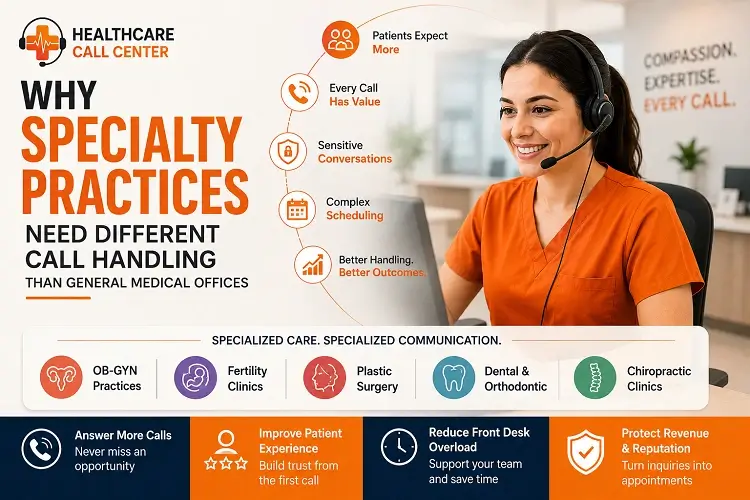
Specialty practices often deal with higher patient anxiety, higher appointment value, more emotional decision-making, more complex scheduling, and more sensitive communication. That means the way calls are answered, routed, documented, and followed up cannot be treated like a basic front-desk task.
A specialty clinic does not need generic phone coverage. It needs call handling that understands the difference between a routine message, a high-intent appointment request, an urgent concern, and a patient who may choose another provider if the first call feels cold or rushed.
That is where better call handling becomes a growth, trust, and patient-experience advantage.
What Makes Specialty Practice Calls Different?
Specialty practices receive calls that carry more context than general appointment requests.
A patient calling a primary care office may ask about availability, insurance, lab results, or a routine concern. Specialty practices handle those calls too, but they also deal with patients who may be nervous, confused, embarrassed, or deciding between multiple providers.
Common specialty practice calls include:
- New consultation requests
- Procedure questions
- Insurance and financing questions
- Referral questions
- After-hours concerns
- Follow-up scheduling
- Pre-appointment questions
- Post-procedure messages
- New patient intake calls
- Callbacks after marketing inquiries
The caller may not be ready to book immediately, but the call still matters. A rushed answer or voicemail can break trust before the patient ever visits the office.
This is why specialty practices need call handling that is more patient-aware, more structured, and more conversion-focused than basic call answering.
Specialty Calls Often Have Higher Revenue Impact
In many specialty practices, one missed call can represent a much larger opportunity than a routine appointment.
For example:
- A fertility clinic may receive calls from patients comparing IVF providers.
- A plastic surgery practice may receive consultation inquiries from patients ready to book.
- An OB-GYN practice may receive calls from pregnant patients who need reassurance and fast routing.
- A dental or orthodontic practice may receive new patient calls driven by local search or paid ads.
- A chiropractic clinic may receive same-day pain-related appointment requests.
When these calls go unanswered, the cost is not only operational. It can affect revenue, patient acquisition, marketing ROI, and long-term patient relationships.
Specialty practices often invest heavily in SEO, Google Ads, referral relationships, and reputation. But if the phone is not answered when interest is highest, that marketing spend leaks out of the business.
A strong medical answering service helps protect those opportunities by making sure patient calls are answered, captured, and routed according to the practice’s rules.
General Call Handling Is Too Basic for Specialty Clinics
Basic call handling usually focuses on one thing: answer the phone and take a message.
That may be enough for a low-context business call. It is not enough for specialty healthcare.
Specialty practices need more than message-taking.
They need call support that can:
- Identify the type of caller
- Capture the right information
- Follow practice-specific instructions
- Understand which calls need urgent routing
- Support appointment requests
- Reduce voicemail gaps
- Protect patient privacy
- Keep communication consistent
- Help callers feel heard, not processed
A generic answering service may treat every call the same. But a specialty practice cannot afford that.
A fertility call should not feel like a dental call. A plastic surgery consultation inquiry should not be handled like a billing question. A best OB-GYN answering service should not sit in a general message queue.
The more specialized the practice, the more important the call flow becomes.
Patients Choose Specialty Providers Based on Trust
Specialty care is personal.
Patients are not only choosing a provider based on credentials. They are also judging how the practice feels from the first interaction.
That first interaction is often a phone call.
If the caller hears voicemail, waits too long, gets transferred too many times, or speaks with someone who sounds rushed, the practice may lose trust before the appointment is booked.
This is especially true in specialties where patients are making emotional or high-value decisions.
A caller may be thinking:
- Will this practice take my concern seriously?
- Can I trust them with something this personal?
- Do they sound organized?
- Will they call me back?
- Is this the kind of office I want handling my care?
The person answering the phone influences those answers. That first interaction is part of the broader patient experience, which is why consistent call handling can have an impact beyond simply answering the phone.
That is why 24/7 medical call center services for specialty practices should not feel robotic or generic. For specialty practices, the goal is not just to answer more calls. The goal is to create a calmer, more reliable first impression.
Specialty Practices Need Clear Call Routing Rules
Call routing matters more in specialty care because not every message should be handled the same way.
Some calls are simple appointment requests. Some need a callback from the front desk. Some need clinical review. Some need after-hours escalation. Some should be documented for the next business day.
Without clear call routing, staff can become overwhelmed, patients may wait too long, and urgent messages can get mixed into routine queues.
A better call handling system should define:
- Which calls are urgent
- Which calls go to the on-call provider
- Which calls go to scheduling
- Which calls can wait until business hours
- Which information must be collected
- Which scripts or disclaimers should be used
- Which calls require special handling by specialty
This helps protect both the patient and the practice.
For example, an after-hours medical answering service should not simply collect names and phone numbers. It should follow the practice’s instructions for routing and documenting after-hours messages.
Front Desk Teams Are Already Overloaded
Many specialty practices expect the front desk to handle everything.
They check in patients. They answer phones. They manage schedules. They verify insurance. They respond to provider requests. They handle patient questions. They support callbacks. They deal with walk-ins. They manage last-minute cancellations.
Then the phone rings again.
Even a strong front desk can miss calls during peak hours. Lunch breaks, staff shortages, patient check-ins, and appointment rushes create gaps. Those gaps often become voicemail.
A front desk overflow answering service helps reduce that pressure by covering calls when the in-office team cannot answer quickly.
For specialty practices, this is not just a convenience. It can protect high-value patient inquiries and reduce staff burnout.
Specialty Practices Need Better Intake Consistency
In specialty healthcare, the details matter.
A caller may need to share:
- Reason for visit
- Referral status
- Insurance details
- Preferred appointment time
- Procedure interest
- Symptoms or concerns
- Existing patient status
- Best callback number
- Location preference
- Urgency level
If this information is incomplete, the practice may need extra callbacks. That slows down scheduling and creates friction for the patient.
Consistent call handling helps the practice capture the right information the first time.
This is especially important for multi-location groups, specialty clinics with multiple providers, and practices with different appointment types. A new patient consultation may require a different process than a follow-up appointment. A surgical consult may require different intake than a routine office visit.
The better the intake process, the smoother the patient journey.
After-Hours Calls Are More Sensitive for Specialty Practices
After-hours calls are different.
Patients calling after hours may be anxious. They may not know whether their concern can wait. They may be dealing with symptoms, discomfort, post-procedure questions, pregnancy concerns, or medication confusion.
A voicemail message does not always give them confidence.
Specialty practices need after-hours call handling that gives patients a clear path. Practices evaluating this type of coverage can also review the benefits of an after-hours medical answering service.
The goal is not to replace clinical judgment. The goal is to answer the call, collect the right information, and route the message according to the provider’s rules.
This is why after-hours support is especially valuable for:
- OB-GYN practices
- Fertility clinics
- Plastic surgery practices
- Dental practices
- Chiropractic clinics
- Dermatology offices
- Orthopedic groups
- Mental health practices
Every specialty has different patient expectations. The call handling process should reflect that.
A Florida chiropractor answering service can help clinics handle pain-related appointment requests, callbacks, and after-hours messages without overloading the front desk.
What Good Specialty Practice Call Handling Should Include
Specialty practice call handling should be structured, documented, and aligned with the practice’s workflow.
At minimum, it should include:
1. Practice-Specific Call Scripts
The caller should not feel like they reached a generic answering line. The call flow should match the specialty, the practice tone, and the type of patient inquiry.
2. Appointment Request Capture
New patient calls should be captured clearly, especially when the caller is ready to book or wants a consultation. Consistent appointment scheduling support helps reduce delays between the initial inquiry and the next available step.
3. Urgent Message Routing
The answering team should know when a call needs immediate escalation based on the practice’s rules.
4. Front Desk Overflow Coverage
The system should support the in-office team during peak call times, lunch breaks, staff gaps, and busy clinic hours.
5. After-Hours Support
Patients should have a reliable path after the office closes, especially in specialties where after-hours concerns are common.
6. HIPAA-Aware Processes
Patient communication must be handled carefully. Practices should verify that vendors understand healthcare privacy expectations and can support HIPAA-compliant medical answering service workflows.
The U.S. Department of Health & Human Services explains that the HIPAA Privacy Rule establishes national standards for protecting individually identifiable health information.
7. Clear Documentation
Messages should be captured in a way that helps staff act quickly and avoid confusion.
Specialty Call Handling Is Not Just an Operations Fix
Better call handling helps the practice in several ways.
It can:
- Reduce missed calls
- Improve patient trust
- Capture more appointment requests
- Reduce front desk pressure
- Improve follow-up speed
- Support marketing ROI
- Strengthen after-hours communication
- Protect high-value patient inquiries
- Create a more professional first impression
For specialty practices, phone support is part of the patient experience. It is also part of growth.
If a practice is investing in SEO, referrals, ads, reviews, or local visibility, it needs a call handling process that protects that investment.
For a closer look at the connection between unanswered calls and revenue, see how a medical answering service protects revenue and reduces missed calls.
A patient who cannot reach your practice today may simply choose another provider instead of calling back tomorrow.
When Should a Specialty Practice Consider Outside Call Support?
A specialty practice should consider outside call support when:
- Calls are going to voicemail during business hours
- Staff are overwhelmed by phone volume
- New patient inquiries are not being followed up quickly
- After-hours calls are inconsistent
- Marketing leads are not converting into appointments
- Multi-location scheduling is becoming harder to manage
- The front desk is stretched between in-person patients and phone calls
- Patients complain about callback delays
- The practice is growing but not ready to hire more staff
Outside call support does not have to replace the front desk. In many cases, it works best as overflow, after-hours, or appointment-support coverage.
The goal is simple: make sure patients reach a calm, trained person when they call.
Final Takeaway
Specialty practices do not need generic call answering.
They need call handling that understands patient sensitivity, appointment value, urgency, scheduling complexity, and front desk pressure.
General medical offices need reliable communication. Specialty practices need that and more. They need a system that protects patient trust from the first call, supports staff during busy hours, and helps convert high-intent inquiries into booked appointments.
If your specialty practice is missing calls, relying too heavily on voicemail, or asking the front desk to handle more than it can realistically manage, it may be time to improve your patient call handling process.
Healthcare Call Center helps specialty practices answer more calls, reduce front desk overload, support after-hours communication, and protect high-intent appointment opportunities.
Book a free consultation
Specialty Practice Call Handling FAQs
1. Why do specialty practices need different call handling?
Specialty practices often handle more sensitive, higher-value, and more urgent patient calls than general medical offices. They need call handling that supports appointment requests, urgent routing, after-hours messages, and patient trust.
2. How is specialty call handling different from a general medical answering service?
Specialty call handling uses practice-specific scripts, intake requirements, routing rules, and escalation instructions based on the type of care being provided. This helps ensure that new consultations, procedure questions, after-hours concerns, and specialty-specific patient needs are handled according to the practice’s workflow.
2. What types of specialty practices benefit from medical answering support?
OB-GYN practices, fertility clinics, plastic surgery practices, dental offices, chiropractic clinics, dermatology practices, orthopedic groups, and mental health practices can all benefit from structured call handling and overflow support.
3. Can a medical answering service help with front desk overflow?
Yes. A medical answering service can help answer calls when the front desk is busy, short-staffed, on lunch, or helping patients in the office. This reduces voicemail gaps and helps capture more appointment opportunities.
4. Is after-hours call handling important for specialty practices?
Yes. Many specialty patients call after hours with questions, concerns, or appointment needs. After-hours call handling helps make sure those calls are answered and routed according to the practice’s instructions.
5. How does better call handling help specialty practices grow?
Better call handling helps specialty practices answer more patient calls, capture more appointment requests, improve patient trust, reduce staff overload, and protect the value of marketing and referral traffic.