by Erika Sanchez | Sep 23, 2026 | After-Hours Call Answering Services
When a medical practice closes for the evening, someone still has to answer the phone. In many practices, that responsibility eventually falls to the on-call physician. An after-hours healthcare answering service takes that weight off the doctor by screening patient calls, collecting details, and escalating calls to the physician according to the practice’s approved urgency and escalation rules.
The problem is that not every call that comes in after hours actually needs a physician. Patients may be calling to request an appointment, reschedule a visit, ask about office hours, leave a routine message, or report a concern that needs follow-up the next business day. Without a reliable call-handling layer, those calls can interrupt physician sleep just as easily as genuinely urgent situations.
A well-designed after-hours answering workflow creates a buffer between the patient and the on-call physician. Patients get a calm human voice at any hour, routine requests can be documented for follow-up, and calls that meet the practice’s escalation criteria can reach the appropriate person. The physician gets fewer unnecessary interruptions, while the practice gets a clearer record of what happened overnight.
The goal is not to keep physicians away from patients who genuinely need them. It is to make sure they are contacted when their involvement is actually required a good physician answering service.
What Really Happens To On-Call Physicians After 5 PM?
The on-call doctor is not a backup receptionist. Yet that is how many practices treat the role. Every unanswered evening call becomes the physician’s problem. A refill question. A billing dispute. A parent asking whether a mild fever needs attention tomorrow. Each one lands on a doctor who was already seeing patients all day.
Picture a typical Tuesday. The physician finishes clinic at 5:30, eats dinner with family, and gets paged at 9:15 about a prescription question that could have waited for the office. At 11:40 there is a second page, this time a billing dispute from an upset patient. At 2:50 in the morning comes a third, a genuine concern that truly needed a doctor. By morning, the physician has slept in fragments, and the first appointment is at 8:00.
The interruptions add up fast. A physician paged three or four times a night for non-urgent matters arrives the next morning already drained. Over weeks, that pattern erodes focus, patience, and job satisfaction. The World Health Organization classifies burnout as an occupational phenomenon driven by unmanaged workplace stress, and interrupted rest is one of its most familiar forms in medicine.
Why Do Non-Urgent Calls Reach The Doctor At Night?
It is almost never the fault of the caller. Patients call at night because that is when they have time, when a symptom worries them, or when a child gets sick after school. Work schedules, childcare, and plain anxiety push calls into the evening hours, and the practice feels it in the pager log.
The problem is what happens next. Without trained call handling, there is no filter between a worried caller and a sleeping physician. Voicemail cannot triage. A generic answering service without medical training either passes everything through, which protects no one, or takes messages nobody reads until morning, which protects no patient. So the call escalates to the on-call doctor by default. Not because it needs a doctor, but because there is no trained call-handling layer to follow the practice’s instructions and route the call appropriately.
The Real Cost of Interrupted Sleep
Sleep broken by pages is not the same as shorter sleep. Research on sleep fragmentation shows that even brief interruptions prevent the deep stages of rest that restore judgment and emotional control. For a physician, that shows up the next morning as slower decisions, shorter patience with staff, and less mental room for complex cases.
The costs reach patients too. A doctor who was awake at 2 AM reviewing a message about medication dosing is making that decision on degraded rest. Most on-call physicians manage this fine for a night. The danger is the rotation that repeats weekly, month after month, until burnout or resignation ends it for you.
Practices pay in hard currency as well. Recruiting a replacement physician takes months and real money. Losing an experienced provider over something as fixable as nighttime phone noise is one of the most preventable staffing losses in medicine.
How An After-Hours Healthcare Answering Service Protects on-call Physicians
The fix is structured call screening built for healthcare. When a patient calls after hours, a trained agent from a healthcare answering service answers with the practice greeting, listens, and follows the call protocol the practice approved in advance. The agent asks the right questions, stays calm with anxious callers, and sorts the call into one of three lanes.
- True Emergency: chest pain, postoperative bleeding, an infant in distress, or anything else the practice defines as urgent. The agent follows the escalation protocol and reaches the on-call physician immediately, with a clear written summary of who is calling, what happened, and what has been done so far.
- Urgent But Morning-Safe: calls that feel urgent to the patient but are clinically safe to wait, such as a worsening but stable symptom or a medication question that is not time critical. The agent captures full details and routes the message to the practice queue for first-thing handling.
- Routine: refills, directions, paperwork, insurance questions, and general inquiries get logged completely without disturbing anyone.
That middle lane is where practices win. Many calls feel urgent to the caller but do not need a physician at 1 AM. A trained agent working from the practice’s own script knows the difference, because the practice defines it in advance. The result is simple. Doctors hear about real emergencies. Everything else waits where it belongs, fully documented and ready for the morning team.
What Does Good After-Hours Call Routing Look Like?
Practices evaluating coverage should look for a few concrete behaviors.
- Calls answered within a few rings by a live person, not a menu tree.
- Warm, plain language instead of scripted stiffness.
- Accurate message capture with names, callback numbers, and the reason for the call.
- Clear escalation rules the practice controls, written down and approved by the physicians who carry the pager.
- Documentation the team can read at 8 AM without decoding it.
For practices that want after-hours callers to move directly into a scheduling workflow, appointment-scheduling support can help capture appointment details and next steps.
It also matters how the service handles gray areas. A good agent knows how to de-escalate an anxious caller, when to involve the on-call nurse line if the practice has one, and how to log a call so the morning team can act on it in one read. Ask to see sample messages before you sign anything.
Handled this way, an after-hours patient call stops being an interruption and becomes information. The morning team arrives to organized messages instead of a voicemail backlog, and the front desk starts the day responding rather than sorting. Practices that also struggle with daytime call volume often pair this with front desk overflow support so the phone is covered at both ends of the day.
A Night With Coverage Versus A Night Without
Consider two versions of the same Wednesday night at a busy family practice.
Without coverage: the office phone rolls to the on-call physician at 5 PM. Fourteen calls come in overnight. The physician personally handles a refill question at 9 PM, a form request at 10:30, an anxious parent at 1 AM whose child has a low-grade fever, and one genuine urgent call at 4 AM. Morning arrives with a voicemail backlog of nine more messages, and the staff spends the first hour of clinic sorting them.
With coverage: the same fourteen calls reach a trained agent. The urgent 4 AM call is escalated to the physician with a written summary, and the doctor calls back prepared. The other thirteen are documented, sorted, and waiting in the morning queue. The physician sleeps. The front desk starts Thursday with a worklist instead of a mess.
Same night. Same patients. Radically different morning for everyone involved.
What To Ask When Evaluating After-Hours Coverage
Bring these questions to any vendor conversation.
- Who actually answers the phone, where are they located, and what training do they receive for medical calls?
- Can protocols be customized by specialty and approved by our physicians?
- How fast do urgent calls reach the on-call provider, and what does the escalation message look like?
- How are messages delivered, and can they flow into our EHR or practice management system?
- Is the service HIPAA-compliant end-to-end, including text and email delivery?
- What is the average speed to answer, and what happens during call spikes?
A service that answers these questions plainly, with examples, is showing you what your callers will experience. One that answers with vague assurances is telling you the same thing.
What This Means For Physician Burnout And Retention
Protecting the on-call physician is not a luxury perk. It is a staffing strategy. Physicians who sleep through the night see more clearly, decide more carefully, and stay longer. In a market where recruiting and onboarding experienced providers can take months and significant resources, keeping the ones you have is the cheapest retention program available. The American Medical Association tracks physician burnout as a leading workforce risk, and unmanaged after-hours demands are a known contributor.
There is a patient-side benefit that matters just as much. When the doctor is only woken for genuine emergencies, the 2 AM call that does reach them gets full attention. Coverage that protects physicians also protects the quality of the care decision being made at that moment. Partners notice. Staff notice. Patients, who no longer reach a harried doctor at midnight, notice most of all.
Who Should Set This Up First?
Any practice where physicians carry a pager or forwarding phone overnight: primary care, OB-GYN, internal medicine, pediatrics, surgical groups, and specialty clinics. It matters most where call volume is heavy, and the on-call rotation is tight, because those are the schedules where night pages compound fastest into burnout.
If your doctors describe on-call weeks as something they dread, the phone system is the first place to look. A healthcare answering service built for after-hours coverage can usually go live quickly, with protocols your physicians approve before the first call.
Your physicians went to school to practice medicine. Let them. Book a free consultation to see what after-hours call coverage would look like for your practice.
Frequently Asked Questions
Do after-hours answering services give medical advice?
No. Agents never advise patients on care. They follow the call protocol your practice sets, capture details, and route calls based on urgency. Anything clinical goes to your on-call team or the instruction sheet you approve.
Will our on-call physician still get emergencies right away?
Yes. True urgent calls follow an escalation path that reaches your on-call physician immediately, usually with a short written summary so the doctor knows the situation before calling back.
What happens to routine calls that come in overnight?
Routine calls like refill requests, scheduling changes, and paperwork questions are logged with full details and delivered to your practice queue for morning follow-up. Nobody is disturbed.
How is this different from voicemail?
Voicemail cannot ask questions, calm a worried patient, or tell an emergency from a routine matter. A trained after-hours agent can, which means fewer callbacks for your staff and faster help for patients.
Can call protocols match our specialty?
Yes. OB-GYN, primary care, pediatric, and surgical practices each get protocols built around their triage rules and provider preferences, approved by the practice before launch.
How quickly can after-hours coverage go live?
Most practices launch within days. The setup work is agreeing on protocols, escalation rules, and message delivery, and a good service walks your team through every step. Nothing changes for patients until you say it is live.
Can an after-hours answering service handle routine calls without waking the physician?
Yes. Routine calls can be documented and routed for next-business-day follow-up according to the practice’s approved workflow. Calls requiring physician involvement can follow the appropriate escalation path.
by Erika Sanchez | Sep 21, 2026 | Healthcare Answering Services
Medical practices lose revenue from missed calls every time a patient hangs up before reaching a live person. The loss is not only the call itself. It is the appointment that never gets booked, the treatment plan that never starts, the follow-up that gets delayed, and the patient who calls a competing practice instead.
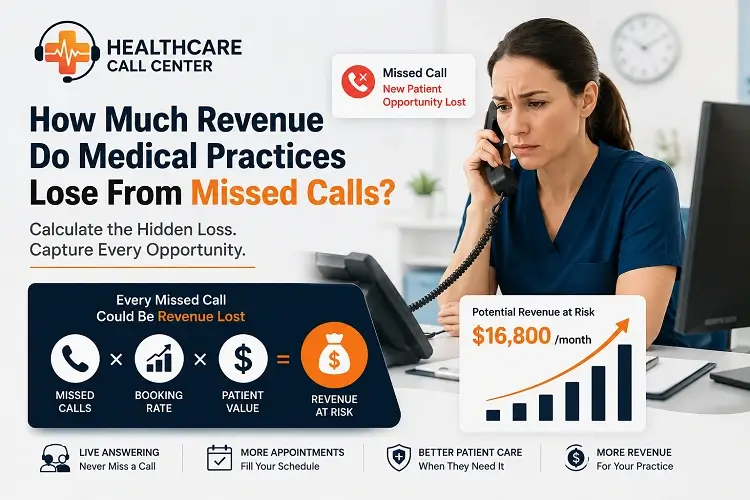
A missed call revenue calculator helps turn that hidden leak into a number your team can see: missed calls multiplied by booking rate multiplied by average patient value.
The short answer: even a small practice can put thousands of dollars in monthly revenue at risk when missed calls occur during peak hours. A larger multi-provider office can put much more at risk.
The fix is not always hiring another full-time employee. For many practices, the better first step is a healthcare answering service that covers call spikes, lunch hours, after-hours gaps, and overflow when staff is with patients.
Why Missed Calls Are More Expensive Than They Look
Most practices underestimate missed calls because they count only the voicemails they can see. That is the wrong measurement. The most expensive missed call is usually the one that never becomes a voicemail. A patient calls, waits, hears ringing or a menu, and gives up. There is no message, no chart note, no callback task, and no proof that revenue just left the building.
This is especially true for new patients. Existing patients may try again because they already trust the practice. A new patient has no loyalty yet. If they are calling about pain, pregnancy symptoms, a fertility question, a cosmetic consult, or a specialist referral, they are likely working through a short list. The office that answers promptly has a better opportunity to turn that inquiry into a booked appointment.
Missed calls also create downstream problems. Staff spend Monday mornings returning vague messages. Patients get frustrated because nobody picked up when they needed help. Providers see gaps in the schedule that could have been filled. Marketing looks weaker than it really is because paid, organic, referral, and local-search traffic may be producing calls that the practice fails to capture.
What Counts as a Missed Call for a Medical Practice?
A missed call is not only an unanswered ring. It includes any patient call that fails to become a useful conversation or documented next step. If the caller hangs up during hold, that is a missed call. If the caller reaches voicemail and never gets called back, that is a missed call. If the message is returned two days later and the patient already booked elsewhere, that is a missed call too.
For revenue analysis, separate missed calls into four categories:
- New patient appointment requests: usually the highest-value calls, because the caller has not chosen a provider yet.
- Existing patient scheduling calls: follow-ups, treatment starts, reschedules, and recurring care.
- Urgent or after-hours calls: pain, complications, anxiety, and time-sensitive concerns that create trust when handled well.
- Administrative calls: insurance, billing, forms, referrals, and records requests that do not always create revenue directly but still shape patient experience.
Do not treat all missed calls equally. A missed billing question is not the same as a missed implant consult. The goal is to calculate the revenue attached to the calls that could have become appointments.
The Simple Missed-Call Revenue Formula
Use this formula:
Missed calls per month x appointment conversion rate x average first-year patient value = estimated monthly revenue at risk.
Here is what each number means.
- Missed calls per month: count calls not answered live, hang-ups during hold, abandoned voicemail, and after-hours calls with no same-day response.
- Appointment conversion rate: the percentage of answered calls that normally become booked appointments. If you do not know it, start with a conservative range and refine after 30 days.
- Average first-year patient value: the expected revenue from that patient over the first year, not just the first visit.
For example, if a chiropractic practice has 80 missed calls per month, a 35% booking rate, and an average first-year patient value of $600, the estimated revenue at risk would be $16,800 per month. This is an illustration, not a guaranteed revenue loss, but to recover the practice needs a dedicated chiropractic answering service provider which helps recover the lost amount.
Example: 20 Missed Calls Per Week
A practice missing 20 calls per week may not feel like it has a crisis. That is only four missed calls per weekday. It can happen during lunch, when two patients are checking out, when the receptionist is collecting insurance details, or when the office gets a post-holiday rush.
Now stretch that across a month. Twenty missed calls per week becomes roughly 80 missed calls per month. If only 25 percent of those callers would have booked, that is 20 missed appointments. If each new or returning appointment is worth 350 dollars in near-term revenue, the practice is looking at 7,000 dollars in monthly production risk. If the average patient value is higher, as it is in fertility, OB-GYN, plastic surgery, dermatology, dental, and specialty practice answering services, the number climbs quickly.
The point is not to pretend every missed call becomes a lost patient. It does not. The point is that the practice does not need a perfect loss rate for missed calls to hurt. A modest call gap, applied every week, creates a real revenue leak.
Which Missed Calls Cost The Most?
The highest-cost missed calls usually share three traits: high urgency, high intent, and low patience. A caller with pain, anxiety, or a time-sensitive question will not wait long. They need help, and they are more likely to engage with a practice that responds promptly.
- New patient calls from Google Business Profile: these callers are often comparing nearby practices and may call the next listing within minutes.
- Specialty consult calls: fertility, plastic surgery, OB-GYN, dermatology, dental implants, and other higher-value services can carry far more revenue than a routine visit.
- After-hours concern calls: anxious patients remember whether a human answered when the office was closed.
- Referral calls: if a patient was referred by another provider and nobody answers, the practice may lose both the appointment and the referral confidence.
- Reschedule calls: these look harmless, but if a patient cannot reschedule easily, an appointment gap becomes a no-show or cancellation.
This is why a missed-call report should never stop at call count. The real question is: which missed calls carried intent? Those are the calls worth protecting first.
Why Voicemail Does Not Recover Most Lost Calls
Voicemail feels like a safety net because it creates a place for the caller to leave information. But voicemail does not capture the patients who hang up. It does not reassure a worried caller. It does not ask the follow-up questions your scheduler needs. It does not turn a new patient inquiry into a confirmed appointment while the caller is still motivated.
Voicemail also moves work to the worst possible time. Instead of answering a live question in the moment, your team starts the next day with a backlog. Messages are incomplete. Phone numbers are misheard. Patients are in meetings when staff calls back. Some people never answer. Others are already booked somewhere else.
For a medical practice, speed is part of care. A caller who reaches a calm human voice is more likely to feel safe, more likely to share complete information, and more likely to stay with the practice. A caller who reaches voicemail is being asked to wait at the exact moment they decided to act.
How Front Desk Overflow Support Closes The Leak
The practical fix is coverage during the moments your internal team cannot answer. That can mean peak morning hours, lunch, provider-change windows, Monday rushes, after-hours calls, or full-day overflow when staffing is thin. Front desk overflow support acts like a pressure valve. When your in-office team is busy, trained agents answer in your practice name, capture the reason for the call, and move the patient to the right next step.
Good overflow support is not a generic message-taking service. It should understand medical-office call flow, protect HIPAA, follow your escalation rules, and document each call in a format your team can use. The goal is not simply to answer more calls. It is to make sure the calls most likely to become appointments are answered and handled appropriately.
HCC’s advantage is that callers are answered by US-based agents HIPAA-compliant and trained to handle healthcare conversations with empathy. That matters because many missed calls are emotional, not transactional. A worried mother, a fertility patient, or a post-op patient does not want a cold script. They want someone who sounds present and can guide the call without pretending to give medical advice.
How To Track Missed-Call Revenue For 30 Days
Before changing staffing or phone systems, track the leak for 30 days. Keep it simple. You do not need a complicated dashboard to get the truth.
- Count total inbound calls by day and hour.
- Count answered calls, abandoned calls, voicemail calls, and calls returned more than one business day later.
- Tag missed calls by type: new patient, existing patient, urgent, referral, billing, or admin.
- Estimate which missed calls could reasonably have become appointments.
- Apply the revenue formula using conservative patient-value assumptions.
Practice leaders often rely on feel. The phone sounds busy, so the team assumes everyone is doing their best. That may be true, but it does not answer the revenue question. A 30-day call audit gives the team facts instead of blame. Industry groups such as the Medical Group Management Association focus heavily on operational benchmarks because small workflow leaks compound when they repeat daily. Missed calls are one of those leaks.
When Missed Calls Become A Staffing Decision
If missed calls happen once in a while, coaching and scheduling adjustments may be enough. If they happen daily, the issue is structural. Your front desk may be doing everything right and still be outnumbered by the phones. That is the moment leadership has to decide whether to hire, change phone routing, add overflow coverage, or combine all three.
The mistake is treating the issue as a receptionist performance problem. In many practices, the front desk is already checking in patients, collecting balances, confirming insurance, managing forms, handling provider requests, and calming walk-ins. The phone is only one part of the job. If call volume keeps growing, missed calls are a system problem, not a person problem.
The American Medical Association publishes practice management resources because administrative friction affects the entire care experience. Phone access is part of that friction. A practice that cannot answer consistently may look disorganized even when its clinical care is excellent.
What Should A Practice Do Next?
Start with the math. Count the missed calls. Estimate the appointment conversion rate. Use conservative patient value. If the number is small, fix scheduling and scripts. If the number is large, protect the phone lines with overflow coverage before spending more on ads, SEO, or local listings.
That last point matters. Marketing brings patients to the phone, but the phone has to convert the demand. If you increase traffic before fixing missed calls, you are filling a leaking bucket. The smarter order is: protect calls first, then scale traffic.
Use the missed-call revenue formula, compare it to the cost of coverage, and decide from the numbers. If you want help estimating the leak for your practice,
Book a free consultation and HCC can walk through the call-flow gaps that are costing appointments.
Frequently Asked Questions
1. How Much Revenue Does A Medical Practice Lose From Missed Calls?
It depends on call volume, booking rate, and average patient value. A simple formula is missed calls per month multiplied by appointment conversion rate multiplied by average first-year patient value. Even conservative assumptions can show thousands of dollars in monthly revenue at risk.
2. What Is The Best Way To Calculate Missed-Call Revenue?
Track missed calls for 30 days, separate new patient calls from administrative calls, estimate how many would have booked, and multiply by realistic patient value. Use conservative numbers first so the result is credible.
3. Do Voicemails Count As Missed Calls?
Yes, if the voicemail does not become a timely booked appointment or useful documented next step. Voicemail is better than nothing, but it does not capture callers who hang up, and it often delays follow-up until the patient has moved on.
4. Which Practices Lose The Most From Missed Patient Calls?
High-value and high-anxiety specialties are most exposed: OB-GYN, fertility, plastic surgery, dermatology, dental, pediatrics, and multi-location medical groups. The higher the patient value and urgency, the more each missed call matters.
5. Can Front Desk Overflow Support Replace Hiring?
Sometimes. If call spikes are concentrated during certain hours, overflow support may solve the problem at lower cost than another full-time employee. If the office is understaffed all day, overflow support can still stabilize the phones while leadership evaluates hiring.
6. Should We Fix Missed Calls Before Increasing Marketing Spend?
Yes. More traffic creates more calls. If the practice cannot answer consistently, new marketing spend increases leakage. Protect the phone first, then scale SEO, ads, local listings, and referral campaigns with confidence.
7. How Can A Medical Practice Reduce Missed Calls?
A practice can reduce missed calls by tracking when calls are missed, identifying peak call periods, improving phone routing, adjusting front-desk workflows, and using overflow or answering support when internal staff cannot keep up.
by Erika Sanchez | Sep 18, 2026 | Medical Answering Services
The offshore quote arrives first because it is the easiest sale in the industry: same 24/7 coverage promise, same polished website, and a per-minute rate that looks 40% cheaper than the US-based alternative. For a practice drowning in after-hours calls, the spreadsheet decision feels obvious. Then the subtle losses start.
An anxious expectant mother asks a question the agent’s script does not cover, and the call ends without an appointment. A caller repeats herself twice, gives up, and dials the next practice on her list. A billing question about deductibles gets a polite non-answer. None of it appears in the monthly report, which still reads “calls answered: 100%.”
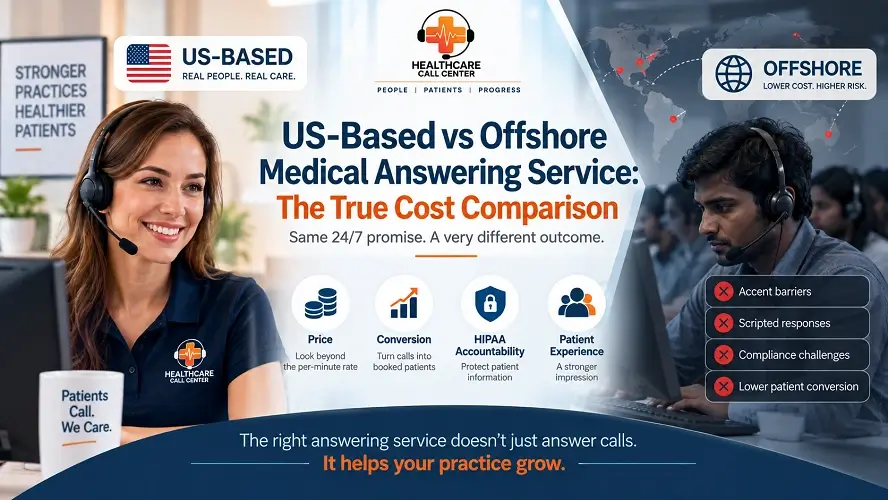
This article compares US-based and offshore medical answering services on the four things that actually decide the outcome: price, conversion, HIPAA accountability, and patient experience. It includes the real per-minute math, the compliance questions most vendors hope you never ask, and a verification checklist you can run before signing any contract.
Quick answer: Offshore medical answering services often advertise lower per-minute rates than US-based services, but the cheapest rate does not necessarily produce the lowest total cost. Practices should compare price alongside booked appointments, call handling quality, HIPAA responsibilities, patient experience, escalation, and data handling. For front-line patient calls, the right question is not simply what each provider charges per minute, but how effectively each service turns patient calls into completed appointments and appropriate follow-up.
What Is A US-Based Medical Answering Service?
A US-based medical answering service is a live-call handling company whose agents live and work inside the United States, are trained on US healthcare workflows such as copays, referrals, and prior authorizations, and operate under direct US legal jurisdiction for HIPAA purposes. Patients hear a familiar accent, a culturally native pace, and an agent who can respond to unscripted moments the way a well-trained front desk would.
The term gets used loosely in this industry, so three definitions matter when you are comparing quotes:
- US-based (onshore): agents, management, data storage, and legal accountability all sit inside the United States.
- Nearshore: agents sit in nearby countries, most commonly Jamaica, Mexico, or Central America, usually in the US time zones but outside US data jurisdiction.
- Offshore: agents sit in distant countries, most commonly the Philippines or India, the world’s two largest voice-outsourcing destinations, at the lowest labor rates and outside the United States and potentially subject to additional jurisdictions and oversight considerations.
Some vendors blend all three without saying so, as a US sales office, nearshore supervisors, offshore agents, and cloud infrastructure scattered across regions. The only way to know what you are buying is to ask where the agents who will answer your phones physically sit, and to get the answer in writing inside the Business Associate Agreement.
What Does An Offshore Answering Service Really Cost Per Minute?
The sticker-price gap is real, so it deserves honest math rather than a straw man. Offshore medical answering services typically publish rates between $0.50 and $0.90 per minute. US-based services, especially those with HIPAA-trained agents who schedule appointments rather than just take messages, run $0.75 to $1.50 per minute.
Published pricing varies widely by vendor, call volume, services, and billing model, but the quotes used in this comparison illustrate a common price difference.
Run a realistic practice through both numbers. A practice receiving 500 patient calls a month at a two-minute average is buying about 1,000 minutes:
- Offshore at $0.65 per minute: $650 per month, $7,800 per year
- US-based at $1.10 per minute: $1,100 per month, $13,200 per year
- Paper savings: $450 per month, $5,400 per year
On a procurement spreadsheet, $5,400 a year looks like a win. But the spreadsheet is counting minutes, and your practice does not sell minutes. It converts calls into patients, and that is where the comparison turns.
What is The Conversion Gap, And Why Does It Decide The Math?
A patient call is not a support ticket. It is usually an emotionally loaded moment: a first-time fertility inquiry, a plastic surgery consult question, a mother calling about a newborn’s fever at 11 pm. What happens in the 90 seconds after pickup decides whether that moment becomes revenue for you or for a competitor.
Where Patient-Call Friction Can Affect Conversion
- Comprehension load. When a caller with a strong regional accent, an insurance question, or an anxious tone meets an agent working in a second language over a compressed voice line, both parties work harder to achieve less. The call runs longer or ends thinner.
- Script rigidity. Offshore operations win their pricing through standardization, so agents are trained to stay inside narrow scripts. That fails exactly when a patient’s question does not fit the card, which is precisely when the caller is most valuable.
- Escalation failure. When the agent cannot help, the fallback is usually a message. Message-taking is where new patients quietly disappear, because most callers who reach an unhelpful endpoint never call back.
The behavioral data behind what missed calls cost a medical practice applies to answered-but-unconverted calls too; healthcare call studies consistently show that only 20% to 30% of callers leave a message when no live, capable person engages them, and around 46% of patient calls arrive during busy windows or after hours in the first place.
An answered call that does not convert is just a missed call with an invoice attached, which is the core lesson in the comparison of voicemail vs. live answering for medical practices.
Put one conversion number on it. If the offshore line converts 5% fewer of your 500 monthly calls into booked appointments, that is 25 lost patients a month. At a blended new-patient value of $350, the annual loss is $105,000, roughly twenty times the paper savings.
In high-value specialties, the arithmetic collapses even faster: one lost plastic surgery consult at $6,500 erases thirteen months of offshore savings in a single call, and one lost fertility patient can erase the entire contract. You can run your own version with a missed call revenue calculator and your actual call log, and the conclusion rarely survives contact with real patient values.
Which HIPAA And BAA Differences Actually Matter?
When an answering service performs functions involving PHI on behalf of a covered entity, the relationship may fall under HIPAA’s business associate requirements. Practices should determine the vendor’s role and ensure the appropriate Business Associate Agreement and safeguards are in place. Since the 2013 Omnibus Rule, business associates are directly liable to the US Department of Health and Human Services, not just contractually liable to you. That single fact is what makes the next three questions matter.
1. Where Does Your Patients’ Data Physically Live?
A US-based provider may make data location, vendor oversight, contractual accountability, and regulatory requirements easier for a US practice to evaluate, but practices should verify the actual data flow and subcontractors rather than relying on geography alone. The HHS business associate guidance is explicit that a BAA must flow down to every subcontractor that touches PHI, so ask for the full chain, not just the vendor signing your contract.
2. Who Can Enforce The Agreement If Something Goes Wrong?
A US-based vendor answers to HHS OCR, which can audit and fine. An offshore vendor signs your BAA, but enforcement against an entity in another jurisdiction is indirect at best. If PHI is mishandled, your practice still owns the breach, the notification duty, and the liability, while your practical recourse weakens with every border the data crosses.
3. What Does A Mistake Cost You?
HIPAA penalty tiers reach roughly $2 million per violation category per year at the top end, and breach notification rules generally give patients and HHS a 60-day clock that starts whether or not your offshore vendor is cooperative. The vendor’s savings never touch these numbers; your practice pays them.
Compliance is also cultural, not just contractual. A US-trained medical answering agent knows what a copay is, why a referral matters, what a prior authorization sounds like, and which phrases calm an anxious caller. That fluency is part of what a medical answering service is actually selling, and it is the part a labor-rate arbitrage cannot replicate.
Why Does Cultural Fluency Convert More Callers?
Patients do not experience your pricing model. They experience one phone call, usually at a stressful moment, and they generalize it: this is what this practice is like. A warm, culturally fluent voice who understands “I need to be seen before Friday because my deductible resets” is delivering your brand.
A halting, scripted interaction is also delivering your brand, at a discount you did not choose. We break down exactly why offshore call centers fail at patient empathy in a separate deep dive, and the same failure pattern repeats across every specialty that depends on the phone.
The empathy gap matters most in the specialties where the phone is the front door. OB-GYN and pregnancy calls carry anxiety that needs a calm, familiar voice. Fertility inquiries are deeply private and irreversible as first impressions.
Consults for aesthetic and surgical practices are calls, and callers judge the practice by the first 30 seconds, which is why specialty-trained coverage built on a physician answering service workflow converts at multiples of a generic script read by whoever happens to be on shift.
Cultural fluency also shows up in small operational moments that decide appointments: recognizing that “I’m calling about my bill” from an elderly patient often means a scheduling conflict underneath, or that a hesitant caller asking “do you take my insurance” is really asking to be talked into booking.
US-based agents who live inside the healthcare system your patients navigate read these signals natively. The same pattern explains why practices pairing their front desk with a 24/7 medical call center keep US agents on the patient-facing line: the risk being managed is not the phone bill; it is the first impression.
US-Based Vs Offshore At A Glance
| Factor |
US-based medical answering |
Offshore answering |
| Per-minute rate |
$0.75 to $1.50 |
$0.50 to $0.90 |
| New-patient conversion |
Higher, especially on specialty and consult calls |
Lower; script-bound on unscripted moments |
| HIPAA posture |
US jurisdiction; direct HHS enforcement; auditable chain |
BAA signed, but data and vendors cross borders |
| Insurance fluency |
Native: copays, deductibles, referrals, prior auth |
Learned, often literal |
| Empathy on anxious calls |
Culturally native warmth and pacing |
Variable, frequently scripted |
| Accent friction |
None |
Present; strongest on elderly and regional-accent callers |
| Breach recourse |
Direct contractual and regulatory recourse |
Indirect, jurisdiction-dependent |
| Billing transparency |
Itemized US contracts |
Surcharges and rounding vary by vendor |
| Best use |
Front-line patient calls, scheduling, triage messaging |
Back-office, non-clinical, overflow volume |
What Hidden Costs Appear After Practices Switch To Offshore?
The invoice is only the first place costs hide. Practices that move patient lines offshore and later switch back consistently describe the same four-act pattern:
- Month one looks great. Volume is handled, the bill is low, and nothing has broken yet.
- Months two to three bring quiet signals. Staff starts noticing messages that make no sense, appointments booked into wrong slots, and callers who “must have dialed the wrong number” because they never mention the awkward call they abandoned.
- Months four to six surface the review or the complaint. An elderly patient tells the front desk, in detail, how hard it was to be understood. A new-patient number sags without an obvious cause, because no report tracks the caller who gave up mid-sentence.
- The audit happens only if someone counts: pull the vendor’s call recordings, match them against booked appointments, and price the gaps at your average patient value. Most practices never run it, which is exactly how a savings story survives on a spreadsheet while the schedule thins out.
None of this is a morality tale about offshore workers, who are often skilled and diligent. It is a systems observation: distance, language, and script constraints each shave a small conversion percentage, and in medical calls those percentages are worth more than the minutes.
How Do You Verify Where Your Answering Service’s Agents Actually Are?
Before signing with any vendor, US-based or not, run this five-question verification.
Get the answers in writing.
- In which country and time zone are the agents who will answer our line physically located?
- List every subcontractor that will touch our calls, recordings, or messages, and explain how applicable BAA obligations flow to them.
- Where are call recordings and message data stored, and where are backups held?
- May we test-call the line at different hours and hear the actual agents before we commit?
- What percentage of the agents handling our account are US-based?
A US-based provider answers all five in one email and usually offers the test calls before you ask. Evasion on any single answer tells you where the rate is actually coming from.
When Does Offshore Capacity Actually Make Sense?
Offshore works when three conditions are all true: the calls are low-stakes and script-friendly, the caller is not a prospective patient forming a first impression, and no PHI crosses the line.
Internal appointment reminders for an existing, stable patient base, vendor coordination, and after-hours overflow that is explicitly message-only can clear that bar. Even then, pairing the overflow with a live US escalation path, the way an after-hours medical answering service does for busy windows, protects the calls that turn out to matter.
The moment the call involves a new patient, an anxious moment, insurance judgment, or a scheduling decision, the math from the sections above applies, and the cheap minute buys an expensive outcome. Most practices that run both keep the patient-facing line domestic and route nothing that touches revenue or PHI offshore.
What Should A Practice That Already Switched Do First?
Audit Before You Cancel: Pull three months of the vendor’s call recordings, match every new-patient inquiry against your appointment calendar, and value the gaps at your average new-patient revenue. That single exercise, which takes an afternoon, usually settles the comparison with your own data instead of anyone’s marketing.
Then Migrate In One Step, Not Two: move the after-hours and overflow lines together, update the on-call protocols, test-call the new line for a week before announcing anything, and keep the 90-day baseline from your audit to verify that recovered calls actually appear in the schedule.
Buy Minutes Or Book Patients
The offshore pitch prices the phone call. Your practice prices the patient. When one recovered caller is worth three months of rate difference, and one lost caller erases a year of savings, the per-minute line item stops being the decision and becomes a detail.
Our US-based, stay-at-home mom agents answer with the warmth and fluency your patients expect, book a free consultation for a free discovery call, and protect PHI under US jurisdiction with a 90%+ answer rate.
US-Based Vs Offshore Medical Answering FAQs
1. Is An Offshore Answering Service Cheaper Than A US-Based One?
Per minute, yes, usually 30% to 50% cheaper. Total cost of ownership, no: conversion loss on new-patient calls typically runs ten to twenty times the per-minute savings, so practices that measure booked appointments instead of minutes almost always come out ahead with US-based agents.
2. Can An Offshore Answering Service Be HIPAA Compliant?
An offshore vendor can sign a Business Associate Agreement, but enforcement and data custody become complicated when PHI crosses borders, and the BAA must flow down to every offshore subcontractor. US-based services keep data under US jurisdiction with direct HHS enforcement, which is why most compliance-conscious practices keep patient-facing calls domestic.
3. What Is The Difference Between Offshore, Nearshore, And US-Based Answering Services?
Offshore agents sit in distant countries such as the Philippines or India at the lowest rates; nearshore agents sit in nearby countries such as Jamaica or Mexico in US time zones; US-based agents, management, data, and legal accountability all sit inside the United States. For patient-facing medical calls, the third option carries the least conversion and compliance risk.
4. How Much Cheaper Is Offshore Per Minute?
Typically $0.50 to $0.90 per minute offshore versus $0.75 to $1.50 per minute US-based, a saving of roughly $450 per month or $5,400 per year for a practice with 500 monthly calls at a two-minute average. One lost specialty patient can erase that entire annual saving.
5. Do US-Based Medical Answering Services Handle Specialty Practices?
Yes, and specialization is where the US-based advantage is largest. Specialty-trained agents understand insurance language, triage protocols, and consult intake for practices like OB-GYN, fertility, and surgical clinics. Specialty-trained agents can be better equipped to handle insurance terminology, specialty workflows, consult questions, and patient concerns than a generic call-handling model.
5. What Should I Do If I Already Switched To Offshore?
Audit three months of call recordings against your appointment calendar, count new-patient calls that did not convert, and value them at your average new-patient revenue. That exercise gives you the baseline to verify recovery after moving the line back to US-based agents.

by Erika Sanchez | Sep 15, 2026 | plastic surgery call center
A rhinoplasty inquiry calls at 7:40 pm while your patient coordinator is closing charts. She has researched three surgeons, saved the down payment, and wants a consultation this month. Nobody answers, so she books with the practice that does. Plastic surgery practices usually do not have a lead problem; they have a capture problem.
In this article, we break down where consult calls leak away, what first-time cosmetic callers need on the phone, and how to book more consultations from the call volume you already pay for.
Quick answer: Plastic surgery practices book more consults by answering every call live, qualifying procedure interest and timeline, and appointment scheduling the consultation during the first call instead of relying on callbacks. Practices that cover evenings and weekends with trained live agents typically recover 30 to 50 consult opportunities per month from calls that used to hit voicemail.
Why Is The Consultation Call The Most Valuable Call In Plastic Surgery?
The consultation call is the most valuable call in a plastic surgery practice because a booked surgical consult represents $3,000 to $12,000 or more in potential procedure revenue, and the first practice to actually speak with the caller usually wins the booking. Cosmetic callers compare two or three surgeons, but momentum fades fast, and the practice that answers first frames the entire decision.
Demand keeps rising, too. National procedure statistics published by the American Society of Plastic Surgeons (ASPS) show surgical and minimally invasive volume holding near record levels, which means more first-time callers than ever are reaching for the phone at odd hours. Each one of those calls deserves the same discipline a surgical schedule gets, which is why serious practices treat their phone line as a dedicated plastic surgery call center rather than a side duty of the front desk.
The consult also compounds far beyond one procedure. A patient who books a breast augmentation typically returns for follow-up visits, add-on treatments such as Botox or medical-grade skincare, and eventually a second surgical procedure years later. She refers friends who are quietly researching the same decision, and those referrals call already half convinced. When a practice prices a consult call, the honest number is not the single procedure fee; it is the multi-year patient relationship that starts with whoever picks up the phone first.
Where Do Plastic Surgery Consult Calls Leak Away?
Most consult calls leak during four windows: while the coordinator is with a patient, during the lunch hour, after the front desk closes, and in the dead zone between a missed call and a late callback. Call data across healthcare practices shows that roughly 46% of patient calls arrive during busy windows or after hours, which is exactly when consult lines are least likely to be staffed.
| Where the call lands |
What typically happens |
What it costs |
| Voicemail during a consult |
Caller leaves no message |
Consult booked elsewhere |
| After-hours voicemail |
Callback the next business day |
Caller has already committed |
| Next-day callback |
Contact rates collapse within minutes |
Half the leads never answer again |
| Unqualified intake call |
Consult slot wasted |
Lower show rate and wasted surgeon time |
Callback speed decides most of the dead-zone losses. Inbound lead studies across industries show that the odds of reaching a caller fall off a cliff within the first few minutes and collapse entirely by the half-hour mark, yet the average practice returns an after-hours plastic surgery inquiry the next business morning.
By then the caller has spoken with a practice that answered at 8 pm, liked the voice she heard, and booked the consult that should have been yours.
The monthly math is uncomfortable but useful:
- 12 consult-line calls per day × 46% arriving during busy or after-hours windows = 5 to 6 calls at risk daily
- 5 × 22 working days = 121 calls per month that need live coverage
- 121 × 35% ready to book = 42 lost consult opportunities per month
- 42 × 40% consult-to-procedure conversion × $6,500 average procedure = $109,200 in monthly surgical pipeline at risk
That number is why the first step for most practices is running their actual call log through a missed call revenue calculator built for medical offices, which converts gut feeling into a line item the whole team can see.
What Do First-Time Cosmetic Callers Want On The Phone?
First-time cosmetic callers want three things: to be taken seriously without judgment, honest price framing, and a clear next step they can book on the spot. A caller asking about a mommy makeover or breast augmentation has often waited years to make that call, and she is listening for warmth before she is listening for information.
Price questions are qualification, not tire-kicking. A coordinator who offers a realistic range and explains what the consult covers builds trust in ninety seconds; a coordinator who dodges pricing entirely loses the booking to whoever answers next. A useful answer sounds like this: surgical consults for that procedure typically run in a stated range, the consult fee is credited toward surgery when the patient books within a stated window, and the surgeon will confirm an exact quote after examination.
That one sentence answers the money question, positions the consult as valuable rather than a sales pitch, and gives the caller a reason to book now instead of comparing five more websites. The same principle behind professional call answering for plastic surgeons applies to every ring: the voice that picks up sets the tone for the entire patient relationship, long before the patient ever meets the surgeon.
How Do You Book More Consults Without More Ad Spend?
Practices book more consults without more ad spend by converting the calls they already receive: live answering on evenings and weekends, direct scheduling into the surgical calendar, a consistent qualification script, and structured follow-up for undecided callers. Here is what that looks like in practice.
- Cover the evening research window: Cosmetic decisions are researched at night, often on a phone after the kids are asleep. A 24/7 plastic surgery answering service captures the 8 pm mommy makeover inquiry that used to die in voicemail.
- Book during the first call: Every callback is a second chance to lose the patient. Dedicated plastic surgery appointment scheduling turns an interested caller into a confirmed consult before she finishes her research session, with intake notes attached.
- Qualify with a light script: Procedure interest, timeline, surgeon preference, and payment readiness take under a minute and protect your consult slots for patients who will actually show.
- Follow up on the fence-sitters: A three-touch follow-up over ten days recovers callers who were interested but distracted. Most practices never call back a second time, which hands the consult to whoever does.
- Protect the calendar from no-shows: Confirmation messages and a reminder cadence lift show rates toward 80%, and the same coverage that books consults also fields post-operative questions, which is the core argument for after-hours plastic surgery answering rather than voicemail.
- Track the funnel numbers weekly: Practices that grow consult volume without new ad spend almost always measure four numbers: calls answered, consults booked, show rate, and consult-to-procedure conversion. A weekly review of those four lines exposes exactly where patients drop, whether that is unanswered evening rings, weak qualification, or follow-up that never happens. What gets measured gets booked.
What Happens After The Consult Is Booked?
After a consult is booked, revenue depends on show rate and follow-through: confirmation messages, a reminder cadence, and a short intake form cut no-shows and make the consultation itself productive. A pre-consult email that explains what to expect, what pricing conversation will happen, and what to bring turns a nervous first-time caller into a prepared buyer.
Undecided consults belong on a nurture list, not in the trash. A sixty-day follow-up sequence catches the patient whose timeline was simply three weeks later than she thought. And the patient who books her procedure becomes the highest-value caller your practice will ever have, because maintenance treatments, future procedures, and referrals all flow from that first booked consult.
The consult itself should end with a review request planted for later, because post-procedure reviews and healed-result photos feed the exact research loop that produces the next first-time caller. Every published review shortens the next caller’s hesitation, and every healed photo album on your gallery page answers objections before the phone ever rings. Booking more consults is a loop, not a single transaction, and the phone is where the loop starts.
Your Next Consult is Already Calling
Every evening your consult line goes to voicemail, ready-to-book patients are dialing the next surgeon on their list. Our US-based, stay-at-home mom agents answer with empathy, qualify procedure interest, and book consultations directly into your calendar with a 90%+ answer rate and HIPAA-conscious call handling.
Book a free consultation with our team, and we will walk through your actual call data to show exactly how many surgical consults your current setup is losing each month.
Plastic Surgery Consult Booking FAQs
Can a live answering service really schedule surgical consults?
Yes. Agents work from your consultation rules, procedure list, and live calendar access, so the caller hangs up with a confirmed date, time, and pre-consult instructions. Clinical questions are escalated by your protocol.
Will callers know they reached a service?
No. Agents answer with your practice name, match your tone, and are trained on your service lines from rhinoplasty to breast augmentation, so the call feels like your best coordinator picked up.
What does consult-line coverage cost compared to more ad spend?
Most practices invest $300 to $900 per month for month-to-month coverage with 30-day notice, while a single surgical consult acquired through paid advertising often costs more than that by itself.

by Erika Sanchez | Sep 15, 2026 | Healthcare Appointment Setter
A healthcare appointment setter is a trained patient communication specialist who answers calls, captures patient details, schedules appointments, confirms visits, handles rescheduling requests, and helps medical practices reduce missed calls. For growing practices, this role is no longer just basic phone support. It directly affects patient access, front desk workload, appointment volume, and revenue. When the role is handled by trained US-based stay-at-home-mom agents, patients also get something most call centers cannot offer: a warm, familiar American voice that understands how local practices communicate.
When a patient calls a medical office, they are often ready to take action. They may want to book a consultation, ask about insurance, reschedule a visit, or get help after business hours. If the call goes to voicemail, if the front desk is too busy, or if the patient feels rushed, that patient may call another provider. A healthcare appointment setter helps prevent that loss by making sure patient inquiries are answered quickly, professionally, and according to the practice’s workflow.
This article explains what healthcare appointment setters do, how they support medical practices, how they differ from a general receptionist, what to look for in a partner, and when outsourcing appointment setting makes sense.
What Does a Healthcare Appointment Setter Do?
A medical answering service with appointment scheduling helps manage the patient communication steps that happen before, during, and after scheduling. The exact responsibilities depend on the practice, specialty, software, and internal protocols, but the core goal is simple: help patients move from inquiry to booked appointment without delay or confusion.
Common responsibilities include:
- Answering inbound patient calls
- Scheduling new patient appointments
- Rescheduling or canceling existing appointments
- Collecting patient contact information
- Gathering insurance or referral details for the practice team
- Confirming appointment dates and times
- Sending reminders by phone, SMS, or email when approved
- Routing urgent calls based on practice instructions
- Documenting call notes inside the approved workflow
- Escalating calls to the in-house team when needed
In a healthcare setting, appointment setting is not only about placing names on a calendar. The appointment setter must understand patient sensitivity, privacy expectations, scheduling rules, provider availability, and how to communicate with empathy. A patient calling an OB-GYN, fertility clinic, plastic surgery practice, dental office, or chiropractic clinic may have very different concerns. The best appointment setters follow customized scripts and workflows for each practice, and US-based agents bring an added layer of comfort here because they already understand American patient expectations, insurance language, and local practice etiquette.
Healthcare Appointment Setter vs. Receptionist: What Is the Difference?
A receptionist usually handles many duties at once. They greet patients, check people in, process paperwork, answer insurance questions, support providers, handle walk-ins, and manage the daily flow inside the office. A healthcare appointment setter has a narrower and more conversion-focused role: answering calls, qualifying the request, and helping the patient schedule the right appointment.
This difference matters because most front desk teams are overloaded. They may be excellent at in-office administration, but they cannot always answer every call during peak times, lunch breaks, after-hours periods, or busy clinic days. When appointment setting is separated from front desk chaos, patients get faster responses, and the in-house team gets more breathing room.
| Role |
Main Focus |
Best Use |
| Receptionist |
In-office patient flow and administrative support |
Check-in, check-out, paperwork, greeting patients, walk-ins, and front desk coordination |
| Healthcare Appointment Setter |
Converting phone inquiries into scheduled appointments |
Answering calls, booking appointments, confirming visits, rescheduling, and reducing missed opportunities |
| Healthcare Call Center |
Scalable patient communication and call coverage |
24/7 live answering, after-hours support, overflow call handling, appointment scheduling, and multi-location patient communication |
Why Appointment Setting Matters for Medical Practices
Most practices spend money to make the phone ring. SEO, Google Ads, referrals, social media, directories, and physician reputation all drive patients toward the same action: contact the practice. But the marketing investment is wasted if the call is not answered or the patient is not guided into an appointment.
Appointment setting matters because it protects the revenue that practices have already worked to generate. A missed patient call can mean a missed consultation, a missed treatment plan, a missed dental case, a missed fertility inquiry, or a missed cosmetic procedure lead. For high-value specialties, even a small number of missed calls can create a serious revenue leak.
Strong appointment setting helps practices:
- Answer more patient calls
- Reduce voicemail dependency
- Improve first impressions
- Book more qualified consultations
- Reduce front desk overload
- Improve scheduling accuracy
- Support after-hours patient inquiries
- Capture leads from marketing campaigns
- Improve patient retention through reminders and follow-up
For practices that rely on new patient inquiries, call response speed can be the difference between a booked appointment and a lost patient. Patients often call more than one provider. The practice that answers first and communicates clearly has an advantage.
Key Benefits of Healthcare Appointment Setters
1. Fewer Missed Calls
Missed calls are one of the most common and most expensive problems in medical practices. They happen during lunch, peak call hours, staff shortages, training days, after-hours periods, and busy clinic flow. A healthcare appointment setter creates extra call coverage so fewer patients reach voicemail.
2. Better Patient Experience
The first phone call shapes how a patient feels about the practice. A rushed or unclear call can create doubt. A warm, calm, and organized call builds confidence. Appointment setters help patients feel heard while still moving the scheduling process forward. US-based stay-at-home-mom agents are especially strong here because they relate to patients as neighbors, not ticket numbers, which keeps sensitive calls calm and personal.
3. Higher Appointment Conversion
Many patients call with hesitation. They may be comparing providers, worried about cost, unsure about the next step, or nervous about the visit. A trained appointment setter can answer basic process questions, explain the next step, and help the patient choose an appointment time.
4. Less Front Desk Burnout
Front desk staff often juggle calls, walk-ins, paperwork, insurance questions, and provider requests at the same time. Appointment setters remove a major workload from the in-house team so they can focus on the patients already in the office.
5. Better Scheduling Accuracy
Different appointment types require different time blocks. New patient visits, follow-ups, consultations, procedures, monitoring appointments, and post-treatment checks all need accurate scheduling. Appointment setters follow practice rules to reduce mistakes, double-booking, and unnecessary rescheduling.
6. After-Hours Patient Capture
Many patients search for care outside normal business hours. They may call after work, on weekends, or after seeing an ad in the evening. If nobody answers, the lead may disappear. A healthcare call center can support medical answering service coverage far beyond the normal front desk schedule, including after-hours medical answering that captures evening and weekend inquiries before a competitor does.
7. Better Reporting and Visibility
When appointment calls are tracked properly, practices can see call volume, missed call patterns, booking rates, common questions, and staffing gaps. These insights help owners make better decisions about marketing, scheduling, and patient communication.
What Medical Appointment Setters Should Be Trained On
Healthcare appointment setting requires more than a friendly voice. The right team should understand healthcare communication, patient privacy expectations, scheduling workflows, and specialty-specific patient concerns.
Important training areas include:
- Practice-specific scripts and approved language
- Appointment types and scheduling rules
- HIPAA-conscious patient communication
- Patient verification steps
- Insurance information collection
- Escalation instructions for urgent calls
- How to handle anxious or frustrated patients
- How to document calls properly
- How to represent the practice’s tone and brand
The best appointment setters do not sound like a generic call center. They sound like an extension of the practice. They use the practice name, follow the approved greeting, understand common patient questions, and know when to route calls back to the clinical or administrative team.
HIPAA and Privacy Considerations for Healthcare Appointment Setting
Healthcare calls can involve sensitive information. Even when an appointment setter is not providing clinical advice, they may handle names, phone numbers, appointment details, insurance information, and other patient-related details. That is why privacy controls matter.
A healthcare appointment setting partner should have:
- HIPAA training for agents
- Secure systems for call documentation
- Role-based access where appropriate
- Clear rules for handling patient information
- Secure communication workflows
- Business Associate Agreement readiness when required
- Quality monitoring and call review processes
Practices should avoid generic answering services that do not understand healthcare privacy expectations. The safer approach is to work with a healthcare-focused team that can follow HIPAA-conscious workflows and practice-specific rules.
Which Practices Benefit Most From Appointment Setters?
Almost any busy medical practice can benefit from scheduling support, but the impact is highest when calls are tied directly to revenue, patient access, or high-value consultations.
Plastic Surgery Practices
Plastic surgery leads are often high-intent and high-value. If a potential patient calls about rhinoplasty, breast augmentation, facelift, tummy tuck, or another cosmetic procedure, the practice needs a fast and confident response. A plastic surgery answering service can help capture more consultation opportunities and reduce missed cosmetic leads.
Fertility and IVF Clinics
Fertility patients are often emotional, time-sensitive, and highly motivated. Appointment setters must handle calls with care, accuracy, and empathy. A fertility clinic answering service helps IVF clinics manage new patient inquiries, scheduling requests, insurance detail collection, and after-hours calls.
OB-GYN Practices
OB-GYN patients may call about new appointments, pregnancy concerns, follow-ups, scheduling changes, or after-hours needs. A specialized OB-GYN answering service can help practices reduce missed pregnancy-related calls and route requests according to office protocols.
Dental Practices
Dental practices lose opportunities when new patient calls go unanswered. Patients may be calling about cleanings, emergency visits, implants, veneers, Invisalign, or insurance questions. A dental answering service can help convert more calls into booked appointments.
Chiropractic Clinics
Chiropractic care often depends on recurring visits and consistent scheduling. Appointment setters can help with new patient intake, follow-up scheduling, reminders, and rescheduling. This keeps the treatment plan moving and reduces gaps in care.
In-House vs. Outsourced Healthcare Appointment Setters
Some practices hire appointment setters in-house. Others outsource to a medical call center. The right choice depends on call volume, budget, coverage needs, and how much management capacity the practice has.
| Factor |
In-House Appointment Setter |
Outsourced Healthcare Call Center |
| Coverage |
Typically available during regular business hours only |
Supports overflow calls, after-hours, evenings, weekends, and 24/7 coverage |
| Hiring & Training |
Practice is responsible for recruiting, onboarding, training, and retaining staff |
Trained healthcare agents are provided by the service provider |
| Cost |
Includes salary, benefits, training, management, and employee turnover costs |
Flexible pricing based on call volume, coverage hours, and practice needs |
| Flexibility |
Limited availability during staff absences, vacations, or peak call periods |
Easily scales to handle seasonal demand, marketing campaigns, or high call volumes |
| Best For |
Larger practices with dedicated internal management and consistent staffing |
Growing practices, multi-location groups, practices with high call volume, or those needing after-hours patient support |
Outsourcing is often the better fit when a practice wants call coverage without hiring, training, and managing additional staff. It also helps during marketing campaigns, seasonal spikes, staff shortages, and expansion into new locations. Outsourcing to a US-based team also removes the offshore friction many practices worry about: no language barriers, no repeated answers, and callers who feel understood on the first try.
What to Look for in a Healthcare Appointment Setting Partner
Not every call center is built for healthcare. Before choosing a partner, practice owners should look for a team that understands medical workflows, patient privacy, and specialty-specific communication.
Look for:
- US-based, HIPAA-trained live agents who understand American patients
- Healthcare-specific experience
- HIPAA-conscious processes
- Custom scripts by specialty
- Ability to follow your escalation rules
- Appointment scheduling support
- Insurance information collection, when needed
- Call recording and quality monitoring, when approved
- Clear reporting on calls, bookings, and missed opportunities
- Agents who communicate with empathy
- Coverage that matches your patient demand
The right partner should not force your practice into a generic script. They should learn your workflow, your providers, your services, your scheduling rules, and your patient communication style. US-based stay-at-home-mom agents are a proven model for this: they answer with empathy, follow specialty scripts precisely, and represent your practice the way your front desk would on its best day.
How Healthcare Appointment Setters Improve ROI
Appointment setters improve ROI by helping practices capture more of the demand they already generate. If a practice is spending money on SEO, ads, referrals, social media, or directory listings, every missed call reduces the value of that spend.
A better appointment setting system can improve ROI by:
- Increasing answered call rate
- Improving the new patient booking rate
- Reducing no-shows through reminders
- Recovering after-hours leads
- Improving follow-up speed
- Reducing front desk interruption
- Helping owners understand call performance
For high-value specialties, the ROI can be significant. A single booked plastic surgery consultation, fertility consultation, dental implant case, or OB-GYN patient can be worth far more than the cost of answering and scheduling the call correctly.
Common Mistakes Practices Make With Appointment Setting
Many practices know they are missing calls, but they underestimate how much damage it creates. Common mistakes include:
- Relying only on voicemail
- Expecting the front desk to handle every call during busy hours
- Not tracking missed calls
- Using generic scripts that do not match the specialty
- Failing to answer after-hours inquiries
- Not training call handlers on patient empathy
- Not linking marketing performance to phone conversion
- Not reviewing call quality
Appointment setting should be treated as a growth function, not just an administrative task. If the phone is the main path from search traffic to a booked appointment, then the call experience is part of the conversion funnel.
When Should a Practice Outsource Appointment Setting?
A practice should consider outsourcing appointment setting when any of these problems are happening:
- Patients complain that nobody answers the phone
- Calls go to voicemail during business hours
- The front desk is overwhelmed
- Marketing leads are not turning into appointments
- After-hours calls are being missed
- No-shows or rescheduling problems are increasing
- The practice is expanding its locations
- The owner does not know how many calls are missed
- The team needs better reporting on call outcomes
Outsourcing does not mean replacing the front desk. It usually works best as support for the front desk. The in-house team continues to manage the patient experience inside the practice, while the appointment setting team helps answer, schedule, and route calls.
Final Takeaway
A healthcare appointment setter helps medical practices turn patient calls into booked appointments. The role supports scheduling, intake, reminders, routing, and patient communication. More importantly, it helps practices protect revenue that is already being generated by marketing, referrals, and patient demand.
For modern medical practices, appointment setting is not just a back-office task. It is part of patient access, patient experience, and practice growth. When calls are answered quickly and handled with care, patients feel supported, and practices capture more opportunities.
If your practice is missing calls, struggling with front desk overload, or losing patient inquiries after hours, Healthcare Call Center can help with trained US-based stay-at-home-mom agents, specialty-specific scripts, a 90%+ answer-rate commitment, and HIPAA-compliant medical answering support built around your workflow.
Ready to stop losing patient calls?
And see how US-based healthcare appointment setting support can help your practice capture more appointments.
FAQs About Healthcare Appointment Setters
What is a healthcare appointment setter?
A healthcare appointment setter is a trained call-handling specialist who answers patient inquiries, schedules appointments, confirms visits, gathers basic information, and routes calls according to the medical practice’s workflow.
Is a healthcare appointment setter the same as a receptionist?
No. A receptionist usually manages in-office administration and patient flow. A healthcare appointment setter focuses mainly on answering calls, scheduling appointments, reducing missed calls, and helping patients move from inquiry to booked visit.
Can appointment setters handle after-hours calls?
Yes. With the right healthcare call center partner, appointment setters can support after-hours calls, weekend coverage, overflow calls, and 24/7 medical answering service workflows.
Do healthcare appointment setters need HIPAA training?
Yes. Appointment setters who handle patient information should be trained on HIPAA-conscious communication, privacy expectations, secure documentation, and practice-approved workflows.
What types of practices use appointment setters?
Appointment setters are useful for OB-GYN practices, fertility clinics, plastic surgery practices, dental offices, chiropractic clinics, med spas, primary care groups, and multi-location healthcare organizations. US-based agents are especially valuable for practices whose patients expect a familiar accent, cultural context, and empathetic conversation on every call.