by Erika Sanchez | Sep 15, 2026 | plastic surgery call center
A rhinoplasty inquiry calls at 7:40 pm while your patient coordinator is closing charts. She has researched three surgeons, saved the down payment, and wants a consultation this month. Nobody answers, so she books with the practice that does. Plastic surgery practices usually do not have a lead problem; they have a capture problem.
In this article, we break down where consult calls leak away, what first-time cosmetic callers need on the phone, and how to book more consultations from the call volume you already pay for.
Quick answer: Plastic surgery practices book more consults by answering every call live, qualifying procedure interest and timeline, and appointment scheduling the consultation during the first call instead of relying on callbacks. Practices that cover evenings and weekends with trained live agents typically recover 30 to 50 consult opportunities per month from calls that used to hit voicemail.
Why Is The Consultation Call The Most Valuable Call In Plastic Surgery?
The consultation call is the most valuable call in a plastic surgery practice because a booked surgical consult represents $3,000 to $12,000 or more in potential procedure revenue, and the first practice to actually speak with the caller usually wins the booking. Cosmetic callers compare two or three surgeons, but momentum fades fast, and the practice that answers first frames the entire decision.
Demand keeps rising, too. National procedure statistics published by the American Society of Plastic Surgeons (ASPS) show surgical and minimally invasive volume holding near record levels, which means more first-time callers than ever are reaching for the phone at odd hours. Each one of those calls deserves the same discipline a surgical schedule gets, which is why serious practices treat their phone line as a dedicated plastic surgery call center rather than a side duty of the front desk.
The consult also compounds far beyond one procedure. A patient who books a breast augmentation typically returns for follow-up visits, add-on treatments such as Botox or medical-grade skincare, and eventually a second surgical procedure years later. She refers friends who are quietly researching the same decision, and those referrals call already half convinced. When a practice prices a consult call, the honest number is not the single procedure fee; it is the multi-year patient relationship that starts with whoever picks up the phone first.
Where Do Plastic Surgery Consult Calls Leak Away?
Most consult calls leak during four windows: while the coordinator is with a patient, during the lunch hour, after the front desk closes, and in the dead zone between a missed call and a late callback. Call data across healthcare practices shows that roughly 46% of patient calls arrive during busy windows or after hours, which is exactly when consult lines are least likely to be staffed.
| Where the call lands |
What typically happens |
What it costs |
| Voicemail during a consult |
Caller leaves no message |
Consult booked elsewhere |
| After-hours voicemail |
Callback the next business day |
Caller has already committed |
| Next-day callback |
Contact rates collapse within minutes |
Half the leads never answer again |
| Unqualified intake call |
Consult slot wasted |
Lower show rate and wasted surgeon time |
Callback speed decides most of the dead-zone losses. Inbound lead studies across industries show that the odds of reaching a caller fall off a cliff within the first few minutes and collapse entirely by the half-hour mark, yet the average practice returns an after-hours plastic surgery inquiry the next business morning.
By then the caller has spoken with a practice that answered at 8 pm, liked the voice she heard, and booked the consult that should have been yours.
The monthly math is uncomfortable but useful:
- 12 consult-line calls per day × 46% arriving during busy or after-hours windows = 5 to 6 calls at risk daily
- 5 × 22 working days = 121 calls per month that need live coverage
- 121 × 35% ready to book = 42 lost consult opportunities per month
- 42 × 40% consult-to-procedure conversion × $6,500 average procedure = $109,200 in monthly surgical pipeline at risk
That number is why the first step for most practices is running their actual call log through a missed call revenue calculator built for medical offices, which converts gut feeling into a line item the whole team can see.
What Do First-Time Cosmetic Callers Want On The Phone?
First-time cosmetic callers want three things: to be taken seriously without judgment, honest price framing, and a clear next step they can book on the spot. A caller asking about a mommy makeover or breast augmentation has often waited years to make that call, and she is listening for warmth before she is listening for information.
Price questions are qualification, not tire-kicking. A coordinator who offers a realistic range and explains what the consult covers builds trust in ninety seconds; a coordinator who dodges pricing entirely loses the booking to whoever answers next. A useful answer sounds like this: surgical consults for that procedure typically run in a stated range, the consult fee is credited toward surgery when the patient books within a stated window, and the surgeon will confirm an exact quote after examination.
That one sentence answers the money question, positions the consult as valuable rather than a sales pitch, and gives the caller a reason to book now instead of comparing five more websites. The same principle behind professional call answering for plastic surgeons applies to every ring: the voice that picks up sets the tone for the entire patient relationship, long before the patient ever meets the surgeon.
How Do You Book More Consults Without More Ad Spend?
Practices book more consults without more ad spend by converting the calls they already receive: live answering on evenings and weekends, direct scheduling into the surgical calendar, a consistent qualification script, and structured follow-up for undecided callers. Here is what that looks like in practice.
- Cover the evening research window: Cosmetic decisions are researched at night, often on a phone after the kids are asleep. A 24/7 plastic surgery answering service captures the 8 pm mommy makeover inquiry that used to die in voicemail.
- Book during the first call: Every callback is a second chance to lose the patient. Dedicated plastic surgery appointment scheduling turns an interested caller into a confirmed consult before she finishes her research session, with intake notes attached.
- Qualify with a light script: Procedure interest, timeline, surgeon preference, and payment readiness take under a minute and protect your consult slots for patients who will actually show.
- Follow up on the fence-sitters: A three-touch follow-up over ten days recovers callers who were interested but distracted. Most practices never call back a second time, which hands the consult to whoever does.
- Protect the calendar from no-shows: Confirmation messages and a reminder cadence lift show rates toward 80%, and the same coverage that books consults also fields post-operative questions, which is the core argument for after-hours plastic surgery answering rather than voicemail.
- Track the funnel numbers weekly: Practices that grow consult volume without new ad spend almost always measure four numbers: calls answered, consults booked, show rate, and consult-to-procedure conversion. A weekly review of those four lines exposes exactly where patients drop, whether that is unanswered evening rings, weak qualification, or follow-up that never happens. What gets measured gets booked.
What Happens After The Consult Is Booked?
After a consult is booked, revenue depends on show rate and follow-through: confirmation messages, a reminder cadence, and a short intake form cut no-shows and make the consultation itself productive. A pre-consult email that explains what to expect, what pricing conversation will happen, and what to bring turns a nervous first-time caller into a prepared buyer.
Undecided consults belong on a nurture list, not in the trash. A sixty-day follow-up sequence catches the patient whose timeline was simply three weeks later than she thought. And the patient who books her procedure becomes the highest-value caller your practice will ever have, because maintenance treatments, future procedures, and referrals all flow from that first booked consult.
The consult itself should end with a review request planted for later, because post-procedure reviews and healed-result photos feed the exact research loop that produces the next first-time caller. Every published review shortens the next caller’s hesitation, and every healed photo album on your gallery page answers objections before the phone ever rings. Booking more consults is a loop, not a single transaction, and the phone is where the loop starts.
Your Next Consult is Already Calling
Every evening your consult line goes to voicemail, ready-to-book patients are dialing the next surgeon on their list. Our US-based, stay-at-home mom agents answer with empathy, qualify procedure interest, and book consultations directly into your calendar with a 90%+ answer rate and HIPAA-conscious call handling.
Book a free consultation with our team, and we will walk through your actual call data to show exactly how many surgical consults your current setup is losing each month.
Plastic Surgery Consult Booking FAQs
Can a live answering service really schedule surgical consults?
Yes. Agents work from your consultation rules, procedure list, and live calendar access, so the caller hangs up with a confirmed date, time, and pre-consult instructions. Clinical questions are escalated by your protocol.
Will callers know they reached a service?
No. Agents answer with your practice name, match your tone, and are trained on your service lines from rhinoplasty to breast augmentation, so the call feels like your best coordinator picked up.
What does consult-line coverage cost compared to more ad spend?
Most practices invest $300 to $900 per month for month-to-month coverage with 30-day notice, while a single surgical consult acquired through paid advertising often costs more than that by itself.
by Erika Sanchez | Aug 11, 2026 | plastic surgery call center
Every time your front desk misses a call, a potential patient dials the next surgeon on their list. Plastic surgery is not like other medical specialties. Patients calling about procedures are nervous, excited, and full of questions. When that call goes to voicemail, they do not leave a message. They hang up and call someone else.
A plastic surgery call center service solves this problem. Trained agents answer every call, handle patient concerns with empathy, and book consultations directly into your schedule. No missed calls. No lost revenue. No patients slipping away to competitors.
If you are comparing providers, start with our guide to choosing an after-hours plastic surgery answering service that fits your call volume, scheduling workflow, and patient communication needs.
What Is a Plastic Surgery Call Center and What Does It Do?
A plastic surgery call center is a specialized patient communication service built specifically for cosmetic and reconstructive surgery practices. Unlike a generic answering service that takes messages, a plastic surgery call center team is trained to handle the unique flow of cosmetic patient inquiries.
These calls are different from typical medical calls. Patients ask about pricing, recovery timelines, financing options, before-and-after results, and whether a procedure is right for them. They need reassurance, not just information. A receptionist juggling in-office patients cannot give these calls the attention they deserve.
A dedicated call center changes that. Agents trained in plastic surgery patient communication answer every call within seconds. They understand the emotional weight of a rhinoplasty inquiry versus a reconstructive surgery question. They know when to schedule a consultation, when to route to clinical staff, and when to handle the question themselves.
The American Society of Plastic Surgeons reports that cosmetic procedures continue to grow year over year, which means more patients are calling practices to explore their options. The practice that answers the phone first captures that patient.
Why Plastic Surgery Practices Lose Patients to Missed Calls
Missed calls are the single biggest revenue leak in a plastic surgery practice. Here is why it happens and what it costs.
Front desk staff cannot answer every call. They check in patients, handle payments, manage schedules, and assist with in-office procedures. When three calls come in during a consultation check-in, two of those go unanswered.
After-hours Plastic Surgery calls go straight to voicemail. Most plastic surgery offices close at 5 or 6 PM. Patients who research procedures in the evening call after work. If nobody answers, that patient moves on.
New patient inquiries require time and empathy. A patient calling about a facelift may spend ten minutes asking questions before feeling comfortable enough to book. A rushed receptionist cannot provide that level of attention while managing a waiting room.
Want to estimate the potential revenue impact for your own practice? Use our Patient Lead Response Time Calculator to estimate how missed or delayed patient inquiries may affect appointments and revenue.
Weekend calls are another blind spot. Prospective patients spend Saturdays and Sundays researching procedures, looking at before-and-after photos, and calling practices. If your office is closed, those calls go to voicemail. By Monday morning, the patient has already booked a consultation with a competitor who answered.
How Missed Plastic Surgery Calls Affect Consultation Conversion
A missed plastic surgery call is not simply a missed conversation. It can represent a lost consultation, a lost procedure opportunity, and a patient who may never return to your practice.
Plastic surgery patients often compare multiple surgeons before choosing where to schedule a consultation. They may call after seeing a procedure page, reviewing before-and-after photos, or researching a surgeon’s credentials. If they reach voicemail, the next call may go to another practice.
The faster a practice responds to a new inquiry, the more opportunity it has to answer basic questions, build trust, and move the patient toward a consultation. Live call coverage helps remove the delay between patient interest and appointment scheduling.
Plastic surgery consult calls need high-value patient call handling because callers are often comparing providers before booking.
Core Services a Plastic Surgery Call Center Provides
A plastic surgery call center does more than answer phones. It functions as an extension of your practice. Here is what the service covers.
24/7 Live Answering
Every call is answered by a trained agent, day or night. Whether a patient calls at noon or midnight, they speak with a real person. No voicemail. No automated menus. No waiting on hold.
The agent follows your practice protocols for call handling, message taking, escalation, and scheduling. Patients feel like they reached your office, not a third-party service.
Consultation Scheduling
This consultation scheduling capability removes the delay between a high-intent inquiry and the next available appointment. They use your scheduling rules, availability windows, and intake requirements. A patient who calls at 9 PM can leave the call with a confirmed appointment for Thursday morning.
This eliminates the callback delay that kills conversions. Patients who have to wait for a callback often lose interest, book elsewhere, or forget they called.
After-Hours Coverage
The hours between 5 PM and 9 AM are prime time for patient inquiries. People research procedures after work, discuss options with family, and pick up the phone when the office is closed.
A plastic surgery answering service ensures these calls get answered. Agents capture new patient leads, handle urgent post-operative questions, and schedule consultations for the next business day.
New Patient Intake
First-time callers have questions. Lots of them. What does the procedure cost? How long is recovery? Is financing available? Does the surgeon have experience with their specific concern?
Trained agents walk patients through these questions using information you provide. They do not give medical advice. They give the information patients need to feel confident booking a consultation.
Call Routing and Escalation
When a call requires clinical attention, agents route it immediately. A post-operative patient with a concern goes straight to your clinical team. A media inquiry reaches your front office. A billing question gets directed to your billing department.
No message slips lost in a stack of papers. No patient transferred three times before reaching the right person.
How a Plastic Surgery Call Center Differs from a Generic Answering Service
Many practices already use an answering service and assume that is enough. It is not. Generic answering services take messages. They do not understand plastic surgery patient psychology.
Here is the difference:
- Generic Answering Service: Answers the call. Takes a name and number. Sends a message. Patient waits for a callback. Patient may not answer the callback. Patient books elsewhere.
- Plastic Surgery Call Center: Answers the call. Engages the patient. Answers basic questions using practice-approved information. Schedules the consultation on the spot. Patient leaves the call with an appointment.
The first model captures a name. The second model captures a patient.
This distinction matters because cosmetic patients are self-pay. They are spending their own money, which means they shop around. The practice that makes them feel heard and valued on that first call earns their trust and their business.
Who Needs a Plastic Surgery Call Center?
This service is built for practices that cannot afford to miss calls. That includes:
Single-surgeon practices where the surgeon and one receptionist handle everything. Calls go unanswered during consultations, procedures, and lunch breaks.
Multi-provider practices with high call volume. Three surgeons, two nurse practitioners, and one front desk mean calls pile up fast.
Practices offering high-value procedures. A single rhinoplasty, tummy tuck, or mommy makeover can represent significant revenue. Missing that one call is expensive.
Practices in competitive markets. If five plastic surgeons operate in your city, the one who answers the phone wins the patient.
The math is simple. If your practice misses five calls per week from potential new patients, and your average procedure value is significant, the revenue loss is substantial. A call center costs a fraction of what those missed calls cost you.
Read – Why Los Angeles plastic surgery practices need dedicated call center services?
What to Look for in a Plastic Surgery Call Center
Not every call center is built for plastic surgery. When evaluating services, look for these essentials:
1. Specialty Training
Agents should understand plastic surgery terminology, common procedures, patient concerns, and the consultation booking process. A generic call center will not know the difference between a consultation and a pre-op appointment.
2. HIPAA Compliance
Patient information must be handled with strict HIPAA-compliant protocols. According to the U.S. Department of Health and Human Services, covered entities must ensure that business associates handling protected health information comply with privacy and security rules. Your call center should document its compliance procedures, use encrypted systems, and train staff on privacy requirements.
3. Custom Call Protocols
Your practice is unique. The call center should follow your scripts, your scheduling rules, your escalation pathways, and your intake questions. Cookie-cutter protocols lead to mistakes.
4. Bilingual Capability
Plastic surgery serves diverse communities. Bilingual agents ensure you never miss a call from a patient who prefers to speak in their native language.
5. Integration with Your Systems
The call center should integrate with your practice management software, EHR, or scheduling tool. Manual message-passing creates delays and errors.
What Changes When a Plastic Surgery Practice Uses a Call Center
Practices that implement a dedicated plastic surgery call center service see measurable changes:
More consultations booked. When every call is answered, consultation volume increases. Patients who would have gone to voicemail now have appointments on the calendar.
Higher patient satisfaction. Patients reach a real person every time. They feel heard, not processed. That first interaction sets the tone for their entire surgical journey.
Recovered revenue. Calls that previously went unanswered now convert to paying patients. The return on investment is direct and measurable.
Better staff focus. Your front desk team can focus on in-office patients instead of juggling phones. The practice runs smoother.
Improved online reviews. Patients who have a positive first call experience are more likely to leave positive reviews after their procedure. That first phone interaction ripples through your entire reputation.
Why Now Is the Time
The cosmetic surgery market is growing. More patients are researching procedures online and calling practices to ask questions. The practice that answers the phone first wins the consultation.
If your competitors are using voicemail after 5 PM, you have an opportunity. If they are missing calls during the day, you have an advantage. A plastic surgery call center turns that advantage into revenue.
Every day without one is a day you are losing patients to practices that pick up the phone.
Our medical answering service is built for healthcare providers who need reliable, empathetic patient communication at every hour. For plastic surgery practices specifically, our plastic surgery call center services deliver customized call handling that matches your practice voice and protocols.
Ready to Capture Every Patient Call?
Healthcare Call Center provides specialized call center services for plastic surgery practices, staffed by trained agents who understand cosmetic patient communication. From after-hours coverage to full-time answering, we make sure no patient call goes unanswered.
Book a Free Consultation
Frequently Asked Questions
What is a plastic surgery call center?
A plastic surgery call center is a specialized patient communication service that answers calls for cosmetic and reconstructive surgery practices. Trained agents handle patient inquiries, schedule consultations, and provide after-hours coverage.
How much does a plastic surgery call center cost?
Costs vary based on call volume and service level. Most practices find that the revenue recovered from previously missed calls far exceeds the monthly cost. Contact us for a custom quote based on your practice needs.
Can the call center schedule consultations directly?
Yes. Agents book appointments directly into your practice management system using your scheduling rules and availability windows.
Is the service HIPAA-compliant?
Yes. All patient information is handled with strict HIPAA-compliant protocols, including encrypted messaging and secure scheduling access.
What hours does the call center cover?
Our service provides 24/7 coverage, meaning every call is answered whether your office is open or closed.
Will patients know they are speaking to a call center?
Our agents answer calls using your practice name and follow your custom protocols. Patients experience seamless communication that feels like they reached your office directly.
by Felicia Goodman | Aug 5, 2026 | plastic surgery call center
Every phone call to a plastic surgery practice represents $3,000 to $12,000 in potential revenue. A breast augmentation consultation leads to a $6,000 to $12,000 procedure. A rhinoplasty inquiry is worth $5,000 to $10,000. A facelift consult can generate $10,000 to $25,000 in surgical fees. When that call goes to voicemail or is handled poorly by a rushed front desk, the patient calls the next surgeon on Google.
Plastic surgery is unlike any other medical specialty when it comes to phone handling. These patients are not calling about insurance verification or prescription refills. They are calling because they have been thinking about this procedure for months, sometimes years.
They have researched surgeons, looked at before-and-after photos, and finally worked up the courage to pick up the phone. The first voice they hear determines whether they book a consultation or move on.
Practices using a dedicated after-hours plastic surgery call center answering service can answer more consultation inquiries before they become missed revenue opportunities.
Small improvements in how consultation calls are answered, documented, and followed up can significantly increase consultation bookings without increasing marketing spend.
Key Takeaways
- Every plastic surgery inquiry can represent thousands in procedure revenue.
- Live answering helps capture more consultation opportunities.
- Consultation scripts influence booking rates.
- After-hours coverage reduces lost cosmetic leads.
- Faster follow-up improves consult-to-surgery conversion.
Why Plastic Surgery Calls Are Different From Other Medical Calls
Plastic surgery calls are different from general healthcare inquiries. A plastic surgery call center service helps practices capture consultation requests, answer patient questions, and protect high-value opportunities.
Plastic surgery patients are elective, self-paying, and emotionally invested. They are not referred by a primary care doctor. They are not dealing with insurance pre-authorization. They are choosing to spend thousands of dollars on a procedure that is deeply personal. This means every consultation call requires empathy, confidence, and a structured intake process instead of simple message taking.
Because these procedures are discretionary and high value, the first phone conversation often influences whether a patient books a consultation or continues comparing other practices.
Key differences in plastic surgery phone calls:
- Patients are nervous: Many are calling about a procedure for the first time. They need empathy, not efficiency.
- Calls come after hours: Prospective patients research at night and on weekends. They call when they are ready, which is often outside business hours.
- Pricing questions happen early: Patients want to know cost before committing to a consultation. How this is handled determines whether they book.
- Privacy matters enormously: Patients do not want details left on voicemail or discussed where others can hear.
- Competitors are one click away: If your practice does not answer, the patient calls the next surgeon on the Google results page.
- Procedures are seasonal: Calls spike in fall and winter when patients plan procedures around holiday recovery time.
The Math: What Every Consult Call Is Worth
To understand why call handling matters, look at the revenue attached to each plastic surgery consultation. Not every consult converts to surgery, but the ones that do generate significant revenue.
The figures below illustrate why consultation calls deserve immediate attention. Missing even a small number of inquiries each month can represent significant lost surgical revenue.
| Procedure |
Average Cost |
Consult-to-Surgery Rate |
| Breast Augmentation |
$6,000-$12,000 |
60-70% |
| Rhinoplasty |
$5,000-$10,000 |
55-65% |
| Liposuction |
$3,000-$7,500 |
50-60% |
| Facelift |
$10,000-$25,000 |
70-80% |
| Tummy Tuck |
$8,000-$15,000 |
65-75% |
| Mommy Makeover |
$12,000-$20,000 |
70-80% |
While every practice has different pricing and conversion rates, the example below demonstrates how quickly missed consultation calls can affect revenue.
If your practice receives 20 consult inquiries per week and converts 60 percent into booked consultations, that is 12 consults per week. If 65 percent of those consults proceed to surgery at an average of $8,000 per procedure, the weekly revenue from new phone inquiries is over $62,000. Losing even 3 or 4 calls per week to voicemail or poor handling represents $18,000 to $25,000 in monthly lost revenue.
6 Proven Ways to Convert More Plastic Surgery Phone Calls Into Consultations
Most plastic surgery practices do not lose consultations because of poor marketing. They lose them because high-intent callers cannot reach a knowledgeable person when they are ready to book. The six strategies below help improve phone conversion, strengthen patient confidence, and turn more consultation inquiries into scheduled appointments.
1. Answer Every Call Within 3 Rings
Answering every consultation call may sound simple, but it remains one of the biggest reasons plastic surgery practices lose qualified patients. The front desk is checking in patients, dealing with post-op questions, managing inventory, and handling payments. When three calls come in at once, two go to voicemail.
A prospective breast augmentation patient who has been researching for three months calls at 11 AM on a Tuesday. She gets voicemail. She does not leave a message. She calls the next practice on the list, which answers on the second ring. She books a consultation. You lost an $8,000 patient because your front desk was checking in a patient.
The solution is either additional front desk staffing during peak call hours or a specialized answering service that understands plastic surgery. Every call must be answered live. No exceptions.
2. Use a Consult Intake Script That Builds Confidence
When a patient calls about a procedure, the person answering needs to do more than take a name and phone number. They need to make the caller feel confident that they called the right practice.
A strong consult intake script includes:
- Asking what procedure they are interested in (shows you listen)
- Mentioning the surgeon’s experience with that specific procedure
- Explaining what happens during the consultation (removes fear of the unknown)
- Discussing financing options briefly (removes the biggest barrier)
- Offering two specific appointment times (not ‘when works for you?’)
- Confirming they will receive a pre-consult packet with details
Patients who feel cared for during the phone call are more likely to show up for the consultation. The call is their first impression of your practice. Patients who feel comfortable during the first call are more likely to arrive for their consultation with confidence rather than hesitation.
3. Handle Pricing Questions Without Losing the Patient
Plastic surgery patients will ask about price on the first call. This is not a sign that they are price-shopping. It is a sign that they are serious enough to ask. The wrong answer kills the booking.
Do not say: ‘We cannot discuss pricing until after the consultation.’
Instead, give a range and pivot to value:
‘Breast augmentation at our practice typically ranges from $6,500 to $9,500 depending on implant type and surgical approach. During your consultation, Dr. Smith will evaluate your specific case and give you an exact quote that includes all surgical fees, anesthesia, facility costs, and post-operative care.
We also offer financing through CareCredit and Alphaeon. Would you like to schedule a consultation to get a personalized quote?’
This approach satisfies the patient’s need for a ballpark number while creating a reason to book. It also signals transparency, which builds trust.
4. Send a Pre-Consult Packet Immediately
Between the phone call and the consultation appointment, patients experience doubt. They wonder if they can afford it, if the procedure is safe, and if this is the right surgeon. A pre-consult packet sent within 24 hours of booking keeps them engaged and reduces consult no-shows. Maintaining communication between booking and consultation keeps excitement high while reducing uncertainty.
The packet should include:
- Surgeon bio and credentials
- Before-and-after photos of the specific procedure they asked about
- What to expect during the consultation (step by step)
- Financing options and payment plans
- Patient testimonials with real outcomes
- Office location, parking instructions, and what to bring
Practices that send pre-consult packets see consult no-show rates drop by 30 to 40 percent. Patients who receive the packet feel like the practice is invested in them before they have even walked through the door.
5. Implement a 24-Hour Confirmation Sequence
Consult no-shows for plastic surgery average 20 to 30 percent nationally. Every no-show represents a slot that could have gone to another patient and a surgeon’s time that cannot be recovered.
Use a multi-touch confirmation sequence:
- At booking: Calendar invite via text and email
- 48 hours before: Personal call from the patient coordinator (not automated)
- 24 hours before: Text reminder with provider name, time, and parking info
- Morning of: Text confirmation with ‘Reply Y to confirm’
The personal call from the patient coordinator is what separates practices with 10 percent no-show rates from those with 30 percent. Patients who have spoken to a real person twice before the visit rarely skip.
6. Capture After-Hours Calls With Trained Agents
Plastic surgery prospects research at night. They look at photos on RealSelf, read reviews on Google, and watch YouTube videos of procedures. When they are ready to call, it is often 7 PM or 10 PM or Sunday afternoon. If your practice sends those calls to voicemail, you lose them.
A specialized answering service with agents trained on plastic surgery protocols captures every after-hours call. The agent can answer basic questions about procedures, schedule consultations directly into your calendar, take detailed messages for the patient coordinator, and handle post-op concern calls that require routing to the on-call surgeon.
The cost of after-hours answering is a fraction of one procedure. The revenue from capturing even two after-hours consult bookings per month covers the annual service cost.
Common Phone Handling Mistakes That Kill Plastic Surgery Conversions
Audit your practice for these common mistakes:
- Voicemail during business hours: Patients interpret this as ‘they do not have time for me’
- Rushed intake: Taking name and number without asking about the procedure or building rapport
- No financing mention: Patients assume they must pay full amount upfront and never call back
- Generic on-hold music: Replace with educational content about your practice and procedures
- No after-hours coverage: The highest-intent patients call when your office is closed
- Long hold times: More than 45 seconds on hold and the patient hangs up and calls the next surgeon
- Dismissing online inquiries: Patients who submit forms on your website expect a call within 1 hour, not 24
Tracking and Measuring Conversion Success
You cannot improve what you do not track. Plastic surgery practices that take call conversion seriously monitor these metrics monthly:
- Total inbound calls per week (from phone system or answering service dashboard)
- Percentage of calls answered live vs. going to voicemail
- Percentage of answered calls that convert to booked consultations
- Consult no-show rate (by procedure type and by new vs. returning patient)
- Consult-to-surgery conversion rate (by procedure and by surgeon)
- Average time from first call to consultation appointment
- Average time from consultation to scheduled surgery date
- Revenue per consult (total surgical revenue divided by total consults)
Set baseline numbers for each metric and review them with your patient coordinator and front desk monthly. If call-to-consult conversion drops from 70 percent to 55 percent, investigate whether the phone script changed, a new hire is struggling, or calls are going to voicemail more frequently.
If consult-to-surgery rates are strong but call volume is declining, focus on marketing and SEO to bring more prospects to the phone.
Signs Your Practice May Be Losing Consultation Calls
- Calls regularly reach voicemail
- Consultation requests arrive after office hours
- Prospects ask about pricing but never schedule
- Front desk staff are frequently interrupted
- Follow-up takes longer than one business day
- Consultation no-shows are increasing
Building a Culture Where Every Call Matters
The practices that convert the highest percentage of phone calls into booked consultations have one thing in common: a culture where every team member understands that a phone call is not an interruption. It is the most valuable thing happening in the practice at that moment.
Train your front desk, patient coordinators, and answering service to treat every call as a $5,000 to $25,000 opportunity. Because that is exactly what it is. The patient who calls about a rhinoplasty on a Tuesday afternoon is not just another name on the schedule. She is someone who has been thinking about this for two years and finally made the call. The voice she hears determines whether your practice gets that surgery or the one across town does.
Review your call handling monthly. Listen to recordings. Track how many calls convert to consults. Track how many consults convert to surgeries. Identify where in the pipeline patients drop off. Then fix the leak. Practices that do this consistently see year-over-year revenue growth of 15 to 25 percent from phone conversions alone.
The difference between a practice that books 50 consults a month and one that books 80 is rarely about surgeon skill or marketing budget. It is about what happens in the ten seconds after the phone rings. Make sure every call is answered. Make sure every caller feels heard.
For many plastic surgery practices, improving phone conversion is one of the fastest ways to increase revenue without increasing advertising spend.
Capture More Plastic Surgery Consultations Without Missing Another Call
Healthcare Call Center helps plastic surgery practices answer every consultation inquiry with trained live agents who understand cosmetic procedures, patient sensitivity, and after-hours call handling.
Capture more consultations, reduce lead leakage, and protect every high-value patient opportunity.
Schedule a free consultation, and we’ll review where consultation calls may be slipping through before they become lost procedures.
Frequently Asked Questions
Q: How should plastic surgery practices handle pricing questions on the phone?
Give a price range for the specific procedure, explain that the exact cost depends on the surgical approach determined during consultation, mention financing options like CareCredit or Alphaeon, and then offer to schedule a consultation for a personalized quote. Never refuse to discuss pricing, as patients interpret this as the practice being overpriced.
Q: What is the average consult no-show rate for plastic surgery practices?
The average consult no-show rate for plastic surgery ranges from 20 to 30 percent. Practices that send pre-consult packets, make personal confirmation calls from patient coordinators, and send text reminders see rates drop to 10 to 15 percent.
Q: Why do plastic surgery patients call after hours?
Plastic surgery is elective and deeply personal. Patients research procedures at night and on weekends when they have privacy and time. Many call after viewing before-and-after photos or reading reviews during evening research sessions.
Q: Should plastic surgery practices use an answering service?
Yes, if the practice cannot answer every call within 3 rings during business hours or does not have after-hours coverage. A specialized answering service trained on plastic surgery protocols can schedule consultations, handle post-op concerns, route urgent calls to the on-call surgeon, and ensure no prospective patient reaches voicemail.
Q: How much revenue does a plastic surgery practice lose from missed calls?
A practice missing 5 consult calls per week at an average procedure value of $8,000 and a 60 percent consult-to-surgery conversion rate loses approximately $20,000 per week or over $1 million annually in potential surgical revenue. Even recovering 2 of those 5 calls adds $400,000 in annual revenue.
by Erika Sanchez | Jul 3, 2026 | plastic surgery call center
Plastic surgery patients rarely contact only one practice. They compare websites, reviews, photos, pricing signals, and how quickly someone responds. That means your answering service is not just taking messages. It may be the first human touchpoint between a high-value consultation lead and your practice.
If your practice is comparing providers, explore our 24/7 plastic surgery answering service to understand how specialized call coverage protects consultation opportunities.
Why Do Plastic Surgery Calls Need A Different Standard
Plastic surgery leads are often elective, competitive, and high-intent. A caller may be ready to ask about a consultation, financing, recovery, availability, or a specific procedure. If they hit voicemail or receive a cold response, they may move to the next surgeon.
A plastic surgery answering service should be built around speed, warmth, and consultation momentum.
1. Check whether they understand the consultation intent
A generic answering service may take a name and number. That is not enough for plastic surgery. Your team needs to know what procedure the caller is interested in, whether they are looking for a consultation, what timeline they have in mind, and how urgent the follow-up should be. The right provider captures useful context without making the caller feel interrogated.
2. Look for warm, polished call handling
Plastic surgery is a trust-based decision. The caller may feel nervous, excited, embarrassed, or unsure. The person answering should sound polished and calm. They should create confidence, not friction. A rushed or robotic call can damage the premium feel of your practice before the patient ever walks in.
3. Ask how quickly leads are routed
Speed matters in cosmetic surgery. If your practice follows up too late, the patient may have already booked a consultation elsewhere. Ask how the answering service sends call details, who receives them, and how urgent consultation leads are flagged.
4. Confirm they can support busy hours and after-hours demand
Many cosmetic patients call during lunch, after work, evenings, or weekends. If your front desk is busy with in-office patients, the phone can become a lead leak. A strong plastic surgery call center helps cover those gaps so interested patients are not forced into voicemail.
5. Make sure they do not overpromise on your behalf
Your answering service should not quote medical advice, guarantee outcomes, or speak beyond approved practice information. The goal is to guide the caller toward the next step, not to replace the consultation. This is especially important for elective procedures where expectations must be handled carefully.
6. Ask about reporting and missed-call visibility
You should know whether call coverage is protecting opportunities. Look for reporting that helps you understand call volume, captured inquiries, consultation opportunities, and patterns in patient questions. This helps the practice improve both marketing and front-desk operations.
7. Evaluate how well they fit your brand
A premium plastic surgery practice cannot sound like a generic call center. The answering team should adapt to your tone, patient experience, and service standards. Patients should feel like they reached your practice, not an outsourced script.
Questions to ask before choosing a provider
Ask: Do you handle cosmetic surgery calls? How do you identify consultation intent? How do you route urgent leads? Can scripts be customized? How do you protect sensitive information? What reports will we receive? How do you help prevent lost consultation opportunities?
The Cost of One Missed Plastic Surgery Consultation Call
Plastic surgery calls are not low-value inquiries. In many cases, one missed consultation call can represent thousands of dollars in potential revenue. A caller asking about breast augmentation, rhinoplasty, liposuction, or body contouring is often already deep into the decision-making process.
Most practices underestimate how much revenue is lost through missed patient calls. They have researched options, compared before-and-after galleries, read reviews, and narrowed down their choices.
When that patient finally calls your practice, speed matters.
If the call reaches voicemail or the response feels slow, the consultation opportunity may disappear within minutes. Unlike general healthcare calls, cosmetic leads are often comparison shopping in real time. They may contact multiple practices in one afternoon and move forward with the first team that feels responsive, professional, and easy to reach.
That is why missed calls in plastic surgery are more than operational issues. They directly impact consultation volume, procedure bookings, and revenue growth.
Common Mistakes Plastic Surgery Practices Make with Call Handling
Many plastic surgery practices invest heavily in marketing but overlook what happens after the phone rings. Paid ads, SEO, social media, and referral campaigns all aim to generate consultation inquiries. But if the call experience is weak, that marketing investment loses value quickly.
Common mistakes include:
- Relying too heavily on voicemail during lunch or after hours
- Using generic answering services with no understanding of the cosmetic industry
- Delayed callback times for new consultation inquiries
- Poor documentation of procedure interest and caller intent
- Inconsistent call handling across the front desk staff
Even small call-handling gaps can create major leakage in a highly competitive market. The strongest practices treat call coverage as part of the patient experience, not just front-desk support.
A well-trained specialized answering service helps reduce those gaps and ensures that every inquiry receives a professional first response.
Why does a Healthcare Call Center fit plastic surgery practices
Healthcare Call Center helps plastic surgery practices protect consultation opportunities with real human call coverage, warm patient handling, and clear handoffs. The goal is to help your practice respond like a premium brand even when your front desk is busy.
Final Thoughts
The right plastic surgery answering service should not feel like a generic message-taking service. It should help protect patient trust, capture real appointment intent, and give your team clearer follow-up information.
If your practice is ready to improve call coverage, Healthcare Call Center can help you understand where calls may be slipping through and what better coverage could look like.
Frequently Asked Questions
What is a plastic surgery answering service?
A plastic surgery answering service provides call coverage for cosmetic and plastic surgery practices, helping answer inquiries, capture consultation intent, and route information to the practice.
Why do plastic surgery practices need specialized answering services?
Plastic surgery leads are often high-value and involve comparison shopping. Specialized call coverage helps protect consultation opportunities and improves the first human interaction with the practice.
Can an answering service help book more plastic surgery consultations?
It can help protect more consultation opportunities by answering calls, capturing caller intent, and giving the practice clear follow-up information.
What should plastic surgeons look for in an answering service?
They should look for polished tone, fast handoffs, consultation-focused call capture, privacy-aware workflows, and reporting on call opportunities.
by Erika Sanchez | Jun 16, 2026 | plastic surgery call center
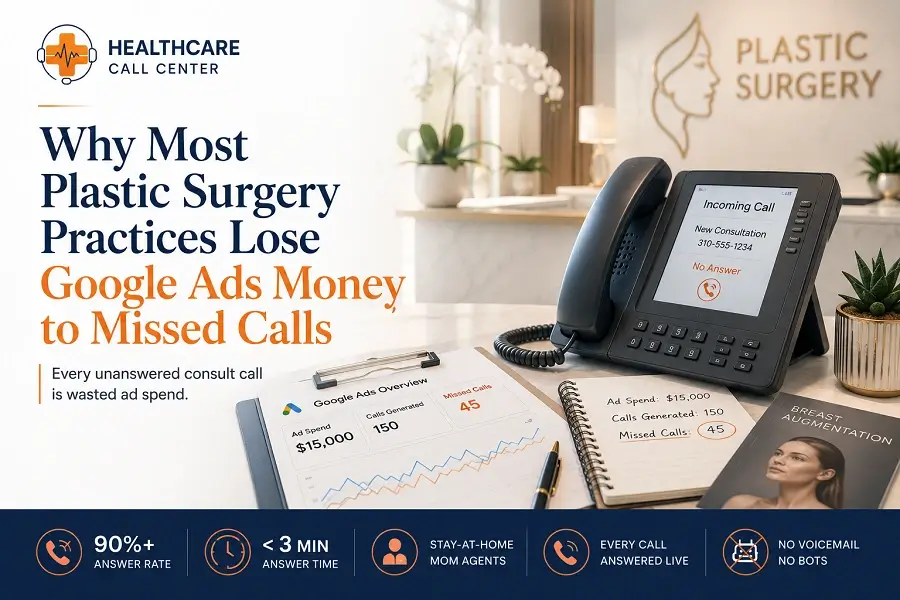
A plastic surgery practice in Beverly Hills spends $15,000 per month on Google Ads. Their campaigns are well-optimized. Their cost-per-click hovers around $8. Their landing pages convert at a healthy rate.
And every single day, calls generated by those ads ring out unanswered.
The front desk is busy checking in a patient. The patient coordinator is on another line. The receptionist stepped away for lunch. The caller, a woman ready to book a mommy makeover consultation, hangs up after four rings and dials the next practice on the list.
That practice just spent ad money to send a patient to their competitor.
This happens every day. And most plastic surgery practices have no idea it is happening.
The Disconnect Between Ad Spend and Call Answering
Google Ads for plastic surgery is a high-stakes game. The aesthetics vertical has some of the highest cost-per-click rates in all of healthcare. Keywords like “breast augmentation,” “tummy tuck,” and “rhinoplasty near me” can cost anywhere from $5 to $20 per click depending on your market.
Practices invest heavily in:
- Campaign structure and ad groups
- Landing page optimization
- Quality Score improvements
- Negative keyword lists
- Retargeting funnels
- Before-and-after galleries
- Patient testimonial videos
All of this work, thousands of dollars and hundreds of hours, exists for one purpose: to make the phone ring.
But what happens when it does?
What Happens After the Click Your Ads
When a prospective patient clicks your ad, they land on your website. They browse your before-and-after gallery. They read your reviews. They check your pricing page. And then they do the thing your entire funnel was designed to produce. They call.
Here is what typical call patterns look like at a busy plastic surgery practice:
- During business hours: The front desk juggles inbound calls, patient check-ins, payment processing, and post-op follow-ups. When two calls come in at the same time, the second one goes to voicemail.
- During lunch: The phones may be covered. Or they may not. Many practices operate with a single receptionist who takes a lunch break.
- After hours: The practice forwards calls to an automated system or a shared voicemail box checked the next morning.
- On weekends: Many practices are closed entirely with no call coverage.
In every one of these scenarios, the ad spend that generated the call has already been spent. Google does not refund your budget when nobody picks up.
The Math Nobody Wants to See
Let us break down what this actually costs a plastic surgery practice.
Say your practice spends $10,000 per month on Google Ads. Your campaigns generate approximately 150 calls per month, a reasonable estimate for a mid-sized aesthetics practice in a competitive market.
Industry research suggests that roughly 30% of inbound calls to medical practices during business hours go unanswered. After hours, that number climbs significantly.
If 30% of your 150 ad-generated calls go unanswered, that is 15 missed calls per month. At roughly $66 per call (based on $10,000 ad spend divided by 150 calls), you have wasted nearly $3,000 in ad spend on calls that nobody answered.
But the real cost is not the ad spend. It is the revenue those calls would have generated.
A single breast augmentation consultation can represent $8,000 to $15,000 in procedure revenue. A mommy makeover can run $12,000 to $20,000. A facelift can exceed $25,000. If even 3 of those 15 missed calls would have booked and completed a procedure, the practice has lost tens of thousands in revenue. All because nobody answered the phone.
Why Voicemail Does Not Work for Ad-Generated Calls
Many practices think they have solved this problem with voicemail. They have not.
Here is what actually happens when an ad-generated call hits voicemail:
The patient does not leave a message. They hang up and call the next practice, usually one of your competitors advertising on the same keywords you are. The patient found you through your ad, was interested enough to call, and then was met with a robotic greeting. That trust you built with your ad, your reviews, your gallery? Gone in seconds.
This is especially true for aesthetic procedures. Unlike urgent medical calls, cosmetic consult calls are emotionally driven. The patient has been thinking about this procedure for months. They finally built up the courage to call. When they hear voicemail, the emotional momentum dies. They do not call back.
The Call Tracking Gap
Most plastic surgery practices use some form of call tracking with their Google Ads campaigns.
They see metrics like:
- Calls generated per campaign
- Call duration
- Call source (which keyword drove the call)
- Time of day patterns
But here is what most call tracking dashboards do not highlight prominently: how many of those calls were actually answered by a human being.
The number is often lower than practice owners expect. And the calls that are not answered? They are charged to your ad budget just the same.
We recommend every plastic surgery practice pull their call tracking report and look specifically at the “unanswered” or “missed” column. Cross-reference those missed calls with your ad spend. The resulting number is what we call your “wasted ad spend.” That is money you paid Google to generate a call that nobody in your practice handled.
The Fix: Live Answering That Protects Your Ad Investment
The solution is not to reduce ad spend. The campaigns are working. The solution is to make sure every call those campaigns generate gets answered by a trained human being.
A dedicated plastic surgery answering service ensures that:
- Every ad-generated call is answered. Not just during business hours. During lunch breaks, after hours, on weekends, and during peak call times when your front desk is overwhelmed.
- Callers reach a real person, not a phone tree. Patients who click your ad and call expect a professional, empathetic human. If they get a menu prompt, they hang up. Live answering eliminates that drop-off.
- Urgent and high-intent calls are prioritized. A trained agent can identify which calls need immediate routing to your patient coordinator (consultation requests, pre-op questions) versus which can be handled with a scheduled callback (general inquiries, pricing questions).
- After-hours calls are captured. The patient who researches mommy makeovers at 10 PM and decides to call does not reach voicemail. They reach a live agent who can schedule a consultation or take a detailed message for your morning team.
- Every call is documented. Call notes, patient information, and scheduling details are securely delivered to your team so nothing falls through the cracks.
Tying It All Together: The Full-Funnel Approach
Your Google Ads strategy is the top of your funnel. It is designed to attract qualified prospective patients and drive them to contact your practice.
But the funnel does not end at the click. It ends at the conversation.
A well-optimized ad campaign paired with a reliable, empathetic answering service creates a seamless experience. The patient sees your ad, clicks, browses, calls, and reaches a warm, knowledgeable human who guides them toward booking a consultation.
That is how ad spend becomes revenue. Every other scenario is just spending money to send patients to your competitors.
What to Look for in a Plastic Surgery Answering Partner
Not every answering service understands the aesthetics vertical. Plastic surgery calls are different from general medical calls.
They require:
- Understanding of elective procedure terminology (augmentation, lift, reconstruction, non-surgical treatments)
- Sensitivity around patient privacy and the emotional nature of cosmetic inquiries
- Familiarity with consult booking workflows and insurance versus self-pay distinctions
- HIPAA-compliant handling of all patient information
- Ability to follow practice-specific escalation protocols
When your ad budget is on the line, the service answering your calls needs to perform at a level that matches the quality of your campaigns. A missed call from a Google Ad is not just a missed call. It is wasted marketing investment.
Frequently Asked Questions!
Q: How much of my Google Ads budget is being wasted on unanswered calls?
A: That depends on your call answer rate. If 30% of your ad-generated calls go unanswered, which is common, then roughly 30% of your call-generating ad spend is effectively wasted. Pull your call tracking data and compare answered versus missed calls to calculate your specific number.
Q: Does after-hours call answering really matter for plastic surgery practices?
A: Yes. Many prospective cosmetic surgery patients research procedures in the evening and on weekends. If they decide to call during those hours and reach voicemail, they typically hang up and call a competitor. After-hours answering captures those high-intent calls.
Q: Will an answering service feel impersonal to my patients?
A: Not if it is the right service. A trained answering service follows your practice’s specific scripts, uses your branding and terminology, and handles calls with empathy. Many practices find that patients cannot tell the difference between their front desk and a trained answering agent.
Q: How quickly can a plastic surgery answering service be set up?
A: A properly structured onboarding process typically takes up to two weeks. This includes script development, team training on your practice’s procedures and protocols, and system integration. Once live, the service operates as a seamless extension of your practice.
Q: Is a plastic surgery answering service HIPAA-compliant?
A: A HIPAA-compliant answering service secures every patient interaction under full HIPAA requirements, including encrypted messaging, trained agents who understand protected health information, and signed Business Associate Agreements with your practice.
by Felicia Goodman | Jun 4, 2026 | plastic surgery call center
Plastic surgery practices run on consultations. A rhinoplasty consultation, a breast augmentation inquiry, a Botox treatment call these are not casual phone calls. They are high-value leads that directly determine practice revenue. And when they hit voicemail, they rarely call back.
The average plastic surgery practice in the United States misses between 20 and 35 percent of incoming calls during business hours, and the numbers get worse after 5 PM. For a practice where a single surgical patient represents $3,000 to $12,000 in procedure revenue, the cost of unanswered calls adds up fast often exceeding $200,000 per year in lost consultation opportunities alone.
The problem is not that plastic surgery practices do not care about phone coverage. It is that the front desk is managing patient check-ins, surgical scheduling, and insurance verification simultaneously, while prospective patients expect the kind of responsiveness they get from a high-end retail experience. The gap between what callers expect and what they get is where most of the revenue leaks out.
- 20-35% of calls missed during business hours at plastic surgery practices
- $3,000-$12,000 average revenue per surgical patient
- $200K+ annual revenue lost from unanswered consultation inquiries
The Plastic Surgery Call Pattern: Not What You Expect
Plastic surgery generates phone traffic that looks nothing like a primary care practice. The call pattern is driven by the treatment cycle not illness and it follows predictable peaks that most practices are not prepared for.
| Phase |
What Patients Call About |
Why It Matters |
| Pre-Consultation |
Pricing, availability, before/after photos, financing |
This IS the sales call — if missed, patient goes elsewhere |
| Post-Consultation |
Scheduling the procedure, prep instructions, second opinions |
Patient is committed but can still switch practices |
| Pre-Op (1-2 weeks before) |
Medication questions, fasting rules, anxiety about surgery |
No-show risk if patient feels unsupported |
| Post-Op Recovery |
Swelling concerns, pain management, follow-up timing |
Complications caught early prevent emergency visits |
| Ongoing Treatments |
Botox/filler touch-ups, skincare product inquiries |
Recurring revenue — easy to lose to a competitor |
The pre-consultation phase is where the most money is lost. A prospective patient who calls about rhinoplasty pricing and gets voicemail does not wait. They check the next practice on Google, and that practice answers the phone. The cost of that missed call is not $200. It is the entire patient lifetime value, which for surgical patients averages $7,500 when you include secondary procedures.
The Conversion Gap: Where Plastic Surgery Practices Lose Revenue
Most plastic surgery practices have no idea how many consultation opportunities they are losing. They track surgical volume and revenue, but they do not track call answer rates, voicemail-to-callback times, or inquiry-to-consultation conversion ratios. The blind spot is significant.
If your practice sees 50 new patient inquiries per month and converts 30% to consultations, you are booking 15 consultations/month.
If your call answer rate is 65% and you fix it to 90%, you add roughly 8-10 more inquiries → 2-3 more consultations → $15K-$30K more revenue/month.
| Metric |
Average Practice |
Top-Performing Practice |
| Call answer rate during business hours |
65-70% |
92-95% |
| After-hours call coverage |
Voicemail only |
Live answering + warm transfer |
| Time to first callback (missed calls) |
Next business day |
Within 2 hours |
| Inquiry-to-consultation conversion |
25-30% |
15-55% |
| Consultation-to-procedure conversion |
40-50% |
65-75% |
| Revenue per new surgical patient |
$3,000-$5,000 |
$8,000-$12,000+ |
The data comes from practice management data across cosmetic surgery practices published by the American Society of Plastic Surgeons (ASPS) and confirmed by practice consulting groups.
The gap between average and top-performing practices is not clinical skill, it is operational efficiency, and phone coverage is the biggest lever.
HIPAA in Plastic Surgery: Yes, It Still Applies
A common misconception in the elective procedure space is that HIPAA rules are relaxed because plastic surgery is largely cosmetic and often self-pay. That assumption is incorrect and can expose a practice to significant risk.
Any communication involving a patient’s health information even if the procedure is elective is covered by HIPAA. A caller who mentions they had breast implants removed, or who discusses their recovery from a tummy tuck with an answering service agent, is sharing Protected Health Information.
The answering service handling those calls must operate under a signed Business Associate Agreement with HIPAA-compliant infrastructure.
Practices that use consumer-grade answering services or hire offshore teams without proper BAA documentation are exposed to regulatory penalties and, more importantly, to patient data breaches. A plastic surgery practice that handles celebrity patients, high-net-worth individuals, or patients who expect absolute discretion has even more at stake.
HIPAA applies to ALL patient health information, including elective procedures. Your answering service needs a signed BAA, encrypted communication, and trained agents.
Why US-Based Agents Matter for Cosmetic Surgery Patients
Plastic surgery patients are not calling from a hospital bed. They are calling from their car, their office, or their living room. They are considering spending thousands of dollars on a procedure that will permanently change their appearance. The person who answers that call sets the tone for the entire patient relationship.
A US-based agent trained on plastic surgery protocols understands the terminology — the difference between a breast lift and a breast augmentation, what a “mommy makeover” includes, why someone might ask about dysport versus botox. They understand insurance processes for reconstructive procedures versus cosmetic ones. They can speak naturally about financing options, recovery timelines, and consultation preparation.
| Caller Scenario |
Generic Answering Service |
Plastic Surgery-Trained US Agent |
| “How much does a rhinoplasty cost?” |
“I’ll take a message.” |
“Consultation is complimentary — I can check Dr. [Name]’s availability this week?” |
| “Do you accept CareCredit?” |
“I don’t know, let me check.” |
“Yes, we accept CareCredit, Alphaeon, and in-house financing.” |
| “I had lipo last week and have unusual swelling” |
“I’ll have someone call you.” |
“Let me connect you with our surgical coordinator right now.” |
| “Do you do Brazilian butt lifts?” |
“I’ll transfer you.” |
“Yes, Dr. [Name] specializes in BBL — would you like to schedule a virtual or in-person consultation?” |
After-Hours Coverage: Capturing the Calls Your Competition Cannot
Plastic surgery inquiries do not follow office hours. Prospective patients research practices in the evening after work. Current patients have post-op concerns on weekends. Someone who saw your Instagram post at 9 PM might call the next morning but they might also call right then, and if nobody answers, the impulse fades.
After-hours call coverage is not a luxury for plastic surgery practices. It is a competitive advantage. Most practices do not have it. The ones that do capture a meaningful percentage of new patient inquiries that their competitors miss entirely.
| After-Hours Scenario |
Without Coverage |
With Live Answering |
| Prospective patient calls at 7 PM |
Voicemail → calls competitor tomorrow |
Consultation scheduled for this week |
| Post-op patient worried about swelling at 10 PM |
Voicemail → ER visit or panic |
Triage, reassurance, or warm transfer to on-call |
| Google Ads click generates call at 8:30 AM Saturday |
Closed until Monday |
Lead captured, appointment booked |
| Patient wants to reschedule filler appointment Sunday |
Leaves message, waits 2 days |
Rescheduled immediately, no revenue gap |
For practices running Google Ads or social media campaigns, after-hours coverage directly protects ad spend. A click for “rhinoplasty near me” or “best plastic surgeon in [their city]” costs $8 to $25 on Google. If that click generates an after-hours call that goes unanswered, the practice paid for the lead and lost it.
Consultation Booking: Turning Calls Into Revenue
The plastic surgery sales cycle is short compared to most healthcare specialties. A prospective patient typically makes a decision within 1-3 consultations. This means the initial phone interaction and the first consultation are disproportionately important, they account for most of the conversion decision.
A trained answering service that understands the plastic surgery patient journey can do more than answer questions. Agents can schedule consultations in real time, collect patient information for pre-visit preparation, verify insurance coverage for reconstructive procedures, and set expectations for the consultation itself. This turns a simple phone answer into a qualified consultation booking.
Practices that implement dedicated plastic surgery answering services consistently report higher inquiry-to-consultation conversion rates. The improvement is not from changing clinical operations. it comes from making sure every prospective patient who calls gets an immediate, professional, knowledgeable response that builds confidence in the practice.
Key Takeaways
Plastic surgery is a competitive market where patients have choices. The practice that answers the phone and answers it well wins more consultations, converts more consultations to procedures, and builds stronger patient relationships that generate referrals and repeat business.
- Track your call answer rate this week – most practices discover they are losing 20-35% of calls
- Calculate the missed call revenue impact, missed calls x conversion rate x average patient value
- HIPAA compliance is non-negotiable even for elective procedures
- US-based agents with plastic surgery training outperform generic services significantly
- After-hours coverage captures inquiries your competition cannot reach
- Integrate answering service with scheduling for real-time consultation booking
Frequently Asked Questions
What does a plastic surgery answering service cost?
Most plastic surgery practices pay between $200 and $1,000 per month depending on call volume, after-hours coverage needs, and service level. For a practice doing 5+ surgical procedures per month, the service typically pays for itself through 1-2 additional captured consultations.
Is a cosmetic surgery answering service HIPAA compliant?
A reputable healthcare answering service for plastic surgery will maintain full HIPAA compliance including signed Business Associate Agreements, encrypted communication channels, access controls, and regular security audits. Verify documentation before signing.
Can an answering service schedule plastic surgery consultations directly?
Yes. Trained agents integrated with the practice scheduling system can book consultations in real time, collect patient demographics and insurance information, and set expectations for the consultation visit eliminating the voicemail-to-callback delay that loses patients.
Why does a plastic surgery practice need a specialized answering service?
Plastic surgery patients ask specific questions about procedures, pricing, financing, and recovery that generic agents cannot answer. A trained agent who understands the difference between surgical and non-surgical options, financing terminology, and pre/post-op protocols converts significantly more calls to consultations.
What happens if a post-op patient calls after hours with a concern?
A properly configured service triages by urgency. Non-urgent recovery questions get protocol-based guidance and next-day follow-up scheduling. Urgent concerns unusual pain, signs of infection get warm-transferred to the on-call surgeon or surgical coordinator immediately.
How does after-hours coverage affect plastic surgery marketing ROI?
Google and social media ads for plastic surgery generate calls outside business hours. Without after-hours coverage, those ad dollars generate voicemails. With live answering, the same ad spend produces booked consultations. The difference in ROI is direct and measurable.
Conclusion
Plastic surgery practices invest heavily in surgical skill, clinic design, and marketing then leave their most valuable touchpoint, the phone, to overworked front desk staff and voicemail systems. It is the single most visible operational gap in the specialty, and prospective patients notice it immediately.
Every unanswered call is a patient who moves to the next practice, and every post-op patient who cannot reach anyone after hours starts questioning whether they chose the right surgeon.
A HIPAA-compliant, US-based answering service with agents trained on plastic surgery procedures captures the consultations that voicemail loses and provides the after-hours support that keeps patients from going elsewhere.
For most practices, the service pays for itself within the first month through captured consultations alone before factoring in improved patient retention, better reviews, and protected marketing spend.