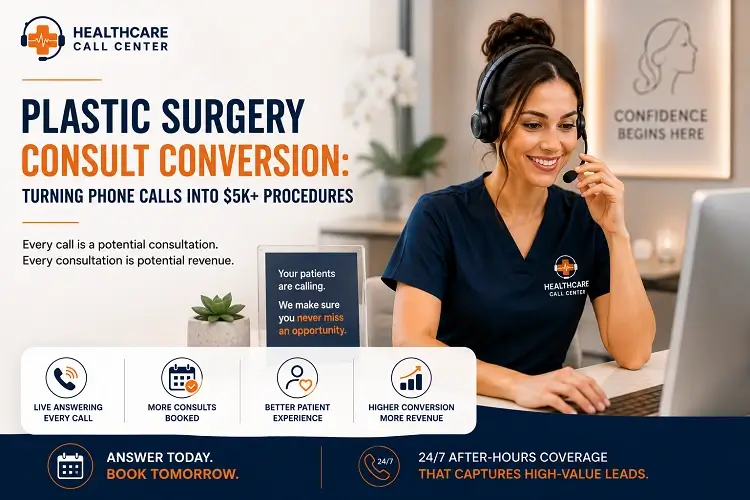
Every phone call to a plastic surgery practice represents $3,000 to $12,000 in potential revenue. A breast augmentation consultation leads to a $6,000 to $12,000 procedure. A rhinoplasty inquiry is worth $5,000 to $10,000. A facelift consult can generate $10,000 to $25,000 in surgical fees. When that call goes to voicemail or is handled poorly by a rushed front desk, the patient calls the next surgeon on Google.
Plastic surgery is unlike any other medical specialty when it comes to phone handling. These patients are not calling about insurance verification or prescription refills. They are calling because they have been thinking about this procedure for months, sometimes years.
They have researched surgeons, looked at before-and-after photos, and finally worked up the courage to pick up the phone. The first voice they hear determines whether they book a consultation or move on.
Practices using a dedicated after-hours plastic surgery call center answering service can answer more consultation inquiries before they become missed revenue opportunities.
Small improvements in how consultation calls are answered, documented, and followed up can significantly increase consultation bookings without increasing marketing spend.
Key Takeaways
- Every plastic surgery inquiry can represent thousands in procedure revenue.
- Live answering helps capture more consultation opportunities.
- Consultation scripts influence booking rates.
- After-hours coverage reduces lost cosmetic leads.
- Faster follow-up improves consult-to-surgery conversion.
Why Plastic Surgery Calls Are Different From Other Medical Calls
Plastic surgery calls are different from general healthcare inquiries. A plastic surgery call center service helps practices capture consultation requests, answer patient questions, and protect high-value opportunities.
Plastic surgery patients are elective, self-paying, and emotionally invested. They are not referred by a primary care doctor. They are not dealing with insurance pre-authorization. They are choosing to spend thousands of dollars on a procedure that is deeply personal. This means every consultation call requires empathy, confidence, and a structured intake process instead of simple message taking.
Because these procedures are discretionary and high value, the first phone conversation often influences whether a patient books a consultation or continues comparing other practices.
Key differences in plastic surgery phone calls:
- Patients are nervous: Many are calling about a procedure for the first time. They need empathy, not efficiency.
- Calls come after hours: Prospective patients research at night and on weekends. They call when they are ready, which is often outside business hours.
- Pricing questions happen early: Patients want to know cost before committing to a consultation. How this is handled determines whether they book.
- Privacy matters enormously: Patients do not want details left on voicemail or discussed where others can hear.
- Competitors are one click away: If your practice does not answer, the patient calls the next surgeon on the Google results page.
- Procedures are seasonal: Calls spike in fall and winter when patients plan procedures around holiday recovery time.
The Math: What Every Consult Call Is Worth
To understand why call handling matters, look at the revenue attached to each plastic surgery consultation. Not every consult converts to surgery, but the ones that do generate significant revenue.
The figures below illustrate why consultation calls deserve immediate attention. Missing even a small number of inquiries each month can represent significant lost surgical revenue.
| Procedure | Average Cost | Consult-to-Surgery Rate |
| Breast Augmentation | $6,000-$12,000 | 60-70% |
| Rhinoplasty | $5,000-$10,000 | 55-65% |
| Liposuction | $3,000-$7,500 | 50-60% |
| Facelift | $10,000-$25,000 | 70-80% |
| Tummy Tuck | $8,000-$15,000 | 65-75% |
| Mommy Makeover | $12,000-$20,000 | 70-80% |
While every practice has different pricing and conversion rates, the example below demonstrates how quickly missed consultation calls can affect revenue.
If your practice receives 20 consult inquiries per week and converts 60 percent into booked consultations, that is 12 consults per week. If 65 percent of those consults proceed to surgery at an average of $8,000 per procedure, the weekly revenue from new phone inquiries is over $62,000. Losing even 3 or 4 calls per week to voicemail or poor handling represents $18,000 to $25,000 in monthly lost revenue.
6 Proven Ways to Convert More Plastic Surgery Phone Calls Into Consultations
Most plastic surgery practices do not lose consultations because of poor marketing. They lose them because high-intent callers cannot reach a knowledgeable person when they are ready to book. The six strategies below help improve phone conversion, strengthen patient confidence, and turn more consultation inquiries into scheduled appointments.
1. Answer Every Call Within 3 Rings
Answering every consultation call may sound simple, but it remains one of the biggest reasons plastic surgery practices lose qualified patients. The front desk is checking in patients, dealing with post-op questions, managing inventory, and handling payments. When three calls come in at once, two go to voicemail.
A prospective breast augmentation patient who has been researching for three months calls at 11 AM on a Tuesday. She gets voicemail. She does not leave a message. She calls the next practice on the list, which answers on the second ring. She books a consultation. You lost an $8,000 patient because your front desk was checking in a patient.
The solution is either additional front desk staffing during peak call hours or a specialized answering service that understands plastic surgery. Every call must be answered live. No exceptions.
2. Use a Consult Intake Script That Builds Confidence
When a patient calls about a procedure, the person answering needs to do more than take a name and phone number. They need to make the caller feel confident that they called the right practice.
A strong consult intake script includes:
- Asking what procedure they are interested in (shows you listen)
- Mentioning the surgeon’s experience with that specific procedure
- Explaining what happens during the consultation (removes fear of the unknown)
- Discussing financing options briefly (removes the biggest barrier)
- Offering two specific appointment times (not ‘when works for you?’)
- Confirming they will receive a pre-consult packet with details
Patients who feel cared for during the phone call are more likely to show up for the consultation. The call is their first impression of your practice. Patients who feel comfortable during the first call are more likely to arrive for their consultation with confidence rather than hesitation.
3. Handle Pricing Questions Without Losing the Patient
Plastic surgery patients will ask about price on the first call. This is not a sign that they are price-shopping. It is a sign that they are serious enough to ask. The wrong answer kills the booking.
Do not say: ‘We cannot discuss pricing until after the consultation.’
Instead, give a range and pivot to value:
‘Breast augmentation at our practice typically ranges from $6,500 to $9,500 depending on implant type and surgical approach. During your consultation, Dr. Smith will evaluate your specific case and give you an exact quote that includes all surgical fees, anesthesia, facility costs, and post-operative care.
We also offer financing through CareCredit and Alphaeon. Would you like to schedule a consultation to get a personalized quote?’
This approach satisfies the patient’s need for a ballpark number while creating a reason to book. It also signals transparency, which builds trust.
4. Send a Pre-Consult Packet Immediately
Between the phone call and the consultation appointment, patients experience doubt. They wonder if they can afford it, if the procedure is safe, and if this is the right surgeon. A pre-consult packet sent within 24 hours of booking keeps them engaged and reduces consult no-shows. Maintaining communication between booking and consultation keeps excitement high while reducing uncertainty.
The packet should include:
- Surgeon bio and credentials
- Before-and-after photos of the specific procedure they asked about
- What to expect during the consultation (step by step)
- Financing options and payment plans
- Patient testimonials with real outcomes
- Office location, parking instructions, and what to bring
Practices that send pre-consult packets see consult no-show rates drop by 30 to 40 percent. Patients who receive the packet feel like the practice is invested in them before they have even walked through the door.
5. Implement a 24-Hour Confirmation Sequence
Consult no-shows for plastic surgery average 20 to 30 percent nationally. Every no-show represents a slot that could have gone to another patient and a surgeon’s time that cannot be recovered.
Use a multi-touch confirmation sequence:
- At booking: Calendar invite via text and email
- 48 hours before: Personal call from the patient coordinator (not automated)
- 24 hours before: Text reminder with provider name, time, and parking info
- Morning of: Text confirmation with ‘Reply Y to confirm’
The personal call from the patient coordinator is what separates practices with 10 percent no-show rates from those with 30 percent. Patients who have spoken to a real person twice before the visit rarely skip.
6. Capture After-Hours Calls With Trained Agents
Plastic surgery prospects research at night. They look at photos on RealSelf, read reviews on Google, and watch YouTube videos of procedures. When they are ready to call, it is often 7 PM or 10 PM or Sunday afternoon. If your practice sends those calls to voicemail, you lose them.
A specialized answering service with agents trained on plastic surgery protocols captures every after-hours call. The agent can answer basic questions about procedures, schedule consultations directly into your calendar, take detailed messages for the patient coordinator, and handle post-op concern calls that require routing to the on-call surgeon.
The cost of after-hours answering is a fraction of one procedure. The revenue from capturing even two after-hours consult bookings per month covers the annual service cost.
Common Phone Handling Mistakes That Kill Plastic Surgery Conversions
Audit your practice for these common mistakes:
- Voicemail during business hours: Patients interpret this as ‘they do not have time for me’
- Rushed intake: Taking name and number without asking about the procedure or building rapport
- No financing mention: Patients assume they must pay full amount upfront and never call back
- Generic on-hold music: Replace with educational content about your practice and procedures
- No after-hours coverage: The highest-intent patients call when your office is closed
- Long hold times: More than 45 seconds on hold and the patient hangs up and calls the next surgeon
- Dismissing online inquiries: Patients who submit forms on your website expect a call within 1 hour, not 24
Tracking and Measuring Conversion Success
You cannot improve what you do not track. Plastic surgery practices that take call conversion seriously monitor these metrics monthly:
- Total inbound calls per week (from phone system or answering service dashboard)
- Percentage of calls answered live vs. going to voicemail
- Percentage of answered calls that convert to booked consultations
- Consult no-show rate (by procedure type and by new vs. returning patient)
- Consult-to-surgery conversion rate (by procedure and by surgeon)
- Average time from first call to consultation appointment
- Average time from consultation to scheduled surgery date
- Revenue per consult (total surgical revenue divided by total consults)
Set baseline numbers for each metric and review them with your patient coordinator and front desk monthly. If call-to-consult conversion drops from 70 percent to 55 percent, investigate whether the phone script changed, a new hire is struggling, or calls are going to voicemail more frequently.
If consult-to-surgery rates are strong but call volume is declining, focus on marketing and SEO to bring more prospects to the phone.
Signs Your Practice May Be Losing Consultation Calls
- Calls regularly reach voicemail
- Consultation requests arrive after office hours
- Prospects ask about pricing but never schedule
- Front desk staff are frequently interrupted
- Follow-up takes longer than one business day
- Consultation no-shows are increasing
Building a Culture Where Every Call Matters
The practices that convert the highest percentage of phone calls into booked consultations have one thing in common: a culture where every team member understands that a phone call is not an interruption. It is the most valuable thing happening in the practice at that moment.
Train your front desk, patient coordinators, and answering service to treat every call as a $5,000 to $25,000 opportunity. Because that is exactly what it is. The patient who calls about a rhinoplasty on a Tuesday afternoon is not just another name on the schedule. She is someone who has been thinking about this for two years and finally made the call. The voice she hears determines whether your practice gets that surgery or the one across town does.
Review your call handling monthly. Listen to recordings. Track how many calls convert to consults. Track how many consults convert to surgeries. Identify where in the pipeline patients drop off. Then fix the leak. Practices that do this consistently see year-over-year revenue growth of 15 to 25 percent from phone conversions alone.
The difference between a practice that books 50 consults a month and one that books 80 is rarely about surgeon skill or marketing budget. It is about what happens in the ten seconds after the phone rings. Make sure every call is answered. Make sure every caller feels heard.
For many plastic surgery practices, improving phone conversion is one of the fastest ways to increase revenue without increasing advertising spend.
Capture More Plastic Surgery Consultations Without Missing Another Call
Healthcare Call Center helps plastic surgery practices answer every consultation inquiry with trained live agents who understand cosmetic procedures, patient sensitivity, and after-hours call handling.
Capture more consultations, reduce lead leakage, and protect every high-value patient opportunity.
Book a Free Consultation
Schedule a free consultation, and we’ll review where consultation calls may be slipping through before they become lost procedures.
Frequently Asked Questions
Q: How should plastic surgery practices handle pricing questions on the phone?
Give a price range for the specific procedure, explain that the exact cost depends on the surgical approach determined during consultation, mention financing options like CareCredit or Alphaeon, and then offer to schedule a consultation for a personalized quote. Never refuse to discuss pricing, as patients interpret this as the practice being overpriced.
Q: What is the average consult no-show rate for plastic surgery practices?
The average consult no-show rate for plastic surgery ranges from 20 to 30 percent. Practices that send pre-consult packets, make personal confirmation calls from patient coordinators, and send text reminders see rates drop to 10 to 15 percent.
Q: Why do plastic surgery patients call after hours?
Plastic surgery is elective and deeply personal. Patients research procedures at night and on weekends when they have privacy and time. Many call after viewing before-and-after photos or reading reviews during evening research sessions.
Q: Should plastic surgery practices use an answering service?
Yes, if the practice cannot answer every call within 3 rings during business hours or does not have after-hours coverage. A specialized answering service trained on plastic surgery protocols can schedule consultations, handle post-op concerns, route urgent calls to the on-call surgeon, and ensure no prospective patient reaches voicemail.
Q: How much revenue does a plastic surgery practice lose from missed calls?
A practice missing 5 consult calls per week at an average procedure value of $8,000 and a 60 percent consult-to-surgery conversion rate loses approximately $20,000 per week or over $1 million annually in potential surgical revenue. Even recovering 2 of those 5 calls adds $400,000 in annual revenue.