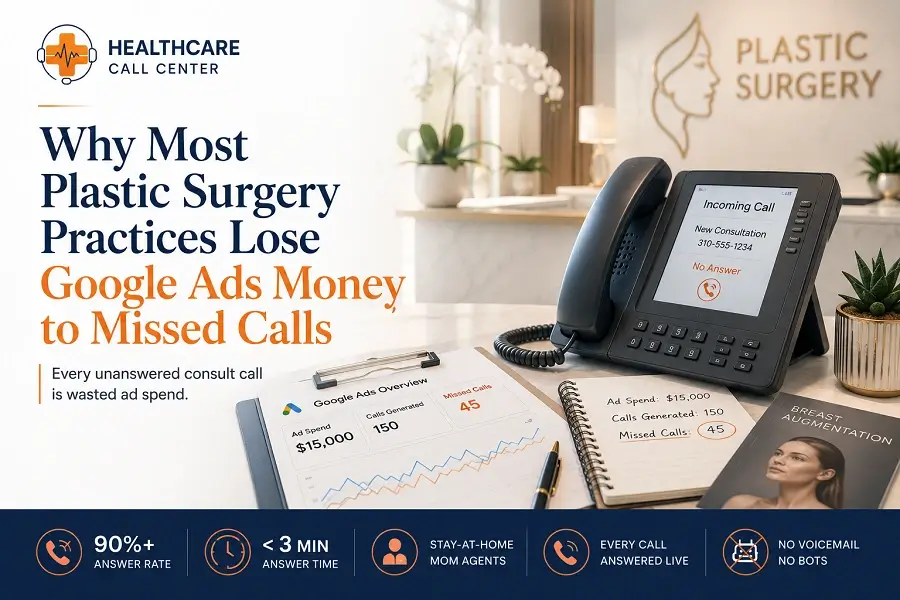
A plastic surgery practice in Beverly Hills spends $15,000 per month on Google Ads. Their campaigns are well-optimized. Their cost-per-click hovers around $8. Their landing pages convert at a healthy rate.
And every single day, calls generated by those ads ring out unanswered.
The front desk is busy checking in a patient. The patient coordinator is on another line. The receptionist stepped away for lunch. The caller, a woman ready to book a mommy makeover consultation, hangs up after four rings and dials the next practice on the list.
That practice just spent ad money to send a patient to their competitor.
This happens every day. And most plastic surgery practices have no idea it is happening.
The Disconnect Between Ad Spend and Call Answering
Google Ads for plastic surgery is a high-stakes game. The aesthetics vertical has some of the highest cost-per-click rates in all of healthcare. Keywords like “breast augmentation,” “tummy tuck,” and “rhinoplasty near me” can cost anywhere from $5 to $20 per click depending on your market.
Practices invest heavily in:
- Campaign structure and ad groups
- Landing page optimization
- Quality Score improvements
- Negative keyword lists
- Retargeting funnels
- Before-and-after galleries
- Patient testimonial videos
All of this work, thousands of dollars and hundreds of hours, exists for one purpose: to make the phone ring.
But what happens when it does?
What Happens After the Click Your Ads
When a prospective patient clicks your ad, they land on your website. They browse your before-and-after gallery. They read your reviews. They check your pricing page. And then they do the thing your entire funnel was designed to produce. They call.
Here is what typical call patterns look like at a busy plastic surgery practice:
- During business hours: The front desk juggles inbound calls, patient check-ins, payment processing, and post-op follow-ups. When two calls come in at the same time, the second one goes to voicemail.
- During lunch: The phones may be covered. Or they may not. Many practices operate with a single receptionist who takes a lunch break.
- After hours: The practice forwards calls to an automated system or a shared voicemail box checked the next morning.
- On weekends: Many practices are closed entirely with no call coverage.
In every one of these scenarios, the ad spend that generated the call has already been spent. Google does not refund your budget when nobody picks up.
The Math Nobody Wants to See
Let us break down what this actually costs a plastic surgery practice.
Say your practice spends $10,000 per month on Google Ads. Your campaigns generate approximately 150 calls per month, a reasonable estimate for a mid-sized aesthetics practice in a competitive market.
Industry research suggests that roughly 30% of inbound calls to medical practices during business hours go unanswered. After hours, that number climbs significantly.
If 30% of your 150 ad-generated calls go unanswered, that is 15 missed calls per month. At roughly $66 per call (based on $10,000 ad spend divided by 150 calls), you have wasted nearly $3,000 in ad spend on calls that nobody answered.
But the real cost is not the ad spend. It is the revenue those calls would have generated.
A single breast augmentation consultation can represent $8,000 to $15,000 in procedure revenue. A mommy makeover can run $12,000 to $20,000. A facelift can exceed $25,000. If even 3 of those 15 missed calls would have booked and completed a procedure, the practice has lost tens of thousands in revenue. All because nobody answered the phone.
Why Voicemail Does Not Work for Ad-Generated Calls
Many practices think they have solved this problem with voicemail. They have not.
Here is what actually happens when an ad-generated call hits voicemail:
The patient does not leave a message. They hang up and call the next practice, usually one of your competitors advertising on the same keywords you are. The patient found you through your ad, was interested enough to call, and then was met with a robotic greeting. That trust you built with your ad, your reviews, your gallery? Gone in seconds.
This is especially true for aesthetic procedures. Unlike urgent medical calls, cosmetic consult calls are emotionally driven. The patient has been thinking about this procedure for months. They finally built up the courage to call. When they hear voicemail, the emotional momentum dies. They do not call back.
The Call Tracking Gap
Most plastic surgery practices use some form of call tracking with their Google Ads campaigns.
They see metrics like:
- Calls generated per campaign
- Call duration
- Call source (which keyword drove the call)
- Time of day patterns
But here is what most call tracking dashboards do not highlight prominently: how many of those calls were actually answered by a human being.
The number is often lower than practice owners expect. And the calls that are not answered? They are charged to your ad budget just the same.
We recommend every plastic surgery practice pull their call tracking report and look specifically at the “unanswered” or “missed” column. Cross-reference those missed calls with your ad spend. The resulting number is what we call your “wasted ad spend.” That is money you paid Google to generate a call that nobody in your practice handled.
The Fix: Live Answering That Protects Your Ad Investment
The solution is not to reduce ad spend. The campaigns are working. The solution is to make sure every call those campaigns generate gets answered by a trained human being.
A dedicated plastic surgery answering service ensures that:
- Every ad-generated call is answered. Not just during business hours. During lunch breaks, after hours, on weekends, and during peak call times when your front desk is overwhelmed.
- Callers reach a real person, not a phone tree. Patients who click your ad and call expect a professional, empathetic human. If they get a menu prompt, they hang up. Live answering eliminates that drop-off.
- Urgent and high-intent calls are prioritized. A trained agent can identify which calls need immediate routing to your patient coordinator (consultation requests, pre-op questions) versus which can be handled with a scheduled callback (general inquiries, pricing questions).
- After-hours calls are captured. The patient who researches mommy makeovers at 10 PM and decides to call does not reach voicemail. They reach a live agent who can schedule a consultation or take a detailed message for your morning team.
- Every call is documented. Call notes, patient information, and scheduling details are securely delivered to your team so nothing falls through the cracks.
Tying It All Together: The Full-Funnel Approach
Your Google Ads strategy is the top of your funnel. It is designed to attract qualified prospective patients and drive them to contact your practice.
But the funnel does not end at the click. It ends at the conversation.
A well-optimized ad campaign paired with a reliable, empathetic answering service creates a seamless experience. The patient sees your ad, clicks, browses, calls, and reaches a warm, knowledgeable human who guides them toward booking a consultation.
That is how ad spend becomes revenue. Every other scenario is just spending money to send patients to your competitors.
What to Look for in a Plastic Surgery Answering Partner
Not every answering service understands the aesthetics vertical. Plastic surgery calls are different from general medical calls.
They require:
- Understanding of elective procedure terminology (augmentation, lift, reconstruction, non-surgical treatments)
- Sensitivity around patient privacy and the emotional nature of cosmetic inquiries
- Familiarity with consult booking workflows and insurance versus self-pay distinctions
- HIPAA-compliant handling of all patient information
- Ability to follow practice-specific escalation protocols
When your ad budget is on the line, the service answering your calls needs to perform at a level that matches the quality of your campaigns. A missed call from a Google Ad is not just a missed call. It is wasted marketing investment.
Frequently Asked Questions!
Q: How much of my Google Ads budget is being wasted on unanswered calls?
A: That depends on your call answer rate. If 30% of your ad-generated calls go unanswered, which is common, then roughly 30% of your call-generating ad spend is effectively wasted. Pull your call tracking data and compare answered versus missed calls to calculate your specific number.
Q: Does after-hours call answering really matter for plastic surgery practices?
A: Yes. Many prospective cosmetic surgery patients research procedures in the evening and on weekends. If they decide to call during those hours and reach voicemail, they typically hang up and call a competitor. After-hours answering captures those high-intent calls.
Q: Will an answering service feel impersonal to my patients?
A: Not if it is the right service. A trained answering service follows your practice’s specific scripts, uses your branding and terminology, and handles calls with empathy. Many practices find that patients cannot tell the difference between their front desk and a trained answering agent.
Q: How quickly can a plastic surgery answering service be set up?
A: A properly structured onboarding process typically takes up to two weeks. This includes script development, team training on your practice’s procedures and protocols, and system integration. Once live, the service operates as a seamless extension of your practice.
Q: Is a plastic surgery answering service HIPAA-compliant?
A: A HIPAA-compliant answering service secures every patient interaction under full HIPAA requirements, including encrypted messaging, trained agents who understand protected health information, and signed Business Associate Agreements with your practice.