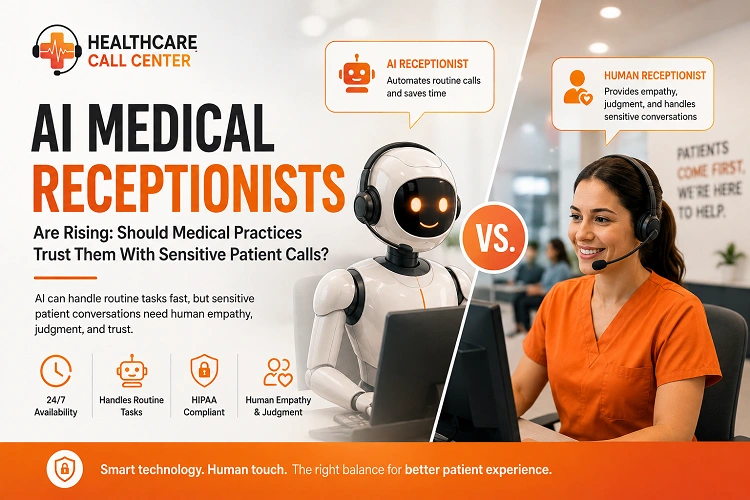
AI medical receptionists are becoming one of the most talked-about trends in healthcare operations.
The promise is easy to understand. AI can answer quickly. AI can work around the clock. AI can handle repetitive questions, appointment requests, reminders, and intake workflows. For medical practices struggling with staffing gaps and constant phone volume, that sounds attractive.
But patient calls are not ordinary customer service calls.
A patient may be worried, embarrassed, confused, frustrated, or in pain. A caller may ask about symptoms, medication, pregnancy concerns, surgery recovery, insurance, scheduling, or urgent next steps. Sometimes the most important part of the call is not the question itself. It is the tone, hesitation, and context behind it.
That is where the AI conversation becomes more complicated.
AI medical receptionists may help with certain tasks, but medical practices should be careful before trusting automation with every patient call. Sensitive communication still requires human judgment, empathy, privacy awareness, and clear escalation rules.
This article explains where AI medical receptionists may fit, where human support still matters, and what practices should check before changing how patient calls are handled.
Why AI Medical Receptionists Are Getting Attention
Medical practices are under pressure.
Front desk teams are busy. Hiring is expensive. Patients expect fast responses. Calls arrive during check-in, lunch breaks, staff shortages, provider schedule changes, and after-hours windows. Many practices are trying to answer more calls without adding more full-time staff.
AI tools promise to help with that pressure.
Common AI receptionist features include:
- Answering routine calls
- Capturing patient information
- Scheduling or routing requests
- Sending reminders
- Answering common questions
- Supporting intake workflows
- Reducing hold time
- Offering 24/7 availability
These features can be useful, especially for repetitive administrative tasks.
But the rise of AI does not remove the need for thoughtful patient communication.
It raises a new question: which calls are safe to automate, and which calls still need a trained human response?
Patient Calls Are Not All the Same
One mistake practices make is treating every inbound call as the same kind of task.
Some calls are simple. A patient may ask for office hours, directions, or basic appointment availability. Those calls may be easier to automate or route through structured workflows.
Other calls are more sensitive.
A patient may say:
- I am worried about this symptom.
- I need to speak with someone about my test results.
- I am in pain after a procedure.
- I am pregnant and not sure what to do.
- I need to reschedule, but I am upset about the delay.
- I am confused about what the doctor told me.
- I do not want to explain this more than once.
These calls require more than speed.
They require listening, tone, escalation judgment, and a call flow that protects patient trust.
A medical answering service should do more than take messages. It should help the practice answer patient calls, capture the right information, route messages appropriately, and follow the practice’s approved workflow.
Where AI Medical Receptionists Can Help
AI can be useful when the task is structured, repetitive, and low-risk.
For example, AI may help with:
- Basic appointment request intake
- Office hours questions
- Reminder calls or texts
- Simple routing prompts
- Frequently asked administrative questions
- Collecting non-urgent callback information
- Helping reduce hold time during call spikes
In these situations, AI can support efficiency.
The key is not whether AI can answer a phone. The key is whether the call type is appropriate for automation.
Medical practices should avoid using AI as a blanket replacement for all patient communication. A better approach is to define where automation helps and where human support should remain in the loop.
Where Human Call Handling Still Matters
Human support becomes especially valuable when calls involve sensitivity, uncertainty, emotion, or situations that require escalation.
Patients do not always explain their needs in clean categories. They may start with a simple scheduling question and then reveal a concern. They may sound calm but be anxious. They may not know whether their issue is urgent. They may need confidence that their concern has been heard, documented correctly, and routed to the right person.
Human call handling is especially important for:
- OB-GYN calls
- Fertility clinic calls
- Plastic surgery consultation inquiries
- Dental pain or after-hours calls
- Chiropractic same-day appointment requests
- Post-procedure concerns
- Mental health practice calls
- Multi-location routing confusion
- Complaints or frustrated callers
A trained human can notice context, slow down, clarify the request, and follow the practice’s escalation rules.
That does not mean AI has no role. It means sensitive patient calls should not be treated as generic automation tasks.
HIPAA and Privacy Must Be Reviewed Carefully
Medical practices should be cautious with any phone support tool that touches patient information.
AI tools may capture, process, store, transcribe, or route patient details. That creates privacy and compliance questions the practice must understand before adopting the system.
Before using an AI medical receptionist, ask:
- What patient information is collected?
- Where is the information stored?
- Who can access call data?
- Is there a business associate agreement if needed?
- How are call recordings or transcripts handled?
- Can the practice control scripts and escalation rules?
- How are errors reviewed?
- What happens if the AI misunderstands the caller?
Practices should also compare AI tools against HIPAA-compliant medical answering service processes to understand what level of control, documentation, and privacy support they need.
HIPAA is not a marketing phrase. It is an operational responsibility. The U.S. Department of Health & Human Services (HHS) explains that the HIPAA Privacy Rule establishes national standards for protecting individually identifiable health information.
AI Can Create Patient Experience Risks
Patients may accept automation for simple tasks. But they may lose trust if automation creates friction during sensitive moments.
Common risks include:
- The patient feels unheard.
- The AI misunderstands the request.
- The call is routed incorrectly.
- The patient repeats information multiple times.
- The patient cannot reach a human quickly.
- Urgent context is missed.
- The practice appears impersonal.
In healthcare, trust matters. A patient calling a medical office is not always looking for the fastest response. Sometimes they are looking for the right response.
This is why US-Based healthcare call center services for patient retention should be evaluated by more than answer speed. Practices should also consider call quality, routing accuracy, patient experience, escalation handling, and follow-through.
AI vs Human Medical Receptionist: The Practical Difference
Here is the simplest way to think about it.
| Call Type | AI Medical Receptionist | Human Medical Receptionist |
| Office hours and directions | Good fit | Can handle |
| Simple appointment requests | Good fit with defined workflow | Can handle |
| Routine reminders | Good fit | Can handle |
| New patient inquiries | May need human escalation | Strong fit |
| Sensitive patient concerns | Human escalation recommended | Strong fit |
| Emotional or frustrated callers | Limited context | Strong fit |
| Urgent or unclear calls | Requires escalation rules | Strong fit |
| Complex specialty calls | Human support recommended | Strong fit |
| After-hours coverage | Can assist with defined workflows | Strong fit when judgment is needed |
AI is strongest when the call is predictable. Humans are strongest when the call is personal.
A predictable call has a clear path. The caller needs office hours, directions, appointment availability, or a simple message.
A personal call has emotion, urgency, complexity, or uncertainty. The caller may need careful listening, reassurance, escalation, or a judgment-based next step.
Practices comparing different answering models can also review our guide to medical answering services in 2026, which compares healthcare-specialized, generic, and AI-powered answering options.
Most medical practices receive both kinds of calls every day.
That means the best model may not be AI-only or human-only. It may be a structured call handling system that uses technology where it helps while keeping human support available for the calls that matter most.
What Practices Should Check Before Using AI for Patient Calls
Before using AI medical receptionist tools, practices should complete a basic review.
1. Call Types
List which calls are safe for automation and which should go to a human.
2. Escalation Rules
Define when a call should be routed to staff, the on-call provider, or the next business day queue.
3. Privacy Controls
Review how patient information is collected, stored, transmitted, and accessed.
4. Patient Experience
Test whether callers can easily reach a human when needed.
5. Error Handling
Decide who reviews misunderstood calls, incomplete messages, and routing mistakes.
6. Specialty Needs
Decide whether certain specialties need more human support because of patient sensitivity.
7. After-Hours Coverage
Review whether after-hours calls require a live answering process, escalation rules, or a hybrid workflow.
A practice should not adopt AI because it sounds modern. It should adopt tools only where they improve patient access without weakening trust.
How Human Answering Support Fits Into the AI Era
The rise of AI does not make human answering support less important.
It makes the role more specific.
Human call support is valuable when the practice needs:
- Empathy in the first conversation
- Better intake for high-value appointments
- Clear message capture
- Escalation based on practice rules
- After-hours call handling
- Front desk overflow support
- Specialty-specific call flows
- A calm voice for anxious callers
A medical virtual receptionist can help practices answer more patient calls without overloading the front desk. The value is not only coverage. It is patient-aware communication.
For sensitive healthcare calls, that difference matters. For practices dealing with persistent front-desk workload and missed calls, see how call center outsourcing can reduce staff burnout and missed calls.
A Practical Hybrid Model for Medical Practices
For practices that use both AI and human support, the key is defining exactly which calls each system handles and when a human takes over.
AI may help with simple routing, reminders, and structured administrative prompts. Human answering support should remain available for sensitive conversations, unclear requests, specialty inquiries, and calls that may affect patient trust.
A practical hybrid model can look like this:
- AI supports basic routing and repetitive questions.
- Human agents handle new patient inquiries and sensitive calls.
- Staff receive clean messages with the right context.
- Urgent calls follow practice-approved escalation rules.
- After-hours calls are answered instead of being left to voicemail.
This approach protects efficiency without making the patient feel abandoned inside an automated system. It also gives the practice more control over risk.
Medical practices should remember that automation is only helpful when it improves the patient journey. If AI creates confusion, delays, or distrust, the practice may save time in one area while losing patients in another.
Final Takeaway
AI medical receptionists are rising because medical practices need more call coverage, faster response times, and relief from front desk overload.
But patient calls are not all the same.
Some tasks may be appropriate for automation. Others still require human judgment, empathy, and careful routing. Practices should not ask AI to handle every patient conversation without first reviewing call types, privacy risks, escalation rules, and patient experience.
The strongest approach is selective. Use technology where it improves efficiency, and keep human support where sensitivity, context, trust, and escalation matter most.
Healthcare Call Center helps medical practices answer more calls, reduce front desk overload, support after-hours communication, and keep human support available when patient conversations require more than automation.
Book a Free Consultation to review your current call coverage and determine where AI, human support, or a combination of both may fit your practice.
Frequently Asked Questions
1. What is an AI medical receptionist?
An AI medical receptionist is a phone or messaging tool that uses automation to answer calls, collect information, route requests, schedule appointments, or respond to common patient questions.
2. Can AI medical receptionists replace human receptionists?
AI may help with routine tasks, but it should not automatically replace human support for sensitive patient calls, urgent concerns, emotional conversations, or complex routing needs.
3. Can AI and human medical receptionists work together?
Yes. A practice can use AI for approved routine tasks such as basic routing, reminders, and simple administrative questions while directing sensitive, unclear, urgent, or complex calls to trained human support. The practice should define clear escalation rules and regularly review how the system performs.
4. Are AI medical receptionists HIPAA compliant?
Some vendors may offer HIPAA-supporting features, but practices must verify privacy controls, data storage, access rules, business associate agreements, transcripts, and call handling workflows before using any tool.
5. When should a medical practice use human call handling instead of AI?
Human call handling is better for sensitive calls, specialty practice inquiries, after-hours concerns, urgent routing, frustrated patients, and calls where tone or context matters.
6. What is the safest way to use AI for patient calls?
The safest approach is to define which calls AI can handle, keep human escalation available, review privacy requirements, test caller experience, and monitor errors or incomplete messages.