Outsourcing patient calls can be a smart move for a medical practice, but it should not start with choosing a vendor.
It should start with an audit.
Too many practices begin by asking, “Which medical call center should we use?” That question matters, but it comes too late. The better first question is: “Where is our phone process breaking down right now?”
Without that answer, a practice may outsource the wrong problem. It may pay for after-hours coverage when the real issue is lunch-hour overflow. It may ask for appointment support when the real issue is poor call routing. It may blame the front desk when the real issue is volume, staffing, or unclear workflows.
A strong audit helps the practice understand what kind of support it actually needs. It also helps prevent patient calls from being treated like generic messages.
Patient calls affect scheduling, retention, trust, revenue, and patient experience. Before outsourcing a medical call center, a medical practice should know exactly what those calls are worth and where they are being lost.
Why Practices Consider Outsourcing Patient Calls
Are you still thinking should you outsource your medical call center?
Most practices do not consider outside call support because everything is working perfectly.
They consider it because something is already creating pressure.
Common reasons include:
- Too many calls going to voicemail
- Front desk staff overwhelmed during peak hours
- Long callback delays
- Missed new patient inquiries
- After-hours calls handled inconsistently
- Appointment requests not captured quickly
- Staff burnout from constant phone interruptions
- Multi-location routing confusion
- Poor visibility into missed call volume
- Marketing leads not turning into booked appointments
These are serious problems, but they do not all require the same solution.
A medical call center service can help with many of them, but the setup should match the actual need. A practice that needs overflow coverage during business hours should not set up the same system as a practice that only needs after-hours message routing.
That is why the audit matters.
Audit Area 1: Missed Call Volume
The first thing to audit is simple: how many patient calls are being missed?
Many practices underestimate this number because they only count voicemails. But not every missed caller leaves a voicemail. Some hang up. Some call back later. Some contact another provider. Some search again and choose a competitor.
A missed call audit should look at:
- Total inbound calls
- Answered calls
- Missed calls
- Voicemails received
- Hang-ups before voicemail
- Repeat callers
- Calls missed by day and time
- Calls missed by location
- Calls missed after marketing campaigns
This gives the practice a more honest view of the phone problem.
If missed calls are concentrated during business hours, the practice may need front desk overflow support. If missed calls happen after closing, the practice may need after-hours coverage. If missed calls happen across several locations, the practice may need a more standardized call handling process.
Audit Area 2: Peak Call Times
Not all missed calls happen randomly.
Most practices have predictable pressure points. Monday mornings. Lunch breaks. Late afternoons. Days after a holiday. Days when a provider schedule changes. Times when the front desk is checking in patients or dealing with insurance questions.
A call audit should identify when the front desk is most likely to miss calls.
This matters because outsourcing does not have to mean handing over every call. Many practices only need support during specific windows.
For example, a front desk overflow answering service can help during peak times when staff is busy with in-office patients. This gives the practice coverage without replacing the front desk.
The goal is not to remove the human team from the patient experience. The goal is to make sure the patient reaches someone when the in-office team is overloaded.
Audit Area 3: New Patient Call Handling
New patient calls deserve special attention.
These callers may be comparing practices. They may be responding to a referral. They may have found the practice through Google. They may be ready to book, but only if the first conversation feels clear and helpful.
A new patient call audit should ask:
- Are new patient calls answered quickly?
- Is the caller’s reason for visit captured?
- Is insurance or referral information captured correctly?
- Is the caller offered the right next step?
- Are appointment requests documented clearly?
- Are missed new patient calls called back quickly?
- Are calls from ads or SEO pages handled differently?
This is especially important for specialty practices where one appointment can carry high lifetime value.
If new patient calls are going to voicemail, the practice is not only losing calls. It may be losing growth.
Audit Area 4: Existing Patient Support
Existing patient calls also affect retention.
A patient may call to reschedule, ask a follow-up question, confirm instructions, check on a referral, or clarify next steps. If the practice is hard to reach, the patient may become frustrated even if the clinical care is strong.
Audit existing patient calls by reviewing:
- Callback delays
- Repeat calls from the same patient
- Common reasons patients call
- Whether messages are complete
- Whether staff know which calls need priority
- Whether calls are routed to the correct team
- Whether patients complain about reaching the office
Retention often depends on small moments of reliability. A patient who feels ignored may not say anything. They may simply stop returning.
Better healthcare call center services can help practices answer more calls and reduce the friction that weakens patient trust.
Audit Area 5: After-Hours Coverage
After-hours calls are different from daytime calls.
Patients may be anxious. They may not know whether a concern can wait. They may need to leave a message that must be routed correctly. They may need reassurance that the practice has a process in place.
Before outsourcing after-hours calls, a practice should define:
- Which calls should be routed urgently
- Which calls can wait until morning
- Which provider or team receives messages
- What information must be collected
- How messages are documented
- How callers are told what to expect next
An after-hours medical answering service should follow the practice’s instructions, not invent its own clinical process.
Audit Area 6: Call Routing Rules
Outsourced support only works well when routing rules are clear.
If the practice does not know how calls should be handled internally, an outside partner cannot fix that by guessing.
Call routing rules should answer:
- Which calls go to scheduling?
- Which calls go to billing?
- Which calls go to the clinical team?
- Which calls go to the on-call provider?
- Which calls are location-specific?
- Which calls need same-day follow-up?
- Which calls can become messages for the next business day?
This is especially important for multi-location practices and specialty clinics.
A call support partner should help execute the practice’s workflow. The workflow needs to be clear before the calls are handed off.
For regional teams, a medical answering service for Florida practices can help standardize call coverage across offices, providers, and busy hours.
Audit Area 7: Intake Quality
A patient call is only useful if the right information is captured.
Incomplete messages create extra work. Staff have to call the patient back, ask the same questions again, and rebuild context. Patients may feel like no one listened.
A good audit should review message quality.
Look for whether calls include:
- Patient name
- Best callback number
- New or existing patient status
- Reason for call
- Requested location
- Preferred appointment time
- Provider preference
- Urgency level
- Insurance or referral detail when needed
- Clear next step
If intake quality is poor, outsourcing should include better scripts and structured message capture.
Audit Area 8: HIPAA and Privacy Expectations
Medical practices cannot treat patient calls like ordinary business calls.
The U.S. Department of Health & Human Services (HHS) provides HIPAA guidance on protecting individually identifiable health information and the privacy requirements healthcare organizations should consider when handling patient information.
Patient information may be shared during scheduling, follow-up, after-hours messages, or specialty inquiries. That means the practice should verify how any call support partner handles privacy, documentation, access, and communication.
Before choosing a vendor, ask:
- Do they understand healthcare privacy expectations?
- Can they support HIPAA-conscious workflows?
- How are messages documented and delivered?
- Who can access call information?
- How are scripts and escalation rules managed?
- Will the practice have clear control over call instructions?
For more compliance-focused support, ask your provider if they support HIPAA compliance or not.
Audit Area 9: Patient Experience
A call audit should not only measure whether the call was answered. It should also review how the call feels.
The patient experience depends on tone, clarity, patience, and next steps.
Ask:
- Does the caller feel rushed?
- Are calls answered with a calm tone?
- Are questions handled clearly?
- Does the caller know what happens next?
- Are appointment requests treated as high priority?
- Does the call experience match the practice’s brand?
For many patients, the phone call is the first real interaction with the practice. A poor call experience can damage trust before the visit happens.
Audit Area 10: Marketing Source and Revenue Leakage
Practices should connect missed calls to marketing sources when possible.
If a patient calls after visiting a location page, reading a blog, clicking an ad, or finding the practice in local search, that call represents marketing intent.
When it is missed, the practice loses more than a call. It loses the value of the marketing effort that created the call.
The audit should ask:
- Which campaigns drive phone calls?
- Which pages generate high-intent calls?
- Which locations receive the most calls?
- Are calls from paid ads being answered?
- Are calls from SEO pages being captured?
- Are new patient calls tracked separately from existing patient calls?
This helps the practice understand how call handling affects growth.
What to Do After the Audit
Once the audit is complete, the practice can choose the right support model.
Some practices need:
- Business-hours overflow support
- After-hours answering
- Appointment request capture
- Multi-location routing
- Specialty call handling
- New patient intake support
- Backup coverage for staff shortages
- A combination of all of the above
If appointment requests are one of the main gaps, practices should also review their appointment scheduling workflow and determine where delays are occurring.
The key is matching support to the actual gap.
Outsourcing patient calls should not mean giving up control. It should extend the practice’s ability to answer patients consistently while keeping scripts, routing rules, escalation instructions, and communication standards under practice control.
Final Takeaway
Before outsourcing patient calls, medical practices should audit where calls are being missed, why they are being missed, and what kind of support patients actually need.
The right call support partner can help answer more calls, reduce voicemail gaps, protect appointment opportunities, support after-hours communication, and reduce front desk overload.
But the strongest results come when the practice starts with a clear picture of the problem.
Healthcare Call Center helps medical practices answer more patient calls, support front desk teams, and protect appointment opportunities with structured call handling built around the practice’s actual workflow.
Book a Free Consultation to review your missed-call volume, peak call times, after-hours needs, routing gaps, and patient call workflow.
Medical Practice Call Outsourcing FAQs
1. What should a medical practice audit before outsourcing patient calls?
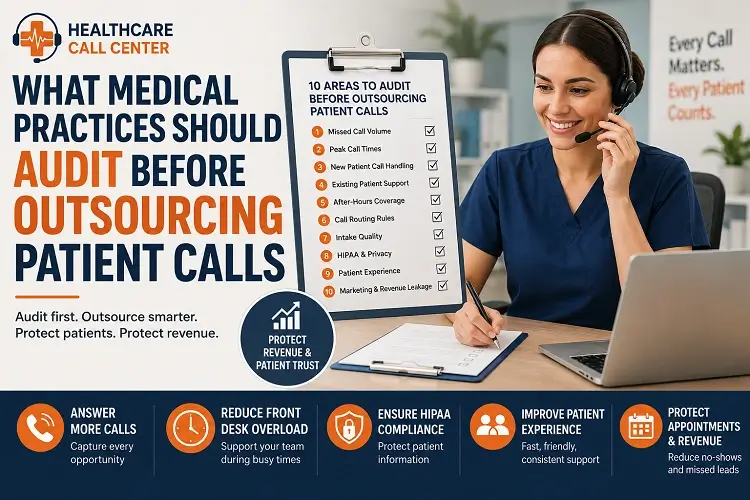
A medical practice should audit missed call volume, peak call times, new patient call handling, after-hours coverage, call routing rules, intake quality, privacy expectations, patient experience, and marketing-related call leakage.
2. Is outsourcing patient calls the same as replacing the front desk?
No. Many practices use outsourced call support for overflow, after-hours coverage, or appointment request capture. It can support the front desk rather than replace it.
3. How can an audit help choose the right medical answering service?
An audit shows whether the practice needs business-hours overflow, after-hours answering, scheduling support, multi-location routing, or specialty call handling. This makes vendor selection more accurate.
4. What should a practice know before outsourcing patient calls?
A practice should know its missed-call volume, peak call times, after-hours needs, routing rules, intake requirements, privacy expectations, and the types of calls that need human escalation.
5. Why do missed calls matter before outsourcing?
Missed calls reveal where the practice is losing patients, appointments, and follow-up opportunities. Understanding those gaps helps the practice choose the right call coverage model.
6. Should HIPAA be part of the call outsourcing audit?
Yes. Medical practices should review how patient information is handled, documented, routed, and accessed before choosing any outside call support partner.