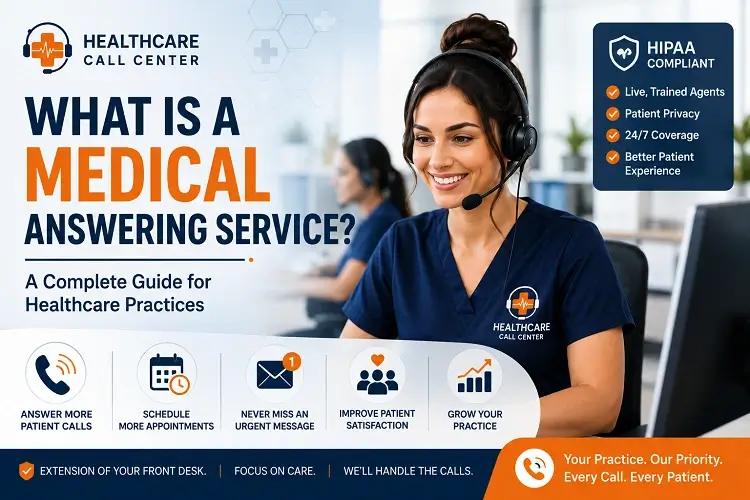
A medical answering service is a specialized call-handling solution where trained live agents answer phone calls for healthcare practices. Unlike a generic answering service that handles plumbers, real estate agents, and pizza shops on the same line, a medical answering service is built specifically for healthcare. Agents are trained on HIPAA compliance, patient privacy, medical terminology, medical answering service with scheduling support, and urgent message routing.
Think of it as an extension of your front desk that never takes a lunch break, never goes home at 5 PM, and never puts a pregnant patient with a concern on hold for six minutes.
When a patient calls your practice after hours, during lunch, or when your staff is slammed, the call goes to a trained agent instead of voicemail. That agent follows your practice scripts, captures patient information, schedules appointments directly in your system, and routes urgent clinical messages to the right provider.
The patient feels heard. Your practice captures revenue that would have otherwise gone to the clinic down the street.
At a Glance
- Live agents answer patient calls on behalf of your practice.
- Supports after-hours, lunch breaks, and busy front desk periods.
- Can capture appointments, messages, and new patient inquiries.
- Routes urgent calls based on your approved workflows.
- Helps reduce missed calls and improve patient experience.
Most practices already have a phone system in place. A medical answering service simply becomes an extension of that system, allowing every patient call to reach a trained live agent instead of voicemail.
How Does a Medical Answering Service Work?
The setup is simple. You forward your practice phone number to a dedicated number provided by the answering service. When a patient calls, a live agent answers within a few rings using a greeting you customize.
Here is what happens step by step:
- Patient calls your practice number after hours or during overflow periods.
- Call forwards to the answering service instantly. No delay, no transfer tone.
- Trained agent answers with your custom greeting (for example, “Thank you for calling Riverside Family Medicine, how may I help you?”).
- Agent follows your practice-specific script to handle the call: schedule an appointment, take a message, answer a basic question, or escalate an urgent matter.
- Message details are delivered to your team via secure text, email, or directly into your EHR system.
- Your morning report shows every call, message, and appointment captured overnight.
Most routine patient calls are handled in just a few minutes, allowing patients to receive immediate assistance while your team stays focused on in-office care.
What Calls Can a Medical Answering Service Handle?
A properly trained medical answering service handles the full range of patient communication that flows through a typical practice. This is not just message-taking. A dedicated HIPAA-compliant healthcare call center service functions as an extension of your operations team.
- New patient intake calls: Capture insurance details, reason for visit, and preferred provider. Route to scheduling.
- Appointment scheduling and changes: Agents book, reschedule, or cancel appointments directly in your practice management system.
- Prescription refill requests: Log the request, verify patient identity, and route to the correct provider for approval.
- Urgent clinical messages: Identify true emergencies, follow escalation protocols, and contact the on-call provider immediately.
- Billing and insurance questions: Capture the inquiry and route to your billing team with full context.
- After-hours triage: Follow your triage protocols to determine what needs immediate attention versus what can wait until morning.
Medical Answering Service vs. Generic Answering Service
This is where most practices make an expensive mistake. They sign up for a $0.75-per-call service they found on Google, only to discover the agent answering their patient calls also handles calls for a tow truck company and a hair salon.
Although both services answer phone calls, the differences in healthcare knowledge, compliance, and patient experience are significant.
A medical answering service is fundamentally different from a generic one. Here is how they compare:
| Feature | Medical Answering Service | Generic Answering Service |
| HIPAA Training | Required and verified | Not required |
| Agent Training | Medical terminology, triage, EHR | Script reading only |
| Appointment Scheduling | Direct integration with your system | Message-taking only |
| Urgent Message Routing | Custom escalation protocols | Standard voicemail or text |
| Patient Privacy | Encrypted messaging, BAAs signed | No privacy safeguards |
| Language Support | Bilingual agents common | English only typically |
| Average Cost | $200-$2,500/month | $30-$300/month |
The price difference reflects the training, technology, and compliance infrastructure required to handle healthcare calls safely. A $200/month medical answering service that captures one new patient call worth $500 pays for itself. A $50/month generic service that mishandles a HIPAA-protected message can cost you thousands in penalties.
Who Needs a Medical Answering Service?
If your practice receives patient phone calls, you need one. But certain practice types benefit more than others:
- Single-provider practices: Your front desk cannot answer every call while checking in patients. Overflow coverage during busy hours prevents missed new patient inquiries.
- Multi-location groups: Centralized call handling ensures consistent patient experience across all locations. No more “that office is at lunch, try back later.”
- Specialty practices with high-value patients: Fertility clinics, plastic surgery centers, and dental implant practices lose significant revenue from each missed call. A single missed IVF patient inquiry can cost $15,000 to $50,000 in lifetime value.
- OB-GYN and urgent care: Patients calling at 2 AM with pregnancy concerns need a human response, not a voicemail box. Proper triage routing ensures the on-call provider gets the right calls immediately.
Even practices with experienced front desk teams benefit because call volume is rarely consistent throughout the day. A medical answering service provides extra capacity during peak periods without requiring another full-time employee.
How Much Does a Medical Answering Service Cost?
Most medical practices pay between $200 and $2,500 per month. The cost depends on call volume, the pricing model used, and the features included.
Monthly pricing varies based on call volume, after-hours coverage, appointment scheduling support, bilingual services, and workflow complexity.
- Per-call pricing: $0.75 to $1.50 per call. Best for small practices with under 300 calls per month.
- Per-minute pricing: $0.85 to $1.75 per minute. Appears precise but often runs 20-40% over expectations.
- Flat-rate pricing: $199 to $1,500 per month for a set volume. Predictable budgeting and rewards efficient call handling.
For a detailed breakdown of pricing models, hidden fees, and real practice cost examples, see our complete medical answering service pricing guide.
What to Look for When Choosing a Medical Answering Service
Not all medical answering services are created equal. Before signing a contract, evaluate these non-negotiables:
- HIPAA compliance with a signed Business Associate Agreement (BAA)
- US-based agents trained on medical terminology and patient privacy
- Direct integration with your EHR or practice management system
- Bilingual agents if your patient population needs Spanish-language support
- 24/7 coverage with no holiday surcharges
- Custom script building for your specialty and protocols
- Call recording and dashboard reporting included in the base price
- Month-to-month contract with transparent overage rates
If a provider cannot check every box on this list, keep looking. Your patient calls are too valuable to hand to the cheapest bidder. Are they offering a secure medical answering service or not?
Why Practices Switch from Voicemail to a Medical Answering Service
The average medical practice misses 25% of incoming calls during business hours. Not because staff is lazy, but because front desk teams cannot answer the phone while checking in patients, handling intake forms, and managing the provider schedule.
When those missed calls go to voicemail, 80% of callers hang up without leaving a message. Of those who hang up, 35% call a competitor next. You never see the lost revenue in a report. It simply shows up as fewer new patients and slower growth.
A medical answering service captures those calls. Patients speak to a real person, get their needs addressed, and leave with a positive impression of your practice. The appointment book fills up. Urgent messages reach the right provider. Your front desk starts the morning with a clean report instead of a full voicemail box.
Benefits of a Medical Answering Service
- Fewer missed patient calls
- Better patient experience
- Increased appointment capture
- Reduced front desk workload
- Reliable after-hours coverage
- More consistent patient communication
Stop Losing Patients to Voicemail
Every call your practice misses is a patient who wanted help and got a machine instead. Some of those patients call back. Many do not. A medical answering service makes sure every patient hears a human voice, every time they call.
We help medical practices across the country capture missed calls, schedule more appointments, and give patients the responsive care they expect. Book a free consultation to see how it works for your practice.
Book a Free Consultation
Frequently Asked Questions
Q: Is a medical answering service the same as a medical call center?
A: Not exactly. A medical answering service primarily handles inbound patient calls, messages, and scheduling. A medical call center provides broader services including outbound patient outreach, chronic care management, triage, and multi-channel communication. Many providers offer both. If you need more than message-taking and scheduling, a medical call center may be the better fit.
Q: Can a medical answering service schedule appointments in my EHR?
A: Yes, most healthcare-specialized services integrate directly with popular EHR and practice management systems including Epic, Athena, eClinicalWorks, and NextGen. Ask the provider specifically about your platform during the consultation.
Q: How quickly do agents answer calls?
A: The industry standard is 3 rings or fewer, which is about 15-20 seconds. Practices should verify this in the service level agreement. If average answer time exceeds 30 seconds, patients will hang up.
Q: Are medical answering services HIPAA compliant?
A: Healthcare-specialized services are. They sign a Business Associate Agreement, use encrypted messaging, train agents on patient privacy, and maintain audit logs. Generic answering services are not HIPAA compliant and should not handle patient calls.
Q: What happens if a patient has a medical emergency?
A: The agent follows your practice-specific triage protocol. For emergencies, they instruct the patient to call 911 or go to the nearest emergency room. For urgent but non-emergency situations, they contact the on-call provider immediately using your escalation chain.