Most medical practices do not need more traffic first. They need to stop losing the patient calls they already earn.
A patient finds your practice on Google. She reads the reviews. She checks the services page. Then she calls during lunch, after 5 PM, while the front desk is checking in patients, or when one team member is out sick. If that call goes to voicemail, sits on hold, or gets a rushed callback hours later, the marketing spend has already leaked.
That is why a patient call coverage audit should come before more SEO, ads, directories, or local campaigns. Before increasing demand, practices should know whether their existing call flow can consistently turn patient interest into conversations and appointments.
The blog shows where patient intent gets lost after the phone rings, and it helps your practice fix the conversion path before buying more demand.
Quick Takeaway
More rankings and more clicks only matter if your practice can answer, route, and convert the patient calls they create.
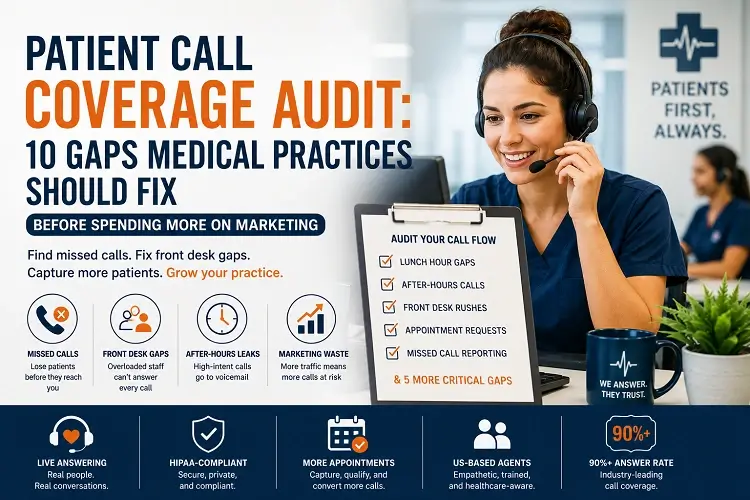
The 10 Patient Call Coverage Gaps to Check First
| Gap to Check | What to Review |
| Lunch-hour calls | Are calls answered when front desk staffing is thin? |
| After-hours calls | Do patients reach voicemail after the office closes? |
| Front desk rushes | Who answers when staff is helping patients in person? |
| New patient calls | Are high-intent callers identified and prioritized? |
| Escalation rules | Are urgent and routine calls routed differently? |
| Appointment requests | Are scheduling details captured completely? |
| Bilingual needs | Can patients get support in the languages your market needs? |
| Weekend calls | What happens to calls received when the office is closed? |
| Missed-call reporting | Can you see when and why calls are being missed? |
| Call handling quality | Are patients reaching trained healthcare-aware agents? |
Why Patient Call Coverage Matters Before More Marketing Spend
Marketing creates demand. Patient call coverage captures demand. When those two systems are not aligned, the numbers can look confusing. Website traffic may rise, impressions may improve, and the phone may ring more often, but booked appointments can still feel flat.
For healthcare, the call is often the conversion point. A patient may not fill out a form when she is worried, in pain, pregnant, comparing providers, or trying to schedule between work meetings. She calls because she wants a clear next step. If no one answers, the practice may never know how close that patient was to booking.
A patient call coverage audit helps answer the question that marketing reports cannot answer on their own: are we converting the calls we already receive?
The 5 Highest-Impact Call Coverage Leaks to Check First
A full audit can go deep, but most practices find the biggest issues in five places.
| Where calls leak | What fixes it |
| Lunch breaks | Live overflow support during thin-staff windows |
| After 5 PM | After-hours answering with clear escalation rules |
| Busy front desk | Call backup when staff are helping in-office patients |
| Appointment requests | Clean capture of appointment type, urgency, and next step |
| Reporting gaps | Weekly call visibility by time, source, and reason |
If even two of these areas are weak, more marketing can make the problem worse. It sends more patients into a phone workflow that is not ready to capture them.
Audit question: What happens to new patient calls between 11:30 AM and 1:30 PM?
Gap 1: Medical Practices Miss Calls During Lunch Breaks
Lunch breaks are one of the most predictable call coverage gaps in healthcare. The front desk gets thinner at the same time patients are using their own lunch break to call doctors, dentists, specialists, and clinics.
This is not a staff-effort problem. It is a workflow problem. One person may be checking in patients, collecting forms, answering insurance questions, and trying to cover the phones. When the line rings twice at once, something has to give.
The audit should look at calls between 11:30 AM and 1:30 PM. If new patient calls are going to voicemail during that window, the practice is losing high-intent demand in a place that is easy to fix with front desk overflow support.
Audit question: What happens to new patient calls between 11:30 AM and 1:30 PM?
Gap 2: After-Hours Patient Calls Go to Voicemail
After-hours calls are not low-value calls. They are often the calls patients make when the need finally feels urgent enough to act. A patient may call after work, after symptoms worsen, after a child is asleep, or after comparing providers online.
Voicemail creates delay at the exact moment the patient wants reassurance. In competitive markets, that delay can send the patient to another practice, urgent care, or a competitor who answers live.
A strong after-hours medical answering service does not replace the clinical team. It answers live, collects the right details, follows escalation rules, and helps the patient understand the next step. That turns after-hours demand into a protected patient relationship instead of a missed opportunity.
Audit question: How many patient calls arrive after 5 PM, and what happens to those callers?
Gap 3: Front Desk Overflow Breaks the Patient Experience
The busiest in-office moments are often the busiest phone moments too. Patients arrive. Providers run behind. Insurance questions pile up. The phone rings. A new patient is on the line, but the front desk is helping someone standing in front of them.
This is where overflow call coverage matters. It gives the practice a safety layer during rush windows so callers still reach a real person. The goal is not to take control away from the front desk. The goal is to protect the calls the front desk cannot physically answer in the moment.
Conversion checkpoint
If your practice is getting traffic but the phone experience is inconsistent, fix the call path before increasing spend.
Audit question: When your front desk is helping patients in person, who protects the phones?
Gap 4: New Patient Calls Are Not Treated Like Conversion Moments
A new patient call should not be handled like a routine message. It is a buying moment, a trust moment, and often a competitive moment. The patient may be choosing between three practices in the same search session.
That call needs a cleaner capture process than “Patient called about appointment”. The person answering should collect the reason for visit, appointment type, urgency, preferred time, callback details, and the promised next step. Without that structure, the practice creates more callback work and gives the patient time to drift away.
Audit question: Does your team capture the reason for the visit, appointment type, urgency, preferred time, callback details, and next step?
Gap 5: Escalation Rules Are Not Clear Enough
Medical calls are not generic message-taking. Some are routine. Some are urgent. Some need same-day routing. Some should go to an on-call provider. Others can be documented for the next business day.
When escalation rules are not written clearly, call handling becomes inconsistent. This is especially relevant for specialty practices such as OB-GYN, fertility, behavioral health, dental, plastic surgery, and other practices where patient calls may require careful routing.
The audit should ask whether a trained agent could follow the practice workflow without guessing. If the answer is no, the problem is not the agent. The problem is the missing protocol.
Audit question: Could a trained agent follow your escalation rules without asking the front desk what to do every time?
Gap 6: Bilingual Patient Calls Are Not Covered
In many markets, bilingual support is not a nice extra. It is part of patient access. If Spanish-speaking patients cannot explain the need clearly, the practice can lose trust before the appointment is even booked.
This matters most after hours and during rush windows, when the front desk is unavailable or overloaded. A bilingual call coverage layer helps patients feel understood and helps the practice capture cleaner next-step information.
Audit question: What happens when a Spanish-speaking patient calls after hours or during a front desk rush?
Gap 7: Weekend Calls Wait Until Monday
Patients search for care at night, on weekends, and during holidays. They read reviews on Sunday. They compare providers after work. They call when pain, anxiety, pregnancy concerns, or scheduling needs finally feel urgent.
If those calls wait until Monday, some of those patients will not still be available. The practice that answers first often gets the appointment first. A weekend call coverage plan protects the demand your SEO and local visibility are already creating.
Audit question: How many weekend or holiday calls are currently waiting until the next business day?
Gap 8: Missed Calls Are Not Being Reported
You cannot fix what you cannot see. Many practices know when the phone feels busy, but they do not know how many calls are missed, when they are missed, which pages drive them, or which call reasons create the most leakage.
A basic report should show answered calls, missed calls, call windows, call reasons, appointment requests, urgent escalations, and follow-up tasks. Once the leak is visible, the fix becomes much easier to prioritize.
Practices can also use the missed call revenue calculator to estimate the potential impact of unanswered calls.
Audit question: Can your current answering team handle specialty-specific calls with the tone, terminology, and routing rules your practice requires?
Gap 9: Generic or Offshore Call Handling Can Hurt Patient Trust
Patient calls are emotional. A worried parent, a pregnant patient, a dental patient in pain, or a fertility patient waiting for answers does not want to feel processed by a distant script.
Generic and offshore call centers may answer the phone, but answering is not the same as protecting the patient relationship. Tone, cultural familiarity, pronunciation, empathy, and healthcare context all matter.
Healthcare Call Center uses US-based stay-at-home mom agents trained for healthcare call handling. That model helps patients feel heard while still following the practice workflow.
Audit question: If you increased your SEO or advertising leads by 25% tomorrow, could your current phone system answer and convert the additional calls?
Gap 10: The Practice Adds Marketing Before Fixing the Call Path
This is the most expensive gap. The practice sees a traffic problem, so it buys more ads, pushes more SEO, or adds more directory listings. But the real issue is what happens after the patient calls.
If lunch calls are missed, after-hours calls hit voicemail, and appointment requests are not captured cleanly, more marketing simply increases the number of calls at risk. The better move is to strengthen the call coverage system first, then scale demand into a workflow that can actually convert it.
How to Run a 15-Minute Patient Call Coverage Audit
Start with one week of call data. You do not need a complex operations project to find the biggest gaps.
- Pull call volume by hour and day.
- Mark missed, abandoned, and voicemail calls.
- Separate new patient calls from existing patient calls.
- Check lunch, after-hours, weekend, and Monday call volume.
- Review how appointment requests are documented.
- Check whether urgent calls have clear routing rules.
- Compare appointment-page traffic with booked appointments.
- Check whether bilingual support is needed.
- Review whether call volume changed after major SEO, advertising, or page launches.
- Estimate the potential impact of missed calls.
Audit checkpoint: If the practice is already investing in SEO, ads, directories, referrals, or local visibility, fix major call-coverage gaps before increasing demand.
What a Strong Patient Call Coverage System Looks Like
A strong call coverage system is not complicated. It is clear, reliable, and built around real patient behavior.
- Live answering during busy windows
- After-hours support when the office is closed
- Overflow support when the front desk is overloaded
- Clear escalation rules for urgent calls
- Clean appointment request capture
- Reporting that shows when calls leak
- Bilingual support where the market needs it
The best system does not make your front desk less important. It gives them US-based backup, protects patient experience, and makes the marketing investment easier to convert.
How Healthcare Call Center Helps Close These Gaps
Our HIPAA-compliant Healthcare Call Center services help medical practices protect the phone calls their marketing already earns. The service supports after-hours calls, front desk overflow, appointment requests, message routing, and high-intent patient inquiries with a 90%+ answer-rate guarantee.
The model is intentionally different from offshore script reading. HCC uses US-based stay-at-home mom agents who understand American patients, speak with empathy, and follow healthcare-specific workflows. Calls are handled with HIPAA-conscious processes, practice-specific scripts, and clear escalation rules.
The result is a stronger conversion layer: fewer voicemail gaps, better patient experience, cleaner message routing, and more appointment opportunities protected from the traffic your practice already worked to earn. The 90%+ answer-rate standard gives practices a clear coverage target they can monitor over time.
Before You Spend More on Marketing, Fix the Call Path
Before increasing SEO, advertising, or referral activity, make sure your practice can answer and convert the patient calls it already receives.
Book a Free Consultation to review your patient call coverage, missed-call risk, after-hours needs, and front desk overflow.
Final Thoughts
A patient call coverage audit helps medical practices find the real conversion leaks hiding behind marketing reports. It shows whether the practice is losing calls during lunch, after hours, during front desk rushes, on weekends, or inside weak follow-up workflows.
Once those gaps are fixed, every SEO ranking, ad click, referral, and local search visit has a better chance of becoming a real patient conversation.
Frequently Asked Questions
1. What is patient call coverage?
Patient call coverage is the system a medical practice uses to make sure patient calls are answered, routed, documented, and followed up across office hours, after-hours windows, busy periods, weekends, and staffing gaps.
2. Why should medical practices audit call coverage before spending more on marketing?
More marketing can create more calls, but it does not guarantee more booked appointments. If calls are missed, rushed, or poorly documented, the practice may lose patients even while traffic increases.
3. What are the most common patient call coverage gaps?
Common gaps include lunch-hour missed calls, after-hours voicemail, front desk overflow, unclear escalation rules, incomplete appointment request capture, no bilingual coverage, weak reporting, and generic or offshore call handling.
4. How does a medical answering service help with patient call coverage?
A medical answering service helps answer calls live, collect patient details, follow escalation rules, support appointment requests, route messages, and protect calls when the front desk is busy or the office is closed.
5. Are US-based agents better for medical patient calls?
US-based agents often provide stronger cultural familiarity, empathy, pronunciation, and patient trust than offshore script-based call handling. This is especially important for sensitive healthcare calls.
6. How long does a patient call coverage audit take?
A basic patient call coverage audit can start with one week of call data. Practices can review missed calls, call volume by time, voicemail activity, appointment requests, after-hours calls, and follow-up delays to identify the highest-impact gaps.