The medical answering service industry has grown significantly over the past decade, with practices increasingly outsourcing patient phone coverage to third-party providers. Within that market, offshore call centers represent a substantial portion of the available options often positioned as the most cost-effective solution for practices managing tight budgets.
But cost-effectiveness in healthcare answering isn’t just about the monthly invoice. It’s about what happens on the calls themselves, and whether those interactions support or undermine the patient relationship your practice has built.
Medical answering service empathy, the ability to understand and respond appropriately to a patient’s clinical and emotional needs during a phone interaction is where offshore call centers might underperform.
This isn’t a criticism of individual agents. It’s a structural limitation that practices need to understand before making a vendor decision.
The Empathy Gap in Healthcare Phone Interactions
Empathy in patient communication isn’t about being warm or friendly. It’s about clinical comprehension. When a patient calls with a concern, the person answering needs to understand what they’re describing, assess whether it’s urgent or routine, and respond in a way that addresses the actual need, not just follow a script.
Offshore agents handling healthcare calls typically work from generalized answering scripts. They’re trained in customer service fundamentals, not in clinical communication. That shows up in several measurable ways:
Patients often describe symptoms using everyday language rather than clinical terminology. Effective healthcare communication requires agents to understand those descriptions, ask appropriate follow-up questions, and follow established escalation protocols when necessary. When that understanding is missing, important details can be overlooked or delayed.
Patients may not remember every detail of a phone conversation, but they often remember how that interaction made them feel. Empathetic patient communication plays an important role in building trust, reducing anxiety, and creating a positive experience before a patient ever visits the practice.
Cultural and Communication Barriers
Healthcare communication in the United States involves navigating a specific insurance landscape, referral networks, and medical terminology that doesn’t translate cleanly across cultures.
Patients ask about in-network coverage status, prior authorization requirements, co-pay structures, and whether a specific procedure is covered under their plan. A US-based live medical receptionist handles these questions conversationally because they operate within the same system. Offshore agents typically rely on reference materials that don’t cover the nuance of individual patient situations.
Beyond terminology, there’s the clinical context issue. Understanding the difference between first-trimester and third-trimester bleeding, recognizing that post-surgical “numbness” might indicate a nerve issue rather than normal healing, knowing that “the baby hasn’t moved much today” at 32 weeks requires different handling than at 22 weeks, these distinctions matter for patient safety and appropriate escalation.
Without that context, calls get misclassified. Urgent situations get logged as routine inquiries. Routine questions trigger unnecessary escalations that disrupt clinical staff. Neither outcome serves the practice or the patient.
Many of these insurance and coverage requirements are governed by federal healthcare regulations and payer policies.
HIPAA Compliance and Data Handling
Protected health information discussed on patient calls diagnoses, medications, symptoms, appointment details fall under HIPAA. When those calls are processed by an offshore answering service operating outside US jurisdiction, the compliance structure becomes more complex.
Offshore vendors can technically meet HIPAA requirements, and many hold the necessary certifications. But enforcement and accountability operate differently when the data handler is in another country under different privacy regulations. If a breach involves patient records processed offshore, the practice itself remains liable to HHS.
The offshore vendor’s legal exposure is limited in ways that a US-based partners would not be.
For practices evaluating vendor options, a HIPAA compliant answering service based in the United States provides a straightforward compliance chain data stays in US jurisdiction, business associate agreements are enforceable under US law, and breach notification and accountability processes follow established domestic frameworks.
This isn’t speculation about offshore capabilities. It’s an acknowledgment that the practice’s risk profile changes when patient data crosses borders, and most practices don’t fully account for that risk during vendor selection.
Impact on Patient Retention
Patient retention in healthcare isn’t solely determined by clinical outcomes. Phone interactions play a measurable role in whether patients stay with a practice or seek care elsewhere.
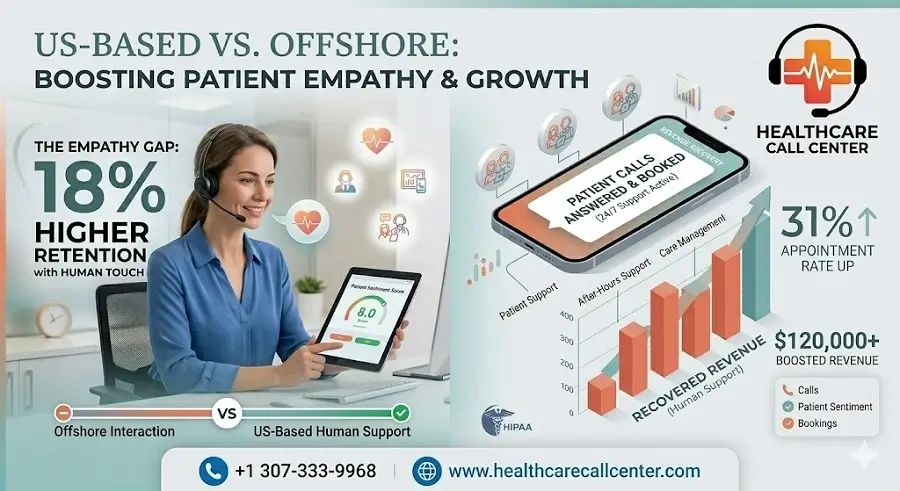
Studies and industry data consistently show that patient experience including phone communication quality directly correlates with retention rates. When patients encounter impersonal, scripted, or confusing phone interactions, it erodes their confidence in the practice overall. They may not attribute the poor experience specifically to the answering service. They attribute it to the practice.
For a practice handling 600 calls monthly with offshore answering service coverage, even a moderate negative experience rate on patient-facing calls can translate to 8-12 lost patient relationships per month. In specialties like dental, OB-GYN, and plastic surgery where individual patient lifetime value ranges from $3,000 to $10,000+ the revenue impact compounds quickly.
Practices that have transitioned from offshore to US-based healthcare call center solutions generally report measurable improvements in new patient conversion within 60-90 days, typically in the 15-25% range.
Complaint volumes related to phone communication tend to drop as well. These aren’t anecdotal observations; they’re consistent patterns across multiple practice types and sizes.
What US-Based Healthcare Call Centers Do Differently
A US-based call center services designed for healthcare operations offers three structural advantages over offshore alternatives.
- Cultural And System Fluency – Agents understand the insurance terminology, referral requirements, and healthcare delivery structure that US patients navigate daily. Conversations flow without translation delays or clarification loops. Patients experience the interaction as a natural extension of the practice.
- Healthcare-Specific Training – Rather than general customer service scripts, agents trained for healthcare communication follow specialty-specific protocols distinguishing urgent from routine, escalating appropriately, and documenting calls in formats that integrate with clinical workflows.
- Domestic Compliance And Accountability – Patient data remains within US jurisdiction. Business associate agreements are enforceable under US law. Practices maintain a clean compliance trail without the added complexity of cross-border data handling.
The cost difference between offshore and US-based medical answering service options typically ranges from $200-800 per month. For most practices, that gap is recovered through improved patient conversion and retention within the first quarter.
How to Evaluate a Healthcare Answering Service Provider
If your practice is currently using or considering an offshore answering service, these are the areas worth examining:
- Call quality – Review random call recordings across different times and call types not the vendor’s selected samples. Focus on how agents handle clinical questions, urgent scenarios, and patient concerns that don’t fit neatly into a script.
- Patient feedback – Check online reviews and patient complaint logs for phone-related comments. Patterns of frustration with phone communication often trace back to answering service quality rather than clinical care.
- Triage and escalation protocols – Determine whether agents are trained to recognize urgent clinical situations and follow practice-specific escalation paths, or whether they default to logging calls for next-day follow-up regardless of urgency.
- Compliance structure – Confirm where patient data is stored and processed, what security protocols are in place, and how the vendor handles breach notification and accountability.
- Performance metrics – Track new patient conversion rates, call abandonment rates, and patient retention before and after any vendor change. These numbers tell you more about answering service quality than any vendor-provided SLA.
Is Your Current Answering Service Supporting the Patient Experience?
If you’re evaluating healthcare answering service providers or comparing offshore and US-based options, a conversation with an experienced healthcare communication team can help clarify what level of support your practice actually needs.
Frequently Asked Questions!
Does offshore answering service quality actually impact patient retention?
Yes. Phone interactions represent the first point of contact for most patients. When those interactions feel impersonal or fail to address clinical concerns appropriately, it affects patient perception of the entire practice.
What differentiates medical answering service empathy from standard customer service?
Healthcare empathy requires clinical comprehension understanding what patients are describing, assessing urgency, and responding with appropriate follow-up.
Can offshore answering services meet HIPAA requirements?
Offshore vendors can hold the necessary certifications, but enforcement and accountability differ when data is processed outside US jurisdiction. Practices remain fully liable for any breaches involving their patient data.
What does a US-based answering service cost compared to offshore?
Offshore services typically range from $300-800 per month. US-based healthcare call centers generally cost $500-2,000 depending on call volume and coverage hours.
How do US-based agents handle after-hours calls differently?
US-based agents trained for healthcare follow practice-specific triage protocols that distinguish urgent from routine after-hours concerns. They can escalate immediately to on-call providers with relevant clinical details, rather than defaulting to “call back during business hours” responses.
Conclusion
The phone is where patients form their first impression of a practice. When the person on the other end doesn’t understand their clinical concerns, can’t navigate the healthcare system they depend on, and responds with scripted generalities instead of informed empathy, that impression is negative and it sticks.
Offshore call centers serve industries where the stakes are lower and the interactions are simpler. Healthcare isn’t one of them. The clinical complexity, the regulatory requirements, and the direct impact on patient safety and trust all point toward US-based answering solutions with healthcare-specific training as the more appropriate option for medical practices.
If your practice is evaluating answering service providers, the questions to ask aren’t about price they’re about what happens on the actual calls. Listen to recordings. Check complaint patterns. Track retention metrics. The data will tell you what you need to know.