by Erika Sanchez | Jun 1, 2026 | Patient Communication
The medical answering service industry has grown significantly over the past decade, with practices increasingly outsourcing patient phone coverage to third-party providers. Within that market, offshore call centers represent a substantial portion of the available options often positioned as the most cost-effective solution for practices managing tight budgets.
But cost-effectiveness in healthcare answering isn’t just about the monthly invoice. It’s about what happens on the calls themselves, and whether those interactions support or undermine the patient relationship your practice has built.
Medical answering service empathy, the ability to understand and respond appropriately to a patient’s clinical and emotional needs during a phone interaction is where offshore call centers might underperform.
This isn’t a criticism of individual agents. It’s a structural limitation that practices need to understand before making a vendor decision.
The Empathy Gap in Healthcare Phone Interactions
Empathy in patient communication isn’t about being warm or friendly. It’s about clinical comprehension. When a patient calls with a concern, the person answering needs to understand what they’re describing, assess whether it’s urgent or routine, and respond in a way that addresses the actual need, not just follow a script.
Offshore agents handling healthcare calls typically work from generalized answering scripts. They’re trained in customer service fundamentals, not in clinical communication. That shows up in several measurable ways:
Patients often describe symptoms using everyday language rather than clinical terminology. Effective healthcare communication requires agents to understand those descriptions, ask appropriate follow-up questions, and follow established escalation protocols when necessary. When that understanding is missing, important details can be overlooked or delayed.
Patients may not remember every detail of a phone conversation, but they often remember how that interaction made them feel. Empathetic patient communication plays an important role in building trust, reducing anxiety, and creating a positive experience before a patient ever visits the practice.
Cultural and Communication Barriers
Healthcare communication in the United States involves navigating a specific insurance landscape, referral networks, and medical terminology that doesn’t translate cleanly across cultures.
Patients ask about in-network coverage status, prior authorization requirements, co-pay structures, and whether a specific procedure is covered under their plan. A US-based live medical receptionist handles these questions conversationally because they operate within the same system. Offshore agents typically rely on reference materials that don’t cover the nuance of individual patient situations.
Beyond terminology, there’s the clinical context issue. Understanding the difference between first-trimester and third-trimester bleeding, recognizing that post-surgical “numbness” might indicate a nerve issue rather than normal healing, knowing that “the baby hasn’t moved much today” at 32 weeks requires different handling than at 22 weeks, these distinctions matter for patient safety and appropriate escalation.
Without that context, calls get misclassified. Urgent situations get logged as routine inquiries. Routine questions trigger unnecessary escalations that disrupt clinical staff. Neither outcome serves the practice or the patient.
Many of these insurance and coverage requirements are governed by federal healthcare regulations and payer policies.
HIPAA Compliance and Data Handling
Protected health information discussed on patient calls diagnoses, medications, symptoms, appointment details fall under HIPAA. When those calls are processed by an offshore answering service operating outside US jurisdiction, the compliance structure becomes more complex.
Offshore vendors can technically meet HIPAA requirements, and many hold the necessary certifications. But enforcement and accountability operate differently when the data handler is in another country under different privacy regulations. If a breach involves patient records processed offshore, the practice itself remains liable to HHS.
The offshore vendor’s legal exposure is limited in ways that a US-based partners would not be.
For practices evaluating vendor options, a HIPAA compliant answering service based in the United States provides a straightforward compliance chain data stays in US jurisdiction, business associate agreements are enforceable under US law, and breach notification and accountability processes follow established domestic frameworks.
This isn’t speculation about offshore capabilities. It’s an acknowledgment that the practice’s risk profile changes when patient data crosses borders, and most practices don’t fully account for that risk during vendor selection.
Impact on Patient Retention
Patient retention in healthcare isn’t solely determined by clinical outcomes. Phone interactions play a measurable role in whether patients stay with a practice or seek care elsewhere.
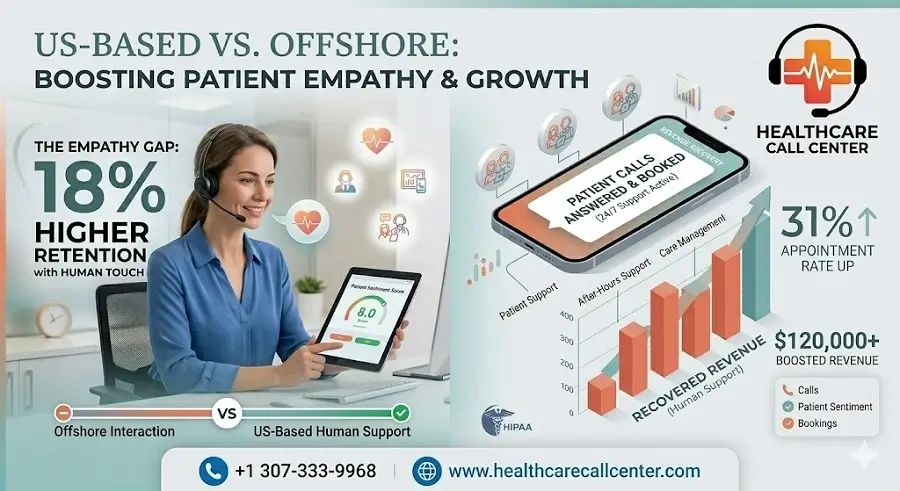
Studies and industry data consistently show that patient experience including phone communication quality directly correlates with retention rates. When patients encounter impersonal, scripted, or confusing phone interactions, it erodes their confidence in the practice overall. They may not attribute the poor experience specifically to the answering service. They attribute it to the practice.
For a practice handling 600 calls monthly with offshore answering service coverage, even a moderate negative experience rate on patient-facing calls can translate to 8-12 lost patient relationships per month. In specialties like dental, OB-GYN, and plastic surgery where individual patient lifetime value ranges from $3,000 to $10,000+ the revenue impact compounds quickly.
Practices that have transitioned from offshore to US-based healthcare call center solutions generally report measurable improvements in new patient conversion within 60-90 days, typically in the 15-25% range.
Complaint volumes related to phone communication tend to drop as well. These aren’t anecdotal observations; they’re consistent patterns across multiple practice types and sizes.
What US-Based Healthcare Call Centers Do Differently
A US-based call center services designed for healthcare operations offers three structural advantages over offshore alternatives.
- Cultural And System Fluency – Agents understand the insurance terminology, referral requirements, and healthcare delivery structure that US patients navigate daily. Conversations flow without translation delays or clarification loops. Patients experience the interaction as a natural extension of the practice.
- Healthcare-Specific Training – Rather than general customer service scripts, agents trained for healthcare communication follow specialty-specific protocols distinguishing urgent from routine, escalating appropriately, and documenting calls in formats that integrate with clinical workflows.
- Domestic Compliance And Accountability – Patient data remains within US jurisdiction. Business associate agreements are enforceable under US law. Practices maintain a clean compliance trail without the added complexity of cross-border data handling.
The cost difference between offshore and US-based medical answering service options typically ranges from $200-800 per month. For most practices, that gap is recovered through improved patient conversion and retention within the first quarter.
How to Evaluate a Healthcare Answering Service Provider
If your practice is currently using or considering an offshore answering service, these are the areas worth examining:
- Call quality – Review random call recordings across different times and call types not the vendor’s selected samples. Focus on how agents handle clinical questions, urgent scenarios, and patient concerns that don’t fit neatly into a script.
- Patient feedback – Check online reviews and patient complaint logs for phone-related comments. Patterns of frustration with phone communication often trace back to answering service quality rather than clinical care.
- Triage and escalation protocols – Determine whether agents are trained to recognize urgent clinical situations and follow practice-specific escalation paths, or whether they default to logging calls for next-day follow-up regardless of urgency.
- Compliance structure – Confirm where patient data is stored and processed, what security protocols are in place, and how the vendor handles breach notification and accountability.
- Performance metrics – Track new patient conversion rates, call abandonment rates, and patient retention before and after any vendor change. These numbers tell you more about answering service quality than any vendor-provided SLA.
Is Your Current Answering Service Supporting the Patient Experience?
If you’re evaluating healthcare answering service providers or comparing offshore and US-based options, a conversation with an experienced healthcare communication team can help clarify what level of support your practice actually needs.
Schedule a Consultation
Frequently Asked Questions!
Does offshore answering service quality actually impact patient retention?
Yes. Phone interactions represent the first point of contact for most patients. When those interactions feel impersonal or fail to address clinical concerns appropriately, it affects patient perception of the entire practice.
What differentiates medical answering service empathy from standard customer service?
Healthcare empathy requires clinical comprehension understanding what patients are describing, assessing urgency, and responding with appropriate follow-up.
Can offshore answering services meet HIPAA requirements?
Offshore vendors can hold the necessary certifications, but enforcement and accountability differ when data is processed outside US jurisdiction. Practices remain fully liable for any breaches involving their patient data.
What does a US-based answering service cost compared to offshore?
Offshore services typically range from $300-800 per month. US-based healthcare call centers generally cost $500-2,000 depending on call volume and coverage hours.
How do US-based agents handle after-hours calls differently?
US-based agents trained for healthcare follow practice-specific triage protocols that distinguish urgent from routine after-hours concerns. They can escalate immediately to on-call providers with relevant clinical details, rather than defaulting to “call back during business hours” responses.
Conclusion
The phone is where patients form their first impression of a practice. When the person on the other end doesn’t understand their clinical concerns, can’t navigate the healthcare system they depend on, and responds with scripted generalities instead of informed empathy, that impression is negative and it sticks.
Offshore call centers serve industries where the stakes are lower and the interactions are simpler. Healthcare isn’t one of them. The clinical complexity, the regulatory requirements, and the direct impact on patient safety and trust all point toward US-based answering solutions with healthcare-specific training as the more appropriate option for medical practices.
If your practice is evaluating answering service providers, the questions to ask aren’t about price they’re about what happens on the actual calls. Listen to recordings. Check complaint patterns. Track retention metrics. The data will tell you what you need to know.
by Erika Sanchez | Mar 6, 2026 | Patient Communication
Today, healthcare providers face growing pressure to manage patient communication efficiently while still delivering high-quality care. With a large volume of incoming calls about appointment scheduling, insurance questions, and after-hours concerns, many practices struggle to respond quickly. When patients cannot reach a clinic easily, they often choose another provider.
As a result, many practices are turning to healthcare call center solutions to improve patient communication. The addition of this type of service will allow providers to respond to patients faster and more efficiently while also providing other benefits such as compliance with HIPAA regulations, reduction of administrative burden on current staff and better consistency in appointment scheduling. Therefore, the addition of a healthcare call center will create increased operational stability for your practice, increased partnership with your patients, and greater control over your appointment flow and your revenue opportunities.
Many clinics are now turning to healthcare call center services to manage patient communication more efficiently while protecting revenue opportunities.
Why Healthcare Call Centers Are Becoming Essential for Medical Practices
Patient Communication is a major factor in the daily operations of any health care organization. Many aspects of patient communication range from scheduling an appointment to discussing health insurance, to name a few. Many health care practices deal with a variety of issues on a daily basis, such as a high volume of calls from patients who seek answers to a range of questions including appointment scheduling, refills and other after hours issues.
If patients do not receive the information they request or if their request is not addressed in a timely manner, there is a high likelihood that the health care practice will lose not only new patients but also current ones. Healthcare call center services can help ensure that patient communication is done effectively and efficiently.
Top 10 Reasons Medical Practices Are Adopting Healthcare Call Center Services
Healthcare practices today face increasing pressure to manage patient communication efficiently while maintaining high standards of care. From appointment scheduling to after-hours inquiries, clinics must respond quickly and consistently to patient needs.
Below are 10 key reasons why many medical practices are now adopting healthcare call center services to strengthen communication and improve daily operations.
1. Growing Patient Expectations for Immediate Communication
When you contact a healthcare provider, you want to get an immediate response. Many people contact clinics during their breaks at work or other daily obligations. However, if they hear a busy signal or reach voicemail, they often contact another provider who responds faster.
Many practices have discovered that communication delays directly affect patient satisfaction and appointment bookings. If a patient’s call is returned promptly and all their questions answered thoroughly, the patient will feel valued by the practice and have confidence in the value of their time.
Consistent response times also build trust with patients because they feel support from the first interaction; this reliability can also play a role in whether or not the patient will go ahead and schedule an appointment or keep looking for another provider.
2. Reducing Pressure on Front Desk Staff
The role of front desk staff is crucial to the effectiveness of a medical office. The front desk’s duties include greeting patients, confirming insurance coverage, managing paperwork, scheduling providers and assisting patients with checking in. However, the ongoing influx of incoming phone calls creates a lot of distractions for the front desk staff.
When phones ring constantly, front desk staff must divide their attention between in-person patients and incoming calls. Managing multiple requests at once can lead to scheduling mistakes or delayed call responses.
Many healthcare offices that introduce a call center into their operations see a significant improvement in how they manage both patients and calls, a more focused front office staff and less disruption allows front desk staff to concentrate on providing quality service to patients that come into their office, while calls are handled remotely.
The addition of a call center can positively impact an office in many ways, including:
- Allow front desk staff to focus more on in-office patient services
- Ensure patients receive consistent responses instead of long wait times
- Improve accuracy in administrative tasks such as documentation and insurance verification
The result is a less chaotic front office and a better experience for the patient and the front desk staff.
3. Improving Appointment Scheduling Accuracy
Appointment scheduling involves more complexity than it may appear. Each procedure will require a different period of time within the designated appointment areas. Certain appointments may also require preparation directions. Provider availability must be closely monitored to avoid significant disruption to the overall clinic schedule as a result of individual appointment scheduling errors.
Medical schedulers trained in communication techniques help ensure the scheduling of patient appointments is done accurately, in accordance with policies established by the clinic, and in a manner that corresponds with patient needs and respective types.
Accurate scheduling helps maintain operational stability by creating a more predictable day for both providers and patients. Providers can devote their attention to patient care with fewer disruptions from making schedule changes, and patients have shorter wait times for their scheduled appointments.
4. Capturing Missed Call Opportunities
Many medical practices underestimate how much missed phone calls affect their operations. When someone is calling the clinic to schedule an appointment, it generally occurs during the busy hours when employees at the front desk are busy helping patients already in the clinic. When they do not get an answer, potential appointments are lost due to missed chances.
Call handling systems ensure that every incoming call is acknowledged and managed properly. For instances in which a clinic cannot provide immediate support for an incoming call, there will be a process to ensure the patient is contacted shortly thereafter for assistance.
This process will increase the number of patients that would otherwise have been lost due to missed calls being returned. Clinics often see increased appointment bookings over time because fewer patient inquiries are lost due to unanswered calls.
5. Strengthening HIPAA-Compliant Communication
When communicating with patients, the information shared may include sensitive details (such as medical or insurance issues) and potentially even a record of their past appointments. Protecting this information is essential to maintaining compliance and ensuring patients feel confident that their records remain secure.
Many clinics rely on HIPAA-compliant healthcare call center services to ensure patient information remains secure while handling appointment requests, inquiries, and follow-up communication. These types of providers ensure that patient data remains secure during each point of contact by following strict privacy policies and procedures.
Reliable privacy practices provide benefits to clinics in the following ways:
- Protect patient conversations
- Ensure documentation procedures are followed
- Maintain compliance with healthcare privacy regulations
These methods help to increase trust in the patient while reducing risks for the practice.
6. Supporting After-Hours Patient Communication
After hours, patients frequently reach out for advice from a physician. Appointments, follow-up questions or urgent issues requiring attention before the next day can lead patients to call after hours.
However, many clinics lack structured support for after-hours calls, and patients are often directed to voicemail, which may cause them to experience some concern over whether someone has received the message and will respond in a timely manner.
When communication systems provide after-hours assistance, patients can have an opportunity to speak to trained department members who can document their concerns and address them properly. The messages and requests received after hours will be forwarded to the clinic with detailed documentation for follow-up.
This level of availability reassures patients that the clinic remains committed to their needs even when the office is closed.
7. Allowing Physicians to Focus More on Patient Care
Physicians often face disruptions in patient care when communication processes within the clinic are inefficient. When appointment setting becomes complicated due to confusing instructions or delays associated with customer service inquiries, physicians might experience an extra burden because they will have to step in to resolve the issue.
While some involvement is necessary, these interruptions can disrupt the consistency of patient care.
If organized communications support is employed (e.g., with patient scheduling and customer service personnel), many of these types of disruptions can be eliminated from physician workflows. In this scenario, physicians have more time to manage their patients than to manage their administrative processes.
As a result, physicians will be able to work with their patients at a consistent rate, and their administrative processes will continue to run smoothly.
8. Creating Consistent Patient Experiences
The quality of a medical practice can be judged by how well it communicates with patients, which is why many clinics invest in patient communication services for healthcare to maintain consistent and professional interactions. Patients are more confident in a practice when staff handle calls professionally and communicate information clearly.
To ensure that every patient receives the same courteous and informative communication, communication specialists are trained to follow the same customer service protocols established by each practice. This helps to provide uniform service.
Providing uniform service is very important for creating patient trust. When patients have the knowledge that they will receive helpful guidance each time they contact a practice, they are more likely to continue to receive care from that provider.
9. Helping Medical Practices Scale Efficiently
The growth of a medical practice is a positive indication of its success; however, it can also create additional challenges to the way it operates. When adding to the number of providers, services, or locations, the volume of calls received will usually increase quickly. If communication systems cannot handle this growth, patients may experience longer wait times or unanswered calls.
A flexible communication infrastructure, such as a call center for healthcare, allows a medical practice to grow and expand without negatively impacting its internal staff. By being able to add additional call capacity as patient demand increases, clinics can grow while continuing to conduct stable daily business.
The ability to add capacity as needed will also allow medical practices to effectively manage their growth while providing for long-term success.
10. Using Call Data to Improve Practice Operations
Patient calling trends provide insight into the daily operations of a practice. Call patterns often reveal patient scheduling preferences, frequently asked questions, and peak call hours, significant FAQs from patients, and peak times for calls to be made to the office and those hours are tracked in a structured manner.
An office will be able to examine and analyze call patterns when a structured system is in place to track patient telephone calls and, therefore, be able to utilize that data to improve medical operations. This information will provide a practice with an understanding of the way patients use the service and where improvements can be made.
Call data provides clinics with valuable operational insights into patient communication patterns, which typically will include (for example):
- The hours of highest volume of patient calls.
- The types of appointments that are most frequently requested.
Understanding these trends will allow clinics to refine their scheduling procedures, modify their staffing levels, and improve their patient education resources.
Building Long-Term Patient Relationships
Trust, clear communication, and consistent care form the foundation of strong relationships between patients and healthcare providers, including during routine phone calls with a patient. If the phone conversation is conducted calmly and professionally, it can help establish a sense of security immediately upon the first contact between the patient and the clinic.
When clinics have communication systems that allow every patient to receive prompt and courteous service from the clinic, they reinforce their long-term business partnership with the communities they serve. Consequently, patients are able to visit the clinic for treatment again, refer friends and family to the clinic as required, and maintain a continuing relationship with their provider.