Every medical practice has the same problem. Patients call when your front desk cannot answer. During lunch. After hours. On weekends. At the same time, your team is with a patient in the exam room. And every one of those unanswered calls is a patient who needed something, whether that is an appointment, a prescription, reassurance about a symptom, or urgent medical guidance.
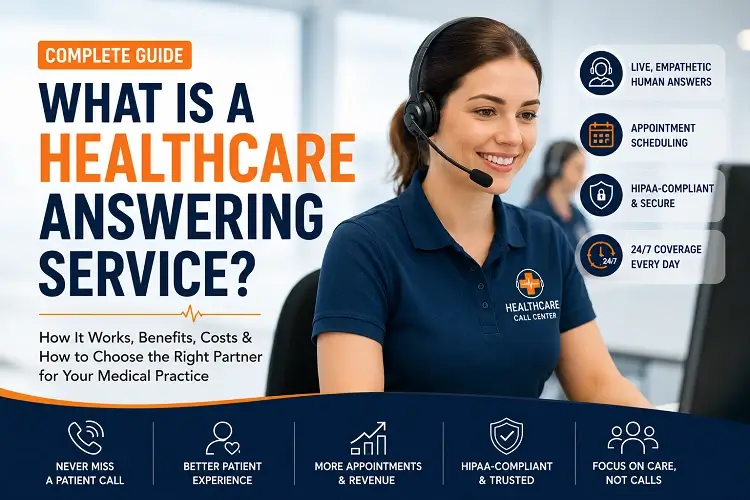
A healthcare answering service solves this problem by ensuring every patient call, 24 hours a day and 7 days a week, is answered by a trained, empathetic human who can schedule appointments, follow triage protocols, and represent your practice with warmth and professionalism.
This blog covers everything you need to know about what a healthcare answering service is, how it works, what it costs, and how to choose the right partner for your practice.
What Is a Healthcare Answering Service?
A healthcare answering service is a specialized live-call solution designed specifically for medical practices. Unlike a generic answering service that simply takes messages, a healthcare-focused service provides a comprehensive suite of capabilities designed to protect practice revenue and improve patient experience.
Live human agents are trained on healthcare communication and HIPAA compliance. They understand medical terminology, insurance basics, and the emotional dynamics of patient calls. Appointment scheduling happens directly in your EMR or practice management software, with no double entry and no missed bookings. Triage protocols are executed following your specific clinical guidelines, so urgent calls are escalated exactly the way you want them handled.
On-call physician routing goes through secure, documented channels with full audit trails. New patient intake captures insurance information, medical history, referral source, and any details your practice needs to prepare for the first appointment. Prescription refill routing reduces front desk phone traffic. Bilingual support serves diverse patient populations. And every interaction is documented in HIPAA-compliant systems with encrypted storage and detailed access controls.
In short, a dedicated healthcare front desk overflow support acts as an extension of your front desk. One that never goes home, never takes a lunch break, and never lets a patient call go to voicemail.
Why Voicemail Is Costing Medical Practices Patients and Revenue
The data on patient phone behavior is clear and consistent across multiple studies. Approximately 72% of callers who reach voicemail hang up without leaving a message. Of those who hang up, about 60% dial the next provider on their list within 10 minutes. Among new patient callers, 85% say they would not leave a voicemail for a first appointment. And patients consistently equate answered calls with quality care, meaning unanswered calls signal indifference and erode trust before the patient ever walks through your door.
When your practice sends calls to voicemail after hours, you are not just inconveniencing patients. You are actively pushing them toward competitors who simply picked up the phone.
Consider the math for a typical medical practice. If you receive 40 calls per day and miss 25% of them, that is 10 missed calls per day. Over 22 working days, that becomes 220 missed calls per month. If 30% of those would have booked an appointment, you would have lost 66 appointments per month. At an average appointment value of $300, that is $19,800 in lost revenue monthly. Annualized, your practice is losing $237,600.
You can plug your own numbers into a revenue calculator to see your practice’s exact gap.
How a Healthcare Answering Service Works
The process is designed to be simple and fast. Before going live, the service analyzes your practice’s call patterns. They look at peak hours, missed-call windows, after-hours volume, and specialty-specific needs. This analysis becomes your custom call-handling blueprint.
Then agents are trained on your specific protocols, specialty terminology, scheduling rules, and escalation procedures. They learn your practice the way a new front desk team member would, but with the structure and oversight of a professional training program. Within approximately 2 weeks, calls begin routing to your dedicated team. Your front desk gets immediate relief during busy hours, and after-hours calls are handled by trained agents who follow your exact protocols.
Monthly reports show answered call volume, new appointments booked, after-hours capture rate, and revenue recovered. You see exactly what the service delivers with no guessing about ROI.
Which Healthcare Practices Benefit Most from a Medical Answering Service?
While any medical practice can benefit, certain specialties see dramatically higher returns on investment.
OB-GYN and maternal care practices deal with pregnant patients who call at all hours with urgent concerns. A specialized OB-GYN answering service handles triage, schedules prenatal visits, and escalates true emergencies, protecting both patients and practice revenue. Patient lifetime values of $4,000 to $10,000 make every missed call expensive.
Fertility and IVF clinics handle some of the highest-value calls in healthcare. One missed fertility call can mean a lost IVF cycle worth $15,000 to $50,000. A fertility clinic answering service captures every high-value inquiry and books consultations while the patient is emotionally ready to commit.
Plastic surgery practices receive consultation leads from Google Ads, social media campaigns, and referrals. If the front desk misses a call at 8 PM, that lead calls the next surgeon on the list. A plastic surgery answering service ensures every consultation opportunity is captured regardless of when the call comes in.
Dental practices face the same challenge with patients calling during lunch, after work, and on weekends. A dental answering service captures new patient inquiries, routes emergencies, and keeps hygiene and treatment schedules full.
Primary care and multi-specialty practices handle an enormous administrative call volume. Prescription refills, referral coordination, appointment changes, and patient questions all compete for front desk time. A medical call center service absorbs this volume so your clinical team can focus on the patients in the office.
Stay-at-Home Moms vs Offshore Teams vs AI Receptionists
Not all answering services deliver the same quality. The three primary models differ significantly in patient experience quality.
Stay-at-home mom teams deliver the highest empathy and patient satisfaction. They bring lived healthcare experience, native US cultural context, low turnover, and full HIPAA compliance. They cost moderately more than offshore options but deliver substantially better results in patient retention and revenue capture.
Offshore call centers offer the lowest cost but also the lowest quality. Agents read generic scripts with limited healthcare training, have no lived understanding of American healthcare, and experience high turnover, which means your patients hear new voices constantly. Patients can tell within seconds that they are talking to someone who does not understand their situation.
AI and bot receptionists are the cheapest option but cannot handle nuanced healthcare conversations. They have no emotional intelligence, cannot triage, and cause high drop-off rates when conversations become complex. In healthcare, where anxiety and emotion drive most calls, bots fail at exactly the moment patients need the most support.
The cheapest option costs less per month but loses far more in missed patients, compliance risk, and damaged reputation over time.
Why HIPAA Compliance Matters in a Healthcare Answering Service
Any answering service handling patient calls must be fully HIPAA-compliant. This is not optional and not something to figure out after a breach. A compliant service signs a Business Associate Agreement before handling a single call. Every agent completes formal HIPAA training.
All systems use encryption for data in transit and at rest. Secure message delivery means no personal email or consumer messaging apps. Audit logs track every interaction involving protected health information.
Agents are based in the United States under US privacy jurisdiction. And a documented breach response plan exists so that if something goes wrong, everyone knows exactly what to do.
If a service cannot provide all of the above, the legal and financial risk of using it falls entirely on your practice.
How Much Does a Healthcare Answering Service Cost?
Pricing varies based on call volume, specialty, and coverage scope. Per-call pricing typically ranges from $0.75 to $1.50 per call and works best for practices with low volume but high-value individual calls. Per-minute pricing ranges from $0.75 to $1.25 per minute and suits practices with short, straightforward calls. Flat monthly pricing ranges from $200 to $900 and provides budget predictability. Multi-location enterprise practices typically negotiate custom pricing.
The real cost question is never how much the service costs. It is how much you are losing without one. For most practices, the service pays for itself by capturing just 2 to 3 additional appointments per month.
Ready to Stop Missing Patient Calls?
Book a free consultation today, and we’ll review your current call flow, identify where patient calls are being missed, and show you how much revenue your practice could recover. No pressure. Just practical insights tailored to your practice.
👉 Book Your Free Consultation
Frequently Asked Questions
1. What is a healthcare answering service?
A healthcare answering service provides live, HIPAA-compliant call handling for medical practices. Trained agents answer patient calls, schedule appointments, take messages, follow your call-handling protocols, and provide after-hours support so patients always reach a real person instead of voicemail.
2. Is a healthcare answering service HIPAA-compliant?
Yes. A healthcare answering service should operate under strict HIPAA-compliant procedures, including secure message handling, encrypted systems, trained agents, and a signed Business Associate Agreement (BAA) to help protect patient information.
3. Can a healthcare answering service schedule appointments?
Yes. Many healthcare answering services can schedule, reschedule, and cancel appointments based on your practice’s workflow. Depending on your setup, agents may work directly within your scheduling software or follow your approved booking process.
4. What types of medical practices benefit from a healthcare answering service?
Healthcare answering services support a wide range of practices, including primary care, OB-GYN, fertility clinics, plastic surgery practices, dental offices, orthopedic clinics, behavioral health providers, urgent care centers, and multi-specialty medical groups.
5. How much does a healthcare answering service cost?
Pricing depends on factors such as monthly call volume, coverage hours, specialty requirements, and workflow complexity. Many practices find the service pays for itself by capturing just a few additional appointments each month while improving patient satisfaction and reducing missed calls.
How to Choose the Best Healthcare Answering Service
Before signing with any provider, ask whether they have agents trained for your specific specialty. Confirm they will sign a BAA. Find out if they can integrate with your EMR and scheduling system.
Ask about their average answer speed. Request to see a dashboard with call outcomes and ROI metrics. Ask where their agents are based and whether you can customize triage protocols. Confirm coverage for after-hours, weekends, and holidays. Ask about onboarding timeline and contract terms.
If you are ready to see how much your practice is losing to missed calls, book a free consultation with Healthcare Call Center and get a custom call audit in 48 hours. No pressure, no obligation. Just the numbers.