When a patient calls your office after hours and tells an answering service their name, their date of birth, and why they are calling, protected health information has just left your four walls. Under HIPAA, that makes your answering service a business associate, and a signed Business Associate Agreement is not optional paperwork. It is the document that makes the entire arrangement legal.
Yet BAA quality varies enormously between providers. Some arrive thorough and specific. Others are two generic pages that would equally cover a landscaping company. And some providers quietly operate without one at all. This guide covers what a HIPAA-compliant answering service BAA must actually include, the five red flags that should stop a signature, and the day-to-day habits that separate genuinely compliant services from checkbox ones.
Quick Answer
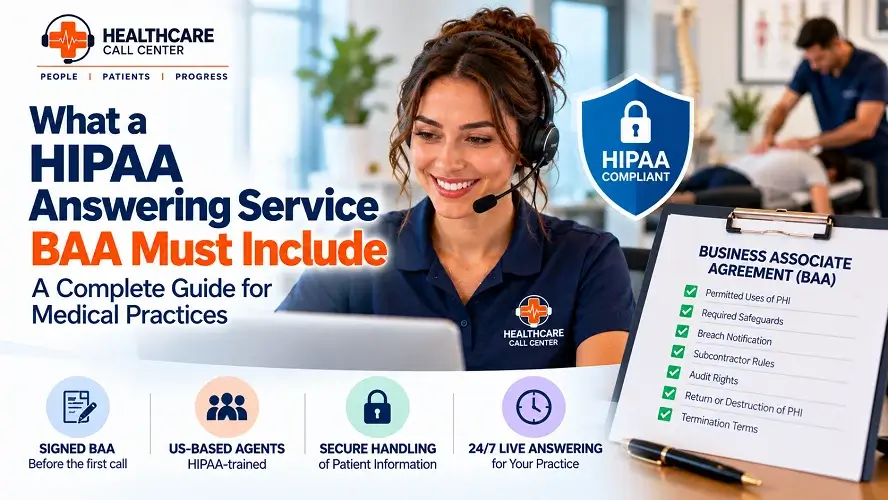
Any answering service that hears, stores, or transmits patient information on your behalf is a business associate under HIPAA and must sign a Business Associate Agreement before taking a single call. A proper BAA defines permitted uses of PHI, required safeguards, breach notification timelines, subcontractor rules, audit rights, and termination terms. If a provider hesitates on any of these, walk away.
Why Your Answering Service Needs a BAA
HIPAA’s Privacy Rule prohibits sharing protected health information with outside vendors except under a BAA. An answering service is one of the clearest business-associate cases in healthcare: agents routinely hear names, birth dates, phone numbers, symptoms, medication names, and appointment details. All of it becomes PHI the moment it connects to treatment, payment, or healthcare operations.
The obligation runs both ways. Your practice may not knowingly let a vendor handle PHI without a BAA, and the vendor may not handle it without one. A missing BAA is not a technicality. It is the exact scenario OCR enforcement actions are built around, and penalties attach to both parties.
One clarification practices often miss: the BAA obligation applies to every line that can carry PHI. After-hours lines, appointment lines, even the main number. If a new patient can call it and describe a symptom, it needs to be covered.
What Your Answering Service BAA Must Cover
A compliant BAA is specific. At minimum, it should address:
- Permitted uses of PHI. Exactly what the service may do with what it hears: answer, document, route, book, and relay. Nothing else.
- Required safeguards. Administrative (training, access controls), physical (secure facilities), and technical (encryption in transit and at rest) protections spelled out, not just promised.
- Breach notification. A binding commitment to notify you of any breach or suspected breach without unreasonable delay, with a defined timeframe.
- Subcontractor rules. Any downstream vendor (telecom, hosting, transcription) is itself bound to equivalent terms, and you are told who they are.
- Minimum necessary standard. Agents access only the PHI a task requires, and scripts are designed to avoid collecting PHI that isn’t needed.
- Audit and inspection rights. Your right, or your compliance officer’s, to review safeguards and records.
- Return or destruction of PHI. What happens to recordings and logs when the relationship ends.
- Termination trigger. A breach of the BAA is grounds for termination, not just a conversation.
A BAA light on these sections is not necessarily invalid, but it is a signal about how the provider thinks compliance works.
The 5 Red Flags When Choosing a HIPAA Answering Service
- No BAA offered, or a shrug. Some consumer-grade virtual receptionist services simply don’t sign BAAs. If the answer to “can you sign a BAA?” is anything other than an immediate yes with a document attached, the decision makes itself.
- “We’re HIPAA certified.” There is no such thing as HIPAA certification. Any provider claiming certification either misunderstands the law or is selling you a badge. Real compliance is documented, audited, and specific.
- Offshore agent ambiguity. If calls are answered outside the United States, ask exactly where, under what data-transfer protections, and how breach notification would work across borders. Offshore answering raises cost and complexity on every HIPAA question, and patients notice the difference in quality too.
- Vague breach timelines. The BAA should commit to notification within a defined window. Words like “promptly” with no definition push you to the back of the line in exactly the situation where you need to be first.
- No subcontractor transparency. If the service farms overflow to another call center or hosts recordings with an unnamed vendor, you are entitled to know, and their BAA must bind those vendors to the same terms.
Questions to Ask Before You Sign
Bring this list to the sales call:
Will you sign a BAA before the first call, and may I see the template now?
Where are calls answered, and by whom?
How are agents trained on HIPAA, and how often?
Where are recordings stored, how are they encrypted, and for how long?
What is your written breach-notification commitment?
Which subcontractors touch our PHI?
What was your last security review, and will you share the summary?
A confident provider answers these in minutes. A hesitant one answers in weeks, after you’ve already moved on.
What HIPAA Compliance Looks Like Day to Day
The BAA is the contract; compliance is the habit. On a genuinely compliant service, agents are trained on the minimum necessary standard: they collect what the protocol requires and nothing more. Scripts avoid unnecessary PHI, so a caller booking a routine appointment is not asked to recite their history.
Messages route through secure, access-controlled systems rather than personal phones or email. Recordings and logs live in encrypted storage with role-based access and defined retention. And training is repeated, documented, and dated, not a one-time video from 2022.
Common Myths That Create Real Risk
- “We’re a small practice, HIPAA doesn’t apply.” It does. Size has nothing to do with it.
- “We never leave after-hours messages, so no PHI changes hands.” The PHI changes hands the moment the caller says their name and reason for calling, voicemail or not.
- “The service said they’re HIPAA compliant, so it’s covered.” Their compliance claim does not transfer your obligation. The BAA does.
How HCC Handles It
Every HCC engagement starts with a signed BAA before the first call, and every call path is treated as in scope. Agents are 100% US-based, HIPAA-trained on medical call flows, and held to the minimum necessary standard in both scripts and systems.
Recordings and logs live in encrypted storage with defined retention; breach commitments are written into the agreement with defined timelines; and our 90%+ answer-rate guarantee comes with call logs you can audit any month you like. The same standard runs through our HIPAA-compliant medical answering service coverage.
Who Is (and Isn’t) a Business Associate
The test is whether the vendor creates, receives, maintains, or transmits PHI on your behalf. An answering service that hears patient details: yes. A transcription vendor: yes. A company that simply delivers office supplies and never touches patient data: no.
Edge cases are where practices get tripped up. A cleaning crew with after-hours access to offices where PHI is discussed is generally not a business associate (incidental access, no PHI handling on your behalf). But an IT support vendor with access to your phone system recordings is. When in doubt, the safe posture is to require a BAA. No vendor is harmed by signing one, and some will strengthen their own practices to do it.
Note that the obligation scales with access: if your healthcare answering service only takes messages with names and callback numbers, it still handles PHI in the form of appointment-related information tied to a patient’s identity. Treat every call path as in-scope.
The Cost of Getting It Wrong
Operating without a required BAA is itself a violation, separate from whatever breach might later occur. Federal civil penalties for HIPAA violations are tiered by culpability and run to roughly two million dollars per violation category per year at the top tier, and state attorneys general can pursue additional actions. Beyond fines, a disclosure event means breach notification to affected patients, potential credit monitoring obligations, and the reputational cost of telling patients their information wasn’t protected.
Set against that, the prevention is remarkably cheap: a well-drafted BAA, a provider that answers the compliance questions directly, and an annual review. It is one of the few compliance investments where the downside is catastrophic and the cost of doing it right is close to zero.
Pre-Signature Compliance Checklist
Before countersigning any answering service agreement, confirm:
- The BAA is attached to the contract, not promised for later.
- Breach notification has a defined timeframe, not adjectives.
- Subcontractors are disclosed and bound.
- Safeguards (training, encryption, access controls) are described in the document itself.
- Recordings and logs have stated storage locations and retention periods.
- Return-or-destroy terms exist for the end of the relationship.
- Audit rights are included, not negotiated away.
- The signature block includes a named entity you have verified, not a different company than the one selling to you.
One More Layer: State Privacy Laws
HIPAA is the federal floor, not the ceiling. States including Texas (with its own medical records privacy act) and Washington (with consumer health data legislation) layer additional requirements on top, and several define PHI more broadly than HIPAA does.
A BAA drafted only to federal minimums may leave gaps a state law would fill. The practical move: ask providers whether their agreements are written to federal standards alone or account for stricter state regimes, and loop your compliance officer or attorney into the review either way.
Frequently Asked Questions
Does my answering service really need a BAA?
Yes. The moment the service receives protected health information on your behalf- a patient’s name, birth date, or reason for calling- it is acting as a business associate under HIPAA, and a signed BAA is required before any PHI is shared.
Is there such a thing as HIPAA certification for answering services?
No. There is no government HIPAA certification for vendors. A provider claiming to be “HIPAA certified” is a red flag; real compliance shows up as a specific BAA, training records, and documented safeguards.
What happens if my answering service doesn’t have a BAA?
You are both exposed. Impermissible disclosure of PHI without a BAA is a violation that can attach penalties to your practice, not just the vendor, and you would bear the burden of notifying affected patients.
Can I use a regular virtual receptionist service for patient calls?
Only if they sign a BAA and can demonstrate HIPAA safeguards. Many consumer virtual-receptionist services explicitly do not sign BAAs, which rules them out for any line that can carry patient information.
How often should we review our answering service BAA?
Review it annually and whenever the service changes systems, subcontractors, or handling practices, and whenever HIPAA rules update. Your compliance officer should keep the current signed copy with your security documentation.
Next Step
HCC signs the BAA before the first call, and backs it with US-based, HIPAA-trained agents and a 90%+ answer-rate guarantee. Book a 15-minute discovery call to see the agreement and the onboarding plan, or start with the free call coverage audit.