A front desk staffing gap looks simple on paper.
One person is out. One role is unfilled. One location is short-staffed. One team is trying to do more with fewer people.
But inside a medical practice, that gap spreads quickly.
Patients wait longer. Calls go unanswered. Voicemails pile up. Appointment requests slow down. Staff rushes through conversations. Follow-up gets delayed. Providers feel the pressure. The practice may still look busy, but patient access begins to weaken.
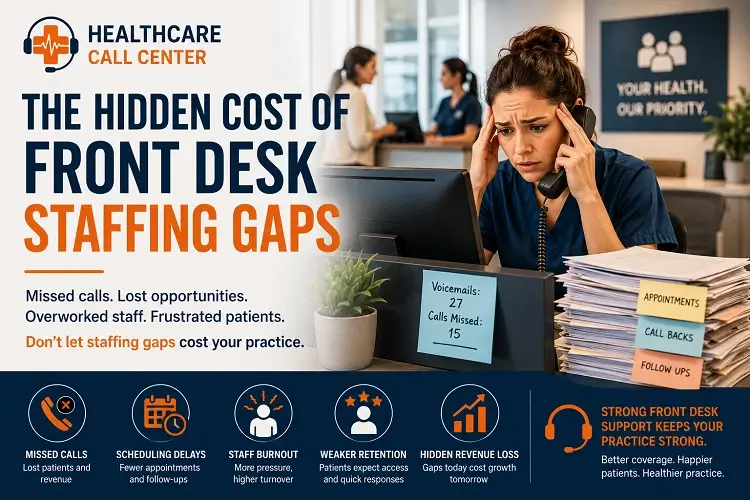
The real cost of a front desk staffing gap is not only payroll. It is missed patient calls, lost appointment opportunities, staff burnout, weaker retention, and a patient experience that feels harder than it should.
This is why medical practices should treat front desk coverage as a growth and patient access issue, not only an administrative issue.
Why the Front Desk Carries So Much Pressure
The front desk is often the busiest communication point in the practice. AMA directly discusses system inefficiencies, administrative burdens, and workplace factors associated with physician burnout.
A front desk team may handle:
- Patient check-in
- Patient check-out
- Phone calls
- Appointment scheduling
- Insurance questions
- Provider messages
- Referral questions
- Walk-in patients
- Forms and paperwork
- Cancellations and reschedules
- Billing questions
- New patient inquiries
- Follow-up calls
That is a lot of work for one team.
When staffing is stable, the team may still feel busy. When staffing is thin, the system becomes fragile.
The phone is usually the first place the pressure shows. Calls ring longer. Patients are placed on hold. Voicemail becomes the backup plan. Staff may answer quickly but sound rushed. Messages may be incomplete because the person answering is also trying to help someone standing at the desk.
This is where a front desk overflow answering service can help protect the patient experience.
Missed Calls Are the First Hidden Cost
The most obvious hidden cost of a staffing gap is the missed call.
But missed calls are often undercounted.
A practice may see voicemails and assume that number reflects the problem. It does not. Many callers do not leave voicemails. Some hang up. Some try again later. Some call a competitor. Some give up because they are already frustrated.
A missed call can represent:
- A new patient appointment
- A returning patient follow-up
- A referral inquiry
- A reschedule request
- A cancellation that could have been refilled
- A post-visit concern
- An after-hours message
- A patient who needed reassurance
The cost depends on the caller’s intent.
If the caller was ready to book, the missed call may cost revenue. If the caller was an existing patient, it may cost trust. If the caller had a concern, it may create anxiety and extra follow-up work later.
A 24/7 medical answering service helps reduce this risk by making sure more calls are answered when the front desk is overloaded.
Staffing Gaps Slow Down Scheduling
Scheduling is one of the first workflows to suffer when the front desk is short-staffed.
Patients call to book, reschedule, confirm, or ask about availability. If those calls are delayed, the schedule becomes harder to manage.
A staffing gap can cause:
- Slower new patient booking
- More missed appointment requests
- More unfilled cancellations
- Longer callback queues
- More patient frustration
- More pressure on staff later in the day
Scheduling delays are not just inconvenient. They can reduce revenue and weaken patient retention.
A patient who cannot book quickly may choose another provider. A patient who cannot reschedule easily may miss care. A cancellation that is not handled in time may leave an empty appointment slot.
This is why phone coverage and appointment access are connected.
Staff Burnout Becomes a Patient Experience Problem
Front desk staff often carry the emotional weight of the practice.
They handle frustrated patients, urgent requests, provider interruptions, insurance confusion, and constant phone volume. When staffing is thin, every interaction becomes harder.
Burnout can show up as:
- Shorter call tone
- More mistakes
- Slower callbacks
- Less patience with callers
- Lower message quality
- Higher turnover risk
- More internal stress
Patients can feel that pressure.
Even when staff is trying their best, a rushed or overwhelmed call experience can make the practice feel disorganized.
The solution is not always telling staff to work harder. In many cases, they are already working at capacity. The better solution is to reduce avoidable pressure.
A call support partner can help by answering overflow calls, collecting clear messages, and giving staff room to focus on patients in the office.
Patient Access Breaks Down at the Phone
Patient access is often discussed in terms of appointment availability, insurance acceptance, and provider schedules. But for many patients, access starts with the phone.
If a patient cannot reach the practice, the rest of the access system does not matter.
The patient may never book the appointment. They may never ask the question. They may never complete the follow-up step. They may never get routed to the right person.
A staffing gap can turn the phone into a bottleneck.
This affects:
- New patient acquisition
- Follow-up care
- Reschedules
- Medication questions
- Procedure questions
- Referral coordination
- Patient satisfaction
- Online reviews
- Retention
Strong US-based healthcare call center services help practices improve patient access by making sure calls are answered and routed more consistently.
The Cost Is Higher for Specialty Practices
Front desk staffing gaps are especially expensive for specialty practices
In specialty care, calls often carry higher value and more sensitivity. A fertility patient may be calling after a difficult update. A plastic surgery lead may be ready to book a consultation. An OB-GYN patient may be worried. A dental patient may be in pain. A chiropractic patient may want a same-day visit.
These calls should not sit unanswered.
Specialty practices often invest heavily in SEO, referrals, reviews, and paid marketing. A missed call can waste that investment.
The practice may never know exactly which caller was lost. But over time, the pattern becomes visible: fewer booked consultations, lower conversion from marketing, more patient complaints, and more pressure on the team.
After-Hours Gaps Add Another Layer
Staffing gaps during the day are one problem. After-hours coverage is another.
Patients do not only call during office hours. They call after work, during evenings, on weekends, and when they remember something important. Some calls can wait. Some need clear routing. Some simply need to be answered and documented correctly.
If after-hours calls go to voicemail without a clear process, the practice may create more work for the next business day.
An after-hours medical answering service helps make sure calls are answered, captured, and routed according to the practice’s rules.
This can reduce patient frustration and give the front desk a cleaner starting point in the morning.
Hiring More Staff Is Not Always Enough
Hiring may be necessary, but it is not always the complete answer.
A new staff member cannot solve every call spike. They cannot cover every lunch break, sick day, after-hours call, or campaign-driven surge. They also require training, management, payroll, and time before they become fully effective.
Practices should ask whether the problem is permanent workload, predictable peak-hour pressure, or variable call volume.
If call pressure comes in waves, overflow support may be more efficient than adding another full-time role.
The goal is not to automate every patient interaction. It is to match the right type of call support to the workload your front desk is actually experiencing.
A blended model often works best:
- The front desk handles in-office patients and core workflows.
- Overflow support answers calls when staff is busy.
- After-hours support covers calls when the office is closed.
- Clear routing rules keep messages organized.
This creates coverage without overloading the team.
How to Identify the Real Cost of a Staffing Gap
Practices should audit the impact of front desk staffing gaps, not just the staffing schedule.
Review:
- Missed calls by day and time
- Voicemail volume
- Callback delays
- New patient call conversion
- Empty schedule slots
- Patient complaints about phone access
- Staff overtime or stress patterns
- Calls missed during lunch or check-in rushes
- Calls from paid campaigns or SEO pages
- After-hours call volume
This helps the practice understand whether the staffing gap is affecting growth and retention and whether the solution is additional staff, overflow coverage, after-hours support, or a combination of the three.
Practices can also use a missed call revenue calculator to estimate the potential financial impact of unanswered patient calls.
The goal is not to blame the front desk. The goal is to find where the system needs support.
What Better Front Desk Support Looks Like
Better front desk support does not have to be complicated.
It should help the practice:
- Answer more calls
- Reduce voicemail dependency
- Capture appointment requests
- Route messages clearly
- Support after-hours callers
- Reduce staff pressure
- Improve patient access
- Protect marketing ROI
- Keep the patient experience consistent
The best support model should feel like an extension of the practice’s workflow, with practice-specific scripts, routing rules, escalation instructions, and secure message handling. It should follow practice-specific instructions, protect patient information, and help callers feel heard.
This is the strongest primary authority for your healthcare privacy point. HHS explains that the Privacy Rule establishes national standards for protecting medical records and individually identifiable health information.
That is the difference between basic message-taking and healthcare-aware call handling.
Why This Problem Can Grow Quietly
Front desk staffing gaps do not always create an obvious crisis at first. The practice may still be seeing patients. The schedule may still look full. Staff may still be answering many calls each day.
But the missed opportunities often happen quietly.
A new patient does not book. A caller does not leave a voicemail. A follow-up gets delayed. A cancellation is not filled. A patient feels the practice is hard to reach and starts comparing other options.
Because these losses are scattered across many small moments, they can be easy to ignore. That is what makes them dangerous.
By the time the problem shows up in lower conversion, weaker retention, or staff turnover, the practice may have been leaking opportunities for months.
This is why practices should review front desk coverage before the problem becomes visible in revenue. The phone is often the earliest warning sign that the team needs support.
Final Takeaway
Front desk staffing gaps cost medical practices more than payroll.
They create missed calls, slower scheduling, patient frustration, staff burnout, and lost appointment opportunities. They also weaken the patient experience before the patient ever sees a provider.
Medical practices do not need to choose between overloading the front desk and sending callers to voicemail. With the right call handling support, they can protect patient access, support staff, and answer more calls during the moments that matter.
Healthcare Call Center helps medical practices reduce front desk overload, answer more patient calls, support after-hours communication, and protect appointment opportunities.
Book a Free Consultation to review your front desk call volume, staffing gaps, overflow needs, and after-hours coverage.
Front Desk Staffing Gap FAQs
1. What is a front desk staffing gap in a medical practice?
A front desk staffing gap happens when the practice does not have enough available staff to manage patient calls, check-ins, scheduling, insurance questions, and administrative work without delays or missed calls.
2. How do front desk staffing gaps affect patient calls?
Staffing gaps can cause longer hold times, missed calls, voicemail dependency, delayed callbacks, incomplete messages, and frustrated patients who cannot reach the practice quickly.
3. Can a medical answering service help with staffing gaps?
Yes. A medical answering service can help by covering overflow calls, after-hours calls, appointment requests, and message capture when the front desk is overloaded or unavailable.
4. When should a medical practice use front desk overflow support?
A practice should consider front desk overflow support when calls are regularly missed during peak hours, lunch breaks, check-in periods, staffing shortages, or other high-volume windows.
5. Is overflow call support better than hiring more staff?
It depends on the problem. If call volume spikes during specific times, overflow support may be more efficient. If the practice has constant workload growth, hiring may also be needed.
6. How can practices measure the cost of front desk staffing gaps?
Practices can review missed calls, voicemail volume, callback delays, new patient conversion, schedule gaps, patient complaints, and call volume during peak times or after-hours windows.