by Erika Sanchez | Sep 21, 2026 | Healthcare Answering Services
Medical practices lose revenue from missed calls every time a patient hangs up before reaching a live person. The loss is not only the call itself. It is the appointment that never gets booked, the treatment plan that never starts, the follow-up that gets delayed, and the patient who calls a competing practice instead.
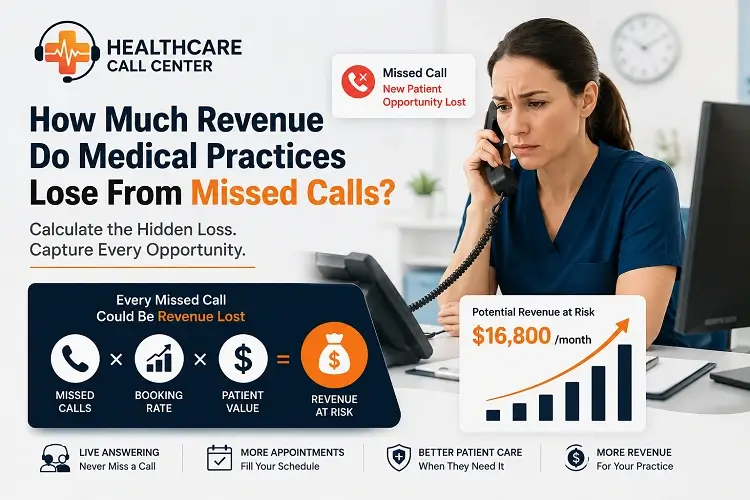
A missed call revenue calculator helps turn that hidden leak into a number your team can see: missed calls multiplied by booking rate multiplied by average patient value.
The short answer: even a small practice can put thousands of dollars in monthly revenue at risk when missed calls occur during peak hours. A larger multi-provider office can put much more at risk.
The fix is not always hiring another full-time employee. For many practices, the better first step is a healthcare answering service that covers call spikes, lunch hours, after-hours gaps, and overflow when staff is with patients.
Why Missed Calls Are More Expensive Than They Look
Most practices underestimate missed calls because they count only the voicemails they can see. That is the wrong measurement. The most expensive missed call is usually the one that never becomes a voicemail. A patient calls, waits, hears ringing or a menu, and gives up. There is no message, no chart note, no callback task, and no proof that revenue just left the building.
This is especially true for new patients. Existing patients may try again because they already trust the practice. A new patient has no loyalty yet. If they are calling about pain, pregnancy symptoms, a fertility question, a cosmetic consult, or a specialist referral, they are likely working through a short list. The office that answers promptly has a better opportunity to turn that inquiry into a booked appointment.
Missed calls also create downstream problems. Staff spend Monday mornings returning vague messages. Patients get frustrated because nobody picked up when they needed help. Providers see gaps in the schedule that could have been filled. Marketing looks weaker than it really is because paid, organic, referral, and local-search traffic may be producing calls that the practice fails to capture.
What Counts as a Missed Call for a Medical Practice?
A missed call is not only an unanswered ring. It includes any patient call that fails to become a useful conversation or documented next step. If the caller hangs up during hold, that is a missed call. If the caller reaches voicemail and never gets called back, that is a missed call. If the message is returned two days later and the patient already booked elsewhere, that is a missed call too.
For revenue analysis, separate missed calls into four categories:
- New patient appointment requests: usually the highest-value calls, because the caller has not chosen a provider yet.
- Existing patient scheduling calls: follow-ups, treatment starts, reschedules, and recurring care.
- Urgent or after-hours calls: pain, complications, anxiety, and time-sensitive concerns that create trust when handled well.
- Administrative calls: insurance, billing, forms, referrals, and records requests that do not always create revenue directly but still shape patient experience.
Do not treat all missed calls equally. A missed billing question is not the same as a missed implant consult. The goal is to calculate the revenue attached to the calls that could have become appointments.
The Simple Missed-Call Revenue Formula
Use this formula:
Missed calls per month x appointment conversion rate x average first-year patient value = estimated monthly revenue at risk.
Here is what each number means.
- Missed calls per month: count calls not answered live, hang-ups during hold, abandoned voicemail, and after-hours calls with no same-day response.
- Appointment conversion rate: the percentage of answered calls that normally become booked appointments. If you do not know it, start with a conservative range and refine after 30 days.
- Average first-year patient value: the expected revenue from that patient over the first year, not just the first visit.
For example, if a chiropractic practice has 80 missed calls per month, a 35% booking rate, and an average first-year patient value of $600, the estimated revenue at risk would be $16,800 per month. This is an illustration, not a guaranteed revenue loss, but to recover the practice needs a dedicated chiropractic answering service provider which helps recover the lost amount.
Example: 20 Missed Calls Per Week
A practice missing 20 calls per week may not feel like it has a crisis. That is only four missed calls per weekday. It can happen during lunch, when two patients are checking out, when the receptionist is collecting insurance details, or when the office gets a post-holiday rush.
Now stretch that across a month. Twenty missed calls per week becomes roughly 80 missed calls per month. If only 25 percent of those callers would have booked, that is 20 missed appointments. If each new or returning appointment is worth 350 dollars in near-term revenue, the practice is looking at 7,000 dollars in monthly production risk. If the average patient value is higher, as it is in fertility, OB-GYN, plastic surgery, dermatology, dental, and specialty practice answering services, the number climbs quickly.
The point is not to pretend every missed call becomes a lost patient. It does not. The point is that the practice does not need a perfect loss rate for missed calls to hurt. A modest call gap, applied every week, creates a real revenue leak.
Which Missed Calls Cost The Most?
The highest-cost missed calls usually share three traits: high urgency, high intent, and low patience. A caller with pain, anxiety, or a time-sensitive question will not wait long. They need help, and they are more likely to engage with a practice that responds promptly.
- New patient calls from Google Business Profile: these callers are often comparing nearby practices and may call the next listing within minutes.
- Specialty consult calls: fertility, plastic surgery, OB-GYN, dermatology, dental implants, and other higher-value services can carry far more revenue than a routine visit.
- After-hours concern calls: anxious patients remember whether a human answered when the office was closed.
- Referral calls: if a patient was referred by another provider and nobody answers, the practice may lose both the appointment and the referral confidence.
- Reschedule calls: these look harmless, but if a patient cannot reschedule easily, an appointment gap becomes a no-show or cancellation.
This is why a missed-call report should never stop at call count. The real question is: which missed calls carried intent? Those are the calls worth protecting first.
Why Voicemail Does Not Recover Most Lost Calls
Voicemail feels like a safety net because it creates a place for the caller to leave information. But voicemail does not capture the patients who hang up. It does not reassure a worried caller. It does not ask the follow-up questions your scheduler needs. It does not turn a new patient inquiry into a confirmed appointment while the caller is still motivated.
Voicemail also moves work to the worst possible time. Instead of answering a live question in the moment, your team starts the next day with a backlog. Messages are incomplete. Phone numbers are misheard. Patients are in meetings when staff calls back. Some people never answer. Others are already booked somewhere else.
For a medical practice, speed is part of care. A caller who reaches a calm human voice is more likely to feel safe, more likely to share complete information, and more likely to stay with the practice. A caller who reaches voicemail is being asked to wait at the exact moment they decided to act.
How Front Desk Overflow Support Closes The Leak
The practical fix is coverage during the moments your internal team cannot answer. That can mean peak morning hours, lunch, provider-change windows, Monday rushes, after-hours calls, or full-day overflow when staffing is thin. Front desk overflow support acts like a pressure valve. When your in-office team is busy, trained agents answer in your practice name, capture the reason for the call, and move the patient to the right next step.
Good overflow support is not a generic message-taking service. It should understand medical-office call flow, protect HIPAA, follow your escalation rules, and document each call in a format your team can use. The goal is not simply to answer more calls. It is to make sure the calls most likely to become appointments are answered and handled appropriately.
HCC’s advantage is that callers are answered by US-based agents HIPAA-compliant and trained to handle healthcare conversations with empathy. That matters because many missed calls are emotional, not transactional. A worried mother, a fertility patient, or a post-op patient does not want a cold script. They want someone who sounds present and can guide the call without pretending to give medical advice.
How To Track Missed-Call Revenue For 30 Days
Before changing staffing or phone systems, track the leak for 30 days. Keep it simple. You do not need a complicated dashboard to get the truth.
- Count total inbound calls by day and hour.
- Count answered calls, abandoned calls, voicemail calls, and calls returned more than one business day later.
- Tag missed calls by type: new patient, existing patient, urgent, referral, billing, or admin.
- Estimate which missed calls could reasonably have become appointments.
- Apply the revenue formula using conservative patient-value assumptions.
Practice leaders often rely on feel. The phone sounds busy, so the team assumes everyone is doing their best. That may be true, but it does not answer the revenue question. A 30-day call audit gives the team facts instead of blame. Industry groups such as the Medical Group Management Association focus heavily on operational benchmarks because small workflow leaks compound when they repeat daily. Missed calls are one of those leaks.
When Missed Calls Become A Staffing Decision
If missed calls happen once in a while, coaching and scheduling adjustments may be enough. If they happen daily, the issue is structural. Your front desk may be doing everything right and still be outnumbered by the phones. That is the moment leadership has to decide whether to hire, change phone routing, add overflow coverage, or combine all three.
The mistake is treating the issue as a receptionist performance problem. In many practices, the front desk is already checking in patients, collecting balances, confirming insurance, managing forms, handling provider requests, and calming walk-ins. The phone is only one part of the job. If call volume keeps growing, missed calls are a system problem, not a person problem.
The American Medical Association publishes practice management resources because administrative friction affects the entire care experience. Phone access is part of that friction. A practice that cannot answer consistently may look disorganized even when its clinical care is excellent.
What Should A Practice Do Next?
Start with the math. Count the missed calls. Estimate the appointment conversion rate. Use conservative patient value. If the number is small, fix scheduling and scripts. If the number is large, protect the phone lines with overflow coverage before spending more on ads, SEO, or local listings.
That last point matters. Marketing brings patients to the phone, but the phone has to convert the demand. If you increase traffic before fixing missed calls, you are filling a leaking bucket. The smarter order is: protect calls first, then scale traffic.
Use the missed-call revenue formula, compare it to the cost of coverage, and decide from the numbers. If you want help estimating the leak for your practice,
Book a free consultation and HCC can walk through the call-flow gaps that are costing appointments.
Frequently Asked Questions
1. How Much Revenue Does A Medical Practice Lose From Missed Calls?
It depends on call volume, booking rate, and average patient value. A simple formula is missed calls per month multiplied by appointment conversion rate multiplied by average first-year patient value. Even conservative assumptions can show thousands of dollars in monthly revenue at risk.
2. What Is The Best Way To Calculate Missed-Call Revenue?
Track missed calls for 30 days, separate new patient calls from administrative calls, estimate how many would have booked, and multiply by realistic patient value. Use conservative numbers first so the result is credible.
3. Do Voicemails Count As Missed Calls?
Yes, if the voicemail does not become a timely booked appointment or useful documented next step. Voicemail is better than nothing, but it does not capture callers who hang up, and it often delays follow-up until the patient has moved on.
4. Which Practices Lose The Most From Missed Patient Calls?
High-value and high-anxiety specialties are most exposed: OB-GYN, fertility, plastic surgery, dermatology, dental, pediatrics, and multi-location medical groups. The higher the patient value and urgency, the more each missed call matters.
5. Can Front Desk Overflow Support Replace Hiring?
Sometimes. If call spikes are concentrated during certain hours, overflow support may solve the problem at lower cost than another full-time employee. If the office is understaffed all day, overflow support can still stabilize the phones while leadership evaluates hiring.
6. Should We Fix Missed Calls Before Increasing Marketing Spend?
Yes. More traffic creates more calls. If the practice cannot answer consistently, new marketing spend increases leakage. Protect the phone first, then scale SEO, ads, local listings, and referral campaigns with confidence.
7. How Can A Medical Practice Reduce Missed Calls?
A practice can reduce missed calls by tracking when calls are missed, identifying peak call periods, improving phone routing, adjusting front-desk workflows, and using overflow or answering support when internal staff cannot keep up.
by Erika Sanchez | Aug 25, 2026 | Healthcare Answering Services
A healthcare front desk can be busy even when the practice is running well.
Patients call to schedule appointments, reschedule visits, ask about referrals, confirm insurance, request directions, follow up on messages, or speak with the right department. At the same time, the front desk may be checking in patients, supporting providers, handling paperwork, managing in-office questions, and trying to keep the day moving.
That is where front desk overflow becomes a real patient access problem.
When calls stack up faster than the team can answer them, patients may wait too long, hang up, leave incomplete messages, or call again later with more frustration. For a healthcare practice, that is not just an operational issue. It affects appointment flow, patient experience, and the value of every marketing channel sending people to the phone.
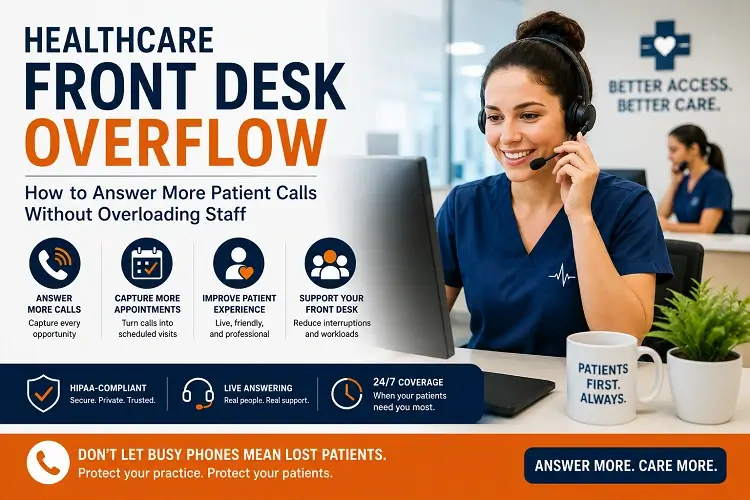
A strong healthcare answering service helps practices create a live answering layer around the front desk so more patient calls are answered, documented, and routed correctly.
This is not about replacing the front desk. It is about protecting it.
What Is Front Desk Overflow in Healthcare?
Front desk overflow happens when more patient calls come in than the in-office team can comfortably answer in real time.
This can happen during:
- Morning call rushes
- Lunch breaks
- Staff shortages
- Provider delays
- Appointment reminder periods
- Monday catch-up volume
- Insurance or referral-heavy days
- Seasonal demand spikes
- After-hours transitions
- Multi-location routing confusion
In many practices, overflow does not look dramatic from the outside. The phones ring, the team tries to keep up, patients wait, and some calls go unanswered or delayed.
The important question is not whether your front desk gets busy. It is what happens to patient calls when it does.
A patient calling to book an appointment may not know whether the team is short-staffed or helping another patient in person. They only know whether someone answered, listened, and helped them move forward.
That is why front desk overflow support matters. It helps the practice maintain a live human response even when the front desk is busy.
Why Front Desk Overflow Matters for Patient Access
Patient access starts before the appointment. It often starts with the first phone call.
If a patient cannot reach someone quickly, the practice may lose momentum before the relationship even begins. For existing patients, unanswered calls can create confusion. For new patients, delayed call response can make the practice feel difficult to reach.
Good front desk overflow coverage helps with three major goals:
- Answer more patient calls when demand is highest
- Capture appointment requests before they get lost
- Protect the in-office team from constant interruption
This is especially important for practices investing in SEO, Google Business Profile visibility, referrals, paid ads, or local reputation. If those channels generate calls, the answering system has to be strong enough to handle them.
Traffic without call coverage creates leakage.
Common Signs Your Practice Needs Front Desk Overflow Support
A medical practice may need overflow support if the team notices patterns like:
- Patients saying they tried to call but could not reach anyone
- Voicemails piling up during busy hours
- Front desk staff constantly switching between in-person patients and phone calls
- Appointment requests delayed until later in the day
- Calls missed during lunch breaks or provider rushes
- New patient inquiries not getting fast enough follow-up
- Staff feeling interrupted all day
- Multi-location calls going to the wrong place
- Weekend or after-hours calls requiring Monday cleanup
None of these signs mean the front desk is failing. Most of the time, it means the team is carrying more communication volume than one desk can handle.
The goal is to identify the specific windows and call types where additional coverage would have the biggest impact.
That is where a medical answering service can support the practice by answering overflow calls live and capturing the right information.
How Live Answering Supports a Busy Healthcare Front Desk
Live answering gives the front desk a backup layer.
When the team is unavailable, busy, or closed, trained agents can answer calls based on the practice’s workflow. They can greet patients, collect details, identify the reason for the call, document the message, and route the next step.
Depending on the practice, overflow answering can support:
- New appointment requests
- Reschedule requests
- Cancellation details
- Callback requests
- Referral questions
- Provider-specific routing
- Location-based call routing
- General patient questions
- After-hours message capture
- Urgent message escalation based on approved rules
The exact workflow should be based on the practice’s approved scripts, scheduling rules, routing instructions, and escalation requirements.
The goal is not to make the call process complicated. The goal is to make sure patient calls do not disappear when the front desk is overloaded.
A well-built front desk overflow support system gives the practice more breathing room without leaving patients waiting.
Why Appointment Request Capture Is the Biggest Win
For many practices, the most valuable overflow calls are appointment-related.
These calls may come from:
- New patients ready to schedule
- Existing patients needing follow-up
- Patients responding to referrals
- Patients calling after finding the practice on Google
- Patients comparing providers
- Patients trying to reschedule before they forget
If those calls are missed, delayed, or sent to voicemail, the appointment opportunity becomes weaker.
That is why appointment request capture should be a major part of front desk overflow planning. A live answering team can collect the patient’s name, callback number, preferred appointment type, preferred provider, location, timing needs, and reason for calling.
Then the in-office team can follow up with better context.
This does two things:
- It helps patients feel heard right away.
- It gives the front desk cleaner information when they return the call.
For practices that want more structured scheduling support, appointment scheduling support can help connect call answering with appointment workflows.
Front Desk Overflow vs After-Hours Answering
Front desk overflow and after-hours answering are related, but they are not the same.
Front desk overflow supports the practice when the office is technically open, but the team is too busy to answer every call.
After-hours answering supports the practice when the office is closed, such as evenings, weekends, holidays, or other closed-office periods.
Many practices need both.
| Situation |
Front Desk Overflow |
After-Hours Answering |
| Office open but phones are busy |
✓ |
— |
| Lunch or staffing gap |
✓ |
— |
| Evening calls |
— |
✓ |
| Weekend calls |
— |
✓ |
| Front desk helping patients in person |
✓ |
— |
| Holiday calls |
— |
✓ |
| Peak scheduling periods |
✓ |
— |
For example, a practice may miss calls:
- At 9:00 AM when phones are busiest
- At 12:30 PM during lunch
- At 4:45 PM when staff are wrapping up
- At 7:00 PM when patients call after work
- On Saturday when someone is ready to schedule
A complete call coverage strategy should look at every call gap, not only nights and weekends.
That is why an after-hours medical answering service works best when paired with overflow coverage during busy front desk windows.
What a Good Healthcare Overflow Workflow Should Include
A strong overflow answering workflow should be simple, clear, and built around the practice’s real call patterns.
At minimum, it should include:
1. Custom Greeting
Patients should hear a greeting that feels connected to the practice, not generic or confusing.
2. Call Reason Capture
Agents should identify whether the call is about scheduling, cancellation, referral, billing direction, provider message, location question, or another approved category.
3. Appointment Request Details
For appointment-related calls, the workflow should capture the details the practice needs for follow-up.
4. Routing Rules
Messages should go to the correct person, location, provider team, or department based on the practice’s instructions.
5. Escalation Rules
If certain calls require faster attention, agents should follow the practice’s approved escalation process.
6. HIPAA-Conscious Documentation
Healthcare calls need careful handling, documentation, and routing. Practices should choose a partner with healthcare-specific processes, not a generic message-taking setup.
For sensitive call workflows, a HIPAA-compliant medical answering service page can help practices understand what to look for.
Which Practices Benefit Most From Front Desk Overflow Support?
Front desk overflow support can help many types of healthcare practices, but it is especially valuable for practices with steady patient call volume or high appointment value.
Healthcare Answering Services Benefits for these practices:
- OB-GYN practices
- Fertility clinics
- Dental practices
- Plastic surgery practices
- Chiropractic offices
- Primary care clinics
- Specialty practices
- Multi-location healthcare groups
- Practices investing in SEO or paid ads
- Practices with limited front desk capacity
The common thread is simple: patient calls matter, and the front desk cannot always answer every one live.
For specialty practices, overflow support can be even more important because callers often need empathy, patience, and accurate message handling. A rushed or missed call can create unnecessary friction in the patient journey.
The right workflow may also vary by specialty, which is why scripts, intake fields, and escalation rules should be configured around the practice rather than copied from a generic call center script.
How Front Desk Overflow Support Improves Marketing ROI
Many practices think about call answering as an operations issue. But it also affects marketing performance.
If a practice is investing in:
- SEO
- Google Business Profile
- Local service pages
- Blog content
- Referrals
- Paid ads
- Directory listings
- Review generation
Then calls are one of the main conversion points.
A patient may read a blog, visit a service page, check reviews, and then call. If that call is missed, the marketing path breaks at the final step.
Practices can also use the Missed Call Revenue Calculator to estimate the potential revenue impact of unanswered calls.
Front desk overflow support helps close that gap.
It makes sure more callers reach a live human, more appointment requests are captured, and more marketing-generated demand turns into real follow-up opportunities.
This is why call coverage should be part of SEO and CRO planning, not only staffing planning.
What to Review Before Setting Up Overflow Answering
Start with one week of call data if possible. Look for patterns rather than relying only on staff impressions.
Before adding overflow support, a practice should review its current call flow.
Important questions include:
- When do most calls come in?
- Which hours create the most pressure?
- Which calls are most valuable?
- Which calls can be captured by an answering team?
- Which calls must stay with the in-office team?
- What information should be collected?
- Who receives messages?
- Which calls need escalation?
- Which locations or providers need separate routing?
- What should happen after-hours?
This review helps create a clean workflow before calls are answered by the overflow team.
A good setup starts with the real patient journey, not a generic script.
How Healthcare Call Center Helps With Front Desk Overflow
Our 24/7 Medical Call Center helps medical practices answer more patient calls without forcing the front desk to carry every call alone.
Coverage can be configured around the hours, locations, call types, and escalation rules that create the most pressure for each practice.
The support can include:
- Live patient call answering
- Front desk overflow coverage
- Appointment request capture
- After-hours message support
- Custom greetings and scripts
- Location and provider routing
- HIPAA-conscious call documentation
- Call flow recommendations
- Escalation based on approved practice rules
The goal is to help practices protect patient access while giving the in-office team more space to focus on the patients in front of them.
When overflow support is built correctly, the front desk stays in control — but patients still get a live response when the team is busy.
Final Takeaway
Front desk overflow is not just a phone problem. It is a patient access problem.
When calls come in faster than the front desk can answer them, appointment requests can be delayed, patient experience can suffer, and marketing performance can leak at the exact moment a patient is ready to act.
A strong healthcare answering workflow helps solve that problem.
With live answering, appointment request capture, after-hours coverage, and clear routing, practices can support more patient calls without overwhelming the front desk.
If your practice is growing, investing in SEO, or seeing more patient call volume, front desk overflow support may be one of the simplest ways to protect appointment demand.
Ready to review your call flow?
Book a free consultation and see where patient calls may be leaking.
Frequently Asked Question
What is front desk overflow in healthcare?
Front desk overflow happens when more patient calls come in than the in-office team can answer live. This often happens during busy mornings, lunch breaks, staff shortages, provider delays, after-hours transitions, or high-volume scheduling periods.
How does a healthcare answering service help with front desk overflow?
A healthcare answering service gives the practice a live answering layer when the front desk is busy or unavailable. Agents can answer calls, capture appointment requests, document messages, and route calls based on the practice’s workflow.
Is front desk overflow support the same as after-hours answering?
No. Front desk overflow support helps when the office is open but busy. After-hours answering helps when the office is closed. Many practices use both to cover more patient call gaps.
Can overflow agents capture appointment requests?
Yes. Agents can collect appointment type, patient contact details, preferred times, provider preferences, callback needs, and other scheduling details based on the practice’s approved workflow.
What types of practices need front desk overflow support?
OB-GYN, fertility, dental, plastic surgery, chiropractic, primary care, specialty practices, and multi-location groups often benefit from overflow support because patient calls can come in faster than the front desk can answer them.
Can front desk overflow support work with a multi-location practice?
Yes. Overflow support can use location-specific routing instructions so calls can be directed to the appropriate office, provider, department, or follow-up workflow based on the practice’s rules.
by Felicia Goodman | Jul 30, 2026 | Healthcare Answering Services
As a physician, your day does not end when you leave the office. Patients call with concerns at all hours. Some are routine – a question about medication timing or a request to reschedule. Others are urgent – post-operative pain, a sudden reaction, a worried parent calling about a child’s fever at 11 PM.
When a patient calls after hours and reaches voicemail, two things happen. First, their anxiety increases because they cannot reach the person they trust most: their doctor. Second, they make a decision that costs your practice revenue and threatens patient retention – they either go to urgent care, visit an emergency room, or call a competitor who answers.
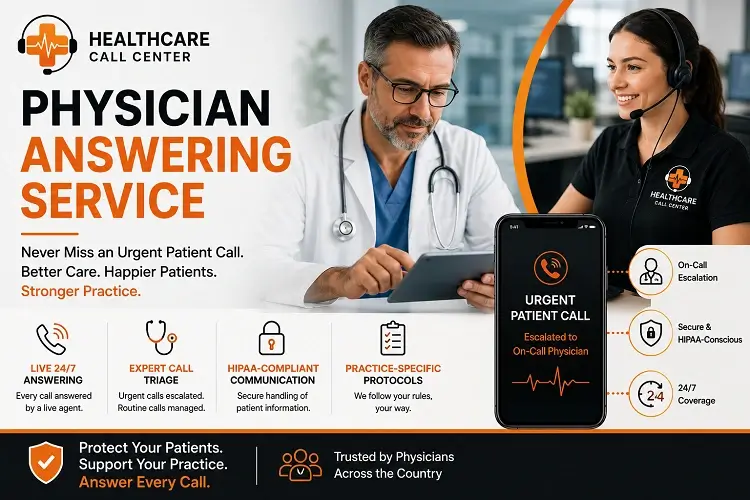
A physician medical answering service solves this problem. But not the old-fashioned kind that takes messages and sends them whenever someone remembers to check. A modern physician answering service is an extension of your practice – answering calls with your standards, triaging urgent from routine, following your specific escalation protocols, and ensuring that when something matters, you hear about it immediately.
What Is a Physician Answering Service?
A physician answering service is a specialized call handling provider that manages patient calls on behalf of doctors and medical practices. Unlike a generic answering service, a physician-specific service is built around the realities of medical practice:
- Urgent vs. non-urgent triage – Agents are trained to distinguish between a patient who needs to reach the on-call physician immediately and one whose question can wait until office hours.
- On-call provider escalation – When a call is urgent, the service follows your specific escalation protocol: paging the on-call physician, texting the covering provider, or routing to a specific specialist.
- HIPAA-compliant message delivery – Messages containing PHI are delivered through secure, encrypted channels – never standard SMS or email.
- Patient empathy and professionalism – Agents understand that patients calling a doctor’s office are often anxious, in pain, or scared. The tone is calm, professional, and compassionate.
- Practice-specific protocols – Every physician’s practice is different. The answering service follows your specific rules for what constitutes urgent, how to reach the on-call provider, and what information to collect.
Why Physicians Need a Specialized Answering Service (Not a Generic One)
Many physicians use generic answering services because they are cheap. This is a false economy. Here is what goes wrong:
Poor Triage Decisions
A generic agent does not understand medical urgency. They might page the physician for a non-urgent question, or worse, take a message for something that needed immediate attention. A physician answering service trains agents on medical triage protocols specific to your specialty.
Unprofessional Patient Interactions
Patients calling a doctor’s office expect to speak with someone who sounds competent and knowledgeable. A generic agent reading from a script without understanding medical terminology creates a poor impression of your practice.
Compliance Gaps
A generic answering service may not have a BAA in place, may deliver messages via unsecured channels, and may not train agents on PHI handling. Every one of these is a HIPAA violation waiting to happen.
No Escalation Protocol
When a patient calls at 2 AM with chest pain, the message cannot wait until morning. A physician answering service has clear, documented escalation paths for exactly these situations. A generic service might just take a message and move on.
Patient Frustration
Patients who reach a confused or unhelpful answering service often hang up and go elsewhere. A missed urgent call can lead to a patient visiting an emergency room unnecessarily (increasing healthcare costs) or delaying needed care (worsening outcomes).
How a Physician Answering Service Works
Call Answering
When a patient calls your practice after hours during front desk overflow periods, the call is automatically routed to the answering service. The agent answers with your practice name and follows your customized greeting.
Triage and Assessment
The agent follows your triage protocol to determine urgency. Is this a medical emergency?
If so, they direct the patient to call 911 or go to the nearest emergency room. Is this an urgent issue that needs the on-call physician? They follow your escalation protocol. Is this a routine matter? They take a detailed message for the next business day.
Message Delivery
For routine messages, the service delivers the information through your preferred secure channel: encrypted email, secure web portal, or direct entry into your practice management system. Messages include patient name, callback number, reason for call, and any relevant details.
Urgent Escalation
For urgent calls, the service follows your documented escalation path. This might be a text page to the on-call physician, a phone call to a covering provider, or a direct transfer. You define what constitutes urgent and exactly how the service should respond.
Documentation and Reporting
Every call is logged: time, caller, nature of call, action taken, and resolution. You receive regular reports showing call volume, after-hours activity, urgent call frequency, and response times.
What Physicians Should Look for in an Answering Service
Medical Specialization
The service should work exclusively or primarily with medical practices. Agents should be trained on medical terminology, patient communication standards, and triage protocols. Ask what percentage of their clients are healthcare providers.
Custom Triage Protocols
Your answering service should build triage protocols specific to your specialty. A dermatologist, an OB-GYN, and a psychiatrist all have different definitions of “urgent.” The service must understand and follow your specific rules.
On-Call Schedule Management
Your on-call schedule changes regularly. The answering service should have a system to receive and update on-call information in real time – so the right provider is always reached for urgent calls.
HIPAA Compliance
BAA, secure messaging, PHI training, audit trails. These are non-negotiable. Ask to see documentation of their compliance program.
Call Recording and Quality Monitoring
Calls should be recorded (with proper disclosure and consent) and reviewed regularly for quality. You should be able to listen to specific calls if there is a question about how a situation was handled.
Fast Answer Times
The service should answer calls within 3 rings or fewer. A patient calling with an urgent concern should not wait on hold.
Multiple Communication Channels
The best services offer more than phone answering. They can handle web chat, patient portal messages, and telehealth triage – providing a unified patient communication experience.
Physician Answering Service by Specialty
Primary Care Physicians
After-hours calls often involve medication questions, acute illness concerns, and post-visit follow-up. The answering service triages which calls need immediate attention and which can wait for morning.
OB-GYNs and Pregnancy Care
Pregnant patients call after hours with cramping, bleeding, decreased fetal movement, and labor concerns. The answering service must recognize obstetric urgency and escalate immediately to the on-call provider.
Surgeons and Surgical Specialists
Post-operative patients call with pain, swelling, fever, or wound concerns. The answering service must understand which symptoms warrant immediate provider contact versus routine next-day follow-up.
Psychiatrists and Mental Health Providers
Patients in mental health crisis may call after hours. The answering service must handle these calls with appropriate sensitivity and know when to connect the patient to crisis resources versus scheduling a next-day appointment.
Dentists and Dental Specialists
Dental emergencies – severe pain, broken teeth, lost crowns – need timely attention. The answering service can triage urgency and route true emergencies to the on-call dentist. See how our Dental Call Center Services support busy dental practices.
Plastic Surgeons
Post-op cosmetic surgery patients calling with concerns need careful triage. The answering service distinguishes between normal recovery questions and signs of complications that need immediate attention.
The Cost of Not Having a Physician Answering Service
Lost Revenue from Missed New Patient Calls
New patient inquiries are the lifeblood of a growing practice. If those calls go to voicemail after hours, a significant percentage of prospective patients simply call the next practice on their list. One missed new patient call can represent thousands of dollars in lifetime patient value.
Patient Safety Risks
When urgent calls go to voicemail, patients may delay seeking care, attempt to self-manage, or visit an emergency room unnecessarily. A live answering service ensures urgent calls are escalated promptly.
Physician Burnout from Direct After-Hours Calls
Some physicians give out their personal cell number for after-hours emergencies. This leads to non-urgent calls interrupting personal and family time. A physician answering service acts as a filter – only truly urgent calls reach you.
Patient Churn from Poor After-Hours Experience
Patients who cannot reach their doctor after hours feel abandoned. Even if the issue is minor, the experience of reaching voicemail when you are worried about your health damages trust. Over time, patients switch to practices that are more accessible.
Compliance and Liability Exposure
If your current after-hours solution is an untrained staff member checking voicemail from home, or a generic answering service without a BAA, you are exposed. A HIPAA-compliant physician answering service eliminates this risk.
Physician Answering Service Costs
Most physician answering services use per-call or per-minute pricing:
- Per-call: $1.00 to $3.00 per call, depending on complexity and whether triage is required
- Per-minute: $0.75 to $1.50 per minute of call time
- Monthly plans: $150 to $600 per month for solo physicians, $400 to $1,500 for multi-provider practices
The cost should be evaluated against the revenue at stake. A single new-patient consultation across many specialties is worth $500 to $5,000+. Recovering one or two new patient calls per month more than covers the cost of the service.
How to Choose the Best Physician Answering Service
Start by mapping your needs:
- How many after-hours calls do you receive per month?
- What is your current after-hours setup?
- Do you need overflow support during business hours?
- What are your triage protocols?
- How many providers need coverage?
Then evaluate 3 to 5 services against these criteria:
- Healthcare specialization (are they exclusively medical?)
- HIPAA compliance documentation
- Triage protocol customization
- On-call schedule management
- Average answer speed
- Message delivery method
- Reporting capabilities
- References from similar practices
- Pricing structure and transparency
- Contract terms (month-to-month vs. annual)
The best physician answering service is one that feels like an extension of your practice – not a third-party vendor. Patients should not be able to tell the difference between calling your office and calling the answering service.
Making It Work for Your Practice
A physician answering service is more than a vendor – it is a partner in patient care. The right service ensures that every patient call is answered by someone who is professional, compassionate, and knowledgeable about your practice. It protects your patients when you cannot answer the phone yourself, and it protects your practice from the revenue loss, compliance risks, and patient churn that come with missed calls.
If you are still sending after-hours calls to voicemail, or if your current answering service is not delivering the quality your patients deserve, it may be time to upgrade.
Book a free consultation to see how Healthcare Call Center can provide physician answering service that protects your patients and your practice.
FAQs
- What is a physician answering service?
A physician answering service is a specialized call handling provider that manages patient calls for doctors and medical practices. It includes urgent vs. non-urgent triage, on-call provider escalation, a HIPAA-compliant medical answering service, and patient communication that meets medical standards.
- How much does a physician answering service cost?
Most physician answering services charge $1.00 to $3.00 per call or $0.75 to $1.50 per minute. Monthly plans range from $150 for solo physicians to $1,500 for multi-provider practices, depending on call volume and service complexity.
- Can a physician answering service handle urgent after-hours calls?
Yes. The service follows your documented triage protocols to identify urgent calls and escalate them to your on-call provider immediately. Non-urgent calls are documented and delivered for next-business-day follow-up.
- Is a physician answering service HIPAA compliant?
A legitimate physician answering service must be HIPAA compliant. This includes signing a BAA, using encrypted message delivery, training agents on PHI handling, and maintaining audit trails for all patient interactions.
- Will the answering service know when to contact me directly?
Yes. During setup, you define your triage protocols and escalation rules. The service is trained on exactly what constitutes an urgent call for your specialty and follows your specific instructions for when to page, text, or call you directly.
by Erika Sanchez | Jul 22, 2026 | Healthcare Answering Services
Patient retention is often discussed as if it begins after the appointment. In reality, retention starts much earlier. It begins when a patient calls with a question, concern, scheduling need, refill request, follow-up issue, or anxiety about what happens next. If that call is rushed, missed, or sent to voicemail, the patient experience changes before the provider ever gets involved.
A human healthcare answering service gives practices a way to protect those moments. It helps patients reach a calm, trained person instead of an unanswered phone line. It supports front desk teams when they are overloaded. It helps after-hours call answering callers feel acknowledged. Most importantly, it reinforces the idea that the practice is responsive and organized.
This matters because patients do not stay loyal only because of clinical quality. They stay when the full experience feels trustworthy. Access, communication, follow-up, empathy, and reliability all shape whether a patient returns, refers a family member, or quietly looks for another provider.
Why Phone Communication Affects Patient Retention
Patients judge a practice through many small moments. Was the phone answered? Did the person understand the concern? Was the message captured correctly? Did the caller know what would happen next? These questions may feel operational, but they shape trust. A patient who cannot reach the office may begin to wonder whether the practice will be available when something is more serious.
Healthcare communication also carries more emotion than many other industries. Patients may be calling about pain, test results, pregnancy concerns, fertility questions, post-procedure symptoms, insurance confusion, or an appointment they are nervous to schedule. A rushed voicemail prompt can feel cold. A human voice can slow the moment down and create confidence.
For patient retention, the first call after an appointment can be as important as the first appointment itself. If patients feel ignored during follow-up, they may not return for ongoing care. If they feel supported, they are more likely to stay connected to the practice.
What Makes a Healthcare Answering Service Retention-Focused
A live healthcare answering service improves retention when it does more than collect names and phone numbers. The service should understand the practice’s patient journey. It should know which calls need urgent routing, which calls need structured intake, which messages can wait, and which details the front desk needs to follow up properly.
Retention-focused answering starts with empathy. The caller should feel heard, not processed. It also requires consistency. Every call should follow practice-approved instructions so patients receive the same type of guidance no matter when they call. Finally, it requires clean message delivery. A helpful phone call can still fail if the message reaches the wrong person, lacks context, or arrives too late.
The best healthcare answering service becomes part of the practice’s communication system. It does not replace the care team. It protects access to the care team.
A Retention-Focused Healthcare Answering Service Should Include
- Live human answering
- After-hours coverage
- Front desk overflow support
- Urgent message routing
- Practice-specific call scripts
- Clear message delivery
- HIPAA-conscious workflows
- Consistent patient communication
Human Answering Versus Automated Call Handling
Automation can help with simple routing, reminders, and basic information. But many healthcare calls are not simple. A patient may start with one question and reveal a more sensitive concern. A parent may not know whether a symptom is urgent. A fertility patient may be anxious about timing. A plastic surgery patient may need reassurance after a procedure. A dental patient may be deciding whether to book now or wait.
A human healthcare answering service can listen for context. It can ask approved follow-up questions, confirm details, and communicate warmth. This does not mean the call team gives clinical advice. It means the patient does not feel abandoned while the practice’s escalation rules are followed.
| Automated Answering |
Human Healthcare Answering |
| Fixed scripts |
Natural conversations |
| Limited understanding |
Understands patient context |
| Often ends in voicemail |
Live human response |
| Basic routing |
Practice-approved escalation |
| Less personal |
Builds patient trust |
How Live Answering Supports Specialty Practices
Specialty practices often have higher-emotion calls than general service businesses. OB-GYN callers may have pregnancy questions after hours. Fertility patients may be worried about timing and instructions. Plastic surgery patients may call with post-procedure concerns. Dental patients may be in pain. Chiropractic, dermatology, and med-spa callers may need help deciding whether to book or ask a follow-up question.
In each case, patient retention depends on the practice feeling reachable. If patients only reach voicemail, they may feel they are on their own. If they reach a trained human who can capture the concern and route the message appropriately, they feel connected to the practice.
This is why a human healthcare answering service is not only an acquisition tool. It is also a retention tool. It helps practices keep the patients they already worked hard to earn. We at Healthcare Call Center have trained stay-at-home moms as agents who are full of empathy and skills to support patients in appointment booking and your practice growth.
How Better Phone Communication Improves Patient Retention
Patients are more likely to stay with a practice when communication is easy, consistent, and responsive. Live answering supports patient retention by improving access, reducing missed calls, ensuring timely follow-up, and helping patients feel heard during important moments.
It should also use specific healthcare language that shows topical authority, including after-hours coverage, front desk overflow, urgent message routing, appointment requests, patient communication services, and HIPAA-conscious workflows.
The article should not simply say “answer more calls.” It should explain how better call handling supports long-term relationships. For example, a caller who gets help after hours is more likely to trust the practice. A patient whose message is routed correctly is less likely to feel forgotten. A new patient who reaches a warm human voice is more likely to book and return.
Those concrete connections make the content more useful for human readers and easier for AI systems to summarize accurately.
Why Healthcare Call Center Supports Better Patient Retention
Healthcare Call Center focuses on human, healthcare-specific communication. That matters for practices that want call support without making patients feel like they are speaking to a generic service. The right answering process should sound calm, clear, and aligned with the practice’s tone.
For retention, the value is in consistent responsiveness. Patients should not feel that their access depends on whether the front desk happened to be free at that exact second. They should be able to call during busy hours, after hours, or during staffing gaps and still receive a professional response.
When patients feel the practice is reachable, they are more likely to continue care. That is the retention value of human answering. It turns the phone from a weak point into a trust-building channel.
Keep More Patients by Improving Every Phone Call
Patient retention starts long before the next appointment. If unanswered calls, delayed callbacks, or inconsistent after-hours communication are affecting your patient experience, Healthcare Call Center can help.
👉 Book a Free Consultation
Final Takeaway For Practice Leaders
The right healthcare answering service strategy is not about adding another vendor for the sake of it. It is about protecting patient access at the exact moments when communication usually breaks down. Healthcare practices work hard to earn patient trust through clinical care, but that trust can weaken when callers cannot reach anyone, cannot explain what they need, or do not know what happens next.
For Healthcare Call Center, the content should close by connecting the topic back to human support, healthcare-specific workflows, and patient communication. The final CTA should invite the reader to book a consultation if missed calls, voicemail drop-offs, overflow, or inconsistent patient follow-up are affecting the practice experience.
Frequently Asked Questions
How does a healthcare answering service improve patient retention?
It improves retention by helping patients reach a live person, reducing voicemail frustration, capturing messages clearly, supporting follow-up, and making the practice feel more responsive.
Is human answering better than automated answering for healthcare calls?
Human answering is often better for sensitive healthcare calls because trained people can listen for context, show empathy, and follow practice-approved escalation rules.
Can an answering service help after hours?
Yes. A healthcare answering service can capture after-hours calls, route urgent messages according to protocol, and help patients know their concern was received.
Does patient retention depend on phone access?
Phone access is one important part of retention. Patients are more likely to stay with a practice when communication feels easy, reliable, and respectful.
What practices benefit most from human healthcare answering?
Specialty practices, high-call-volume offices, after-hours care teams, dental offices, OB-GYN practices, fertility clinics, plastic surgery practices, and offices with front desk overflow can benefit.
Does patient retention improve when missed calls decrease?
Yes. When patients can reach a live person instead of voicemail, they’re more likely to feel supported, complete follow-up care, and continue choosing the same practice for future healthcare needs.