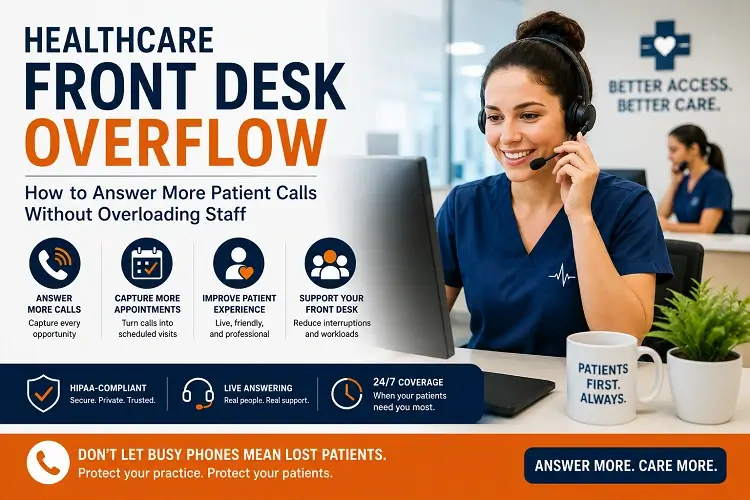
A healthcare front desk can be busy even when the practice is running well.
Patients call to schedule appointments, reschedule visits, ask about referrals, confirm insurance, request directions, follow up on messages, or speak with the right department. At the same time, the front desk may be checking in patients, supporting providers, handling paperwork, managing in-office questions, and trying to keep the day moving.
That is where front desk overflow becomes a real patient access problem.
When calls stack up faster than the team can answer them, patients may wait too long, hang up, leave incomplete messages, or call again later with more frustration. For a healthcare practice, that is not just an operational issue. It affects appointment flow, patient experience, and the value of every marketing channel sending people to the phone.
A strong healthcare answering service helps practices create a live answering layer around the front desk so more patient calls are answered, documented, and routed correctly.
This is not about replacing the front desk. It is about protecting it.
What Is Front Desk Overflow in Healthcare?
Front desk overflow happens when more patient calls come in than the in-office team can comfortably answer in real time.
This can happen during:
- Morning call rushes
- Lunch breaks
- Staff shortages
- Provider delays
- Appointment reminder periods
- Monday catch-up volume
- Insurance or referral-heavy days
- Seasonal demand spikes
- After-hours transitions
- Multi-location routing confusion
In many practices, overflow does not look dramatic from the outside. The phones ring, the team tries to keep up, patients wait, and some calls go unanswered or delayed.
The important question is not whether your front desk gets busy. It is what happens to patient calls when it does.
A patient calling to book an appointment may not know whether the team is short-staffed or helping another patient in person. They only know whether someone answered, listened, and helped them move forward.
That is why front desk overflow support matters. It helps the practice maintain a live human response even when the front desk is busy.
Why Front Desk Overflow Matters for Patient Access
Patient access starts before the appointment. It often starts with the first phone call.
If a patient cannot reach someone quickly, the practice may lose momentum before the relationship even begins. For existing patients, unanswered calls can create confusion. For new patients, delayed call response can make the practice feel difficult to reach.
Good front desk overflow coverage helps with three major goals:
- Answer more patient calls when demand is highest
- Capture appointment requests before they get lost
- Protect the in-office team from constant interruption
This is especially important for practices investing in SEO, Google Business Profile visibility, referrals, paid ads, or local reputation. If those channels generate calls, the answering system has to be strong enough to handle them.
Traffic without call coverage creates leakage.
Common Signs Your Practice Needs Front Desk Overflow Support
A medical practice may need overflow support if the team notices patterns like:
- Patients saying they tried to call but could not reach anyone
- Voicemails piling up during busy hours
- Front desk staff constantly switching between in-person patients and phone calls
- Appointment requests delayed until later in the day
- Calls missed during lunch breaks or provider rushes
- New patient inquiries not getting fast enough follow-up
- Staff feeling interrupted all day
- Multi-location calls going to the wrong place
- Weekend or after-hours calls requiring Monday cleanup
None of these signs mean the front desk is failing. Most of the time, it means the team is carrying more communication volume than one desk can handle.
The goal is to identify the specific windows and call types where additional coverage would have the biggest impact.
That is where a medical answering service can support the practice by answering overflow calls live and capturing the right information.
How Live Answering Supports a Busy Healthcare Front Desk
Live answering gives the front desk a backup layer.
When the team is unavailable, busy, or closed, trained agents can answer calls based on the practice’s workflow. They can greet patients, collect details, identify the reason for the call, document the message, and route the next step.
Depending on the practice, overflow answering can support:
- New appointment requests
- Reschedule requests
- Cancellation details
- Callback requests
- Referral questions
- Provider-specific routing
- Location-based call routing
- General patient questions
- After-hours message capture
- Urgent message escalation based on approved rules
The exact workflow should be based on the practice’s approved scripts, scheduling rules, routing instructions, and escalation requirements.
The goal is not to make the call process complicated. The goal is to make sure patient calls do not disappear when the front desk is overloaded.
A well-built front desk overflow support system gives the practice more breathing room without leaving patients waiting.
Why Appointment Request Capture Is the Biggest Win
For many practices, the most valuable overflow calls are appointment-related.
These calls may come from:
- New patients ready to schedule
- Existing patients needing follow-up
- Patients responding to referrals
- Patients calling after finding the practice on Google
- Patients comparing providers
- Patients trying to reschedule before they forget
If those calls are missed, delayed, or sent to voicemail, the appointment opportunity becomes weaker.
That is why appointment request capture should be a major part of front desk overflow planning. A live answering team can collect the patient’s name, callback number, preferred appointment type, preferred provider, location, timing needs, and reason for calling.
Then the in-office team can follow up with better context.
This does two things:
- It helps patients feel heard right away.
- It gives the front desk cleaner information when they return the call.
For practices that want more structured scheduling support, appointment scheduling support can help connect call answering with appointment workflows.
Front Desk Overflow vs After-Hours Answering
Front desk overflow and after-hours answering are related, but they are not the same.
Front desk overflow supports the practice when the office is technically open, but the team is too busy to answer every call.
After-hours answering supports the practice when the office is closed, such as evenings, weekends, holidays, or other closed-office periods.
Many practices need both.
| Situation | Front Desk Overflow | After-Hours Answering |
| Office open but phones are busy | ✓ | — |
| Lunch or staffing gap | ✓ | — |
| Evening calls | — | ✓ |
| Weekend calls | — | ✓ |
| Front desk helping patients in person | ✓ | — |
| Holiday calls | — | ✓ |
| Peak scheduling periods | ✓ | — |
For example, a practice may miss calls:
- At 9:00 AM when phones are busiest
- At 12:30 PM during lunch
- At 4:45 PM when staff are wrapping up
- At 7:00 PM when patients call after work
- On Saturday when someone is ready to schedule
A complete call coverage strategy should look at every call gap, not only nights and weekends.
That is why an after-hours medical answering service works best when paired with overflow coverage during busy front desk windows.
What a Good Healthcare Overflow Workflow Should Include
A strong overflow answering workflow should be simple, clear, and built around the practice’s real call patterns.
At minimum, it should include:
1. Custom Greeting
Patients should hear a greeting that feels connected to the practice, not generic or confusing.
2. Call Reason Capture
Agents should identify whether the call is about scheduling, cancellation, referral, billing direction, provider message, location question, or another approved category.
3. Appointment Request Details
For appointment-related calls, the workflow should capture the details the practice needs for follow-up.
4. Routing Rules
Messages should go to the correct person, location, provider team, or department based on the practice’s instructions.
5. Escalation Rules
If certain calls require faster attention, agents should follow the practice’s approved escalation process.
6. HIPAA-Conscious Documentation
Healthcare calls need careful handling, documentation, and routing. Practices should choose a partner with healthcare-specific processes, not a generic message-taking setup.
For sensitive call workflows, a HIPAA-compliant medical answering service page can help practices understand what to look for.
Which Practices Benefit Most From Front Desk Overflow Support?
Front desk overflow support can help many types of healthcare practices, but it is especially valuable for practices with steady patient call volume or high appointment value.
Healthcare Answering Services Benefits for these practices:
- OB-GYN practices
- Fertility clinics
- Dental practices
- Plastic surgery practices
- Chiropractic offices
- Primary care clinics
- Specialty practices
- Multi-location healthcare groups
- Practices investing in SEO or paid ads
- Practices with limited front desk capacity
The common thread is simple: patient calls matter, and the front desk cannot always answer every one live.
For specialty practices, overflow support can be even more important because callers often need empathy, patience, and accurate message handling. A rushed or missed call can create unnecessary friction in the patient journey.
The right workflow may also vary by specialty, which is why scripts, intake fields, and escalation rules should be configured around the practice rather than copied from a generic call center script.
How Front Desk Overflow Support Improves Marketing ROI
Many practices think about call answering as an operations issue. But it also affects marketing performance.
If a practice is investing in:
- SEO
- Google Business Profile
- Local service pages
- Blog content
- Referrals
- Paid ads
- Directory listings
- Review generation
Then calls are one of the main conversion points.
A patient may read a blog, visit a service page, check reviews, and then call. If that call is missed, the marketing path breaks at the final step.
Practices can also use the Missed Call Revenue Calculator to estimate the potential revenue impact of unanswered calls.
Front desk overflow support helps close that gap.
It makes sure more callers reach a live human, more appointment requests are captured, and more marketing-generated demand turns into real follow-up opportunities.
This is why call coverage should be part of SEO and CRO planning, not only staffing planning.
What to Review Before Setting Up Overflow Answering
Start with one week of call data if possible. Look for patterns rather than relying only on staff impressions.
Before adding overflow support, a practice should review its current call flow.
Important questions include:
- When do most calls come in?
- Which hours create the most pressure?
- Which calls are most valuable?
- Which calls can be captured by an answering team?
- Which calls must stay with the in-office team?
- What information should be collected?
- Who receives messages?
- Which calls need escalation?
- Which locations or providers need separate routing?
- What should happen after-hours?
This review helps create a clean workflow before calls are answered by the overflow team.
A good setup starts with the real patient journey, not a generic script.
How Healthcare Call Center Helps With Front Desk Overflow
Our 24/7 Medical Call Center helps medical practices answer more patient calls without forcing the front desk to carry every call alone.
Coverage can be configured around the hours, locations, call types, and escalation rules that create the most pressure for each practice.
The support can include:
- Live patient call answering
- Front desk overflow coverage
- Appointment request capture
- After-hours message support
- Custom greetings and scripts
- Location and provider routing
- HIPAA-conscious call documentation
- Call flow recommendations
- Escalation based on approved practice rules
The goal is to help practices protect patient access while giving the in-office team more space to focus on the patients in front of them.
When overflow support is built correctly, the front desk stays in control — but patients still get a live response when the team is busy.
Final Takeaway
Front desk overflow is not just a phone problem. It is a patient access problem.
When calls come in faster than the front desk can answer them, appointment requests can be delayed, patient experience can suffer, and marketing performance can leak at the exact moment a patient is ready to act.
A strong healthcare answering workflow helps solve that problem.
With live answering, appointment request capture, after-hours coverage, and clear routing, practices can support more patient calls without overwhelming the front desk.
If your practice is growing, investing in SEO, or seeing more patient call volume, front desk overflow support may be one of the simplest ways to protect appointment demand.
Ready to review your call flow?
Book a free consultation and see where patient calls may be leaking.
Frequently Asked Question
What is front desk overflow in healthcare?
Front desk overflow happens when more patient calls come in than the in-office team can answer live. This often happens during busy mornings, lunch breaks, staff shortages, provider delays, after-hours transitions, or high-volume scheduling periods.
How does a healthcare answering service help with front desk overflow?
A healthcare answering service gives the practice a live answering layer when the front desk is busy or unavailable. Agents can answer calls, capture appointment requests, document messages, and route calls based on the practice’s workflow.
Is front desk overflow support the same as after-hours answering?
No. Front desk overflow support helps when the office is open but busy. After-hours answering helps when the office is closed. Many practices use both to cover more patient call gaps.
Can overflow agents capture appointment requests?
Yes. Agents can collect appointment type, patient contact details, preferred times, provider preferences, callback needs, and other scheduling details based on the practice’s approved workflow.
What types of practices need front desk overflow support?
OB-GYN, fertility, dental, plastic surgery, chiropractic, primary care, specialty practices, and multi-location groups often benefit from overflow support because patient calls can come in faster than the front desk can answer them.
Can front desk overflow support work with a multi-location practice?
Yes. Overflow support can use location-specific routing instructions so calls can be directed to the appropriate office, provider, department, or follow-up workflow based on the practice’s rules.