Your front desk team starts most days with a pile of work that has nothing to do with patients. Insurance paperwork is missing for three visits this week. Four follow-up calls from last week are still unscheduled. Two new patient inquiries that came in overnight are sitting in voicemail. By the time the phones get busy, half the morning is already gone, and the pile has grown.
A Healthcare AI practice agent exists to eat that pile. Not the patient care, not the judgment calls, and not the human conversations your team is great at. The repetitive back-office work that quietly consumes hours of staff time every week.
Quick Summary
An AI practice agent is a chat-based assistant that runs recurring back-office work for a medical practice from one shared chat window. It chases missing documents, builds daily follow-up lists, texts back missed calls within 30 seconds, sends appointment reminders, checks schedules, and posts daily reports, while trained humans review anything sensitive before it reaches a patient. Unlike a traditional chatbot, an AI practice agent is designed to execute recurring workflows, not simply respond to individual questions.
What Is an AI Practice Agent?
An AI practice agent is a software assistant that performs ongoing operational tasks for a medical practice instead of just answering questions about them. That distinction matters. A chatbot reacts when a patient types a question into a widget, while an AI medical receptionist is designed for patient-facing communication and phone-related workflows. An AI practice agent is given standing instructions, connects to the tools your practice already uses, and does the work on a schedule or on request.
The whole team uses the same agent through a chat app most staff already have on their phones, Telegram or Slack. Front office, billing, and the practice manager see the same thread. Someone asks, the agent acts, and the result lands where everyone can see it.
The category is new, which is why the definition varies from vendor to vendor. At Healthcare Call Center, the AI Practice Agent combines automation with human oversight: the agent does the legwork, and trained operators review anything sensitive, especially anything that touches protected health information.
How is an AI Practice Agent Different From a Chatbot?
A chatbot primarily responds when someone asks a question. An AI practice agent is designed to carry out recurring workflows based on instructions, schedules, and connected practice systems.
For example, a chatbot might answer, “What are your office hours?” An AI practice agent might generate the morning follow-up list, identify missing documents, send approved reminders, and report which tasks still need human attention.
The difference is simple: a chatbot answers; an AI practice agent helps execute the workflow.
What Does an AI Practice Agent Actually Do?
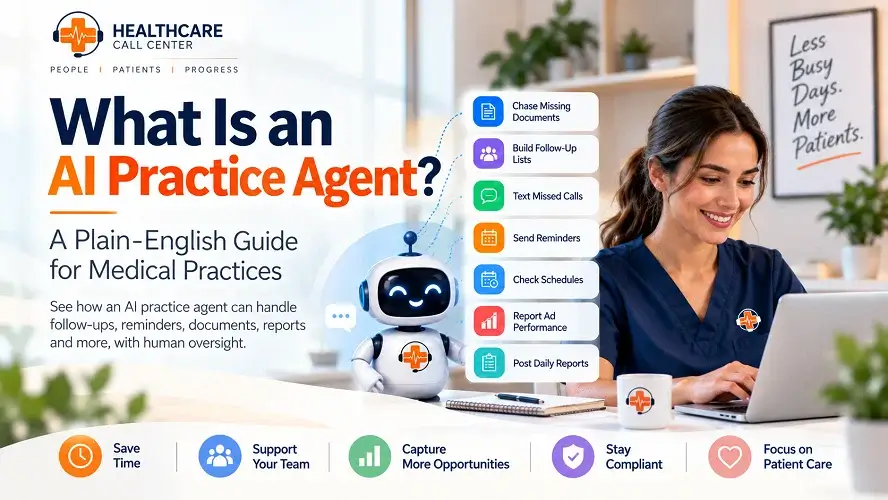
The honest answer is: the boring work that never feels urgent until it piles up. Here are the seven tasks practices hand over first.
Every practice is a little different, but after mapping dozens of workflows, the same tasks come up again and again. If your week contains any of the following, this section is for you.
1. Chasing Missing Documents
Lab results, referral letters, insurance forms, and intake paperwork go missing constantly. The agent tracks what is outstanding for each patient, follows up automatically, and keeps one running list of what is still missing, so nobody scrolls through old group chats to figure it out.
2. Building the Morning Follow-Up List
Every morning, the agent posts a short list of the follow-ups due that day in your shared chat. Your team starts with a plan instead of reconstructing one from memory and sticky notes.
3. Texting Back Missed Calls in 30 Seconds
When a call goes unanswered, the agent sends missed-call users a text within 30 seconds, so a ready-to-book patient gets a response instead of silence. The callbacks land in one queue for your team to finish personally.
4. Sending Appointment Reminders and Confirmations
Reminder batches go out on schedule, confirmations come back into one thread, and no-show-prone slots get flagged early enough to refill.
5. Checking Tomorrow’s Schedule
Ask who is in tomorrow, where the open slots are, or which patients need a reminder, and you get a straight answer pulled from your practice calendar.
6. Watching Ad Performance
For practices running Meta ads, the agent reports overnight spend, lead counts, and which ad needs attention, and can pause an underperforming ad for human approval.
7. Posting the Daily Report
Spend, leads, reminders completed, and open follow-ups are posted in your thread every morning while the numbers are still actionable.
What an AI Practice Agent Will Not Do
The limits are the point. A well-run AI practice agent does not give medical advice, does not make clinical decisions, and does not message a patient without your rules in place. Anything sensitive, such as insurance changes or anything touching protected health information, is flagged and reviewed by trained human operators before it goes out.
That human oversight layer is what separates a practice agent from a raw automation script. The bot handles legwork at machine speed. People stay responsible for judgment.
Tasks That Should Stay With Humans
An AI practice agent can support administrative workflows, but practices should define clear boundaries for tasks involving:
- Medical advice or clinical interpretation
- Symptoms and diagnosis
- Medication decisions
- Urgent or emergency concerns
- Complex insurance or billing disputes
- Sensitive patient communications
- Anything requiring professional judgment
The agent should route these situations according to the practice’s escalation rules rather than attempting to make the decision itself.
AI Practice Agent vs Chatbot vs Virtual Receptionist vs Answering Service
These four get mixed up constantly, so here is the plain-English version.
| Option | What it does | Best for |
| Chatbot | Answers website questions | Basic site inquiries |
| AI Practice Agent | Runs back-office tasks in your team chat, on your rules | Document chases, follow-ups, reminders, reports |
| Virtual Receptionist | Remote human handles calls and admin | Business-hours call coverage |
| Answering Service | Live humans answer patient calls 24/7 | After-hours and overflow phone coverage |
| Primary Interaction | Where the service primarily interacts | Website, internal team chat, or patient phone calls depending on the option |
Notice that an AI practice agent and an answering service are not competitors. One runs the back office in chat. The other answers the phones. Practices with steady call volume usually need both, which is how Healthcare Call Center packages them: live US-based agents cover patient calls around the clock, and the agent runs everything else in the thread.
Who Benefits Most From an AI Practice Agent?
Multi-location groups use it to keep every site’s follow-ups in one thread instead of five separate inboxes. Solo and two-provider practices use it as the ops person they have not hired yet, covering document chases, reminders, and daily reports without adding payroll.
Practices running Meta ads use the daily spend and lead reporting to catch a failing ad in hours instead of weeks. And growing specialty practices, from med spas to fertility clinics, use it to protect the high-value bookings that sit at the bottom of a bloated task list. The common thread is simple: if the work repeats, follows a rule, and lives in a tool you already use, the agent can probably take it.
A Day With an AI Practice Agent
Here is what a normal morning looks like in the shared window.
7:58 am. The daily report lands: ad spend from yesterday, 19 new leads, 14 reminder confirmations, and 2 missing-document follow-ups flagged for review.
8:04 am. Your front desk asks: “Send today’s reminder batch.” The agent sends it and reports back: 18 sent, 3 phone numbers failed validation.
9:30 am. A team member asks about tomorrow. The agent answers: 18 appointments, 2 openings, 3 patients flagged for confirmation calls.
Total time spent in the chat: a few minutes. No tab hopping, no sticky notes, no end-of-month surprises.
Is an AI Practice Agent HIPAA-aware?
Whether an AI practice agent needs to operate under HIPAA depends on how it is used and whether it creates, receives, maintains, or transmits protected health information on behalf of a covered entity. Practices should verify the vendor’s data flows, security controls, access management, and Business Associate Agreement requirements before connecting systems containing PHI.
For HCC’s implementation, the agent is designed around HIPAA-conscious workflows, data minimization, human oversight, and the appropriate contractual safeguards for workflows involving PHI.
Practices using AI in patient-facing workflows should also understand emerging AI disclosure requirements and how those rules may affect patient communication.
How Fast Can a Practice Start?
Faster than most practices expect. The process starts with a $49 working session, where you watch the agent handle your biggest chore live on sample data and leave with a written plan you keep either way. Full setup, including workflow mapping, tool connections, training, and launch, typically finishes within 2 business days. Operation runs 499 dollars per month, with no long-term contracts.
Do You Still Need a Live Answering Service?
Yes, if your phones ring. An AI practice agent works in text, inside your team chat. It cannot comfort an anxious patient calling about a procedure at 9 pm, and it cannot have the warm, human conversation that turns a first-time caller into a booked consultation.
That is live answering’s job. US-based agents answer in your practice name around the clock, which is where the after-hours coverage gap hurts most practices first. The agent and the healthcare answering service cover different lanes: the bot runs the back office while live humans handle the phones. If you want to size the phone problem at your practice, start with the missed call revenue calculator, then read our breakdown of how much revenue medical practices lose from after-hours missed calls.
Frequently Asked Questions
What is an AI practice agent in simple terms?
It is a chat-based assistant that does recurring administrative work for your practice, such as chasing documents, sending reminders, and posting daily reports, following your rules and escalating anything sensitive to a human.
Does an AI practice agent replace front desk staff?
No. It removes the repetitive chores, so your team can focus on patients and judgment calls. Your team reviews everything important before it goes out.
Is patient information safe with an AI agent?
Yes, when it is set up correctly: HIPAA-compliant infrastructure, a signed Business Associate Agreement, data minimization, and human review on sensitive messages.
How long does setup take?
Most practices are live within 2 business days of full setup. The 49 dollar session happens first, and you keep the written plan either way.
How much does an AI practice agent cost?
At Healthcare Call Center: a 49 dollar one-hour working session to start, 5,000 dollars one-time for full setup, and 499 dollars per month to operate. No long-term contracts.
The Bottom Line
An AI practice agent is not a robot replacing your team. It is the reliable back-office helper that chases what everyone forgets, reports what everyone guesses at, and gives your front desk its mornings back. Pair it with live human phone coverage and your practice stops leaking time and patients in two different places.
The practices that see the biggest gains treat the agent like a new hire, not a magic button: they map their workflows honestly, set clear escalation rules, and review the first two weeks of output. Do that, and the 4-8 hours a week is not a marketing promise. It is arithmetic.
Book a free consultation with Healthcare Call Center, and we will show you the agent working on sample data from a practice like yours.