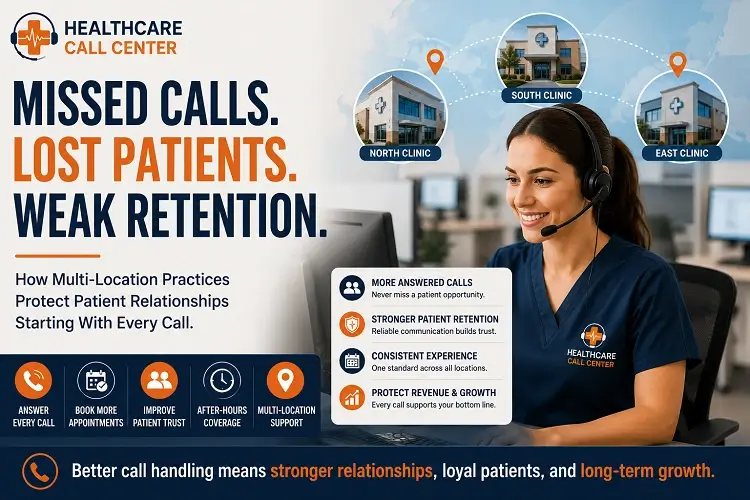
Multi-location practices often focus on growth metrics first.
They track new patient volume, referral sources, ad spend, provider utilization, appointment availability, and revenue by location. Those numbers matter. But one of the biggest patient retention problems often starts with something much simpler.
A phone call that never gets answered.
For a single-location practice, missed calls are already expensive. For a multi-location practice, the problem multiplies. More locations mean more front desks, more schedules, more providers, more call flows, more patient questions, and more chances for callers to fall through the cracks.
When patients cannot reach the office, they do not always complain. They may simply call another location, choose another provider, skip a follow-up, delay care, or stop trusting the practice to respond when they need help.
That is why missed calls are not only a lead problem. They are a patient retention problem.
For growing medical groups, better call handling is not just an operational fix. It is a way to protect patient relationships across every location.
Why Missed Calls Matter More in Multi-Location Practices
A multi-location practice has more moving parts than a single office.
Patients may call one location to ask about another. A provider may rotate between offices. Scheduling rules may vary by location. Some offices may be busier than others. One front desk may be fully staffed while another is stretched thin.
From the patient’s point of view, none of that should matter.
They expect the practice to answer, understand the request, and route them to the right next step. If the call is missed, the patient does not think about staffing patterns or operational complexity. They feel ignored.
That feeling can damage retention.
A patient who cannot reach the practice may wonder:
- Will anyone call me back?
- Is this office too busy for me?
- Should I find a provider that is easier to reach?
- Will follow-up care be this frustrating?
- Can I trust this group with something important?
For multi-location practices, consistency matters. A patient should not receive a great call experience at one location and a poor one at another. Missed calls create inconsistency, and inconsistency weakens trust.
Missed Calls Create a Weak First Impression
Patient retention starts earlier than many practices realize.
It does not begin after the first visit. It begins when the patient first tries to contact the practice.
If a caller is a new patient, that first call may decide whether they book. If a caller is an existing patient, that first failed attempt may decide whether they stay loyal. This is when a dedicated medical virtual receptionist helps to recover your missed-call patient and convert it as booked patient.
A missed call can create several problems at once:
- The patient may not leave a voicemail.
- The patient may call a competitor.
- The patient may delay scheduling.
- The patient may lose confidence in the practice.
- The front desk may spend time chasing callbacks later.
- The marketing team may not know the lead was lost.
This is why a US-based healthcare call center for patient retention matters for practices that are trying to grow. The phone experience is part of the patient experience.
If the first call feels unreliable, the practice starts the relationship from behind.
Retention Is Not Just About Clinical Care
Patients stay with a practice for more than clinical outcomes.
They stay because the experience feels reliable. They stay because communication is clear. They stay because scheduling is easy. They stay because they know how to reach someone when they need help.
Clinical care may be excellent, but poor access can still push patients away.
A multi-location practice can invest in strong providers, updated technology, a polished website, and strong reviews. But if patients cannot get through by phone, the practice still feels hard to work with.
Retention is built through repeated moments of confidence.
A patient books easily. A question gets answered. A callback happens when expected. A follow-up appointment is scheduled without friction. An after-hours message is routed properly. A billing or referral question does not disappear.
Missed calls break those moments.
Multi-Location Practices Often Do Not See the Full Missed Call Problem
One of the hardest parts of missed call management is visibility.
A practice may know how many appointments were booked. It may know how many calls were returned. It may even know how many voicemails were received.
But many practices do not clearly know how many patient calls were missed, which location missed them, why they were missed, and what happened afterward.
This creates a dangerous blind spot.
A location may look healthy because the schedule is full, but it may still be losing future growth through unanswered calls. Another location may appear underperforming, but the real issue may be call coverage during peak hours.
Common missed call blind spots include:
- Lunch-hour call gaps
- Monday morning call spikes
- End-of-day overflow
- Staff meeting coverage gaps
- Multi-location transfer confusion
- High-volume campaign days
- Calls missed while checking in patients
- Calls missed because staff are handling insurance or billing questions
Without better visibility, the practice may blame demand, marketing, or provider availability when the phone process is the real issue.
Missed Calls Create Follow-Up Delays
A missed call is rarely solved by voicemail alone.
Even when a patient leaves a message, the front desk still has to return the call. That callback may happen hours later or the next business day. By then, the patient may be unavailable, frustrated, or already booked somewhere else.
For multi-location practices, callback delays can grow quickly because teams are already managing in-office patients and daily administrative work.
The process often looks like this:
- Patient calls during a busy time.
- The call goes unanswered.
- The patient leaves a voicemail, or does not.
- Staff reviews voicemail later.
- Staff call back when the patient is unavailable.
- The patient calls again.
- The cycle repeats.
This creates more work for the staff and more friction for the patient.
A better medical answering service can reduce that cycle by answering the call earlier, capturing the request, and routing it according to the practice’s instructions.
Patient Retention Drops When Access Feels Unreliable
Patients are more likely to stay with a practice when they believe access is dependable.
Access does not only mean appointment availability. It also means communication access.
Can they reach the practice when they call? Can they ask a question? Can they reschedule? Can they confirm instructions? Can they get routed to the right team?
When access feels unreliable, patients may start looking elsewhere.
This is especially true for:
- Patients managing ongoing care
- Patients with repeated follow-up needs
- Patients comparing specialty providers
- Parents calling on behalf of children
- Patients with anxiety around symptoms or procedures
- Patients who need help outside standard office hours
For multi-location practices, the risk is higher because patients often have choices. If one location is hard to reach, they may switch locations. If the whole group feels hard to reach, they may switch providers entirely.
Missed Calls Hurt Marketing ROI
Multi-location groups often spend heavily on growth.
They invest in SEO, local search, Google Business Profiles, paid ads, referral relationships, reputation management, and patient reactivation campaigns.
All of that effort is designed to create action.
The patient sees the practice, feels interested, and calls.
If that call is missed, the marketing investment loses power. The campaign may still generate traffic. The website may still rank. The ad may still receive clicks. But the conversion fails at the phone.
This is why missed calls should be measured as part of marketing performance, not only front desk performance.
For example:
- A location page may rank well, but calls may go unanswered.
- A paid ad may generate high-intent calls, but staff may be overloaded.
- A referral campaign may work, but patients may not reach the right location.
- A new specialty page may drive interest, but intake may be inconsistent.
Growth does not end at the click. It continues through the call.
Staff Burnout Makes the Retention Problem Worse
Front desk teams are often blamed for missed calls, but the issue is usually capacity.
A front desk person cannot check in a patient, answer a provider question, verify insurance, manage a schedule change, handle a walk-in, and answer every phone call at the same time.
In multi-location groups, this pressure can vary by office. One location may be stable. Another may be short-staffed. Another may have a sudden call spike because of a local campaign or provider schedule change.
When staff is overloaded, call quality drops.
Patients may hear rushed answers. Calls may be placed on hold. Messages may be incomplete. Follow-up may be delayed. Staff may become frustrated with callers who simply need help.
A front desk overflow answering service helps reduce pressure by covering calls when the in-office team cannot answer quickly.
This protects both patients and staff.
After-Hours Coverage Also Affects Retention
Many patient relationships are tested outside normal business hours.
A patient may remember the practice not because everything went perfectly during the day, but because someone answered when they were worried after hours.
For multi-location practices, after-hours call handling can become complicated. Different providers may cover different locations. Different specialties may have different escalation rules. Some calls can wait. Some should be routed sooner.
If after-hours communication is inconsistent, patients may lose confidence.
An after-hours medical answering service helps create a clear process for calls after the office closes. The goal is not to replace clinical decision-making. The goal is to make sure calls are answered, documented, and routed based on the practice’s rules.
For retention, that reliability matters.
Multi-Location Practices Need Standardized Call Handling
A growing practice cannot rely on each location making its own call handling process.
That may work for a while, but it becomes harder to manage as the group expands.
Standardized call handling helps create consistency across the organization.
A strong process should define:
- How new patient calls are answered
- How existing patient calls are routed
- How appointment requests are captured
- How urgent messages are escalated
- How after-hours calls are documented
- How overflow coverage works
- How location-specific details are handled
- How staff know which calls need priority
This does not mean every location loses flexibility. It means every patient gets a consistent baseline experience.
For multi-location groups, consistency is a retention advantage.
Which Calls Should Multi-Location Practices Prioritize?
Not every call has the same urgency or business impact.
Practices should pay special attention to calls that directly affect retention and revenue, including:
New Patient Appointment Requests
These calls should be answered quickly because caller intent is high. A delay can send the patient to another provider.
Follow-Up Scheduling Calls
Follow-up visits protect care continuity and future revenue. Missed follow-up calls can weaken retention.
Reschedule and Cancellation Calls
If these calls are not handled quickly, schedule gaps can increase, and patients may not rebook.
Post-Visit Questions
Patients who feel unsupported after the visit may become less loyal.
After-Hours Messages
These calls often carry more anxiety and require clear routing rules.
Location Transfer Calls
Patients should not feel stuck between offices. A multi-location group needs clear routing support.
How Better Call Handling Supports Patient Retention
Better call handling improves retention because it reduces friction.
It helps patients feel that the practice is reachable, organized, and responsive.
It also helps staff work from clearer information instead of chasing incomplete voicemails.
A stronger call handling process can support retention by:
- Answering more calls during peak hours
- Reducing voicemail dependency
- Capturing complete patient details
- Routing calls to the right location or team
- Supporting appointment requests
- Reducing callback delays
- Improving after-hours message handling
- Helping staff focus on in-office patients
- Creating a consistent experience across locations
For multi-location practices, that consistency is essential.
How to Audit Missed Calls Across Multiple Locations
Before a practice can fix missed calls, it needs to understand where the problem is happening.
A simple audit should review:
- Which locations miss the most calls
- Which days and times have the highest missed call volume
- How many missed callers leave voicemail
- How quickly callbacks happen
- How many missed calls come from new patients
- How many missed calls happen after marketing campaigns
- How after-hours calls are routed
- Whether locations follow the same call handling process
- Which pages or campaigns generate calls that are not answered
This audit can reveal whether the problem is staffing, call flow, scheduling complexity, or lack of overflow support.
It can also show which locations need support first.
What Multi-Location Practices Should Do Next
The best next step is not always hiring more staff.
Hiring can help, but it may not solve call spikes, lunch coverage, after-hours gaps, or inconsistent location processes.
Multi-location practices should first ask:
- Are we missing calls during predictable busy times?
- Are new patient calls getting answered quickly?
- Are callbacks happening fast enough?
- Do all locations follow the same call flow?
- Do patients reach the right location or team?
- Do we have after-hours coverage rules?
- Do we know which missed calls cost us appointments?
If the answer is unclear, the phone process needs attention.
A structured call handling partner can help provide coverage where the practice needs it most, whether that is overflow, after-hours, appointment requests, or multi-location routing support.
Final Takeaway
Missed calls are not only missed conversations.
For multi-location practices, they can become missed appointments, lost follow-ups, weaker patient trust, lower marketing ROI, and higher staff pressure.
Patient retention depends on reliability. If patients cannot reach the practice when they need help, they may not stay loyal, even if the clinical care is strong.
The solution starts with visibility and consistency. Practices need to know where calls are being missed, which locations need support, and how patient calls should be answered and routed.
Healthcare Call Center helps medical practices answer more calls, reduce front desk overload, support after-hours communication, and protect patient relationships across locations.
Book a free consultation
Frequently Asked Questions
1. How do missed calls affect patient retention?
Missed calls affect patient retention by making the practice feel hard to reach. Patients may delay care, miss follow-ups, lose trust, or choose another provider if they cannot get help when they call.
2. Why are missed calls a bigger problem for multi-location practices?
Multi-location practices have more schedules, providers, front desks, routing rules, and patient call paths. Without consistent call handling, patients can experience different service levels depending on which location they call.
3. Can a medical answering service help multi-location practices?
Yes. A medical answering service can help answer overflow calls, capture appointment requests, support after-hours communication, and route messages according to each location’s instructions.
4. What calls should multi-location practices prioritize?
Multi-location practices should prioritize new patient calls, follow-up scheduling, reschedule requests, post-visit questions, after-hours messages, and calls that need location-specific routing.
5. How can practices reduce missed calls without hiring more staff?
Practices can reduce missed calls by using front desk overflow coverage, after-hours answering support, clearer routing rules, call tracking, and standardized call handling across locations.