Answering the phone matters, but it is not the full job. Once a patient is on the line, the practice needs to know what should happen next.
Should the call go to scheduling? Should it become a routine callback? Should it be routed to a provider message queue? Should it follow an escalation rule?
This is where patient call routing becomes important.
Patient call routing is the process of turning a live call into the right next action. For medical practices, it helps reduce confusion, protect patient experience, and give staff clearer information.
Without routing rules, calls become vague messages. A note like “patient called” does not help the front desk, the provider, or the patient. A better medical call center workflow captures the reason for the call, classifies it correctly, and routes it to the right place.
Quick Answer: What Is Patient Call Routing?
Patient call routing is the process of directing a patient call to the right next step based on the reason for the call and the practice’s approved workflow. That may mean scheduling an appointment, creating a routine callback, sending a provider message, routing an after-hours request, or following an approved escalation path.
The goal is to capture the right information, identify the appropriate call category, and follow the practice’s instructions so the patient reaches the right person or next step.
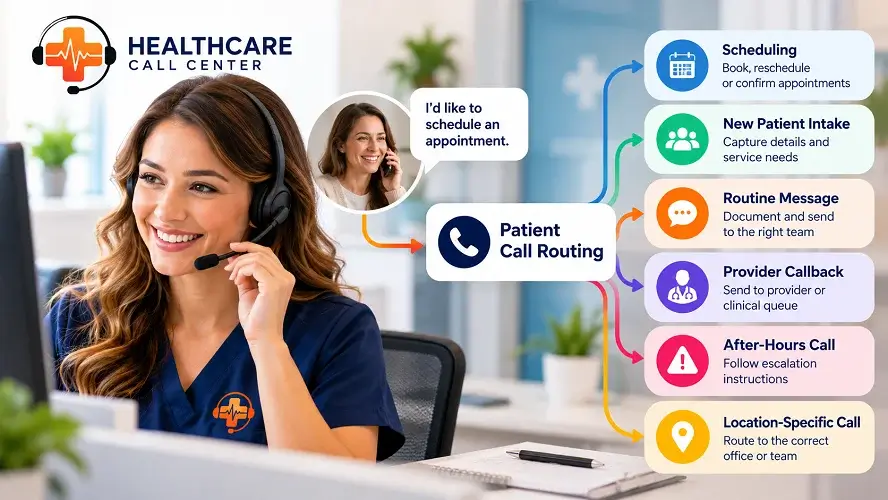
Common Patient Call Routing Categories
| Call Type | What It Usually Needs | Routing Destination |
| Appointment request | Date, time, provider, reason for visit | Scheduling or front desk |
| New patient intake | Caller details, service need, urgency, referral source | Intake or scheduling team |
| Routine message | Clear reason and requested next step | Front desk or message queue |
| Provider callback | Patient details and callback reason | Provider or clinical message queue |
| After-hours call | Call reason and urgency based on script | Next-day queue or escalation path |
| Location-specific call | Preferred or existing location | Correct office or team |
This kind of structure prevents every call from being treated the same way.
A Simple Patient Call Routing Workflow
A practical routing workflow can follow seven basic steps:
- Answer and identify the practice
- Confirm the caller’s basic information
- Understand the reason for the call
- Identify the appropriate call category
- Capture the information required for that category
- Follow the practice’s routing or escalation instructions
- Confirm the next step with the patient
The important part is consistency. Agents should not have to guess where a call belongs or what information the next person needs.
Why Call Routing Matters in Healthcare
Healthcare calls often include sensitive information, appointment needs, symptoms, provider questions, billing concerns, and follow-up requests. If the call is routed poorly, the patient may wait too long, or the wrong team may receive the message.
Good routing helps the practice respond faster and more accurately. It also protects staff from sorting through unclear notes.
For example, a patient asking to reschedule should not be mixed into a general callback pile. A new patient inquiry should not be documented like a routine question. A provider message should include enough context for the next person to act.
Scheduling, Callback, or Escalation: How to Decide
The best routing systems start with clear categories.
Scheduling
Scheduling calls include booking, rescheduling, canceling, or confirming appointments. The answering team should capture caller name, phone number, patient status, appointment type, preferred time, and location or provider preference. For practices that need additional help moving callers toward an appointment, medical appointment scheduling support can help support the scheduling workflow.
Callback
Callback requests are calls that need follow-up but not immediate escalation. These may include administrative questions, non-urgent patient requests, records questions, or general follow-up needs.
Routine Message
Routine messages need clear documentation. The message should explain why the patient called, what they need, and who should respond.
Escalation
Escalation calls follow practice-approved instructions. Agents should not judge medical urgency on their own. They should follow the script that tells them when to notify an on-call provider, direct the caller to emergency guidance, or place the message in a same-day queue.
What Patient Call Routing Agents Should Not Do
Call routing is about following the practice’s workflow, not replacing clinical judgment.
Unless specifically authorized and trained under the HIPAA protocols, answering agents should not diagnose symptoms, recommend treatment, independently determine medical urgency, or create their own escalation rules.
Instead, agents should follow the practice-approved script and escalation instructions. When a call falls outside the defined workflow, the appropriate next step may be to escalate it to the designated clinical or administrative team rather than improvise an answer.
This distinction is especially important for after-hours calls and conversations involving symptoms, medications, test results, or other sensitive health information.
Why Generic Answering Services Often Miss the Mark
Generic answering services may be able to answer calls, but they may not be configured around the healthcare-specific routing rules a medical practice needs. A basic workflow may capture only a name, phone number, and short message without distinguishing between scheduling, new patient intake, provider callbacks, routine requests, or escalation scenarios.
That creates downstream work. Staff have to call back just to understand why the patient called. Providers may receive incomplete messages. Appointment opportunities may sit in the wrong queue.
A healthcare-focused medical answering service should understand patient status, appointment intent, call reason, routing rules, and specialty workflows.
How Routing Supports HIPAA-Conscious Communication
Patient call routing should be designed with privacy in mind because calls may involve protected health information. A well-defined workflow helps the answering team collect information appropriate to the purpose of the call, document it consistently, and route it according to the practice’s approved procedures.
Practices that use outside call-handling support should also evaluate whether the vendor can support a HIPAA-compliant medical answering service workflow appropriate to the information being handled.
HIPAA’s minimum-necessary standard generally calls for reasonable efforts to limit certain uses, disclosures, and requests for protected health information to what is needed for the intended purpose. The exact information an agent should collect depends on the type of call and the practice’s workflow.
The goal is not simply to move a message from one person to another. Sensitive patient information should reach the appropriate team through an approved process, with clear rules about who handles the message and what happens next.
Specialty Examples
Different specialties need different routing rules.
An OB-GYN practice may need call paths for pregnancy-related questions, appointment changes, postpartum concerns, and provider messages. A 24/7 OB-GYN call answering service can support specialty-specific routing based on the practice’s approved workflows.
A fertility clinic may need careful handling for intake calls, cycle-related questions, medication messages, and emotionally sensitive patient concerns. A fertility clinic answering service can help capture and route these calls according to the clinic’s procedures.
A plastic surgery practice may need fast routing for consultation requests, post-procedure questions, and lead follow-up. Plastic surgery call center services can help organize these inquiries and route them to the appropriate next step.
A dental practice may need routing for urgent dental pain, scheduling, cancellations, and insurance questions.
A chiropractic practice may need routing for new patient inquiries, appointment requests, cancellations, same-day concerns, and follow-up messages. A HIPAA-compliant chiropractic answering service can help capture these calls and route them according to the practice’s approved workflow.
The core idea is the same: the call should match the workflow of the practice.
How to Build a Better Routing Workflow
A better routing workflow starts with the most common call reasons. Most practices can list these quickly: scheduling, rescheduling, billing questions, provider messages, new patient inquiries, after-hours needs, and location questions.
For practices that need coverage beyond normal office hours, an after-hours healthcare answering service can provide a defined path for calls that arrive when the front desk is closed.
Once the list is clear, the practice should decide what information must be captured for each call type. Scheduling calls need appointment details. Provider messages need a clear reason and callback information. New patient intake calls need service interest and preferred appointment timing. After-hours calls need routing based on approved instructions.
The answering team should not guess. They should follow a call flow that the practice approves.
What Good Call Notes Look Like
A weak call note says, “Patient called. Please call back.” A strong call note says who called, why they called, whether they are new or existing, what service or provider they need, and what next step they expect.
This difference matters. Strong notes reduce repeat calls, reduce staff confusion, and help the practice respond faster. They also create better reporting because calls can be grouped by reason and outcome.
How Routing Supports Growth
When practices invest in SEO, new service pages, referrals, paid campaigns, or local search visibility, more patient inquiries may reach the phone. That demand only creates an opportunity if the calls are answered and routed correctly.
A patient who wants to schedule should move toward scheduling. A new patient inquiry should reach the appropriate intake or scheduling workflow. A provider message should contain enough context for the next person to act. An after-hours call should follow the practice’s approved escalation path.
This is why patient call routing supports both operations and marketing. It connects the demand generated by the practice’s marketing efforts to the people and workflows responsible for turning that demand into appointments or appropriate follow-up.
Routing is not administrative busywork. It is part of patient access, staff efficiency, and conversion.
How to Measure Patient Call Routing Performance
A routing workflow should be measurable. Practices can track:
- Total patient calls received
- Calls answered live
- Missed calls
- Calls by reason or category
- New patient inquiries
- Appointment requests
- Provider callbacks
- Escalated calls
- Calls routed incorrectly
- Average callback time
- Appointments scheduled from phone inquiries
These measures help identify where calls are getting stuck. For example, a high number of new patient calls with a low appointment rate may point to a scheduling or follow-up problem. A high number of incorrectly routed messages may indicate that the call script or routing rules need to be clarified.
The goal is not simply to answer more calls. It is to understand whether calls are reaching the right workflow and producing a clear next step for the patient.
Patient Call Routing Implementation Checklist
A practice can build a basic routing workflow by following these steps:
- 1. List the most common call reasons: Include scheduling, new patient intake, routine messages, provider callbacks, billing questions, location questions, after-hours calls, and escalation scenarios.
- 2. Create a routing destination for each call type: Decide whether each category goes to scheduling, the front desk, a provider message queue, an after-hours workflow, or another approved destination.
- 3. Define the information required for each category: A scheduling call needs different information than a provider callback. Avoid collecting unnecessary details simply because they are available.
- 4. Document escalation rules: Agents should know exactly when to follow an escalation path and who receives the message.
- 5. Train the answering team on the workflow: The goal is consistency. Agents should not have to guess where a call belongs.
- 6. Review routing performance regularly: Look for unclear messages, incorrect routing, missed calls, delayed callbacks, and other patterns that show where the workflow needs improvement.
A routing system should evolve as the practice adds providers, locations, specialties, services, or new call types.
Reader Takeaway
The main takeaway is simple: the call is not finished when someone answers. The call is finished when the right information reaches the right person, and the patient knows what happens next.
That is the difference between basic phone coverage and a useful patient communication workflow. That is the difference between basic phone coverage and a useful patient communication workflow. When calls are answered, documented, and routed correctly, patients have a clearer path forward, and staff has the information they need to act.
Final Recommendation
Patient call routing turns live answering into a useful operational system. It helps medical practices decide what needs scheduling, callback, routine documentation, or escalation.
If your practice receives vague messages, delayed callbacks, or misrouted patient requests, the issue may not be call volume alone. It may be call routing.
Healthcare Call Center helps practices build healthcare-specific answering workflows so patient calls are answered, documented, and routed with more clarity.
Book a free consultation to review your patient call routing workflow.
Frequently Asked Questions
What is patient call routing?
Patient call routing is the process of directing a patient call to the right next step, such as scheduling, callback, routine message handling, or escalation.
Can answering agents decide what is urgent?
No. Agents should follow practice-approved escalation rules. They should not make clinical decisions.
What information should be captured during call routing?
Caller name, phone number, patient status, reason for call, appointment need, location or provider preference, urgency based on script, and next step.
Why does call routing matter for medical practices?
It reduces unclear messages, misrouted calls, delayed follow-up, staff confusion, and patient frustration.
Does call routing support HIPAA-conscious workflows?
Yes. Clear routing helps patient information move through approved processes instead of being handled inconsistently.
What is the difference between call answering and call routing?
Call answering is the process of receiving and communicating with the patient. Call routing determines what happens next, such as scheduling an appointment, creating a callback, sending a provider message, or following an approved escalation workflow.
How can a medical practice improve its call routing?
A practice can improve call routing by identifying common call types, assigning each type to the correct destination, defining the information that should be captured, documenting escalation rules, training the answering team, and reviewing routing performance regularly.