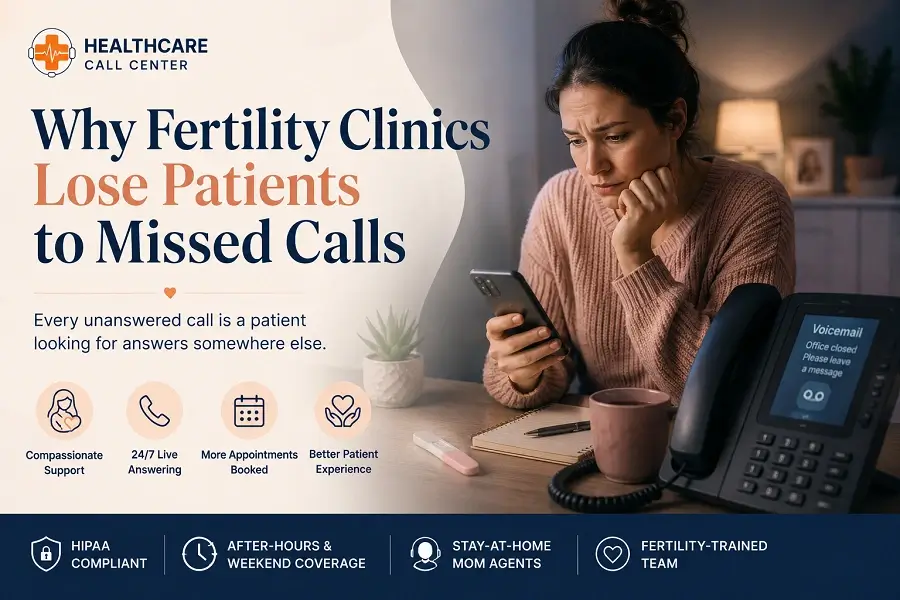
A patient calls your fertility clinic at 9:14 PM on a Tuesday.
She has been trying to get pregnant for two years. She just took a pregnancy test, and it was negative again. She is crying. She has questions about her next IVF cycle. She wants to know if she should adjust her medication timing. She needs to talk to someone who understands what she is going through.
Your clinic is closed. The call goes to voicemail.
“You have reached Fertility Associates. Our office hours are 8 AM to 5 PM Monday through Friday. Please leave a message and we will return your call on the next business day.”
She hangs up. She does not leave a message.
She opens Google and searches “fertility clinic near me.” Three results show up. She calls the second one. A live person answers. That clinic schedules her for a consultation the next morning.
You just lost a patient worth $15,000 to $50,000 in treatment revenue. And you will never even know she called.
Fertility Calls Are Not Regular Patient Calls
Most medical calls are routine. Appointment confirmations. Prescription refills. Insurance questions. Billing disputes. And this is where you need a dedicated 24/7 fertility answering service to handle your after-hours call.
Fertility calls are different.
Fertility patients are dealing with one of the most emotionally charged experiences a person can go through. They are navigating hope, fear, grief, anticipation, and anxiety all at once. Every phone call to your clinic carries enormous emotional weight.
A patient might call because:
- They got a negative pregnancy test after an IVF transfer
- They are experiencing spotting and are terrified they are losing the pregnancy
- They need clarification on injection instructions at 10 PM
- They received lab results and do not understand what they mean
- They want to schedule a consultation because their biological clock is ticking
- They had a positive test and are calling through tears of joy
Every single one of these calls matters deeply to the patient. And every single one of them is an opportunity for your clinic to either strengthen the relationship or lose the patient entirely.
When those calls go to voicemail, the message the patient receives is clear. Nobody is here for you right now. The message patients often feel is simple: no one is available to help right now. Call back during business hours.
That is not the message a fertility patient needs to hear.
The Financial Reality of Missed Fertility Calls
Fertility treatment is one of the highest-value services in healthcare. A single IVF cycle costs between $12,000 and $25,000. Many patients undergo multiple cycles. Add in medication, genetic testing, frozen embryo transfers, and supplementary treatments, and the lifetime value of a single fertility patient can exceed $50,000.
Now think about what happens when that patient calls after hours and reaches voicemail.
They do not leave a message. They call another clinic. Fertility patients are highly motivated. They are actively researching their options. If your clinic is not available when they need you, they will find one that is.
Losing even one new fertility patient per month to a missed call can mean $600,000 or more in lost annual revenue. For a growing practice, that is the difference between scaling and stagnating.
And it is not just new patients. Existing patients who cannot reach your clinic when they need support may start to lose confidence in your care. If they feel abandoned during the most stressful moments of their treatment journey, they may transfer to another clinic for their next cycle.
When Fertility Calls Come In (And Get Missed)
Fertility patient calls do not follow a neat 9-to-5 schedule. They come in at all hours because fertility does not wait for business hours.
- Early mornings – Patients doing self-injections often call before work with questions about dosage or timing. If your office opens at 8 AM, those 6:30 AM calls go unanswered.
- Lunch hours – Your front desk is steps away for lunch, and calls pile up. A patient calling about lab results gets voicemail.
- Evenings – This is the biggest gap. Patients get off work, process their emotions, and call fertility clinics between 6 PM and 10 PM. Almost every one of these calls hits voicemail.
- Weekends – IVF does not stop on Saturdays and Sundays. Patients on stimulation protocols have questions every single day. Weekend coverage is critical.
- During procedures – When your nursing staff is in a retrieval or transfer, the front desk cannot answer every call. Overflow calls go to voicemail.
Each gap represents patients who need help right now and cannot get it.
Why Voicemail Is Especially Damaging in Fertility Care
Voicemail is bad enough in general healthcare. In fertility care, it is particularly destructive.
Fertility patients are in a vulnerable emotional state when they call. They may have been working up the courage to make the call for weeks. They may have just received difficult news. They may be calling during a crisis moment.
When that patient hears a voicemail greeting, the emotional impact is significant. They feel abandoned. They feel like their concerns do not matter. They feel like they are just another number in a system that does not care.
That emotional response does not just cost you one phone call. It colors their entire perception of your clinic. Even if they eventually connect with you during business hours, their first impression was that you were not there when they needed you.
In contrast, when a live person answers on the first or second ring, the emotional impact is immediate and positive. The patient feels heard. They feel supported. They feel confident that this clinic actually cares about them as a person, not just as a patient.
That confidence translates into higher consult booking rates, better patient retention, and more positive reviews.
What a Fertility-Focused Answering Service Does
A fertility clinic answering service or IVF clinic answering service is not a generic call center. The right service understands the unique needs of fertility patients and fertility clinics.
- Live agents answer every call – No matter what time a patient calls, a real person picks up. Not a bot. Not a menu. A trained, empathetic human voice.
- HIPAA-compliant communication – Every call is handled with strict privacy protocols. Patient information is protected at every step. Agents understand the sensitivity of fertility-related health information.
- Protocol-based handling – You define exactly how different call types should be managed. A patient with a positive pregnancy test gets a different response than a patient asking about billing. A medical emergency triggers your escalation protocol. A new patient inquiry gets routed to scheduling.
- Appointment scheduling – Agents can access your scheduling system and book consultations directly. New patients hang up with a confirmed appointment instead of a promise to call back.
- Emotional awareness – Fertility calls require a different kind of communication. Agents trained in fertility patient interaction know how to listen, how to comfort, and how to guide without being clinical or cold.
- Message routing – For calls that need clinical attention, agents send detailed, secure messages to the right nurse or coordinator. No information is lost between the patient calling and your team following up.
Building Patient Trust Through Every Call
Fertility patients choose clinics based on more than success rates and pricing. They choose based on trust. They want to feel like they are in the hands of a team that will be there for them throughout the entire journey.
That trust starts with the very first phone call.
When a patient calls your clinic and a live person answers immediately, speaks with warmth, and handles their concern professionally, that patient feels confident in their choice. They tell their friends. They leave positive reviews. They become long-term patients.
When a patient calls and gets voicemail, that trust never has a chance to form. The patient moves on to a clinic that answered.
Every call your fertility clinic receives is a chance to build or break patient trust. The question is whether someone is there to answer.
The Bottom Line for Fertility Clinics
Fertility treatment is emotionally intense, time-sensitive, and high-value. Patients who call your clinic need help, reassurance, and connection. They do not need voicemail.
After-hours call coverage is not a luxury for fertility clinics. It is a necessity. Every missed call is a potential patient lost. Every voicemail is a trust broken before it was ever formed.
A live fertility clinic answering service ensures that every patient who calls your clinic gets the support they need, exactly when they need it. New patients get scheduled. Existing patients feel supported. Clinical emergencies get escalated properly. And your front desk team gets relief during the most chaotic parts of the day.
Your patients are calling. The only question is whether someone will be there to pick up.
Is Your Fertility Clinic Missing After-Hours Calls?
Every missed fertility call is a patient looking for answers somewhere else.
Book a free consultation to see how Healthcare Call Center helps fertility clinics capture every call and support patients 24/7.
FAQs
Why do fertility patients call after hours so often?
Fertility treatment involves daily medications, timed procedures, and constant monitoring. Patients have questions outside of business hours about injections, symptoms, lab results, and next steps. The emotional nature of fertility treatment also means patients process their feelings in the evenings and weekends, which is when they reach out.
How much revenue does a missed fertility call cost?
A single IVF patient typically generates $15,000 to $50,000 in treatment revenue over their time at your clinic. If you miss one new patient consult call per week because of after-hours voicemail, the annual revenue impact can exceed $750,000.
Can an answering service handle sensitive fertility patient communication?
Yes. A specialized fertility answering service trains its agents on fertility-specific communication. Agents understand the emotional weight of fertility calls, follow HIPAA-compliant protocols, and know how to handle each call type with the appropriate level of care and urgency.
What happens when a patient calls with a fertility emergency after hours?
The answering service follows your custom escalation protocol. For clinical emergencies, the agent contacts the on-call nurse or physician directly. For urgent but non-emergency concerns, the agent gathers detailed information and routes it to the right team member for a morning follow-up.
How quickly can a fertility clinic answering service be set up?
Most fertility answering services can be fully operational within up to two weeks. This includes custom protocol development, script creation, scheduling system integration, HIPAA compliance verification, and agent training specific to your clinic.