by Erika Sanchez | Sep 4, 2026 | Fertility & IVF Clinic Answering Service
When IVF patients call a fertility clinic, they typically want three things: a compassionate person who listens, clear answers about the next step, and confidence that their information will be handled privately. A strong first call should help patients understand what happens next, capture their questions accurately, and connect them with the right member of the fertility team.
Every IVF journey starts the same way: a private moment, a deep breath, and a phone call. Before a patient ever books a consultation, they call the clinic to see who answers. That first call quietly decides whether they move forward with your practice or keep searching.
Understanding what IVF patients expect when they call is not a soft skill. For a fertility clinic, it is revenue protection, reputation protection, and patient care all at once.
Here is what patients are really looking for, and how your phone experience can meet them.
Why the First Call Matters to IVF Patients
Fertility treatment is one of the most emotionally loaded purchases in healthcare. Patients have often tried for months or years before they dial. They may be grieving, hopeful, or both at once.
They are also investing real money. IVF treatment often costs tens of thousands of dollars per cycle, much of it out of pocket. Patients research clinics the way people research major life purchases. They compare websites, read reviews, and call.
On that call, they are asking one question above all:
Will this clinic treat me like a person or like a case number?
- A rushed answer reads as indifference.
- A long hold reads as disorganization.
- A generic voicemail reads as a closed door.
- A calm, kind, informed voice reads as a clinic they can trust with the hardest chapter of their lives.
Most clinics never hear about the callers they lost. The phone just stops ringing for them.
What IVF Patients Actually Ask on the First Call
Front desk teams know these calls well. A trained fertility clinic answering service team should handle them just as smoothly:
1. Are You Accepting New Patients?
The simplest question, and the one most often fumbled. Callers want a warm yes and a clear next step, not a transfer chain.
2. How Much Does Treatment Cost?
Patients deserve honesty about the process. Agents should not quote medical pricing, but they can capture the question and route it to financial counseling staff with context attached.
3. Do You Take My Insurance?
Insurance questions are stressful for fertility patients. A patient agent captures plan details so your billing team can answer accurately on the first callback.
4. What Are the Next Steps?
New patients ask about consultations, testing timelines, and how soon they can be seen. Agents explain the intake path you approve and book or pass the request.
5. Can I Talk to Someone About My Situation?
Some callers just need to be heard for a moment. Agents trained in empathetic, judgment-free listening turn these calls into consultations instead of hang-ups.
6. Do You Offer the Treatment I Was Told About?
Callers arrive with research from other doctors or forums. Agents capture the specific question for your clinical team instead of guessing.
The Emotional State Behind IVF Calls
IVF calls are not ordinary scheduling calls. Callers may be:
- Navigating infertility grief they have not shared with family.
- Recovering from a failed cycle at another clinic.
- Calling on behalf of a partner who cannot face another disappointing conversation.
- Worried about age-related time pressure.
- Overwhelmed by pricing, medication schedules, and medical jargon.
None of these callers wants pep talks or clinical detachment. They want patience, warmth, and competence. Our US-based agents, many of them stay-at-home moms, understand the vulnerability in these calls because they understand families. That is why empathy is a hiring requirement, not a script line, and it is why our fertility clinic answering service trains specifically for sensitive fertility conversations.
Where Most Clinics Fail the First Call
The failures are rarely intentional. They are the side effects of a busy front desk:
- Phones ring out while staff check in patients in person.
- Hold times stretch past five minutes during morning rush.
- After-hours callers reach a generic office voicemail.
- Messages arrive incomplete, so staff call back without context.
- New patient calls are treated like routine reschedules.
Each failure is small. Together they tell your highest-value callers that the clinic is too busy for them. For a treatment that often costs more than a car, that impression is expensive.
What a Trained Answering Team Does Differently for IVF Calls
A trained live answering team closes the gap between how your clinic operates and how it sounds on the phone:
- Calls are answered promptly in your clinic name, with your approved greeting.
- Agents capture caller details, treatment interest, referral source, and the exact question your team must answer.
- Consultation requests route straight to your scheduling workflow, including our dedicated fertility appointment scheduling support.
- Emotionally heavy calls are handled with patience and zero judgment.
- Urgent concerns follow escalation rules your clinical team defines.
- You receive clear documentation for every call, every day.
HIPAA-Conscious Handling for Sensitive Fertility Calls
Fertility calls include some of the most private information a patient will ever share: diagnoses, cycle history, medications, and personal circumstances. Patients expect discretion by default.
That is why our workflows follow HIPAA-conscious call handling:
- Agents collect only the information your workflow needs.
- Messages route through secure channels, never personal phones.
- Access to call documentation is limited to authorized staff.
- Scripts avoid making patients repeat sensitive details unnecessarily.
Our HIPAA-compliant healthcare answering service page explains the full security approach, and a dedicated IVF clinic call handling service covers what it means specifically for fertility practices.
After-Hours IVF Calls Matter More Than You Think
Anxiety does not keep office hours. IVF patients call at night and on weekends, especially around cycle milestones, medication questions, and results. When your office closes, those calls do not stop.
A live answering team keeps your clinic human around the clock. See how our after-hours fertility clinic call handling works, including nights, weekends, and holidays.
What to Capture on Every IVF Call
Consistent intake makes your clinical and billing teams faster. Every IVF clinic call handling service should capture:
- Caller name and best callback number.
- Patient status: new inquiry, current patient, or former patient.
- Reason for the call in the caller’s own words.
- Treatment interest or referral source if volunteered.
- Urgency per your escalation rules.
- Preferred contact method and best time to reach them.
How IVF Patients Actually Choose Between Clinics
Many IVF patients compare multiple fertility clinics before deciding where to schedule a consultation. Websites look similar. Reviews blur together. The phone call becomes the tiebreaker.
In a single first call, patients judge:
- How fast someone answered.
- Whether the voice was warm or transactional.
- Whether their question got a real answer or a brush-off.
- How confident they felt about the next step.
- Whether they had to repeat themselves.
Clinics rarely lose these callers on clinical quality. They lose them in the fifteen seconds after the phone rings. That is why practices that obsess over consultation experience also obsess over the call that earns the consultation.
A Simple Test: Call Your Own Clinic Today
Ask someone who does not work with you to call your main line at 8 AM, during lunch, and at 6:30 PM. Note how long it took to reach a human, how the greeting felt, and what happened after hours.
If any of those calls felt cold, slow, or impersonal, that is exactly what your next IVF patient experienced this week. The fix is faster than you think.
What One IVF Patient Is Worth
An IVF patient can represent substantial long-term value to a fertility practice across consultations, testing, treatment cycles, and related services. Losing even two first calls a month to voicemail can quietly erase more revenue than a full year of answering support calls.
Estimate your own number with our missed call revenue calculator before you decide anything else.
The First Call Also Shapes Word of Mouth
IVF patients talk to each other. Support groups, fertility forums, and friend groups trade clinic recommendations daily, and the stories they share are rarely about clinical protocols. They are about how the clinic made them feel.
The patient who reached a kind human on the first ring tells that story. The patient who spent two days chasing a callback tells that one instead. Every answered call is a small deposit in your clinic’s reputation, and every missed one is a withdrawal you will never see posted.
The First Call Is the First Step of Care
IVF patients will forgive almost anything except feeling invisible. When your phone line meets them with warmth, patience, and competence, your clinic stands out before the consultation ever begins.
Book a Free Consultation & Talk to our team about covering your fertility clinic calls with trained, US-based agents. We will review your call flow and show you exactly where patients are slipping through, with no pressure and no obligation.
Frequently Asked Questions
Can an answering service really understand IVF calls?
Yes, when the team is trained for it. Our agents practice fertility-specific scenarios, from pricing questions to emotionally heavy calls, and follow scripts your clinic approves.
Will patients know they are talking to an outside team?
Only if you want them to; calls are answered in your clinic name with your greeting, so most patients simply experience a faster, kinder answer.
What happens if a caller is upset or crying?
Agents are trained to slow down, listen, and let the caller feel heard before capturing details. Escalation rules you define decide what happens next.
Can you book consultations directly?
Agents capture complete consultation requests with preferred times. Many fertility practices also connect the service to their scheduling workflow for direct booking.
How do we protect patient privacy on fertility calls?
Calls follow HIPAA-conscious workflows with secure message routing and minimum-necessary data capture. See our HIPAA-compliant healthcare answering service page for details.
by Erika Sanchez | Jul 1, 2026 | Fertility & IVF Clinic Answering Service
Choosing a fertility clinic answering service is not a simple vendor decision. For fertility and IVF practices, the first phone call can carry more emotional weight than almost any other step in the patient journey. A caller may be exploring IVF after years of trying to conceive. They may be asking about egg freezing, donor options, insurance, financing, appointment availability, or whether your clinic can help with a situation that feels deeply personal.
That is why a fertility clinic answering service needs to do more than answer calls. It needs to protect trust, capture patient intent, support appointment momentum, and give your in-office team clear information for follow-up.
A generic call center may be able to take a name and number. But fertility patients often need a calmer, more thoughtful experience. They want to feel like the clinic understands the sensitivity of the decision they are making. If the call goes to voicemail, feels rushed, or results in a vague handoff, the patient may continue searching and contact another fertility clinic before your team ever calls back.
This article explains what fertility clinics should look for before hiring an answering service, what questions to ask, and how to compare providers before choosing one.
Why fertility clinic calls are different from general medical calls
Fertility calls are different because the patient journey is different. A dermatology patient may call to ask for the next available appointment. A dental patient may call to schedule a cleaning or discuss pain. A fertility patient may call after months of private research, emotional stress, and major financial planning.
That caller is often not just looking for a time slot. They are listening for signs that your clinic is organized, kind, responsive, and capable of guiding them through a complicated process.
That makes the first call a trust signal. If a caller reaches voicemail, waits too long, or receives a cold response, it can create doubt. They may wonder whether the clinic will be responsive later in treatment, whether the staff will be supportive, or whether another practice may be easier to work with.
A strong fertility answering service understands that every call is part of the patient experience. It does not treat fertility inquiries like routine message-taking. It helps callers feel heard while capturing the details your team needs.
Patients are already comparing clinics
This is where the patient started comparing clinics because the person searching for a fertility clinic answering service is usually not learning what call coverage is for the first time. They may already know their clinic has a phone coverage problem. They may be comparing providers. They may be trying to decide whether a specialized healthcare call center is worth it compared with a cheaper generic answering service.
At this stage, the right question is not “Do we need someone to answer phones?”
The better question is “Can this provider protect our patient experience and help us capture more consultation opportunities?”
Fertility clinics have a high-value patient journey. A missed or poorly handled call may not be a small administrative issue. It may represent a potential consultation, a treatment inquiry, or a patient who is ready to take the next step. When those calls are not handled carefully, the practice can lose opportunities before they ever become visible in the schedule.
1. Look for empathy, not just availability
The first thing to evaluate is tone. Many answering services can provide availability. Fewer can provide empathy.
Fertility patients may be emotional, nervous, hopeful, private, or overwhelmed. They may not know exactly what to ask. They may need a calm person to gather information and guide them toward the right next step.
When comparing fertility answering services, ask how calls are handled.
Are agents trained to slow down and listen?
Do they understand that fertility calls can be sensitive?
Can they speak with warmth without giving medical advice?
Do they know how to make a caller feel supported rather than processed?
Empathy matters because patient trust starts before the consultation. A caller who feels rushed or dismissed may not book. A caller who feels heard is more likely to continue the process.
2. Make sure the service captures consultation intent
A fertility clinic answering service should not only collect basic contact information. It should help identify why the patient is calling and what kind of next step they may need.
For example, a caller may be asking about IVF, egg freezing, fertility testing, second opinions, donor options, financing, insurance, or new patient consultation availability. Your clinic does not need the answering service to diagnose or advise. But your team does need a useful handoff.
A weak handoff says: “Patient called. Please call back.”
A stronger handoff says: “New patient inquiry. Interested in IVF consultation. Asked about insurance and next available appointment. Prefers afternoon callback.”
That second version gives your team context. It helps the follow-up feel personal. It can also reduce back-and-forth and help your staff prioritize high-intent inquiries.
3. Ask how after-hours fertility calls are handled
Many fertility patients research clinics outside normal business hours. They may call after work, during lunch, in the evening, or on weekends. If your practice is only reachable during office hours, you may be missing high-intent patients when they are most ready to act.
An after-hours fertility answering service should do more than take a message. It should capture the caller’s reason for calling, explain the next step according to your clinic’s instructions, and route the information clearly.
This is especially important for clinics that invest in SEO, Google Business Profile, paid ads, social media, or referral partnerships. If marketing creates demand but the phone experience breaks down after-hours, the clinic may pay to generate interest and then lose the patient at the first call.
4. Confirm the provider understands HIPAA-safe workflows
Fertility calls can involve sensitive information. Patients may mention treatment history, diagnoses, timing, medications, insurance, or personal circumstances. Your answering service should understand healthcare privacy expectations and use workflows that are appropriate for patient communication.
Before hiring any provider, ask how patient information is documented, where messages are stored, who receives them, and how access is controlled. Ask whether the team understands what should not be discussed in unsafe channels. Ask how they avoid casual handling of sensitive details.
A fertility clinic should avoid any provider that treats patient information like ordinary consumer lead data. Fertility communication requires more care.
5. Look for customized scripts, not generic call center language
Generic scripts often sound wrong for fertility clinics. A caller can usually tell when someone is reading a cold script that was not built for the practice.
The right fertility answering service should be able to customize call flows around your clinic’s services, tone, hours, locations, provider availability, scheduling process, and escalation rules.
A good script should guide the conversation without sounding robotic. It should help the agent capture the right details while still sounding human. It should also set the right expectation for what happens next, such as whether the clinic will call back, when follow-up usually occurs, or how new patient inquiries are routed.
6. Ask about escalation rules and boundaries
An answering service should not pretend to be a clinician. It should not give medical advice, interpret symptoms, or make promises about treatment. For fertility clinics, boundaries are important.
Before hiring a provider, define what should happen for different call types. New patient inquiry. Existing patient message. Appointment change. Billing question. Urgent concern. Medication question. Lab-related question. After-hours issue.
Your provider should follow your rules. They should know what to document, what to escalate, and what to route for the next business day. This helps protect both the patient experience and the clinic’s workflow.
7. Evaluate the handoff quality
The handoff is where the value of a fertility clinic call center becomes visible. If your team receives unclear, incomplete, or delayed information, the answering service becomes another operational burden.
Ask to see a sample message or call summary. Does it include patient name, phone number, reason for calling, service interest, urgency, callback preference, and any relevant notes? Is it easy for your front desk or intake coordinator to understand? Does it help the team follow up with confidence?
A good handoff should make your team faster. It should not force staff to start the conversation from zero.
8. Make sure reporting is included
A fertility clinic answering service should help you understand what is happening with your calls. At a minimum, you should be able to see call volume, call reasons, after-hours demand, missed-call risk, and captured opportunities.
Reporting matters because call coverage is not just a cost. It is part of your patient acquisition and patient access system. If you know when calls are coming in, what patients ask about, and where follow-up is needed, you can improve scheduling, staffing, marketing, and patient communication.
Without reporting, you are guessing.
9. Compare specialized healthcare support against generic answering services
A generic answering service may be cheaper, but cheaper is not always better for fertility practices. The question is whether the provider can protect the patient experience and support your clinic’s revenue-producing patient journey.
A specialized healthcare call center is more likely to understand privacy, empathy, escalation rules, appointment intent, and the importance of clear documentation. A generic service may be fine for basic message-taking, but fertility clinics usually need more than that.
When comparing providers, do not only compare price. Compare the quality of the patient experience, handoff clarity, healthcare knowledge, and ability to support high-intent consultation inquiries.
10. Use this checklist before hiring a fertility answering service
Before choosing a provider, ask these questions:
- Do you have experience with fertility, IVF, or specialty healthcare practices?
• How do you train agents to handle sensitive patient calls?
• Can your scripts be customized to our clinic’s services and tone?
• How do you document new patient inquiries?
• How quickly are call summaries sent to our team?
• How do you handle after-hours and weekend calls?
• What information do you capture for consultation inquiries?
• How do you protect sensitive patient information?
• Can you follow our escalation rules?
• What reporting do we receive?
• How do you help our team identify high-intent patient opportunities?
If a provider cannot answer these questions clearly, they may not be the right fit for a fertility clinic.
Why is a Healthcare Call Center built for fertility practices
Healthcare Call Center supports fertility clinics with real human call coverage, healthcare-aware workflows, and clear handoffs. The goal is not to replace your clinical team. The goal is to make sure patient calls are answered with warmth, documented properly, and routed in a way your staff can act on.
For fertility clinics, this matters because the phone call is often the first moment a patient decides whether your practice feels trustworthy. A strong answering service helps protect that moment.
If your clinic is comparing fertility answering services, start by reviewing the dedicated fertility clinic answering service page: https://healthcarecallcenter.com/fertility-clinic-answering-service/
Final Thoughts
The right fertility clinic answering service should feel like an extension of your practice. It should help patients feel heard, help your staff receive better information, and help your clinic protect high-intent consultation opportunities.
Before you hire a provider, look beyond basic availability. Ask about empathy, handoff quality, after-hours coverage, privacy workflows, escalation rules, customization, and reporting.
Fertility patients are not just calling for information. Many are looking for reassurance that they are choosing the right clinic. Your call coverage should support that trust from the first ring.
Frequently Asked Questions
What is a fertility clinic answering service?
A fertility clinic answering service provides call coverage for fertility and IVF practices when the in-office team is busy, unavailable, or closed. It helps answer calls, capture patient intent, and route information back to the clinic.
Why do fertility clinics need a specialized answering service?
Fertility patients often have sensitive questions and high emotional urgency. A specialized answering service can help callers feel heard while capturing the details the clinic needs for follow-up.
Can a fertility answering service help with after-hours calls?
Yes. A fertility answering service can help capture after-hours inquiries, document the caller’s reason for calling, and send a clear handoff to the clinic for follow-up.
What should fertility clinics look for before hiring an answering service?
Fertility clinics should look for empathy, healthcare experience, HIPAA-safe workflows, customized scripts, clear handoffs, after-hours coverage, escalation rules, and reporting.
Is a generic answering service enough for an IVF clinic?
A generic answering service may handle basic message-taking, but IVF and fertility clinics usually need a more specialized approach because calls are sensitive, high-intent, and often tied to consultation decisions.
by Erika Sanchez | Jun 25, 2026 | Fertility & IVF Clinic Answering Service
A fertility patient does not usually contact one clinic and wait patiently for a reply. She researches. She compares. She reads reviews. She checks success stories. Then she reaches out to the clinics that feel most trustworthy.
At that moment, speed matters.
Not because fertility care should feel rushed. Not because patients want a sales pitch. Speed matters because the first clinic that responds with clarity, empathy, and confidence often becomes the clinic the patient trusts first.
For fertility clinics, speed-to-lead is not just a marketing metric. It is a patient acquisition advantage.
A new IVF inquiry may represent a treatment journey worth thousands of dollars. But before that patient ever books a consultation, she has to feel that your clinic is responsive, organized, and emotionally safe. If her first call hits voicemail, if her message waits overnight, or if she gets a rushed callback from a busy front desk, the trust gap begins immediately.
That is why a fertility clinic answering service is not simply about answering the phone. It is about protecting the first moment of trust.
What Speed-to-Lead Means in Fertility Marketing
Speed-to-lead is the time between a patient inquiry and your clinic’s first real response. In simple terms, it measures how fast your clinic responds after someone fills out a form, calls the office, clicks an ad, or asks for an appointment.
In many industries, speed-to-lead is treated as a sales performance metric. In fertility care, it is more personal. A patient who contacts an IVF clinic may be anxious, hopeful, overwhelmed, or already disappointed by previous treatment experiences. That patient is not just looking for information. She is looking for reassurance.
A fast response tells her three things:
- This clinic is organized.
- This clinic takes patient inquiries seriously.
- This clinic may be safe to trust with something deeply personal.
A slow response tells a different story, even if that story is unfair. It suggests the clinic is too busy, too disorganized, or not ready to prioritize her needs. That impression can form before she ever speaks to a doctor.
Why Fertility Patients Compare Multiple Clinics
Most fertility patients are not casual shoppers, but they are careful researchers. IVF is expensive, emotional, and life-changing. Patients often compare multiple clinics before deciding where to book their first consultation.
They look at success rates. They read reviews. They compare physicians. They ask friends or online communities. Then they contact the clinics that make the shortlist.
Here is the important part: the first response can shape the entire decision.
If one clinic answers live, explains next steps, shows empathy, and offers a consultation time, that clinic creates momentum. If another clinic sends the call to voicemail or replies the next day with a generic message, the patient may already be emotionally committed elsewhere.
This is why speed-to-lead matters more in fertility than in many other medical specialties. The patient is not only choosing clinical expertise. She is choosing the team that feels most present when she first reaches out.
Your Front Desk Is Part of the Fertility Conversion Funnel
Many fertility clinics think of the front desk as an administrative function. It is not. Your front desk is part of your conversion funnel.
Every Google Ads click, organic search visit, referral, and social media impression eventually has to become a real patient conversation. If that conversation does not happen quickly and smoothly, your marketing spend leaks revenue.
A fertility clinic may invest heavily in SEO, paid ads, reputation management, and physician branding. But if the first call goes unanswered, those investments do not convert at the rate they should.
This is the hidden leak in fertility marketing. The problem is not always traffic. The problem is often response time.
A fertility call center helps close that gap by making sure inquiries are answered quickly, routed properly, and handled with the sensitivity the patient expects.
Why Generic Answering Services Fail IVF Clinics
Fertility calls are different from routine medical calls. Generic answering services often fail where a specialized medical answering service succeeds for fertility practices.
Fertility patients may ask about consultation availability, insurance questions, treatment timelines, prior failed cycles, donor options, financing, lab access, or next steps after an online inquiry. Even when the agent cannot provide clinical advice, the way the call is handled matters.
A good IVF answering service should know how to:
- Respond with empathy without overpromising clinical outcomes.
- Collect the right intake information.
- Route urgent or sensitive calls based on clinic protocol.
- Schedule consultations or pass qualified inquiries quickly to the clinic.
- Protect patient privacy through HIPAA-compliant workflows.
- Represent the clinic’s tone with calm, clear communication.
This is why fertility clinics need more than a basic message-taking service. They need call coverage built around patient experience and conversion.
Speed Does Not Mean Pressure
One mistake clinics make is assuming faster response means more aggressive sales behavior. That is not what fertility patients need.
Speed-to-lead does not mean rushing the patient. It means being present when the patient is ready to talk.
A strong first response should feel calm, human, and helpful. The goal is not to push the patient into treatment. The goal is to make the next step feel simple.
For example, the difference between these two responses is huge:
Cold response: ‘Someone will call you back later.’
Better response: ‘I understand this is an important decision. I can help get your information to the right team and see what consultation times are available.’
Both responses may take less than a minute. But only one builds trust.
Where Fertility Clinics Lose Speed
Most fertility clinics do not lose leads because nobody cares. They lose leads because the front desk is overloaded.
Common gaps include:
- Calls during lunch hours when staff are short-handed.
- After-work calls from patients who cannot call during business hours.
- Weekend inquiries from patients doing research at home.
- Google Ads calls that arrive when staff are handling in-office patients.
- Web form submissions that sit too long before follow-up.
- Voicemails that get returned after the patient has contacted another clinic.
These are operational gaps, but they create marketing losses. The clinic may never see them clearly unless call tracking and response time are measured.
What a Fertility Clinic Answering Service Should Do
The right fertility clinic answering service should do more than answer phones. It should support the entire patient inquiry process.
That includes:
- Live answering during office hours, overflow periods, evenings, weekends, and holidays.
- Consultation scheduling based on your clinic’s rules.
- HIPAA-compliant intake and message handling.
- Escalation protocols for sensitive or urgent calls.
- Clear documentation so your internal team knows what happened.
- Reporting on missed calls, answered calls, and booked opportunities.
When this system works, your clinic does not need to choose between patient care and lead response. Your front desk can focus on in-office patients while trained support captures new inquiries before they go cold.
How Faster Response Times Improve IVF Conversions
In fertility marketing, speed creates trust. Trust creates momentum. Momentum creates booked consultations.
When a patient reaches your clinic and hears a calm human voice, the decision process changes. She is no longer just comparing websites. She is having a real experience with your brand.
That first experience can make your clinic feel accessible, organized, and emotionally supportive. It can also make the next step clear: book the consultation, submit intake information, or speak with the right team member.
This is where speed-to-lead becomes a conversion strategy. It is not only about answering fast. It is about answering well while the patient is still actively deciding.
How to Improve Speed-to-Lead Without Burning Out Staff
Improving response time does not always mean hiring more front desk staff. It means designing a better call coverage system.
Start with these steps:
- Audit your call logs for missed calls, peak call windows, and after-hours inquiries.
- Track how long it takes to respond to forms, voicemails, and missed calls.
- Separate urgent patient calls from new consultation inquiries.
- Create clear scripts for IVF inquiries, financing questions, and appointment scheduling.
- Use a fertility-trained call center for overflow and after-hours support.
- Review weekly reporting to see which inquiry sources convert into booked consultations.
The goal is not more activity. The goal is a faster, calmer, more consistent patient response.
For clinics handling sensitive IVF inquiries, IVF appointment scheduling support can help capture patient intent before the caller loses momentum.
Final Thought: Speed Builds Trust
Fertility patients are making one of the most personal decisions of their lives. They are not only evaluating your doctors, technology, or success stories. They are evaluating how your clinic makes them feel from the first interaction.
If your clinic responds quickly, clearly, and compassionately, you create trust before the first appointment. If your clinic responds slowly, that trust may go to another practice.
Speed-to-lead is not just a marketing concept for fertility clinics. It is a patient experience standard.
Healthcare Call Center helps fertility clinics answer patient inquiries quickly, route calls properly, and protect every high-value IVF opportunity with HIPAA-compliant, empathy-first support.
Book a free consultation to see how many fertility patient inquiries your clinic may be missing and how to recover them.
Frequently Asked Questions
Why does speed-to-lead matter for fertility clinics?
Speed-to-lead matters because fertility patients often compare several clinics before booking. A fast, empathetic response helps build trust while the patient is still actively deciding where to schedule an IVF consultation.
What is a fertility clinic answering service?
A fertility clinic answering service provides live call coverage for IVF and fertility practices. It helps answer patient inquiries, collect intake details, schedule consultations, route urgent calls, and support HIPAA-compliant communication.
How is fertility call handling different from general medical answering?
Fertility calls are often emotional, time-sensitive, and high-value. Agents need to communicate with empathy, avoid clinical overpromising, follow escalation protocols, and understand the sensitivity of IVF patient inquiries.
Can a fertility call center help with after-hours inquiries?
Yes. A fertility call center can answer calls after hours, on weekends, during lunch breaks, and during overflow periods so patient inquiries do not sit in voicemail while the patient contacts another clinic.
Is the fertility clinic’s call answering HIPAA compliant?
A reputable fertility clinic answering service should use HIPAA-compliant workflows, trained agents, secure systems, and a signed Business Associate Agreement when handling patient information.
How quickly can a fertility clinic improve response time?
With the right call coverage partner, setup can happen in up to 2 weeks. That includes call flow planning, script setup, escalation rules, and agent training based on the clinic’s process.
by Erika Sanchez | Jun 18, 2026 | Fertility & IVF Clinic Answering Service
A patient calls your fertility clinic at 9:14 PM on a Tuesday.
She has been trying to get pregnant for two years. She just took a pregnancy test, and it was negative again. She is crying. She has questions about her next IVF cycle. She wants to know if she should adjust her medication timing. She needs to talk to someone who understands what she is going through.
Your clinic is closed. The call goes to voicemail.
“You have reached Fertility Associates. Our office hours are 8 AM to 5 PM Monday through Friday. Please leave a message and we will return your call on the next business day.”
She hangs up. She does not leave a message.
She opens Google and searches “fertility clinic near me.” Three results show up. She calls the second one. A live person answers. That clinic schedules her for a consultation the next morning.
You just lost a patient worth $15,000 to $50,000 in treatment revenue. And you will never even know she called.
Fertility Calls Are Not Regular Patient Calls
Most medical calls are routine. Appointment confirmations. Prescription refills. Insurance questions. Billing disputes. And this is where you need a dedicated 24/7 fertility answering service to handle your after-hours call.
Fertility calls are different.
Fertility patients are dealing with one of the most emotionally charged experiences a person can go through. They are navigating hope, fear, grief, anticipation, and anxiety all at once. Every phone call to your clinic carries enormous emotional weight.
A patient might call because:
- They got a negative pregnancy test after an IVF transfer
- They are experiencing spotting and are terrified they are losing the pregnancy
- They need clarification on injection instructions at 10 PM
- They received lab results and do not understand what they mean
- They want to schedule a consultation because their biological clock is ticking
- They had a positive test and are calling through tears of joy
Every single one of these calls matters deeply to the patient. And every single one of them is an opportunity for your clinic to either strengthen the relationship or lose the patient entirely.
When those calls go to voicemail, the message the patient receives is clear. Nobody is here for you right now. The message patients often feel is simple: no one is available to help right now. Call back during business hours.
That is not the message a fertility patient needs to hear.
The Financial Reality of Missed Fertility Calls
Fertility treatment is one of the highest-value services in healthcare. A single IVF cycle costs between $12,000 and $25,000. Many patients undergo multiple cycles. Add in medication, genetic testing, frozen embryo transfers, and supplementary treatments, and the lifetime value of a single fertility patient can exceed $50,000.
Now think about what happens when that patient calls after hours and reaches voicemail.
They do not leave a message. They call another clinic. Fertility patients are highly motivated. They are actively researching their options. If your clinic is not available when they need you, they will find one that is.
Losing even one new fertility patient per month to a missed call can mean $600,000 or more in lost annual revenue. For a growing practice, that is the difference between scaling and stagnating.
And it is not just new patients. Existing patients who cannot reach your clinic when they need support may start to lose confidence in your care. If they feel abandoned during the most stressful moments of their treatment journey, they may transfer to another clinic for their next cycle.
When Fertility Calls Come In (And Get Missed)
Fertility patient calls do not follow a neat 9-to-5 schedule. They come in at all hours because fertility does not wait for business hours.
- Early mornings – Patients doing self-injections often call before work with questions about dosage or timing. If your office opens at 8 AM, those 6:30 AM calls go unanswered.
- Lunch hours – Your front desk is steps away for lunch, and calls pile up. A patient calling about lab results gets voicemail.
- Evenings – This is the biggest gap. Patients get off work, process their emotions, and call fertility clinics between 6 PM and 10 PM. Almost every one of these calls hits voicemail.
- Weekends – IVF does not stop on Saturdays and Sundays. Patients on stimulation protocols have questions every single day. Weekend coverage is critical.
- During procedures – When your nursing staff is in a retrieval or transfer, the front desk cannot answer every call. Overflow calls go to voicemail.
Each gap represents patients who need help right now and cannot get it.
Why Voicemail Is Especially Damaging in Fertility Care
Voicemail is bad enough in general healthcare. In fertility care, it is particularly destructive.
Fertility patients are in a vulnerable emotional state when they call. They may have been working up the courage to make the call for weeks. They may have just received difficult news. They may be calling during a crisis moment.
When that patient hears a voicemail greeting, the emotional impact is significant. They feel abandoned. They feel like their concerns do not matter. They feel like they are just another number in a system that does not care.
That emotional response does not just cost you one phone call. It colors their entire perception of your clinic. Even if they eventually connect with you during business hours, their first impression was that you were not there when they needed you.
In contrast, when a live person answers on the first or second ring, the emotional impact is immediate and positive. The patient feels heard. They feel supported. They feel confident that this clinic actually cares about them as a person, not just as a patient.
That confidence translates into higher consult booking rates, better patient retention, and more positive reviews.
What a Fertility-Focused Answering Service Does
A fertility clinic answering service or IVF clinic answering service is not a generic call center. The right service understands the unique needs of fertility patients and fertility clinics.
- Live agents answer every call – No matter what time a patient calls, a real person picks up. Not a bot. Not a menu. A trained, empathetic human voice.
- HIPAA-compliant communication – Every call is handled with strict privacy protocols. Patient information is protected at every step. Agents understand the sensitivity of fertility-related health information.
- Protocol-based handling – You define exactly how different call types should be managed. A patient with a positive pregnancy test gets a different response than a patient asking about billing. A medical emergency triggers your escalation protocol. A new patient inquiry gets routed to scheduling.
- Appointment scheduling – Agents can access your scheduling system and book consultations directly. New patients hang up with a confirmed appointment instead of a promise to call back.
- Emotional awareness – Fertility calls require a different kind of communication. Agents trained in fertility patient interaction know how to listen, how to comfort, and how to guide without being clinical or cold.
- Message routing – For calls that need clinical attention, agents send detailed, secure messages to the right nurse or coordinator. No information is lost between the patient calling and your team following up.
Building Patient Trust Through Every Call
Fertility patients choose clinics based on more than success rates and pricing. They choose based on trust. They want to feel like they are in the hands of a team that will be there for them throughout the entire journey.
That trust starts with the very first phone call.
When a patient calls your clinic and a live person answers immediately, speaks with warmth, and handles their concern professionally, that patient feels confident in their choice. They tell their friends. They leave positive reviews. They become long-term patients.
When a patient calls and gets voicemail, that trust never has a chance to form. The patient moves on to a clinic that answered.
Every call your fertility clinic receives is a chance to build or break patient trust. The question is whether someone is there to answer.
The Bottom Line for Fertility Clinics
Fertility treatment is emotionally intense, time-sensitive, and high-value. Patients who call your clinic need help, reassurance, and connection. They do not need voicemail.
After-hours call coverage is not a luxury for fertility clinics. It is a necessity. Every missed call is a potential patient lost. Every voicemail is a trust broken before it was ever formed.
A live fertility clinic answering service ensures that every patient who calls your clinic gets the support they need, exactly when they need it. New patients get scheduled. Existing patients feel supported. Clinical emergencies get escalated properly. And your front desk team gets relief during the most chaotic parts of the day.
Your patients are calling. The only question is whether someone will be there to pick up.
Is Your Fertility Clinic Missing After-Hours Calls?
Every missed fertility call is a patient looking for answers somewhere else.
Book a free consultation to see how Healthcare Call Center helps fertility clinics capture every call and support patients 24/7.
FAQs
Why do fertility patients call after hours so often?
Fertility treatment involves daily medications, timed procedures, and constant monitoring. Patients have questions outside of business hours about injections, symptoms, lab results, and next steps. The emotional nature of fertility treatment also means patients process their feelings in the evenings and weekends, which is when they reach out.
How much revenue does a missed fertility call cost?
A single IVF patient typically generates $15,000 to $50,000 in treatment revenue over their time at your clinic. If you miss one new patient consult call per week because of after-hours voicemail, the annual revenue impact can exceed $750,000.
Can an answering service handle sensitive fertility patient communication?
Yes. A specialized fertility answering service trains its agents on fertility-specific communication. Agents understand the emotional weight of fertility calls, follow HIPAA-compliant protocols, and know how to handle each call type with the appropriate level of care and urgency.
What happens when a patient calls with a fertility emergency after hours?
The answering service follows your custom escalation protocol. For clinical emergencies, the agent contacts the on-call nurse or physician directly. For urgent but non-emergency concerns, the agent gathers detailed information and routes it to the right team member for a morning follow-up.
How quickly can a fertility clinic answering service be set up?
Most fertility answering services can be fully operational within up to two weeks. This includes custom protocol development, script creation, scheduling system integration, HIPAA compliance verification, and agent training specific to your clinic.

by Erika Sanchez | Jun 8, 2026 | Fertility & IVF Clinic Answering Service
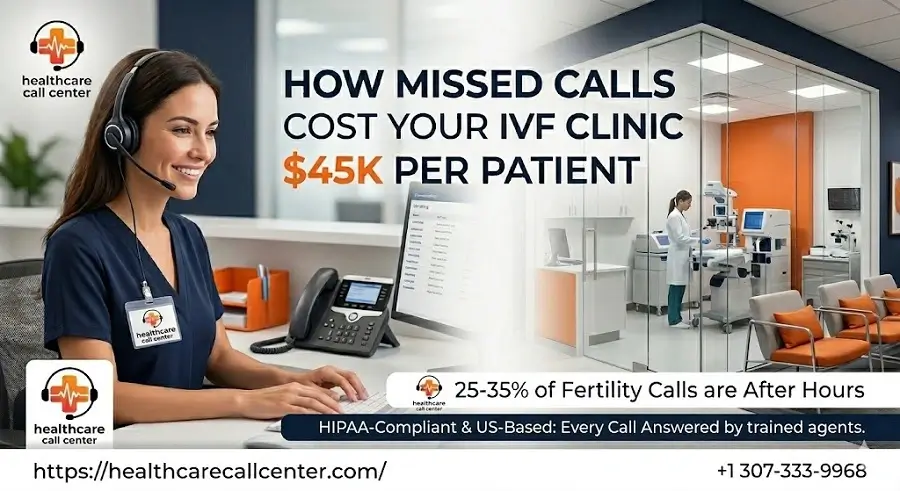
The average IVF clinic in the United States handles 80 to 150 patient calls per day. Between 25 and 35 percent of those calls come in outside normal business hours, early mornings before the first appointment, evenings after staff leave, weekends, and holidays. For a specialty where a single new patient represents $15,000 to $50,000 in lifetime treatment revenue, every unanswered call has a measurable financial impact that compounds over time.
Most fertility practices still rely on voicemail, part-time receptionists, or generic medical answering services with no familiarity with IVF protocols or the emotional reality of patients navigating fertility treatment. This gap between what patients need and what they experience on the phone is one of the most overlooked drivers of patient attrition in the fertility industry.
25 to 35 percent of fertility patient calls come in outside business hours. Each missed new inquiry can represent $15,000 or more in lifetime patient value.
Why IVF Call Patterns Are Different From Standard Medical Practices
IVF treatment generates phone activity that looks nothing like a routine OB-GYN visit or a standard specialist referral. Patients call repeatedly throughout a single treatment cycle, not because they are difficult or uninformed, but because the treatment timeline demands it.
During ovarian stimulation, patients call about medication dosing, side effects, and lab results. During the two-week wait after embryo transfer, call volume does not drop. It shifts to emotional support needs, patients asking if cramping is normal, whether they should avoid certain activities, or what a negative home pregnancy test might mean. If these calls hit voicemail at 6 PM on a Friday, the patient spends the entire weekend in distress that could have been resolved in 90 seconds.
This call pattern repeats across every IVF cycle for every patient. A clinic running 30 to 50 cycles per month generates thousands of touchpoints where the quality of phone support directly affects patient experience and retention.
The Revenue Impact of Missed Calls in IVF
The financial impact is not theoretical. It is calculable based on call volume, conversion rate, and patient lifetime value.
$15,000+ average lifetime value of a fertility patient
- 20 to 35 percent – improvement in consultation conversion with dedicated answering
- 40 percent – of new patient inquiries start with a phone call
- Under 30 seconds – the window to answer before a prospective patient calls the next clinic
A clinic that misses 10 calls per week from prospective patients, with a 25 percent conversion rate and $15,000 average patient value, leaves approximately $5.8 million in potential annual revenue on the table. Even in smaller markets where those numbers compress, the math remains the same: calls answered equal revenue captured, and calls missed equal revenue lost permanently.
For clinics running Google Ads campaigns
where a single click for “IVF clinic near me” costs $15 to $25, an unanswered call means paying for the lead and losing the opportunity. An answering service protects that ad spend by converting every inbound click into a live conversation.
HIPAA Compliance Is Not Negotiable for Fertility Data
Fertility treatment involves some of the most sensitive patient health information in medicine. Patients share genetic testing results, mental health histories, and intimate relationship details during phone consultations. Every call with a fertility patient involves Protected Health Information subject to HIPAA regulations.
Any answering service handling these calls must provide:
- A signed Business Associate Agreement before accessing any patient information
- Encrypted message delivery for call notes and voicemail transcription
- Role-based access controls limiting who can view patient data
- Regular security audits and documented breach response procedures
The HHS Office for Civil Rights has increased enforcement actions against smaller healthcare organizations in recent years. Fertility clinics using non-compliant answering services face regulatory penalties and patient trust damage that is nearly impossible to recover from, particularly in a specialty where patients choose their clinic based on reputation and referrals.
After-Hours Coverage: Why It Is a Patient Safety Issue for IVF
IVF treatment does not follow a 9-to-5 schedule. Patients take medications at specific times that fall outside business hours. They experience symptoms that prompt questions when the clinic is closed. Without 24/7 support, patients face three poor options:
Leave a voicemail and wait hours or days for a callback, which for a patient experiencing spotting after transfer means hours of escalating anxiety.
Visit an emergency room for concerns that could have been addressed by phone in under two minutes.
Search online and encounter unreliable or alarming information from forums and social media.
A dedicated after-hours answering service solves this by triaging calls in real time. Non-urgent questions receive protocol-based guidance and next-day scheduling. Urgent clinical concerns pain after egg retrieval, signs of ovarian hyperstimulation syndrome, fever after anesthesia get warm-transferred to the on-call physician immediately.
After-hours coverage in IVF is not a convenience feature. It is a patient safety measure that also happens to drive retention and reduce emergency department utilization.
US-Based Agents Versus Offshore: The Difference Matters More in Fertility
Fertility patients call because they are anxious and need reassurance, not because they need directions to the office. They are calling about spotting during the luteal phase, nausea from hormone medications, or whether a fever after retrieval warrants a trip to the ER. These calls require someone who understands the clinical context and responds with appropriate urgency — not someone reading from a generic medical script.
What US-Based Agents Provide That Offshore Teams Cannot
US-based agents trained on IVF protocols understand the healthcare system insurance verification for fertility benefits, referral authorization processes, prescription terminology, and the emotional weight of these conversations. They recognize urgency in a patient’s voice when they ask about “spotting after transfer” because they have been trained to understand that phrase in context.
Research published by the NIH confirmed that infertility patients rate communication quality as critical to their treatment experience and frequently report it as insufficient. Cultural and language barriers between patients and offshore agents widen this gap significantly. A patient undergoing their third IVF cycle, calling at 10 PM about cramping, needs a calm, knowledgeable response — not a delayed callback or a transferred call to someone unfamiliar with their file.
Converting Inquiries Into Consultations: The Phone Is Your Funnel
New patient inquiries are where phone handling has the most direct financial impact for IVF clinics. Most prospective patients start with a phone call, questions about success rates, insurance coverage, pricing, and available protocols. The speed and quality of that first response determines whether they book a consultation or move on to the next clinic on their list.
A trained answering service does more than take messages. Agents collect key patient information during the initial call — age, diagnosis, treatment history, insurance details and route it directly into the scheduling system. This turns a voicemail into a pre-qualified consultation booking, eliminating the callback delay that causes prospective patients to choose a competitor.
For clinics investing in paid search, this integration is critical. Every unanswered call from a Google Ads click is money spent with zero return. A 24/7 answering service ensures the clinic captures every paid lead, not just the ones that arrive during business hours.
What to Look for in an IVF Answering Service
Not all medical answering services are equipped for fertility. When evaluating providers, these factors separate adequate services from ones that actually improve clinic performance:
- Fertility-specific training – Agents should understand IVF treatment cycles, common medications, and the emotional context of fertility calls, not just general medical terminology.
- Real-time scheduling integration – The service should connect directly to your EMR or scheduling platform so appointments are booked immediately, not relayed through message tickets.
- HIPAA compliance documentation – Request the Business Associate Agreement, security audit reports, and breach response plan before signing.
- After-hours triage protocols – The service should have clear escalation procedures for urgent clinical concerns, with warm transfer to on-call physicians.
- US-based agents – For fertility patients in emotionally vulnerable states, a US-based agent who understands the healthcare system and cultural context makes a measurable difference in satisfaction and retention.
Key Takeaways
Fertility clinic call coverage is a revenue driver, a patient safety measure, and a competitive differentiator not a back-office operational detail. Clinics that invest in dedicated, HIPAA-compliant answering services see measurable returns in consultation volume, patient retention, and online reputation.
- Track your unanswered calls this week. The data will make the case for investment.
- Verify HIPAA compliance documentation before signing with any answering service.
- Prioritize US-based agents with specific fertility or IVF training.
- Ensure after-hours coverage includes warm transfer to on-call clinical staff.
Integrate your answering service with your scheduling system for real-time consultation booking.
Frequently Asked Questions
What does an IVF clinic answering service do?
It handles all incoming calls for the practice, new patient inquiries, consultation scheduling, medication questions, insurance verification, and after-hours triage. Trained agents follow clinic-specific IVF protocols to route calls and escalate urgent concerns to on-call physicians.
How much does an IVF answering service cost?
Most fertility practices pay between $200 and $800 per month depending on call volume and service level. A single missed IVF consultation can exceed $20,000 in treatment fees, so the service typically pays for itself within the first month of operation.
Can an answering service schedule IVF consultations directly?
Yes. A service integrated with your scheduling platform can collect patient information, verify insurance, and book consultations in real time eliminating the voicemail-to-callback delay that causes prospective patients to choose a competitor.
Is after-hours fertility answering HIPAA compliant?
Reputable healthcare answering services maintain full HIPAA compliance including signed Business Associate Agreements, encrypted message delivery, role-based access controls, and regular security audits. Always verify compliance documentation before contracting.
What happens when a patient calls with an urgent concern after hours?
Non-urgent calls receive protocol-based guidance and next-day scheduling. Urgent clinical concerns, pain after retrieval, signs of OHSS, fever get warm-transferred to the on-call physician immediately.
How does US-based differ from offshore for IVF calls?
US-based agents understand American healthcare terminology, insurance processes, and the cultural context of fertility treatment. For patients in emotionally vulnerable states, this makes a measurable difference in satisfaction, trust, and long-term retention.
Conclusion
Healthcare Call Center provides HIPAA-compliant, US-based answering services designed for fertility and IVF clinics. Our agents are trained on IVF treatment protocols and understand the communication needs of patients at every stage of treatment.
If your practice is experiencing missed calls, voicemail overload, or after-hours gaps, contact us to discuss what dedicated 24/7 coverage looks like for your clinic.
by Erika Sanchez | Jun 3, 2026 | Fertility & IVF Clinic Answering Service
Most fertility clinics get 80 to 150 calls a day, and roughly a quarter of those come in before 8 AM, after 5 PM, or on weekends. That’s not unusual for any medical practice except in fertility, the financial stakes are different.
A new patient who goes through IVF represents anywhere from $15,000 to $50,000 in lifetime treatment revenue. So when those calls hit voicemail, it’s not just a missed call. It’s money walking out the door.
The problem is that most fertility practices handle these calls the same way a general practitioner does front desk during business hours, voicemail after that, and maybe a generic answering service that doesn’t know the difference between a trigger shot question and a scheduling question.
Patients notice. And in fertility, where people research clinics extensively and compare experiences on Reddit and Facebook groups, that phone experience becomes public fast.
The IVF Call Pattern: Why Fertility Is Different
IVF treatment generates phone activity that looks nothing like a standard medical practice. Patients call repeatedly throughout a single treatment cycle not because they are difficult, but because the treatment timeline demands it.
| Treatment Stage |
What Patients Call About |
Urgency Level |
| Ovarian Stimulation (Days 1-10) |
Injection timing, side effects, missed doses |
Medium-High |
| Trigger Shot (Day 10-12) |
Timing confirmation, last-minute questions |
Critical |
| Egg Retrieval Recovery (Day 12-14) |
Pain, bloating, follow-up scheduling |
High |
| Two-Week Wait (Day 14-28) |
Symptom concerns, anxiety, spotting questions |
Medium |
| Beta Results & Beyond |
Next steps, frozen transfer planning |
High |
During the two-week wait after embryo transfer, call volume does not drop, it shifts to emotional support needs. Patients call asking if cramping is normal, whether they should avoid certain activities, or what a negative home pregnancy test means. If these calls hit voicemail at 6 PM on a Friday, the patient spends the entire weekend in distress that could have been resolved in 90 seconds.
A dedicated fertility clinic appointment scheduling service helps IVF practices capture new patient requests, callbacks, and reschedules with more context.
Common Fertility Calls That Require Immediate Attention
While answering service agents do not provide medical advice, they can follow clinic-specific protocols to identify situations that may require prompt escalation.
Examples include:
- Severe pain after egg retrieval
- Signs of ovarian hyperstimulation syndrome (OHSS)
- Medication timing concerns
- Trigger shot timing questions
- Heavy bleeding
- Fever following a procedure
Having clear escalation procedures helps ensure patients receive timely support while keeping providers informed.
The Cost of Missed Calls: By the Numbers
The financial impact is not theoretical. It is calculable.
- $15,000+ – average lifetime value of a fertility patient
- 20-35% – improvement in consultation conversion with dedicated answering
- 40% – of new patient inquiries start with a phone call
- 30 seconds – the window to answer before conversion drops significantly
Even a small number of missed inquiries can have a meaningful impact on consultation volume and patient acquisition. For fertility clinics, every opportunity to connect with a prospective patient matter. Even if those numbers seem high for your market, the principle holds at any scale: calls answered equal revenue captured.
Why HIPAA Compliance Matters for Fertility Clinics
Fertility treatment generates some of the most sensitive patient health information in medicine. Patients share genetic information, mental health assessments, and intimate relationship details during treatment. Every phone call with a fertility patient involves Protected Health Information (PHI) subject to HIPAA regulations.
Any answering service handling these calls must provide:
| Requirement |
What It Means |
Risk If Missing |
| Signed BAA |
Business Associate Agreement with the answering service |
HHS penalties up to $50K/violation |
| Encrypted Channels |
All patient data transmitted via encryption |
Breach exposure during transit |
| Access Controls |
Limited, audited access to patient information |
Unauthorized PHI access |
| Agent Training |
Staff trained on PHI handling procedures |
Accidental disclosure risk |
| Audit Logs |
Documented record of all data access |
No accountability for violations |
The HHS Office for Civil Rights has increasingly targeted smaller healthcare organizations in enforcement actions. Fertility clinics that use non-compliant answering services face both regulatory penalties and patient trust damage that is nearly impossible to recover from.
US-Based vs. Offshore: Why It Matters for Fertility
Fertility patients call because they are anxious, not because they need directions. They are calling about spotting during the luteal phase, nausea from medications, or whether a fever after retrieval warrants a trip to the ER. These calls require someone who understands the clinical context, not just someone following a script.
What US-Based Agents Provide That Offshore Teams Cannot
A US-based agent trained on IVF protocols understands the healthcare system insurance verification, referral processes, prescription terminology. They recognize urgency in a patient’s voice when they ask about “spotting after transfer” because they have been trained to understand that phrase in context.
A study published by the NIH confirmed that infertility patients rate communication quality as critical and frequently report it as insufficient a gap that cultural and language distance only widens on the phone.
| Factor |
US-Based Agent |
Offshore Agent |
| Fertility protocol knowledge |
Trained on IVF cycle specifics |
Generic medical training |
| Insurance terminology |
Familiar with US carriers and verification |
Limited familiarity |
| Cultural context |
Understands American patient expectations |
May miss cultural nuances |
| Urgency recognition |
Can identify time-sensitive IVF concerns |
Follows general escalation rules |
| Patient empathy calibration |
Understands emotional weight of fertility treatment |
May not grasp clinical significance |
After-Hours Coverage: Protecting Patients During Critical Windows
IVF treatment does not follow a 9-to-5 schedule. Patients take medications at specific times outside business hours. They experience symptoms that prompt questions when the clinic is closed. Without after-hours support, patients choose between three bad options:
Leave a voicemail and wait hours or days for a callback. Visit an ER for concerns that could have been addressed by phone. Search online and encounter unreliable or alarming information.
A dedicated after-hours answering service solves this by triaging calls in real time. Non-urgent questions get protocol-based guidance and next-day scheduling. Urgent clinical concerns such as pain after egg retrieval or signs of ovarian hyperstimulation get warm-transferred to the on-call physician immediately.
After-hours coverage is not a convenience feature for fertility clinics. It is a patient safety measure that also happens to drive retention.
Converting Inquiries Into Consultations
New patient inquiries are where phone handling has the most direct financial impact. Most prospective patients start with a phone call questions about success rates, insurance, pricing, and available protocols. The speed and quality of that initial response determines whether they book a consultation or call the next clinic.
A trained answering service does more than take messages. Agents can collect key patient information during the initial call age, diagnosis, treatment history, insurance details and route it directly into the scheduling system.
This turns a voicemail into a pre-qualified consultation booking.
| Scenario |
Without Answering Service |
With Answering Service |
| Prospective patient calls during lunch |
Voicemail → callback tomorrow |
Consultation booked immediately |
| Patient calls Saturday morning |
Closed until Monday |
Appointment scheduled for Monday |
| Google Ads click generates a call at 7 PM |
Voicemail → ad spend wasted |
Lead captured, consultation booked |
| Patient calls with insurance question |
Staff busy → voicemail |
Agent verifies coverage in real time |
For clinics running paid search campaigns, this is particularly critical. A Google Ads click for “IVF clinic near me” can cost $15 to $25. If the resulting call goes unanswered, the clinic paid for the lead but lost the opportunity. An answering service protects that investment.
Key Takeaways
Fertility clinic call coverage is not a back-office operational concern. It is a revenue driver, a patient safety measure, and a competitive differentiator. The clinics that invest in dedicated, HIPAA-compliant answering services see measurable returns in consultation volume, patient retention, and online reputation.
✓ Track your unanswered calls this week, the data will make the case for you
✓ Verify HIPAA compliance before signing with any answering service
✓ Prioritize US-based agents with fertility-specific training
✓ Ensure after-hours coverage includes warm transfer to on-call staff
✓ Integrate answering service with your scheduling system for real-time booking
Every Fertility Patient Call Matters
The decision to contact a fertility clinic is rarely made casually. Patients often spend weeks or months researching providers before making that first call. Ensuring those conversations are answered promptly and handled professionally can make a meaningful difference in both patient experience and consultation conversion.
[Schedule a Consultation]
Frequently Asked Questions
What does a fertility clinic answering service do?
It handles all incoming calls for the practice; new patient inquiries, appointment scheduling, medication questions, and after-hours triage. Trained agents follow clinic-specific protocols to route calls, provide guidance, and escalate urgent concerns to on-call physicians.
How much does a fertility answering service cost?
Costs vary based on call volume, coverage requirements, and service features. Many clinics find that improved call handling and consultation scheduling offset the investment.
Can an answering service schedule IVF consultations directly?
Yes. A service integrated with your scheduling system can collect patient information, verify insurance, and book consultations in real time eliminating the voicemail-to-callback delay that causes prospective patients to choose a competitor.
Is after-hours answering HIPAA compliant?
A reputable healthcare answering service maintains full HIPAA compliance including signed Business Associate Agreements, encrypted message delivery, access controls, and regular security audits. Always verify compliance documentation before contracting.
What happens when a patient calls with an urgent concern after hours?
The service triages by urgency. Non-urgent calls get protocol-based guidance and next-day scheduling. Urgent concerns pain after retrieval, signs of OHSS get warm-transferred to the on-call physician immediately.
How does US-based differ from offshore for fertility calls?
US-based agents understand American healthcare terminology, insurance processes, and cultural context. For fertility patients in vulnerable emotional states, this makes a measurable difference in satisfaction and retention.
Conclusion
Fertility clinics spend heavily on clinical technology, marketing campaigns, and patient experience improvements then leave their phone lines to voicemail systems and overworked front desk staff. It is the most visible operational gap in the specialty, and patients notice it immediately. Every unanswered call is a prospective patient who moves to the next clinic on their list, and every patient who cannot reach anyone after hours is a patient who starts questioning whether they made the right choice.
The fix is not complicated. A HIPAA-compliant, US-based answering service with agents trained on fertility protocols captures the calls that voicemail loses, converts the inquiries that voicemail wastes, and provides the after-hours support that keeps patients from switching practices mid-cycle. For most fertility clinics, the service pays for itself within the first month through captured consultations alone.
If your practice has been losing calls or if you are not sure how many calls you are losing because nobody is tracking it start there. Count the unanswered calls for one week. The number will make the decision obvious.