Your front desk is drowning. The phones will not stop. A patient is on hold, another is walking in, and the fax machine is beeping. Somewhere in that chaos, a new patient inquiry goes to voicemail – and that patient calls the next practice on their Google search results instead.
This is the daily reality for growing medical practices, and it is exactly why more clinics are choosing to outsource their medical call center operations.
But outsourcing your medical call center is not just about hiring someone to answer phones. It is a strategic operational decision that affects patient experience, revenue capture, staff workload, and compliance. This guide walks through what it actually means to outsource a medical call center, when it makes sense, what it costs, and how to choose the right partner.
What Does It Mean to Outsource a Medical Call Center?
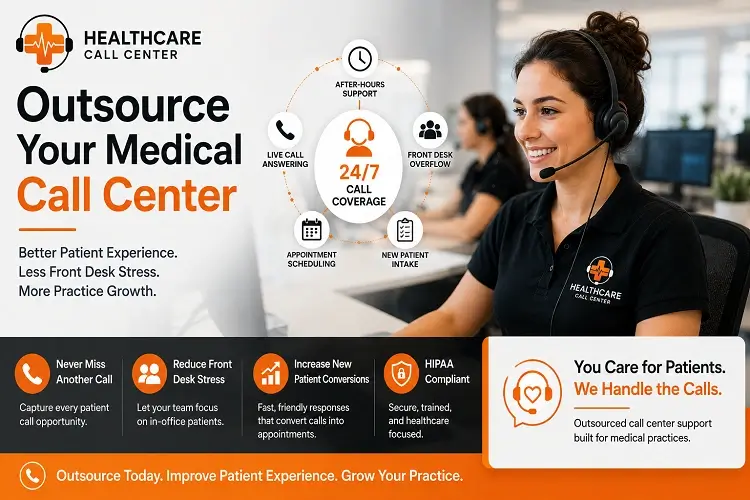
Outsourcing a medical call center means partnering with a specialized service provider to handle some or all of your practice’s inbound and outbound patient calls. This is not a generic answering service that takes messages. A true medical call center partner handles:
- Inbound patient calls – appointment scheduling support, prescription refills, lab result inquiries, insurance questions, and urgent message routing
- After-hours coverage – nights, weekends, and holidays so no patient call goes to voicemail
- Overflow call handling – when your front desk is overwhelmed, calls roll over to the call center so no one waits on hold
- Outbound patient communication – appointment reminders, follow-up calls, recall campaigns, and patient outreach
- New patient intake – capturing leads from website forms, marketing campaigns, and referral sources before they go cold
The depth of service depends on what your practice needs. Some practices outsource only after-hours calls. Others use a call center for all inbound calls during business hours, freeing their front desk team for in-person patient care.
Signs Your Practice Needs to Outsource Its Call Center
Not every practice needs to outsource. But these signs indicate it is time to evaluate:
- You are missing calls during business hours. If your front desk cannot answer every call within three rings during regular hours, you are losing patients. Studies show that 75% of callers who reach voicemail hang up without leaving a message. For a practice spending money on marketing, every missed call is wasted ad spend.
- Your after-hours calls go to voicemail. Patients call after hours because they have a need that cannot wait until morning. If those calls hit voicemail, the patient either waits anxiously or calls a competitor. An outsourced call center ensures every after-hours call is answered by a live person.
- Your staff is burned out from multitasking. When front desk staff is simultaneously checking in patients, answering phones, and handling administrative work, everything suffers. Patient check-in takes longer. Calls are rushed. Errors increase. Outsourcing call handling lets your in-house team focus on the patients standing in front of them.
- You are running marketing campaigns but cannot track lead conversion. If you are paying for Google Ads, SEO, or social media marketing but cannot track which calls come from which campaigns, you are flying blind. A medical call center can track call sources, qualify leads, and report on conversion rates.
- You have multiple locations with inconsistent phone handling. Multi-location practices often have different front desk processes at each site, leading to inconsistent patient experiences. A centralized outsourced call center standardizes how every patient call is handled across all locations.
- New patient inquiries are not being captured. The most expensive call to miss is from a new patient. If your team cannot answer every new patient inquiry quickly, you are losing revenue before the patient ever walks through the door.
Before choosing a provider, practices should review a medical call outsourcing checklist to understand where their phone process is actually breaking down
In-House vs Outsourced Medical Call Center: Honest Comparison
In-House Call Handling
Advantages:
- Staff knows your patients personally
- Direct integration with your practice management software
- Immediate access to providers for questions
Disadvantages:
- Limited to business hours (unless you staff 24/7, which is extremely expensive)
- Staff multitasking leads to missed calls and rushed interactions
- Scaling requires hiring, training, and managing more staff
- No specialized training in phone-based patient communication
- High overhead – salary, benefits, PTO, sick days, turnover costs
Outsourced Medical Call Center
Advantages:
- 24/7 coverage without staffing complexity
- Trained agents who specialize in phone-based patient communication
- Scales instantly – no hiring or training delays
- Consistent patient experience across all calls and locations
- Detailed call analytics and reporting
- Lower total cost than staffing a 24/7 in-house team
Disadvantages:
- Agents do not know your patients personally (mitigated by CRM integration and call protocols)
- Requires upfront setup time for call flows, scripts, and training
- Quality varies between providers (vetting is critical)
For most growing practices, the decision comes down to this: your in-house team is best at in-person patient care. An outsourced call center is best at phone-based patient communication. When you let each focus on what they do best, the practice runs more efficiently, and patients get a better experience.
What to Look for When You Outsource a Medical Call Center
Not all medical call centers are created equal. When evaluating partners, look for:
HIPAA Compliance
This is the baseline. Any call center handling patient calls must sign a Business Associate Agreement, use secure messaging, and train agents on PHI handling. If a provider hesitates on any of these, move on.
Healthcare Specialization
A call center that also handles plumbers and real estate agents is not a medical call center. Look for providers that specialize in healthcare and understand the nuances of medical phone communication – clinical terminology, patient privacy, empathy for anxious callers, and specialty-specific workflows.
Bilingual Capabilities
Your patient population likely includes non-native English speakers. A call center with bilingual agents ensures language barriers do not cost you or your patients.
CRM and Practice Management Integration
The best call centers integrate with your existing systems – whether that is Athena, Epic, Practice Fusion, or GoHighLevel. This means appointments booked during a call appear in your system in real time, with no manual data entry.
Call Recording and Quality Assurance
Ask whether calls are recorded (with appropriate patient consent), how quality is monitored, and what metrics they track. Look for first-call resolution rates, average answer speed, and patient satisfaction scores.
Scalability
If your practice grows or you open new locations, your call center should be able to scale with you – adding agents, extending hours, or taking on new call types without a lengthy onboarding process.
Transparent Reporting
You should receive regular reports showing call volume, answer rates, appointment booking rates, after-hours activity, and lead source tracking. Data transparency is non-negotiable.
What Does It Cost to Outsource a Medical Call Center?
Pricing models vary, but most medical call centers use one of these structures:
Per-Minute Billing
You pay for the actual time agents spend on calls. Rates typically range from $0.75 to $1.50 per minute. This works well for practices with low to moderate call volume.
Per-Call Billing
You pay a flat rate per call, usually $1.00 to $3.00 depending on complexity. This provides more predictable budgeting.
Monthly Subscription
A fixed monthly fee covers a set number of minutes or calls, with overages billed separately. Plans typically range from $200 to $1,500 per month depending on practice size and service level.
Dedicated Agent
Some practices opt for a dedicated agent or team that exclusively handles their calls. This is the most expensive option ($2,000 to $5,000+ per month) but provides the highest level of consistency and familiarity with your practice.
The real cost question is not “how much does the call center charge?” but ” how much are missed calls costing my practice?”
A single missed new patient call for a plastic surgery practice can mean losing a $5,000 to $15,000 procedure. For a fertility clinic, a missed inquiry could represent $15,000 to $50,000 in treatment revenue. When you frame the cost against the revenue at stake, outsourcing becomes one of the highest-ROI investments a practice can make.
How to Transition to an Outsourced Medical Call Center
Switching from in-house call handling to an outsourced model requires planning, but a good partner makes the transition smooth.
Step 1: Audit your current call volume and patterns. Pull data from your phone system showing total calls per day, peak hours, after-hours volume, and average wait times. This baseline helps you choose the right service level.
Step 2: Define your call flows and protocols. What happens when a patient calls with an emergency? How should new patient inquiries be handled? What information needs to be captured for appointment booking? Document these workflows.
Step 3: Choose a partner and sign a BAA. Review your options, ask for references from similar medical practices, and ensure the Business Associate Agreement is in place before any patient calls are handled.
Step 4: Train the call center on your practice. Provide information about your specialties, providers, scheduling rules, common patient questions, and practice policies. The best call centers will guide this process.
Step 5: Start with a pilot period. Route only after-hours calls or overflow calls to the call center first. Monitor quality, gather feedback from staff and patients, and adjust protocols before full rollout.
Step 6: Review performance monthly. Look at answer rates, booking rates, patient feedback, and cost. Adjust as needed.
Common Myths About Outsourcing a Medical Call Center
“Patients will know it is outsourced.”
If the call center is well-trained, patients will not know. Agents answer with your practice name, follow your scripts, and access your scheduling system. The experience should be seamless.
“We will lose control over the patient experience.”
You actually gain more control because every call follows your documented protocols. In-house staff handle calls inconsistently depending on their workload and mood. An outsourced team follows standardized processes.
“It is too expensive.”
Compare the cost of outsourcing to the cost of a missed new patient. For most practices, recovering one or two patients per month covers the entire cost of the service.
“Our patients want to talk to someone they know.”
Some do. But most patients simply want their call answered quickly by someone who is helpful, professional, and can solve their problem. A trained call center agent delivers that consistently.
Making the Decision
Outsourcing your medical call center is not about replacing your front desk. It is about extending your practice’s ability to serve patients beyond what in-house staffing alone can achieve. The right partner handles the calls your team cannot get to, captures the leads that would otherwise be lost, and ensures that every patient – whether they call at noon or midnight – hears a live, caring voice on the other end.
If your practice is growing, your call volume is increasing, or your staff is stretched thin, it may be time to explore what an outsourced medical call center can do for you.
Book a free consultation to see how Healthcare Call Center can handle your patient calls with the care, compliance, and consistency your practice deserves.
FAQs
1. How much does it cost to outsource a medical call center?
Most medical call centers charge $0.75 to $1.50 per minute, $1.00 to $3.00 per call, or $200 to $1,500 per month for bundled plans. Costs depend on call volume, specialty requirements, and service level. A dedicated agent model runs $2,000 to $5,000+ monthly.
2. Will patients know my calls are outsourced?
No. A well-trained medical call center answers with your practice name, follows your protocols, and accesses your scheduling system. The patient experience should be indistinguishable from calling your front desk directly.
3. Is a HIPAA-compliant BAA included when I outsource?
It must be. Any medical call center you partner with should sign a Business Associate Agreement before handling patient calls. If a provider will not sign one, do not work with them.
4. Can an outsourced call center handle after-hours emergency calls?
Yes. Medical call centers are equipped to triage after-hours calls, follow your urgent message protocols, and route true emergencies to your on-call provider. Non-urgent calls are handled and forwarded to your team for the next business day.
5. How long does it take to set up an outsourced medical call center?
Most implementations take 1 to 2 weeks, depending on the complexity of your call flows, number of locations, and integration requirements. A good partner will guide the setup process and provide training for their agents on your practice specifics.