by Erika Sanchez | Jul 29, 2026 | Medspa Call Center Services
Your front desk is drowning. The phones will not stop. A patient is on hold, another is walking in, and the fax machine is beeping. Somewhere in that chaos, a new patient inquiry goes to voicemail – and that patient calls the next practice on their Google search results instead.
This is the daily reality for growing medical practices, and it is exactly why more clinics are choosing to outsource their medical call center operations.
But outsourcing your medical call center is not just about hiring someone to answer phones. It is a strategic operational decision that affects patient experience, revenue capture, staff workload, and compliance. This guide walks through what it actually means to outsource a medical call center, when it makes sense, what it costs, and how to choose the right partner.
What Does It Mean to Outsource a Medical Call Center?
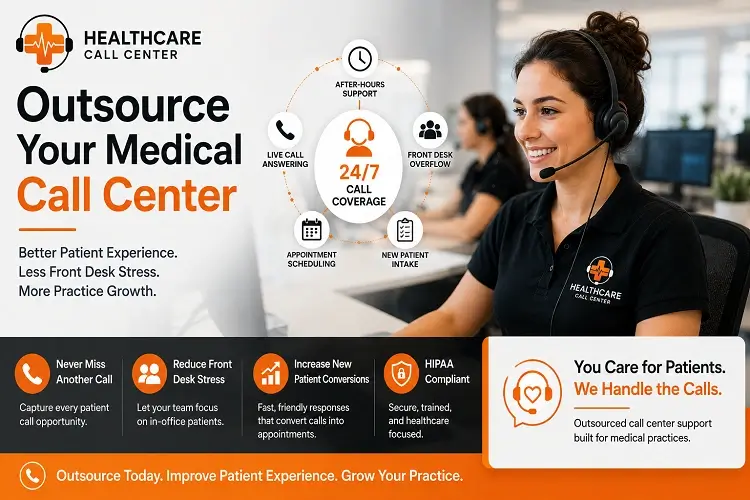
Outsourcing a medical call center means partnering with a specialized service provider to handle some or all of your practice’s inbound and outbound patient calls. This is not a generic answering service that takes messages. A true medical call center partner handles:
- Inbound patient calls – appointment scheduling support, prescription refills, lab result inquiries, insurance questions, and urgent message routing
- After-hours coverage – nights, weekends, and holidays so no patient call goes to voicemail
- Overflow call handling – when your front desk is overwhelmed, calls roll over to the call center so no one waits on hold
- Outbound patient communication – appointment reminders, follow-up calls, recall campaigns, and patient outreach
- New patient intake – capturing leads from website forms, marketing campaigns, and referral sources before they go cold
The depth of service depends on what your practice needs. Some practices outsource only after-hours calls. Others use a call center for all inbound calls during business hours, freeing their front desk team for in-person patient care.
Signs Your Practice Needs to Outsource Its Call Center
Not every practice needs to outsource. But these signs indicate it is time to evaluate:
- You are missing calls during business hours. If your front desk cannot answer every call within three rings during regular hours, you are losing patients. Studies show that 75% of callers who reach voicemail hang up without leaving a message. For a practice spending money on marketing, every missed call is wasted ad spend.
- Your after-hours calls go to voicemail. Patients call after hours because they have a need that cannot wait until morning. If those calls hit voicemail, the patient either waits anxiously or calls a competitor. An outsourced call center ensures every after-hours call is answered by a live person.
- Your staff is burned out from multitasking. When front desk staff is simultaneously checking in patients, answering phones, and handling administrative work, everything suffers. Patient check-in takes longer. Calls are rushed. Errors increase. Outsourcing call handling lets your in-house team focus on the patients standing in front of them.
- You are running marketing campaigns but cannot track lead conversion. If you are paying for Google Ads, SEO, or social media marketing but cannot track which calls come from which campaigns, you are flying blind. A medical call center can track call sources, qualify leads, and report on conversion rates.
- You have multiple locations with inconsistent phone handling. Multi-location practices often have different front desk processes at each site, leading to inconsistent patient experiences. A centralized outsourced call center standardizes how every patient call is handled across all locations.
- New patient inquiries are not being captured. The most expensive call to miss is from a new patient. If your team cannot answer every new patient inquiry quickly, you are losing revenue before the patient ever walks through the door.
Before choosing a provider, practices should review a medical call outsourcing checklist to understand where their phone process is actually breaking down
In-House vs Outsourced Medical Call Center: Honest Comparison
In-House Call Handling
Advantages:
- Staff knows your patients personally
- Direct integration with your practice management software
- Immediate access to providers for questions
Disadvantages:
- Limited to business hours (unless you staff 24/7, which is extremely expensive)
- Staff multitasking leads to missed calls and rushed interactions
- Scaling requires hiring, training, and managing more staff
- No specialized training in phone-based patient communication
- High overhead – salary, benefits, PTO, sick days, turnover costs
Outsourced Medical Call Center
Advantages:
- 24/7 coverage without staffing complexity
- Trained agents who specialize in phone-based patient communication
- Scales instantly – no hiring or training delays
- Consistent patient experience across all calls and locations
- Detailed call analytics and reporting
- Lower total cost than staffing a 24/7 in-house team
Disadvantages:
- Agents do not know your patients personally (mitigated by CRM integration and call protocols)
- Requires upfront setup time for call flows, scripts, and training
- Quality varies between providers (vetting is critical)
For most growing practices, the decision comes down to this: your in-house team is best at in-person patient care. An outsourced call center is best at phone-based patient communication. When you let each focus on what they do best, the practice runs more efficiently, and patients get a better experience.
What to Look for When You Outsource a Medical Call Center
Not all medical call centers are created equal. When evaluating partners, look for:
HIPAA Compliance
This is the baseline. Any call center handling patient calls must sign a Business Associate Agreement, use secure messaging, and train agents on PHI handling. If a provider hesitates on any of these, move on.
Healthcare Specialization
A call center that also handles plumbers and real estate agents is not a medical call center. Look for providers that specialize in healthcare and understand the nuances of medical phone communication – clinical terminology, patient privacy, empathy for anxious callers, and specialty-specific workflows.
Bilingual Capabilities
Your patient population likely includes non-native English speakers. A call center with bilingual agents ensures language barriers do not cost you or your patients.
CRM and Practice Management Integration
The best call centers integrate with your existing systems – whether that is Athena, Epic, Practice Fusion, or GoHighLevel. This means appointments booked during a call appear in your system in real time, with no manual data entry.
Call Recording and Quality Assurance
Ask whether calls are recorded (with appropriate patient consent), how quality is monitored, and what metrics they track. Look for first-call resolution rates, average answer speed, and patient satisfaction scores.
Scalability
If your practice grows or you open new locations, your call center should be able to scale with you – adding agents, extending hours, or taking on new call types without a lengthy onboarding process.
Transparent Reporting
You should receive regular reports showing call volume, answer rates, appointment booking rates, after-hours activity, and lead source tracking. Data transparency is non-negotiable.
What Does It Cost to Outsource a Medical Call Center?
Pricing models vary, but most medical call centers use one of these structures:
Per-Minute Billing
You pay for the actual time agents spend on calls. Rates typically range from $0.75 to $1.50 per minute. This works well for practices with low to moderate call volume.
Per-Call Billing
You pay a flat rate per call, usually $1.00 to $3.00 depending on complexity. This provides more predictable budgeting.
Monthly Subscription
A fixed monthly fee covers a set number of minutes or calls, with overages billed separately. Plans typically range from $200 to $1,500 per month depending on practice size and service level.
Dedicated Agent
Some practices opt for a dedicated agent or team that exclusively handles their calls. This is the most expensive option ($2,000 to $5,000+ per month) but provides the highest level of consistency and familiarity with your practice.
The real cost question is not “how much does the call center charge?” but ” how much are missed calls costing my practice?”
A single missed new patient call for a plastic surgery practice can mean losing a $5,000 to $15,000 procedure. For a fertility clinic, a missed inquiry could represent $15,000 to $50,000 in treatment revenue. When you frame the cost against the revenue at stake, outsourcing becomes one of the highest-ROI investments a practice can make.
How to Transition to an Outsourced Medical Call Center
Switching from in-house call handling to an outsourced model requires planning, but a good partner makes the transition smooth.
Step 1: Audit your current call volume and patterns. Pull data from your phone system showing total calls per day, peak hours, after-hours volume, and average wait times. This baseline helps you choose the right service level.
Step 2: Define your call flows and protocols. What happens when a patient calls with an emergency? How should new patient inquiries be handled? What information needs to be captured for appointment booking? Document these workflows.
Step 3: Choose a partner and sign a BAA. Review your options, ask for references from similar medical practices, and ensure the Business Associate Agreement is in place before any patient calls are handled.
Step 4: Train the call center on your practice. Provide information about your specialties, providers, scheduling rules, common patient questions, and practice policies. The best call centers will guide this process.
Step 5: Start with a pilot period. Route only after-hours calls or overflow calls to the call center first. Monitor quality, gather feedback from staff and patients, and adjust protocols before full rollout.
Step 6: Review performance monthly. Look at answer rates, booking rates, patient feedback, and cost. Adjust as needed.
Common Myths About Outsourcing a Medical Call Center
“Patients will know it is outsourced.”
If the call center is well-trained, patients will not know. Agents answer with your practice name, follow your scripts, and access your scheduling system. The experience should be seamless.
“We will lose control over the patient experience.”
You actually gain more control because every call follows your documented protocols. In-house staff handle calls inconsistently depending on their workload and mood. An outsourced team follows standardized processes.
“It is too expensive.”
Compare the cost of outsourcing to the cost of a missed new patient. For most practices, recovering one or two patients per month covers the entire cost of the service.
“Our patients want to talk to someone they know.”
Some do. But most patients simply want their call answered quickly by someone who is helpful, professional, and can solve their problem. A trained call center agent delivers that consistently.
Making the Decision
Outsourcing your medical call center is not about replacing your front desk. It is about extending your practice’s ability to serve patients beyond what in-house staffing alone can achieve. The right partner handles the calls your team cannot get to, captures the leads that would otherwise be lost, and ensures that every patient – whether they call at noon or midnight – hears a live, caring voice on the other end.
If your practice is growing, your call volume is increasing, or your staff is stretched thin, it may be time to explore what an outsourced medical call center can do for you.
Book a free consultation to see how Healthcare Call Center can handle your patient calls with the care, compliance, and consistency your practice deserves.
FAQs
1. How much does it cost to outsource a medical call center?
Most medical call centers charge $0.75 to $1.50 per minute, $1.00 to $3.00 per call, or $200 to $1,500 per month for bundled plans. Costs depend on call volume, specialty requirements, and service level. A dedicated agent model runs $2,000 to $5,000+ monthly.
2. Will patients know my calls are outsourced?
No. A well-trained medical call center answers with your practice name, follows your protocols, and accesses your scheduling system. The patient experience should be indistinguishable from calling your front desk directly.
3. Is a HIPAA-compliant BAA included when I outsource?
It must be. Any medical call center you partner with should sign a Business Associate Agreement before handling patient calls. If a provider will not sign one, do not work with them.
4. Can an outsourced call center handle after-hours emergency calls?
Yes. Medical call centers are equipped to triage after-hours calls, follow your urgent message protocols, and route true emergencies to your on-call provider. Non-urgent calls are handled and forwarded to your team for the next business day.
5. How long does it take to set up an outsourced medical call center?
Most implementations take 1 to 2 weeks, depending on the complexity of your call flows, number of locations, and integration requirements. A good partner will guide the setup process and provide training for their agents on your practice specifics.
by Erika Sanchez | Jun 11, 2026 | Medspa Call Center Services
A medical spa can spend thousands of dollars on ads, SEO, social media, before-and-after content, and local marketing.
But if a potential patient calls and no one answers, that marketing spend can leak out through one simple gap: missed communication.
That is why more med spas are considering a medical spa virtual receptionist.
Not because the in-house front desk is failing.
Usually, the front desk is doing too much.
They are checking in patients, answering treatment questions, collecting forms, supporting providers, managing payments, handling schedule changes, and trying to answer every phone call at the same time.
For a growing medspa, the question is not only:
“How much does a virtual receptionist cost?”
The better question is:
“What is the cost of letting high-intent consultation calls go unanswered?”
This blog breaks down the cost and value of a medical spa virtual receptionist, when it makes sense, and what to look for before outsourcing patient communication support.
What Is a Medical Spa Virtual Receptionist?
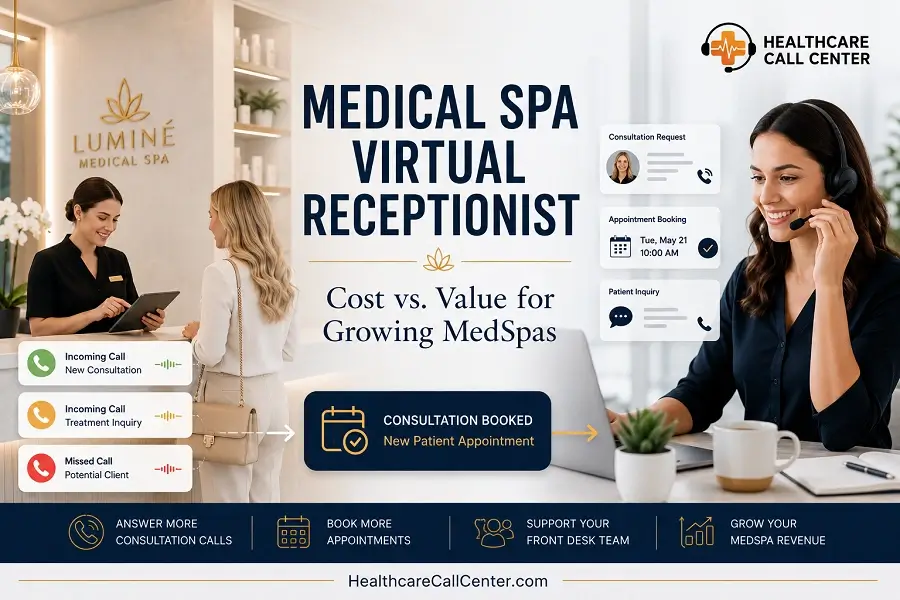
A medical spa virtual receptionist helps aesthetic practices answer patient calls, support consultation requests, manage appointment inquiries, route treatment-related questions, and provide consistent communication when in-house staff are unavailable or busy assisting patients.
For many growing medspas, it serves as an extension of the front desk, helping improve responsiveness without increasing administrative pressure.
A medical spa virtual receptionist is remote patient communication support for medspas, aesthetic clinics, cosmetic practices, and wellness-focused healthcare businesses.
Instead of sitting at the physical front desk, the virtual receptionist helps answer calls, collect patient details, support appointment requests, route questions, and document conversations based on the practice’s workflow.
A medical spa virtual receptionist may help with:
- New consultation calls
- Appointment requests
- Rescheduling and cancellation calls
- Front-desk overflow
- After-hours inquiries
- Missed-call follow-up
- Patient information collection
- Treatment inquiry routing
- Call documentation
The goal is not to replace your in-office team.
The goal is to protect them from overload.
When your front desk is busy helping the patient in front of them, a virtual receptionist helps make sure the patient calling in still receives a calm, professional response.
Why MedSpas Need Better Call Coverage
Medspa patients often compare several providers before booking.
They may look at your Instagram, check reviews, browse treatment pages, compare pricing, and then call when they feel ready to ask questions or schedule a consultation.
That first phone call matters.
A patient may call during lunch. Another may call after work. Someone else may call while your front desk is checking out a patient or helping a provider.
If the call goes to voicemail, the patient may not wait.
They may call the next medspa.
For medspas, missed calls can affect:
- Consultation requests
- Marketing ROI
- Patient trust
- Follow-up workload
- Schedule gaps
- Staff stress
- New-patient conversion
This is why a virtual receptionist should not be viewed only as a cost.
It is a coverage layer that helps protect the opportunities your marketing is already creating.
The Real Cost of Missed MedSpa Calls
A missed call does not always show up clearly in reports.
But the impact can still be real.
A missed call can mean a patient never books a consultation. It can mean a campaign produced interest, but the practice failed to capture the conversation. It can mean the front desk spends the next day chasing voicemails instead of helping live patients.
For aesthetic clinics, the timing of the call often matters.
When a patient is interested in Botox, fillers, laser treatments, body contouring, skin treatments, or a cosmetic consultation, they may be comparing options in real time.
If one clinic answers and another does not, the answered call has the advantage.
The true cost of missed calls is not just the message. It is the patient journey that never starts.
Medical Spa Virtual Receptionist Cost: What Impacts Pricing?
The cost of a medical spa virtual receptionist depends on how much support your practice needs.
Common pricing factors include:
- Call volume
- Coverage hours
- After-hours support needs
- Scheduling complexity
- Number of providers
- Number of locations
- Types of treatments offered
- Follow-up workflow complexity
- Reporting and documentation needs
A small medspa that only needs overflow support will usually need a different plan than a multi-provider aesthetic clinic running ads and receiving calls throughout the day.
That is why the best way to evaluate cost is not to compare it only against payroll.
A better comparison is:
How much opportunity are we losing when patients cannot reach us?
If your medspa is generating inquiries but missing calls during busy windows, the value of better coverage may be higher than the monthly service cost.
Your in-house team supports the patients inside the clinic.
Your virtual receptionist supports calls when the in-house team is busy, unavailable, or after hours.
That creates a more stable patient communication system.
When a Medical Spa Virtual Receptionist Makes Sense
A virtual receptionist may make sense if your medspa is seeing any of these signs:
- Calls are going to voicemail during business hours
- Staff are constantly interrupted by the phone
- Patients call after hours and wait until the next day for a response
- Your team spends too much time returning missed calls
- Marketing campaigns are generating calls your front desk cannot always answer
- Consultation requests are slipping through the cracks
- Staff feel overwhelmed by call volume
- Follow-up is inconsistent
- You want better call documentation and routing
A medical spa virtual receptionist is especially useful during busy front-desk windows, after-hours inquiry periods, campaign response periods, missed-call follow-up, and appointment scheduling support.
The service helps protect both the caller experience and the in-office patient experience.
HIPAA-Compliant Call Handling Matters for MedSpas
Medical spas often handle sensitive information.
Patients may discuss medical history, treatment goals, medications, procedures, appearance concerns, or personal health details.
That means privacy matters.
A medical spa virtual receptionist should use HIPAA-compliant workflows for call handling, documentation, and patient communication.
Before choosing a partner, ask:
- How are agents trained on patient privacy?
- How is caller information documented?
- How are calls routed?
- How are scripts approved?
- How are escalation rules followed?
A cheap call service that does not understand healthcare workflows can create problems.
Medspas should look for patient communication support built for healthcare, not a generic answering service that treats every call the same.
Why the Human Touch Still Matters
Automation can help with reminders, forms, and simple follow-up.
But aesthetic patients often want to feel heard before they book.
They may be nervous about a procedure. They may be embarrassed to ask certain questions. They may need reassurance before scheduling a consultation.
A human voice can create trust in a way automation often cannot.
That is why Healthcare Call Center uses trained stay-at-home mom agents for patient communication support. The goal is warm, calm, professional call handling that follows your practice’s workflow while making patients feel respected.
A medspa patient does not want to feel like a ticket number.
They want to feel like someone listened.
How Healthcare Call Center Supports MedSpas
Healthcare Call Center helps medspas and aesthetic practices improve patient communication without putting more pressure on the in-house front desk.
We support:
- Live call answering
- Front-desk overflow
- After-hours patient calls
- Appointment request support
- Missed-call follow-up
- Patient information collection
- Practice-specific scripts
- Call documentation
- Escalation based on your written protocols
We do not replace your team. We help your team breathe.
That means your front desk can focus on the patients inside the clinic while callers still receive a human response.
Setup is typically completed in up to 2 weeks once scripts, routing rules, scheduling workflows, and escalation instructions are confirmed.
Final Thoughts
A medical spa virtual receptionist has a cost. But missed calls have a cost too.
So does staff burnout. So does poor follow-up.
So does a patient calling another medspa because your team was too busy to answer.
For growing medspas, the real question is not only what support costs.
The better question is how many patient opportunities are already being created but not fully captured.
A virtual receptionist can help close that gap. It gives your practice more consistent call coverage, calmer patient communication, better documentation, and more support during the moments your front desk needs backup most.
If your medspa is growing and your team is feeling the pressure of increasing call volume, Healthcare Call Center can help identify communication gaps and improve patient accessibility without adding more strain to your front desk.
Frequently Asked Questions!
What is a medical spa virtual receptionist?
A medical spa virtual receptionist is a remote patient communication support role that helps medspas answer calls, collect patient information, support appointment requests, handle front-desk overflow, and document conversations based on approved practice workflows.
How much does a medical spa virtual receptionist cost?
Cost depends on call volume, coverage hours, scheduling complexity, follow-up needs, number of providers, and workflow requirements. The best way to evaluate cost is to compare it against the value of better call coverage and fewer missed patient opportunities.
Can a virtual receptionist schedule medspa appointments?
Yes, if the practice allows it. A virtual receptionist can follow the medspa’s scheduling workflow, collect patient details, document appointment requests, and route calls based on approved rules.
Is a medical spa virtual receptionist HIPAA-compliant?
A virtual receptionist supporting medspa patients should use HIPAA-compliant workflows. This includes careful handling of patient information, privacy-focused documentation, and training around healthcare communication standards.
Is a virtual receptionist better than hiring another front desk employee?
It depends on the practice. An in-house front desk employee is valuable for face-to-face patient support. A virtual receptionist is often valuable for overflow calls, after-hours calls, missed-call recovery, and call coverage during busy windows.
When should a medspa consider virtual receptionist support?
A medspa should consider virtual receptionist support when calls are going unanswered, staff are overloaded, marketing campaigns are creating more inquiries, after-hours calls are being missed, or follow-up is becoming inconsistent.
by Felicia Goodman | Apr 27, 2026 | Medspa Call Center Services
If you’re running a medspa with two or three locations, you already know the feeling. Your Google Ads are performing. Your Instagram is getting engagement. Your injector’s Botox results are going viral in local Facebook groups. The leads are coming in.
But your front desk is drowning.
Between checking in patients, processing payments, answering provider questions, restocking rooms, and handling the constant stream of walk-ins and phone calls, your front desk coordinator is doing the job of three people.
And the first thing that slips?
Answering the phone with the care and attention that a $500 Botox inquiry deserves.
Why Medspas Struggle to Handle Patient Call Volume
There is a growth ceiling for many medspa owners today. Marketing brings in leads, but operational systems struggle to keep up and every missed call means lost revenue.
The Medspa Growth Problem Nobody Talks About
Here’s what the typical medspa growth curve looks like:
Year 1: 1 location, 1-2 providers, moderate call volume. Owner/Office Manager answers all calls directly with very high conversion rates.
Year 2: Expand to another location OR provider. Calls double. Front desk becomes a splitter at multiple locations OR a single location is completely swamped and answers less than 50% of calls. Many calls go to voicemail.
Year 3: You’re running Google Ads, doing social media, maybe running a Groupon or special offer. Call volume triples from Year 1. You have two front desk staff, but between in-person patients and phone calls, 30-40% of calls still go unanswered.
At this point, most medspa owners assume the solution is to hire more front desk staff. But that creates its own problems higher payroll, more training, more scheduling complexity, and the fundamental issue that front desk roles are administrative, not conversion-focused.
Why Medspa Calls Are Harder Than They Look
Medspa inquiries are not simple appointment requests; they are conversion conversations. They’re consultative sales conversations disguised as simple questions.
A caller says: “Hi, I was wondering about your laser hair removal pricing.”
That’s not actually a pricing question. That’s someone who:
- Doesn’t fully understand the treatment yet
- Wants reassurance that it’s worth the investment
- Needs someone to guide them toward a consultation
- Is probably comparing your prices with two other medspas
Same caller. Same question. Completely different trajectory.
Managing Calls Across Multiple Medspa Locations
If you’re operating across two, three, or more locations, the phone problem compounds exponentially.
Each location generates its own call volume. Each has its own schedule, its own provider availability, its own treatment menu. A patient calling about a HydraFacial at Location A has different needs than someone asking about CoolSculpting at Location B.
Without centralized systems, each location operates independently, creating inefficiencies. Patients get put on hold, transferred, and eventually voicemail. The experience is fragmented, and conversion rates plummet.
Medical call center services for medspas solve this by creating a single, centralized team that handles all inbound calls across every location. Every caller gets the same high-quality experience regardless of which location they’re calling or how busy that specific clinic is.
High-Volume Marketing Demands High-Volume Call Handling
Here’s a scenario I see all the time. A medspa owner runs a seasonal promotion — maybe a “Summer Skin Ready” package or a “New Year, New You” Botox event. The marketing works brilliantly. The phone rings 40 times that day instead of the usual 15.
But the front desk can only answer 20 calls. The other 20 go to voicemail. By the time someone calls back, if they call back the momentum is gone. The patient has already booked somewhere else.
This is the fundamental disconnect in medspa marketing: you invest in driving demand, but you don’t invest in capturing it. This creates a major leak in your revenue pipeline.
You get maximum benefits of having a medical call center service with your marketing. Whether you get 15 calls or 150 calls in a day, every caller gets answered immediately by someone trained to convert them. Your marketing ROI goes up not because the ads got better, but because you stopped wasting the leads they generated.
The Consultation Booking Problem
Consultation bookings are the lifeblood of a medspa bringing in new customers for packages and treatments to create new revenue streams. To ensure your medspa doesn’t die off by failing to bring in new clients, your front desk staff must be equipped to turn interested patients into booked consultations.
But how exactly do they do that?
To convert calls effectively, staff need real-time access to schedules, treatment knowledge, and the ability to guide patients toward booking. Without this, even high-quality leads are lost.
These aren’t natural skills for someone whose primary job is checking patients in and stocking treatment rooms. They require training, practice, and dedicated time to master.
How Medspa Call Center Services Work
When a medspa partners with a specialized call handling service, several changes occur with the day-to-day functions of the medspa. Staff members of the medspa are assigned to a new job: not answering calls. Instead, their work shifts to other tasks while the call service greets customers and directs callers to the appropriate medspa staff member. This allows medical spas to give their customers and clients a better experience. By having a call service handle the initial steps of customer contact,
The patient’s experience begins with a call to the medspa to schedule an appointment. The medspa owner’s experience begins with the lead arriving from an online marketing campaign – from this point on, every lead is promptly converted to an appointment by an employee who is the ONLY employee at the medspa whose job is to convert leads to scheduled appointments.
The Financial Impact
Let’s apply the concepts from the video to a real-world example: a multi-location medspa generating $2M per year.
Average treatment value across services: $350 per visit
Average patient visits per year: 4
Average patient lifetime value: $1,400
For example, a medspa receiving 400 calls per month can significantly increase revenue by improving call conversion rates. Therefore, we average 100 consultations per month. 60% of those consultations are expected to show for treatment. Of those treatments 50% are expected to result in additional patients. So in summary the medspa can expect to serve 30 new patients per month.
Now increase the phone conversion rate to 15% (achievable with dedicated appointment setters):
– 400 calls → 180 consultations (up from 100)
– 108 show up (60% show rate)
– 54 convert to treatment (50%)
– 54 new patients × $1,400 LTV = $75,600 per month in new patient value
That’s roughly **$907,000 per year** in additional patient lifetime value from the same call volume. The only change is who answers the phone.
Member Retention and Follow-Up
The call handling advantage doesn’t stop at new patient acquisition. Medspa membership models monthly Botox, quarterly laser treatments, annual skin packages depend on consistent follow-up and easy rebooking.
When a patient’s membership renewal is coming up, a proactive call or text can be the difference between a retained member and a lost one. When someone misses a follow-up appointment, a same-day outreach dramatically increases the odds of rescheduling.
Most medspa front desk teams are too busy handling the patients in front of them to make these outbound calls consistently. A dedicated call team can handle both, answering inbound calls with conversion focus and making strategic outbound follow-ups to retain existing patients.
What to Look for in a Medspa Call Partner
Choosing the correct call handling service for your medspa is of the utmost importance, so we’ve outlined a few crucial criteria for you to consider when selecting a practice partner to manage your business communications.
Can your team see your live schedule and book in real time?
If not, you will struggle to convert leads.
Medspa trained
Unlike many other answering companies we have specialized training for providing exceptional service to Medspas and the aesthetic medical offices they serve. Unlike many other answering companies we can tell the difference between an IPL and BBL. We can answer calls for your Medspa and its patients and staff during business hours, as well as respond to irate or confused callers.
HIPAA awareness
Make sure your call handling provider understands healthcare privacy and has procedures in place to document calls even if PHI is not revealed on the call.
Transparent reporting
It is important to us that you have a clear understanding of the number of calls answered, the number of calls that result in consultations and the call to booking ratio. If the agency does not have the ability to provide you with these numbers then it is unlikely that they will add value to your business.
Scalability. The whole point is that the system scales with your growth. Whether you add a third location, launch a new marketing campaign, or run a seasonal promotion, the call handling should absorb the volume without missing a beat.
The Competitive Advantage of Better Call Handling
Here’s something most medspa owners don’t think about: your competitors are probably dropping the ball on phone calls too. Which means if you get this right, you gain an outsized advantage.
When a patient calls three medspas and two send them to voicemail while one answers immediately with a knowledgeable, friendly human who books them a consultation on the spot that’s where they will book. Every time.
In a market where treatments and pricing are increasingly similar across providers, the phone experience is one of the few places where you can create genuine differentiation. It’s not flashy. It’s not Instagram-worthy. But it’s the thing that actually drives revenue.
The medspas that win aren’t the ones with the best ads or the coolest treatment rooms. They’re the ones that answer every call, convert every lead, and never let a patient slip through the cracks.
Improve Your Medspa Call Handling Today
If your medspa is missing calls or struggling to convert inquiries, you are likely losing high-value patients every day. A structured call center system helps capture every lead and turn more inquiries into booked consultations.
FAQs About Medspa Call Center Services
How is a medspa call center different from a general answering service?
A general answering service takes messages. A medspa call center books appointments, staff who know your treatments, talk pricing, and schedule consultations while the patient is still on the phone. Conversion difference is usually 2–3x.
Will my patients know they’re not talking to someone at my clinic? Not if it’s set up right. They answer with your practice name, know your providers, and work off your live schedule. Most patients can’t tell the difference.
Can a call center handle medspa membership pricing and packages? Yes, but only with proper training. Monthly credits, tiered pricing, annual commitments make sure they’ve actually learned your model before going live.
What happens if a caller has a medical question? Trained handlers know their limits. Scheduling and pricing they handle. Anything clinical goes straight to a provider. Any good call partner has an escalation protocol for this.
How do I measure whether it’s actually increasing revenue? Three numbers: answer rate (95%+), call-to-consultation conversion (target 40–50%), and consultation-to-treatment conversion. Get your baseline first, then check at 30 days.