by Erika Sanchez | Jul 15, 2026 | After-Hours Call Answering Services
A prospective patient finds your practice on Google at 7 PM. She has been researching rhinoplasty for three weeks. She has reviewed your before-and-after photos, checked your reputation, and is ready to book a consultation. She calls your office.
She gets voicemail.
She does not leave a message. She calls the next plastic surgeon in the search results. That practice answers. She books with them.
This happens every night at plastic surgery practices across the country. The frustrating part is that most practices never see the loss clearly because after-hours calls are rarely tracked with the same discipline as website leads, form fills, or ad clicks.
Every missed consultation call represents more than a missed phone call; it is a patient who was ready to take the next step. An after-hours plastic surgery answering service helps practices answer consultation inquiries, qualify new leads, schedule appointments, and route urgent post-operative concerns even when the office is closed. For practices investing in SEO, Google Ads, and referrals, protecting these high-intent calls is just as important as generating them.
What Is an After-Hours Plastic Surgery Answering Service?
An after-hours plastic surgery answering service is a live call answering team that handles patient calls when your office is closed, busy, or unavailable. For plastic surgery practices, it helps capture new consultation inquiries, qualify leads, schedule appointments, and route urgent post-operative calls based on your escalation rules.
The goal is not just to answer the phone. The goal is to protect high-value consult opportunities at the exact moment a patient is motivated enough to call.
Why Plastic Surgery Calls Are Different After Hours
Plastic surgery calls are not routine scheduling calls. They are high-intent, high-value inquiries from patients who have often been researching for weeks or months. When they finally pick up the phone, they are usually ready to take the next step toward a consultation.
But these calls do not only happen during business hours. They come in the evenings when patients are off work, on Saturdays when they have time to research, and during lunch breaks when they finally have a private moment to call.
The patient who calls at 8 PM is not casually browsing. She is comparing options. If she reaches voicemail, she may continue down the search results and contact another practice. Plastic surgery is competitive. Patients have options. The practice that responds first often wins the consultation.
Common Plastic Surgery Calls That Come In After Hours
After-hours consult calls are often more valuable than they look. These are not always simple questions. Many are buying-intent conversations that need a calm, professional response.
Patients commonly call after hours asking:
- How much does rhinoplasty cost?
- Can I book a breast augmentation consultation?
- Do you offer financing options?
- How soon can I schedule a mommy makeover consultation?
- Is liposuction right for me?
- Can I reschedule my consultation?
- Is swelling after surgery normal?
- I think something isn’t right after surgery. Who should I speak to?
A trained plastic surgery answering service gives each caller a real response instead of letting that intent disappear into voicemail.
What Happens When You Miss After-Hours Calls
The math is straightforward. If your practice receives 50 calls per day and 46% come during after-hours or busy windows, that is 23 calls at risk every single day.
Not all of those calls would become patients. But even if only 10% would have scheduled a consultation, that is 2 to 3 lost consultation opportunities per day. At an average plastic surgery patient value of $5,000 to $12,000 or more, the revenue adds up fast.
Over a month, that can mean 50 to 60 lost consultation opportunities. Over a year, it can mean 600 to 700 missed chances to speak with patients who were actively considering a procedure.
The loss is not only revenue. Patients who get voicemail or no timely callback often share that experience with friends, in local groups, or in online review spaces. A missed first impression can create a ripple effect beyond the original call.
Beyond Lost Revenue: Other Hidden Costs
Missed after-hours calls affect more than revenue.
- Lower consultation booking rates
- Reduced return on Google Ads spend
- Lost SEO-generated leads
- Poor first impressions
- Increased pressure on front-desk staff
- Delayed response times
- Lower patient satisfaction
- More missed referral opportunities
Practices spend thousands generating patient inquiries. Every unanswered call reduces the return on that investment.
After-Hours Plastic Surgery Answering Service vs Voicemail
Voicemail is passive. A trained answering service is active. That difference matters when a patient is ready to book.
| Patient Call Scenario |
Voicemail |
After-Hours Answering Service |
| New consult call at 8 PM |
Patient may hang up |
Live agent answers |
| Price or procedure question |
No response until next day |
Lead is qualified immediately |
| Ready-to-book patient |
May call another surgeon |
Consultation can be scheduled |
| Post-op concern |
Patient waits or panics |
Call follows escalation protocol |
| Practice visibility |
Hard to track |
Calls recorded and reported |
What an After-Hours Answering Service Does for Plastic Surgery Practices
An after-hours medical answering service that specializes in healthcare does not just pick up the phone. It acts as a seamless extension of your front desk and protects the patient experience when your in-office team is unavailable.
Captures Every Call
When a patient calls after hours, a live agent answers using your practice name. The patient does not feel abandoned or pushed into voicemail. They experience a warm, professional interaction that matches your brand.
Qualifies the Lead
The agent follows your custom script to qualify the inquiry. What procedure is the patient interested in? What is their timeline? Are they self-pay or considering financing? Have they had a consultation before? That information is captured and routed to your team.
Books the Consultation
If your practice allows direct booking, the agent can schedule the consultation directly into your system. The patient hangs up with a confirmed date and time. No callback queue. No lost lead sitting on a message pad.
Handles Urgent Post-Op Calls
Post-operative patients sometimes call after hours with concerns. The agent follows your escalation protocol. Non-urgent calls are documented for morning follow-up. Urgent calls are warm-transferred to your on-call provider.
Follows Up
The service can handle pre-consult reminders, rescheduling, and no-show follow-ups. Your consultation show rate improves because every inquiry has a next step.
Why Response Time Matters for Plastic Surgery Consult Calls
Plastic surgery leads are high-intent, but they are not always loyal. When a patient calls after hours and reaches voicemail, they often continue researching and contact another practice. A live response within minutes can be the difference between a booked consultation and a lost opportunity.
Research consistently shows that patients are significantly more likely to choose the first practice that responds to their inquiry. For plastic surgery practices competing for consultation appointments, even a short delay can mean losing a motivated patient to another provider.
If you want to estimate the revenue impact of slow response times, use the Patient Lead Response Time Calculator. It shows how delayed responses affect booked appointments and revenue by specialty.
Which Plastic Surgery Practices Need After-Hours Call Coverage Most?
Not every practice needs the same level of coverage, but certain plastic surgery practices are at higher risk of losing consult calls after hours.
- Practices running Google Ads or SEO campaigns
- Practices offering high-value procedures like rhinoplasty, breast augmentation, mommy makeover, liposuction, and facial surgery
- Multi-location plastic surgery groups
- Practices with overwhelmed front desks
- Practices receiving calls after 5 PM, during lunch, or on weekends
- Practices with post-operative patient calls that require escalation rules
If your marketing is working but your phones are not fully covered, you may be paying to generate leads that never become consultations.
How It Works: Setup in Up to 2 Weeks
You do not need to overhaul your phone system. Setup typically takes up to 2 weeks and includes:
- Custom script built from your practice call-handling policies
- Procedure-specific training for rhinoplasty, breast augmentation, body contouring, facial procedures, and other high-value services
- Call routing is configured for your phone system
- Scheduling integration with your practice management software when available
- Escalation protocols mapped to your on-call providers
- Agent training on your practice tone, greeting, and patient communication style
What to Look for in an After-Hours Service
Not every answering service is qualified to handle plastic surgery calls. Before signing, verify the service can support both consult capture and patient safety.
- HIPAA compliance with a signed BAA
- Specialty training so agents understand plastic surgery terminology
- Scheduling integration so consults can be booked when your practice allows it
- Escalation protocols for urgent post-op concerns
- Bilingual support if your patient population needs it
- Call recording and reporting so you can review quality
- Month-to-month terms if you want flexibility before scaling coverage
For a complete evaluation framework, read our checklist for choosing a medical answering service.
Is an After-Hours Answering Service Worth It for Plastic Surgery Practices?
Yes, for most plastic surgery practices, an after-hours answering service is worth it if even one additional consultation per month converts into a paid procedure. With average plastic surgery patient values often ranging from $3,000 to $12,000 or more, recovering a small number of missed calls can cover the monthly cost of call coverage.
The key is to measure the right numbers: after-hours call volume, missed-call rate, consultation booking rate, consultation show rate, and average patient value. Once those numbers are visible, the decision becomes much clearer.
The Hidden Cost of Missing After-Hours Plastic Surgery Calls
If your practice is not tracking after-hours calls, you are flying blind. Start by pulling your phone records for the last 30 days. Count how many calls came in after 5 PM, on weekends, and during lunch. Then calculate what those calls are worth using the Missed Call Revenue Calculator.
For many plastic surgery practices, the revenue at risk from missed after-hours calls is 10 to 20 times the monthly cost of an answering service. The question is not whether you can afford call coverage. The question is whether you can afford to keep losing consultations to voicemail.
An after-hours plastic surgery answering service is not simply about answering phones. It helps protect your marketing investment, improve patient experience, and convert more consultation opportunities into scheduled appointments.
to see how after-hours coverage fits your plastic surgery practice. We will review your call data and show you where consult calls may be slipping away.
Frequently Asked Questions
What happens when a patient calls my plastic surgery practice after hours?
Without an answering service, the call usually goes to voicemail. Most prospective patients do not wait. With an after-hours answering service, a live agent answers using your practice name, follows your custom script, qualifies the lead, and can book the consultation directly into your schedule if your practice allows it.
Can the answering service handle post-operative patient calls?
Yes. Agents follow your escalation protocols for post-operative concerns. Non-urgent calls are documented for morning follow-up. Urgent calls are warm-transferred to your on-call provider immediately.
How much does an after-hours answering service cost for a plastic surgery practice?
Most plastic surgery practices invest $300 to $900 per month, depending on call volume and coverage scope. Compared to the revenue lost from missed consultation calls, the service can often pay for itself when it helps recover even one additional booked procedure.
Will patients know they are talking to an outside service?
No. Agents answer using your practice name and follow your greeting and call-handling policies. Most patients experience it as a seamless extension of your front desk.
Can the service book consultations into my scheduling system?
Yes, if your practice allows direct booking. The service can integrate with many practice management and scheduling systems. Confirm compatibility with your specific system during setup.
How long does setup take?
Setup typically takes up to 2 weeks. This includes script building, agent training on plastic surgery terminology, call routing configuration, scheduling integration, escalation mapping, and testing before going live.
What is the best answering service for plastic surgery practices?
The best answering service for plastic surgery practices is one that offers HIPAA-compliant call handling, procedure-specific scripts, consultation scheduling, post-op escalation protocols, call recording, reporting, and trained agents who understand high-value consult calls.
Do plastic surgery practices need 24/7 call answering?
Not every practice needs full 24/7 coverage, but most plastic surgery practices benefit from evening, weekend, lunch-hour, and overflow call support because high-intent consult calls often happen outside normal office hours.
Can an answering service help book more plastic surgery consultations?
Yes. A trained answering service can capture consultation inquiries when your office is closed, qualify the lead, answer basic intake questions, and schedule the consultation directly if your practice allows booking access.
Can an after-hours answering service answer financing questions?
Yes. Agents can follow your approved scripts to answer common financing questions, collect patient details, and route more complex inquiries to your office according to your workflow.
by Erika Sanchez | Jul 14, 2026 | Medical Answering Services, Medical Call Center Services
Most practices do not switch answering services because they want to. They switch because the current one is losing messages, mishandling urgent patient calls, sending calls to offshore agents who do not understand American healthcare, or charging hidden fees that show up on the second invoice.
The cost of choosing wrong is not just money. A single missed after-hours call from a new patient can represent $500 for a general practice, $2,500 for an OB-GYN, $6,000 for a plastic surgery consultation, or $20,000 for a fertility clinic. One missed call a day for a month can cost more than an entire year of medical answering service fees. If you’re unsure how much missed calls may already be costing your practice, use our Missed Call Revenue Calculator to estimate your potential revenue gap based on your own call volume.
The problem is not that bad services exist. The problem is that most practices do not know what to verify before signing. This checklist covers every area that matters for healthcare practices specifically, so you can evaluate any HIPAA-compliant medical answering service with confidence.
What Should You Look for in a Medical Answering Service?
The most important factors are HIPAA compliance, a signed Business Associate Agreement (BAA), healthcare-trained agents, specialty-specific experience, reliable after-hours coverage, transparent pricing, appointment scheduling support, and clear reporting. A provider should feel like an extension of your front desk rather than a generic call center.
Quick Checklist Before You Sign
Before choosing a medical answering service, make sure you verify:
- Signed HIPAA Business Associate Agreement (BAA)
- Healthcare-trained agents
- Specialty-specific experience
- 24/7 after-hours coverage
- Appointment scheduling integration
- Transparent pricing
- Clear escalation protocols
- Call reporting and recordings
- Month-to-month contract options
- References from healthcare practices
Now let’s dive deep into all these 12 points. What you need to take care of.
The 12-Point Medical Answering Service Checklist
1. Signed Business Associate Agreement (BAA)
A BAA is legally required under HIPAA for any third party that handles protected health information. If a provider hesitates, charges extra, or claims they do not need one because they “do not handle PHI,” end the conversation immediately. A service that answers calls for a medical practice is inherently handling PHI the moment a patient mentions a symptom, a medication, or an appointment reason.
Read the agreement carefully. Confirm it covers all services the agents will perform, including message taking, appointment scheduling, and call routing. Some services offer a watered-down BAA that excludes certain features.
What to ask: “Do you sign a BAA as part of the standard agreement? Is it included in the base price? Can I review it before committing?”
2. HIPAA Agent Training Documentation
A signed BAA means nothing if the agents answering your calls have not been trained on HIPAA requirements. Ask how agents are trained, how often training is refreshed, and whether the service can document completion for the specific agents handling your calls.
Generic compliance training is not the same as healthcare-specific PHI handling. Agents who also handle calls for plumbers and real estate agents may not have the depth of training your patients deserve. Be cautious of services that say “all agents are HIPAA trained” but cannot show you what that includes.
What to ask: “How are agents trained on HIPAA? Can you document completion? How often is training refreshed?”
3. Specialty-Specific Agent Training
A service that handles calls for HVAC companies, law firms, and roofing contractors is not qualified to handle calls for a fertility clinic, an OB-GYN practice, or a plastic surgery center. Each medical specialty has its own terminology, urgency levels, patient emotions, and common call types.
A fertility patient calling about IVF cycle results needs an agent who understands the emotional weight. A dental patient in severe pain at 9 PM needs someone who recognizes urgency and follows your emergency protocol. A plastic surgery patient calling about post-op concerns needs an agent who knows when to escalate and when to reassure.
What to ask: “Do you work with [your specialty] practices? How do agents learn specialty terminology? Can I see a sample script?”
4. Call Escalation Protocols
When a patient calls at 2 AM with an urgent concern, the agent needs to know exactly what to do. Not “take a message and call back in the morning.” The service should follow your specific escalation protocol with tiered urgency levels.
A proper protocol includes Level 1 (routine, next business day), Level 2 (time-sensitive, notify provider within 1 hour), and Level 3 (emergency, page or call provider immediately). The service should warm-transfer Level 3 calls, not cold-transfer or send to voicemail.
Test the protocol during setup. Call the service at 11 PM, describe an urgent scenario, and see what happens. If the agent fumbles or sends you to voicemail, the system is not working.
What to ask: “How do you handle urgent after-hours calls? Can you warm-transfer to our on-call provider? Can we customize escalation tiers?”
5. After-Hours, Weekend, and Holiday Coverage
The primary reason most practices hire the best medical answering service is for after-hours coverage. Yet many services treat after-hours as a premium add-on. About 30 to 40 percent of patient inquiries come in outside regular business hours, including evenings, weekends, and lunch breaks.
Ask whether 24/7 coverage is included in the base price or charged at a higher rate.
Ask about holidays: do they charge 1.5x or 2x on Christmas and Thanksgiving?
Also, ask about average answer time. Patients should never wait more than 3 or 4 rings.
What to ask: “Is 24/7 included in the base price? Are there holiday surcharges? What percentage of calls are answered within 3 rings?”
6. Scheduling System Integration
If the service cannot book appointments into your scheduling system, they are just taking messages. That creates a callback queue and delays the patient experience. Patients who wait for a callback often book with a competitor in the meantime.
Ask whether they integrate with your specific EHR or scheduling platform. Direct booking is better for everyone. The patient gets immediate confirmation, your front desk is freed from callback work, and the service becomes a revenue function, not just message-taking.
What to ask: “Can you integrate with our scheduling system? Do agents book directly or send requests? Is there a setup fee?”
7. Pricing Model and Hidden Fees
Medical answering services typically use per-call, per-minute, or flat-rate pricing. Per-call incentivizes rushed calls. Per minute can lead to padding time. Flat-rate rewards are efficient but may cap the volume included.
The most important factor is transparency. Do they publish rates on their website, or force you through a sales call first? Services that hide pricing usually price-discriminate. Ask about setup fees, script customization fees, holiday surcharges, integration fees, and early termination fees. Get the full schedule in writing.
What to ask: “Can you share pricing upfront? What is included? What are common additional fees? Can I see a sample invoice?”
8. Contract Terms and Exit Clause
Month-to-month is the gold standard. If a service requires an annual contract, there should be a clear exit clause with 30 days’ notice. Avoid early termination fees, auto-renewal clauses, and vague service level language.
Some services offer annual discounts, which can be reasonable after a 60 to 90-day trial. But never commit to a year upfront without testing first. Read the fine print on what happens when you cancel.
Do you lose access to recordings? Is there a number porting fee?
What to ask: “Is the contract month-to-month? What is the notice period? What happens to my data if I cancel?”
9. Setup Time and Onboarding Quality
A specialized medical call center service typically needs up to 2 weeks to build scripts, train agents, configure scheduling, set up escalation protocols, and test. If a service promises 24-hour setup, they are skipping customization and using generic templates.
The onboarding should include a discovery call where you walk through your practice’s call flow, common questions, urgency definitions, and provider preferences. Scripts should be written by someone who understands healthcare workflows, not a generic call center manager.
What to ask: “How long does setup take? Who builds the scripts? Can we review and approve before launch?”
10. Call Recording, Reporting, and Visibility
Without call recordings and reporting, you have no way to verify message accuracy or agent quality. You need a dashboard showing total calls answered, average answer time, call outcomes (message, appointment, escalated), and missed-call recovery rate.
Call recordings protect your practice. If a patient claims information was not passed along, or a staff member questions how a call was handled, you can pull the recording and verify. The dashboard should be accessible 24/7, not sent as a weekly summary.
What to ask: “Do you provide call recordings? What metrics are in your dashboard? How long are recordings stored?”
11. Bilingual and Multilingual Support
Over 42 million people in the United States speak Spanish at home. Healthcare is one of the most critical areas where language access matters. A patient who cannot communicate symptoms or scheduling needs in their preferred language is at risk of inferior care.
Ask whether bilingual support is included in the base price or charged extra. Ask which languages are available and whether bilingual agents are available 24/7 or only during weekday business hours. Some services advertise bilingual support but only have Spanish agents during certain shifts.
What to ask: “Do you offer bilingual support? Is it included or extra? Are bilingual agents available 24/7?”
12. References, Reviews, and Healthcare Reputation
Ask for references from practices in your specialty. A service claiming to work with hundreds of healthcare practices should connect you with 2 to 3 practice managers. Call those references and ask about after-hours quality, message accuracy, and whether the service has ever lost a patient message.
Check Google reviews, but also look at healthcare practice manager communities on Facebook, LinkedIn, and Reddit. Real feedback from peers reveals what sales calls do not. A service with consistent complaints about slow callbacks or agents not understanding medical terminology has structural issues.
What to ask: “Can you provide references from [your specialty] practices? What do reviews say about after-hours quality?”
Why the Cheapest Answering Service Often Costs More
Many practices begin by comparing monthly pricing, assuming every answering service offers essentially the same experience. In reality, the monthly fee is often the smallest cost. A low-priced provider that misses appointment opportunities, mishandles urgent calls, or creates a poor first impression can cost far more than the savings on your invoice.
Think beyond the subscription price. Ask how many new patients could be lost if calls go unanswered, whether agents understand your specialty, and how quickly urgent situations are escalated. Even one missed consultation in specialties such as fertility, plastic surgery, or dental implants may exceed the annual cost difference between providers.
The goal is not to choose the cheapest service. It is to choose the one that protects patient trust, supports your workflow, and helps your practice capture every opportunity.
Red Flags That Should End Your Evaluation
Walk away immediately if you see any of these:
- No BAA or BAA costs extra
- Agents cannot explain how they handle urgent calls
- No clear pricing without a sales call
- Annual contract with no exit clause or early termination fee
- No call recording or reporting dashboard
- Agents sound robotic, rushed, or disengaged during your test call
- Service treats medical calls the same as plumber calls
- Offshore agents unfamiliar with American healthcare and insurance
- You find complaints in practice manager communities about lost messages
Choose With Confidence, Not Guesswork
Picking the wrong medical answering service costs more than money. It costs patient trust, booked appointments, and revenue you may never realize you lost. The right service should feel like an extension of your front desk. Agents who understand your specialty. Coverage that captures every call. Reports that give you real visibility.
Use this 12-point checklist on every conversation. If a service cannot answer these questions clearly, they are not the right partner for your practice.
Want Help Evaluating Your Options?
We built the Healthcare Call Center around the 12 things on this checklist. Specialty-trained stay-at-home mom agents. HIPAA-conscious call handling. Month-to-month terms. Real reporting you can check anytime.
Book a free consultation, and we will walk through your call flow, missed-call risk, and coverage gaps using your actual practice numbers. No pressure, no generic pitch.
Frequently Asked Questions
What is the most important thing to check when choosing a medical answering service?
The signed BAA is non-negotiable. Without it, your practice is not HIPAA-compliant regardless of what the service claims. After the BAA, prioritize specialty-specific agent training and a clear after-hours escalation protocol.
How long does it take to set up a medical answering service?
Most healthcare-specialized services need up to 2 weeks for script building, agent training, scheduling integration, and testing. If a service promises 24-hour setup, they are skipping customization and using generic templates.
Should I choose a service that only works with healthcare practices?
Yes. Healthcare-specialized services understand medical terminology, HIPAA, escalation, and patient communication in ways generic services cannot match. One mishandled urgent call can cost more than a year of answering service fees.
What questions should I ask before signing a contract?
Ask about BAA inclusion, agent HIPAA training, specialty experience, after-hours rates, holiday surcharges, scheduling integration, pricing transparency, contract terms, setup time, call recording, reporting, bilingual support, and references from similar practices.
How do I test an answering service before committing?
Route overflow calls for 2 weeks, then switch to full after-hours in week 3. Place test calls yourself at different times. Monitor recordings, message accuracy, and escalation handling. Never commit to an annual without a 60 to 90-day trial.
What is the biggest mistake practices make when choosing a medical answering service?
Choosing based on price alone. The cheapest service often lacks HIPAA training documentation, specialty knowledge, or reliable after-hours coverage. One missed urgent call can cost more than an entire year of service fees.
by Erika Sanchez | Jul 13, 2026 | Medical Call Center Services
Choosing a medical answering service is not like choosing software. You are trusting a third party to talk to your patients when you cannot. The wrong service damages patient trust, loses appointments, and creates HIPAA liability.
This comparison breaks down the types of medical answering services available in 2026, what they do well, where they fall short, and how to figure out which one actually fits your practice.
Quick Summary
If you’re comparing 24/7 medical answering service providers:
- Generic answering services are inexpensive but lack healthcare expertise.
- Healthcare-specialized services offer HIPAA compliance, trained agents, and scheduling support.
- AI answering services work for simple tasks but still struggle with complex patient conversations.
- Always compare providers based on compliance, training, integrations, pricing, and reporting.
Which Medical Answering Service Is Best?
There isn’t one answer for every practice. A solo dental office has different needs than a multi-location fertility clinic or hospital network. The best medical answering service is the one that matches your specialty, patient volume, workflow, compliance requirements, and budget while providing reliable, HIPAA-compliant support for every patient call.
The Three Types of Medical Answering Services
Before comparing specific providers, you need to understand what type of service you are evaluating.
Type 1: Generic Answering Services
These companies answer phones for everyone plumbers, attorneys, HVAC companies, and healthcare practices. They are inexpensive (often $0.75-$1.25 per call) but they are not healthcare specialists. Their agents do not know medical terminology, they are not trained on HIPAA workflows, and they cannot schedule appointments into your EHR.
Best for: Practices that only need basic message-taking with no clinical context.
Watch out for: No BAA, no HIPAA training, no understanding of urgent vs non-urgent calls.
Type 2: Healthcare-Specialized Answering Services
These providers work exclusively or primarily with healthcare practices. Agents are trained on HIPAA compliance, medical terminology, appointment scheduling, and call escalation protocols. They sign BAAs, use encrypted systems, and understand the difference between a routine scheduling call and a patient experiencing symptoms.
Best for: Practices that need reliable call coverage from agents who understand healthcare workflows.
Watch out for: Pricing varies widely. Some healthcare-specialized services charge premium rates without delivering premium quality.
Type 3: AI-Powered Answering Services
A newer category. These services use AI voice agents or chatbots to handle calls. They are significantly cheaper than human agents but have limitations: they struggle with complex patient emotions; they cannot build rapport.
According to MGMA and industry research, patients often ask “Are you a real person?” within the first 30 seconds.
Best for: Practices that need ultra-low-cost coverage for high-volume, simple transactions (prescription refills, appointment confirmations).
Watch out for: AI services that claim HIPAA compliance without a signed BAA. AI platforms must meet the same encryption and access-logging standards as live services.
| Feature |
Generic Service |
Healthcare Answering Service |
AI Answering Service |
| HIPAA Training |
❌ Usually No |
✅ Yes |
⚠️ Varies |
| Signs BAA |
❌ Sometimes |
✅ Yes |
⚠️ Verify |
| Appointment Scheduling |
Limited |
✅ Yes |
Limited |
| Understands Medical Calls |
❌ |
✅ |
Limited |
| Handles Patient Emotions |
❌ |
✅ |
❌ |
| After-Hours Coverage |
✅ |
✅ |
✅ |
| Best For |
Basic messages |
Medical practices |
Simple repetitive calls |
What to Compare When Evaluating Providers
Skip the marketing pages. Ask every provider these questions before requesting a quote.
1. HIPAA Compliance and BAA
Does the service sign a Business Associate Agreement? Is it included in the price or an add-on? Are agents trained on PHI handling, or is compliance just a checkbox?
2. Agent Training
Are agents trained on your specialty? A service that handles dental calls is not automatically qualified to handle OB-GYN calls. Ask how they train agents on specialty-specific workflows.
3. After-Hours Coverage
Is 24/7 after-hour answering coverage included in the base price or charged as a premium? What happens on holidays? Do they charge 1.5x or 2x rates on Christmas, Thanksgiving, or New Year’s?
4. Scheduling Integration
Can they book appointments directly into your scheduling system? Which EHRs and practice management systems do they integrate with? Is there a setup fee for integration?
5. Call Escalation
When a patient calls at 2 AM with an urgent concern, what happens? Does the agent follow your escalation protocol, or do they just take a message? Can they warm-transfer to your on-call provider?
6. Pricing Transparency
Do they publish their rates, or do you have to “request a quote”? What is included in the base price and what costs extra? What happens if you exceed your monthly call cap?
7. Contract Terms
Is it month-to-month or annual? Is there a 30-day notice requirement? Are there early termination fees?
Every HIPAA-compliant answering service should sign a Business Associate Agreement (BAA).
How Different Practice Types Should Choose
Small Practices (1-2 providers)
You need affordable coverage without complexity. A flat-rate plan at $150-$300/month from a healthcare-specialized service is typically the right fit. Prioritize: HIPAA compliance, basic scheduling, message delivery, and after-hours coverage.
Avoid: Per-minute pricing (unpredictable at low volume) and enterprise-level services with features you will not use.
Mid-Size Practices (3-5 providers)
You need overflow support, after-hours coverage, and possibly scheduling integration. A per-call plan at $1.00-$1.50/call or a flat-rate plan at $400-$600/month works for most. Prioritize: EHR integration, custom scripts, call escalation protocols, and bilingual support if needed.
Avoid: Generic services that cannot handle specialty-specific calls or integrate with your systems.
Large Practices and Multi-Location Groups (6+ providers)
You need enterprise-level coverage: 24/7 support, multi-location routing, detailed reporting, custom integrations, and dedicated account management. Budget $800-$1,500+/month. Prioritize: Reporting dashboards, multi-location call routing, dedicated agents, SLA guarantees, and custom workflow automation.
Avoid: Services that cannot scale or provide detailed analytics on call volume, outcomes, and performance.
Questions to Ask Before Signing a Medical Answering Service Contract
Before choosing a medical answering service, ask the questions that reveal how well they will actually protect your patient experience. Start with after-hours coverage: who answers calls when your office is closed, and are those agents trained for healthcare conversations? Ask whether agents are based in the U.S. or offshore, because patient comfort, accent clarity, and familiarity with healthcare expectations can affect call quality.
You should also ask how calls are recorded, stored, reviewed, and protected for HIPAA-sensitive workflows. A good medical answering company should clearly explain what reporting you receive, including answered calls, missed calls, booking activity, call outcomes, and escalation notes.
Customization matters too. Ask whether you can create custom scripts by specialty, provider, location, insurance question, or urgency level. Finally, confirm whether onboarding is included or charged separately. The best answering service should help set up scripts, train agents, review your call flow, and prepare your practice before going live.
These questions help you compare more than price. They show whether the service can truly represent your practice when your team is busy, closed, or unavailable.
Red Flags That Should End Your Evaluation
- No signed BAA walk away immediately
- Agents who cannot explain the difference between urgent and non-urgent calls
- No clear escalation protocol for after-hours emergencies
- Pricing that only becomes clear after a sales call
- Long-term contracts with no exit clause
- No reporting or call analytics
- Agents who sound like they are reading a script with no warmth or empathy
The Real Question Is Not “Which Service Is Best”
There is no universal best medical answering service. The right question is: which service is best for your practice type, call volume, specialty, and budget?
A small dental practice with 100 calls per month needs something different from a multi-location fertility clinic with 1,000 calls per month. A generic service that costs $0.75 per call may seem cheap until you realize they have no BAA, no HIPAA training, and no understanding of your patients.
Start by understanding your actual needs. Pull your call data. Count your after-hours calls. Calculate what missed calls are costing you using the [Missed Call Revenue Calculator](https://healthcarecallcenter.com/missed-call-revenue-calculator/). Then evaluate providers against the criteria above.
If you want to see what a healthcare-specialized service looks like in practice,
We will review your call volume, show you how the workflow fits your practice, and give you transparent pricing.
Frequntly Asked Question
What is the best medical answering service for small practices?
Small practices (1-2 providers) should look for a healthcare-specialized service with flat-rate pricing between $150-$300/month, HIPAA compliance, and basic scheduling support. Avoid per-minute pricing and generic services without a BAA.
How do I compare medical answering services?
Compare providers on seven criteria: HIPAA compliance (signed BAA), agent training (specialty-specific), after-hours coverage (included or premium), scheduling integration (EHR compatibility), call escalation protocols, pricing transparency, and contract terms (month-to-month preferred).
Are AI answering services HIPAA-compliant?
Some are, but many are not. An AI platform must sign a BAA and meet the same encryption and access-logging standards as a live service. AI platforms that lack a BAA are not HIPAA-compliant regardless of their technical sophistication. Always verify before signing.
Should I choose per-call or flat-rate pricing?
Per-call pricing works well for practices with predictable call volume. Flat-rate pricing is better for practices that want budget certainty. Avoid per-minute pricing if your calls tend to be long or complex, as costs can escalate quickly.
Can a medical answering service schedule appointments into my EHR?
Healthcare-specialized services can integrate with most major EHR and practice management systems. Generic services typically cannot. If scheduling integration is important, confirm compatibility with your specific system before signing.
What is the cheapest HIPAA-compliant medical answering service?
The cheapest legitimate HIPAA-compliant option is typically a flat-rate plan starting around $200/month from a healthcare-specialized provider. Anything cheaper usually means no BAA, no HIPAA training, or hidden fees that appear later.
by Erika Sanchez | Jul 10, 2026 | Healthcare Call Center Services
You have heard the sound a thousand times. A patient calls your practice after hours. The phone rings four times. Then they hear it. A recorded voice tells them the office is closed, lists the hours, instructs them to call 911 in an emergency, and asks them to leave a message after the beep.
What does the patient do next?
They hang up. And they call the next practice on their list.
This scenario plays out at medical practices across the country every single night. And the cost is far greater than anyone realizes.
The Voicemail Problem in Healthcare
Voicemail was designed for a world where patients had no other options. In 2026, they will have plenty. When a patient reaches voicemail, their behavior is remarkably consistent and thoroughly documented.
Approximately 72% of callers hang up without leaving a message. Of those who hang up, about 60% call a different provider within 10 minutes. Among new patient callers specifically, 85% say they would not leave a voicemail to book a first appointment. These are not statistics from a single study. They reflect consistent findings across healthcare communication research over the past decade.
This is not a patient behavior problem that you can solve by asking patients to be more patient. This is a practice revenue problem disguised as a patient behavior problem. Every call that hits voicemail is a patient who may book with a competitor, and revenue that disappears before your front desk even knows the call happened.
Why Do Patients Hang Up Instead of Leaving a Voicemail?
It is easy to assume that if a patient really needs an appointment, they will leave a message and wait for a callback. In reality, that is rarely what happens.
Today’s patients have more choices than ever before. A quick Google search usually shows several nearby practices offering the same service. If the first office sends them to voicemail, it only takes a few seconds to tap the next phone number on the screen. Smartphones have made switching providers almost effortless.
Timing also plays a big role. Many patients call after work, during lunch, or late in the evening because those are the only moments they have available. They are often hoping to book an appointment, ask about a concern, or speak to someone while the issue is fresh in their mind. Waiting until the next business day is not always an option they feel comfortable with.
There is also uncertainty. When someone leaves a voicemail, they have no idea if they will receive a callback in ten minutes, two hours, or the following day. That uncertainty creates frustration, especially when they are worried about their health or trying to schedule care quickly.
For many patients, the first phone call is also their first impression of your practice. Reaching a real medical call center service provider where a person creates confidence. Reaching a voicemail often creates doubt. And in healthcare, where trust matters from the very first interaction, that small moment can determine whether a patient books with your practice or another one.
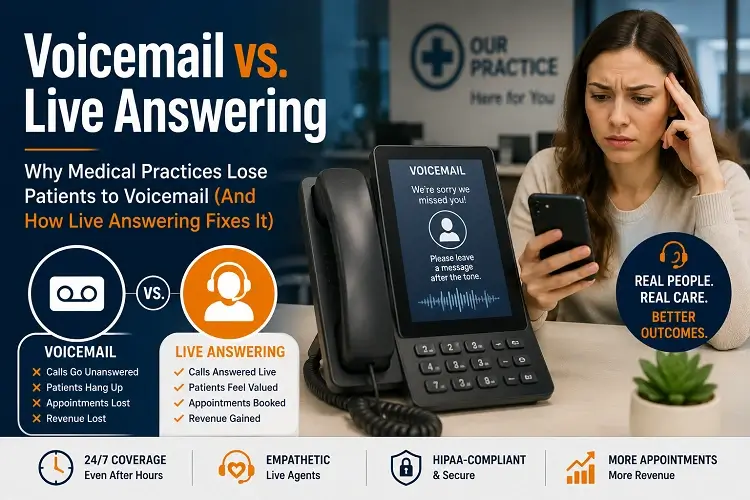
Voicemail vs. Live Answering: A Side-by-Side Comparison
The difference between voicemail and live answering is not subtle. Voicemail is a wall that stops patient engagement. Live answering is a door that invites it.
With voicemail, the patient never reaches a human. The appointment does not get booked until the next business day at the earliest. The patient feels like a transaction, not a valued patient. After-hours emergencies are handled by telling the patient to call 911, regardless of the actual clinical urgency. New patient capture rates sit below 15% because most callers simply will not leave a message for a practice they have never visited.
With live answering, the patient reaches a human within 2 to 3 rings. The appointment gets booked on the call, in real time. The patient feels valued from the first interaction. After-hours emergencies follow your triage protocol with proper escalation. New patient capture rates exceed 80% because the caller is speaking to a real person who can answer questions, provide reassurance, and guide them toward booking.
The Hidden Costs of Medical Voicemail
Most practice administrators look at voicemail as free. There is no monthly fee, no per-call charge, no vendor to manage. But the cost is real, and it hides in the revenue you never collected.
Lost new patient revenue is the highest cost. A new patient who calls after hours and reaches voicemail is unlikely to leave a message. They will call a competitor, and you will never know the call happened. Consider a plastic surgery practice that misses 3 new patient calls per week after hours. An average consultation is worth $400, and the average procedure conversion is worth $8,000. The practice is losing $24,000 per week in potential procedure value, which adds up to over $1.2 million annually.
Patient erosion is a slower but equally damaging cost. Even existing patients lose patience with voicemail over time. If they consistently reach a machine instead of a person, they start to feel like the practice does not value their time. The switching costs in healthcare are lower than most practices think, especially for specialties with high competition.
Compliance and liability risk is a hidden cost that many practices overlook. When patients leave medical information on an unsecured voicemail system, protected health information may be exposed in ways that violate HIPAA. A live, HIPAA-compliant answering service eliminates this risk entirely.
Staff burnout is the final hidden cost. Your front desk team starts every morning with a backlog of voicemails to return. They start the day behind, rushing through calls, giving each patient less attention than they deserve, and feeling overwhelmed before the first patient even arrives.
Signs Your Practice Is Losing Patients to Voicemail
Many practices do not realize voicemail has become a problem until they start looking closely at their call patterns. The warning signs are often there long before anyone notices the impact on patient growth.
One of the biggest indicators is a large number of unanswered calls outside normal office hours. If patients regularly reach voicemail in the evenings, on weekends, or during lunch breaks, there is a good chance some of those callers are choosing another provider instead of waiting for a callback.
Another common sign is a front desk that starts every morning working through dozens of voicemail messages before they can focus on patients already in the office. When staff spend the first hour returning missed calls, everything else tends to fall behind.
You may also notice fewer new patient appointments despite maintaining steady website traffic or advertising campaigns. If people are finding your practice but not booking, the patient experience may be creating an invisible bottleneck.
Even online reviews can provide clues. Comments mentioning difficulty reaching the office, delayed callbacks, or frustration with voicemail often point to communication issues rather than clinical care.
If any of these situations sound familiar, your practice may not have a marketing problem at all. It may simply have a call coverage problem that is costing it new patients every day.
What Patients Expect When They Call a Medical Practice
When patients call a healthcare practice, they want three things. They want to reach a human, not a phone tree, not a bot, not a voicemail box. They want to feel heard, meaning their concern matters even if it is routine. And they want to know the next step, whether that is a booked appointment, a scheduled callback time, or clear instructions.
Voicemail delivers none of these. An AI chatbot delivers the illusion of the first one but fails on the other two because it cannot handle nuance, emotion, or clinical judgment. A trained live agent delivers all three consistently, which is why practices that switch from voicemail to live answering see immediate improvements in patient satisfaction and revenue capture.
This is why our healthcare answering service uses stay-at-home moms. Real people who can listen, respond with empathy, and guide patients to the right next step. Whether that means booking an appointment, following a triage protocol, or simply reassuring an anxious caller that someone cares about their situation.
Voicemail vs. Live Answering: The Revenue Difference
Take a typical practice with 40 calls per day, an after-hours and missed-call rate of 25%, an average appointment value of $300, and 22 working days per month.
With voicemail, 10 calls per day reach voicemail. About 2 leave a message and 8 hang up. Of the 8 who hung up, roughly 5 would have booked an appointment. Monthly revenue lost equals $33,000.
With live answering, 10 calls per day are answered live. About 7 book an appointment on the call. Monthly revenue recovered equals $46,200.
The live answering service that costs $500 to $800 per month just generated a $33,000 monthly return on investment. That is not a marginal improvement. It is a transformational shift in how the practice captures revenue.
You can calculate your own numbers using our revenue calculator to see the exact gap for your practice.
What Changes After Switching to a Live Answering Service
Here is what changes when a practice moves from voicemail to live answering.
Monday mornings start with a clean slate instead of a voicemail backlog. The front desk team focuses on in-office patients instead of returning calls from the weekend. After-hours calls are handled by trained agents who follow your specific protocols. New patient inquiries are captured and booked in real time rather than being lost to voicemail. Patient satisfaction improves because callers feel valued from their very first interaction with your practice.
Staff productivity increases because the team is not constantly playing catch-up. Reports from the answering service provide visibility into call patterns that were previously invisible. You learn exactly how many calls come in after hours, what patients are asking about, and how many appointments are being captured.
How to Replace Voicemail with a Healthcare Answering Service
Switching is simpler than most practices expect. Start by auditing your current call flow to understand when calls are going to voicemail and how many are coming in per week. Then define your protocols for what agents should do with urgent calls, prescription refills, and appointment requests.
Choose a HIPAA-compliant partner and make sure they sign a BAA and understand your specialty. Start with after-hours coverage only, then expand to overflow during busy periods as you get comfortable with the service. Use the reporting dashboard to track call outcomes and refine your scripts over time.
Most practices go live within 2 weeks of signing up, and the impact is immediate.
The Bottom Line
Voicemail is not a patient communication strategy. It is a revenue leak that quietly drains your practice every single night. Every call that hits the beep is a patient who might book with a competitor, delay needed care, feel like your practice does not care, or never call you again.
In 2026, patients expect their healthcare providers to be accessible. Live answering is the simplest and most cost-effective way to meet that expectation while recovering revenue that voicemail has been quietly costing you.
If you are ready to stop losing patients to voicemail, book a free consultation and get a custom call audit in 48 hours.
Frequently Asked Questions
What percentage of patients actually leave a voicemail when they reach a medical practice?
Studies show approximately 72% of callers hang up without leaving a message when they reach voicemail. Among new patient callers, that number is even higher, with 85% saying they would not leave a voicemail for a first appointment. Most of those callers simply dial the next provider on their list.
Is voicemail ever acceptable for a healthcare practice?
Voicemail has a limited role for non-urgent administrative messages like prescription refill requests or appointment time changes. But for new patient inquiries, urgent medical concerns, after-hours calls, and anything involving a patient who is ready to book, voicemail directly costs the practice revenue and patient trust.
How quickly does a live answering service pick up compared to voicemail?
A dedicated healthcare answering service typically answers calls within 3 to 4 rings, often under 15 seconds. Voicemail pickup is technically instant, but it fails at the actual goal, which is connecting the patient with a helpful human who can solve their problem and schedule their appointment.
Does a live answering service cost more than voicemail?
Yes, a live answering service costs more than free voicemail. But the real comparison is about return on investment. If a practice misses even 5 calls per week from new patients, and each appointment is worth $300 to $500, the lost revenue far exceeds the monthly cost of a live answering service. Most practices recover the cost by capturing just 2 to 3 additional appointments per month.
Can a live answering service handle after-hours and weekend calls?
Yes. A healthcare answering service provides 24/7 coverage, including after-hours, weekends, and holidays. Trained agents follow your practice’s specific protocols for triage, message delivery, on-call physician routing, and appointment scheduling, so patients always reach a real person regardless of when they call.
by Erika Sanchez | Jul 9, 2026 | Healthcare Call Center Services
Every medical practice has the same problem. Patients call when your front desk cannot answer. During lunch. After hours. On weekends. At the same time, your team is with a patient in the exam room. And every one of those unanswered calls is a patient who needed something, whether that is an appointment, a prescription, reassurance about a symptom, or urgent medical guidance.
A healthcare answering service solves this problem by ensuring every patient call, 24 hours a day and 7 days a week, is answered by a trained, empathetic human who can schedule appointments, follow triage protocols, and represent your practice with warmth and professionalism.
This blog covers everything you need to know about what a healthcare answering service is, how it works, what it costs, and how to choose the right partner for your practice.
What Is a Healthcare Answering Service?
A healthcare answering service is a specialized live-call solution designed specifically for medical practices. Unlike a generic answering service that simply takes messages, a healthcare-focused service provides a comprehensive suite of capabilities designed to protect practice revenue and improve patient experience.
Live human agents are trained on healthcare communication and HIPAA compliance. They understand medical terminology, insurance basics, and the emotional dynamics of patient calls. Appointment scheduling happens directly in your EMR or practice management software, with no double entry and no missed bookings. Triage protocols are executed following your specific clinical guidelines, so urgent calls are escalated exactly the way you want them handled.
On-call physician routing goes through secure, documented channels with full audit trails. New patient intake captures insurance information, medical history, referral source, and any details your practice needs to prepare for the first appointment. Prescription refill routing reduces front desk phone traffic. Bilingual support serves diverse patient populations. And every interaction is documented in HIPAA-compliant systems with encrypted storage and detailed access controls.
In short, a dedicated healthcare front desk overflow support acts as an extension of your front desk. One that never goes home, never takes a lunch break, and never lets a patient call go to voicemail.
Why Voicemail Is Costing Medical Practices Patients and Revenue
The data on patient phone behavior is clear and consistent across multiple studies. Approximately 72% of callers who reach voicemail hang up without leaving a message. Of those who hang up, about 60% dial the next provider on their list within 10 minutes. Among new patient callers, 85% say they would not leave a voicemail for a first appointment. And patients consistently equate answered calls with quality care, meaning unanswered calls signal indifference and erode trust before the patient ever walks through your door.
When your practice sends calls to voicemail after hours, you are not just inconveniencing patients. You are actively pushing them toward competitors who simply picked up the phone.
Consider the math for a typical medical practice. If you receive 40 calls per day and miss 25% of them, that is 10 missed calls per day. Over 22 working days, that becomes 220 missed calls per month. If 30% of those would have booked an appointment, you would have lost 66 appointments per month. At an average appointment value of $300, that is $19,800 in lost revenue monthly. Annualized, your practice is losing $237,600.
You can plug your own numbers into a revenue calculator to see your practice’s exact gap.
How a Healthcare Answering Service Works
The process is designed to be simple and fast. Before going live, the service analyzes your practice’s call patterns. They look at peak hours, missed-call windows, after-hours volume, and specialty-specific needs. This analysis becomes your custom call-handling blueprint.
Then agents are trained on your specific protocols, specialty terminology, scheduling rules, and escalation procedures. They learn your practice the way a new front desk team member would, but with the structure and oversight of a professional training program. Within approximately 2 weeks, calls begin routing to your dedicated team. Your front desk gets immediate relief during busy hours, and after-hours calls are handled by trained agents who follow your exact protocols.
Monthly reports show answered call volume, new appointments booked, after-hours capture rate, and revenue recovered. You see exactly what the service delivers with no guessing about ROI.
Which Healthcare Practices Benefit Most from a Medical Answering Service?
While any medical practice can benefit, certain specialties see dramatically higher returns on investment.
OB-GYN and maternal care practices deal with pregnant patients who call at all hours with urgent concerns. A specialized OB-GYN answering service handles triage, schedules prenatal visits, and escalates true emergencies, protecting both patients and practice revenue. Patient lifetime values of $4,000 to $10,000 make every missed call expensive.
Fertility and IVF clinics handle some of the highest-value calls in healthcare. One missed fertility call can mean a lost IVF cycle worth $15,000 to $50,000. A fertility clinic answering service captures every high-value inquiry and books consultations while the patient is emotionally ready to commit.
Plastic surgery practices receive consultation leads from Google Ads, social media campaigns, and referrals. If the front desk misses a call at 8 PM, that lead calls the next surgeon on the list. A plastic surgery answering service ensures every consultation opportunity is captured regardless of when the call comes in.
Dental practices face the same challenge with patients calling during lunch, after work, and on weekends. A dental answering service captures new patient inquiries, routes emergencies, and keeps hygiene and treatment schedules full.
Primary care and multi-specialty practices handle an enormous administrative call volume. Prescription refills, referral coordination, appointment changes, and patient questions all compete for front desk time. A medical call center service absorbs this volume so your clinical team can focus on the patients in the office.
Stay-at-Home Moms vs Offshore Teams vs AI Receptionists
Not all answering services deliver the same quality. The three primary models differ significantly in patient experience quality.
Stay-at-home mom teams deliver the highest empathy and patient satisfaction. They bring lived healthcare experience, native US cultural context, low turnover, and full HIPAA compliance. They cost moderately more than offshore options but deliver substantially better results in patient retention and revenue capture.
Offshore call centers offer the lowest cost but also the lowest quality. Agents read generic scripts with limited healthcare training, have no lived understanding of American healthcare, and experience high turnover, which means your patients hear new voices constantly. Patients can tell within seconds that they are talking to someone who does not understand their situation.
AI and bot receptionists are the cheapest option but cannot handle nuanced healthcare conversations. They have no emotional intelligence, cannot triage, and cause high drop-off rates when conversations become complex. In healthcare, where anxiety and emotion drive most calls, bots fail at exactly the moment patients need the most support.
The cheapest option costs less per month but loses far more in missed patients, compliance risk, and damaged reputation over time.
Why HIPAA Compliance Matters in a Healthcare Answering Service
Any answering service handling patient calls must be fully HIPAA-compliant. This is not optional and not something to figure out after a breach. A compliant service signs a Business Associate Agreement before handling a single call. Every agent completes formal HIPAA training.
All systems use encryption for data in transit and at rest. Secure message delivery means no personal email or consumer messaging apps. Audit logs track every interaction involving protected health information.
Agents are based in the United States under US privacy jurisdiction. And a documented breach response plan exists so that if something goes wrong, everyone knows exactly what to do.
If a service cannot provide all of the above, the legal and financial risk of using it falls entirely on your practice.
How Much Does a Healthcare Answering Service Cost?
Pricing varies based on call volume, specialty, and coverage scope. Per-call pricing typically ranges from $0.75 to $1.50 per call and works best for practices with low volume but high-value individual calls. Per-minute pricing ranges from $0.75 to $1.25 per minute and suits practices with short, straightforward calls. Flat monthly pricing ranges from $200 to $900 and provides budget predictability. Multi-location enterprise practices typically negotiate custom pricing.
The real cost question is never how much the service costs. It is how much you are losing without one. For most practices, the service pays for itself by capturing just 2 to 3 additional appointments per month.
Ready to Stop Missing Patient Calls?
Book a free consultation today, and we’ll review your current call flow, identify where patient calls are being missed, and show you how much revenue your practice could recover. No pressure. Just practical insights tailored to your practice.
Frequently Asked Questions
1. What is a healthcare answering service?
A healthcare answering service provides live, HIPAA-compliant call handling for medical practices. Trained agents answer patient calls, schedule appointments, take messages, follow your call-handling protocols, and provide after-hours support so patients always reach a real person instead of voicemail.
2. Is a healthcare answering service HIPAA-compliant?
Yes. A healthcare answering service should operate under strict HIPAA-compliant procedures, including secure message handling, encrypted systems, trained agents, and a signed Business Associate Agreement (BAA) to help protect patient information.
3. Can a healthcare answering service schedule appointments?
Yes. Many healthcare answering services can schedule, reschedule, and cancel appointments based on your practice’s workflow. Depending on your setup, agents may work directly within your scheduling software or follow your approved booking process.
4. What types of medical practices benefit from a healthcare answering service?
Healthcare answering services support a wide range of practices, including primary care, OB-GYN, fertility clinics, plastic surgery practices, dental offices, orthopedic clinics, behavioral health providers, urgent care centers, and multi-specialty medical groups.
5. How much does a healthcare answering service cost?
Pricing depends on factors such as monthly call volume, coverage hours, specialty requirements, and workflow complexity. Many practices find the service pays for itself by capturing just a few additional appointments each month while improving patient satisfaction and reducing missed calls.
How to Choose the Best Healthcare Answering Service
Before signing with any provider, ask whether they have agents trained for your specific specialty. Confirm they will sign a BAA. Find out if they can integrate with your EMR and scheduling system.
Ask about their average answer speed. Request to see a dashboard with call outcomes and ROI metrics. Ask where their agents are based and whether you can customize triage protocols. Confirm coverage for after-hours, weekends, and holidays. Ask about onboarding timeline and contract terms.
If you are ready to see how much your practice is losing to missed calls, book a free consultation with Healthcare Call Center and get a custom call audit in 48 hours. No pressure, no obligation. Just the numbers.