by Erika Sanchez | Jul 28, 2026 | HIPPA-Compliance in Healthcare
When a patient calls your practice after hours, they share something deeply personal. A pregnancy scare. A post-op complication. A question about insurance coverage for a procedure they are anxious about. Every one of those calls contains protected health information (PHI), and every one of those calls needs to be answered by someone who understands what that means.
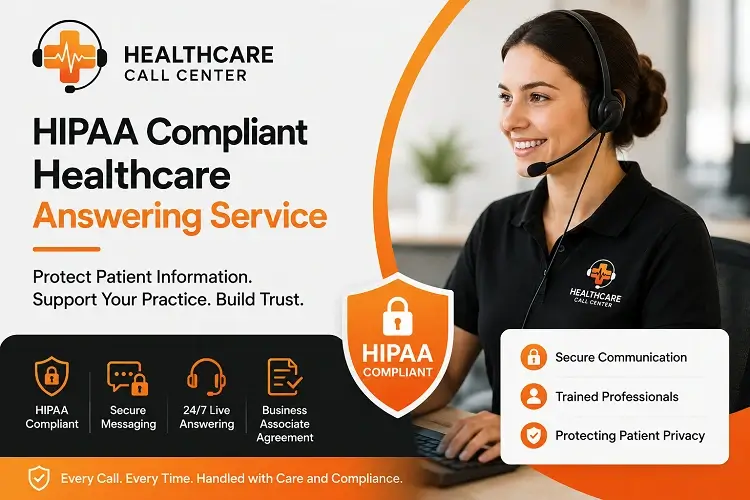
That is where a HIPAA-compliant healthcare answering service comes in.
But not every answering service that claims to be “HIPAA-compliant” actually is. Some use the phrase as a marketing label without the infrastructure, training, or legal agreements to back it up. This guide breaks down what HIPAA compliance actually means for an answering service, what questions to ask before signing a contract, and how the right partner protects both your patients and your practice.
Healthcare organizations remain among the most targeted industries for cyberattacks, and HIPAA violations can result in substantial financial penalties and damage to patient trust. Choosing a us based healthcare call center helps reduce both compliance and operational risks.
What Makes an Answering Service HIPAA Compliant?
HIPAA compliance for an answering service is not a single certification or a checkbox. It is a combination of administrative, physical, and technical safeguards that together ensure PHI is handled responsibly at every touchpoint.
HIPAA compliance is achieved through a combination of policies, technology, employee training, and documented procedures. Every component works together to protect patient information from unauthorized access, accidental disclosure, and security breaches throughout the call-handling process.
A truly HIPAA-compliant healthcare answering service must have:
- A signed Business Associate Agreement (BAA) – This is non-negotiable. Under HIPAA, any third party that handles PHI on your behalf is a “business associate.” Without a BAA, the answering service is operating outside legal compliance, and your practice carries the liability.
- Workforce training on PHI handling – Every agent who touches a patient call must understand what constitutes PHI, how to handle it, and what constitutes a breach. Training should be documented and refreshed regularly.
- Secure message delivery – Messages containing PHI cannot be sent via standard SMS, email, or unencrypted channels. A HIPAA-compliant service uses secure messaging platforms, encrypted email, or secure web portals.
- Access controls – Only authorized agents should have access to patient information. Role-based access ensures that agents only see what they need to handle the call.
- Audit trails – The service should log who accessed what information and when. This is critical for breach investigation and compliance auditing.
- Incident response procedures – If something goes wrong, there must be a documented plan for identifying, reporting, and mitigating a breach.
When any one of these safeguards is missing, patient information becomes more vulnerable to unauthorized access or disclosure. A truly HIPAA-compliant healthcare answering service implements every safeguard together rather than relying on a single security feature or marketing claim.
Why Standard Answering Services Are Not Enough
Many practices use general-purpose answering services because they are cheaper. But a standard answering service that takes medical calls without a BAA, without secure messaging, and without PHI training is a compliance risk.
Many answering services are designed for general businesses such as law firms, plumbers, or real estate offices. Healthcare practices operate under much stricter privacy requirements, meaning a service that works well for another industry may expose medical practices to unnecessary compliance risks.
Consider this scenario: A patient calls after hours and leaves a message with the answering service about their fertility treatment schedule. The service texts the message to the practice manager via standard SMS. That text message now contains PHI sitting on an unencrypted phone, routed through a commercial carrier, with no audit trail.
If that message is intercepted, lost, or seen by someone who should not have access, it is a reportable HIPAA breach. The practice – not the answering service – is responsible for reporting it, notifying the patient, and dealing with the consequences.
Even seemingly routine patient messages can contain protected health information. Appointment details, treatment discussions, medication questions, insurance information, and provider names may all qualify as PHI depending on the context. That is why secure communication methods matter for every patient interaction, not only emergencies.
A HIPAA-compliant healthcare answering service eliminates this risk by:
- Using only secure, encrypted channels for any message containing PHI
- Operating under a signed BAA that clearly defines responsibilities
- Training agents to recognize and handle PHI appropriately
- Maintaining audit logs for every interaction
Not every company advertising HIPAA compliance follows the same operational standards. Asking the right questions before signing a contract helps you identify providers that genuinely understand healthcare privacy requirements rather than simply using HIPAA as a marketing term.
What to Ask Before Hiring a HIPAA Compliant Healthcare Answering Service
Before you trust an answering service with your patients’ information, ask these questions:
- Will you sign a Business Associate Agreement?
If the answer is no or “we do not usually do that,” walk away. A BAA is legally required under HIPAA for any vendor handling PHI.
- How do you deliver messages containing patient information?
The correct answer involves encrypted secure messaging, a HIPAA-compliant web portal, or secure email. Standard text messages and regular email are not acceptable.
- How are your agents trained on HIPAA and PHI handling?
Look for services that provide documented, recurring training – not just a one-time onboarding session. Agents should understand minimum necessary standards, patient rights, and breach reporting.
- What audit controls do you have in place?
You should be able to request logs showing who accessed your patients’ information, when, and for what purpose.
- What happens in the event of a breach?
A compliant service has a documented incident response plan and will notify your practice immediately if a breach occurs.
- Do you carry cyber liability insurance?
This is not strictly required by HIPAA, but it demonstrates that the service takes risk seriously and has financial backing if something goes wrong.
The answers to these questions provide a clear picture of how seriously an answering service approaches compliance. Providers that hesitate to discuss security procedures or cannot provide documentation should be evaluated carefully before being trusted with patient information.
Healthcare specialties manage different types of patient conversations, but every interaction deserves the same level of privacy and professionalism. A healthcare answering service should adapt its workflows to the needs of each specialty while maintaining consistent HIPAA safeguards.
How HIPAA Compliant Answering Services Handle Different Call Types
Different medical specialties have different compliance needs. A HIPAA-compliant healthcare answering service should be able to handle:
General Medical Practices
- Appointment scheduling and rescheduling
- Prescription refill requests
- Lab result delivery (via secure channels only)
- Urgent message routing to on-call providers
Fertility and IVF Clinics
- Cycle coordination calls
- Medication timing questions
- Test result delivery
- Emotional support for patients in sensitive moments – all while maintaining PHI security
Plastic Surgery Practices
- Consultation scheduling
- Pre-op and post-op call screening
- Payment and financing inquiries (which often intersect with PHI)
- Privacy-conscious message handling for elective procedures
Dental Practices
- Emergency triage
- Appointment changes
- Insurance questions that involve diagnosis codes
- Referral coordination
OB-GYN and Pregnancy Clinics
- Pregnancy-related urgent calls
- Test result delivery
- Prescription questions
- After-hours concern routing
Regardless of specialty, every patient deserves confidence that their personal information is handled securely. Consistent processes, secure communication, and properly trained agents help create a better patient experience while supporting your practice’s compliance responsibilities.
In every case, the answering service must treat all patient information as PHI – even details that might seem routine, like appointment times, can reveal diagnostic information (a 30-minute slot with an oncologist vs. a routine checkup).
HIPAA violations often begin with small communication mistakes rather than large-scale cyberattacks. An unsecured text message, an improperly handled voicemail, or unauthorized access to patient information can quickly become a costly compliance issue.
The Cost of Non-Compliance
HIPAA violations are expensive. The Office for Civil Rights (OCR) can impose penalties ranging from $100 to $50,000 per violation, with a maximum of $1.5 million per year for identical violations. But the financial penalty is often the smallest cost.
The real costs of a breach include:
- Mandatory patient notification (in writing, within 60 days)
- Potential media notification if the breach affects 500+ individuals
- OCR investigation and corrective action plans
- Legal fees and potential civil lawsuits
- Reputation damage in your community
- Loss of patient trust that can take years to rebuild
Using a HIPAA-compliant healthcare answering service is one of the simplest ways to reduce these risks. When calls are handled securely, messages are delivered through encrypted channels, and agents are trained on PHI handling, the attack surface for breaches shrinks dramatically.
Beyond financial penalties, compliance failures can disrupt daily operations, consume valuable staff time, and damage patient confidence. Preventing these issues is significantly less expensive than responding to them after a breach has occurred.
Who Benefits Most From a HIPAA-Compliant Healthcare Answering Service?
Then bullets
- Medical practices
- Dental offices
- Plastic surgeons
- Behavioral health
- Fertility clinics
- Multi-location providers
- Urgent care
- Dermatology
- Cardiology
- Pediatrics
Investing in a HIPAA-compliant answering service should be viewed as both an operational improvement and a risk management strategy. While pricing varies, practices should evaluate overall value, security standards, and patient experience instead of focusing solely on monthly costs.
What a HIPAA Compliant Healthcare Answering Service Actually Costs
Pricing varies based on call volume, specialty requirements, and service level. Most HIPAA-compliant answering services charge either per-minute or per-call, with monthly minimums.
Typical pricing structures:
- Per-minute billing: $0.75 to $1.50 per minute of call time
- Per-call billing: $1.00 to $3.00 per call, depending on complexity
- Monthly bundles: $200 to $800 per month for practices with moderate call volume
When comparing providers, ask exactly what services are included in the monthly price. Features such as appointment scheduling, bilingual support, after-hours coverage, secure message delivery, and overflow call handling may vary between providers and can significantly affect overall value.
The key question is not “how much does it cost?” but “how much does it cost to lose a patient call?” A missed new patient inquiry for a fertility clinic can represent $15,000 to $50,000 in lifetime value. A missed post-op call from a plastic surgery patient can lead to complications and lost revenue. HIPAA-compliant answering services are not an expense – they are risk management and revenue protection combined.
Many practices do not realize they have communication gaps until patients begin complaining, appointments are missed, or staff becomes overwhelmed. Recognizing these warning signs early allows practices to improve both compliance and patient satisfaction.
Signs You Need a HIPAA Compliant Answering Service
You might need a HIPAA-compliant healthcare answering service if:
- Your front desk goes home at 5 PM, and calls go to voicemail
- Your current answering service refuses to sign a BAA
- Patient messages are being sent via standard text message
- Your staff is overwhelmed by call volume during business hours
- You have multiple locations and no centralized call handling
- You are spending on marketing but losing leads to missed calls
- You want to offer after-hours support without hiring additional staff
If several of these situations describe your practice, reviewing your current call handling process may reveal opportunities to improve patient communication, reduce administrative workload, and strengthen HIPAA compliance.
If any of these sound familiar, it is worth evaluating whether your current call handling is truly protecting your patients and your practice.
Common HIPAA Communication Mistakes Medical Practices Should Avoid
Even practices with experienced staff can unintentionally create HIPAA risks during everyday communication. Some of the most common mistakes include:
- Sending patient information through standard text messages instead of secure messaging platforms.
- Leaving detailed voicemail messages that reveal sensitive health information.
- Sharing staff login credentials for convenience.
- Using personal mobile phones to communicate with patients.
- Working with answering services that refuse to sign a Business Associate Agreement (BAA).
Avoiding these common mistakes helps reduce compliance risks while creating a safer and more professional experience for every patient.
Why Healthcare Call Center Takes HIPAA Compliance Seriously
At Healthcare Call Center, every patient call is handled by a trained agent who understands HIPAA requirements. Our infrastructure is built around secure communication, our agents receive recurring compliance training, and we sign a BAA with every practice we work with.
We handle calls for fertility clinics, plastic surgery practices, dental offices, OB-GYN offices, and multi-location medical groups. Each specialty has unique compliance considerations, and our agents are trained to handle them all with the care your patients deserve.
Every unanswered patient call is more than a missed opportunity. It may also represent a communication gap that affects patient satisfaction, operational efficiency, and compliance.
Schedule a free consultation with Healthcare Call Center to learn how our HIPAA-conscious answering services help medical practices protect patient information while ensuring every call is answered professionally, day or night.
Frequently Asked Questions
1. What is a HIPAA-compliant healthcare answering service?
A HIPAA-compliant healthcare answering service is a call handling provider that meets HIPAA Privacy and Security Rule requirements when managing patient calls. This includes signing a Business Associate Agreement, using secure messaging, training agents on PHI handling, and maintaining audit controls.
2. Do I need a BAA with my answering service?
Yes. Under HIPAA, any third-party vendor that handles PHI on your behalf is considered a business associate. A signed BAA is legally required and defines how PHI can be used and protected.
3. Can answering services send patient messages via text?
Standard SMS text messages are not HIPAA-compliant because they are not encrypted. A HIPAA-compliant answering service uses secure messaging platforms or encrypted channels to deliver any message containing PHI.
4. How much does a HIPAA-compliant answering service cost?
Most HIPAA-compliant answering services charge $0.75 to $1.50 per minute or $1.00 to $3.00 per call, with monthly plans ranging from $200 to $800 depending on call volume and specialty requirements.
5. What happens if an answering service has a data breach?
If a breach occurs, the answering service must notify your practice immediately. Both the practice and the service may have reporting obligations under HIPAA. A signed BAA ensures clear responsibility and notification procedures are in place before a breach happens.
by Erika Sanchez | Jul 22, 2026 | Healthcare Answering Services
Patient retention is often discussed as if it begins after the appointment. In reality, retention starts much earlier. It begins when a patient calls with a question, concern, scheduling need, refill request, follow-up issue, or anxiety about what happens next. If that call is rushed, missed, or sent to voicemail, the patient experience changes before the provider ever gets involved.
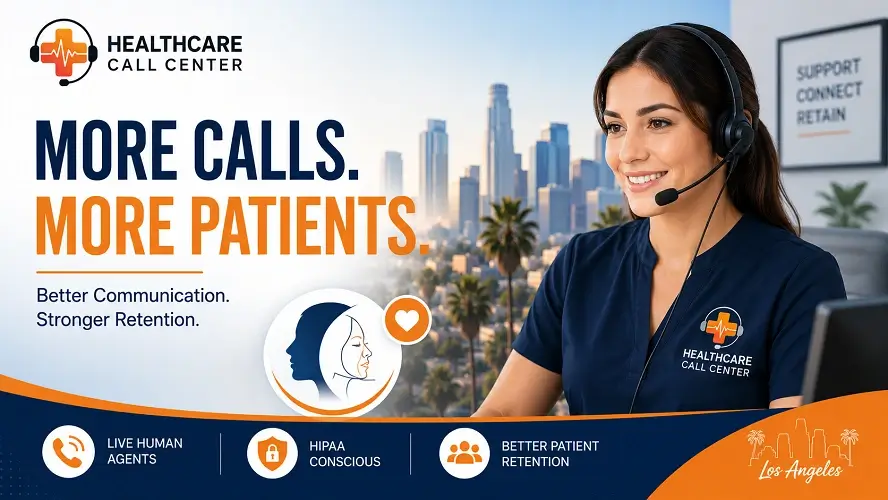
A human healthcare answering service gives practices a way to protect those moments. It helps patients reach a calm, trained person instead of an unanswered phone line. It supports front desk teams when they are overloaded. It helps after-hours call answering callers feel acknowledged. Most importantly, it reinforces the idea that the practice is responsive and organized.
This matters because patients do not stay loyal only because of clinical quality. They stay when the full experience feels trustworthy. Access, communication, follow-up, empathy, and reliability all shape whether a patient returns, refers a family member, or quietly looks for another provider.
Why Phone Communication Affects Patient Retention
Patients judge a practice through many small moments. Was the phone answered? Did the person understand the concern? Was the message captured correctly? Did the caller know what would happen next? These questions may feel operational, but they shape trust. A patient who cannot reach the office may begin to wonder whether the practice will be available when something is more serious.
Healthcare communication also carries more emotion than many other industries. Patients may be calling about pain, test results, pregnancy concerns, fertility questions, post-procedure symptoms, insurance confusion, or an appointment they are nervous to schedule. A rushed voicemail prompt can feel cold. A human voice can slow the moment down and create confidence.
For patient retention, the first call after an appointment can be as important as the first appointment itself. If patients feel ignored during follow-up, they may not return for ongoing care. If they feel supported, they are more likely to stay connected to the practice.
What Makes a Healthcare Answering Service Retention-Focused
A live healthcare answering service improves retention when it does more than collect names and phone numbers. The service should understand the practice’s patient journey. It should know which calls need urgent routing, which calls need structured intake, which messages can wait, and which details the front desk needs to follow up properly.
Retention-focused answering starts with empathy. The caller should feel heard, not processed. It also requires consistency. Every call should follow practice-approved instructions so patients receive the same type of guidance no matter when they call. Finally, it requires clean message delivery. A helpful phone call can still fail if the message reaches the wrong person, lacks context, or arrives too late.
The best healthcare answering service becomes part of the practice’s communication system. It does not replace the care team. It protects access to the care team.
A Retention-Focused Healthcare Answering Service Should Include
- Live human answering
- After-hours coverage
- Front desk overflow support
- Urgent message routing
- Practice-specific call scripts
- Clear message delivery
- HIPAA-conscious workflows
- Consistent patient communication
Human Answering Versus Automated Call Handling
Automation can help with simple routing, reminders, and basic information. But many healthcare calls are not simple. A patient may start with one question and reveal a more sensitive concern. A parent may not know whether a symptom is urgent. A fertility patient may be anxious about timing. A plastic surgery patient may need reassurance after a procedure. A dental patient may be deciding whether to book now or wait.
A human healthcare answering service can listen for context. It can ask approved follow-up questions, confirm details, and communicate warmth. This does not mean the call team gives clinical advice. It means the patient does not feel abandoned while the practice’s escalation rules are followed.
| Automated Answering |
Human Healthcare Answering |
| Fixed scripts |
Natural conversations |
| Limited understanding |
Understands patient context |
| Often ends in voicemail |
Live human response |
| Basic routing |
Practice-approved escalation |
| Less personal |
Builds patient trust |
How Live Answering Supports Specialty Practices
Specialty practices often have higher-emotion calls than general service businesses. OB-GYN callers may have pregnancy questions after hours. Fertility patients may be worried about timing and instructions. Plastic surgery patients may call with post-procedure concerns. Dental patients may be in pain. Chiropractic, dermatology, and med-spa callers may need help deciding whether to book or ask a follow-up question.
In each case, patient retention depends on the practice feeling reachable. If patients only reach voicemail, they may feel they are on their own. If they reach a trained human who can capture the concern and route the message appropriately, they feel connected to the practice.
This is why a human healthcare answering service is not only an acquisition tool. It is also a retention tool. It helps practices keep the patients they already worked hard to earn. We at Healthcare Call Center have trained stay-at-home moms as agents who are full of empathy and skills to support patients in appointment booking and your practice growth.
How Better Phone Communication Improves Patient Retention
Patients are more likely to stay with a practice when communication is easy, consistent, and responsive. Live answering supports patient retention by improving access, reducing missed calls, ensuring timely follow-up, and helping patients feel heard during important moments.
It should also use specific healthcare language that shows topical authority, including after-hours coverage, front desk overflow, urgent message routing, appointment requests, patient communication services, and HIPAA-conscious workflows.
The article should not simply say “answer more calls.” It should explain how better call handling supports long-term relationships. For example, a caller who gets help after hours is more likely to trust the practice. A patient whose message is routed correctly is less likely to feel forgotten. A new patient who reaches a warm human voice is more likely to book and return.
Those concrete connections make the content more useful for human readers and easier for AI systems to summarize accurately.
Why Healthcare Call Center Supports Better Patient Retention
Healthcare Call Center focuses on human, healthcare-specific communication. That matters for practices that want call support without making patients feel like they are speaking to a generic service. The right answering process should sound calm, clear, and aligned with the practice’s tone.
For retention, the value is in consistent responsiveness. Patients should not feel that their access depends on whether the front desk happened to be free at that exact second. They should be able to call during busy hours, after hours, or during staffing gaps and still receive a professional response.
When patients feel the practice is reachable, they are more likely to continue care. That is the retention value of human answering. It turns the phone from a weak point into a trust-building channel.
Keep More Patients by Improving Every Phone Call
Patient retention starts long before the next appointment. If unanswered calls, delayed callbacks, or inconsistent after-hours communication are affecting your patient experience, Healthcare Call Center can help.
👉 Book a Free Consultation
Final Takeaway For Practice Leaders
The right healthcare answering service strategy is not about adding another vendor for the sake of it. It is about protecting patient access at the exact moments when communication usually breaks down. Healthcare practices work hard to earn patient trust through clinical care, but that trust can weaken when callers cannot reach anyone, cannot explain what they need, or do not know what happens next.
For Healthcare Call Center, the content should close by connecting the topic back to human support, healthcare-specific workflows, and patient communication. The final CTA should invite the reader to book a consultation if missed calls, voicemail drop-offs, overflow, or inconsistent patient follow-up are affecting the practice experience.
Frequently Asked Questions
How does a healthcare answering service improve patient retention?
It improves retention by helping patients reach a live person, reducing voicemail frustration, capturing messages clearly, supporting follow-up, and making the practice feel more responsive.
Is human answering better than automated answering for healthcare calls?
Human answering is often better for sensitive healthcare calls because trained people can listen for context, show empathy, and follow practice-approved escalation rules.
Can an answering service help after hours?
Yes. A healthcare answering service can capture after-hours calls, route urgent messages according to protocol, and help patients know their concern was received.
Does patient retention depend on phone access?
Phone access is one important part of retention. Patients are more likely to stay with a practice when communication feels easy, reliable, and respectful.
What practices benefit most from human healthcare answering?
Specialty practices, high-call-volume offices, after-hours care teams, dental offices, OB-GYN practices, fertility clinics, plastic surgery practices, and offices with front desk overflow can benefit.
Does patient retention improve when missed calls decrease?
Yes. When patients can reach a live person instead of voicemail, they’re more likely to feel supported, complete follow-up care, and continue choosing the same practice for future healthcare needs.
by Erika Sanchez | Jul 21, 2026 | dentist call center services
Dental practices do not lose patient trust only inside the operatory. They can lose it before a patient ever sits in the chair. A parent calling about a child with tooth pain, a working adult trying to book a crown consultation during lunch, or a new patient comparing offices after moving to the area is usually looking for one simple thing: a real person who can answer the phone, understand the request, and help them take the next step.
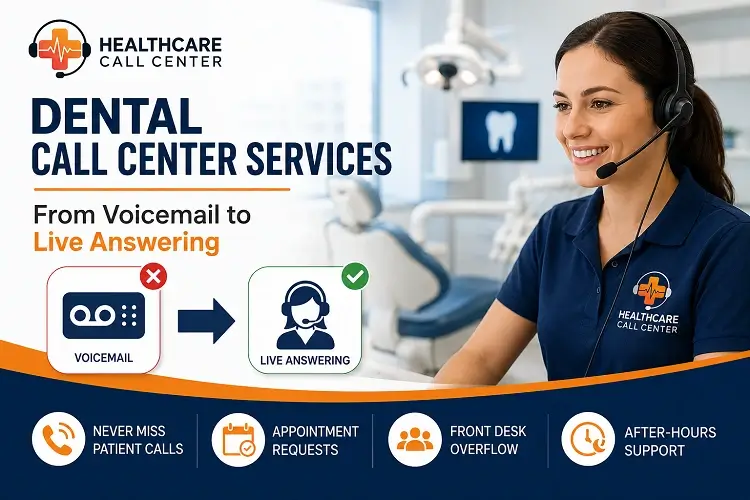
That is why 24-hour dental call center services are becoming more important for practices that still depend on voicemail, callbacks, or overloaded front desk teams. Voicemail may feel like a safety net, but patients do not always treat it that way. Many callers hang up, search for another dental office, or delay care because the first point of contact did not feel responsive. A dental answering service gives practices a more reliable way to answer live calls, capture appointment requests, route urgent messages, and support patient communication when the front desk is busy or the office is closed.
This article explains why dental practices are moving from voicemail to live answering, what dental call center services should actually include, and how to choose a support model that improves patient experience without making the practice feel impersonal.
Why voicemail is weak for dental patient calls
Voicemail works when a caller is patient, comfortable leaving details, and confident someone will respond quickly. Dental callers often do not fit that pattern. They may be anxious, in pain, price-shopping, embarrassed about a dental issue, or trying to coordinate a visit around work and school schedules. If they reach voicemail, the question is not just whether they leave a message. The bigger question is whether they still feel confident in the practice.
Dental care is personal. Patients want to know that someone heard them. A live answering experience can immediately acknowledge the concern, collect the right information, explain the next step, and help the caller feel that the practice is organized. Voicemail cannot reassure a patient. It cannot clarify whether the concern is urgent. It cannot capture a preferred appointment window. It cannot answer basic location or scheduling questions. It simply asks the patient to wait.
That delay matters most when the patient is new. Existing patients may leave a message because they already trust the office. New patients have no reason to wait if another dental office answers live. For practices investing in SEO, Google Ads, referrals, or local visibility, the call experience after the click is just as important as the traffic source itself.
Voicemail Vs Live Dental Call Answering
| Voicemail |
Live Dental Answering |
| Patient waits |
Patient speaks to a live person |
| Missed appointment requests |
Appointment requests captured |
| Limited information |
Structured intake |
| No urgency assessment |
Practice-approved escalation |
| No reassurance |
Immediate human interaction |
What Dental Call Center Services Should Include
A good dental call center service is not just a generic receptionist script with the word dental added. Dental callers have specific needs, and the answering process should reflect that. At minimum, dental call center services should support live call answering, new patient intake, appointment request capture, after-hours message handling, emergency routing, insurance question routing, and front desk overflow during busy hours.
The goal is not to replace the dental team. It is to make sure every patient call is acknowledged while giving in-office staff more time to focus on patients already in the practice. At the same time, it protects the front desk from call overload and helps ensure patients are not left waiting while staff assists patients in the office.
The best dental answering service for Texas or any city should also understand the difference between routine and time-sensitive requests. A chipped tooth, severe pain, swelling, post-procedure concern, or question after oral surgery needs a different workflow than a cleaning request. The call center does not diagnose, but it can follow practice-approved escalation rules so the right message reaches the right person.
A Quality Dental Call Center Should Include
- Live U.S.-based answering
- New patient intake
- Appointment request capture
- After-hours support
- Front desk overflow
- Emergency message routing
- Practice-specific scripts
- HIPAA-conscious workflows
- Follow guidelines of ADA (American Dental Association)
When Dental Practices Benefit Most from Live Answering
Live answering can improve several moments in the patient journey. The first is new patient acquisition. A caller who reaches a person is easier to convert into a scheduled visit than a caller who reaches voicemail. The second is front desk overflow. Dental front desks are asked to greet patients, verify details, collect forms, explain next steps, coordinate providers, and answer phones at the same time. During peak hours, even a strong team can miss calls.
The third moment is after-hours coverage. Dental concerns do not always happen between 9 and 5. A patient may call after work, over the weekend, or after a procedure. An after-hours dental answering service can capture the message and route urgent issues according to the practice’s protocol. The fourth moment is lunch breaks and staffing gaps. If the entire patient experience depends on one or two people being available at all times, missed calls become predictable.
Dental practices should think of live answering as capacity support. It gives the front desk more room to focus on patients already in the office while still protecting calls from patients trying to get in.
How Live Answering Supports SEO And Paid Traffic
Ranking for dental call center services, dental answering service, or call center for dentists is useful only if the practice can turn interest into conversations. The same principle applies to a dental office trying to rank locally for treatment terms. A search visitor who clicks, calls, and reaches voicemail may never become a patient. That makes call handling a conversion factor, even though it does not appear directly inside a keyword report.
For practices running Google Ads or investing in local SEO, every call should be treated like a conversion opportunity. Live answering helps protect that investment by making sure the call is acknowledged quickly. It also creates cleaner intake data for the practice. Instead of a voicemail that says, “Hi, call me back,” the team can receive a structured message with the caller’s reason, preferred time, and urgency.
How to Choose the Right Dental Answering Service
Before choosing a dental answering service, practice leaders should ask how the provider handles training, scripting, escalation, secure message delivery, appointment request capture, and after-hours workflows. The provider should be able to work from practice-approved instructions rather than improvising clinical answers. Dental answering should be empathetic, but it must also stay within safe boundaries.
Ask whether humans answer calls, whether the team can follow specialty-specific scripts, how urgent messages are identified, how messages are delivered, and how changes to scripts are managed. If the service will collect patient information, ask how patient privacy is protected and whether the workflow aligns with HIPAA-conscious communication standards. The right provider should make the practice feel more organized, not less in control.
Also ask how the service works during high-volume times. A practice may not need the same support all day. Some offices need help during lunch, early morning, late afternoon, evenings, weekends, campaign periods, or staff shortages. Flexible coverage matters because the goal is to support the practice’s real call patterns.
Signs Your Practice May Need a Dental Call Center
- Calls frequently go to voicemail
- Staff struggle during peak hours
- New patient calls are missed
- Patients complain about callbacks
- After-hours messages pile up
Why Dental Practices Choose Healthcare Call Center (HCC)
Healthcare Call Center (HCC) is a HIPAA-compliant medical call center that specializes in healthcare communication, helping dental practices answer patient calls, capture appointment requests, manage front desk overflow, and support after-hours communication with trained live agents.
The strongest use case is not simply answering every phone call. It is supporting the moments when the dental office is most vulnerable to missed opportunities: new patient calls, overflow during busy front desk hours, after-hours concerns, and appointment requests that need a fast response. When live answering is set up with the right scripts and escalation rules, it becomes an extension of the practice’s patient communication system.
Dental practices do not need more voicemail. They need a call experience that feels professional, calm, and responsive. That is the real reason more practices are switching from voicemail to live answering.
Ready to Improve Your Dental Patient Call Experience?
Missed calls can quickly become missed appointments and lost revenue. If your practice is struggling with voicemail, front desk overload, or after-hours patient calls, Healthcare Call Center can help.
Book a free consultation to see how our dental call center services can support your practice.
Final Takeaway For Practice Leaders
The right dental call center services strategy is not about adding another vendor for the sake of it. It is about protecting patient access at the exact moments when communication usually breaks down. Healthcare practices work hard to earn patient trust through clinical care, but that trust can weaken when callers cannot reach anyone, cannot explain what they need, or do not know what happens next.
A better call experience gives the practice more control. Patients reach a person. Messages arrive with context. Staff can focus on the patients in front of them. After-hours and overflow calls do not disappear into voicemail. The practice can create a calmer, more reliable communication system without asking the in-office team to do everything at once.
Frequently Asked Questions
What are dental call center services?
Dental call center services help dental practices answer patient calls, capture appointment requests, route urgent messages, support after-hours communication, and reduce front desk overload.
Is a dental answering service different from regular voicemail?
Yes. Voicemail records a message and makes the patient wait. A dental answering service gives callers a live human response, collects structured information, and routes messages based on the practice’s workflow.
Are dental call center services HIPAA compliant?
They can be, but it depends on the provider and how the service is managed. Dental practices should choose a call center that follows healthcare communication workflows, protects patient information, and uses practice-approved procedures for handling calls and messages.
Can a dental call center schedule appointments?
Some dental call center services can support appointment requests or scheduling workflows, depending on the practice’s systems and permissions. At minimum, they should capture preferred appointment times and call reasons clearly.
When should a dental practice use live answering?
Live answering is useful during office hours, lunch breaks, staff shortages, after-hours periods, weekends, and any time the front desk cannot reliably answer every call.
Does a dental answering service replace the front desk?
No. The best model supports the front desk by handling overflow, after-hours calls, and structured intake so in-office staff can focus on patients in the practice.
by Erika Sanchez | Jul 20, 2026 | Medical Answering Services
Every missed call at a medical practice costs between $500 and $2,000 in lost revenue, depending on practice specialty. A missed new patient inquiry can represent significant lost revenue over time. Every unanswered after-hours patient question erodes trust. Every rushed, scripted interaction pushes a patient one step closer to finding another provider.
Yet most medical answering service comparisons online today read like marketing brochures. They list features, mention HIPAA compliance, and move on, without ever asking the question that matters most: how does this service actually make patients feel?
Throughout this blog, we’ll compare leading providers and explain what separates a medical answering service built for healthcare from a general answering service.
We evaluated the top medical answering services based on what actually drives patient satisfaction and practice growth: the human touch behind every call, HIPAA-compliant infrastructure, specialty knowledge, and a genuine understanding of what patients go through when they pick up the phone to call a medical office.
How We Evaluated Medical Answering Services
These are the criteria we have followed while evaluatign these list of answering services:
- HIPAA compliance and willingness to sign a BAA
- 24/7 availability
- Healthcare specialization
- Specialty-specific training
- Patient communication approach
- Public reviews and reputation
- Transparency about pricing and answer rates
- Integration capabilities
- Features relevant to medical practices
This comparison is based on publicly available information, provider documentation, customer reviews where available, and healthcare communication best practices. Practices should independently verify features and pricing before making a decision.
Short on time?
Here’s a quick comparison before diving into each provider.
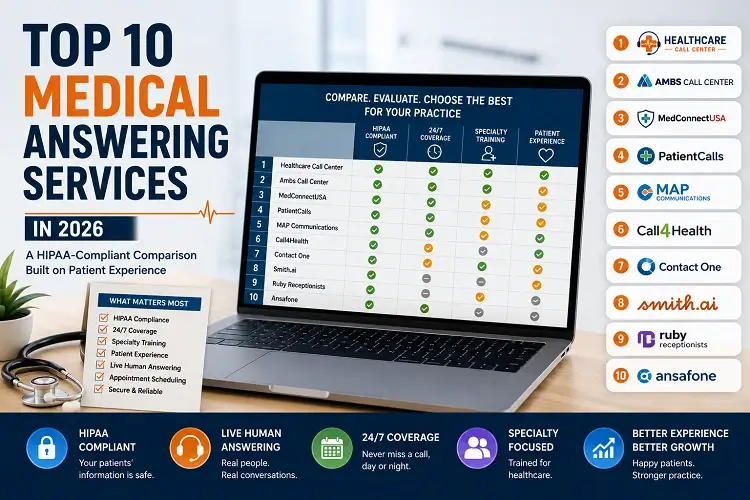
Quick Comparison: Top 10 Medical Answering Services
| Provider |
Best For |
HIPAA Compliant |
24/7 Coverage |
Specialty Training |
| 1. Healthcare Call Center |
Specialty practices wanting empathy-driven patient communication |
✅ Yes |
✅ Yes |
✅ Per-vertical (OB-GYN, fertility, plastic surgery, dental, chiropractic) |
| 2. Ambs Call Center |
Large healthcare systems needing reliable 24/7 triage |
✅ Yes |
✅ Yes |
⚠️ General healthcare |
| 3. MedConnectUSA |
Plastic surgery and specialty practices after hours |
✅ Yes |
✅ Yes |
⚠️ Some specialties |
| 4. PatientCalls |
Hospitals and homecare/hospice organizations |
✅ Yes |
✅ Yes |
⚠️ General medical |
| 5. MAP Communications |
Small practices wanting affordable live answering |
✅ Yes |
✅ Yes |
❌ Generalist |
| 6. Call4Health |
Practices needing nurse triage and clinical escalation |
✅ Yes |
✅ Yes |
✅ Clinical (nurse-staffed) |
| 7. Contact One |
Small-to-mid practices focused on compliance |
✅ Yes |
✅ Yes |
❌ Generalist |
| 8. Smith.ai |
Practices wanting tech-forward virtual receptionists |
✅ Yes |
⚠️ Business hours + after-hours |
❌ Generalist |
| 9. Ruby Receptionists |
Small practices wanting friendly, brand-matched receptionists |
⚠️ Partial |
⚠️ Limited after-hours |
❌ Generalist |
| 10. Ansafone |
Enterprise practices and health systems with high volume |
✅ Yes |
✅ Yes |
⚠️ General healthcare |
Now let’s break down each provider in detail: what they do well, where they fall short, and what type of practice they fit best.
1. Healthcare Call Center
Best for: Specialty practices that want every patient call answered with genuine empathy, clinical awareness, and conversion-focused professionalism
Healthcare Call Center (HCC) represents a fundamentally different approach to medical answering services. While most providers build their service around call routing and message delivery, HCC builds theirs around patient experience specifically- the experience of speaking to someone who sounds like they genuinely care.
What Makes Healthcare Call Center Different
The “stay-at-home moms” model. HCC’s agents are stay-at-home mothers who are specially trained in HIPAA-compliant patient communication. Healthcare Call Center staffs its agents with trained stay-at-home moms who specialize in compassionate patient communication. The goal is to create a calm, reassuring experience for patients while following practice-specific workflows.
Specialty-specific training. Unlike generalist services where one agent handles everything from plumbing calls to prescription refills, HCC trains agents per vertical. An agent handling OB-GYN calls understands the urgency of third-trimester bleeding. An agent handling fertility calls knows that a patient awaiting IVF results is in one of the most emotionally charged moments of their life.
90%+ answer rate guarantee. HCC is one of the few medical answering services for after-hours that publicly commits to a specific answer rate. Healthcare Call Center publicly states a 90%+ answer rate, helping practices reduce missed patient opportunities during business hours and after-hours.
HIPAA-compliant enterprise infrastructure. Behind the empathetic phone presence, HCC maintains a HIPAA-compliant infrastructure that meets enterprise standards. Secure messaging, call recording, appointment scheduling, and integration with practice management systems are all built in. Compliance isn’t an afterthought — it’s woven into the workflow.
What HCC Does Exceptionally Well
- Patient empathy that converts: Agents don’t just take messages, but they also make patients feel heard, understood, and cared for. This is particularly valuable for high-anxiety specialties (fertility, OB-GYN, plastic surgery) where the first phone interaction sets the tone for the entire patient relationship.
- Vertical-specific agent training: OB-GYN, fertility, plastic surgery, dental, and chiropractic practices each get agents trained on that specialty’s terminology, patient concerns, and common scenarios.
- Conversion-focused intake: For elective specialties, HCC treats every new patient call as a revenue opportunity, gathering the right information and supporting medical appointment scheduling whenever practices allow direct booking rather than just forwarding a message.
- 1,200+ calls handled daily: Scale that proves the model works in production, not just in theory.
Where HCC Could Improve
To be transparent: HCC is not the cheapest option on this list, and they’re not the right fit for every practice. Organizations that need nurse-staffed clinical triage (like Call4Health offers) will need to supplement. Practices with extremely high call volume and complex EMR integration needs may find Ambs’ larger integration ecosystem more immediately compatible. And HCC’s model is optimized for specialty practices. A general family medicine clinic may not see the same differentiation in patient experience.
But for practices where every patient call matters, where the phone interaction is the difference between a booked consultation and a lost patient. Healthcare Call Center delivers something no other provider on this list offers: genuine human empathy, backed by specialty training, delivered at scale.
Here’s HCC Pros & Cons
Pros
- Specialty-trained agents
- Stay-at-home mom model
- 90%+ answer rate
- Healthcare only
Cons
- No nurse triage
- Custom pricing
2. Ambs Call Center
Best for: Large healthcare systems and multi-location practices needing enterprise-grade 24/7 support
Ambs Call Center has been answering phones for medical offices since 1932, nearly a century of healthcare communication experience. They serve major institutions including University of Michigan Medicine, Henry Ford Health, and Baylor College of Medicine. Their infrastructure is robust: HIPAA-compliant secure texting, EMR integrations, API access, and a proprietary portal for call management.
What they do well
Ambs is the gold standard for operational excellence in medical answering services. Their third-party HIPAA audits, CAM-X Award of Excellence, and deep integration ecosystem (TigerConnect, pMD, Symplr, OnPage) make them ideal for practices that need everything wired into existing systems.
Where they fall short
Ambs is built for volume and reliability, not intimacy. Their agents are professional and well-trained, but the experience can feel institutional. For practices where the phone call is the first step in converting a prospective patient, especially in high-value specialties like fertility or plastic surgery, Ambs’ approach may not maximize conversion.
3. MedConnectUSA
Best for: Plastic surgery and specialty practices needing dedicated after-hours support
MedConnectUSA has been a medical-only answering service since 1991, and it shows. They’ve received the Association of TeleServices International Award of Excellence 22 times, including 19 consecutive years. Their focus on healthcare gives them a depth that generalist services can’t match.
What they do well
MedConnectUSA understands specialty practices. Their plastic surgery answering service is genuinely well-built. They handle consultation screening, post-operative care calls, and sensitive inquiries with appropriate discretion.
Where they fall short
MedConnectUSA’s service model is traditional. They excel at message-taking and call routing but lack the modern patient experience layer, things like empathy-driven call handling, conversion-focused intake, or specialty-specific agent training that goes beyond scripts.
4. PatientCalls
Best for: Hospitals, homecare agencies, and multi-provider organizations
PatientCalls is a healthcare-exclusive answering service that focuses on high-volume, mission-critical call handling. They’re trusted by organizations like Providence Health, Einstein Health, and Kaiser Permanente names that signal their enterprise-grade reliability.
What they do well
PatientCalls excels at infrastructure. Their EMR integration, secure messaging platform, and ability to handle high call volumes make them a natural fit for hospitals and large group practices.
Where they fall short
PatientCalls is built for institutional clients, not individual specialty practices. The experience for a patient calling a small fertility clinic or a solo plastic surgeon may feel impersonal, more like calling a hospital switchboard than a caring extension of the practice.
5. MAP Communications
Best for: Small practices wanting affordable, dependable live answering
MAP Communications has been in the answering service business for decades. They offer 24/7 live operator coverage with HIPAA-trained agents, customizable scripts, and on-call scheduling. Their agents are U.S.-based, and they provide BAA agreements for medical clients.
What they do well
MAP is reliable and affordable. For a small practice that simply needs someone to answer the phone professionally after hours, take messages, and route urgent calls, MAP delivers consistently.
Where they fall short
MAP is a generalist answering service that serves many industries. Their healthcare training covers HIPAA basics but doesn’t extend to specialty knowledge. Agents won’t know the difference between a BBL consultation and a rhinoplasty follow-up.
6. Call4Health
Best for: Practices that need nurse triage and clinical escalation capabilities
Call4Health has been serving the healthcare industry for over 22 years, and their distinguishing feature is nurse-staffed triage. They don’t just answer phones; they have licensed nurses who can assess symptoms and escalate clinically.
What they do well
Their nursing staff sets them apart. For practices where patients frequently call with medical questions (not just scheduling), having a registered nurse on the line provides real clinical value. Their tenure in healthcare is also impressive, with over two decades of focused experience.
Where they fall short
Call4Health’s model is built around clinical triage, not patient experience. Calls can feel clinical rather than warm. For elective specialties like plastic surgery or fertility where patient anxiety, empathy, and conversion are critical the clinical tone.
7. Contact One
Best for: Small-to-mid practices that prioritize HIPAA compliance above all else
Contact One is a healthcare-focused answering service that emphasizes security and compliance. They offer 24/7 live answering, secure messaging, and appointment scheduling, with HIPAA compliance woven into every layer of their operation.
What they do well
Contact One takes compliance seriously. Their secure messaging, encrypted communications, and staff training around PHI are solid. For practices in highly regulated environments or those that have been burned by compliance gaps in the past, Contact One provides peace of mind.
Where they fall short
Their service feels transactional. Agents are courteous and professional but tend to follow scripts closely. There’s little evidence of specialty-specific training or an emphasis on patient empathy. The experience feels like speaking to a trained operator rather than someone who genuinely understands what the patient is going through.
8. Smith.ai
Best for: Tech-forward practices wanting AI-assisted virtual receptionist services
Smith.ai has built a modern virtual receptionist platform that blends live agents with AI-powered intake, scheduling, and lead capture. They integrate well with practice management software and CRMs, making them a strong fit for practices that want everything digitized and tracked.
What they do well
Smith.ai’s technology is genuinely impressive. Their platform captures detailed call notes, routes leads intelligently, and syncs with your existing tools. The agent quality is solid, and their Clutch reviews reflect high satisfaction rates.
Where they fall short
Like Ruby Receptionists, Smith.ai serves multiple industries: legal, financial, home services, and healthcare. Their agents are not specifically trained in medical patient communication, and their HIPAA compliance setup requires careful configuration.
9. Ruby Receptionists
Best for: Small practices wanting friendly, brand-matched virtual receptionists
Ruby is one of the most recognizable names in virtual receptionist services. Their receptionists are known for being warm, engaging, and good at making callers feel valued. They train their team extensively on customer service and phone etiquette.
What they do well
Ruby excels at the “first impression” game. Their receptionists are friendly, professional, and skilled at building rapport quickly. For small practices, especially in cash-pay specialties, Ruby’s polished phone presence can elevate the brand.
Where they fall short
Ruby is not a healthcare-exclusive service, and their HIPAA compliance coverage has limitations depending on the plan you choose. Their after-hours answering services coverage is limited compared to dedicated medical answering services, and their agents lack specialty-specific training.
10. Ansafone
Best for: Large healthcare systems and enterprise practices with high call volume
Ansafone is a well-established call center that serves multiple industries, with healthcare being one of their stronger verticals. They offer 24/7 live call answering, patient intake services, and bilingual support, all backed by robust call routing technology.
What they do well
Ansafone handles scale well. If your practice receives hundreds of calls per day across multiple locations, their infrastructure can absorb the volume. Their customizable scripts and bilingual agents are a plus for diverse patient populations.
Where they fall short
Ansafone is a multi-industry call center, not a healthcare-exclusive provider. Agents handle calls for telecom companies, e-commerce brands, and financial services in the same facility.
Features Every Medical Answering Service Should Offer
✔ HIPAA compliance
✔ Signed Business Associate Agreement (BAA)
✔ Live answering
✔ After-hours coverage
✔ Appointment scheduling
✔ Secure message delivery
✔ Escalation workflows
✔ Detailed reporting
✔ Specialty-specific scripts
How to Choose the Right Medical Answering Service for Your Practice
After reviewing all 10 providers, here’s a framework for making the right decision for your specific practice:
1. Start With Your Patient Journey
Effective communication is widely recognized as a key component of safer, higher-quality healthcare.
Think about what happens when a patient calls your office.
Are they scheduling a routine appointment?
Asking about test results?
Experiencing anxiety about a procedure?
Emergencies aside, most patient calls are emotional before they are logistical. The right answering service should match the emotional temperature of your patients.
- High-anxiety specialties (fertility, OB-GYN, oncology): Prioritize empathy, specialty training, and human warmth. Look for Healthcare Call Center or MedConnectUSA.
- High-volume general practices: If your biggest challenge is peak-hour call volume rather than after-hours coverage, a front desk overflow answering service may be a better solution than full-time live answering.
- Elective/cash-pay specialties (plastic surgery, med-spa, dental): Prioritize conversion-focused intake and patient experience. Healthcare Call Center and MedConnectUSA excel here.
- Clinical triage needs: If patients frequently call with medical questions requiring clinical judgment, Call4Health’s nurse triage model is the strongest.
2. Ask These Questions Before Signing
- Are your agents trained specifically for my specialty, or do they handle all industries?
- What is your guaranteed answer rate? (If they can’t answer this, that’s a red flag.)
- Do you provide a BAA (Business Associate Agreement) as part of the standard contract?
- How are after-hours urgent calls escalated to my on-call provider?
- What secure messaging and EMR integration options do you support?
- Do you offer bilingual agents? Are they trained in medical terminology in both languages?
- How does your pricing scale as our call volume grows?
If you’re narrowing down your options, our Medical Answering Service Checklist can help you compare providers based on HIPAA compliance, patient experience, scheduling capabilities, reporting, integrations, and after-hours support.
You can also estimate how delayed patient response times and missed calls may affect appointments and potential revenue using our free Patient Lead Response Time Calculator.
3. Watch for These Red Flags
- “HIPAA compliant” without a BAA: A service can claim HIPAA compliance, but if they won’t sign a Business Associate Agreement, they’re not actually compliant for your practice.
- Per-minute pricing without a cap: A seemingly affordable monthly plan can multiply quickly if your call volume spikes during flu season or a marketing push. Always ask how pricing scales.
- Generalist agents handling medical calls: If the same agents who handle plumbing and real estate calls are also answering your patients’ medical questions, the patient experience will suffer.
- No published answer rate: If a service won’t commit to a specific answer rate or response time, they’re likely not measuring it — which means they don’t know how many calls they’re missing.
What Most Medical Answering Services Won’t Tell You
After reviewing these 10 providers, a few patterns emerged that most services don’t advertise:
The “HIPAA Compliant” Label Is Often Just a Label
Almost every service on this list claims HIPAA compliance. But true compliance means: signed BAA, encrypted message delivery, access controls, staff training programs, and regular third-party audits. Several providers mention HIPAA compliance in their marketing but don’t publicly describe their audit process.
Script-Reading Kills Patient Trust
Most traditional answering services train agents to follow scripts closely. This ensures consistency but comes at a cost: patients can tell when someone is reading from a screen. The call feels transactional, not personal. Services like Healthcare Call Center and Ruby Receptionists buck this trend by prioritizing natural conversation, but for different reasons. Ruby focuses on brand polish; HCC focuses on patient empathy.
The Per-Minute Pricing Trap
Many services advertise attractive monthly rates, but the fine print often includes per-minute or per-call overage charges that kick in after a modest base allowance. A practice that averages 50 calls per month in January can easily spike to 150 calls per month during cold and flu season.
Offshore Agents and the Empathy Gap
Some services use offshore agents to keep costs down. While these agents are often well-trained and professional, there’s a measurable empathy gap when the person answering the phone doesn’t share the cultural context of the patient calling.
Note: Information in this comparison is based on publicly available sources at the time of writing. Features, pricing, integrations, and service offerings may change over time, so practices should verify details directly with each provider before making a final decision.
Medical Answering Service Comparison Summary
Choosing a medical answering service is one of the most consequential operational decisions a practice can make. Every missed call is a patient who may go elsewhere. Every rushed interaction is a patient experience that could have been better. And every after-hours emergency handled poorly is a liability clinical, reputational, and emotional.
But if your practice depends on patient experience, if every call represents a relationship, a conversion, or a moment of patient anxiety that needs to be met with genuine human care, then Healthcare Call Center’s model of empathy-driven, specialty-trained, stay-at-home mom agents offers something no other provider on this list can replicate.
The right medical answering service should combine secure patient communication, reliable availability, and a patient experience that reflects the quality of your practice.
Ready to see how Healthcare Call Center handles your patient calls?
Get a free consultation or call (307) 333-9968 to learn how our stay-at-home mom agents can transform your patient communication day or night.
Frequently Asked Questions About Medical Answering Services
What is a medical answering service?
A medical answering service is a professional service that handles phone calls for medical practices, including appointment scheduling, message taking, urgent call triage, after-hours coverage, and patient intake.
How much does a medical answering service cost?
Pricing varies widely based on call volume, specialty, features, and level of integration required. Most services offer custom quotes after a brief consultation. The key is to understand not just the monthly rate but how pricing scales as your practice grows.
Is HIPAA compliance required for medical answering services?
Yes. If a service handles any patient health information (PHI) even just taking messages that contain patient names and callback numbers. They must be HIPAA compliant and sign a Business Associate Agreement (BAA). The U.S. Department of Health and Human Services Office for Civil Rights oversees HIPAA enforcement.
What’s the difference between a medical answering service and a regular answering service?
A regular answering service handles calls for any industry: plumbers, real estate agents, lawyers, e-commerce brands. Their agents are generalists. A medical answering service focuses exclusively (or primarily) on healthcare, with agents trained in HIPAA compliance.
Can medical answering services schedule appointments?
Yes, most medical answering services offer appointment scheduling as part of their service. However, the depth of integration varies. Some services simply take a message and forward it to your staff.
What makes Healthcare Call Center different from other medical answering services?
Healthcare Call Center differentiates through its staffing model: agents are stay-at-home moms specially trained in HIPAA-compliant patient communication and assigned to specific medical specialties.
How often should I review my answering service?
At least once each year or whenever your practice experiences significant growth, adds locations, changes specialties, or notices changes in patient call volume.
Can I switch medical answering services without changing my phone number?
Yes. Most medical answering service providers can work with your existing business phone number by updating call forwarding or routing rules, allowing practices to switch providers with minimal disruption.
Do medical answering services support multi-location practices?
Many providers support multiple office locations with customized greetings, routing rules, provider schedules, and reporting for each location.
by Erika Sanchez | Jul 16, 2026 | After-Hours Call Answering Services
A fertility patient may not call during normal office hours. She may call after work, after an injection, during the two-week wait, or on a weekend when anxiety is high and the clinic is closed. If that call goes to voicemail, the patient may feel unsupported at the exact moment she needs a calm next step.
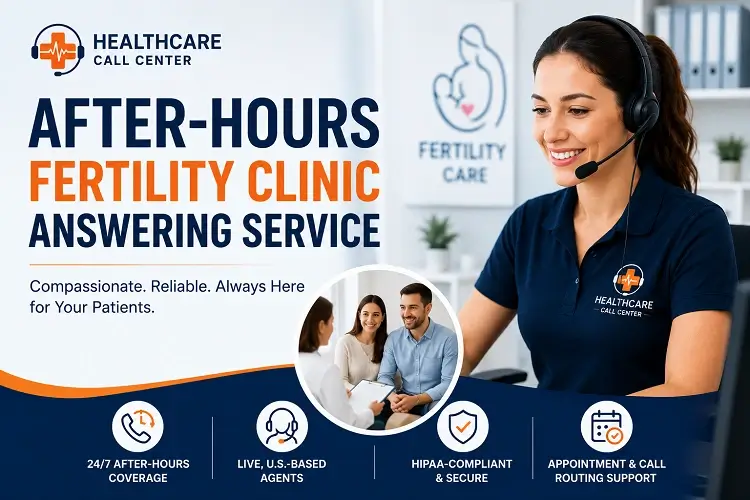
An after-hours fertility clinic answering service gives IVF clinics live call coverage outside normal business hours. It helps answer patient calls, collect the right information, route messages, follow clinic escalation rules, and protect new patient inquiries that would otherwise be lost to voicemail.
This article explains why after-hours calls matter so much in fertility care, what types of calls happen outside office hours, how a trained answering team should handle them, and how clinics can use after-hours support without creating clinical risk or confusing patients.
For fertility clinics, every patient interaction matters. Whether someone is starting IVF treatment, managing an active cycle, or calling with a time-sensitive concern, delayed communication can increase anxiety and reduce confidence in the practice. An after-hours fertility clinic answering service helps ensure every call receives a professional response while following your clinic’s approved workflows and escalation protocols.
Quick Answer: What Is an After-Hours Fertility Clinic Answering Service?
An after-hours fertility clinic answering service is a live call-handling team that answers fertility and IVF patient calls when the clinic is closed, busy, or unavailable. The service does not diagnose, change medication instructions, or provide clinical advice. Instead, agents follow the clinic’s approved scripts, document the call, collect key details, and escalate urgent concerns according to the clinic’s rules.
For clinics, the goal is simple: fewer missed after-hours fertility calls, better patient communication, and clearer routing for new patient inquiries, scheduling requests, and time-sensitive messages.
Why Fertility Patients Call After Hours
Fertility care does not feel like a normal appointment journey for patients. IVF cycles are emotional, time-sensitive, and filled with moments where patients may need reassurance or clear routing. Even when the clinic gives strong instructions during the day, questions can come up later when the patient is home and thinking through every detail.
Common reasons fertility patients call after hours include:
- Questions after hormone injections
- IVF medication timing concerns
- Anxiety during the two-week wait
- New patient consultation inquiries
- Appointment rescheduling
- Post-procedure questions
- Weekend or evening scheduling requests
- Questions about next steps after monitoring appointments
This is why an after-hours IVF clinic answering service is not just a convenience. It supports the patient experience during the moments when fertility patients are most likely to feel uncertain.
What Happens When Fertility Calls Go to Voicemail
Voicemail creates a gap between the patient’s concern and the clinic’s response. Sometimes that gap is harmless. Other times, it creates stress, delays, or lost new patient opportunities.
When a fertility patient reaches voicemail after hours, several things can happen:
- The patient does not leave a message because the concern feels too private.
- The patient searches online or asks strangers in IVF forums.
- A prospective patient calls another clinic that answers live.
- A scheduling issue waits until the next day and creates more front desk pressure.
- The clinic loses visibility into what patients are asking after hours.
The issue is not that every after-hours call is urgent. The issue is that every after-hours call needs the right next step. A trained answering team helps create that path.
Why Response Time Matters for Fertility Clinics
Fertility patients often compare several clinics before scheduling a consultation. When one clinic answers quickly and another sends callers to voicemail, the first interaction can influence where the patient decides to begin treatment. Fast, compassionate communication helps build trust before the first appointment.
Many fertility patients research clinics outside normal office hours, making evenings and weekends an important time to capture consultation inquiries and provide reassurance when patients are ready to reach out.
Common After-Hours IVF and Fertility Calls
Every clinic has its own protocols, but after-hours fertility calls usually fall into a few common categories.
| Call Type |
What the Patient Needs |
How an Answering Service Helps |
| Medication or injection concern |
Clear routing, reassurance, and next-step guidance based on clinic protocol |
Collects information and escalates if required by clinic rules |
| Two-week wait anxiety |
A calm response and appropriate message routing |
Documents the concern and routes it for follow-up |
| New patient IVF inquiry |
Consultation information and scheduling next steps |
Captures details and can schedule if the clinic allows it |
| Appointment change |
Rescheduling or callback support |
Document the request or book according to scheduling access |
| Post-procedure concern |
Escalation based on clinic policy |
Routes urgent concerns to the on-call provider when required |
This table is important because it shows the difference between answering a phone and managing a fertility call safely. The answering service should never guess. It should follow the clinic’s written rules.
What an After-Hours Fertility Answering Service Should Not Do
This is where many clinics need to be careful. A healthcare-specific medical answering service should support communication, not replace clinical judgment.
An after-hours answering team should not:
- Promise treatment outcomes
- Estimate IVF success rates
- Recommend medications
- Change appointment instructions without clinic approval
Instead, the team should collect the patient’s name, callback number, concern, timing, and relevant non-clinical details requested by the clinic. Then the call should be documented, routed, or escalated based on the clinic’s approved workflow.
Patients experiencing medical emergencies should immediately contact their healthcare provider or emergency services rather than rely on an answering service.
How a 24/7 IVF Clinic Answering Service Supports New Patient Growth
Not every after-hours call comes from an existing patient. Many are prospective patients who are researching fertility clinics after work, on weekends, or during private moments when they finally feel ready to ask questions.
For a fertility clinic, one missed new patient inquiry can be expensive. IVF patients often represent a high-value treatment journey, but they are also emotionally cautious. If they call and nobody answers, they may not wait until morning.
A 24/7 IVF clinic answering service can help with:
- New patient inquiry capture
- Medical Consultation scheduling support
- Insurance or financing information collection for the clinic team
- Callback requests
- Location and service questions
- Routing inquiries to the right team member
- Protecting SEO and paid campaign leads after hours
This is where after-hours coverage connects directly to marketing ROI. If your clinic spends money on SEO, Google Ads, referrals, and website content, the phone must be covered when patients are ready to act. You can estimate the impact of slower response times using our Patient Lead Response Time Calculator.
How After-Hours Coverage Protects Patient Trust
Fertility patients are not only evaluating clinical expertise. They are also evaluating responsiveness, empathy, privacy, and emotional safety. The first phone interaction can shape how supported a patient feels.
A positive first phone experience can also improve:
- Consultation conversion
- Patient satisfaction
- Online reviews
- Referral opportunities
- Trust in the clinic
- Overall patient experience
That matters because fertility patients often talk with partners, friends, online communities, and support groups about their clinic experience. A clinic that feels responsive and organized can earn trust before the first consultation even happens.
What Happens When a Fertility Patient Calls After Hours?
Setup should be based on the fertility clinic’s actual workflows, not a generic answering script.
A proper after-hours fertility call coverage setup usually includes:
- Clinic-approved greeting and call script
- Call categories for new patients, existing patients, scheduling, and urgent concerns
- Escalation rules for on-call providers
- Message routing rules for next-business-day follow-up
- Scheduling access if the clinic allows direct booking
- Training on fertility terminology and patient sensitivity
- HIPAA-conscious handling and secure documentation
- Reporting on call volume, call type, response patterns, and missed-call recovery
For many clinics, setup can happen within up to 2 weeks, depending on scripts, scheduling access, routing rules, and training requirements.
What to Look for in an After-Hours Fertility Call Partner
Fertility clinics should not choose a generic call center that only takes messages. The partner needs to understand healthcare workflows, privacy expectations, and the emotional weight of fertility communication.
If you’re evaluating providers, our comprehensive Medical Answering Service Checklist walks through the questions healthcare practices should ask before choosing an answering service partner.
Look for a partner that offers:
- Healthcare-specific call handling experience
- HIPAA-conscious processes and BAA readiness when required
- Custom fertility scripts
- Clear escalation protocols
- Scheduling support when approved by the clinic
- Call documentation and reporting
- Quality monitoring
- Empathy-focused agent training
- Coverage for evenings, weekends, holidays, and overflow periods
If you are comparing providers, this checklist should be more important than price alone. The wrong answering service can create confusion. The right one feels like an extension of your clinic.
If you’re still researching providers, our comparison of the best medical answering services explains the differences between healthcare-focused answering services and general call centers.
After-Hours Fertility Calls vs General Medical Calls
Fertility calls require a different communication style from many general medical calls. Patients may be nervous about timing, privacy, cost, treatment steps, or what their body is doing. Even when a call is not clinically urgent, it can feel urgent to the patient.
That is why after-hours fertility coverage should combine three things:
- Live answer speed
- Strict protocol following
- Empathetic communication
A general answering service may be able to take a message. A fertility-aware answering service should help protect the patient relationship while routing the call correctly.
When Should a Fertility Clinic Add After-Hours Coverage?
A fertility clinic should consider after-hours coverage if any of these problems are happening:
- Patients complain that calls are not answered after hours.
- New patient inquiries arrive outside office hours.
- The front desk starts every morning with a backlog of voicemails.
- Patients ask cycle-related questions through untracked channels.
- Marketing campaigns are generating leads outside business hours.
- Staff is overwhelmed by Monday morning callbacks.
- The clinic does not know how many calls it misses after 5 PM.
The best first step is to pull the last 30 days of phone records. Count evening, weekend, holiday, lunch-hour, and abandoned calls. Then compare that volume against booked consultations, response time, and patient value.
Final Takeaway
After-hours fertility calls are not random interruptions. They are often the moments when patients are most anxious, most private, or most ready to take the next step.
An after-hours fertility clinic answering service helps IVF clinics answer those calls with structure, empathy, and clear routing. It does not replace clinical staff. It supports the clinic by making sure patients are not left with voicemail when they need a next step.
If your fertility clinic is missing calls after hours, you may be losing both patient trust and new consultation opportunities. Healthcare Call Center can help you build after-hours call coverage around your clinic’s scripts, escalation rules, and scheduling workflow.
Ready to improve after-hours IVF call coverage?
FAQs About After-Hours Fertility Clinic Answering Service
What is an after-hours fertility clinic answering service?
An after-hours fertility clinic answering service is a live call-handling service that answers fertility and IVF patient calls when the clinic is closed, busy, or unavailable. Agents follow clinic-approved scripts, document calls, and route or escalate messages based on the clinic’s rules.
Can an answering service handle IVF medication or injection calls?
An answering service can collect information and route the call according to clinic protocol, but it should not give medical advice, change medication instructions, or interpret symptoms. Clinical questions should be escalated to the appropriate clinic team member when required.
Why do fertility patients call after hours?
Fertility patients often call after hours because they finally have privacy, feel anxious during the IVF process, need help with scheduling, or have questions after leaving the clinic. Many new patient inquiries also happen after work or on weekends.
Can after-hours coverage help fertility clinics book more consultations?
Yes. If the clinic allows scheduling access, trained agents can capture new patient inquiries, collect contact details, answer approved process questions, and book or route consultation requests before the patient calls another clinic.
How long does setup take for fertility clinic call coverage?
Setup can take up to 2 weeks depending on call scripts, scheduling access, escalation rules, phone routing, and agent training. The process should be customized around the clinic’s workflow.