by Erika Sanchez | Aug 6, 2026 | Medical Answering Services
Choosing the cheapest medical answering service can cost far more than paying for the right one. Understanding how providers price their services helps you avoid hidden fees, compare quotes fairly, and choose a solution that protects both patient experience and revenue.
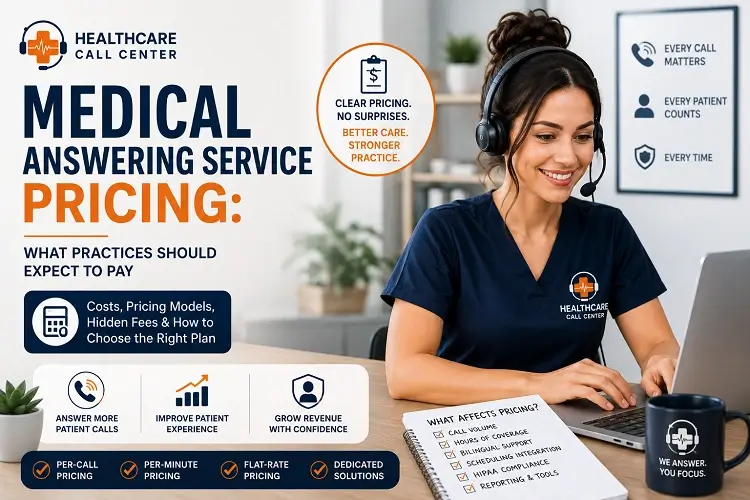
Most medical practices start shopping for an answering service the same way: they Google the price, see numbers ranging from $30 to $3,000 per month, and get more confused than when they started. The spread is not a mistake. Medical answering service pricing depends on your call volume, the pricing model the provider uses, the features included, and whether the service is actually built for healthcare or just a generic call center that added the word medical to its website.
By the end of this article, you will know what a medical answering service should realistically cost, how to compare providers fairly, which pricing model fits your practice, and where hidden fees usually appear.
Whether you are a single-location clinic fielding 150 calls a week or a multi-specialty group managing thousands of calls across locations, the math works the same way once you understand the structure.
At a Glance
- Most practices pay $200–$2,500/month, depending on call volume.
- Three pricing models dominate the industry: per-call, per-minute, and flat-rate.
- Hidden fees can increase costs if you do not review contracts carefully.
- The right service should be evaluated on value, not price alone.
- Missed patient calls often cost more than the answering service itself.
How Much Does a Medical Answering Service Cost?
The short answer is that most medical practices pay between $200 and $2,500 per month for HIPAA-compliant medical answering services. The long answer depends entirely on which pricing model the provider uses and how many calls your practice receives.
The table below shows typical pricing ranges based on practice size. Actual costs vary depending on call volume, coverage hours, integrations, and workflow complexity.
Here is what real monthly costs look like across three practice sizes:
| Practice Size |
Calls/Month |
Typical Monthly Cost |
Best Pricing Model |
| Small (1-2 providers) |
100-300 |
$150-$400 |
Per-call |
| Medium (3-8 providers) |
300-800 |
$400-$1,200 |
Flat-rate |
| Large (9+ providers) |
800-2,000+ |
$1,200-$3,500 |
Flat-rate or dedicated |
| Multi-location groups |
2,000+ |
$2,500-$8,000+ |
Custom/dedicated agents |
These ranges reflect what healthcare-specialized services charge. Generic answering services that also handle plumbers and real estate calls may quote lower rates, but they often lack HIPAA compliance, specialty-trained agents, and scheduling integration. The savings disappear quickly when a missed urgent call costs your practice a patient.
What Affects Medical Answering Service Pricing?
Several factors influence monthly pricing beyond call volume, including after-hours medical call coverage, bilingual support, scheduling integration, dedicated agents, reporting, and specialty-specific workflows. Understanding these variables helps explain why two providers can quote very different prices for what appears to be the same service.
The Three Pricing Models Explained
Although pricing looks different from one provider to another, almost every medical answering service follows one of three pricing models.
1. Per-Call Pricing
You pay a fixed rate for every call answered, typically $0.75 to $1.50 per call. Some providers bundle minutes (90 seconds per call) and charge extra for longer calls. Per-call pricing works well for small practices with low, predictable call volume. The risk is that providers incentivize short calls.
If an agent rushes through a complex patient inquiry to stay within the included minute, the patient experience suffers. Per-call plans also usually charge for wrong numbers, hang-ups, and test calls, which inflates your bill by 15 to 25 percent if the provider counts every ring.
Best for: Solo practitioners and small clinics with under 300 calls per month.
2. Per-Minute Pricing
You pay for the exact time agents spend on your calls, usually $0.85 to $1.75 per minute. Per-minute billing sounds precise and fair, but it rewards providers for longer calls.
An agent who places a patient on hold, repeats questions, or transfers slowly generates more revenue for the service. Most practices find that per-minute bills run 20 to 40 percent higher than expected.
Best for: Practices with very short, predictable call types (appointment confirmations, simple message-taking).
3. Flat-Rate Pricing
You pay a fixed monthly fee that includes a set number of calls or minutes, with overages billed separately. Flat-rate plans typically range from $199 to $1,500 per month depending on included volume. This model rewards efficiency because the provider does not earn more by keeping calls longer.
It also makes budgeting predictable, which finance teams appreciate. The downside is that if you consistently exceed your included minutes, overage rates can be steep.
The Medical Group Management Association (MGMA) regularly publishes operational resources that help medical practices evaluate staffing and patient communication costs.
Best for: Medium and large practices that want predictable monthly costs and value call quality over speed.
What Drives Medical Answering Service Costs Up?
Several factors push pricing above the baseline ranges. Not all of them are visible on a provider’s pricing page, which is why getting a full fee schedule before signing matters.
- After-hours and holiday surcharges: Some providers charge 1.5x or 2x rates for calls outside business hours, on weekends, or on holidays. If 30 to 40 percent of your patient calls come in after hours, these surcharges can double your effective monthly cost.
- Bilingual agents: Spanish-language support is essential for many practices, but some providers charge 15 to 30 percent extra for bilingual agents or only offer them during weekday shifts.
- Scheduling integration: Connecting the answering service to your EHR or practice management system may involve a one-time setup fee of $200 to $800 plus an ongoing monthly integration fee.
- Script customization: Basic scripts are usually included, but complex multi-specialty scripts with custom escalation protocols can add $100 to $300 per month.
- Call recording and dashboard access: Some providers include this free, others charge $50 to $150 per month for recording storage and reporting access.
- Dedicated agents: If you want the same agents handling your calls every time, expect to pay a premium. Dedicated agent pricing typically starts at $1,500 to $3,000 per month because the provider has to reserve staff exclusively for your account.
- Multi-location coverage: Practices with multiple locations often need separate scripts, call routing rules, and provider directories per site, which adds setup complexity and monthly fees.
Why Some Medical Answering Services Cost More Than Expected
Hidden Fees to Watch For
The advertised monthly rate rarely tells the full story. These are the fees that show up on invoice two or three, after you have already switched:
- Setup fees: $100 to $500 for script building, number provisioning, and agent training
- Holiday surcharges: 1.5x to 2x rates on Thanksgiving, Christmas, New Year, and July 4th
- Number porting fees: $50 to $200 if you move your forwarding number away later
- Early termination fees: $200 to $1,000 if you cancel before the contract term ends
- Per-message fees: Some services charge $0.25 to $0.75 per message delivered via text, email, or secure portal
- API or integration fees: Monthly charges for CRM, EHR, or scheduling tool connections
- Archive and recording retrieval fees: Charges for accessing call recordings older than 30 or 60 days
- Rush setup fees: $200 to $400 if you need to go live in under one week
Ask every provider for a sample invoice from a practice similar to yours. If they cannot provide one, that itself is a red flag.
How to Compare Medical Answering Service Quotes
When comparing two or three providers, normalize the pricing by calculating cost per call. Take the total monthly fee including all add-ons and divide by your expected call volume. A provider quoting $400 per month for 500 included calls is charging $0.80 per call. A provider quoting $300 per month for 300 calls plus $1.25 per overage call may look cheaper but costs more once you exceed the bucket.
Comparing quotes by monthly price alone rarely tells the full story.
Use the checklist below to evaluate the value of before signing a contract
- Is 24/7 coverage included in the base price or charged as an add-on?
- Are holiday rates the same as weekday rates?
- Is bilingual support included or extra?
- Does the base price include scheduling integration with your EHR?
- Are call recordings and reporting included for free?
- Is the contract month-to-month or annual?
- What is the per-call or per-minute overage rate?
- Are there fees for script changes after launch?
- Does the provider charge for test calls or wrong numbers?
- What happens to your data and recordings if you cancel?
Comparing providers this way makes it much easier to see which quote offers better long-term value rather than simply the lowest monthly price.
Providers offering medical answering service with scheduling support generally charge more because agents capture appointment requests and follow practice-specific workflows.
Is a Medical Answering Service Worth the Cost?
To answer this, compare the monthly service cost against the revenue you lose from missed calls. Practices often focus on the monthly bill while overlooking the revenue lost from unanswered calls. In many specialties, recovering just one or two new patient appointments can offset the monthly service cost.
A practice receiving 500 calls per month that misses 25 percent of them during busy hours, lunch breaks, and after-hours periods is losing 125 calls. If even 10 of those are new patient inquiries worth $300 to $2,500 each, the monthly revenue at risk ranges from $3,000 to $25,000.
A flat-rate answering service at $400 to $600 per month pays for itself by capturing just one or two new patient calls that would have otherwise gone to voicemail and then to a competitor. For specialties with higher patient values such as fertility clinics ($15K to $50K per patient) or plastic surgery ($3K to $12K per procedure), the math is even more compelling.
You can calculate your own missed-call cost using our Missed Call Revenue Calculator, which factors in your call volume, miss rate, and average patient value to show exactly how much revenue walks out the door every month.
Questions to Ask Before Signing
Before you commit to any medical answering service, ask these questions directly.
The answers tell you whether the price is real or just the starting point.
- Can you share a sample invoice from a practice my size?
- Is 24/7 included in the base price? Are holidays extra?
- What is your per-call overage rate if I exceed my plan?
- Do you charge for wrong numbers, test calls, or hang-ups?
- Is bilingual support included in the base price?
- Do you charge for scheduling integration? What about script changes?
- Is there a setup fee? How much?
- Is the contract month-to-month? What is the notice period?
- Are call recordings and reporting included or extra?
- Do you have references from practices in my specialty?
Real Pricing Scenarios – The examples below illustrate how pricing changes based on specialty, practice size, and workflow requirements. While every practice is different, they provide a realistic benchmark for evaluating quotes.
Real Pricing Examples: What Three Practices Actually Pay
To make this concrete, here are three real-world scenarios showing how pricing works across different practice sizes and specialties. Names and details have been changed, but the math reflects actual industry pricing.
Example 1: Single-Location Family Medicine (2 Providers)
A family medicine practice in Arizona receives about 220 calls per month, with 35 percent coming after hours. They chose a per-call plan at $1.10 per call with a $50 monthly base fee. Their average monthly bill is $292. The plan includes message-taking, appointment scheduling via their EHR, and basic call reporting.
They tested two holiday periods and found no surcharges. Total annual cost: approximately $3,500. The practice estimates they recover 8 to 12 new patient calls per month that previously went to voicemail, representing $2,400 to $3,600 in recovered revenue monthly.
Example 2: Multi-Specialty Group (6 Providers, 3 Locations)
A multi-specialty group in Texas with three locations fields about 900 calls per month across internal medicine, OB-GYN, and pediatrics. They selected a flat-rate plan at $1,150 per month for 1,000 included minutes, with overages at $0.95 per minute. Their average monthly bill runs $1,250 to $1,400 depending on seasonal volume.
The plan includes dedicated scripting per specialty, bilingual agents, scheduling integration with Epic, call recording, and a custom dashboard. Multi-location routing adds $150 per month per additional location. Total annual cost: approximately $16,800. A bilingual medical answering service may increase monthly costs but improves accessibility for multilingual patient populations.
The group previously had two full-time front desk staff dedicated to phone management at $45,000 each in salary and benefits. The answering service reduced the need for one of those hires, saving approximately $40,000 annually.
Example 3: Fertility Clinic Network (4 Locations)
A fertility clinic network with four IVF centers receives about 1,600 calls per month, many of them emotionally sensitive patient calls about cycle results, injection schedules, and two-week-wait anxiety. They require dedicated agents trained on IVF protocols and HIPAA.
Their custom plan costs $3,200 per month and includes eight dedicated agents, 24/7 coverage with no holiday surcharges, bilingual support in English and Spanish, CRM integration, and a compliance dashboard for their medical director. Total annual cost: $38,400. With average IVF patient revenue at $15,000 to $50,000 per cycle, capturing even two additional patient calls per month that would have gone to voicemail covers the entire annual service cost.
The Bottom Line on Medical Answering Service Pricing
The right answering service is not the cheapest one; it is the one that helps your practice answer more patient calls while keeping monthly costs predictable. The pricing model you choose matters more than the sticker price because hidden fees, overage charges, and holiday surcharges can inflate a $300 plan into an $800 bill within two months.
The most expensive answering service is not the one with the highest monthly fee. It is the one that misses calls, mishandles urgent patient inquiries, lacks HIPAA training, and costs you, patients you never knew you lost. Choose based on total value: HIPAA compliance, specialty training, scheduling integration, transparent pricing, and references from practices like yours. The right service pays for itself within the first week by capturing revenue that would have gone to voicemail.
Stop Guessing About Pricing. Talk to Us.
Not sure which pricing model fits your practice? We’ll review your current call volume, estimate the cost of missed patient calls, and recommend the most cost-effective solution based on your workflow—without pressure or hidden fees.
Frequently Asked Questions
Q: How much does a medical answering service cost per month?
Most medical practices pay between $200 and $2,500 per month. Small practices with 100 to 300 calls typically pay $150 to $400. Medium practices with 300 to 800 calls pay $400 to $1,200. Multi-location groups with 2,000 or more calls pay $2,500 to $8,000 or more depending on complexity and dedicated agent requirements.
Q: Is per-call or flat-rate pricing better for medical practices?
Flat-rate pricing is better for most medium and large practices because it provides predictable monthly costs and does not incentivize rushed calls. Per-call pricing works for small practices with low, predictable call volume. Per-minute pricing is rarely the best choice because it rewards providers for longer calls.
Q: Do medical answering services charge extra for after-hours calls?
Some do, and some do not. Services that specialize in healthcare typically include 24/7 coverage in the base price. Generic answering services often charge 1.5x or 2x rates for evenings, weekends, and holidays. Always ask whether holiday rates apply and what the surcharge is before signing.
Q: What hidden fees should I watch for with medical answering services?
Common hidden fees include setup charges ($100 to $500), holiday surcharges (1.5x to 2x), per-message delivery fees ($0.25 to $0.75), scheduling integration fees ($200 to $800 setup plus monthly), early termination fees ($200 to $1,000), and charges for test calls or wrong numbers. Ask for a sample invoice before committing.
Q: Is a medical answering service worth the cost for a small practice?
Yes. Even a small practice losing 10 new patient calls per month at $300 average value is losing $3,000 in monthly revenue. A $200 to $400 answering service pays for itself by capturing just one or two of those calls. The service also improves patient satisfaction and reduces front desk burnout.

by Erika Sanchez | Aug 4, 2026 | dentist call center services
A single no-show costs a dental practice between $200 and $600 in lost production. A patient who skips a crown prep, a root canal, or an implant consultation does not just waste a chair. They waste the time your team spent scheduling, confirming, preparing the operatory, and pulling records. When that happens three or four times a week, the annual revenue loss easily exceeds $30,000 to $60,000.
Dental practices across the country are dealing with rising no-show rates. Many dental practices continue to experience higher no-show rates as patients increasingly rely on online booking and digital communication.
People book appointments online, forget about them, and do not feel obligated to show up. Traditional reminder calls and postcard mailers are no longer enough. The practices that are winning have built systems that combine communication, scheduling psychology, and technology to keep chairs full.
The good news is that most dental no-shows are preventable. The seven strategies below help practices reduce missed appointments, recover lost production, and keep more chairs full without adding more front desk staff.
Practices that use a dental call answering service can answer more patient calls before they become missed appointment opportunities.
Key Takeaways
- Dental no-shows cost thousands in lost production every month.
- Multi-channel reminders reduce missed appointments.
- Live answering helps patients confirm or reschedule before they become no-shows.
- Same-day waitlists recover lost chair time.
- Tracking repeat no-shows improves scheduling efficiency.
According to the CDC Oral Health program, regular dental visits play an important role in maintaining oral health and preventing disease.
How Much Do Dental No-Shows Actually Cost?
Before fixing the problem, you need to understand the scale. The average no-show rate in dental practices ranges from 10 to 20 percent depending on specialty, location, and patient demographics.
For a practice with 200 appointments per week and an average production value of $350 per slot, a 15 percent no-show rate means 30 missed appointments weekly. That is $10,500 in lost weekly production or over $500,000 annually.
The example below shows how even a moderate no-show rate can affect monthly production across different types of dental practices.
Here is what no-shows cost at different practice sizes:
| Practice Type |
Avg Production/Slot |
No-Show Rate |
Monthly Revenue Lost |
| General Dentistry |
$300-$400 |
12-18% |
$3,600-$7,200 |
| Orthodontics |
$250-$350 |
15-20% |
$3,000-$7,000 |
| Oral Surgery |
$500-$1,200 |
8-12% |
$4,000-$12,000 |
| Cosmetic/Implants |
$800-$2,500 |
10-15% |
$8,000-$18,750 |
These numbers assume one operatory and one provider. Multi-provider practices multiply the loss. The point is not to make you feel bad about the math. It is to show that even a small reduction in no-show rate produces real, recoverable revenue.
7 Strategies to Reduce Dental No-Shows
Reducing dental no-shows starts with improving how patients communicate with your practice before their appointment. The seven strategies below can help you recover more appointments without increasing front desk workload.
1. Use Multi-Channel Appointment Reminders
A single phone call reminder two days before the appointment is the industry standard. It is also exactly what every other dental practice does, and patients have learned to ignore it. The practices seeing the lowest no-show rates use a combination of text, email, and phone reminders sent at strategic intervals.
An effective reminder sequence looks like this:
- 7 days before: Email reminder with appointment details and a confirmation link
- 3 days before: SMS reminder with a reply-to-confirm prompt
- 1 day before: SMS reminder with the specific time, provider name, and parking instructions
- 2 hours before: Optional SMS for high-value procedures or new patients
Text messages have a 98 percent open rate compared to 20 percent for email and 6 percent for phone calls. Patients are far more likely to text back to confirm or reschedule than to answer a phone call from an unknown number. Automated reminder systems through your practice management software can handle this without adding front desk workload.
2. Require Deposits for High-Value Procedures
Implant consultations, full-mouth reconstruction cases, sedation dentistry, and cosmetic procedures represent significant chair time and preparation. When a patient no-shows for a $2,500 procedure, the loss is not just the production value. It is the laboratory work, materials reserved, and the operatory that could have served another patient.
Charging a refundable deposit of $50 to $200 for high-value appointments dramatically reduces no-shows. The deposit is applied to the patient’s treatment cost at the visit. If they no-show, the deposit is forfeited. Most patients who are serious about treatment will not object. The patients who do object are often the ones most likely to skip.
Frame the policy as protecting the patient’s appointment time, not as a penalty. Say: ‘We reserve two hours of Dr. Smith’s schedule and prepare materials specifically for your visit. A $100 deposit holds your appointment and is applied directly to your treatment.’
3. Build a Same-Day Waitlist
Even with great reminders, some patients will cancel last minute or simply not show. A same-day waitlist turns that empty chair into revenue. Maintain a list of 8 to 15 patients who want earlier appointments. When a cancellation comes in at 8 AM, your front desk texts the waitlist: ‘We have an opening today at 10 AM with Dr. Smith. Reply YES to claim this slot.’
Most practice management software supports waitlists, but many practices do not use the feature actively. The key is having a trained front desk person who knows to check the waitlist the moment a cancellation comes in, not at the end of the day. Every filled same-day slot is recovered revenue that would have been lost.
4. Make Confirmation Frictionless
If confirming an appointment requires calling the office during business hours, waiting on hold, and speaking to a staff member, patients will not do it. Confirmation needs to be a one-tap action from a text message. Reply Y to confirm. Reply R to reschedule. That is it.
When confirmation requires effort, patients put it off. By the time they remember, the appointment has passed. Every reminder you send should include a single action the patient can take in under five seconds. This is where most practices lose the battle. They send reminders that require the patient to call back, which is the exact friction that causes no-shows.
5. Answer Every Patient Call, Even After Hours
Patients who call to confirm, reschedule, or ask about their appointment and reach voicemail are more likely to skip the visit entirely. They think: ‘If they did not answer, maybe it is not important.’ Or they call another dentist who does answer and book there instead.
Patients often call to confirm, reschedule, or cancel. A dental appointment scheduling service helps capture these calls before they turn into empty chairs.
Every missed confirmation call is another opportunity for a patient to cancel silently or book with another dental office.
About 30 to 40 percent of patient calls come in outside of typical office hours. Lunch breaks, evenings, and weekends are prime times for patients to manage personal appointments. If your front desk cannot answer every call, a dental answering service that is trained on your scheduling system ensures no patient call goes to voicemail.
The agent can confirm appointments, reschedule, answer basic questions, and even book new patient consultations directly into your calendar. This alone can cut no-shows significantly because patients who speak to a live person are more likely to feel accountable for the appointment.
6. Use Pre-Appointment Engagement for New Patients
New patients have the highest no-show rates across all dental specialties. They have no relationship with your practice, no history with your team, and no emotional investment in showing up. The fix is building engagement between the booking and the visit.
Send new patients a welcome sequence:
- Immediately after booking: Welcome email with provider photo, office photo, and what to expect
- 3 days before: Text with parking instructions, insurance information request, and confirmation link
- Day before: Text reminder with provider name and appointment time
When a patient sees your team’s faces, knows where to park, and understands what to expect, they are psychologically committed to showing up. Practices that implement welcome sequences report cutting new patient no-shows by 25 to 40 percent.
7. Track No-Show Data and Flag Repeat Offenders
You cannot fix what you do not measure. Your practice management software tracks no-shows per patient, but most practices never look at the report. Run a monthly no-show report and identify patients who have missed two or more appointments in the past 12 months.
For repeat offenders:
- Require deposits for all future appointments, not just high-value ones
- Schedule them into last-minute or same-day slots only, not prime morning slots
- Send additional reminder touches (day-of phone call, not just text)
- After three no-shows, dismiss the patient from the practice per your policy
This sounds harsh, but a patient who no-shows four times in a year is costing your practice $1,000 to $2,500 in lost production. That chair should go to a patient who will show up.
Patients who call after business hours should still reach a real person. An after-hours medical answering service helps capture appointment requests before the next business day.
The Connection Between Live Answering and No-Show Reduction
Most no-show reduction strategies focus on reminders and scheduling. But the moment that matters most is when a patient calls your office. If they reach voicemail, they hang up. If they reach a rushed front desk person who sounds annoyed, they feel like an inconvenience. If they reach a calm, friendly voice that helps them with their question and confirms their appointment, they show up.
This is why practices that use a dental answering service see lower no-show rates. Every patient call is answered by a trained agent who can confirm appointments, reschedule without friction, answer questions about insurance or preparation, and make the patient feel valued. The appointment becomes a commitment to a person, not just a line on a calendar.
When patients know that a real person is available every time they call, including evenings and weekends, they treat the practice with more respect. They call to cancel instead of ghosting. They reschedule instead of disappearing. And they show up because the practice has demonstrated that their time matters.
What to Do When a Patient No-Shows Anyway
Even with every strategy in place, no-shows will still happen. How you handle them determines whether that patient comes back or disappears forever. The first 24 hours after a missed appointment are critical. Most patients feel guilty about missing. They expect a frustrated phone call from the front desk. What they do not expect is a caring message that asks if everything is okay.
Follow this no-show recovery sequence:
- Within 2 Hours: Send a friendly text: ‘Hi [Name], we noticed you missed your appointment today. Is everything okay? We have openings this week if you would like to reschedule.’
- Same day: If no response to text, call. Do not leave a stern voicemail. Say: ‘We were worried when we did not see you today. Please call us when you have a moment.’
- Next day: Send an email with a direct rescheduling link. Remove all friction. One click to pick a new time.
- After 7 days: Send a final message. If still no response, move the patient to an inactive list and require deposits for future bookings.
The tone matters more than the timing. Patients who receive a caring, judgment-free outreach are 60 percent more likely to reschedule than those who receive a standard missed-appointment notice. Your goal is not to scold. It is to recover the patient and the revenue.
The American Dental Association (ADA) also emphasizes effective appointment management and patient communication as important operational best practices for dental practices.
Signs Your Practice Has a No-Show Problem
- Patients frequently miss morning appointments
- New patient appointments have the highest no-show rate
- Your team spends hours returning missed calls
- Last-minute cancellations leave empty chair time
- Patients often reach voicemail when trying to confirm appointments
Start With the Strategy That Has the Biggest Impact
You do not need to implement all seven strategies at once. Start with the one that addresses your biggest leak. If most of your no-shows are new patients, focus on pre-appointment engagement. If your problem is last-minute cancellations, build a same-day waitlist. If patients frequently complain they cannot reach your office, invest in live answering support.
Every practice is different, but the math is the same. Reducing your no-show rate by even 3 to 5 percentage points can add $30,000 to $80,000 in annual production without adding a single new patient to your base. The patients are already booked. You just need them to show up.
Reduce Dental No-Shows by Answering Every Patient Call
Healthcare Call Center helps dental practices capture appointment requests, confirm visits, answer after-hours calls, and reduce missed opportunities before they become empty chairs. Schedule a free consultation to review your current call flow.
Frequently Asked Questions
Q: What is the average no-show rate for dental practices?
The average no-show rate for dental practices ranges from 10 to 20 percent. General dentistry typically sees 12 to 18 percent, orthodontics 15 to 20 percent, and oral surgery 8 to 12 percent. High-value procedures like implants and cosmetic cases tend to have lower no-show rates when deposits are required.
Q: How much does a dental no-show cost?
A single dental no-show costs between $200 and $600 in lost production depending on the procedure. For a practice with 200 weekly appointments and a 15 percent no-show rate, the monthly revenue loss ranges from $3,600 to $10,800. Over a year, this adds up to $40,000 to $130,000 in lost production.
Q: Do text message reminders reduce dental no-shows?
Yes. Text message reminders reduce no-show rates by 20 to 35 percent on average. SMS has a 98 percent open rate compared to 20 percent for email. The most effective approach is a multi-channel sequence: email 7 days before, SMS 3 days before, SMS 1 day before, and optionally SMS 2 hours before for high-value appointments.
Q: Should dental practices charge no-show fees?
No-show fees are effective for repeat offenders but can damage patient relationships if applied too aggressively. A better approach is requiring refundable deposits for high-value procedures like implants, sedation, and cosmetic consultations. Charge the deposit to hold the appointment and apply it to treatment at the visit.
Q: How does live answering reduce dental no-shows?
Patients who reach voicemail when calling to confirm or reschedule are more likely to skip the appointment entirely. Live answering ensures every patient call is answered by a trained agent who can confirm appointments, reschedule without friction, and make patients feel valued. This accountability reduces no-shows by 15 to 25 percent.
by Erika Sanchez | Aug 3, 2026 | Medical Answering Services, Medical Call Center Services
Ranking on Google does not book appointments. Answering patient calls does. A healthcare practice can invest in SEO, paid ads, and great service pages, but if patient calls go unanswered, those marketing wins quickly become lost appointments.
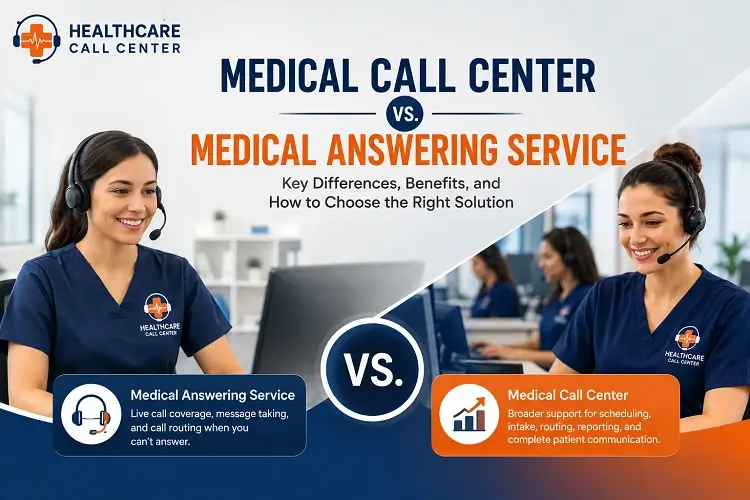
That is why many practices compare a medical call center vs. a medical answering service. The terms sound similar, but they do not always mean the same thing. A medical answering service usually helps answer calls, take messages, and route patient requests when the front desk is busy or closed. A medical call center can support a larger communication system, including scheduling, intake, front desk overflow, after-hours coverage, reporting, and routing by location or provider.
The better question is not which term sounds stronger. The better question is what your practice needs after the phone rings.
If your issue is missed calls, you may need a medical answering service. If your issue is call flow, routing, scheduling, and visibility, you may need a medical call center model. For many growing practices, the best answer is a combination of both.
Quick Answer: What Is the Difference?
A medical answering service is usually focused on live call coverage. It answers calls when your internal team cannot, captures caller information, documents the reason for the call, and follows your routing instructions.
A medical call center is broader. It may include live answering, appointment scheduling support, new patient intake, patient call routing, overflow handling, after-hours coverage, and reporting. It is designed to manage patient communication more systematically.
Simple breakdown:
- Medical answering service: best for missed calls, voicemail reduction, after-hours coverage, and front desk overflow.
- Medical call center: best for scheduling workflows, intake, reporting, multi-location routing, and higher call complexity.
- Blended model: best for practices that need both live answering and structured patient call management.
This distinction matters because answering the phone is only the first step. The call still needs to be documented clearly, routed correctly, and connected to the right next action.
What Is a Medical Answering Service?
A medical answering service gives healthcare practices live call coverage when the front desk is busy, closed, or overloaded. It can cover lunch hours, weekends, holidays, after-hours calls, and high-volume periods during the business day.
A basic answering service may only take a name and number. A strong medical answering service should do more. It should use practice-approved scripts, capture whether the caller is a new or existing patient, document the reason for the call, and route messages based on your rules.
For example, a new patient asking about availability should not be handled the same way as an existing patient asking for a provider callback. A scheduling request should not be documented like a billing question. Good answering support captures these differences so your team can follow up faster and with more context.
This is especially important because patients do not always leave voicemail. A new patient who reaches voicemail may call another practice. Live answering helps keep that opportunity inside your practice.
What Is a Medical Call Center?
A medical call center is a broader patient communication operation. It may include answering service coverage, but it also supports more complete workflows.
A medical call center can help with inbound patient calls, appointment requests, new patient intake calls, call routing, front desk overflow, after-hours messages, follow-up workflows, multi-location routing, and reporting. The goal is consistency. Each call is answered, categorized, documented, and sent to the correct next step.
This matters for practices with more complex call needs. A fertility clinic may need sensitive intake handling. An OB-GYN practice may need pregnancy-related call routing. A plastic surgery practice may need fast response for consultation leads. A dental practice may need scheduling support and urgent-call routing. A multi-location group may need calls routed by location, provider, or appointment type.
A healthcare call center is not only about answering more calls. It is about building a better patient communication system.
The table below highlights the practical differences between the benefits of medical answering service and a medical call center so you can choose the right solution for your practice.
Comparison Table: Medical Call Center vs Medical Answering Service
| Category |
Medical Answering Service |
Medical Call Center |
| Main purpose |
Answer missed or overflow calls |
Manage broader patient call workflows |
| Best for |
Practices needing live coverage |
Practices needing routing, intake, scheduling, and reporting |
| Coverage |
After-hours, weekends, holidays, overflow |
Business hours, after-hours, overflow, multi-location support |
| Call handling |
Message capture and routing |
Categorization, routing, intake, scheduling support, reporting |
| Scheduling |
May capture appointment requests |
Can support deeper scheduling workflows |
| Reporting |
Often basic |
Usually more detailed by call type or outcome |
| Best fit |
Simple coverage gaps |
Growing practices and specialty clinics |
The right option depends on the complexity of your calls. If most calls are simple messages, answering service coverage may be enough. If calls require intake, routing, scheduling, and reporting, a call center model may be stronger.
When a Medical Answering Service Is the Right Fit
A HIPAA-compliant medical answering service is often the right starting point when the practice is losing calls to voicemail.
You may need one if:
- Patients often reach voicemail
- Calls are missed during lunch or peak hours
- The front desk is busy with in-office patients
- New patient calls are not answered consistently
- After-hours calls need live coverage
- Appointment requests need to be captured clearly
- Staff spend too much time returning incomplete voicemails
For many practices, this solves the most urgent problem quickly. More calls get answered, patients hear a live human voice, and the front desk receives cleaner messages.
The important point is to choose a healthcare-focused provider. Generic answering services may answer the phone, but they may not understand medical office workflows, patient privacy expectations, scheduling intent, or provider routing instructions.
When a Medical Call Center Is the Better Fit
A medical call center is usually better when the practice needs more than basic message taking.
You may need a medical call center model if:
- You manage multiple locations
- You need appointment scheduling support
- You need new patient intake support
- You want call routing by provider, location, or service line
- You need reporting on call reasons and outcomes
- You want to standardize call handling across the practice
- You are using SEO or paid ads to drive more patient calls
This model helps leadership understand what is happening on the phones. It can show whether calls are about scheduling, new patient inquiries, after-hours needs, provider callbacks, or other categories. That visibility is valuable when the practice is trying to grow.
Signs Your Practice Has Outgrown a Basic Answering Service
Your current call support may not be strong enough if:
- Messages only say “patient called”
- Staff have to call back just to understand the request
- New patient inquiries are not separated from routine messages
- Appointment requests are not clearly labeled
- Callers are not asked whether they are new or existing patients
- Providers receive messages that should have gone to the front desk
- The front desk receives messages that should have been escalated
- You cannot report how many appointment opportunities were captured
These problems usually mean the practice does not only need someone to answer the phone. It needs a better call workflow.
According to the Agency for Healthcare Research and Quality (AHRQ), choosing between a medical answering service and a medical call center starts with understanding how your practice currently handles patient calls.
How to Choose the Right Option
Start with a simple call-flow audit.
Ask:
- When are calls missed most often?
- Are missed calls happening after hours or during the day?
- Do patients leave voicemail?
- Are voicemail messages complete?
- Do calls need routing by provider, location, or urgency?
- Do you need appointment scheduling support?
- Do you need reporting by call type or outcome?
If the main issue is unanswered calls, start with a medical answering service. If the issue is workflow, routing, intake, scheduling, and reporting, choose a medical call center model.
Example: How One Patient Call Can Change the Outcome
Imagine a new patient calls at 4:55 p.m. after finding your practice through Google. They want to know if you accept new patients and whether an appointment is available next week.
If the call goes to voicemail, the patient may call the next provider. If a basic answering service only writes “patient called,” your front desk still has to call back and restart the conversation. If a healthcare-focused answering workflow captures the caller name, phone number, patient status, reason for call, preferred appointment time, and next step, your team can follow up with confidence.
A medical call center model can take this further by tagging the call as a new patient scheduling request, routing it to the correct location, and reporting it as a conversion opportunity.
That is why the difference matters. The same call can become a lost lead, a vague message, or a clear appointment opportunity.
What to Ask Before Choosing a Provider
Before choosing a medical answering service or medical call center, ask practical questions:
- Do agents use healthcare-specific scripts?
- Can they capture appointment requests clearly?
- Can they separate new patient calls from existing patient calls?
- Can they route by provider, location, call type, or urgency?
- Can they support after-hours and front desk overflow?
- Can they document messages in a way staff can act on?
- Can they provide reporting on call types and outcomes?
The answers will tell you whether the provider is simply answering phones or helping your practice improve patient communication.
Final Recommendation
A medical answering service is best when your practice needs reliable live coverage for missed calls, after-hours calls, or front desk overflow.
A medical call center is best when your practice needs a more structured system for patient calls, scheduling requests, intake, routing, and reporting.
For many healthcare practices, the best solution is a blended model: live answering for coverage, plus structured workflows for clear documentation and routing.
Healthcare Call Center helps medical practices answer more calls, protect patient trust, and route conversations clearly so fewer opportunities are lost to voicemail or confusion.
Find the Right Call Support for Your Practice
Whether you need a medical answering service, a medical call center, or a combination of both, Healthcare Call Center can review your current call flow and identify where patient calls are being lost.
Book a free consultation and discover how better call handling can protect more appointments.
Frequently Asked Questions
Which is better: a medical answering service or a medical call center?
Neither is universally better. A medical answering service is ideal for practices that need reliable live call coverage, while a medical call center is better for practices that also need appointment support, patient intake, call routing, reporting, and more structured communication workflows.
Is a medical call center the same as a medical answering service?
No. A medical answering service usually focuses on live answering, message capture, and call routing. A medical call center is broader and may include scheduling support, intake, overflow coverage, reporting, and multi-location workflows.
Which one should a small medical practice choose?
If the main issue is missed calls or after-hours coverage, start with a medical answering service. If the practice also needs routing, intake, scheduling workflows, or reporting, a medical call center model may fit better.
Can a medical answering service help with appointment requests?
Yes. A healthcare-focused answering service can capture appointment intent, caller details, preferred times, new or existing patient status, and next-step notes for the front desk.
Why does live call support matter for SEO leads?
SEO can bring patients to the website, but the phone call often decides whether they book. If the call goes to voicemail, the practice may lose the lead to another provider.
What should a practice look for in a call support partner?
Look for live human answering, healthcare-specific scripts, and having HIPAA Privacy Rule workflows, clear message documentation, appointment request capture, escalation rules, after-hours coverage, and useful reporting.
by Erika Sanchez | Jul 31, 2026 | Healthcare Call Center Services
Running one medical practice is hard enough. Running three, five, or ten locations multiplies every operational challenge – especially when it comes to patient communication.
Location A has a front desk that answers every call within two rings. Location B struggles with a single receptionist handling a high volume of calls. Location C just opened, and the staff is still learning the scheduling system. Meanwhile, patients are calling different locations, getting different answers, experiencing different levels of service, and forming inconsistent impressions of your brand.
This is the multi-location communication problem, and it is one of the most common reasons growing practice groups seek out a centralized healthcare call center.
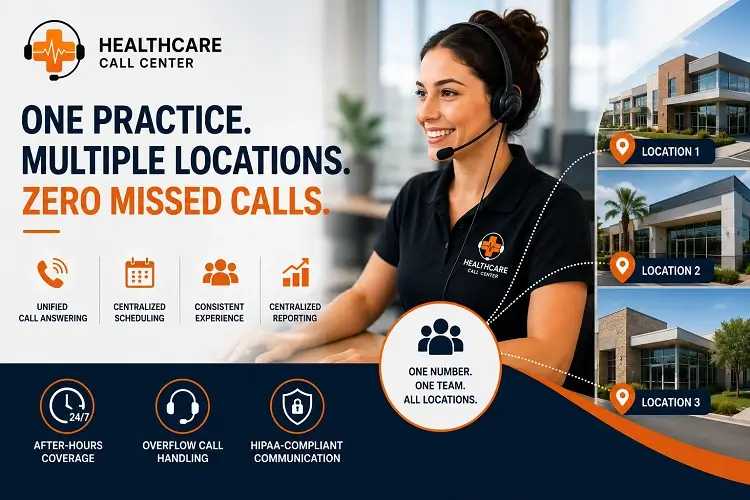
A healthcare call center for multi-location practices solves this by creating a single, consistent point of contact for every patient call – regardless of which location they are trying to reach. Calls are answered the same way, scheduling is handled in the same system, and the patient experience is identical whether they call your flagship location or your newest satellite office.
The Multi-Location Communication Problem
When practices expand to multiple locations, phone communication tends to fragment. Each location hires its own front desk staff, sets its own call handling procedures, and manages its own scheduling. On paper, this looks like independence. In practice, it creates chaos.
The most common problems include:
Inconsistent Patient Experience
A patient who had a great phone experience at Location A calls Location B and gets a rushed, put-on-hold, unhelpful interaction. They wonder if it is the same practice. Brand trust erodes.
Missed Calls at High-Volume Locations
The busiest location inevitably has the most missed calls. While Location C is underutilized, Location A is turning away patients because the phone goes unanswered. There is no system to route overflow calls to available staff.
No Centralized Visibility
Each location reports its own call metrics (if they track them at all). There is no unified dashboard showing total call volume, answer rates, booking rates, or patient satisfaction across all sites. Leadership cannot see which locations are performing and which are struggling.
Scheduling Complexity
Providers rotate between locations. New patients do not know which location to call. Referrals get sent to the wrong site. Without centralized scheduling, appointments are missed or double-booked.
After-Hours Gaps
If each location handles its own after-hours patient calls, coverage is inconsistent. One location might have a shared on-call phone. Another might send everything to voicemail. Patients have no idea what to expect when they call after 5 PM.
Staff Burnout at Busy Locations
The front desk at the highest-volume location is perpetually overwhelmed. Turnover is high. New hires take months to train. And the cycle repeats.
How a Centralized Healthcare Call Center Solves These Problems
A healthcare call center designed for multi-location practices addresses each of these challenges with a single, coordinated system.
Unified Call Answering
All patient calls – whether to Location A, B, or C – route through the central call center. Agents answer with the appropriate location name, follow practice-wide protocols, and handle each call to the same standard. The patient experience is consistent across every site.
Overflow and Load Balancing
When Location A is overwhelmed, calls automatically roll to the call center. No patient waits on hold for more than a few rings. The call center acts as an extension of your front desk, absorbing volume spikes during busy periods.
Centralized Scheduling
Agents have access to a unified scheduling system that shows availability across all locations and providers. When a patient calls, the agent can find the earliest available appointment at any convenient location – maximizing booking efficiency and distributing patient load.
Multi-Location Provider Management
Providers who work at multiple locations are tracked in the scheduling system. Agents know exactly where each provider is on each day and can book accordingly. Patients are directed to the right location for their preferred provider without confusion.
After-Hours Coverage for All Locations
A single call center handles after-hours calls for every location. Patients calling any of your offices after business hours reach the same trained agents, follow the same urgent message protocols, and can book appointments for the next business day. Consistent, reliable, professional – every location, every hour.
Centralized Reporting and Analytics
Practice leadership receives a single dashboard showing call metrics across all locations: total calls, answer rates, booking rates, after-hours activity, peak call times, and new patient inquiries by location. This data reveals which locations need additional front desk support, which providers are in highest demand, and where marketing efforts are generating the most calls.
What Multi-Location Practices Should Look for in a Call Center Partner
Not every call center can handle the complexity of multi-location medical practices. When evaluating partners, prioritize:
Multi-Location Scheduling Experience
The call center must have experience managing schedules across multiple sites, provider rotations, and location-specific rules. Ask for case studies or references from other multi-location medical groups.
Scalable Infrastructure
If you plan to add more locations, the call center should be able to onboard new sites quickly – adding phone numbers, call flows, and scheduling rules without major disruption.
Location-Specific Call Flows
Each location may have different providers, services, hours, and patient demographics. The call center should be able to configure location-specific greetings, call routing, and scheduling rules while maintaining a consistent overall brand experience.
HIPAA Compliance Across All Sites
A single BAA should cover all your locations. The call center must maintain compliance standards uniformly – no exceptions for smaller or newer sites.
Bilingual Agents
Multi-location practices often serve diverse communities. A call center with bilingual agents ensures every patient at every location can communicate effectively.
CRM and Practice Management Integration
The call center should integrate with your practice management software across all locations. Whether you use a single instance of Athena or different systems at different sites, the integration must be seamless.
Real-World Impact: What Changes When You Centralize
Before Centralization:
- 3 locations, each with its own front desk handling calls
- Location 1: 92% answer rate, patients happy
- Location 2: 71% answer rate, patients frustrated
- Location 3: 84% answer rate, inconsistent experience
- After-hours: all locations go to voicemail
- New patient inquiries: 30% captured, 70% lost to voicemail or long hold times
- Monthly booked appointments from phone calls: 180
After Centralization:
- All calls answered by a central healthcare call center plus location-based front desk
- Consistent 95%+ answer rate across all locations
- After-hours calls answered live by trained agents
- New patient inquiries: 85% captured and booked on the call
- Monthly booked appointments from phone calls: 310 (a 72% increase)
- Front desk staff at all locations focused on in-person patient care
- Leadership has a single dashboard showing performance across all sites
The centralization does not replace your front desk. It supplements them – handling overflow, after-hours, and new patient inquiries so your in-house team can focus on patients who are physically present.
Specialties That Benefit Most from Multi-Location Call Centers
Plastic Surgery Networks
Multiple locations often share surgeons who rotate between offices. A centralized call center manages the complexity of provider schedules across sites and ensures consultation requests are booked at the right location with the right surgeon.
Dental Groups
Dental service organizations (DSOs) and multi-location dental practices face high call volume and frequent emergency requests. A centralized call center handles overflow, emergency triage, and new patient booking across all locations.
Fertility Clinic Networks
Fertility patients often need to reach their clinic urgently – medication questions, cycle timing, test results. A centralized call center ensures patients at every location get the same responsive, empathetic care regardless of which clinic they are calling.
OB-GYN Groups
Pregnancy-related calls are time-sensitive and emotional. A centralized call center standardizes how these calls are handled, ensuring every patient at every location receives consistent, compassionate support.
Primary Care and Multi-Specialty Groups
Large medical groups with multiple specialties and locations benefit from a call center that can route calls, schedule across departments, and handle the complexity of multi-provider, multi-site operations.
Implementation: How to Roll Out a Centralized Call Center
Phase 1: Assessment – Audit current call volume, answer rates, and scheduling systems across all locations. Identify the biggest pain points and quick wins.
Phase 2: Integration – Connect the call center to your scheduling systems. Configure call flows, provider rules, and location-specific protocols.
Phase 3: Pilot – Launch at one or two locations first. Monitor call quality, booking accuracy, and patient feedback. Refine before expanding.
Phase 4: Full Rollout – Extend to all locations. Train front desk staff on how to work with the call center (overflow, after-hours handoff, new patient routing).
Phase 5: Optimization – Review monthly reports, adjust staffing, refine call flows, and expand service as needed.
The entire process typically takes 3 to 6 weeks for a practice with 3 to 10 locations, assuming cloud-based scheduling systems are already in place.
The Bottom Line for Multi-Location Practices
Every location you add increases call volume, scheduling complexity, and the risk of inconsistent patient experiences. A centralized healthcare call center absorbs that complexity, ensuring that whether a patient calls your newest satellite office or your flagship location, they get the same fast, professional, empathetic response.
For multi-location practice groups, centralization is not a luxury. It is the operational infrastructure that makes growth sustainable.
Book a free consultation to see how Healthcare Call Center can centralize patient communication across all your practice locations.
FAQs
1. How does a centralized call center handle calls for multiple practice locations?
Each location has a unique phone number that routes to the central call center. Agents answer with the specific location name, follow location-specific call flows, and access a unified scheduling system that shows availability across all sites and providers.
2. Can a multi-location call center integrate with different scheduling systems at each site?
Yes. If your locations use different practice management software, the call center can integrate with each system separately or work through a unified scheduling platform that syncs across all sites.
3. How much does a centralized healthcare call center cost for multi-location practices?
Pricing depends on the number of locations, total call volume, and service level. Most multi-location practices spend $800 to $3,000 per month, with costs offset by increased booking rates and recovered missed-call revenue.
4. Will the call center replace our front desk staff?
No. The call center supplements your front desk by handling overflow calls, after-hours coverage, and new patient inquiries. Your in-house team focuses on patients in the office while the call center ensures no phone-based patient is missed.
5. How long does it take to implement a centralized call center for multiple locations?
Typical implementation takes 3 to 6 weeks for practices with 3 to 10 locations, assuming cloud-based scheduling systems are in place. Larger networks may require 6 to 12 weeks depending on complexity.
by Erika Sanchez | Jul 29, 2026 | Medspa Call Center Services
Your front desk is drowning. The phones will not stop. A patient is on hold, another is walking in, and the fax machine is beeping. Somewhere in that chaos, a new patient inquiry goes to voicemail – and that patient calls the next practice on their Google search results instead.
This is the daily reality for growing medical practices, and it is exactly why more clinics are choosing to outsource their medical call center operations.
But outsourcing your medical call center is not just about hiring someone to answer phones. It is a strategic operational decision that affects patient experience, revenue capture, staff workload, and compliance. This guide walks through what it actually means to outsource a medical call center, when it makes sense, what it costs, and how to choose the right partner.
What Does It Mean to Outsource a Medical Call Center?
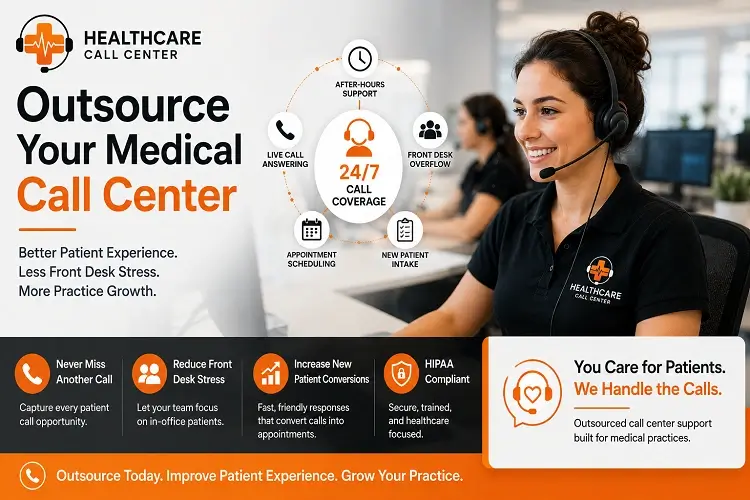
Outsourcing a medical call center means partnering with a specialized service provider to handle some or all of your practice’s inbound and outbound patient calls. This is not a generic answering service that takes messages. A true medical call center partner handles:
- Inbound patient calls – appointment scheduling support, prescription refills, lab result inquiries, insurance questions, and urgent message routing
- After-hours coverage – nights, weekends, and holidays so no patient call goes to voicemail
- Overflow call handling – when your front desk is overwhelmed, calls roll over to the call center so no one waits on hold
- Outbound patient communication – appointment reminders, follow-up calls, recall campaigns, and patient outreach
- New patient intake – capturing leads from website forms, marketing campaigns, and referral sources before they go cold
The depth of service depends on what your practice needs. Some practices outsource only after-hours calls. Others use a call center for all inbound calls during business hours, freeing their front desk team for in-person patient care.
Signs Your Practice Needs to Outsource Its Call Center
Not every practice needs to outsource. But these signs indicate it is time to evaluate:
- You are missing calls during business hours. If your front desk cannot answer every call within three rings during regular hours, you are losing patients. Studies show that 75% of callers who reach voicemail hang up without leaving a message. For a practice spending money on marketing, every missed call is wasted ad spend.
- Your after-hours calls go to voicemail. Patients call after hours because they have a need that cannot wait until morning. If those calls hit voicemail, the patient either waits anxiously or calls a competitor. An outsourced call center ensures every after-hours call is answered by a live person.
- Your staff is burned out from multitasking. When front desk staff is simultaneously checking in patients, answering phones, and handling administrative work, everything suffers. Patient check-in takes longer. Calls are rushed. Errors increase. Outsourcing call handling lets your in-house team focus on the patients standing in front of them.
- You are running marketing campaigns but cannot track lead conversion. If you are paying for Google Ads, SEO, or social media marketing but cannot track which calls come from which campaigns, you are flying blind. A medical call center can track call sources, qualify leads, and report on conversion rates.
- You have multiple locations with inconsistent phone handling. Multi-location practices often have different front desk processes at each site, leading to inconsistent patient experiences. A centralized outsourced call center standardizes how every patient call is handled across all locations.
- New patient inquiries are not being captured. The most expensive call to miss is from a new patient. If your team cannot answer every new patient inquiry quickly, you are losing revenue before the patient ever walks through the door.
Before choosing a provider, practices should review a medical call outsourcing checklist to understand where their phone process is actually breaking down
In-House vs Outsourced Medical Call Center: Honest Comparison
In-House Call Handling
Advantages:
- Staff knows your patients personally
- Direct integration with your practice management software
- Immediate access to providers for questions
Disadvantages:
- Limited to business hours (unless you staff 24/7, which is extremely expensive)
- Staff multitasking leads to missed calls and rushed interactions
- Scaling requires hiring, training, and managing more staff
- No specialized training in phone-based patient communication
- High overhead – salary, benefits, PTO, sick days, turnover costs
Outsourced Medical Call Center
Advantages:
- 24/7 coverage without staffing complexity
- Trained agents who specialize in phone-based patient communication
- Scales instantly – no hiring or training delays
- Consistent patient experience across all calls and locations
- Detailed call analytics and reporting
- Lower total cost than staffing a 24/7 in-house team
Disadvantages:
- Agents do not know your patients personally (mitigated by CRM integration and call protocols)
- Requires upfront setup time for call flows, scripts, and training
- Quality varies between providers (vetting is critical)
For most growing practices, the decision comes down to this: your in-house team is best at in-person patient care. An outsourced call center is best at phone-based patient communication. When you let each focus on what they do best, the practice runs more efficiently, and patients get a better experience.
What to Look for When You Outsource a Medical Call Center
Not all medical call centers are created equal. When evaluating partners, look for:
HIPAA Compliance
This is the baseline. Any call center handling patient calls must sign a Business Associate Agreement, use secure messaging, and train agents on PHI handling. If a provider hesitates on any of these, move on.
Healthcare Specialization
A call center that also handles plumbers and real estate agents is not a medical call center. Look for providers that specialize in healthcare and understand the nuances of medical phone communication – clinical terminology, patient privacy, empathy for anxious callers, and specialty-specific workflows.
Bilingual Capabilities
Your patient population likely includes non-native English speakers. A call center with bilingual agents ensures language barriers do not cost you or your patients.
CRM and Practice Management Integration
The best call centers integrate with your existing systems – whether that is Athena, Epic, Practice Fusion, or GoHighLevel. This means appointments booked during a call appear in your system in real time, with no manual data entry.
Call Recording and Quality Assurance
Ask whether calls are recorded (with appropriate patient consent), how quality is monitored, and what metrics they track. Look for first-call resolution rates, average answer speed, and patient satisfaction scores.
Scalability
If your practice grows or you open new locations, your call center should be able to scale with you – adding agents, extending hours, or taking on new call types without a lengthy onboarding process.
Transparent Reporting
You should receive regular reports showing call volume, answer rates, appointment booking rates, after-hours activity, and lead source tracking. Data transparency is non-negotiable.
What Does It Cost to Outsource a Medical Call Center?
Pricing models vary, but most medical call centers use one of these structures:
Per-Minute Billing
You pay for the actual time agents spend on calls. Rates typically range from $0.75 to $1.50 per minute. This works well for practices with low to moderate call volume.
Per-Call Billing
You pay a flat rate per call, usually $1.00 to $3.00 depending on complexity. This provides more predictable budgeting.
Monthly Subscription
A fixed monthly fee covers a set number of minutes or calls, with overages billed separately. Plans typically range from $200 to $1,500 per month depending on practice size and service level.
Dedicated Agent
Some practices opt for a dedicated agent or team that exclusively handles their calls. This is the most expensive option ($2,000 to $5,000+ per month) but provides the highest level of consistency and familiarity with your practice.
The real cost question is not “how much does the call center charge?” but ” how much are missed calls costing my practice?”
A single missed new patient call for a plastic surgery practice can mean losing a $5,000 to $15,000 procedure. For a fertility clinic, a missed inquiry could represent $15,000 to $50,000 in treatment revenue. When you frame the cost against the revenue at stake, outsourcing becomes one of the highest-ROI investments a practice can make.
How to Transition to an Outsourced Medical Call Center
Switching from in-house call handling to an outsourced model requires planning, but a good partner makes the transition smooth.
Step 1: Audit your current call volume and patterns. Pull data from your phone system showing total calls per day, peak hours, after-hours volume, and average wait times. This baseline helps you choose the right service level.
Step 2: Define your call flows and protocols. What happens when a patient calls with an emergency? How should new patient inquiries be handled? What information needs to be captured for appointment booking? Document these workflows.
Step 3: Choose a partner and sign a BAA. Review your options, ask for references from similar medical practices, and ensure the Business Associate Agreement is in place before any patient calls are handled.
Step 4: Train the call center on your practice. Provide information about your specialties, providers, scheduling rules, common patient questions, and practice policies. The best call centers will guide this process.
Step 5: Start with a pilot period. Route only after-hours calls or overflow calls to the call center first. Monitor quality, gather feedback from staff and patients, and adjust protocols before full rollout.
Step 6: Review performance monthly. Look at answer rates, booking rates, patient feedback, and cost. Adjust as needed.
Common Myths About Outsourcing a Medical Call Center
“Patients will know it is outsourced.”
If the call center is well-trained, patients will not know. Agents answer with your practice name, follow your scripts, and access your scheduling system. The experience should be seamless.
“We will lose control over the patient experience.”
You actually gain more control because every call follows your documented protocols. In-house staff handle calls inconsistently depending on their workload and mood. An outsourced team follows standardized processes.
“It is too expensive.”
Compare the cost of outsourcing to the cost of a missed new patient. For most practices, recovering one or two patients per month covers the entire cost of the service.
“Our patients want to talk to someone they know.”
Some do. But most patients simply want their call answered quickly by someone who is helpful, professional, and can solve their problem. A trained call center agent delivers that consistently.
Making the Decision
Outsourcing your medical call center is not about replacing your front desk. It is about extending your practice’s ability to serve patients beyond what in-house staffing alone can achieve. The right partner handles the calls your team cannot get to, captures the leads that would otherwise be lost, and ensures that every patient – whether they call at noon or midnight – hears a live, caring voice on the other end.
If your practice is growing, your call volume is increasing, or your staff is stretched thin, it may be time to explore what an outsourced medical call center can do for you.
Book a free consultation to see how Healthcare Call Center can handle your patient calls with the care, compliance, and consistency your practice deserves.
FAQs
1. How much does it cost to outsource a medical call center?
Most medical call centers charge $0.75 to $1.50 per minute, $1.00 to $3.00 per call, or $200 to $1,500 per month for bundled plans. Costs depend on call volume, specialty requirements, and service level. A dedicated agent model runs $2,000 to $5,000+ monthly.
2. Will patients know my calls are outsourced?
No. A well-trained medical call center answers with your practice name, follows your protocols, and accesses your scheduling system. The patient experience should be indistinguishable from calling your front desk directly.
3. Is a HIPAA-compliant BAA included when I outsource?
It must be. Any medical call center you partner with should sign a Business Associate Agreement before handling patient calls. If a provider will not sign one, do not work with them.
4. Can an outsourced call center handle after-hours emergency calls?
Yes. Medical call centers are equipped to triage after-hours calls, follow your urgent message protocols, and route true emergencies to your on-call provider. Non-urgent calls are handled and forwarded to your team for the next business day.
5. How long does it take to set up an outsourced medical call center?
Most implementations take 1 to 2 weeks, depending on the complexity of your call flows, number of locations, and integration requirements. A good partner will guide the setup process and provide training for their agents on your practice specifics.