by Erika Sanchez | Aug 13, 2026 | Medical Answering Services
Patients do not stop calling when the front desk closes. They call after work, on weekends, during holidays, when symptoms feel urgent, when they need to cancel or reschedule, and when they are finally ready to book an appointment but cannot reach a real person.
For medical offices, those after-hours calls can quickly turn into voicemail backlogs, missed appointment opportunities, unclear urgent messages, frustrated patients, and extra pressure on the front desk the next morning.
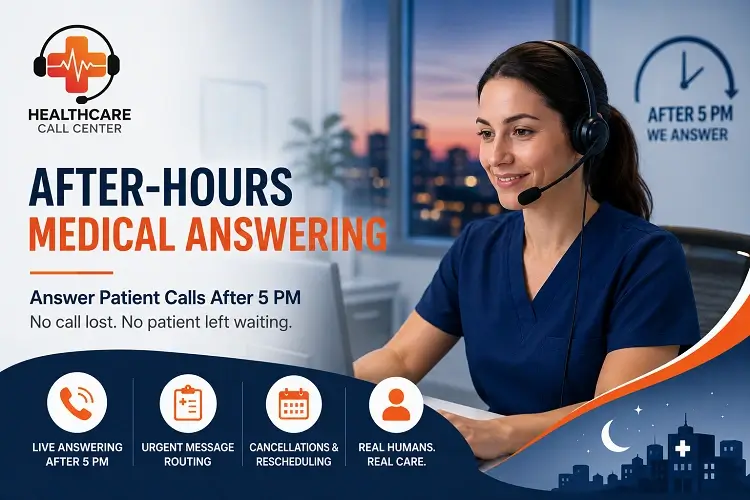
An after-hours medical answering service helps practices answer patient calls after 5 PM, collect the right details, route urgent messages based on practice-approved rules, and organize routine requests for follow-up.
If your practice is missing patient calls after hours, book a free consultation to review your call flow, after-hours coverage, missed-call risk, and patient scheduling needs.
Why After-Hours Patient Calls Matter for Medical Offices
After-hours calls matter because they often come from patients who are already worried, busy, or ready to take action. Some patients cannot call during normal business hours because of work, childcare, transportation, or caregiver responsibilities. Others call in the evening because a symptom changed, a medication question came up, or they need to know whether a message should wait until morning.
When those calls go to voicemail, the patient experience becomes uncertain. The caller may wonder whether anyone received the message, when they will hear back, or whether they should look for help somewhere else. For a medical practice, that delay can affect patient confidence, scheduling efficiency, and the workload waiting for the team the next day.
A dedicated after-hours medical answering service gives the practice a cleaner process for handling calls that come in after the office closes.
How After-Hours Answering Helps Route Urgent Patient Messages
One of the most important reasons to improve after-hours coverage is message routing. Patients may call about symptoms, post-procedure questions, medication concerns, test-related questions, or other situations that feel urgent to them.
A trained answering team should not diagnose, give medical advice, or replace a licensed clinician. Instead, agents collect the caller’s information, follow the practice’s approved script, and route urgent messages according to the provider’s escalation rules. Non-urgent messages can be documented clearly for review during business hours.
This gives the practice a safer and more consistent process than an unmanaged voicemail box. It also helps patients feel heard instead of abandoned after the front desk closes.
For practices that need coverage that follows privacy-aware procedures, our HIPAA-compliant medical answering service page explains how healthcare call workflows should be handled.
After-Hours Calls Often Include Cancellations, Reschedules, and Appointment Requests
Not every after-hours call is urgent. Many calls are operational. Patients call after hours to cancel, reschedule, ask about appointment times, request a callback, or leave details for the office team.
If those messages sit in voicemail until morning, the practice may start the day with avoidable scheduling problems. A Monday morning cancellation left on Sunday night can turn into an empty slot. A new patient inquiry left unanswered can become a lost opportunity if the patient contacts another provider first.
This is where a
This is where a medical answering service can support the front desk by capturing details, documenting the reason for the call, and helping the team follow up more efficiently.
The Human and Financial Cost of Missed After-Hours Patient Calls
A missed after-hours call is not always just one missed message. It can create a chain reaction.
A patient with a concern may feel ignored. A cancellation may not be seen until the appointment slot is already wasted. A new patient may keep searching and call another practice. A caregiver may leave an incomplete voicemail that forces the front desk to make multiple follow-up calls the next morning.
Here is a simple way to think about it: if a practice receives 20 after-hours calls per week and even 30% are delayed, missed, or poorly documented, that is 6 calls per week at risk. Over a month, that becomes 24 patient calls that could have been handled more clearly.
Some of those calls may be routine. Some may involve appointments. Some may involve patient concerns. The operational value comes from having a consistent system so the practice knows what came in, who needs follow-up, and which messages require faster routing.
If response time is already a concern, use the patient lead response time calculator to estimate how delays may affect patient inquiry follow-up.
In-House After-Hours Coverage vs. an Outsourced Medical Answering Service
Some practices try to manage after-hours calls internally. That can work for small call volumes, but it often creates staffing pressure, on-call fatigue, inconsistent documentation, and unclear escalation habits. Outsourcing can give the practice a more structured model without asking the in-office team to remain available at all hours.
An in-house approach also means the practice depends on one or two people. If they are sick, on vacation, or simply unavailable, coverage breaks. A service provides redundancy so calls are always answered, regardless of individual staff availability.
For practices with high daytime call volume, pairing after-hours coverage with
For practices with high daytime call volume, pairing after-hours coverage with front desk overflow support can reduce pressure during both shifts.
Why Medical Offices Outsource After-Hours Call Answering
Medical offices outsource after-hours call answering because patient access expectations have changed while staffing remains difficult. Patients expect faster responses. Front-desk teams are already busy during the day. Providers do not want every routine call interrupting them after hours, but they also do not want important messages buried in voicemail.
A healthcare-focused answering team can help bridge that gap. The goal is not to replace the practice team. The goal is to support the practice’s call flow when the office is closed, busy, or unavailable.
For practices that need broader coverage, a medical virtual receptionist can handle both daytime overflow and after-hours patient communication.
What a Good After-Hours Medical Answering Service Should Include
A good after-hours medical answering service should include more than basic message-taking. Medical practices should look for a system that can support both patient experience and office workflow.
- Live answer of every call, no voicemail trees
- Practice-specific greeting and scripts
- Urgent message routing based on provider escalation rules
- Non-urgent message documentation for next-day follow-up
- Appointment request capture (cancellations, reschedules, new bookings)
- HIPAA-conscious message handling and documentation
- Secure message delivery to the practice
- Call documentation and reporting for review
- Coverage for evenings, weekends, holidays, and lunch breaks
- Scalable support for single-location and multi-location practices
Practices should also ask about reporting. A good provider will share call summaries, response times, and message accuracy metrics so the practice can evaluate performance over time. This data helps identify patterns such as recurring patient questions, peak after-hours call times, and opportunities to improve front-desk workflows during the day.
The onboarding process matters as much as the features. A strong provider will spend time learning the practice’s greeting, common patient questions, provider preferences, escalation paths, and message delivery format before going live. Without this setup, even a feature-rich service can create confusion for patients and staff.
How After-Hours Call Coverage Improves the Patient Experience
Patients often remember how a practice responds when they are anxious, confused, or trying to get help outside normal hours. A live answer can provide reassurance even when the final follow-up happens the next business day.
Good after-hours coverage helps patients understand that their message was received, their details were captured, and the practice has a process for routing calls. That experience feels very different from leaving a voicemail and hoping someone hears it later.
For practices that depend on trust, reviews, referrals, and repeat appointments, the after-hours experience can influence how patients feel about the entire office.
The after-hours experience also affects online reviews. Patients who feel ignored after hours are more likely to share negative feedback. Patients who feel supported are more likely to leave positive reviews and recommend the practice to others.
Patients who reach a live person after hours are more likely to feel that the practice values their time. This is especially true for new patients who are comparing providers. If a prospective patient calls three practices after work and only one answers, that practice has a significant advantage in winning the appointment.
Practices in competitive local markets may also need a medical answering service in Florida to cover after-hours calls, overflow, and appointment requests.
Operational Benefits for Medical Practices
After-hours answering can also improve the next business day. Instead of starting the morning with a long voicemail queue, the team can receive organized call notes and understand which patients need follow-up first.
This helps reduce front-desk pressure, especially for practices that already deal with appointment calls, insurance questions, patient callbacks, referrals, and new patient inquiries during business hours.
For specialty practices, after-hours coverage also protects high-value appointment slots. A fertility clinic patient calling about a treatment question, a plastic surgery patient with a post-procedure concern, or a dental patient in pain all benefit from reaching a live person instead of voicemail.
See how specialty call support works with our 24/7 medical call center coverage.
Voicemail vs. Live After-Hours Answering (Comparison Table)
Many practices still rely on voicemail after hours. Voicemail may be simple, but it often creates delays and incomplete information.
Live answering gives the practice a more organized way to capture and route patient calls.
| Situation |
Voicemail Only |
Live After-Hours Answering |
| New patient calls after 5 PM |
Voicemail. Patient may call competitor. |
Live answer. Patient details captured. |
| Existing patient rescheduling |
Waits until next business day. |
Call answered. Request documented. |
| Urgent but non-emergency question |
Voicemail, callback next day. |
Message routed per practice urgency rules. |
| Weekend appointment inquiry |
Not handled until Monday. |
Call answered. Patient gets response path. |
| Patient calling from a referral |
May not leave a message. |
Live answer increases trust and captures lead. |
| Incomplete or unclear message |
Front desk must call back to clarify. |
Agent asks clarifying questions in real time. |
How to Choose the Right After-Hours Medical Answering Service
Before choosing a provider, medical offices should make sure the service understands healthcare workflows and can match the practice’s call-handling requirements.
- Does the team have healthcare call experience?
- Will they follow practice-specific scripts?
- Can they route urgent calls based on your escalation instructions?
- Do they use HIPAA-conscious procedures?
- Can they capture appointment requests?
- Do they offer both after-hours and daytime overflow coverage?
- Is there a review period to fine-tune scripts and call handling?
- Can the service scale as the practice grows?
Finally, ask about trial periods or review windows. A provider that is confident in its service should offer a way to evaluate call quality, message accuracy, and patient experience before committing to a long-term agreement.
It is also worth asking how the provider handles message delivery. Some practices prefer text or email delivery, while others want messages integrated into their practice management system. The provider should be able to match the practice’s preferred workflow rather than forcing a one-size-fits-all approach.
After-Hours Calls Should Not Become Morning Voicemail Backlogs
After-hours calls are part of the patient experience. They can include urgent concerns, routine questions, cancellations, reschedules, new patient inquiries, and messages that need clear follow-up.
When those calls are left unmanaged, the practice starts the next day behind. When they are answered and documented properly, the team has a clearer picture of what happened after hours and what needs attention next.
If your medical office is relying on voicemail after 5 PM, book a free consultation to review where patient calls may be slipping through and how after-hours call coverage can support your front desk.
Frequently Asked Questions
What is an after-hours medical answering service?
An after-hours medical answering service answers patient calls when a medical office is closed or unavailable. It can collect caller details, follow practice-approved scripts, route urgent messages, document non-urgent calls, and support appointment-related requests.
Why do medical offices need after-hours answering?
Medical offices need after-hours answering because patients often call after work, on weekends, or outside normal office hours with scheduling needs, symptoms, cancellations, and follow-up questions. Live answering helps reduce voicemail gaps and improves patient access.
How are urgent after-hours calls handled?
An after-hours answering service can collect details and route urgent messages according to the practice’s approved escalation rules. Agents should not diagnose or provide medical advice unless the service includes licensed clinical triage.
Can the service capture appointment requests after hours?
Yes. Depending on the practice workflow, agents can document appointment requests, cancellation notices, rescheduling needs, and callback details so the office can follow up clearly.
Is an after-hours answering service HIPAA compliant?
A healthcare answering service should use HIPAA-conscious workflows for patient information, secure message handling, access controls, and practice-approved routing. Practices should confirm compliance requirements before launch.
What should I look for when choosing an after-hours medical answering service?
Look for healthcare experience, custom scripts, secure message routing, escalation workflows, appointment request support, weekend coverage, reporting, and a setup process that matches your practice’s call flow.
by Erika Sanchez | Aug 12, 2026 | dentist call center services
Dental practices run on appointments. When the schedule is full, the practice thrives. When chairs sit empty because of missed calls, no-shows, and last-minute cancellations, revenue disappears quietly.
The problem is not that patients stop calling. They call during lunch, after hours, while your front desk is checking in a patient, or while someone else is on hold. Those calls go unanswered, and unanswered calls do not come back.
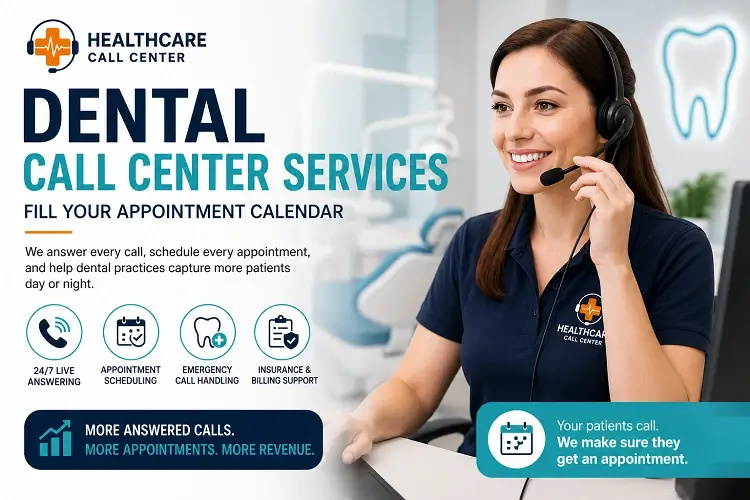
Dental call center services can fix your missed call issues and book more appointments for you. A trained team answers every patient call, schedules appointments directly into your system, handles rescheduling, and captures emergency inquiries before they walk to the competitor down the street.
This article explains what dental call center services do, why your practice needs them, and how they directly impact your bottom line.
What Are Dental Call Center Services?
Dental Answering services are specialized patient communication solutions built for dental practices. Unlike a generic answering service that takes messages, a dental-focused call center team understands how dental practices operate.
They know the difference between a routine cleaning and a dental emergency. They understand insurance pre-authorizations, financing questions, and new patient intake. They can follow your scheduling rules, manage cancellations, and route urgent clinical questions to the right person.
Every call is handled by a real person who treats patients with empathy and professionalism. No automated menus. No hold music for five minutes. No voicemail that patients hang up on.
According to the American Dental Association, patient communication is one of the top factors influencing case acceptance and retention. Practices that respond quickly to patient inquiries consistently outperform those that do not.
Why Dental Practices Lose Patients to Missed Calls
Many dental practices miss calls when front-desk staff are handling patients, insurance, payments, and scheduling simultaneously.
Your front desk is pulled in multiple directions. They check patients in, collect payments, verify insurance, manage the schedule, and assist the clinical team. When two patients are at the front desk and the phone rings, the call goes unanswered.
Lunch breaks create gaps. Many practices stagger lunch coverage poorly. Calls during the lunch hour often go to voicemail, and lunch hour is prime time for patient inquiries.
After-hours dental calls go nowhere. Dental offices typically close between 5 and 6 PM. Patients who experience tooth pain in the evening or think about scheduling an appointment after work cannot reach anyone. They either wait and forget, or they call a competitor who advertises 24/7 availability. In this case, only a dedicated After-Hours Dental Answering Service can help you book more appointments.
Emergency calls get lost. A patient with a cracked tooth at 8 PM does not want to leave a voicemail. A trained agent documents the concern, follows the practice’s approved emergency protocol, and routes or escalates the call to the appropriate dental team member.
Each missed call represents a patient who wanted your services and could not reach you. That is revenue walking out the door.
Core Services a Dental Call Center Provides
A dental call center functions as a seamless extension of your front desk. Here is what the service covers.
24/7 Live Answering
Every call is answered by a trained agent. Day, night, weekends, holidays. Patients always reach a real person who can help them.
The agent follows your practice protocols for call handling, message taking, emergency triage, and scheduling. Patients experience the same level of care they would get from your best front desk team member.
Appointment Scheduling
Agents book appointments directly into your practice management system. They use your dental appointment scheduling rules, operator preferences, hygiene recare intervals, and new patient protocols.
A patient who calls at 10 PM with a toothache can leave the call with a confirmed emergency appointment for 8 AM the next morning. No callback delay. No lost lead.
Emergency Call Triage
Dental emergencies do not follow business hours. A trained agent can assess whether the call requires immediate attention, schedule a same-day emergency slot, or provide home care guidance until the office opens.
This is where practices differentiate themselves. Patients remember the practice that answered at midnight during a dental emergency. They become loyal, long-term patients.
New Patient Intake
First-time callers have questions about insurance, financing, office location, parking, and the dentist’s experience with specific procedures. Agents walk through these questions using practice-approved information.
They do not give clinical advice. They provide the details patients need to feel confident booking their first appointment.
Insurance and Billing Assistance
Agents can answer basic insurance questions, verify coverage details using your provided scripts, and direct complex billing questions to your billing team. This reduces the number of calls pulled away from your in-office staff.
How Dental Call Center Services Differ from a Generic Answering Service
Many dental practices already have an answering service and think the problem is solved. It is not.
- Generic Answering Service: Takes a name and number. Sends a message. Patient waits. Patient books elsewhere.
- Dental Call Center Service: Engages the patient. Answers questions. Schedules the appointment. Patient leaves the call with confirmation.
The difference is conversion. A message-taking service captures data. A dental call center captures patients.
Think about the patient journey. Someone searching for a dentist calls three practices. The first goes to voicemail. The second answers but says they will call back. The third answers, answers the patient’s questions, and books the appointment on the spot. That third practice wins the patient every time.
Who Needs Dental Call Center Services?
These services are built for practices that want to grow without adding overhead.
Solo practitioners who cannot afford to miss a single new patient call. Every missed call is a patient who goes to the practice down the street.
Multi-doctor practices with high call volume that overwhelms front desk staff during peak hours.
DSOs and multi-location groups that need consistent call handling across all locations with unified protocols and reporting.
Specialty practices such as oral surgery, orthodontics, periodontics, and endodontics where calls involve complex scheduling, referrals, and insurance verification.
Emergency-focused practices that need after-hours coverage for urgent patient concerns.
If your practice misses more than two or three calls per day, the revenue lost from those calls exceeds the cost of a dental call center service.
What to Look for in Dental Call Center Services
Not all call centers understand dental. When evaluating providers, check for these essentials.
Dental Specialty Training
Agents should understand dental terminology, common procedures, insurance basics, and the difference between a hygiene recare and a comprehensive exam. Generic call centers confuse patients and create scheduling errors.
HIPAA Compliance
All patient information must be handled with strict HIPAA-compliant protocols. Encrypted messaging, secure access to your scheduling system, documented compliance training, and signed business associate agreements are non-negotiable.
Custom Practice Protocols
Your practice has specific scheduling rules, fee schedules, insurance plans, and communication preferences. The call center must follow your scripts, not theirs.
Bilingual Agents
Dental practices serve diverse communities. Bilingual agents ensure every patient receives clear communication regardless of language preference.
Reporting and Analytics
You should receive detailed call reports showing volume, outcome, appointment conversion rate, after-hours activity, and emergency call frequency. Data drives better decisions.
What Dental Practices Can Improve With Call Center Support
Practices that implement dental call center services see consistent improvements:
More new patient appointments booked. When every call is answered, new patient acquisition increases. Patients who would have gone to voicemail now have confirmed appointments.
Reduced no-show impact. When agents follow up with appointment reminders and handle rescheduling, no-show rates drop. Open slots get filled faster.
Higher patient satisfaction. Patients reach a helpful person every time. That positive first interaction builds trust before the patient ever sits in the chair.
Increased emergency capture. After-hours emergency calls that previously went to voicemail now convert to scheduled appointments. These are often high-value cases.
Better front desk efficiency. With the phone handled, your in-office team can focus on patients standing in front of them instead of juggling calls.
Stronger online reputation. Patients who have positive phone experiences are more likely to leave reviews. Your phone answering quality directly affects your star rating.
The Connection Between Call Answering and Revenue
Every dental practice owner knows the math. A missed new patient call represents the lifetime value of that patient, not just one appointment.
Want to estimate what missed calls could be costing your practice? Use our Missed Call Revenue Calculator to estimate the potential appointment and revenue impact.
A new patient who comes in for a cleaning and exam may return twice a year for decades. They may refer family members. They may accept treatment plans for crowns, implants, or orthodontics.
When that first call goes unanswered, all of that future revenue disappears. The patient simply calls the next dentist on Google Maps.
Dental call center services exist to make sure that first call is answered. Every time. By someone who can help.
Why Now Is the Right Time
The dental industry is competitive. Patients have more choices than ever. Online directories, insurance provider lists, and Google Maps make it easy for patients to call multiple practices in minutes.
The practice that answers first wins. The practice that sends patients to voicemail loses.
If your competitors are missing calls, you have an opportunity to capture their patients. If you are the one missing calls, you are feeding them patients every day.
Every week without a dental call center is a week of missed revenue. The cost of the service is recovered many times over by the appointments it captures.
Ready to Fill Every Chair in Your Practice?
Our HIPAA-compliant healthcare call center services provides specialized dental call center services that keep your schedule full and your patients cared for. From 24/7 live answering to emergency triage and appointment scheduling, we handle every patient communication with professionalism and empathy.
Our dental answering service is built specifically for dental practices. We understand your workflow, your patients, and your goals.
Frequently Asked Questions
What are dental call center services?
Dental call center services are specialized patient communication solutions for dental practices. Trained agents answer calls, schedule appointments, handle emergency triage, and provide after-hours coverage using the practice’s own protocols.
How much do dental call center services cost?
Costs vary based on call volume and service level. Most dental practices find that the revenue recovered from previously missed calls far exceeds the monthly cost. Contact us for a custom quote.
Can the call center schedule appointments directly into our system?
Yes. Agents book appointments directly into your practice management software using your scheduling rules, provider availability, and appointment type protocols.
What happens with after-hours emergency calls?
Trained agents assess the urgency of the situation using your protocols. They can schedule emergency appointments, provide home care guidance, or escalate to the on-call dentist when necessary.
Is the service HIPAA-compliant?
Yes. All patient information is handled with strict HIPAA-compliant protocols, including encrypted communication, secure system access, and documented staff training.
Can the service handle multi-location dental practices?
Yes. Our service supports multi-location groups with unified protocols, location-specific scheduling, and consolidated reporting across all offices.
by Erika Sanchez | Aug 11, 2026 | plastic surgery call center
Every time your front desk misses a call, a potential patient dials the next surgeon on their list. Plastic surgery is not like other medical specialties. Patients calling about procedures are nervous, excited, and full of questions. When that call goes to voicemail, they do not leave a message. They hang up and call someone else.
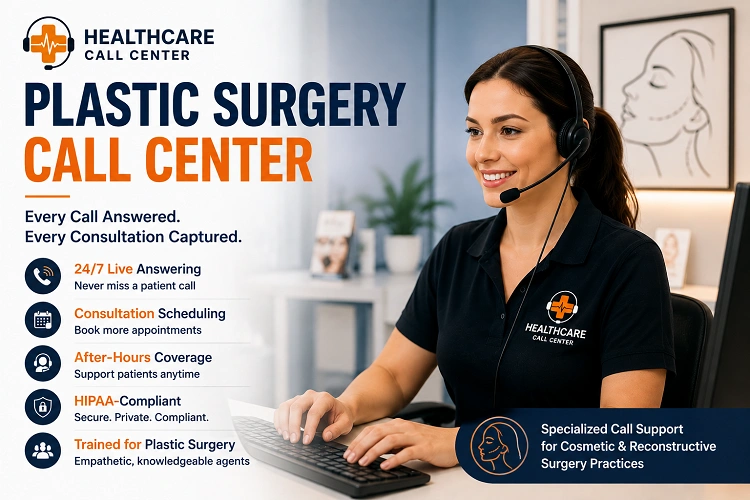
A plastic surgery call center service solves this problem. Trained agents answer every call, handle patient concerns with empathy, and book consultations directly into your schedule. No missed calls. No lost revenue. No patients slipping away to competitors.
If you are comparing providers, start with our guide to choosing an after-hours plastic surgery answering service that fits your call volume, scheduling workflow, and patient communication needs.
What Is a Plastic Surgery Call Center and What Does It Do?
A plastic surgery call center is a specialized patient communication service built specifically for cosmetic and reconstructive surgery practices. Unlike a generic answering service that takes messages, a plastic surgery call center team is trained to handle the unique flow of cosmetic patient inquiries.
These calls are different from typical medical calls. Patients ask about pricing, recovery timelines, financing options, before-and-after results, and whether a procedure is right for them. They need reassurance, not just information. A receptionist juggling in-office patients cannot give these calls the attention they deserve.
A dedicated call center changes that. Agents trained in plastic surgery patient communication answer every call within seconds. They understand the emotional weight of a rhinoplasty inquiry versus a reconstructive surgery question. They know when to schedule a consultation, when to route to clinical staff, and when to handle the question themselves.
The American Society of Plastic Surgeons reports that cosmetic procedures continue to grow year over year, which means more patients are calling practices to explore their options. The practice that answers the phone first captures that patient.
Why Plastic Surgery Practices Lose Patients to Missed Calls
Missed calls are the single biggest revenue leak in a plastic surgery practice. Here is why it happens and what it costs.
Front desk staff cannot answer every call. They check in patients, handle payments, manage schedules, and assist with in-office procedures. When three calls come in during a consultation check-in, two of those go unanswered.
After-hours Plastic Surgery calls go straight to voicemail. Most plastic surgery offices close at 5 or 6 PM. Patients who research procedures in the evening call after work. If nobody answers, that patient moves on.
New patient inquiries require time and empathy. A patient calling about a facelift may spend ten minutes asking questions before feeling comfortable enough to book. A rushed receptionist cannot provide that level of attention while managing a waiting room.
Want to estimate the potential revenue impact for your own practice? Use our Patient Lead Response Time Calculator to estimate how missed or delayed patient inquiries may affect appointments and revenue.
Weekend calls are another blind spot. Prospective patients spend Saturdays and Sundays researching procedures, looking at before-and-after photos, and calling practices. If your office is closed, those calls go to voicemail. By Monday morning, the patient has already booked a consultation with a competitor who answered.
How Missed Plastic Surgery Calls Affect Consultation Conversion
A missed plastic surgery call is not simply a missed conversation. It can represent a lost consultation, a lost procedure opportunity, and a patient who may never return to your practice.
Plastic surgery patients often compare multiple surgeons before choosing where to schedule a consultation. They may call after seeing a procedure page, reviewing before-and-after photos, or researching a surgeon’s credentials. If they reach voicemail, the next call may go to another practice.
The faster a practice responds to a new inquiry, the more opportunity it has to answer basic questions, build trust, and move the patient toward a consultation. Live call coverage helps remove the delay between patient interest and appointment scheduling.
Plastic surgery consult calls need high-value patient call handling because callers are often comparing providers before booking.
Core Services a Plastic Surgery Call Center Provides
A plastic surgery call center does more than answer phones. It functions as an extension of your practice. Here is what the service covers.
24/7 Live Answering
Every call is answered by a trained agent, day or night. Whether a patient calls at noon or midnight, they speak with a real person. No voicemail. No automated menus. No waiting on hold.
The agent follows your practice protocols for call handling, message taking, escalation, and scheduling. Patients feel like they reached your office, not a third-party service.
Consultation Scheduling
This consultation scheduling capability removes the delay between a high-intent inquiry and the next available appointment. They use your scheduling rules, availability windows, and intake requirements. A patient who calls at 9 PM can leave the call with a confirmed appointment for Thursday morning.
This eliminates the callback delay that kills conversions. Patients who have to wait for a callback often lose interest, book elsewhere, or forget they called.
After-Hours Coverage
The hours between 5 PM and 9 AM are prime time for patient inquiries. People research procedures after work, discuss options with family, and pick up the phone when the office is closed.
A plastic surgery answering service ensures these calls get answered. Agents capture new patient leads, handle urgent post-operative questions, and schedule consultations for the next business day.
New Patient Intake
First-time callers have questions. Lots of them. What does the procedure cost? How long is recovery? Is financing available? Does the surgeon have experience with their specific concern?
Trained agents walk patients through these questions using information you provide. They do not give medical advice. They give the information patients need to feel confident booking a consultation.
Call Routing and Escalation
When a call requires clinical attention, agents route it immediately. A post-operative patient with a concern goes straight to your clinical team. A media inquiry reaches your front office. A billing question gets directed to your billing department.
No message slips lost in a stack of papers. No patient transferred three times before reaching the right person.
How a Plastic Surgery Call Center Differs from a Generic Answering Service
Many practices already use an answering service and assume that is enough. It is not. Generic answering services take messages. They do not understand plastic surgery patient psychology.
Here is the difference:
- Generic Answering Service: Answers the call. Takes a name and number. Sends a message. Patient waits for a callback. Patient may not answer the callback. Patient books elsewhere.
- Plastic Surgery Call Center: Answers the call. Engages the patient. Answers basic questions using practice-approved information. Schedules the consultation on the spot. Patient leaves the call with an appointment.
The first model captures a name. The second model captures a patient.
This distinction matters because cosmetic patients are self-pay. They are spending their own money, which means they shop around. The practice that makes them feel heard and valued on that first call earns their trust and their business.
Who Needs a Plastic Surgery Call Center?
This service is built for practices that cannot afford to miss calls. That includes:
Single-surgeon practices where the surgeon and one receptionist handle everything. Calls go unanswered during consultations, procedures, and lunch breaks.
Multi-provider practices with high call volume. Three surgeons, two nurse practitioners, and one front desk mean calls pile up fast.
Practices offering high-value procedures. A single rhinoplasty, tummy tuck, or mommy makeover can represent significant revenue. Missing that one call is expensive.
Practices in competitive markets. If five plastic surgeons operate in your city, the one who answers the phone wins the patient.
The math is simple. If your practice misses five calls per week from potential new patients, and your average procedure value is significant, the revenue loss is substantial. A call center costs a fraction of what those missed calls cost you.
Read – Why Los Angeles plastic surgery practices need dedicated call center services?
What to Look for in a Plastic Surgery Call Center
Not every call center is built for plastic surgery. When evaluating services, look for these essentials:
1. Specialty Training
Agents should understand plastic surgery terminology, common procedures, patient concerns, and the consultation booking process. A generic call center will not know the difference between a consultation and a pre-op appointment.
2. HIPAA Compliance
Patient information must be handled with strict HIPAA-compliant protocols. According to the U.S. Department of Health and Human Services, covered entities must ensure that business associates handling protected health information comply with privacy and security rules. Your call center should document its compliance procedures, use encrypted systems, and train staff on privacy requirements.
3. Custom Call Protocols
Your practice is unique. The call center should follow your scripts, your scheduling rules, your escalation pathways, and your intake questions. Cookie-cutter protocols lead to mistakes.
4. Bilingual Capability
Plastic surgery serves diverse communities. Bilingual agents ensure you never miss a call from a patient who prefers to speak in their native language.
5. Integration with Your Systems
The call center should integrate with your practice management software, EHR, or scheduling tool. Manual message-passing creates delays and errors.
What Changes When a Plastic Surgery Practice Uses a Call Center
Practices that implement a dedicated plastic surgery call center service see measurable changes:
More consultations booked. When every call is answered, consultation volume increases. Patients who would have gone to voicemail now have appointments on the calendar.
Higher patient satisfaction. Patients reach a real person every time. They feel heard, not processed. That first interaction sets the tone for their entire surgical journey.
Recovered revenue. Calls that previously went unanswered now convert to paying patients. The return on investment is direct and measurable.
Better staff focus. Your front desk team can focus on in-office patients instead of juggling phones. The practice runs smoother.
Improved online reviews. Patients who have a positive first call experience are more likely to leave positive reviews after their procedure. That first phone interaction ripples through your entire reputation.
Why Now Is the Time
The cosmetic surgery market is growing. More patients are researching procedures online and calling practices to ask questions. The practice that answers the phone first wins the consultation.
If your competitors are using voicemail after 5 PM, you have an opportunity. If they are missing calls during the day, you have an advantage. A plastic surgery call center turns that advantage into revenue.
Every day without one is a day you are losing patients to practices that pick up the phone.
Our medical answering service is built for healthcare providers who need reliable, empathetic patient communication at every hour. For plastic surgery practices specifically, our plastic surgery call center services deliver customized call handling that matches your practice voice and protocols.
Ready to Capture Every Patient Call?
Healthcare Call Center provides specialized call center services for plastic surgery practices, staffed by trained agents who understand cosmetic patient communication. From after-hours coverage to full-time answering, we make sure no patient call goes unanswered.
Book a Free Consultation
Frequently Asked Questions
What is a plastic surgery call center?
A plastic surgery call center is a specialized patient communication service that answers calls for cosmetic and reconstructive surgery practices. Trained agents handle patient inquiries, schedule consultations, and provide after-hours coverage.
How much does a plastic surgery call center cost?
Costs vary based on call volume and service level. Most practices find that the revenue recovered from previously missed calls far exceeds the monthly cost. Contact us for a custom quote based on your practice needs.
Can the call center schedule consultations directly?
Yes. Agents book appointments directly into your practice management system using your scheduling rules and availability windows.
Is the service HIPAA-compliant?
Yes. All patient information is handled with strict HIPAA-compliant protocols, including encrypted messaging and secure scheduling access.
What hours does the call center cover?
Our service provides 24/7 coverage, meaning every call is answered whether your office is open or closed.
Will patients know they are speaking to a call center?
Our agents answer calls using your practice name and follow your custom protocols. Patients experience seamless communication that feels like they reached your office directly.
by Erika Sanchez | Aug 10, 2026 | Medical Call Center Services
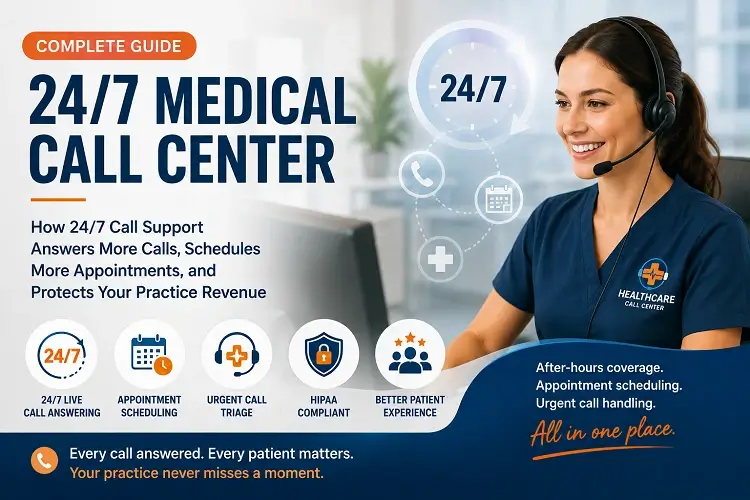
Every missed patient call costs your practice money. When a patient calls after hours and reaches voicemail, they do not leave a message. They call the next provider on the list. A 24/7 medical call center makes sure every call is answered by a trained professional who can schedule appointments, handle urgent inquiries, and protect your revenue around the clock.
Healthcare Call Center provides medical call center services designed for medical practices that cannot afford to miss calls. This guide breaks down what a 24/7 medical call center does, why it matters, and how it transforms patient communication for practices of every size.
What Is a 24/7 Medical Call Center?
A 24/7 medical call center is a dedicated communication service that answers patient calls for healthcare practices at all hours, including nights, weekends, and holidays. Unlike a basic answering service that simply takes messages, a medical call center staffed by trained agents can schedule appointments, triage urgent calls, answer patient questions, and route critical situations to the right provider.
The difference between a standard answering service and a medical call center comes down to training and capability. Medical call center agents understand healthcare workflows. They know how to handle sensitive patient information, follow HIPAA guidelines, and provide the kind of empathetic communication that patients expect from their healthcare providers.
Think of it as an extension of your front desk, one that never clocks out. When your in-house staff goes home, the call center takes over seamlessly. Patients hear a live, knowledgeable voice representing your practice, not a recording asking them to leave a message that might not be returned until the next business day.
Why Your Practice Needs 24/7 Call Coverage
Patient calls do not follow business hours. They come in during lunch breaks, after work, on weekends, and in the middle of the night. If your front desk closes at 5 PM, every call after that goes to voicemail or, worse, to a competitor who answers.
- Consider what happens when calls go unanswered:
- New patients needing immediate appointments call the next available provider
- Referrals from other physicians go unanswered after hours
- Patients with urgent post-procedure questions turn to emergency rooms unnecessarily
- Schedule gaps appear when cancellation calls are not captured in real time
- Existing patients frustrated by voicemail start researching other providers
A 24/7 medical answering service eliminates these gaps. Every call gets answered. Every patient gets directed to the right resource. Every revenue opportunity gets captured, whether it arrives at noon or midnight.
Key Benefits of a 24/7 Medical Call Center
1. Capture Every Revenue Opportunity
New patient calls are the most valuable calls your practice receives. Each one represents a potential long-term patient with recurring revenue over months or years. When those calls go to voicemail after hours, the patient moves on. A 24/7 call center ensures that every new patient inquiry is answered and converted into a booked appointment, maximizing your patient acquisition without adding internal staff.
Consider the math: if your practice misses just two new patient calls per week after hours, and each patient represents an average of $800 in lifetime value, that is over $80,000 in lost revenue every year. A [medical call center](https://healthcarecallcenter.com/medical-answering-service/) captures those calls for a fraction of what they are worth.
2. Reduce No-Shows and Same-Day Cancellations
When patients need to cancel or reschedule, they often call outside business hours. If no one answers, they either skip the appointment entirely or leave a message that staff does not process until the next day. By then, the schedule gap is already lost. A 24/7 call center captures cancellations in real time, giving your team the opportunity to fill the slot from a waitlist or standby patients who want earlier appointments.
3. Improve Patient Satisfaction and Retention
Patients expect accessibility from their healthcare providers. When they call with a question or concern and reach a live, knowledgeable person instead of a recording, their confidence in your practice grows. That confidence translates into loyalty, positive online reviews, and referrals to friends and family members who are looking for a provider who actually picks up the phone.
4. After-Hours Coverage Without Staffing Overhead
Hiring additional front desk staff for evening and weekend coverage is expensive. Between salaries, benefits, training, and management overhead, the cost quickly outweighs the value for most practices. A medical answering service provides full after-hours coverage at a fraction of the cost, with trained agents who already understand medical communication protocols and can start representing your practice on day one.
5. HIPAA-Compliant Communication
Every patient interaction through a 24/7 medical call center must meet HIPAA requirements. Trained agents follow strict protocols for handling protected health information, ensuring that every call, message, and scheduling note meets compliance standards. This protects your practice from costly violations and gives patients confidence that their personal health information is handled with the same care they would expect from your in-house team. Learn more about HIPAA-compliant healthcare call center standards and what to look for in a partner.
6. Consistent Patient Experience Across All Hours
When patients call your practice, they expect the same level of service whether it is 10 AM or 10 PM. A medical call center ensures that every caller receives the same professional, empathetic response regardless of when they call. Scripts are customized to match your practice voice. Protocols align with your clinical workflows. The experience feels seamless, not outsourced.
How a 24/7 Medical Call Center Works
The process is designed to integrate seamlessly with your existing practice workflow. There is no complicated setup, no new phone system to install, and no disruption to your current operations.
Step 1: Call Forwarding Setup
Your practice forwards calls to a dedicated medical call center number during after hours, lunch breaks, overflow periods, or any time you choose. Setup takes minutes and requires no technical changes to your existing phone system. You control exactly when calls route to the call center and when they stay in-house.
Step 2: Live Answering by Trained Agents
Every call is answered by a trained agent who identifies themselves as representing your practice. Agents follow customized scripts and protocols designed specifically for your specialty, whether you run an OB-GYN office, a dental practice, a fertility clinic, or a multi-location medical group. Callers never feel like they have reached a generic call center. They feel like they have reached your practice.
Step 3: Appointment Scheduling and Triage
Agents can schedule appointments directly into your practice management system, handle prescription refill requests, answer common patient questions, and follow triage protocols to determine which calls require immediate provider attention. This is not message-taking. It is active patient communication that keeps your schedule full and your patients cared for.
Step 4: Message Delivery and Follow-Up
Non-urgent messages are delivered to your team through secure channels at the start of each business day. Urgent calls are escalated immediately based on protocols you define, with agents contacting the on-call provider directly. Your morning starts with organized, prioritized messages instead of a backlog of voicemails to sort through.
24/7 Medical Call Center vs Traditional Answering Service
Not all answering services are created equal. Understanding the difference helps you choose the right partner for your practice and avoid paying for a service that does not actually serve your patients.
| Feature |
Traditional Answering Service |
24/7 Medical Call Center |
| Call Answering |
Takes messages only |
Answers, triages, and schedules |
| After-Hours Coverage |
Limited or extra fees |
Included as standard |
| Appointment Scheduling |
Not available |
Real-time scheduling into your system |
| Medical Training |
Generic operators |
Healthcare-trained agents |
| HIPAA Compliance |
Often not covered |
Built into every interaction |
| Triage Protocols |
None |
Custom protocols per specialty |
| Patient Experience |
Impersonal, transactional |
Empathetic, specialty-aware |
| Cost Structure |
Per-message pricing |
Predictable monthly pricing |
Who Benefits Most from 24/7 Call Coverage?
Certain specialties see especially strong returns from round-the-clock call coverage, particularly practices where patient anxiety, urgency, or high out-of-pocket costs make every call critical.
OB-GYN and Pregnancy Clinics: Expectant mothers call at all hours with concerns, questions, and scheduling needs. An OB-GYN answering service ensures every call is handled with the sensitivity and urgency that obstetric care demands. Patients experiencing pregnancy symptoms at midnight need reassurance from a real person, not a voicemail system.
2. Fertility and IVF Clinics: Fertility patients are highly emotionally invested in every step of their treatment journey. A [fertility clinic answering service](https://healthcarecallcenter.com/fertility-clinic-answering-service/) provides the compassionate communication these patients need, even at 2 AM when anxiety peaks and questions about medication timing or symptoms cannot wait until morning.
3. Dental Practices: Dental emergencies do not wait for office hours. A dental call center captures emergency calls, provides initial guidance, and directs urgent cases to the on-call dentist, protecting both the patient and the practice relationship.
4. Plastic Surgery Practices: Pre-op and post-op questions arise around the clock after procedures. A plastic surgery call center ensures patients feel supported throughout their surgical journey, reducing unnecessary ER visits and strengthening the provider-patient relationship during recovery.
5. Multi-Location Medical Groups: Practices with multiple locations face complex call routing challenges. A centralized medical call center streamlines communication across all sites, ensuring no call slips through regardless of which location the patient is trying to reach.
What to Look for in a 24/7 Medical Call Center Partner
Choosing the right call center partner is critical. The wrong choice can damage patient relationships and create compliance risks. Here are the factors that matter most:
Healthcare Specialization
Generic call centers do not understand medical workflows. Look for a partner that specializes in healthcare communication, with agents trained on HIPAA protocols, medical terminology, and the specific needs of your specialty. A physician answering service requires different protocols than a dental or fertility practice.
Customizable Protocols
Your call center should adapt to your practice, not the other way around. Look for a partner that builds custom scripts, triage protocols, and escalation paths based on your specific requirements. You define what constitutes an urgent call, how prescriptions are handled, and which messages require immediate provider notification.
Technology Integration
The best call centers integrate directly with your practice management software. This means real-time appointment scheduling, secure message delivery, and detailed call logging that feeds into your patient records system. Ask about integration capabilities before committing.
Transparent Reporting
You should never have to guess how your calls are being handled. Look for a partner that provides detailed reporting on call volume, answer times, message delivery, and patient outcomes. Regular reporting helps you identify trends, optimize protocols, and measure the return on your investment. Understanding medical answering service pricing structures helps you evaluate whether you are getting value for your investment.
If your practice is losing patients to missed calls, it is time to close the gap.
with Healthcare Call Center today and discover how 24/7 coverage transforms your practice communication, fills your schedule, and keeps your patients loyal.
The Bottom Line
A 24/7 medical call center is not a luxury. It is a revenue protection strategy, a patient satisfaction tool, and a competitive advantage all in one. Every call answered is a patient retained, an appointment booked, and a relationship strengthened. Every call missed is an opportunity handed to the practice down the street.
Common Questions About 24/7 Medical Call Centers
How much does a 24/7 medical call center cost?
Pricing varies based on call volume, specialty requirements, and service scope. Most practices find that the cost of a medical call center is significantly lower than hiring additional staff, and the revenue recovered from captured calls typically covers the cost several times over. The right pricing model depends on your call patterns and the level of service you need.
Can agents schedule appointments directly into my system?
Yes. Medical call center agents integrate directly with your practice management software, allowing them to schedule, reschedule, and cancel appointments in real time. This eliminates the delay of message-taking and keeps your calendar accurate without manual data entry from your front desk team.
What happens with urgent after-hours calls?
Every practice defines its own escalation protocols. Urgent calls are routed to the on-call provider immediately, based on criteria you set. Non-urgent calls are logged and delivered to your team the next business morning with full context so your staff can follow up efficiently.
Is my patient data secure?
Reputable medical call centers operate under strict HIPAA-compliant healthcare call center protocols. All agents are trained on privacy requirements, and systems are designed to protect protected health information at every touchpoint, from the initial call to final message delivery.
Can a call center handle calls for my specific specialty?
Yes. Medical call centers customize their service based on your specialty, from physician answering services to dental, fertility, and plastic surgery practices. Scripts, triage protocols, and agent training are tailored to your specific patient population and clinical workflows.
How quickly are calls answered?
Most medical call centers target answer times under 30 seconds. Fast answer rates are critical because patients who wait too long often hang up and call another provider. Look for a partner that guarantees answer-time performance and provides reporting to verify it.
by Erika Sanchez | Aug 7, 2026 | Medical Answering Services
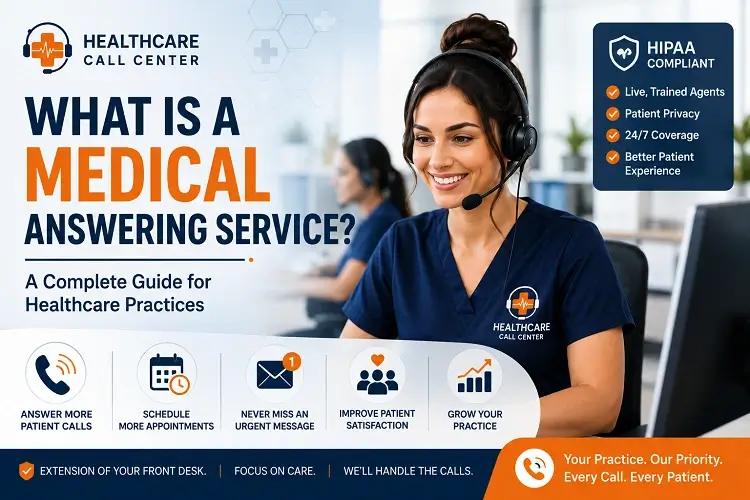
A medical answering service is a specialized call-handling solution where trained live agents answer phone calls for healthcare practices. Unlike a generic answering service that handles plumbers, real estate agents, and pizza shops on the same line, a medical answering service is built specifically for healthcare. Agents are trained on HIPAA compliance, patient privacy, medical terminology, medical answering service with scheduling support, and urgent message routing.
Think of it as an extension of your front desk that never takes a lunch break, never goes home at 5 PM, and never puts a pregnant patient with a concern on hold for six minutes.
When a patient calls your practice after hours, during lunch, or when your staff is slammed, the call goes to a trained agent instead of voicemail. That agent follows your practice scripts, captures patient information, schedules appointments directly in your system, and routes urgent clinical messages to the right provider.
The patient feels heard. Your practice captures revenue that would have otherwise gone to the clinic down the street.
At a Glance
- Live agents answer patient calls on behalf of your practice.
- Supports after-hours, lunch breaks, and busy front desk periods.
- Can capture appointments, messages, and new patient inquiries.
- Routes urgent calls based on your approved workflows.
- Helps reduce missed calls and improve patient experience.
Most practices already have a phone system in place. A medical answering service simply becomes an extension of that system, allowing every patient call to reach a trained live agent instead of voicemail.
How Does a Medical Answering Service Work?
The setup is simple. You forward your practice phone number to a dedicated number provided by the answering service. When a patient calls, a live agent answers within a few rings using a greeting you customize.
Here is what happens step by step:
- Patient calls your practice number after hours or during overflow periods.
- Call forwards to the answering service instantly. No delay, no transfer tone.
- Trained agent answers with your custom greeting (for example, “Thank you for calling Riverside Family Medicine, how may I help you?”).
- Agent follows your practice-specific script to handle the call: schedule an appointment, take a message, answer a basic question, or escalate an urgent matter.
- Message details are delivered to your team via secure text, email, or directly into your EHR system.
- Your morning report shows every call, message, and appointment captured overnight.
Most routine patient calls are handled in just a few minutes, allowing patients to receive immediate assistance while your team stays focused on in-office care.
What Calls Can a Medical Answering Service Handle?
A properly trained medical answering service handles the full range of patient communication that flows through a typical practice. This is not just message-taking. A dedicated HIPAA-compliant healthcare call center service functions as an extension of your operations team.
- New patient intake calls: Capture insurance details, reason for visit, and preferred provider. Route to scheduling.
- Appointment scheduling and changes: Agents book, reschedule, or cancel appointments directly in your practice management system.
- Prescription refill requests: Log the request, verify patient identity, and route to the correct provider for approval.
- Urgent clinical messages: Identify true emergencies, follow escalation protocols, and contact the on-call provider immediately.
- Billing and insurance questions: Capture the inquiry and route to your billing team with full context.
- After-hours triage: Follow your triage protocols to determine what needs immediate attention versus what can wait until morning.
Medical Answering Service vs. Generic Answering Service
This is where most practices make an expensive mistake. They sign up for a $0.75-per-call service they found on Google, only to discover the agent answering their patient calls also handles calls for a tow truck company and a hair salon.
Although both services answer phone calls, the differences in healthcare knowledge, compliance, and patient experience are significant.
A medical answering service is fundamentally different from a generic one. Here is how they compare:
| Feature |
Medical Answering Service |
Generic Answering Service |
| HIPAA Training |
Required and verified |
Not required |
| Agent Training |
Medical terminology, triage, EHR |
Script reading only |
| Appointment Scheduling |
Direct integration with your system |
Message-taking only |
| Urgent Message Routing |
Custom escalation protocols |
Standard voicemail or text |
| Patient Privacy |
Encrypted messaging, BAAs signed |
No privacy safeguards |
| Language Support |
Bilingual agents common |
English only typically |
| Average Cost |
$200-$2,500/month |
$30-$300/month |
The price difference reflects the training, technology, and compliance infrastructure required to handle healthcare calls safely. A $200/month medical answering service that captures one new patient call worth $500 pays for itself. A $50/month generic service that mishandles a HIPAA-protected message can cost you thousands in penalties.
Who Needs a Medical Answering Service?
If your practice receives patient phone calls, you need one. But certain practice types benefit more than others:
- Single-provider practices: Your front desk cannot answer every call while checking in patients. Overflow coverage during busy hours prevents missed new patient inquiries.
- Multi-location groups: Centralized call handling ensures consistent patient experience across all locations. No more “that office is at lunch, try back later.”
- Specialty practices with high-value patients: Fertility clinics, plastic surgery centers, and dental implant practices lose significant revenue from each missed call. A single missed IVF patient inquiry can cost $15,000 to $50,000 in lifetime value.
- OB-GYN and urgent care: Patients calling at 2 AM with pregnancy concerns need a human response, not a voicemail box. Proper triage routing ensures the on-call provider gets the right calls immediately.
Even practices with experienced front desk teams benefit because call volume is rarely consistent throughout the day. A medical answering service provides extra capacity during peak periods without requiring another full-time employee.
How Much Does a Medical Answering Service Cost?
Most medical practices pay between $200 and $2,500 per month. The cost depends on call volume, the pricing model used, and the features included.
Monthly pricing varies based on call volume, after-hours coverage, appointment scheduling support, bilingual services, and workflow complexity.
- Per-call pricing: $0.75 to $1.50 per call. Best for small practices with under 300 calls per month.
- Per-minute pricing: $0.85 to $1.75 per minute. Appears precise but often runs 20-40% over expectations.
- Flat-rate pricing: $199 to $1,500 per month for a set volume. Predictable budgeting and rewards efficient call handling.
For a detailed breakdown of pricing models, hidden fees, and real practice cost examples, see our complete medical answering service pricing guide.
What to Look for When Choosing a Medical Answering Service
Not all medical answering services are created equal. Before signing a contract, evaluate these non-negotiables:
- HIPAA compliance with a signed Business Associate Agreement (BAA)
- US-based agents trained on medical terminology and patient privacy
- Direct integration with your EHR or practice management system
- Bilingual agents if your patient population needs Spanish-language support
- 24/7 coverage with no holiday surcharges
- Custom script building for your specialty and protocols
- Call recording and dashboard reporting included in the base price
- Month-to-month contract with transparent overage rates
If a provider cannot check every box on this list, keep looking. Your patient calls are too valuable to hand to the cheapest bidder. Are they offering a secure medical answering service or not?
Why Practices Switch from Voicemail to a Medical Answering Service
The average medical practice misses 25% of incoming calls during business hours. Not because staff is lazy, but because front desk teams cannot answer the phone while checking in patients, handling intake forms, and managing the provider schedule.
When those missed calls go to voicemail, 80% of callers hang up without leaving a message. Of those who hang up, 35% call a competitor next. You never see the lost revenue in a report. It simply shows up as fewer new patients and slower growth.
A medical answering service captures those calls. Patients speak to a real person, get their needs addressed, and leave with a positive impression of your practice. The appointment book fills up. Urgent messages reach the right provider. Your front desk starts the morning with a clean report instead of a full voicemail box.
Benefits of a Medical Answering Service
- Fewer missed patient calls
- Better patient experience
- Increased appointment capture
- Reduced front desk workload
- Reliable after-hours coverage
- More consistent patient communication
Stop Losing Patients to Voicemail
Every call your practice misses is a patient who wanted help and got a machine instead. Some of those patients call back. Many do not. A medical answering service makes sure every patient hears a human voice, every time they call.
We help medical practices across the country capture missed calls, schedule more appointments, and give patients the responsive care they expect. Book a free consultation to see how it works for your practice.
Frequently Asked Questions
Q: Is a medical answering service the same as a medical call center?
A: Not exactly. A medical answering service primarily handles inbound patient calls, messages, and scheduling. A medical call center provides broader services including outbound patient outreach, chronic care management, triage, and multi-channel communication. Many providers offer both. If you need more than message-taking and scheduling, a medical call center may be the better fit.
Q: Can a medical answering service schedule appointments in my EHR?
A: Yes, most healthcare-specialized services integrate directly with popular EHR and practice management systems including Epic, Athena, eClinicalWorks, and NextGen. Ask the provider specifically about your platform during the consultation.
Q: How quickly do agents answer calls?
A: The industry standard is 3 rings or fewer, which is about 15-20 seconds. Practices should verify this in the service level agreement. If average answer time exceeds 30 seconds, patients will hang up.
Q: Are medical answering services HIPAA compliant?
A: Healthcare-specialized services are. They sign a Business Associate Agreement, use encrypted messaging, train agents on patient privacy, and maintain audit logs. Generic answering services are not HIPAA compliant and should not handle patient calls.
Q: What happens if a patient has a medical emergency?
A: The agent follows your practice-specific triage protocol. For emergencies, they instruct the patient to call 911 or go to the nearest emergency room. For urgent but non-emergency situations, they contact the on-call provider immediately using your escalation chain.