by Erika Sanchez | Aug 19, 2026 | Medical Call Center Services
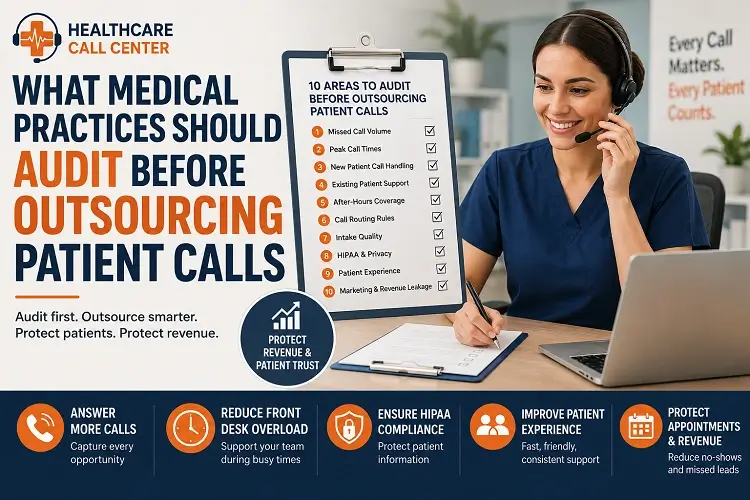
Outsourcing patient calls can be a smart move for a medical practice, but it should not start with choosing a vendor.
It should start with an audit.
Too many practices begin by asking, “Which medical call center should we use?” That question matters, but it comes too late. The better first question is: “Where is our phone process breaking down right now?”
Without that answer, a practice may outsource the wrong problem. It may pay for after-hours coverage when the real issue is lunch-hour overflow. It may ask for appointment support when the real issue is poor call routing. It may blame the front desk when the real issue is volume, staffing, or unclear workflows.
A strong audit helps the practice understand what kind of support it actually needs. It also helps prevent patient calls from being treated like generic messages.
Patient calls affect scheduling, retention, trust, revenue, and patient experience. Before outsourcing a medical call center, a medical practice should know exactly what those calls are worth and where they are being lost.
Why Practices Consider Outsourcing Patient Calls
Are you still thinking should you outsource your medical call center?
Most practices do not consider outside call support because everything is working perfectly.
They consider it because something is already creating pressure.
Common reasons include:
- Too many calls going to voicemail
- Front desk staff overwhelmed during peak hours
- Long callback delays
- Missed new patient inquiries
- After-hours calls handled inconsistently
- Appointment requests not captured quickly
- Staff burnout from constant phone interruptions
- Multi-location routing confusion
- Poor visibility into missed call volume
- Marketing leads not turning into booked appointments
These are serious problems, but they do not all require the same solution.
A medical call center service can help with many of them, but the setup should match the actual need. A practice that needs overflow coverage during business hours should not set up the same system as a practice that only needs after-hours message routing.
That is why the audit matters.
Audit Area 1: Missed Call Volume
The first thing to audit is simple: how many patient calls are being missed?
Many practices underestimate this number because they only count voicemails. But not every missed caller leaves a voicemail. Some hang up. Some call back later. Some contact another provider. Some search again and choose a competitor.
A missed call audit should look at:
- Total inbound calls
- Answered calls
- Missed calls
- Voicemails received
- Hang-ups before voicemail
- Repeat callers
- Calls missed by day and time
- Calls missed by location
- Calls missed after marketing campaigns
This gives the practice a more honest view of the phone problem.
If missed calls are concentrated during business hours, the practice may need front desk overflow support. If missed calls happen after closing, the practice may need after-hours coverage. If missed calls happen across several locations, the practice may need a more standardized call handling process.
Audit Area 2: Peak Call Times
Not all missed calls happen randomly.
Most practices have predictable pressure points. Monday mornings. Lunch breaks. Late afternoons. Days after a holiday. Days when a provider schedule changes. Times when the front desk is checking in patients or dealing with insurance questions.
A call audit should identify when the front desk is most likely to miss calls.
This matters because outsourcing does not have to mean handing over every call. Many practices only need support during specific windows.
For example, a front desk overflow answering service can help during peak times when staff is busy with in-office patients. This gives the practice coverage without replacing the front desk.
The goal is not to remove the human team from the patient experience. The goal is to make sure the patient reaches someone when the in-office team is overloaded.
Audit Area 3: New Patient Call Handling
New patient calls deserve special attention.
These callers may be comparing practices. They may be responding to a referral. They may have found the practice through Google. They may be ready to book, but only if the first conversation feels clear and helpful.
A new patient call audit should ask:
- Are new patient calls answered quickly?
- Is the caller’s reason for visit captured?
- Is insurance or referral information captured correctly?
- Is the caller offered the right next step?
- Are appointment requests documented clearly?
- Are missed new patient calls called back quickly?
- Are calls from ads or SEO pages handled differently?
This is especially important for specialty practices where one appointment can carry high lifetime value.
If new patient calls are going to voicemail, the practice is not only losing calls. It may be losing growth.
Audit Area 4: Existing Patient Support
Existing patient calls also affect retention.
A patient may call to reschedule, ask a follow-up question, confirm instructions, check on a referral, or clarify next steps. If the practice is hard to reach, the patient may become frustrated even if the clinical care is strong.
Audit existing patient calls by reviewing:
- Callback delays
- Repeat calls from the same patient
- Common reasons patients call
- Whether messages are complete
- Whether staff know which calls need priority
- Whether calls are routed to the correct team
- Whether patients complain about reaching the office
Retention often depends on small moments of reliability. A patient who feels ignored may not say anything. They may simply stop returning.
Better healthcare call center services can help practices answer more calls and reduce the friction that weakens patient trust.
Audit Area 5: After-Hours Coverage
After-hours calls are different from daytime calls.
Patients may be anxious. They may not know whether a concern can wait. They may need to leave a message that must be routed correctly. They may need reassurance that the practice has a process in place.
Before outsourcing after-hours calls, a practice should define:
- Which calls should be routed urgently
- Which calls can wait until morning
- Which provider or team receives messages
- What information must be collected
- How messages are documented
- How callers are told what to expect next
An after-hours medical answering service should follow the practice’s instructions, not invent its own clinical process.
Audit Area 6: Call Routing Rules
Outsourced support only works well when routing rules are clear.
If the practice does not know how calls should be handled internally, an outside partner cannot fix that by guessing.
Call routing rules should answer:
- Which calls go to scheduling?
- Which calls go to billing?
- Which calls go to the clinical team?
- Which calls go to the on-call provider?
- Which calls are location-specific?
- Which calls need same-day follow-up?
- Which calls can become messages for the next business day?
This is especially important for multi-location practices and specialty clinics.
A call support partner should help execute the practice’s workflow. The workflow needs to be clear before the calls are handed off.
For regional teams, a medical answering service for Florida practices can help standardize call coverage across offices, providers, and busy hours.
Audit Area 7: Intake Quality
A patient call is only useful if the right information is captured.
Incomplete messages create extra work. Staff have to call the patient back, ask the same questions again, and rebuild context. Patients may feel like no one listened.
A good audit should review message quality.
Look for whether calls include:
- Patient name
- Best callback number
- New or existing patient status
- Reason for call
- Requested location
- Preferred appointment time
- Provider preference
- Urgency level
- Insurance or referral detail when needed
- Clear next step
If intake quality is poor, outsourcing should include better scripts and structured message capture.
Audit Area 8: HIPAA and Privacy Expectations
Medical practices cannot treat patient calls like ordinary business calls.
The U.S. Department of Health & Human Services (HHS) provides HIPAA guidance on protecting individually identifiable health information and the privacy requirements healthcare organizations should consider when handling patient information.
Patient information may be shared during scheduling, follow-up, after-hours messages, or specialty inquiries. That means the practice should verify how any call support partner handles privacy, documentation, access, and communication.
Before choosing a vendor, ask:
- Do they understand healthcare privacy expectations?
- Can they support HIPAA-conscious workflows?
- How are messages documented and delivered?
- Who can access call information?
- How are scripts and escalation rules managed?
- Will the practice have clear control over call instructions?
For more compliance-focused support, ask your provider if they support HIPAA compliance or not.
Audit Area 9: Patient Experience
A call audit should not only measure whether the call was answered. It should also review how the call feels.
The patient experience depends on tone, clarity, patience, and next steps.
Ask:
- Does the caller feel rushed?
- Are calls answered with a calm tone?
- Are questions handled clearly?
- Does the caller know what happens next?
- Are appointment requests treated as high priority?
- Does the call experience match the practice’s brand?
For many patients, the phone call is the first real interaction with the practice. A poor call experience can damage trust before the visit happens.
Audit Area 10: Marketing Source and Revenue Leakage
Practices should connect missed calls to marketing sources when possible.
If a patient calls after visiting a location page, reading a blog, clicking an ad, or finding the practice in local search, that call represents marketing intent.
When it is missed, the practice loses more than a call. It loses the value of the marketing effort that created the call.
The audit should ask:
- Which campaigns drive phone calls?
- Which pages generate high-intent calls?
- Which locations receive the most calls?
- Are calls from paid ads being answered?
- Are calls from SEO pages being captured?
- Are new patient calls tracked separately from existing patient calls?
This helps the practice understand how call handling affects growth.
What to Do After the Audit
Once the audit is complete, the practice can choose the right support model.
Some practices need:
- Business-hours overflow support
- After-hours answering
- Appointment request capture
- Multi-location routing
- Specialty call handling
- New patient intake support
- Backup coverage for staff shortages
- A combination of all of the above
If appointment requests are one of the main gaps, practices should also review their appointment scheduling workflow and determine where delays are occurring.
The key is matching support to the actual gap.
Outsourcing patient calls should not mean giving up control. It should extend the practice’s ability to answer patients consistently while keeping scripts, routing rules, escalation instructions, and communication standards under practice control.
Final Takeaway
Before outsourcing patient calls, medical practices should audit where calls are being missed, why they are being missed, and what kind of support patients actually need.
The right call support partner can help answer more calls, reduce voicemail gaps, protect appointment opportunities, support after-hours communication, and reduce front desk overload.
But the strongest results come when the practice starts with a clear picture of the problem.
Healthcare Call Center helps medical practices answer more patient calls, support front desk teams, and protect appointment opportunities with structured call handling built around the practice’s actual workflow.
Book a Free Consultation to review your missed-call volume, peak call times, after-hours needs, routing gaps, and patient call workflow.
Medical Practice Call Outsourcing FAQs
1. What should a medical practice audit before outsourcing patient calls?
A medical practice should audit missed call volume, peak call times, new patient call handling, after-hours coverage, call routing rules, intake quality, privacy expectations, patient experience, and marketing-related call leakage.
2. Is outsourcing patient calls the same as replacing the front desk?
No. Many practices use outsourced call support for overflow, after-hours coverage, or appointment request capture. It can support the front desk rather than replace it.
3. How can an audit help choose the right medical answering service?
An audit shows whether the practice needs business-hours overflow, after-hours answering, scheduling support, multi-location routing, or specialty call handling. This makes vendor selection more accurate.
4. What should a practice know before outsourcing patient calls?
A practice should know its missed-call volume, peak call times, after-hours needs, routing rules, intake requirements, privacy expectations, and the types of calls that need human escalation.
5. Why do missed calls matter before outsourcing?
Missed calls reveal where the practice is losing patients, appointments, and follow-up opportunities. Understanding those gaps helps the practice choose the right call coverage model.
6. Should HIPAA be part of the call outsourcing audit?
Yes. Medical practices should review how patient information is handled, documented, routed, and accessed before choosing any outside call support partner.
by Erika Sanchez | Aug 18, 2026 | Human Vs AI in Call Answering
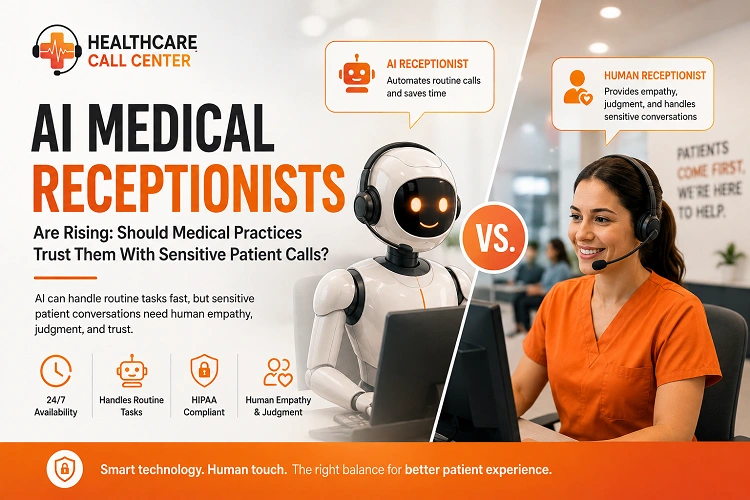
AI medical receptionists are becoming one of the most talked-about trends in healthcare operations.
The promise is easy to understand. AI can answer quickly. AI can work around the clock. AI can handle repetitive questions, appointment requests, reminders, and intake workflows. For medical practices struggling with staffing gaps and constant phone volume, that sounds attractive.
But patient calls are not ordinary customer service calls.
A patient may be worried, embarrassed, confused, frustrated, or in pain. A caller may ask about symptoms, medication, pregnancy concerns, surgery recovery, insurance, scheduling, or urgent next steps. Sometimes the most important part of the call is not the question itself. It is the tone, hesitation, and context behind it.
That is where the AI conversation becomes more complicated.
AI medical receptionists may help with certain tasks, but medical practices should be careful before trusting automation with every patient call. Sensitive communication still requires human judgment, empathy, privacy awareness, and clear escalation rules.
This article explains where AI medical receptionists may fit, where human support still matters, and what practices should check before changing how patient calls are handled.
Why AI Medical Receptionists Are Getting Attention
Medical practices are under pressure.
Front desk teams are busy. Hiring is expensive. Patients expect fast responses. Calls arrive during check-in, lunch breaks, staff shortages, provider schedule changes, and after-hours windows. Many practices are trying to answer more calls without adding more full-time staff.
AI tools promise to help with that pressure.
Common AI receptionist features include:
- Answering routine calls
- Capturing patient information
- Scheduling or routing requests
- Sending reminders
- Answering common questions
- Supporting intake workflows
- Reducing hold time
- Offering 24/7 availability
These features can be useful, especially for repetitive administrative tasks.
But the rise of AI does not remove the need for thoughtful patient communication.
It raises a new question: which calls are safe to automate, and which calls still need a trained human response?
Patient Calls Are Not All the Same
One mistake practices make is treating every inbound call as the same kind of task.
Some calls are simple. A patient may ask for office hours, directions, or basic appointment availability. Those calls may be easier to automate or route through structured workflows.
Other calls are more sensitive.
A patient may say:
- I am worried about this symptom.
- I need to speak with someone about my test results.
- I am in pain after a procedure.
- I am pregnant and not sure what to do.
- I need to reschedule, but I am upset about the delay.
- I am confused about what the doctor told me.
- I do not want to explain this more than once.
These calls require more than speed.
They require listening, tone, escalation judgment, and a call flow that protects patient trust.
A medical answering service should do more than take messages. It should help the practice answer patient calls, capture the right information, route messages appropriately, and follow the practice’s approved workflow.
Where AI Medical Receptionists Can Help
AI can be useful when the task is structured, repetitive, and low-risk.
For example, AI may help with:
- Basic appointment request intake
- Office hours questions
- Reminder calls or texts
- Simple routing prompts
- Frequently asked administrative questions
- Collecting non-urgent callback information
- Helping reduce hold time during call spikes
In these situations, AI can support efficiency.
The key is not whether AI can answer a phone. The key is whether the call type is appropriate for automation.
Medical practices should avoid using AI as a blanket replacement for all patient communication. A better approach is to define where automation helps and where human support should remain in the loop.
Where Human Call Handling Still Matters
Human support becomes especially valuable when calls involve sensitivity, uncertainty, emotion, or situations that require escalation.
Patients do not always explain their needs in clean categories. They may start with a simple scheduling question and then reveal a concern. They may sound calm but be anxious. They may not know whether their issue is urgent. They may need confidence that their concern has been heard, documented correctly, and routed to the right person.
Human call handling is especially important for:
- OB-GYN calls
- Fertility clinic calls
- Plastic surgery consultation inquiries
- Dental pain or after-hours calls
- Chiropractic same-day appointment requests
- Post-procedure concerns
- Mental health practice calls
- Multi-location routing confusion
- Complaints or frustrated callers
A trained human can notice context, slow down, clarify the request, and follow the practice’s escalation rules.
That does not mean AI has no role. It means sensitive patient calls should not be treated as generic automation tasks.
HIPAA and Privacy Must Be Reviewed Carefully
Medical practices should be cautious with any phone support tool that touches patient information.
AI tools may capture, process, store, transcribe, or route patient details. That creates privacy and compliance questions the practice must understand before adopting the system.
Before using an AI medical receptionist, ask:
- What patient information is collected?
- Where is the information stored?
- Who can access call data?
- Is there a business associate agreement if needed?
- How are call recordings or transcripts handled?
- Can the practice control scripts and escalation rules?
- How are errors reviewed?
- What happens if the AI misunderstands the caller?
Practices should also compare AI tools against HIPAA-compliant medical answering service processes to understand what level of control, documentation, and privacy support they need.
HIPAA is not a marketing phrase. It is an operational responsibility. The U.S. Department of Health & Human Services (HHS) explains that the HIPAA Privacy Rule establishes national standards for protecting individually identifiable health information.
AI Can Create Patient Experience Risks
Patients may accept automation for simple tasks. But they may lose trust if automation creates friction during sensitive moments.
Common risks include:
- The patient feels unheard.
- The AI misunderstands the request.
- The call is routed incorrectly.
- The patient repeats information multiple times.
- The patient cannot reach a human quickly.
- Urgent context is missed.
- The practice appears impersonal.
In healthcare, trust matters. A patient calling a medical office is not always looking for the fastest response. Sometimes they are looking for the right response.
This is why US-Based healthcare call center services for patient retention should be evaluated by more than answer speed. Practices should also consider call quality, routing accuracy, patient experience, escalation handling, and follow-through.
AI vs Human Medical Receptionist: The Practical Difference
Here is the simplest way to think about it.
| Call Type |
AI Medical Receptionist |
Human Medical Receptionist |
| Office hours and directions |
Good fit |
Can handle |
| Simple appointment requests |
Good fit with defined workflow |
Can handle |
| Routine reminders |
Good fit |
Can handle |
| New patient inquiries |
May need human escalation |
Strong fit |
| Sensitive patient concerns |
Human escalation recommended |
Strong fit |
| Emotional or frustrated callers |
Limited context |
Strong fit |
| Urgent or unclear calls |
Requires escalation rules |
Strong fit |
| Complex specialty calls |
Human support recommended |
Strong fit |
| After-hours coverage |
Can assist with defined workflows |
Strong fit when judgment is needed |
AI is strongest when the call is predictable. Humans are strongest when the call is personal.
A predictable call has a clear path. The caller needs office hours, directions, appointment availability, or a simple message.
A personal call has emotion, urgency, complexity, or uncertainty. The caller may need careful listening, reassurance, escalation, or a judgment-based next step.
Practices comparing different answering models can also review our guide to medical answering services in 2026, which compares healthcare-specialized, generic, and AI-powered answering options.
Most medical practices receive both kinds of calls every day.
That means the best model may not be AI-only or human-only. It may be a structured call handling system that uses technology where it helps while keeping human support available for the calls that matter most.
What Practices Should Check Before Using AI for Patient Calls
Before using AI medical receptionist tools, practices should complete a basic review.
1. Call Types
List which calls are safe for automation and which should go to a human.
2. Escalation Rules
Define when a call should be routed to staff, the on-call provider, or the next business day queue.
3. Privacy Controls
Review how patient information is collected, stored, transmitted, and accessed.
4. Patient Experience
Test whether callers can easily reach a human when needed.
5. Error Handling
Decide who reviews misunderstood calls, incomplete messages, and routing mistakes.
6. Specialty Needs
Decide whether certain specialties need more human support because of patient sensitivity.
7. After-Hours Coverage
Review whether after-hours calls require a live answering process, escalation rules, or a hybrid workflow.
A practice should not adopt AI because it sounds modern. It should adopt tools only where they improve patient access without weakening trust.
How Human Answering Support Fits Into the AI Era
The rise of AI does not make human answering support less important.
It makes the role more specific.
Human call support is valuable when the practice needs:
- Empathy in the first conversation
- Better intake for high-value appointments
- Clear message capture
- Escalation based on practice rules
- After-hours call handling
- Front desk overflow support
- Specialty-specific call flows
- A calm voice for anxious callers
A medical virtual receptionist can help practices answer more patient calls without overloading the front desk. The value is not only coverage. It is patient-aware communication.
For sensitive healthcare calls, that difference matters. For practices dealing with persistent front-desk workload and missed calls, see how call center outsourcing can reduce staff burnout and missed calls.
A Practical Hybrid Model for Medical Practices
For practices that use both AI and human support, the key is defining exactly which calls each system handles and when a human takes over.
AI may help with simple routing, reminders, and structured administrative prompts. Human answering support should remain available for sensitive conversations, unclear requests, specialty inquiries, and calls that may affect patient trust.
A practical hybrid model can look like this:
- AI supports basic routing and repetitive questions.
- Human agents handle new patient inquiries and sensitive calls.
- Staff receive clean messages with the right context.
- Urgent calls follow practice-approved escalation rules.
- After-hours calls are answered instead of being left to voicemail.
This approach protects efficiency without making the patient feel abandoned inside an automated system. It also gives the practice more control over risk.
Medical practices should remember that automation is only helpful when it improves the patient journey. If AI creates confusion, delays, or distrust, the practice may save time in one area while losing patients in another.
Final Takeaway
AI medical receptionists are rising because medical practices need more call coverage, faster response times, and relief from front desk overload.
But patient calls are not all the same.
Some tasks may be appropriate for automation. Others still require human judgment, empathy, and careful routing. Practices should not ask AI to handle every patient conversation without first reviewing call types, privacy risks, escalation rules, and patient experience.
The strongest approach is selective. Use technology where it improves efficiency, and keep human support where sensitivity, context, trust, and escalation matter most.
Healthcare Call Center helps medical practices answer more calls, reduce front desk overload, support after-hours communication, and keep human support available when patient conversations require more than automation.
Book a Free Consultation to review your current call coverage and determine where AI, human support, or a combination of both may fit your practice.
Frequently Asked Questions
1. What is an AI medical receptionist?
An AI medical receptionist is a phone or messaging tool that uses automation to answer calls, collect information, route requests, schedule appointments, or respond to common patient questions.
2. Can AI medical receptionists replace human receptionists?
AI may help with routine tasks, but it should not automatically replace human support for sensitive patient calls, urgent concerns, emotional conversations, or complex routing needs.
3. Can AI and human medical receptionists work together?
Yes. A practice can use AI for approved routine tasks such as basic routing, reminders, and simple administrative questions while directing sensitive, unclear, urgent, or complex calls to trained human support. The practice should define clear escalation rules and regularly review how the system performs.
4. Are AI medical receptionists HIPAA compliant?
Some vendors may offer HIPAA-supporting features, but practices must verify privacy controls, data storage, access rules, business associate agreements, transcripts, and call handling workflows before using any tool.
5. When should a medical practice use human call handling instead of AI?
Human call handling is better for sensitive calls, specialty practice inquiries, after-hours concerns, urgent routing, frustrated patients, and calls where tone or context matters.
6. What is the safest way to use AI for patient calls?
The safest approach is to define which calls AI can handle, keep human escalation available, review privacy requirements, test caller experience, and monitor errors or incomplete messages.
by Erika Sanchez | Aug 17, 2026 | Structured Call Handling in Healthcare Practices
A patient call is never just a call inside a medical practice.
It may be a new patient trying to book a consultation. It may be a worried parent asking whether a symptom needs attention. It may be a fertility patient calling after an emotional treatment update.
It may be a plastic surgery lead comparing providers before choosing where to spend thousands of dollars. It may be an OB-GYN patient with a sensitive question she does not want to repeat twice.
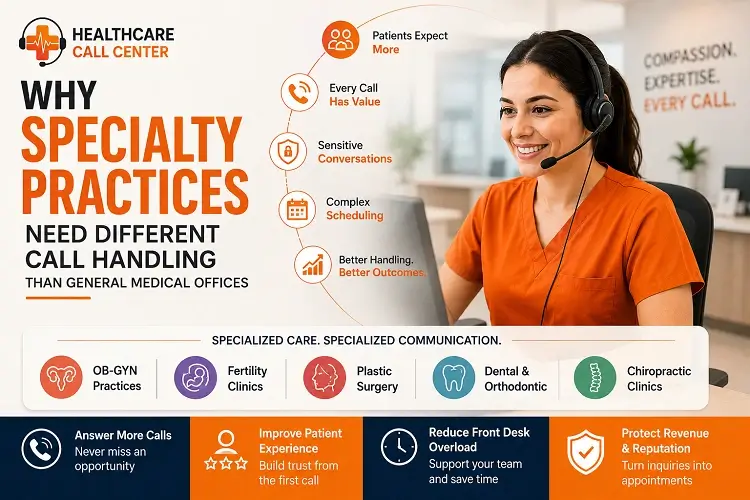
For a general medical office, call handling is already important. But for specialty practices, it becomes even more critical.
Specialty practices often deal with higher patient anxiety, higher appointment value, more emotional decision-making, more complex scheduling, and more sensitive communication. That means the way calls are answered, routed, documented, and followed up cannot be treated like a basic front-desk task.
A specialty clinic does not need generic phone coverage. It needs call handling that understands the difference between a routine message, a high-intent appointment request, an urgent concern, and a patient who may choose another provider if the first call feels cold or rushed.
That is where better call handling becomes a growth, trust, and patient-experience advantage.
What Makes Specialty Practice Calls Different?
Specialty practices receive calls that carry more context than general appointment requests.
A patient calling a primary care office may ask about availability, insurance, lab results, or a routine concern. Specialty practices handle those calls too, but they also deal with patients who may be nervous, confused, embarrassed, or deciding between multiple providers.
Common specialty practice calls include:
- New consultation requests
- Procedure questions
- Insurance and financing questions
- Referral questions
- After-hours concerns
- Follow-up scheduling
- Pre-appointment questions
- Post-procedure messages
- New patient intake calls
- Callbacks after marketing inquiries
The caller may not be ready to book immediately, but the call still matters. A rushed answer or voicemail can break trust before the patient ever visits the office.
This is why specialty practices need call handling that is more patient-aware, more structured, and more conversion-focused than basic call answering.
Specialty Calls Often Have Higher Revenue Impact
In many specialty practices, one missed call can represent a much larger opportunity than a routine appointment.
For example:
- A fertility clinic may receive calls from patients comparing IVF providers.
- A plastic surgery practice may receive consultation inquiries from patients ready to book.
- An OB-GYN practice may receive calls from pregnant patients who need reassurance and fast routing.
- A dental or orthodontic practice may receive new patient calls driven by local search or paid ads.
- A chiropractic clinic may receive same-day pain-related appointment requests.
When these calls go unanswered, the cost is not only operational. It can affect revenue, patient acquisition, marketing ROI, and long-term patient relationships.
Specialty practices often invest heavily in SEO, Google Ads, referral relationships, and reputation. But if the phone is not answered when interest is highest, that marketing spend leaks out of the business.
A strong medical answering service helps protect those opportunities by making sure patient calls are answered, captured, and routed according to the practice’s rules.
General Call Handling Is Too Basic for Specialty Clinics
Basic call handling usually focuses on one thing: answer the phone and take a message.
That may be enough for a low-context business call. It is not enough for specialty healthcare.
Specialty practices need more than message-taking.
They need call support that can:
- Identify the type of caller
- Capture the right information
- Follow practice-specific instructions
- Understand which calls need urgent routing
- Support appointment requests
- Reduce voicemail gaps
- Protect patient privacy
- Keep communication consistent
- Help callers feel heard, not processed
A generic answering service may treat every call the same. But a specialty practice cannot afford that.
A fertility call should not feel like a dental call. A plastic surgery consultation inquiry should not be handled like a billing question. A best OB-GYN answering service should not sit in a general message queue.
The more specialized the practice, the more important the call flow becomes.
Patients Choose Specialty Providers Based on Trust
Specialty care is personal.
Patients are not only choosing a provider based on credentials. They are also judging how the practice feels from the first interaction.
That first interaction is often a phone call.
If the caller hears voicemail, waits too long, gets transferred too many times, or speaks with someone who sounds rushed, the practice may lose trust before the appointment is booked.
This is especially true in specialties where patients are making emotional or high-value decisions.
A caller may be thinking:
- Will this practice take my concern seriously?
- Can I trust them with something this personal?
- Do they sound organized?
- Will they call me back?
- Is this the kind of office I want handling my care?
The person answering the phone influences those answers. That first interaction is part of the broader patient experience, which is why consistent call handling can have an impact beyond simply answering the phone.
That is why 24/7 medical call center services for specialty practices should not feel robotic or generic. For specialty practices, the goal is not just to answer more calls. The goal is to create a calmer, more reliable first impression.
Specialty Practices Need Clear Call Routing Rules
Call routing matters more in specialty care because not every message should be handled the same way.
Some calls are simple appointment requests. Some need a callback from the front desk. Some need clinical review. Some need after-hours escalation. Some should be documented for the next business day.
Without clear call routing, staff can become overwhelmed, patients may wait too long, and urgent messages can get mixed into routine queues.
A better call handling system should define:
- Which calls are urgent
- Which calls go to the on-call provider
- Which calls go to scheduling
- Which calls can wait until business hours
- Which information must be collected
- Which scripts or disclaimers should be used
- Which calls require special handling by specialty
This helps protect both the patient and the practice.
For example, an after-hours medical answering service should not simply collect names and phone numbers. It should follow the practice’s instructions for routing and documenting after-hours messages.
Front Desk Teams Are Already Overloaded
Many specialty practices expect the front desk to handle everything.
They check in patients. They answer phones. They manage schedules. They verify insurance. They respond to provider requests. They handle patient questions. They support callbacks. They deal with walk-ins. They manage last-minute cancellations.
Then the phone rings again.
Even a strong front desk can miss calls during peak hours. Lunch breaks, staff shortages, patient check-ins, and appointment rushes create gaps. Those gaps often become voicemail.
A front desk overflow answering service helps reduce that pressure by covering calls when the in-office team cannot answer quickly.
For specialty practices, this is not just a convenience. It can protect high-value patient inquiries and reduce staff burnout.
Specialty Practices Need Better Intake Consistency
In specialty healthcare, the details matter.
A caller may need to share:
- Reason for visit
- Referral status
- Insurance details
- Preferred appointment time
- Procedure interest
- Symptoms or concerns
- Existing patient status
- Best callback number
- Location preference
- Urgency level
If this information is incomplete, the practice may need extra callbacks. That slows down scheduling and creates friction for the patient.
Consistent call handling helps the practice capture the right information the first time.
This is especially important for multi-location groups, specialty clinics with multiple providers, and practices with different appointment types. A new patient consultation may require a different process than a follow-up appointment. A surgical consult may require different intake than a routine office visit.
The better the intake process, the smoother the patient journey.
After-Hours Calls Are More Sensitive for Specialty Practices
After-hours calls are different.
Patients calling after hours may be anxious. They may not know whether their concern can wait. They may be dealing with symptoms, discomfort, post-procedure questions, pregnancy concerns, or medication confusion.
A voicemail message does not always give them confidence.
Specialty practices need after-hours call handling that gives patients a clear path. Practices evaluating this type of coverage can also review the benefits of an after-hours medical answering service.
The goal is not to replace clinical judgment. The goal is to answer the call, collect the right information, and route the message according to the provider’s rules.
This is why after-hours support is especially valuable for:
- OB-GYN practices
- Fertility clinics
- Plastic surgery practices
- Dental practices
- Chiropractic clinics
- Dermatology offices
- Orthopedic groups
- Mental health practices
Every specialty has different patient expectations. The call handling process should reflect that.
A Florida chiropractor answering service can help clinics handle pain-related appointment requests, callbacks, and after-hours messages without overloading the front desk.
What Good Specialty Practice Call Handling Should Include
Specialty practice call handling should be structured, documented, and aligned with the practice’s workflow.
At minimum, it should include:
1. Practice-Specific Call Scripts
The caller should not feel like they reached a generic answering line. The call flow should match the specialty, the practice tone, and the type of patient inquiry.
2. Appointment Request Capture
New patient calls should be captured clearly, especially when the caller is ready to book or wants a consultation. Consistent appointment scheduling support helps reduce delays between the initial inquiry and the next available step.
3. Urgent Message Routing
The answering team should know when a call needs immediate escalation based on the practice’s rules.
4. Front Desk Overflow Coverage
The system should support the in-office team during peak call times, lunch breaks, staff gaps, and busy clinic hours.
5. After-Hours Support
Patients should have a reliable path after the office closes, especially in specialties where after-hours concerns are common.
6. HIPAA-Aware Processes
Patient communication must be handled carefully. Practices should verify that vendors understand healthcare privacy expectations and can support HIPAA-compliant medical answering service workflows.
The U.S. Department of Health & Human Services explains that the HIPAA Privacy Rule establishes national standards for protecting individually identifiable health information.
7. Clear Documentation
Messages should be captured in a way that helps staff act quickly and avoid confusion.
Specialty Call Handling Is Not Just an Operations Fix
Better call handling helps the practice in several ways.
It can:
- Reduce missed calls
- Improve patient trust
- Capture more appointment requests
- Reduce front desk pressure
- Improve follow-up speed
- Support marketing ROI
- Strengthen after-hours communication
- Protect high-value patient inquiries
- Create a more professional first impression
For specialty practices, phone support is part of the patient experience. It is also part of growth.
If a practice is investing in SEO, referrals, ads, reviews, or local visibility, it needs a call handling process that protects that investment.
For a closer look at the connection between unanswered calls and revenue, see how a medical answering service protects revenue and reduces missed calls.
A patient who cannot reach your practice today may simply choose another provider instead of calling back tomorrow.
When Should a Specialty Practice Consider Outside Call Support?
A specialty practice should consider outside call support when:
- Calls are going to voicemail during business hours
- Staff are overwhelmed by phone volume
- New patient inquiries are not being followed up quickly
- After-hours calls are inconsistent
- Marketing leads are not converting into appointments
- Multi-location scheduling is becoming harder to manage
- The front desk is stretched between in-person patients and phone calls
- Patients complain about callback delays
- The practice is growing but not ready to hire more staff
Outside call support does not have to replace the front desk. In many cases, it works best as overflow, after-hours, or appointment-support coverage.
The goal is simple: make sure patients reach a calm, trained person when they call.
Final Takeaway
Specialty practices do not need generic call answering.
They need call handling that understands patient sensitivity, appointment value, urgency, scheduling complexity, and front desk pressure.
General medical offices need reliable communication. Specialty practices need that and more. They need a system that protects patient trust from the first call, supports staff during busy hours, and helps convert high-intent inquiries into booked appointments.
If your specialty practice is missing calls, relying too heavily on voicemail, or asking the front desk to handle more than it can realistically manage, it may be time to improve your patient call handling process.
Healthcare Call Center helps specialty practices answer more calls, reduce front desk overload, support after-hours communication, and protect high-intent appointment opportunities.
Specialty Practice Call Handling FAQs
1. Why do specialty practices need different call handling?
Specialty practices often handle more sensitive, higher-value, and more urgent patient calls than general medical offices. They need call handling that supports appointment requests, urgent routing, after-hours messages, and patient trust.
2. How is specialty call handling different from a general medical answering service?
Specialty call handling uses practice-specific scripts, intake requirements, routing rules, and escalation instructions based on the type of care being provided. This helps ensure that new consultations, procedure questions, after-hours concerns, and specialty-specific patient needs are handled according to the practice’s workflow.
2. What types of specialty practices benefit from medical answering support?
OB-GYN practices, fertility clinics, plastic surgery practices, dental offices, chiropractic clinics, dermatology practices, orthopedic groups, and mental health practices can all benefit from structured call handling and overflow support.
3. Can a medical answering service help with front desk overflow?
Yes. A medical answering service can help answer calls when the front desk is busy, short-staffed, on lunch, or helping patients in the office. This reduces voicemail gaps and helps capture more appointment opportunities.
4. Is after-hours call handling important for specialty practices?
Yes. Many specialty patients call after hours with questions, concerns, or appointment needs. After-hours call handling helps make sure those calls are answered and routed according to the practice’s instructions.
5. How does better call handling help specialty practices grow?
Better call handling helps specialty practices answer more patient calls, capture more appointment requests, improve patient trust, reduce staff overload, and protect the value of marketing and referral traffic.
by Erika Sanchez | Aug 14, 2026 | OB-GYN Answering Service
OB-GYN practices receive some of the most sensitive calls in healthcare. A patient may be newly pregnant and anxious. Another may be calling about bleeding, pain, a medication question, a fertility concern, a postpartum issue, or a missed appointment. Some calls are routine. Some feel urgent to the patient. All of them require a calm, professional response.
The problem is that most women’s health clinics are already stretched thin. The front desk is handling check-ins, insurance questions, provider messages, prescription requests, scheduling changes, and patients standing in front of them. When the phone keeps ringing, calls slip to voicemail. When calls slip to voicemail, appointment opportunities, patient trust, and urgent messages can get delayed.
A medical answering service for OB-GYN practices gives women’s health clinics a structured way to answer more patient calls, support after-hours coverage, reduce voicemail gaps, and route messages based on practice-approved instructions. It does not replace the clinical team. It supports the patient communication workflow so the practice can stay responsive without overloading staff.
Women’s health practices often need specialty healthcare call support because patient calls can be sensitive, urgent, or appointment-related.
Why OB-GYN Patient Calls Are Different
OB-GYN calls are not the same as general business calls. The caller may be dealing with pregnancy symptoms, fertility stress, abnormal bleeding, birth control questions, prenatal scheduling, postpartum concerns, or test follow-up anxiety. The tone of the call matters. The speed of response matters. The accuracy of the message matters.
Patients in women’s health often need to know that someone has heard their concern, captured the right details, and can route the message appropriately. A voicemail box does not provide that reassurance. A voicemail box does not provide that reassurance.
This is why an OB-GYN answering service needs more than polite call handling. It needs healthcare-specific scripting, privacy-aware workflows, escalation rules, and a clear understanding that the patient experience begins before the appointment ever happens.
The Agency for Healthcare Research and Quality (AHRQ) identifies timely appointments, access to information, and communication with clinicians and staff as important parts of the patient experience.
The Front Desk Problem in Women’s Health Clinics
Most OB-GYN front desks are not missing calls because they are careless. They are missing calls because the workload is too high. A single receptionist may be expected to answer phones, greet patients, manage forms, verify insurance, communicate with providers, process appointment changes, and handle patient callbacks at the same time.
During peak hours, the phone can become impossible to manage. Calls come in before work, during lunch, after school pickup, after 5 PM, and on weekends. Patients may wait on hold, leave voicemail, or hang up and try another practice.
For a women’s health practice, this creates several risks:
- New patient inquiries may never become booked appointments
- Pregnancy-related messages may be delayed or poorly documented
- Cancellations may not be seen until the schedule has already been affected
- Front desk staff may start the day with a backlog of voicemails
- Patients may feel ignored during sensitive moments
A structured answering service reduces that pressure by giving the practice a second layer of call coverage when the front desk is busy, closed, or unavailable.
How a Medical Answering Service Supports OB-GYN Practices
A medical answering service helps OB-GYN practices by answering patient calls, documenting key details, routing urgent messages, and organizing routine requests for follow-up. The service should follow the practice’s approved workflow, not a generic script.
Common OB-GYN call types include:
- New patient appointment requests
- Pregnancy confirmation and prenatal visit questions
- Appointment cancellations and reschedules
- Medication refill routing
- Postpartum callback requests
- Fertility and cycle-related questions
- Test result callback requests
- After-hours concerns that need escalation based on practice rules
The answering team should not diagnose, give medical advice, or decide what is clinically urgent. Instead, agents gather details, follow approved scripts, and route messages according to the practice’s escalation instructions. That distinction is important for both patient safety and staff efficiency.
After-Hours OB-GYN Calls Need a Clear Process
After-hours OB-Gyn calls are especially important for OB-GYN practices because patients may not know whether their concern can wait. A pregnant patient may be worried about symptoms. A postpartum patient may have a question after discharge. A patient undergoing fertility treatment may need to clarify instructions outside normal hours.
A strong after-hours OB-GYN answering service process does three things. First, it answers the call with a real person. Second, it collects the right information. Third, it routes the message based on the practice’s approved urgency rules.
This creates a better experience than voicemail. The patient knows their message was received. The practice gets a clearer call record. Providers are not interrupted by every routine question, but urgent messages are not buried in an inbox overnight.
OB-GYN Answering Service vs. Voicemail
Many women’s health clinics still rely on voicemail after hours or during busy call periods. Voicemail may seem simple, but it often creates more work for the office and more uncertainty for patients.
| Situation |
Voicemail |
OB-GYN Answering Service |
| New patient calls after work |
Patient may hang up or call another practice |
Live answer captures the inquiry and callback details |
| Pregnancy-related concern |
Patient leaves an incomplete message |
Agent follows script and routes based on practice rules |
| Cancellation or reschedule |
Office may not see it until the next day |
Request is documented clearly for follow-up |
| Front desk overloaded |
Calls stack up during clinic hours |
Overflow coverage helps answer more calls |
| After-hours patient anxiety |
Patient waits without reassurance |
Live answer confirms the message was received |
| Provider escalation |
Voicemail may delay urgent routing |
Escalation rules help route the right calls |
How Answering Support Helps Capture More Appointments
OB-GYN practices depend on timely appointment scheduling. New patient calls, prenatal appointment requests, annual exam requests, follow-up visits, fertility-related appointments, and postpartum appointments all affect revenue and patient continuity. When these calls go unanswered, the practice may lose the appointment before the team even knows the patient called.
A medical answering service helps protect these opportunities by making sure calls are answered and documented. Even when the final scheduling step happens during office hours, the inquiry is captured while the patient’s intent is fresh.
This matters because patients often search and call several providers in one session. If your practice is investing in SEO, referrals, or paid campaigns, every missed phone call weakens that investment. Call coverage helps convert patient demand into real appointments.
Want to estimate the potential impact of missed calls on your practice? Use our Missed Call Revenue Calculator to estimate appointment and revenue opportunities.
HIPAA-Conscious Call Handling Matters
OB-GYN calls can include sensitive health details. Any answering workflow must treat patient information carefully. That means secure message handling, appropriate access controls, clear documentation, and practice-approved routing procedures.
A healthcare-focused answering service should understand that privacy is not optional. Agents need to know what information to collect, what not to say, when to escalate, and how to document calls without creating unnecessary risk.
The U.S. Department of Health & Human Services (HHS) explains that the HIPAA Privacy Rule establishes national standards for protecting individually identifiable health information and requires appropriate safeguards for protected health information.
This is why OB-GYN practices should connect answering support with HIPAA-compliant medical answering service workflows instead of using a generic answering service that does not understand healthcare communication.
When OB-GYN Practices Should Consider Outsourced Call Coverage
Not every practice needs the same level of support. Some practices need after-hours answering only. Others need daytime overflow. Multi-provider women’s health groups may need both. The right setup depends on call volume, staffing pressure, appointment demand, and how often patients reach voicemail.
OB-GYN practices should consider outsourced call coverage when:
- The front desk regularly misses calls during clinic hours
- Voicemail volume is high every morning
- Patients complain about not reaching the office
- Providers receive messy or incomplete after-hours messages
- New patient demand is strong but appointments are not increasing
- The practice is expanding locations or adding providers
- The team needs better call documentation without hiring another full-time employee
Outsourcing does not mean giving up control. The practice still defines the script, escalation rules, message categories, and handoff process. The answering service simply supports that workflow when the in-house team cannot cover every call.
What to Look for in an OB-GYN Answering Service
Choosing the right provider matters. OB-GYN practices should avoid generic answering services that only take basic messages. Women’s health calls need a more careful process.
Look for a provider that offers:
- Healthcare-specific call handling experience
- Practice-specific scripts and greetings
- After-hours and overflow coverage
- Escalation rules for urgent messages
- HIPAA-conscious message handling
- Appointment request capture
- Clear call summaries for the office team
- Support for single-location and multi-location practices
- A setup process that learns your workflow before calls go live
The best answering service should feel like an extension of the practice. Patients should feel heard. Staff should receive cleaner information. Providers should see fewer unnecessary interruptions and fewer delayed urgent messages.
How Healthcare Call Center Helps OB-GYN Practices
Healthcare Call Center supports women’s health practices with OB-GYN answering service support, after-hours coverage, front desk overflow support, appointment request capture, and practice-specific message routing. Our team follows your approved scripts and communication rules so patient calls are handled consistently. Practices that need additional front-desk coverage can also explore medical virtual receptionist support.
The goal is simple: help your practice answer more calls, reduce voicemail gaps, protect patient trust, and support appointment growth without adding more pressure to the front desk.
Common Mistakes OB-GYN Practices Make With Call Coverage
1. Treating All Missed Calls as Routine
In OB-GYN care, some missed calls are routine, but others may involve sensitive symptoms, medication questions, scheduling urgency, or anxiety around pregnancy. A generic voicemail process does not help the practice separate routine messages from messages that need faster routing.
2. Assuming Online Forms Replace Phone Calls
Online booking helps, but many women’s health patients still want to talk to a person before choosing a provider. This is especially true for new pregnancies, fertility concerns, insurance questions, and visits that feel emotionally sensitive.
3. Pushing More Responsibility Onto the Front Desk
If the team is already handling check-ins, forms, insurance, provider messages, and patient callbacks, telling them to “answer more calls” does not solve the problem. It creates burnout and inconsistent patient communication.
The better approach is to build a layered call coverage system: the in-house team handles the front desk experience, and the answering team supports overflow, after-hours calls, and structured message capture.
Final Thoughts
OB-GYN practices cannot treat missed calls as a small front desk issue. In women’s health, a missed call can mean a missed appointment, a delayed message, a worried patient, or a lost opportunity to build trust.
A medical answering service for OB-GYN practices gives clinics a practical way to answer more calls, support patients after hours, route messages clearly, and protect the patient experience from the first phone call.
If your women’s health practice is losing calls to voicemail, book a free consultation to review your call flow and see where answering support can help.
Frequently Asked Questions
What is a medical answering service for OB-GYN practices?
A medical answering service for OB-GYN practices answers patient calls, documents messages, routes urgent concerns based on practice rules, and supports scheduling-related communication for women’s health clinics.
Can an OB-GYN answering service handle after-hours calls?
Yes. An OB-GYN answering service can answer calls after hours, collect patient details, follow approved scripts, and route urgent messages according to the practice’s escalation process.
Can the answering service give medical advice?
No. Non-clinical answering agents should not diagnose or give medical advice. They collect information, follow scripts, and route calls based on the practice’s instructions.
Does an OB-GYN answering service help with appointments?
Yes. Depending on the practice workflow, agents can capture appointment requests, cancellations, reschedules, and callback details so the office can follow up efficiently.
Is OB-GYN answering service support HIPAA compliant?
A healthcare answering provider should use HIPAA-conscious workflows, secure message handling, access controls, and practice-approved routing. Practices should confirm compliance requirements before launch.
Who needs OB-GYN answering service support?
OB-GYN practices that miss calls, receive after-hours patient concerns, struggle with voicemail backlogs, or need front desk overflow support can benefit from dedicated answering service coverage.
by Erika Sanchez | Aug 13, 2026 | Medical Answering Services
A busy medical front desk can only handle so much at once.
One patient is checking in. Another is asking about insurance. A staff member is trying to confirm tomorrow’s appointments. A provider needs a message relayed. Then the phone rings again.
That call may be a new patient. It may be a patient trying to reschedule before they become a no-show. It may be a worried parent, a post-procedure question, a referral source, or someone ready to book after comparing practices online.
When the front desk is already overloaded, the call often waits, rolls to voicemail, or gets rushed. That is where a virtual medical receptionist can help.
A virtual medical receptionist gives medical practices live call support without forcing the in-office team to carry every phone call, scheduling request, basic question, and overflow moment alone. For growing practices, it can be the difference between a phone system that creates friction and a patient communication process that keeps appointments moving.
What Is a Virtual Medical Receptionist?
A virtual medical receptionist is a trained remote receptionist who answers calls, supports appointment scheduling, captures patient details, routes messages, and helps medical offices manage front desk communication when the in-house team is busy, unavailable, or closed.
For practices that need broader live patient call coverage, a 24/7 medical answering service can extend this support across after-hours, overflow, appointment requests, and message routing.
Unlike a general business answering service, medical receptionist support has to understand the pace and sensitivity of healthcare calls. Patients may be anxious, confused, frustrated, or trying to make care decisions quickly. The call should feel organized, calm, and human.
For many practices, this support works alongside the existing front desk. It does not replace the practice team. It protects them from overload.
A strong virtual receptionist process can help with:
- New patient call capture
- Appointment request handling
- Front desk overflow during peak hours
- Lunch break and staff shortage coverage
- After-hours call support
- Basic routing and message intake
- Follow-up call handling when appropriate
- Reducing voicemail dependence
The goal is simple: answer more patient calls with less strain on the office team.
Why Medical Practices Are Looking for Virtual Receptionist Support
Medical practices are under pressure from both sides. Patients expect fast, helpful communication. Staff members are already stretched by check-ins, insurance questions, clinical coordination, scheduling changes, billing questions, and provider requests.
A missed call is rarely just a missed call. It can become a missed appointment, a delayed treatment plan, a frustrated patient, or a lost new-patient opportunity.
Patient access and experience are closely connected. AHRQ’s patient experience resources highlight how access to care and communication affect the way patients experience a healthcare organization. When phone access breaks down, the patient experience can decline before the visit ever happens.
The problem is not always that the front desk is doing something wrong. Often, the problem is capacity. The team is expected to handle more communication than the day realistically allows.
A virtual medical receptionist gives the practice a pressure-release valve. Calls can still be answered when the front desk is tied up. Patient information can still be captured. Scheduling requests can still move forward. Staff can focus on the patients standing in front of them without ignoring the patients calling in.
The Front Desk Overflow Problem
Front desk overflow is one of the biggest reasons practices consider virtual receptionist support.
Overflow happens when call volume exceeds what the in-office team can handle in real time. It often occurs during predictable windows: morning rush, lunch breaks, late afternoon callbacks, Monday call spikes, provider schedule changes, and post-holiday volume.
During these periods, even a well-trained front desk team may struggle to keep up. Calls stack up. Hold times increase. Voicemail fills. Staff members feel pressure to move faster, which can make the patient experience feel transactional.
This is where virtual receptionist coverage can support the existing workflow. Instead of forcing every call through the same overwhelmed desk, overflow calls can be answered by trained support that follows the practice’s instructions.
For practices dealing with this issue, dedicated front desk overflow support can help protect both staff capacity and patient access. The right setup makes the office feel more responsive without requiring the practice to immediately hire another full-time receptionist.
How a Virtual Medical Receptionist Helps Answer More Calls
The value of a virtual medical receptionist is not only that calls are answered. It is that calls are answered in a structured way that supports the practice’s goals.
For example, a new patient may call after seeing the practice on Google. If the call goes to voicemail, that patient may call the next provider on the list. If a trained receptionist answers, confirms the need, captures the right information, and guides the patient toward scheduling, the practice has a better chance of turning interest into an appointment.
A virtual receptionist can also help existing patients avoid delays. When patients need to reschedule, confirm an appointment, ask where to send documents, or leave a message for the care team, they should not feel ignored.
Common call-handling tasks include:
- Greeting callers professionally
- Capturing name, phone number, reason for call, and urgency
- Following practice-specific scripts
- Routing clinical or urgent calls based on instructions
- Supporting appointment requests when connected to the right workflow
- Sending messages to the correct office contact
- Reducing unnecessary voicemail use
For appointment-heavy practices, appointment scheduling support can be especially important. Patients who are ready to book should not be forced to wait until someone has time to return a voicemail. The closer the practice gets to live response, the more likely it is to protect demand when it appears.
Virtual Receptionist vs. Traditional Answering Service
Many practice owners hear “virtual receptionist” and “answering service” used together. They overlap, but they are not always the same.
A basic answering service may take messages and forward them. A virtual medical receptionist should feel more like an extension of the practice’s front desk. The difference is in training, scripting, call flow, tone, escalation, and how well the team understands healthcare communication.
For medical offices, the receptionist role is not only administrative. It is part of the patient journey. The person answering the phone may shape whether a patient books, waits, complains, cancels, or chooses another provider.
That is why medical practices should look for support that understands healthcare-specific needs, including patient privacy, call sensitivity, appointment intent, and proper routing.
Where Virtual Medical Receptionist Support Fits Best
Virtual receptionist support is useful for many types of medical practices, but it is especially valuable when call demand is unpredictable or when patient calls directly affect revenue.
It can fit well for:
- Primary care offices managing high daily call volume
- Specialty practices with consultation requests
- Dental offices with appointment and insurance questions
- OB-GYN and fertility practices where callers may be anxious
- Plastic surgery and med spa practices handling high-intent consultation calls
- Multi-location groups with inconsistent front desk capacity
- Practices that receive many calls during lunch, after hours, or staff transitions
The best use case is not always replacing staff. Often, the smartest use is protecting the team already in place.
How Virtual Receptionist Support Helps Staff
Front desk burnout is real. Receptionists are expected to be friendly, fast, accurate, calm, and available at all times. They handle patients in the office while also trying to answer every call. When the phone never stops ringing, even strong employees can become overwhelmed.
A virtual medical receptionist can reduce that pressure by taking overflow calls, handling routine intake, and keeping calls from piling up. This gives in-office staff more room to focus on patients who are physically present and tasks that require local knowledge.
Better support can also improve consistency. Instead of each staff member rushing through calls differently depending on how busy the day feels, calls can follow a documented process. That helps protect the patient experience and makes communication easier to manage.
HIPAA and Patient Privacy Considerations
Medical call support must be handled carefully. Any partner working with patient information needs to understand HIPAA-related responsibilities and follow privacy-conscious workflows.
HHS explains that the HIPAA Privacy Rule establishes national standards to protect individuals’ medical records and other personal health information. For practices, this means call handling cannot be treated like ordinary customer service.
Before choosing a virtual medical receptionist provider, practices should ask:
- Will the team follow HIPAA-conscious call-handling procedures?
- How are messages captured and delivered?
- Can calls be routed based on urgency and practice instructions?
- Are receptionists trained for sensitive patient conversations?
- Does the provider understand healthcare call workflows?
- Can the service support the practice without creating privacy or documentation risks?
The goal is not just answering more calls. The goal is answering calls responsibly.
Why Human Tone Still Matters
Patients do not always call medical offices at calm moments. They may be worried about symptoms, confused about next steps, nervous about a procedure, or frustrated because they could not reach someone earlier.
A rushed or robotic phone experience can make that frustration worse. A calm, human receptionist can make the practice feel more accessible and organized.
Healthcare Call Center is built around this idea. Our team is trained to bring empathy, patience, and structure to medical calls. Our stay-at-home mom agents are trained to bring empathy, patience, and structure to medical calls while following each practice’s scripts and escalation rules.
Patients do not want to feel processed. They want to feel heard.
Virtual Medical Receptionist vs. Hiring Another Full-Time Employee
Hiring another full-time receptionist can be the right move for some practices. But it is not always the first or only option.
A full-time hire brings payroll, training, management time, benefits, coverage gaps, turnover risk, and scheduling limitations. If the practice mainly needs help during peak call periods, lunch breaks, after-hours windows, or overflow spikes, virtual receptionist support may be more flexible.
The question is not simply “Should we hire or outsource?” The better question is: “Where are we losing calls, and what type of coverage solves that problem fastest?”
If the issue is in-office workflow, an internal hire may help. If the issue is missed calls, overflow, inconsistent answering, or after-hours demand, a virtual medical receptionist may give the practice faster relief.
Signs Your Practice May Need a Virtual Medical Receptionist
A practice may be ready for virtual receptionist support if any of these problems are happening regularly:
- Patients complain that they cannot reach the office
- Voicemail is being used as a default call-handling method
- Staff members are constantly interrupted by phone calls
- New patient calls are missed during busy windows
- Appointment requests are delayed
- No-shows increase because confirmations and reschedules are hard to manage
- The office is considering hiring, but only needs partial coverage
- After-hours calls are not being handled consistently
- Call volume spikes on Mondays, lunch breaks, and late afternoons
If the phone is becoming a bottleneck, virtual receptionist support may be worth evaluating.
How to Set Up Virtual Receptionist Support Correctly
The best results come from clear setup. A virtual receptionist should not be asked to “just answer calls” without direction. The more specific the workflow, the easier it is for a virtual receptionist to provide consistent support without making assumptions about clinical or scheduling decisions.
A strong setup should include:
- Call scripts for common patient scenarios
- Clear instructions for urgent vs. non-urgent calls
- Scheduling rules or routing instructions
- Message delivery preferences
- Office hours and after-hours procedures
- Names and roles of key contacts
- Instructions for new patient calls
- Fallback steps when the office is unavailable
The more specific the workflow, the better the patient experience.
How Healthcare Call Center Supports Medical Practices
Healthcare Call Center provides medical call support for practices that need more reliable patient communication without overloading the front desk. Our team helps answer calls, support scheduling workflows, manage overflow, and route messages based on each practice’s instructions.
For practices comparing different options, a dedicated medical answering service can provide broader coverage than a general receptionist solution. The goal is to help practices protect patient calls, reduce missed opportunities, and make the phone experience feel more consistent.
Healthcare Call Center also supports appointment-focused workflows, front desk overflow, after-hours needs, and specialty practices where empathy and careful communication matter.
If your practice is missing calls or your front desk is stretched too thin, the next step is to review where calls are being lost and what coverage would make the biggest difference.
Final Thoughts
A virtual medical receptionist is not just a convenience. For many practices, it is a practical way to protect patient access, support staff, and capture appointment demand that may otherwise be lost.
The front desk should not have to choose between helping the patient in front of them and answering the patient calling in. With the right support, both experiences can improve.
If your practice needs help answering more calls without overloading your team, Healthcare Call Center can help you build a call support plan around your real workflow.
Frequently Asked Question
What is a virtual medical receptionist?
A virtual medical receptionist is a trained remote receptionist who answers patient calls, captures information, routes messages, and supports appointment-related workflows for a medical practice. The service helps the front desk manage calls when staff are busy, unavailable, or closed.
How is a virtual medical receptionist different from a regular answering service?
A regular answering service may only take messages. A virtual medical receptionist should follow medical-office call flows, understand patient communication needs, support scheduling workflows when appropriate, and route calls based on practice instructions.
Can a virtual medical receptionist help with appointment scheduling?
Yes, if the practice sets up the right workflow. A virtual receptionist can help capture appointment requests, guide callers, route scheduling needs, and support appointment-related communication based on the practice’s process.
Is virtual receptionist support useful for front desk overflow?
Yes. Front desk overflow is one of the strongest use cases. When the in-office team is busy with check-ins, insurance questions, and patient flow, virtual receptionist support can help answer calls that might otherwise go to voicemail.
Does a medical virtual receptionist need HIPAA-aware procedures?
Yes. Medical calls may involve patient information, so call handling should follow privacy-conscious procedures. Practices should choose a provider that understands healthcare communication, message handling, escalation, and HIPAA-related responsibilities.
When should a practice consider a virtual medical receptionist?
A practice should consider virtual receptionist support when calls are being missed, voicemail is overused, staff is overloaded, appointment requests are delayed, or patient complaints about phone access are increasing.