by Erika Sanchez | Aug 27, 2026 | Medical Answering Services
Most medical practices do not need more traffic first. They need to stop losing the patient calls they already earn.
A patient finds your practice on Google. She reads the reviews. She checks the services page. Then she calls during lunch, after 5 PM, while the front desk is checking in patients, or when one team member is out sick. If that call goes to voicemail, sits on hold, or gets a rushed callback hours later, the marketing spend has already leaked.
That is why a patient call coverage audit should come before more SEO, ads, directories, or local campaigns. Before increasing demand, practices should know whether their existing call flow can consistently turn patient interest into conversations and appointments.
The blog shows where patient intent gets lost after the phone rings, and it helps your practice fix the conversion path before buying more demand.
Quick Takeaway
More rankings and more clicks only matter if your practice can answer, route, and convert the patient calls they create.
Book a Free Consultation
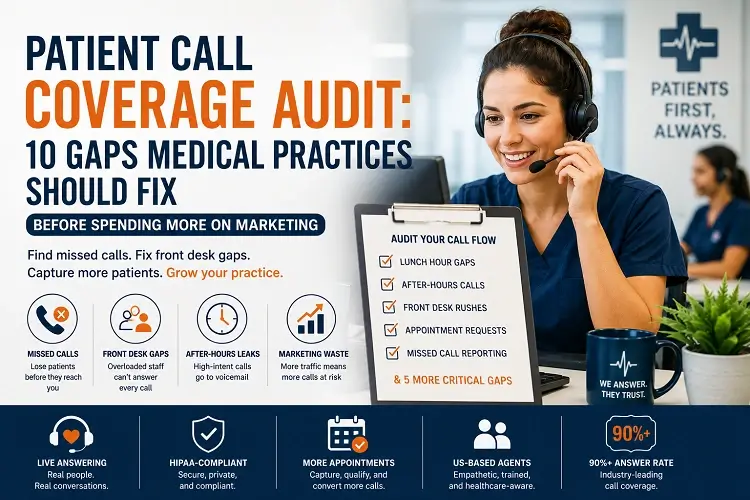
The 10 Patient Call Coverage Gaps to Check First
| Gap to Check |
What to Review |
| Lunch-hour calls |
Are calls answered when front desk staffing is thin? |
| After-hours calls |
Do patients reach voicemail after the office closes? |
| Front desk rushes |
Who answers when staff is helping patients in person? |
| New patient calls |
Are high-intent callers identified and prioritized? |
| Escalation rules |
Are urgent and routine calls routed differently? |
| Appointment requests |
Are scheduling details captured completely? |
| Bilingual needs |
Can patients get support in the languages your market needs? |
| Weekend calls |
What happens to calls received when the office is closed? |
| Missed-call reporting |
Can you see when and why calls are being missed? |
| Call handling quality |
Are patients reaching trained healthcare-aware agents? |
Why Patient Call Coverage Matters Before More Marketing Spend
Marketing creates demand. Patient call coverage captures demand. When those two systems are not aligned, the numbers can look confusing. Website traffic may rise, impressions may improve, and the phone may ring more often, but booked appointments can still feel flat.
For healthcare, the call is often the conversion point. A patient may not fill out a form when she is worried, in pain, pregnant, comparing providers, or trying to schedule between work meetings. She calls because she wants a clear next step. If no one answers, the practice may never know how close that patient was to booking.
A patient call coverage audit helps answer the question that marketing reports cannot answer on their own: are we converting the calls we already receive?
The 5 Highest-Impact Call Coverage Leaks to Check First
A full audit can go deep, but most practices find the biggest issues in five places.
| Where calls leak |
What fixes it |
| Lunch breaks |
Live overflow support during thin-staff windows |
| After 5 PM |
After-hours answering with clear escalation rules |
| Busy front desk |
Call backup when staff are helping in-office patients |
| Appointment requests |
Clean capture of appointment type, urgency, and next step |
| Reporting gaps |
Weekly call visibility by time, source, and reason |
If even two of these areas are weak, more marketing can make the problem worse. It sends more patients into a phone workflow that is not ready to capture them.
Audit question: What happens to new patient calls between 11:30 AM and 1:30 PM?
Gap 1: Medical Practices Miss Calls During Lunch Breaks
Lunch breaks are one of the most predictable call coverage gaps in healthcare. The front desk gets thinner at the same time patients are using their own lunch break to call doctors, dentists, specialists, and clinics.
This is not a staff-effort problem. It is a workflow problem. One person may be checking in patients, collecting forms, answering insurance questions, and trying to cover the phones. When the line rings twice at once, something has to give.
The audit should look at calls between 11:30 AM and 1:30 PM. If new patient calls are going to voicemail during that window, the practice is losing high-intent demand in a place that is easy to fix with front desk overflow support.
Audit question: What happens to new patient calls between 11:30 AM and 1:30 PM?
Gap 2: After-Hours Patient Calls Go to Voicemail
After-hours calls are not low-value calls. They are often the calls patients make when the need finally feels urgent enough to act. A patient may call after work, after symptoms worsen, after a child is asleep, or after comparing providers online.
Voicemail creates delay at the exact moment the patient wants reassurance. In competitive markets, that delay can send the patient to another practice, urgent care, or a competitor who answers live.
A strong after-hours medical answering service does not replace the clinical team. It answers live, collects the right details, follows escalation rules, and helps the patient understand the next step. That turns after-hours demand into a protected patient relationship instead of a missed opportunity.
Audit question: How many patient calls arrive after 5 PM, and what happens to those callers?
Gap 3: Front Desk Overflow Breaks the Patient Experience
The busiest in-office moments are often the busiest phone moments too. Patients arrive. Providers run behind. Insurance questions pile up. The phone rings. A new patient is on the line, but the front desk is helping someone standing in front of them.
This is where overflow call coverage matters. It gives the practice a safety layer during rush windows so callers still reach a real person. The goal is not to take control away from the front desk. The goal is to protect the calls the front desk cannot physically answer in the moment.
Conversion checkpoint
If your practice is getting traffic but the phone experience is inconsistent, fix the call path before increasing spend.
Book a Free Consultation
Audit question: When your front desk is helping patients in person, who protects the phones?
Gap 4: New Patient Calls Are Not Treated Like Conversion Moments
A new patient call should not be handled like a routine message. It is a buying moment, a trust moment, and often a competitive moment. The patient may be choosing between three practices in the same search session.
That call needs a cleaner capture process than “Patient called about appointment”. The person answering should collect the reason for visit, appointment type, urgency, preferred time, callback details, and the promised next step. Without that structure, the practice creates more callback work and gives the patient time to drift away.
Audit question: Does your team capture the reason for the visit, appointment type, urgency, preferred time, callback details, and next step?
Gap 5: Escalation Rules Are Not Clear Enough
Medical calls are not generic message-taking. Some are routine. Some are urgent. Some need same-day routing. Some should go to an on-call provider. Others can be documented for the next business day.
When escalation rules are not written clearly, call handling becomes inconsistent. This is especially relevant for specialty practices such as OB-GYN, fertility, behavioral health, dental, plastic surgery, and other practices where patient calls may require careful routing.
The audit should ask whether a trained agent could follow the practice workflow without guessing. If the answer is no, the problem is not the agent. The problem is the missing protocol.
Audit question: Could a trained agent follow your escalation rules without asking the front desk what to do every time?
Gap 6: Bilingual Patient Calls Are Not Covered
In many markets, bilingual support is not a nice extra. It is part of patient access. If Spanish-speaking patients cannot explain the need clearly, the practice can lose trust before the appointment is even booked.
This matters most after hours and during rush windows, when the front desk is unavailable or overloaded. A bilingual call coverage layer helps patients feel understood and helps the practice capture cleaner next-step information.
Audit question: What happens when a Spanish-speaking patient calls after hours or during a front desk rush?
Gap 7: Weekend Calls Wait Until Monday
Patients search for care at night, on weekends, and during holidays. They read reviews on Sunday. They compare providers after work. They call when pain, anxiety, pregnancy concerns, or scheduling needs finally feel urgent.
If those calls wait until Monday, some of those patients will not still be available. The practice that answers first often gets the appointment first. A weekend call coverage plan protects the demand your SEO and local visibility are already creating.
Audit question: How many weekend or holiday calls are currently waiting until the next business day?
Gap 8: Missed Calls Are Not Being Reported
You cannot fix what you cannot see. Many practices know when the phone feels busy, but they do not know how many calls are missed, when they are missed, which pages drive them, or which call reasons create the most leakage.
A basic report should show answered calls, missed calls, call windows, call reasons, appointment requests, urgent escalations, and follow-up tasks. Once the leak is visible, the fix becomes much easier to prioritize.
Practices can also use the missed call revenue calculator to estimate the potential impact of unanswered calls.
Audit question: Can your current answering team handle specialty-specific calls with the tone, terminology, and routing rules your practice requires?
Gap 9: Generic or Offshore Call Handling Can Hurt Patient Trust
Patient calls are emotional. A worried parent, a pregnant patient, a dental patient in pain, or a fertility patient waiting for answers does not want to feel processed by a distant script.
Generic and offshore call centers may answer the phone, but answering is not the same as protecting the patient relationship. Tone, cultural familiarity, pronunciation, empathy, and healthcare context all matter.
Healthcare Call Center uses US-based stay-at-home mom agents trained for healthcare call handling. That model helps patients feel heard while still following the practice workflow.
Audit question: If you increased your SEO or advertising leads by 25% tomorrow, could your current phone system answer and convert the additional calls?
Gap 10: The Practice Adds Marketing Before Fixing the Call Path
This is the most expensive gap. The practice sees a traffic problem, so it buys more ads, pushes more SEO, or adds more directory listings. But the real issue is what happens after the patient calls.
If lunch calls are missed, after-hours calls hit voicemail, and appointment requests are not captured cleanly, more marketing simply increases the number of calls at risk. The better move is to strengthen the call coverage system first, then scale demand into a workflow that can actually convert it.
How to Run a 15-Minute Patient Call Coverage Audit
Start with one week of call data. You do not need a complex operations project to find the biggest gaps.
- Pull call volume by hour and day.
- Mark missed, abandoned, and voicemail calls.
- Separate new patient calls from existing patient calls.
- Check lunch, after-hours, weekend, and Monday call volume.
- Review how appointment requests are documented.
- Check whether urgent calls have clear routing rules.
- Compare appointment-page traffic with booked appointments.
- Check whether bilingual support is needed.
- Review whether call volume changed after major SEO, advertising, or page launches.
- Estimate the potential impact of missed calls.
Audit checkpoint: If the practice is already investing in SEO, ads, directories, referrals, or local visibility, fix major call-coverage gaps before increasing demand.
What a Strong Patient Call Coverage System Looks Like
A strong call coverage system is not complicated. It is clear, reliable, and built around real patient behavior.
- Live answering during busy windows
- After-hours support when the office is closed
- Overflow support when the front desk is overloaded
- Clear escalation rules for urgent calls
- Clean appointment request capture
- Reporting that shows when calls leak
- Bilingual support where the market needs it
The best system does not make your front desk less important. It gives them US-based backup, protects patient experience, and makes the marketing investment easier to convert.
How Healthcare Call Center Helps Close These Gaps
Our HIPAA-compliant Healthcare Call Center services help medical practices protect the phone calls their marketing already earns. The service supports after-hours calls, front desk overflow, appointment requests, message routing, and high-intent patient inquiries with a 90%+ answer-rate guarantee.
The model is intentionally different from offshore script reading. HCC uses US-based stay-at-home mom agents who understand American patients, speak with empathy, and follow healthcare-specific workflows. Calls are handled with HIPAA-conscious processes, practice-specific scripts, and clear escalation rules.
The result is a stronger conversion layer: fewer voicemail gaps, better patient experience, cleaner message routing, and more appointment opportunities protected from the traffic your practice already worked to earn. The 90%+ answer-rate standard gives practices a clear coverage target they can monitor over time.
Before You Spend More on Marketing, Fix the Call Path
Before increasing SEO, advertising, or referral activity, make sure your practice can answer and convert the patient calls it already receives.
Book a Free Consultation to review your patient call coverage, missed-call risk, after-hours needs, and front desk overflow.
Final Thoughts
A patient call coverage audit helps medical practices find the real conversion leaks hiding behind marketing reports. It shows whether the practice is losing calls during lunch, after hours, during front desk rushes, on weekends, or inside weak follow-up workflows.
Once those gaps are fixed, every SEO ranking, ad click, referral, and local search visit has a better chance of becoming a real patient conversation.
Frequently Asked Questions
1. What is patient call coverage?
Patient call coverage is the system a medical practice uses to make sure patient calls are answered, routed, documented, and followed up across office hours, after-hours windows, busy periods, weekends, and staffing gaps.
2. Why should medical practices audit call coverage before spending more on marketing?
More marketing can create more calls, but it does not guarantee more booked appointments. If calls are missed, rushed, or poorly documented, the practice may lose patients even while traffic increases.
3. What are the most common patient call coverage gaps?
Common gaps include lunch-hour missed calls, after-hours voicemail, front desk overflow, unclear escalation rules, incomplete appointment request capture, no bilingual coverage, weak reporting, and generic or offshore call handling.
4. How does a medical answering service help with patient call coverage?
A medical answering service helps answer calls live, collect patient details, follow escalation rules, support appointment requests, route messages, and protect calls when the front desk is busy or the office is closed.
5. Are US-based agents better for medical patient calls?
US-based agents often provide stronger cultural familiarity, empathy, pronunciation, and patient trust than offshore script-based call handling. This is especially important for sensitive healthcare calls.
6. How long does a patient call coverage audit take?
A basic patient call coverage audit can start with one week of call data. Practices can review missed calls, call volume by time, voicemail activity, appointment requests, after-hours calls, and follow-up delays to identify the highest-impact gaps.
by Erika Sanchez | Aug 26, 2026 | After-Hours Call Answering Services
Patients do not only call medical practices between 9 AM and 5 PM.
They call after work. They call during lunch breaks. They call in the evening after talking with a spouse. They call on weekends after finally deciding to schedule. They call when they are anxious, comparing providers, or trying to understand the next step in their care.
For a healthcare practice, those after-hours calls matter.
Some calls are routine. Some are appointment requests. Some need careful message routing. Some need clear next steps based on the practice’s approved workflow. But when every after-hours caller reaches voicemail, the practice creates a gap between patient intent and patient response.
That gap can affect appointment volume, patient trust, referral follow-through, and the value of every marketing channel that sends people to the phone.
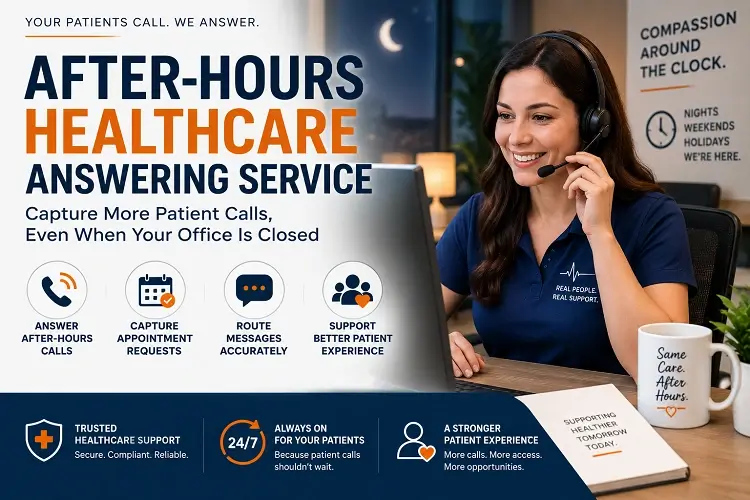
An after-hours healthcare answering service helps medical practices protect patient calls when the office is closed, the front desk is unavailable, or the team needs structured support outside regular business hours.
The goal is simple: make sure important patient calls are answered, captured, documented, and routed instead of disappearing into voicemail.
Why After-Hours Calls Matter for Healthcare Practices
After-hours patient calls often come from people who are already motivated to act.
A patient may have spent the day researching providers and finally decides to call in the evening. A parent may remember to schedule an appointment after the workday ends. A referral patient may call when they find the paperwork. A cosmetic or fertility patient may call after discussing the decision at home.
By the time they call, they may already be close to booking or taking the next step.
If that call reaches voicemail, the practice may still get the message. But the momentum changes. The patient has to wait. The practice has to call back. The caller may miss the return call. The conversation may stretch into another day.
That delay creates friction.
In a competitive healthcare market, friction matters. Patients often compare multiple providers, especially for specialty care, dental services, fertility clinics, plastic surgery, and chiropractic care. If one practice answers and another sends the caller to voicemail, the answering practice creates the stronger first impression.
Medical practice after-hours calls are often the highest-intent calls of the day, because the caller chose that exact moment to act. Reliable after-hours patient call support helps protect that moment.
The Problem With Relying Only on Voicemail
Voicemail is easy to set up, but it is not always a strong patient experience.
When a patient reaches voicemail, several things can happen:
- The patient may hang up without leaving a message.
- The message may be incomplete.
- The caller may not explain the real reason for the call.
- The practice may not know whether the call was urgent, appointment-related, or routine.
- The patient may call another provider before the office reopens.
- The front desk may start the next day with a backlog of unclear messages.
- Staff may spend time calling patients back without enough context.
Voicemail does not guide the patient. It does not ask follow-up questions. It does not capture appointment intent clearly. It does not support patient message routing by urgency or department. It simply asks the caller to leave a message and wait.
For some practices, that may be enough for low-priority calls. But for practices that depend on timely scheduling, patient trust, and clear communication, voicemail alone can create too much leakage.
A strong healthcare answering service gives practices a better option for patient calls that happen outside normal office hours.
What an After-Hours Healthcare Answering Service Does
An after-hours healthcare answering service provides live healthcare call answering support when the practice is closed or unavailable.
Depending on the practice’s workflow, after-hours answering can help with:
- New patient inquiries
- Appointment request capture
- Callback requests
- Reschedule requests
- Cancellation messages
- Referral-related calls
- Provider or department routing
- Location-specific messages
- After-hours message documentation
- Urgent message escalation based on practice-approved rules
This does not mean agents replace clinical staff or make medical decisions. They do not diagnose, advise, or decide what is urgent on their own. Instead, they follow the practice’s instructions.
The practice defines the call flow. The answering team follows it.
That structure matters because healthcare calls need more care than generic business calls. A patient may be anxious, frustrated, worried, or ready to schedule. The person answering needs to be calm, clear, and aligned with the practice’s process.
After-Hours Answering vs Front Desk Overflow
After-hours answering and front desk overflow are related, but they solve different problems.
After-hours answering supports the practice when the office is closed. This includes evenings, weekends, holidays, early mornings, lunch closures, or any time the front desk is not available.
Front desk overflow support supports the practice when the office is open, but the team is too busy to answer every call.
Many practices need both.
For example, a practice may miss calls:
- At 8:15 AM before the team is fully ready
- At 11:30 AM during a scheduling rush
- At 12:45 PM during lunch
- At 4:55 PM when staff are closing out the day
- At 6:30 PM when patients call after work
- On Saturday when someone is finally ready to schedule
If the practice only solves after-hours calls, it may still miss daytime overflow. If it only solves overflow, it may still lose evening and weekend opportunities.
A complete patient call coverage strategy looks at the full call journey, and a patient call answering service can cover both windows when the practice needs it.
Why Appointment Request Capture Is So Important After Hours
Not every after-hours call is urgent. Many are appointment-related.
Patients often call after hours because that is when they finally have time. They may be asking about availability, trying to schedule a consultation, following up on a referral, or checking whether the practice is the right fit.
If those calls go to voicemail, the practice may still get the message. But the appointment intent can weaken.
A live answering workflow can capture details such as:
- Patient name
- Best callback number
- New or existing patient status
- Reason for visit
- Preferred appointment type
- Preferred provider or location
- Best time to call back
- Referral or insurance note if approved by the practice
- Whether the message needs routine follow-up or faster routing
This makes next-day follow-up easier.
Instead of listening to vague voicemail messages, the front desk receives structured information. That helps the team prioritize callbacks, protect appointment requests, and reduce the chance of missing the patient again.
For practices that need more structured scheduling workflows, appointment scheduling support can help connect call answering with appointment request handling.
What Types of Practices Need After-Hours Healthcare Answering?
After-hours call support can help many medical practices, but it is especially useful for practices where patient calls carry high intent or sensitive context.
Strong fits include:
- OB-GYN practices
- Fertility and IVF clinics
- Plastic surgery practices
- Dental offices
- Chiropractic clinics
- Primary care offices
- Specialty practices
- Multi-location healthcare groups
- Practices investing in SEO or paid ads
- Practices with limited front desk capacity
- Practices with high voicemail volume
The common thread is simple: patients are calling because they need a response.
For specialty practices, the first call may shape trust before the patient ever walks in. A fertility patient, plastic surgery lead, OB-GYN patient, or pain-related chiropractic caller may need a more patient, human response than a voicemail greeting can provide.
After-hours support helps protect that first impression.
How After-Hours Call Coverage Supports Marketing ROI
Many practices think of call answering as an operations function. But it also affects marketing performance.
If a practice invests in SEO, Google Business Profile optimization, local service pages, referral partnerships, or content marketing, the phone becomes one of the most important conversion points.
A patient may read a page, check reviews, compare services, and then call. If that call happens after hours and goes unanswered, the practice may lose part of the value created by its marketing.
This is why after-hours call coverage should be part of conversion planning.
Better call coverage can help practices:
- Capture more appointment requests
- Reduce voicemail gaps
- Improve the patient response experience
- Support front desk teams
- Protect referral follow-through
- Improve next-day callback quality
- Reduce missed opportunities from marketing traffic
The goal is not just to answer more calls. The goal is to make sure patient demand does not leak at the phone.
What a Good After-Hours Healthcare Answering Workflow Should Include
A strong after-hours workflow should be clear, simple, and specific to the practice.
1. A Practice-Specific Greeting
Patients should feel like they reached the right place. A generic greeting can create confusion. A practice-specific greeting helps callers understand that their message will be handled through the practice’s process.
2. Clear Call Categories
The answering team should know how to categorize calls. For example:
- Appointment request
- Cancellation
- Reschedule
- Referral question
- Existing patient message
- New patient inquiry
- Location question
- Provider-specific message
- After-hours concern
This helps the practice receive better information.
3. Approved Message Capture Rules
The practice should define what information agents should collect. This prevents incomplete messages and reduces unnecessary back-and-forth the next day.
4. Routing Instructions
Messages should go to the right place. That may be a front desk inbox, scheduling team, provider team, on-call contact, location manager, or secure message workflow.
5. Escalation Rules
If certain types of calls need faster routing, the practice should define that clearly. Agents should not guess. They should follow the escalation instructions approved by the practice.
6. HIPAA-Conscious Handling
Healthcare calls require careful handling. Practices should use workflows that protect patient privacy and avoid unnecessary exposure of sensitive details.
7. Next-Day Follow-Up Process
After-hours answering is only useful if the practice has a follow-up process. Messages should be easy to review, prioritize, and respond to when the office reopens.
A good after-hours setup helps the practice start the next day with organized information instead of a voicemail backlog.
Common After-Hours Call Scenarios
Here are examples of calls an after-hours answering workflow may help capture.
New Patient Inquiry
A patient finds the practice online at night and calls to ask about becoming a new patient. A live answering team can capture the caller’s name, number, reason for calling, and preferred callback time.
Appointment Request
A patient wants to schedule but cannot call during office hours. The answering team can document the request so the scheduling team can follow up with context.
Reschedule or Cancellation
A patient realizes they cannot make an appointment. A live message helps the practice see the change sooner and protect the schedule.
Referral Follow-Up
A referred patient calls after receiving a recommendation. The answering team can capture the referral context and route the message properly.
Location or Provider Question
A caller may need help identifying the right office or provider. The answering team can document the question and direct the next step based on the approved workflow.
After-Hours Concern
Some callers need a message routed according to practice rules. The answering team should follow the practice’s escalation process without giving medical advice.
These situations show why after-hours answering needs structure. The call is not just a name and number. It often carries patient intent.
How After-Hours Support Helps the Front Desk
After-hours calls do not disappear when the office opens. They become next-day workload.
If the practice relies only on voicemail, the front desk may start the day by sorting through unclear messages, returning missed calls, trying to understand urgency, and chasing patients who may not answer.
After-hours answering can reduce that friction.
When messages are captured clearly, the team can see:
- Who called
- Why they called
- Whether they are a new or existing patient
- What they need next
- Which location or provider the message relates to
- When they prefer a callback
- Whether the message should be prioritized
This makes follow-up easier and helps the front desk start the day with better organization.
It also protects patients. Instead of wondering whether anyone heard their voicemail, they spoke with a real person and know the practice has their message.
When Practices Should Consider After-Hours Answering
A practice should consider after-hours answering if it notices any of these patterns:
- Voicemails pile up overnight or over weekends
- New patient calls come in after closing
- Patients say they had trouble reaching the office
- Marketing campaigns generate calls outside business hours
- Referral patients call after work
- The front desk starts the morning behind
- Appointment requests are delayed
- Staff spend too much time returning incomplete messages
- Multi-location messages are hard to route
- The practice wants better patient access without overloading staff
A practice does not need to hand off every call to start. Many begin with evening, weekend, lunch-break, or overflow windows, then expand based on call volume.
For example, a practice in a competitive local market may start with broader coverage through a medical answering service in Florida if patient demand is coming from search, referrals, or multiple service areas.
The best setup depends on the practice’s actual call patterns.
How Healthcare Call Center Helps With After-Hours Call Coverage
Healthcare Call Center helps practices answer more patient calls when the front desk is closed, busy, or unavailable.
Support can include:
- Live patient call answering
- After-hours message capture
- Appointment request capture
- Front desk overflow support
- Custom greetings and scripts
- Message routing by provider, location, or department
- Escalation based on practice-approved rules
- HIPAA-conscious documentation workflows
- Call-flow recommendations before launch
The goal is not to replace the front desk. The goal is to protect the patient call journey around the front desk.
When after-hours coverage is built correctly, patients get a live response, staff get better messages, and the practice reduces the risk of losing appointment intent to voicemail.
Practices that already handle daytime overflow can add structured evening and weekend coverage through an after-hours medical answering service built for medical offices.
For practices that want to review their call flow, book a free consultation and identify where patient calls may be leaking after hours, during overflow, or between front desk coverage windows.
Final Takeaway
After-hours patient calls are easy to underestimate.
A practice may assume most important calls happen during business hours. But patients often call when they have time, when they are anxious, when they are comparing providers, or when they are finally ready to schedule.
If those calls go to voicemail, the practice may still receive a message. But it may lose urgency, context, and appointment momentum.
An after-hours healthcare answering service helps solve that problem by giving patients a live response when the office is closed. It helps capture appointment requests, route messages, reduce voicemail gaps, and support the front desk before the next business day begins.
For growing healthcare practices, after-hours call coverage is not just a convenience.
It is part of patient access, retention, and conversion.
Frequently Asked Questions
What is an after-hours healthcare answering service?
An after-hours healthcare answering service answers patient calls when a medical practice is closed or unavailable. It can help capture appointment requests, document messages, route calls, and follow the practice’s approved after-hours workflow.
How does after-hours answering help medical practices?
After-hours answering helps practices reduce voicemail gaps, capture patient messages, support appointment requests, and organize follow-up before the next business day.
Is after-hours healthcare answering only for urgent calls?
No. Many after-hours calls are appointment requests, callbacks, reschedules, referral questions, or routine patient messages. The answering workflow should route each call based on the practice’s instructions.
Can an after-hours answering service capture appointment requests?
Yes. Agents can capture appointment intent, patient contact information, reason for calling, preferred callback time, provider preference, location needs, and other approved details.
Does after-hours answering replace the front desk?
No. It supports the front desk by covering calls when the team is closed, busy, or unavailable. The practice still controls the workflow, follow-up process, and routing rules.
by Erika Sanchez | Aug 25, 2026 | Healthcare Answering Services
A healthcare front desk can be busy even when the practice is running well.
Patients call to schedule appointments, reschedule visits, ask about referrals, confirm insurance, request directions, follow up on messages, or speak with the right department. At the same time, the front desk may be checking in patients, supporting providers, handling paperwork, managing in-office questions, and trying to keep the day moving.
That is where front desk overflow becomes a real patient access problem.
When calls stack up faster than the team can answer them, patients may wait too long, hang up, leave incomplete messages, or call again later with more frustration. For a healthcare practice, that is not just an operational issue. It affects appointment flow, patient experience, and the value of every marketing channel sending people to the phone.
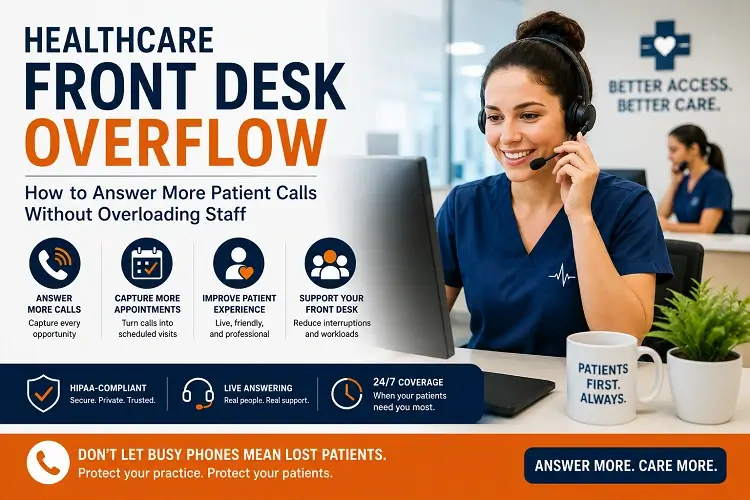
A strong healthcare answering service helps practices create a live answering layer around the front desk so more patient calls are answered, documented, and routed correctly.
This is not about replacing the front desk. It is about protecting it.
What Is Front Desk Overflow in Healthcare?
Front desk overflow happens when more patient calls come in than the in-office team can comfortably answer in real time.
This can happen during:
- Morning call rushes
- Lunch breaks
- Staff shortages
- Provider delays
- Appointment reminder periods
- Monday catch-up volume
- Insurance or referral-heavy days
- Seasonal demand spikes
- After-hours transitions
- Multi-location routing confusion
In many practices, overflow does not look dramatic from the outside. The phones ring, the team tries to keep up, patients wait, and some calls go unanswered or delayed.
The important question is not whether your front desk gets busy. It is what happens to patient calls when it does.
A patient calling to book an appointment may not know whether the team is short-staffed or helping another patient in person. They only know whether someone answered, listened, and helped them move forward.
That is why front desk overflow support matters. It helps the practice maintain a live human response even when the front desk is busy.
Why Front Desk Overflow Matters for Patient Access
Patient access starts before the appointment. It often starts with the first phone call.
If a patient cannot reach someone quickly, the practice may lose momentum before the relationship even begins. For existing patients, unanswered calls can create confusion. For new patients, delayed call response can make the practice feel difficult to reach.
Good front desk overflow coverage helps with three major goals:
- Answer more patient calls when demand is highest
- Capture appointment requests before they get lost
- Protect the in-office team from constant interruption
This is especially important for practices investing in SEO, Google Business Profile visibility, referrals, paid ads, or local reputation. If those channels generate calls, the answering system has to be strong enough to handle them.
Traffic without call coverage creates leakage.
Common Signs Your Practice Needs Front Desk Overflow Support
A medical practice may need overflow support if the team notices patterns like:
- Patients saying they tried to call but could not reach anyone
- Voicemails piling up during busy hours
- Front desk staff constantly switching between in-person patients and phone calls
- Appointment requests delayed until later in the day
- Calls missed during lunch breaks or provider rushes
- New patient inquiries not getting fast enough follow-up
- Staff feeling interrupted all day
- Multi-location calls going to the wrong place
- Weekend or after-hours calls requiring Monday cleanup
None of these signs mean the front desk is failing. Most of the time, it means the team is carrying more communication volume than one desk can handle.
The goal is to identify the specific windows and call types where additional coverage would have the biggest impact.
That is where a medical answering service can support the practice by answering overflow calls live and capturing the right information.
How Live Answering Supports a Busy Healthcare Front Desk
Live answering gives the front desk a backup layer.
When the team is unavailable, busy, or closed, trained agents can answer calls based on the practice’s workflow. They can greet patients, collect details, identify the reason for the call, document the message, and route the next step.
Depending on the practice, overflow answering can support:
- New appointment requests
- Reschedule requests
- Cancellation details
- Callback requests
- Referral questions
- Provider-specific routing
- Location-based call routing
- General patient questions
- After-hours message capture
- Urgent message escalation based on approved rules
The exact workflow should be based on the practice’s approved scripts, scheduling rules, routing instructions, and escalation requirements.
The goal is not to make the call process complicated. The goal is to make sure patient calls do not disappear when the front desk is overloaded.
A well-built front desk overflow support system gives the practice more breathing room without leaving patients waiting.
Why Appointment Request Capture Is the Biggest Win
For many practices, the most valuable overflow calls are appointment-related.
These calls may come from:
- New patients ready to schedule
- Existing patients needing follow-up
- Patients responding to referrals
- Patients calling after finding the practice on Google
- Patients comparing providers
- Patients trying to reschedule before they forget
If those calls are missed, delayed, or sent to voicemail, the appointment opportunity becomes weaker.
That is why appointment request capture should be a major part of front desk overflow planning. A live answering team can collect the patient’s name, callback number, preferred appointment type, preferred provider, location, timing needs, and reason for calling.
Then the in-office team can follow up with better context.
This does two things:
- It helps patients feel heard right away.
- It gives the front desk cleaner information when they return the call.
For practices that want more structured scheduling support, appointment scheduling support can help connect call answering with appointment workflows.
Front Desk Overflow vs After-Hours Answering
Front desk overflow and after-hours answering are related, but they are not the same.
Front desk overflow supports the practice when the office is technically open, but the team is too busy to answer every call.
After-hours answering supports the practice when the office is closed, such as evenings, weekends, holidays, or other closed-office periods.
Many practices need both.
| Situation |
Front Desk Overflow |
After-Hours Answering |
| Office open but phones are busy |
✓ |
— |
| Lunch or staffing gap |
✓ |
— |
| Evening calls |
— |
✓ |
| Weekend calls |
— |
✓ |
| Front desk helping patients in person |
✓ |
— |
| Holiday calls |
— |
✓ |
| Peak scheduling periods |
✓ |
— |
For example, a practice may miss calls:
- At 9:00 AM when phones are busiest
- At 12:30 PM during lunch
- At 4:45 PM when staff are wrapping up
- At 7:00 PM when patients call after work
- On Saturday when someone is ready to schedule
A complete call coverage strategy should look at every call gap, not only nights and weekends.
That is why an after-hours medical answering service works best when paired with overflow coverage during busy front desk windows.
What a Good Healthcare Overflow Workflow Should Include
A strong overflow answering workflow should be simple, clear, and built around the practice’s real call patterns.
At minimum, it should include:
1. Custom Greeting
Patients should hear a greeting that feels connected to the practice, not generic or confusing.
2. Call Reason Capture
Agents should identify whether the call is about scheduling, cancellation, referral, billing direction, provider message, location question, or another approved category.
3. Appointment Request Details
For appointment-related calls, the workflow should capture the details the practice needs for follow-up.
4. Routing Rules
Messages should go to the correct person, location, provider team, or department based on the practice’s instructions.
5. Escalation Rules
If certain calls require faster attention, agents should follow the practice’s approved escalation process.
6. HIPAA-Conscious Documentation
Healthcare calls need careful handling, documentation, and routing. Practices should choose a partner with healthcare-specific processes, not a generic message-taking setup.
For sensitive call workflows, a HIPAA-compliant medical answering service page can help practices understand what to look for.
Which Practices Benefit Most From Front Desk Overflow Support?
Front desk overflow support can help many types of healthcare practices, but it is especially valuable for practices with steady patient call volume or high appointment value.
Healthcare Answering Services Benefits for these practices:
- OB-GYN practices
- Fertility clinics
- Dental practices
- Plastic surgery practices
- Chiropractic offices
- Primary care clinics
- Specialty practices
- Multi-location healthcare groups
- Practices investing in SEO or paid ads
- Practices with limited front desk capacity
The common thread is simple: patient calls matter, and the front desk cannot always answer every one live.
For specialty practices, overflow support can be even more important because callers often need empathy, patience, and accurate message handling. A rushed or missed call can create unnecessary friction in the patient journey.
The right workflow may also vary by specialty, which is why scripts, intake fields, and escalation rules should be configured around the practice rather than copied from a generic call center script.
How Front Desk Overflow Support Improves Marketing ROI
Many practices think about call answering as an operations issue. But it also affects marketing performance.
If a practice is investing in:
- SEO
- Google Business Profile
- Local service pages
- Blog content
- Referrals
- Paid ads
- Directory listings
- Review generation
Then calls are one of the main conversion points.
A patient may read a blog, visit a service page, check reviews, and then call. If that call is missed, the marketing path breaks at the final step.
Practices can also use the Missed Call Revenue Calculator to estimate the potential revenue impact of unanswered calls.
Front desk overflow support helps close that gap.
It makes sure more callers reach a live human, more appointment requests are captured, and more marketing-generated demand turns into real follow-up opportunities.
This is why call coverage should be part of SEO and CRO planning, not only staffing planning.
What to Review Before Setting Up Overflow Answering
Start with one week of call data if possible. Look for patterns rather than relying only on staff impressions.
Before adding overflow support, a practice should review its current call flow.
Important questions include:
- When do most calls come in?
- Which hours create the most pressure?
- Which calls are most valuable?
- Which calls can be captured by an answering team?
- Which calls must stay with the in-office team?
- What information should be collected?
- Who receives messages?
- Which calls need escalation?
- Which locations or providers need separate routing?
- What should happen after-hours?
This review helps create a clean workflow before calls are answered by the overflow team.
A good setup starts with the real patient journey, not a generic script.
How Healthcare Call Center Helps With Front Desk Overflow
Our 24/7 Medical Call Center helps medical practices answer more patient calls without forcing the front desk to carry every call alone.
Coverage can be configured around the hours, locations, call types, and escalation rules that create the most pressure for each practice.
The support can include:
- Live patient call answering
- Front desk overflow coverage
- Appointment request capture
- After-hours message support
- Custom greetings and scripts
- Location and provider routing
- HIPAA-conscious call documentation
- Call flow recommendations
- Escalation based on approved practice rules
The goal is to help practices protect patient access while giving the in-office team more space to focus on the patients in front of them.
When overflow support is built correctly, the front desk stays in control — but patients still get a live response when the team is busy.
Final Takeaway
Front desk overflow is not just a phone problem. It is a patient access problem.
When calls come in faster than the front desk can answer them, appointment requests can be delayed, patient experience can suffer, and marketing performance can leak at the exact moment a patient is ready to act.
A strong healthcare answering workflow helps solve that problem.
With live answering, appointment request capture, after-hours coverage, and clear routing, practices can support more patient calls without overwhelming the front desk.
If your practice is growing, investing in SEO, or seeing more patient call volume, front desk overflow support may be one of the simplest ways to protect appointment demand.
Ready to review your call flow?
Book a free consultation and see where patient calls may be leaking.
Frequently Asked Question
What is front desk overflow in healthcare?
Front desk overflow happens when more patient calls come in than the in-office team can answer live. This often happens during busy mornings, lunch breaks, staff shortages, provider delays, after-hours transitions, or high-volume scheduling periods.
How does a healthcare answering service help with front desk overflow?
A healthcare answering service gives the practice a live answering layer when the front desk is busy or unavailable. Agents can answer calls, capture appointment requests, document messages, and route calls based on the practice’s workflow.
Is front desk overflow support the same as after-hours answering?
No. Front desk overflow support helps when the office is open but busy. After-hours answering helps when the office is closed. Many practices use both to cover more patient call gaps.
Can overflow agents capture appointment requests?
Yes. Agents can collect appointment type, patient contact details, preferred times, provider preferences, callback needs, and other scheduling details based on the practice’s approved workflow.
What types of practices need front desk overflow support?
OB-GYN, fertility, dental, plastic surgery, chiropractic, primary care, specialty practices, and multi-location groups often benefit from overflow support because patient calls can come in faster than the front desk can answer them.
Can front desk overflow support work with a multi-location practice?
Yes. Overflow support can use location-specific routing instructions so calls can be directed to the appropriate office, provider, department, or follow-up workflow based on the practice’s rules.
by Erika Sanchez | Aug 21, 2026 | Healthcare Call Center Services
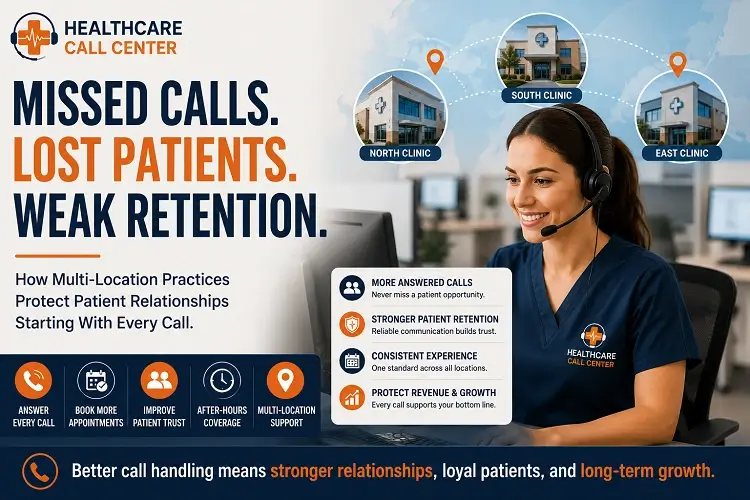
Multi-location practices often focus on growth metrics first.
They track new patient volume, referral sources, ad spend, provider utilization, appointment availability, and revenue by location. Those numbers matter. But one of the biggest patient retention problems often starts with something much simpler.
A phone call that never gets answered.
For a single-location practice, missed calls are already expensive. For a multi-location practice, the problem multiplies. More locations mean more front desks, more schedules, more providers, more call flows, more patient questions, and more chances for callers to fall through the cracks.
When patients cannot reach the office, they do not always complain. They may simply call another location, choose another provider, skip a follow-up, delay care, or stop trusting the practice to respond when they need help.
That is why missed calls are not only a lead problem. They are a patient retention problem.
For growing medical groups, better call handling is not just an operational fix. It is a way to protect patient relationships across every location.
Why Missed Calls Matter More in Multi-Location Practices
A multi-location practice has more moving parts than a single office.
Patients may call one location to ask about another. A provider may rotate between offices. Scheduling rules may vary by location. Some offices may be busier than others. One front desk may be fully staffed while another is stretched thin.
From the patient’s point of view, none of that should matter.
They expect the practice to answer, understand the request, and route them to the right next step. If the call is missed, the patient does not think about staffing patterns or operational complexity. They feel ignored.
That feeling can damage retention.
A patient who cannot reach the practice may wonder:
- Will anyone call me back?
- Is this office too busy for me?
- Should I find a provider that is easier to reach?
- Will follow-up care be this frustrating?
- Can I trust this group with something important?
For multi-location practices, consistency matters. A patient should not receive a great call experience at one location and a poor one at another. Missed calls create inconsistency, and inconsistency weakens trust.
Missed Calls Create a Weak First Impression
Patient retention starts earlier than many practices realize.
It does not begin after the first visit. It begins when the patient first tries to contact the practice.
If a caller is a new patient, that first call may decide whether they book. If a caller is an existing patient, that first failed attempt may decide whether they stay loyal. This is when a dedicated medical virtual receptionist helps to recover your missed-call patient and convert it as booked patient.
A missed call can create several problems at once:
- The patient may not leave a voicemail.
- The patient may call a competitor.
- The patient may delay scheduling.
- The patient may lose confidence in the practice.
- The front desk may spend time chasing callbacks later.
- The marketing team may not know the lead was lost.
This is why a US-based healthcare call center for patient retention matters for practices that are trying to grow. The phone experience is part of the patient experience.
If the first call feels unreliable, the practice starts the relationship from behind.
Retention Is Not Just About Clinical Care
Patients stay with a practice for more than clinical outcomes.
They stay because the experience feels reliable. They stay because communication is clear. They stay because scheduling is easy. They stay because they know how to reach someone when they need help.
Clinical care may be excellent, but poor access can still push patients away.
A multi-location practice can invest in strong providers, updated technology, a polished website, and strong reviews. But if patients cannot get through by phone, the practice still feels hard to work with.
Retention is built through repeated moments of confidence.
A patient books easily. A question gets answered. A callback happens when expected. A follow-up appointment is scheduled without friction. An after-hours message is routed properly. A billing or referral question does not disappear.
Missed calls break those moments.
Multi-Location Practices Often Do Not See the Full Missed Call Problem
One of the hardest parts of missed call management is visibility.
A practice may know how many appointments were booked. It may know how many calls were returned. It may even know how many voicemails were received.
But many practices do not clearly know how many patient calls were missed, which location missed them, why they were missed, and what happened afterward.
This creates a dangerous blind spot.
A location may look healthy because the schedule is full, but it may still be losing future growth through unanswered calls. Another location may appear underperforming, but the real issue may be call coverage during peak hours.
Common missed call blind spots include:
- Lunch-hour call gaps
- Monday morning call spikes
- End-of-day overflow
- Staff meeting coverage gaps
- Multi-location transfer confusion
- High-volume campaign days
- Calls missed while checking in patients
- Calls missed because staff are handling insurance or billing questions
Without better visibility, the practice may blame demand, marketing, or provider availability when the phone process is the real issue.
Missed Calls Create Follow-Up Delays
A missed call is rarely solved by voicemail alone.
Even when a patient leaves a message, the front desk still has to return the call. That callback may happen hours later or the next business day. By then, the patient may be unavailable, frustrated, or already booked somewhere else.
For multi-location practices, callback delays can grow quickly because teams are already managing in-office patients and daily administrative work.
The process often looks like this:
- Patient calls during a busy time.
- The call goes unanswered.
- The patient leaves a voicemail, or does not.
- Staff reviews voicemail later.
- Staff call back when the patient is unavailable.
- The patient calls again.
- The cycle repeats.
This creates more work for the staff and more friction for the patient.
A better medical answering service can reduce that cycle by answering the call earlier, capturing the request, and routing it according to the practice’s instructions.
Patient Retention Drops When Access Feels Unreliable
Patients are more likely to stay with a practice when they believe access is dependable.
Access does not only mean appointment availability. It also means communication access.
Can they reach the practice when they call? Can they ask a question? Can they reschedule? Can they confirm instructions? Can they get routed to the right team?
When access feels unreliable, patients may start looking elsewhere.
This is especially true for:
- Patients managing ongoing care
- Patients with repeated follow-up needs
- Patients comparing specialty providers
- Parents calling on behalf of children
- Patients with anxiety around symptoms or procedures
- Patients who need help outside standard office hours
For multi-location practices, the risk is higher because patients often have choices. If one location is hard to reach, they may switch locations. If the whole group feels hard to reach, they may switch providers entirely.
Missed Calls Hurt Marketing ROI
Multi-location groups often spend heavily on growth.
They invest in SEO, local search, Google Business Profiles, paid ads, referral relationships, reputation management, and patient reactivation campaigns.
All of that effort is designed to create action.
The patient sees the practice, feels interested, and calls.
If that call is missed, the marketing investment loses power. The campaign may still generate traffic. The website may still rank. The ad may still receive clicks. But the conversion fails at the phone.
This is why missed calls should be measured as part of marketing performance, not only front desk performance.
For example:
- A location page may rank well, but calls may go unanswered.
- A paid ad may generate high-intent calls, but staff may be overloaded.
- A referral campaign may work, but patients may not reach the right location.
- A new specialty page may drive interest, but intake may be inconsistent.
Growth does not end at the click. It continues through the call.
Staff Burnout Makes the Retention Problem Worse
Front desk teams are often blamed for missed calls, but the issue is usually capacity.
A front desk person cannot check in a patient, answer a provider question, verify insurance, manage a schedule change, handle a walk-in, and answer every phone call at the same time.
In multi-location groups, this pressure can vary by office. One location may be stable. Another may be short-staffed. Another may have a sudden call spike because of a local campaign or provider schedule change.
When staff is overloaded, call quality drops.
Patients may hear rushed answers. Calls may be placed on hold. Messages may be incomplete. Follow-up may be delayed. Staff may become frustrated with callers who simply need help.
A front desk overflow answering service helps reduce pressure by covering calls when the in-office team cannot answer quickly.
This protects both patients and staff.
After-Hours Coverage Also Affects Retention
Many patient relationships are tested outside normal business hours.
A patient may remember the practice not because everything went perfectly during the day, but because someone answered when they were worried after hours.
For multi-location practices, after-hours call handling can become complicated. Different providers may cover different locations. Different specialties may have different escalation rules. Some calls can wait. Some should be routed sooner.
If after-hours communication is inconsistent, patients may lose confidence.
An after-hours medical answering service helps create a clear process for calls after the office closes. The goal is not to replace clinical decision-making. The goal is to make sure calls are answered, documented, and routed based on the practice’s rules.
For retention, that reliability matters.
Multi-Location Practices Need Standardized Call Handling
A growing practice cannot rely on each location making its own call handling process.
That may work for a while, but it becomes harder to manage as the group expands.
Standardized call handling helps create consistency across the organization.
A strong process should define:
- How new patient calls are answered
- How existing patient calls are routed
- How appointment requests are captured
- How urgent messages are escalated
- How after-hours calls are documented
- How overflow coverage works
- How location-specific details are handled
- How staff know which calls need priority
This does not mean every location loses flexibility. It means every patient gets a consistent baseline experience.
For multi-location groups, consistency is a retention advantage.
Which Calls Should Multi-Location Practices Prioritize?
Not every call has the same urgency or business impact.
Practices should pay special attention to calls that directly affect retention and revenue, including:
New Patient Appointment Requests
These calls should be answered quickly because caller intent is high. A delay can send the patient to another provider.
Follow-Up Scheduling Calls
Follow-up visits protect care continuity and future revenue. Missed follow-up calls can weaken retention.
Reschedule and Cancellation Calls
If these calls are not handled quickly, schedule gaps can increase, and patients may not rebook.
Post-Visit Questions
Patients who feel unsupported after the visit may become less loyal.
After-Hours Messages
These calls often carry more anxiety and require clear routing rules.
Location Transfer Calls
Patients should not feel stuck between offices. A multi-location group needs clear routing support.
How Better Call Handling Supports Patient Retention
Better call handling improves retention because it reduces friction.
It helps patients feel that the practice is reachable, organized, and responsive.
It also helps staff work from clearer information instead of chasing incomplete voicemails.
A stronger call handling process can support retention by:
- Answering more calls during peak hours
- Reducing voicemail dependency
- Capturing complete patient details
- Routing calls to the right location or team
- Supporting appointment requests
- Reducing callback delays
- Improving after-hours message handling
- Helping staff focus on in-office patients
- Creating a consistent experience across locations
For multi-location practices, that consistency is essential.
How to Audit Missed Calls Across Multiple Locations
Before a practice can fix missed calls, it needs to understand where the problem is happening.
A simple audit should review:
- Which locations miss the most calls
- Which days and times have the highest missed call volume
- How many missed callers leave voicemail
- How quickly callbacks happen
- How many missed calls come from new patients
- How many missed calls happen after marketing campaigns
- How after-hours calls are routed
- Whether locations follow the same call handling process
- Which pages or campaigns generate calls that are not answered
This audit can reveal whether the problem is staffing, call flow, scheduling complexity, or lack of overflow support.
It can also show which locations need support first.
What Multi-Location Practices Should Do Next
The best next step is not always hiring more staff.
Hiring can help, but it may not solve call spikes, lunch coverage, after-hours gaps, or inconsistent location processes.
Multi-location practices should first ask:
- Are we missing calls during predictable busy times?
- Are new patient calls getting answered quickly?
- Are callbacks happening fast enough?
- Do all locations follow the same call flow?
- Do patients reach the right location or team?
- Do we have after-hours coverage rules?
- Do we know which missed calls cost us appointments?
If the answer is unclear, the phone process needs attention.
A structured call handling partner can help provide coverage where the practice needs it most, whether that is overflow, after-hours, appointment requests, or multi-location routing support.
Final Takeaway
Missed calls are not only missed conversations.
For multi-location practices, they can become missed appointments, lost follow-ups, weaker patient trust, lower marketing ROI, and higher staff pressure.
Patient retention depends on reliability. If patients cannot reach the practice when they need help, they may not stay loyal, even if the clinical care is strong.
The solution starts with visibility and consistency. Practices need to know where calls are being missed, which locations need support, and how patient calls should be answered and routed.
Healthcare Call Center helps medical practices answer more calls, reduce front desk overload, support after-hours communication, and protect patient relationships across locations.
Frequently Asked Questions
1. How do missed calls affect patient retention?
Missed calls affect patient retention by making the practice feel hard to reach. Patients may delay care, miss follow-ups, lose trust, or choose another provider if they cannot get help when they call.
2. Why are missed calls a bigger problem for multi-location practices?
Multi-location practices have more schedules, providers, front desks, routing rules, and patient call paths. Without consistent call handling, patients can experience different service levels depending on which location they call.
3. Can a medical answering service help multi-location practices?
Yes. A medical answering service can help answer overflow calls, capture appointment requests, support after-hours communication, and route messages according to each location’s instructions.
4. What calls should multi-location practices prioritize?
Multi-location practices should prioritize new patient calls, follow-up scheduling, reschedule requests, post-visit questions, after-hours messages, and calls that need location-specific routing.
5. How can practices reduce missed calls without hiring more staff?
Practices can reduce missed calls by using front desk overflow coverage, after-hours answering support, clearer routing rules, call tracking, and standardized call handling across locations.
by Erika Sanchez | Aug 20, 2026 | Industry News
Somewhere between the demo and the contract, practices adopting AI phone agents stopped asking one question. A question their state legislature answered for them this year.
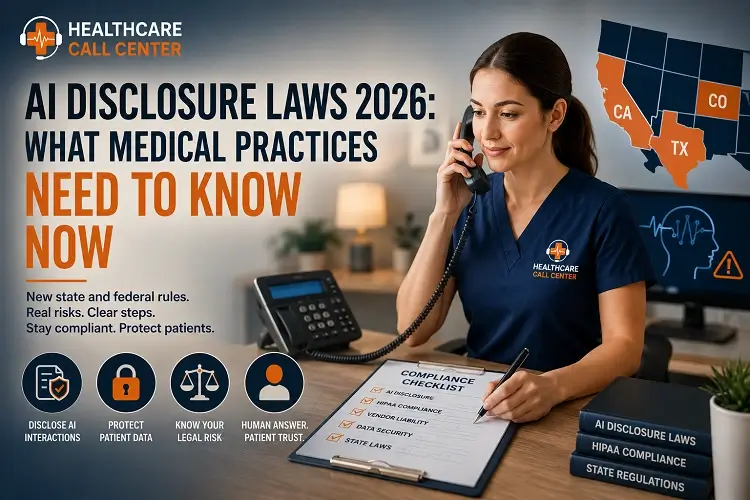
In 2026, AI disclosure laws stopped being a tech policy story and started being a medical practice operations problem. California, Texas, and Colorado have all passed rules that touch how automated voices interact with the public. Federal regulators are tightening AI voice rules on call traffic. And healthcare, the industry where callers share their most sensitive information out loud, sits directly in the path.
If your practice uses an AI receptionist, is evaluating one, or pays any vendor that routes patient calls through automation, this article explains what changed, who carries the risk, and what to do before your next compliance review.
Key Takeaways
- California AB 489, effective January 1, 2026, prohibits AI from implying a patient is receiving care from a licensed healthcare professional, and makes deployers liable too.
- Texas TRAIGA and the Colorado AI Act add transparency duties for AI systems interacting with consumers, with 2026 compliance dates.
- Federal TCPA and FCC rules continue to tighten disclosure requirements for AI-generated voices on calls.
- HIPAA responsibility cannot be delegated to an AI vendor. The practice remains the liable party.
- Human answering services are not covered by AI disclosure rules. Trained humans remain the lowest-friction compliant option.
What are AI disclosure laws, exactly?
AI disclosure laws require businesses to tell people when they are interacting with artificial intelligence instead of a human. Some apply broadly to chatbots and voice agents. Some are industry-specific. The common thread is simple. If a machine is doing the talking, the person on the other end has a right to know.
For medical practices, three state laws matter most right now. California’s AB 489 bans AI systems from making patients believe they are speaking with, or receiving care from, a licensed healthcare provider, and it extends liability to the businesses deploying the AI, not just the developers. Texas passed the TRAIGA framework with transparency obligations for AI systems interacting with consumers. Colorado’s AI Act, which took effect in 2026, imposes duties on developers and deployers of high-risk AI systems, and systems that make material decisions about consumers get extra scrutiny.
Layered on top are federal rules. The FCC has moved repeatedly on AI-generated voices in calls, and TCPA enforcement now treats undisclosed AI voices as a serious violation. None of this requires intent to deceive. Silence itself is becoming the violation.
Does AB 489 apply to my practice’s AI receptionist?
If an AI voice agent answers patient calls in California, or serves California residents, the honest answer is: assume yes, and get a compliance read from your attorney. The law’s healthcare provisions target exactly the scenario AI receptionist vendors sell. A friendly synthetic voice that books appointments, answers questions and reassures callers can drift dangerously close to implying licensed care is on the line.
The trap is subtlety. Your AI does not need to say “I am a nurse” to create liability. A caller who reasonably believes the helpful voice understands her symptoms has already stepped into the zone AB 489 was written to protect.
Who is liable when an AI vendor mishandles patient data?
Here the rules are older than the AI wave, and harsher. Under HIPAA guidance from the Office for Civil Rights, a covered entity cannot hand off its compliance duty. Sign the slickest vendor contract you want. If protected health information leaks through an AI phone system, the practice answers for it, plus a HIPAA-compliant medical answering service infrastructure gap becomes your OCR problem, not the vendor’s.
Vendors know this, which is why sharp-eyed practice managers notice their contracts push indemnification downhill. Read yours this week. The clause you are looking for is the one describing what happens when things go wrong. It is usually shorter than the pricing section.
Do I have to tell patients when AI answers the phone?
In states with AI disclosure rules on the books, the direction is clear. Callers must be informed they are speaking with an AI before the conversation substantively begins. The disclosure needs to be explicit, not buried. An AI that introduces itself with a human-sounding name and skips the “I am an automated assistant” line is building your practice a legal problem one call at a time.
For practices in states without a specific statute yet, two forces are converging. Federal AI voice rules keep expanding, and state legislatures are copying each other’s transparency language at speed. Betting against disclosure requirements spreading is not a strategy. It is a delay.
Do these laws apply to human answering services?
No. Disclosure obligations target artificial voices and automated decision systems. A trained human being who answers the phone, follows your protocols, and escalates urgent calls is outside the AI disclosure framework entirely.
That distinction is why many practices are quietly rethinking the AI-only bet. A US-based medical call center with trained human agents delivers the after-hours coverage AI promises, without disclosure scripts, synthetic voice rules or new liability surfaces. The technology still works. It just works behind the humans, routing calls and logging data, instead of pretending to be one.
We broke down the full trade-off between automated and human answering in our AI medical receptionist risks and benefits guide, and earlier in our piece on what healthcare patients actually prefer, human or AI. The short version of both: automation helps with volume, humans win the moments that decide whether a patient feels safe.
How to audit your phone stack in one afternoon
You do not need a consultant to start. You need one hour and honesty.
- Pull every service that touches an inbound patient call. Answering services, AI receptionists, voicemail transcription, after-hours bots.
- For each one, write down whether a patient could hear an automated voice. If yes, is it disclosed, out loud, before conversation?
- Check where each vendor stores and processes call data, and whether a BAA covers it.
- Ask your AI vendor, in writing, who is liable if a caller reasonably believes they received clinical guidance. Save the answer.
- Note which state each caller population sits in. Multi-state practices inherit multi-state rules.
Most practices find at least one surprise in this exercise. A transcription feature quietly enabled. A chatbot escalation that calls patients back with a synthetic voice. An “after-hours assistant” nobody remembers approving. Finding it yourself beats finding it in an enforcement inquiry.
The compliance posture that ages well
Every rule signed this year points at one principle. Patients deserve to know who they are talking to, and deserve a human when the moment is sensitive. You can comply reactively, retrofitting disclosures and renegotiating vendor contracts each time a legislature moves. Or you can adopt the posture that makes the rules irrelevant.
Put trained humans on patient calls. Let technology assist them quietly. Then there is nothing to disclose, no synthetic voice rule to interpret, no gray zone where a worried caller wonders whether the calm voice booking her prenatal visit has a pulse.
Practices that want to see the difference start with the numbers. Our healthcare call center services team answers with US-based, specialty-trained agents under a 90%+ answer-rate guarantee and full HIPAA compliance. Or run your leak first. The missed call revenue calculator shows what silent voicemail is already costing, before you decide what should answer instead.
The laws will keep coming. Human judgment does not need a compliance memo.
Frequently Asked Questions
Q: Do I legally have to tell patients when AI answers their call?
A: In states with AI disclosure laws, including California under AB 489 and Texas under TRAIGA, callers generally must be informed they are speaking with an AI before the conversation proceeds. Requirements vary by state and continue to evolve through 2026.
Q: Can an AI receptionist legally give medical advice?
A: No. California AB 489 explicitly prohibits AI from implying a patient is receiving care from a licensed healthcare professional. AI systems can handle scheduling and routing, not clinical guidance.
Q: Who is liable if an AI vendor mishandles patient data, the vendor or my practice?
A: The practice. Under HIPAA, covered entities cannot delegate compliance responsibility to a vendor. If protected health information leaks through an AI phone system, the practice answers to regulators.
Q: Do AI disclosure laws apply to human answering services?
A: No. Disclosure rules target AI-generated voices and automated systems. Trained human agents answering under practice protocols are unaffected.
Q: What should I check before deploying an AI receptionist at my practice?
A: Verify where the AI operates, confirm who carries liability in writing, check whether a BAA covers call data, and review your state’s AI disclosure requirements before the first call.