by Erika Sanchez | Sep 4, 2026 | Fertility & IVF Clinic Answering Service
When IVF patients call a fertility clinic, they typically want three things: a compassionate person who listens, clear answers about the next step, and confidence that their information will be handled privately. A strong first call should help patients understand what happens next, capture their questions accurately, and connect them with the right member of the fertility team.
Every IVF journey starts the same way: a private moment, a deep breath, and a phone call. Before a patient ever books a consultation, they call the clinic to see who answers. That first call quietly decides whether they move forward with your practice or keep searching.
Understanding what IVF patients expect when they call is not a soft skill. For a fertility clinic, it is revenue protection, reputation protection, and patient care all at once.
Here is what patients are really looking for, and how your phone experience can meet them.
Why the First Call Matters to IVF Patients
Fertility treatment is one of the most emotionally loaded purchases in healthcare. Patients have often tried for months or years before they dial. They may be grieving, hopeful, or both at once.
They are also investing real money. IVF treatment often costs tens of thousands of dollars per cycle, much of it out of pocket. Patients research clinics the way people research major life purchases. They compare websites, read reviews, and call.
On that call, they are asking one question above all:
Will this clinic treat me like a person or like a case number?
- A rushed answer reads as indifference.
- A long hold reads as disorganization.
- A generic voicemail reads as a closed door.
- A calm, kind, informed voice reads as a clinic they can trust with the hardest chapter of their lives.
Most clinics never hear about the callers they lost. The phone just stops ringing for them.
What IVF Patients Actually Ask on the First Call
Front desk teams know these calls well. A trained fertility clinic answering service team should handle them just as smoothly:
1. Are You Accepting New Patients?
The simplest question, and the one most often fumbled. Callers want a warm yes and a clear next step, not a transfer chain.
2. How Much Does Treatment Cost?
Patients deserve honesty about the process. Agents should not quote medical pricing, but they can capture the question and route it to financial counseling staff with context attached.
3. Do You Take My Insurance?
Insurance questions are stressful for fertility patients. A patient agent captures plan details so your billing team can answer accurately on the first callback.
4. What Are the Next Steps?
New patients ask about consultations, testing timelines, and how soon they can be seen. Agents explain the intake path you approve and book or pass the request.
5. Can I Talk to Someone About My Situation?
Some callers just need to be heard for a moment. Agents trained in empathetic, judgment-free listening turn these calls into consultations instead of hang-ups.
6. Do You Offer the Treatment I Was Told About?
Callers arrive with research from other doctors or forums. Agents capture the specific question for your clinical team instead of guessing.
The Emotional State Behind IVF Calls
IVF calls are not ordinary scheduling calls. Callers may be:
- Navigating infertility grief they have not shared with family.
- Recovering from a failed cycle at another clinic.
- Calling on behalf of a partner who cannot face another disappointing conversation.
- Worried about age-related time pressure.
- Overwhelmed by pricing, medication schedules, and medical jargon.
None of these callers wants pep talks or clinical detachment. They want patience, warmth, and competence. Our US-based agents, many of them stay-at-home moms, understand the vulnerability in these calls because they understand families. That is why empathy is a hiring requirement, not a script line, and it is why our fertility clinic answering service trains specifically for sensitive fertility conversations.
Where Most Clinics Fail the First Call
The failures are rarely intentional. They are the side effects of a busy front desk:
- Phones ring out while staff check in patients in person.
- Hold times stretch past five minutes during morning rush.
- After-hours callers reach a generic office voicemail.
- Messages arrive incomplete, so staff call back without context.
- New patient calls are treated like routine reschedules.
Each failure is small. Together they tell your highest-value callers that the clinic is too busy for them. For a treatment that often costs more than a car, that impression is expensive.
What a Trained Answering Team Does Differently for IVF Calls
A trained live answering team closes the gap between how your clinic operates and how it sounds on the phone:
- Calls are answered promptly in your clinic name, with your approved greeting.
- Agents capture caller details, treatment interest, referral source, and the exact question your team must answer.
- Consultation requests route straight to your scheduling workflow, including our dedicated fertility appointment scheduling support.
- Emotionally heavy calls are handled with patience and zero judgment.
- Urgent concerns follow escalation rules your clinical team defines.
- You receive clear documentation for every call, every day.
HIPAA-Conscious Handling for Sensitive Fertility Calls
Fertility calls include some of the most private information a patient will ever share: diagnoses, cycle history, medications, and personal circumstances. Patients expect discretion by default.
That is why our workflows follow HIPAA-conscious call handling:
- Agents collect only the information your workflow needs.
- Messages route through secure channels, never personal phones.
- Access to call documentation is limited to authorized staff.
- Scripts avoid making patients repeat sensitive details unnecessarily.
Our HIPAA-compliant healthcare answering service page explains the full security approach, and a dedicated IVF clinic call handling service covers what it means specifically for fertility practices.
After-Hours IVF Calls Matter More Than You Think
Anxiety does not keep office hours. IVF patients call at night and on weekends, especially around cycle milestones, medication questions, and results. When your office closes, those calls do not stop.
A live answering team keeps your clinic human around the clock. See how our after-hours fertility clinic call handling works, including nights, weekends, and holidays.
What to Capture on Every IVF Call
Consistent intake makes your clinical and billing teams faster. Every IVF clinic call handling service should capture:
- Caller name and best callback number.
- Patient status: new inquiry, current patient, or former patient.
- Reason for the call in the caller’s own words.
- Treatment interest or referral source if volunteered.
- Urgency per your escalation rules.
- Preferred contact method and best time to reach them.
How IVF Patients Actually Choose Between Clinics
Many IVF patients compare multiple fertility clinics before deciding where to schedule a consultation. Websites look similar. Reviews blur together. The phone call becomes the tiebreaker.
In a single first call, patients judge:
- How fast someone answered.
- Whether the voice was warm or transactional.
- Whether their question got a real answer or a brush-off.
- How confident they felt about the next step.
- Whether they had to repeat themselves.
Clinics rarely lose these callers on clinical quality. They lose them in the fifteen seconds after the phone rings. That is why practices that obsess over consultation experience also obsess over the call that earns the consultation.
A Simple Test: Call Your Own Clinic Today
Ask someone who does not work with you to call your main line at 8 AM, during lunch, and at 6:30 PM. Note how long it took to reach a human, how the greeting felt, and what happened after hours.
If any of those calls felt cold, slow, or impersonal, that is exactly what your next IVF patient experienced this week. The fix is faster than you think.
What One IVF Patient Is Worth
An IVF patient can represent substantial long-term value to a fertility practice across consultations, testing, treatment cycles, and related services. Losing even two first calls a month to voicemail can quietly erase more revenue than a full year of answering support calls.
Estimate your own number with our missed call revenue calculator before you decide anything else.
The First Call Also Shapes Word of Mouth
IVF patients talk to each other. Support groups, fertility forums, and friend groups trade clinic recommendations daily, and the stories they share are rarely about clinical protocols. They are about how the clinic made them feel.
The patient who reached a kind human on the first ring tells that story. The patient who spent two days chasing a callback tells that one instead. Every answered call is a small deposit in your clinic’s reputation, and every missed one is a withdrawal you will never see posted.
The First Call Is the First Step of Care
IVF patients will forgive almost anything except feeling invisible. When your phone line meets them with warmth, patience, and competence, your clinic stands out before the consultation ever begins.
Book a Free Consultation & Talk to our team about covering your fertility clinic calls with trained, US-based agents. We will review your call flow and show you exactly where patients are slipping through, with no pressure and no obligation.
Frequently Asked Questions
Can an answering service really understand IVF calls?
Yes, when the team is trained for it. Our agents practice fertility-specific scenarios, from pricing questions to emotionally heavy calls, and follow scripts your clinic approves.
Will patients know they are talking to an outside team?
Only if you want them to; calls are answered in your clinic name with your greeting, so most patients simply experience a faster, kinder answer.
What happens if a caller is upset or crying?
Agents are trained to slow down, listen, and let the caller feel heard before capturing details. Escalation rules you define decide what happens next.
Can you book consultations directly?
Agents capture complete consultation requests with preferred times. Many fertility practices also connect the service to their scheduling workflow for direct booking.
How do we protect patient privacy on fertility calls?
Calls follow HIPAA-conscious workflows with secure message routing and minimum-necessary data capture. See our HIPAA-compliant healthcare answering service page for details.

by Erika Sanchez | Sep 3, 2026 | Medical Answering Services
Your front desk is checking in a patient. The phone rings. Then it rings again. By the third ring, many callers have already decided to hang up and try the next practice on their list. That is the quiet revenue leak most medical offices never measure. An answering service for medical offices exists to close that leak with trained live agents who answer every call, capture the right details, and route messages by your rules.
This article explains what an answering service for medical offices does, which calls it should handle, how HIPAA-conscious call handling works, and how to choose a team that protects both your patients and your schedule.
Why Medical Offices Keep Losing Patients to Voicemail
Most practices do not lose patients because of bad care.
They lose them in the small gaps of the day:
- The front desk is helping a patient in person and cannot pick up.
- Lunch breaks and staff shortages leave phones unattended.
- Call volume spikes on Monday mornings and after holidays.
- Patients call after the office closes and reach a generic greeting.
- Voicemail boxes fill up with incomplete messages staff must chase down.
The problem is not effort. The problem is math. A ringing phone that goes unanswered is often a new patient, a reschedule, or an urgent concern. When nobody answers, the caller does not leave a message and wait. Many simply call a competitor. And the practice never hears about it.
That is why growing practices treat every inbound call as a patient touchpoint, not an interruption. A live answering team makes that possible without adding front desk headcount.
What an Answering Service for Medical Offices Actually Does
A medical office answering service answers your phones with trained live agents who follow your scripts and routing rules. The goal is simple: every caller hears a calm human voice, and your team receives clear, complete messages.
Here is what that looks like in practice:
- Calls are answered live in your practice name, using your approved greeting.
- Agents capture caller name, phone number, patient status, reason for the call, and the next step your team needs.
- Routine messages are documented and routed to the right person or inbox.
- Urgent calls are escalated based on rules you approve in advance.
- Appointment requests are captured with preferred times so your scheduling team can confirm quickly.
This is not a robot menu that frustrates patients. It is a human extension of your front office that works days, nights, weekends, and holidays. If you want a deeper look at the full service model, see our guide to a medical answering service built for healthcare workflows.
7 Call Types Your Answering Team Should Handle
When you evaluate an answering service for medical offices, ask how it handles the seven call types that make up most practice phone traffic.
1. New Patient Inquiries
New patient calls are usually the highest value calls your office receives. A trained agent answers promptly, explains that the practice is accepting patients, and captures insurance details and preferred providers so your team can complete the booking.
2. Appointment Requests and Reschedules
Agents log preferred dates and times, cancellation reasons, and callback needs. Your scheduling staff confirms instead of playing phone tag.
3. Prescription Questions
Agents never give medical advice. They route refill requests and medication questions to the right person with clear documentation, so nothing sits in voicemail.
4. Urgent Symptom Calls
Your practice decides what counts as urgent. Agents follow the escalation rules you approve, whether that means notifying an on-call provider or documenting the call for morning review.
5. Test Result Calls
Patients call about results because they are anxious. A calm agent captures the request and routes it, which protects both patient privacy and staff time.
6. Insurance and Billing Questions
These calls take time your front desk may not have. Agents capture the question and caller details so billing staff can respond with full context.
7. After-Hours and Overflow Calls
When your office is closed, or your lines are full, the answering team stays live. Our after-hours medical answering service covers nights, weekends, and holidays with the same scripts and rules.
Generic Answering Services vs Medical Office Teams
Plenty of answering services claim they can handle healthcare calls. The difference shows up in the details that matter to a practice.
A generic service reads any script. A medical answering team understands healthcare vocabulary, anxious callers, and the difference between a routine message and a call that needs escalation today.
Key differences to ask about:
- Custom message fields built for healthcare, like patient status and reason for call.
- Escalation rules you control, not one-size-fits-all scripts.
- Agents trained to stay calm with worried or frustrated patients.
- Clear documentation your staff can act on without follow-up calls.
HIPAA-Conscious Call Handling: What It Means in Practice
Patient phone calls often include private information before anyone realizes it. A HIPAA-conscious answering team treats every call that way by default.
In practice, this means:
- Agents collect only the information your workflow needs.
- Messages are routed through secure channels, not personal phones or email.
- Access to call data is limited to the people who need it.
- Scripts avoid asking patients to expose sensitive details unnecessarily.
If compliance is a priority for your practice, read how our HIPAA-compliant healthcare answering service handles secure call workflows and safer message routing.
Why US-Based Agents Matter More Than Practices Expect
Patients notice the voice on the other end of the line. US-based agents offer clear accents, cultural familiarity, and a warm tone that anxious patients immediately recognize.
Our team is made up of US-based stay-at-home moms who understand American patients because they live in the same communities. That background matters on calls about symptoms, billing worries, or scheduling stress. Callers feel heard instead of processed.
We back that with a 90%+ answer rate guarantee. If we do not answer, you do not pay for that call.
The Real Cost of One Missed Patient Call
One unanswered call feels small. Multiply it across a busy month, and it becomes a growth problem.
Consider what a single new patient is worth to your practice over time. For many specialties, one patient relationship is worth hundreds to thousands of dollars. A patient who cannot reach your office and books elsewhere takes that value with them.
You do not have to guess at your number. Run your own numbers with our missed call revenue calculator. In two minutes, you will see what unanswered phones cost your practice every month, before you decide whether a live answering team makes sense.
How to Choose an Answering Service for Medical Offices
Use this checklist when comparing providers:
- Healthcare experience: Ask for examples of medical office workflows they support.
- US-based agents: Confirm where agents are located and how they are trained.
- Custom scripts: You should approve the greeting, questions, and routing rules.
- Escalation control: Your practice defines what is urgent and who gets notified.
- Answer rate guarantee: Look for a published commitment, not vague promises.
- Reporting: You should see call volumes, outcomes, and response times.
- Simple terms: Month-to-month agreements beat long contracts you cannot test.
If a provider cannot answer these points clearly, keep shopping.
How Setup Works
Getting started is simpler than most practices expect:
- Discovery call: We review your call types, hours, and escalation preferences.
- Script build: We write your greeting and message fields for your approval.
- Routing setup: We configure where messages and urgent alerts go.
- Agent training: Our team practices your workflow before going live.
- Test calls: We run scenarios together and adjust.
- Launch: Most practices go live within up to 2 weeks.
Signs Your Office Already Needs Live Answering
Not sure your phone problem is big enough to fix?
Most practices see the signs long before they measure the cost:
- Staff regularly apologize to patients for delayed callbacks.
- A voicemail backlog greets your team every morning.
- Patients mention they could not get through last week.
- The front desk interrupts patient check-in to grab ringing lines.
- After-hours calls land on a generic greeting.
- New patient inquiries drop off during your busiest hours.
If two or more of these sound familiar, live answering will pay for itself quickly. Every item on this list is a call that already slipped somewhere.
Every Patient Call Is a Patient Who Needed You
Your practice already delivers great care. Make sure the phone experience matches it. A trained, US-based answering team captures every call, protects patient information, and keeps your schedule full without burning out your front desk.
Book a free consultation with our team. We will review your call flow, show you where calls are slipping through, and give you clear recommendations with no pressure.
Frequently Asked Questions
1. What does an answering service for medical offices cost?
Pricing depends on call volume and coverage hours. Most practices compare the monthly cost against the revenue of the patient calls they currently miss. Start with our missed call calculator to estimate your own numbers.
2. Will patients know they are speaking with an outside team?
Only if you want them to, calls are answered in your practice name using your approved greeting. Most patients simply experience a helpful person answering faster.
3. Can the service book appointments directly?
Agents capture complete appointment requests with preferred times so your scheduling team can confirm. Many practices also connect the service to their scheduling workflow for faster booking.
4. Is the service HIPAA compliant?
Our workflows are built for HIPAA-conscious secure call handling, including secure message routing and minimum-necessary data capture. See our HIPAA-compliant healthcare answering service page for details.
5. What happens with urgent after-hours calls?
Your practice defines the escalation rules. Agents follow them exactly, whether that means reaching an on-call provider or documenting the call for morning review. See how our after-hours coverage works.

by Erika Sanchez | Sep 2, 2026 | Medical Answering Services
When a patient calls your practice after hours, they share more than a name and a callback number. They describe symptoms. They mention medications. Sometimes they reveal a diagnosis before anyone even asks. Every one of those details is protected health information, and every call that reaches your answering service becomes part of your security perimeter.
A secure medical answering service treats that responsibility as the core of the job, not an afterthought. It combines encryption, strict access controls, trained agents, and documented delivery processes so patient data stays protected from the first ring to the final message.
This article explains what security actually means in a 24 hour medical answering service, how to evaluate any vendor in one call, and why the difference between a generic call center and a security-focused one can decide whether your practice stays compliant.
The key question is not simply whether a vendor says it is HIPAA compliant. It is whether you can verify how patient information is collected, accessed, stored, transmitted, and deleted.
What Is a Secure Medical Answering Service?
A secure medical answering service is a call handling provider built to protect protected health information (PHI) at every step of the call lifecycle. Generic answering services answer phones. Secure medical answering services answer phones inside a framework designed for healthcare: encrypted call channels, controlled data access, confidentiality-trained agents, and message delivery that uses controlled, secure methods for transmitting PHI rather than unsecured email, personal messaging apps, or other consumer communication tools.
The distinction matters because of how calls actually flow through a provider. A patient calls at 9 PM. The agent verifies the caller, captures only the information your protocol requires, logs the message, and routes it to your on-call staff. At every one of those steps, data is created, stored, and transmitted. A secure service controls all three moments. An insecure one may store recordings on unencrypted servers, send summaries through personal messaging apps, or let every agent open every patient record on a shared dashboard.
Security also has a human layer. The person who answers the phone is often the first human your patient speaks to about a sensitive issue. A service can have the best infrastructure in the world and still leak trust if agents are untrained, rushed, or reading from a script written for plumbers instead of patients.
Why Data Security Now Decides Patient Trust
Healthcare consistently ranks as the most expensive industry for data breaches, with average incident costs measured in the millions of dollars in major industry analyses. For a small or mid-size practice, the direct cleanup costs are only the beginning. A breach involving patient call recordings or message logs can become a reportable event, a patient notification obligation, and a reputational problem in your community that outlasts any fine.
Healthcare data breaches can carry high financial and operational costs, including investigation, notification, remediation, legal review, and potential regulatory consequences.
Patients are also paying closer attention. People who call a fertility clinic about an IVF cycle, a psychiatrist’s office about medication, or a plastic surgery practice about a procedure are sharing some of the most private information of their lives. They assume it is handled carefully. When a practice cannot say exactly who answered the call, where the recording is stored, and how the message reached the on-call provider, that assumption breaks. In behavioral health especially, a mental health answering service that guards caller privacy is part of the care itself.
There is a competitive angle too. Practices that can explain their security posture in plain language, from encryption to agent location, win trust faster during the sales conversation. Practices that cannot explain it lose quietly to the ones that can. Choosing a HIPAA-compliant medical call center is the single clearest signal a practice can send, and a secure medical answering service turns security from a compliance chore into a reason patients choose you.
What Are the Six Layers of a Secure Medical Answering Service?
Security in a medical answering service is not one feature. It is a stack of controls that work together. When you evaluate a vendor, walk through all six layers below. A gap in any single layer can expose patient data, so treat the list as a pass or fail checklist rather than a menu.
1. Encryption in transit and at rest
Calls, recordings, and messages should be encrypted while they move across networks and while they sit on servers. Ask the vendor to state, in writing, that TLS protects live call data and that stored recordings and transcripts are encrypted at rest. If they cannot answer without hedging, treat that as a fail.
2. Access controls and authentication
Not every agent needs access to every message. A secure service uses role-based access, unique logins, and multi-factor authentication for staff. Ask how many people can open a specific patient message. The right answer is the smallest number that keeps your workflow moving.
3. US-based data handling
When calls are answered and stored overseas, your patient data crosses borders you do not control. Different countries have different privacy laws and enforcement cultures. US-based agents and infrastructure can make vendor oversight, data-location verification, and alignment with US healthcare requirements easier to evaluate.
4. Confidentiality-trained agents
Every person who touches a call should sign appropriate confidentiality agreements and complete training on handling PHI: what to capture, what to never repeat, and how to escalate. In healthcare, this is the difference between an operator and a trained extension of your front desk.
5. Secure message delivery
Messages should reach your on-call staff through encrypted channels, secure portals, or your existing practice systems. Sending PHI through personal messaging apps or unsecured consumer email can create additional copies of sensitive information outside the practice’s controlled communication environment.
6. Audit logs and monitoring
A secure service records who accessed what and when. If a message goes missing or a number is misdialed, the audit trail shows exactly what happened. Ask how long logs are retained and who can review them.
US-Based vs Offshore: Where Does Your Patient Data Actually Go?
Offshore call centers are often cheaper, and the savings are real. So is the trade-off. Offshore call centers may offer lower costs, but practices should evaluate more than price.
The key questions are where patient information is processed and stored, what contractual and security safeguards are in place, how agents are trained and supervised, and how quickly urgent calls can be escalated. Geographic location alone does not determine whether a vendor is secure, but it can affect oversight, data-location verification, and operational control.
| Factor |
US-Based Secure Service |
Typical Offshore Service |
| Legal framework |
US privacy and healthcare requirements can be evaluated directly |
Additional jurisdictions and contractual requirements may need review |
| Data location |
Data location can be specified and verified with the vendor |
Data may be processed or stored across additional jurisdictions |
| Language and cultural context |
US-based agents familiar with US patient communication |
Experience may vary by provider, location, and training |
| Training oversight |
Direct oversight of training and practice-specific protocols |
Oversight structure varies by vendor |
| Escalation speed |
Protocols can be designed around the practice’s requirements |
Escalation processes vary by vendor and operating model |
| Verification |
Security processes and controls can be reviewed with the vendor |
Verification depends on the vendor’s documentation and access |
None of this means every offshore provider is careless. It means the burden of proof is on you, and you have almost no way to collect it. A secure medical answering service removes the guesswork by keeping the entire call lifecycle inside one verifiable framework. If you want the fuller picture of how onshore support changes patient experience, our guide to a HIPAA-compliant medical call center covers the compliance side in depth.
How Secure Call Handling Works in Practice
Security sounds abstract until you trace one call. Here is what a properly secured after-hours call looks like from end to end, using the same steps a patient would experience with a US-based secure service.
A patient calls your clinic line at 8:40 PM. The call lands over an encrypted connection. The agent, a trained US-based professional, answers in your practice’s name and follows the protocol you approved: verify the caller, determine urgency, capture only the fields you specified. The agent does not free-type PHI into chat windows or personal notes. The message is logged inside the secure platform, timestamped, and attached to your account only.
Delivery follows your rules. Urgent calls patch through to your on-call provider directly. Routine messages land in the encrypted portal, your EHR-integrated inbox, or a secure SMS channel, never a consumer messaging app. The next morning, your front desk sees a clean record of every call, who handled it, and how it was resolved. Nothing about that chain requires luck. Every step was designed before the phone rang.
Ten-Point Checklist: How to Vet a Secure Medical Answering Service
Print this list or paste it into your next vendor call. A provider that answers all ten comfortably has earned a trial. One that stalls on three or more is a risk your patients did not sign up for.
- Is all call data encrypted in transit and at rest, stated in writing?
- Are recordings, transcripts, and messages stored on US-based infrastructure?
- Do agents sign confidentiality agreements before handling live calls?
- Is access role-based, with unique logins and multi-factor authentication?
- How are messages delivered, and can you restrict them to encrypted channels?
- Are audit logs kept, and can your practice review them on request?
- Will the vendor sign a business associate agreement covering their services?
- What is the documented process for a suspected breach or misdirected message?
- How are agents trained on PHI handling, and how often is training refreshed?
- Can the vendor describe data retention and deletion rules for your recordings?
What Weak Security Actually Costs a Practice
The obvious cost of weak security is a breach: investigation, notifications, legal review, and in serious cases, regulatory scrutiny that can reach seven figures across the industry’s worst examples. The less obvious costs start earlier and never show up in a report.
Misdirected messages are the quiet everyday failure. A callback number texted to the wrong patient, a voicemail transcript emailed to an old staff address, a shared inbox that a departed employee still opens from their phone. Each incident is small. Each one is still a disclosure of someone’s private health information, and each one traces back to a process decision made by your physician answering service.
Then there is attrition. Patients rarely complain about security. They simply do not come back. A single story about a leaked message spreads through a waiting room faster than any marketing you can buy. Practices that treat call security as infrastructure, the same way they treat their EHR, protect both their compliance posture and their reputation at the same time.
How HCC Protects Every Patient Call
Healthcare Call Center was built around a simple premise: the person who answers your patients’ calls should be part of your care experience, not a hole in it. Our agents are US-based professionals, trained to handle sensitive healthcare conversations with empathy and precision, supported by HIPAA-conscious enterprise infrastructure that encrypts call data and controls access at every step.
Every account runs on documented protocols. You define what agents capture, how urgency is triaged, and how messages reach your team, whether that is a psychiatrist answering service line where discretion is everything or an after-hours medical answering service flow for your whole practice. Audit trails show who did what on every call, and our 90%+ answer rate guarantee means the security you paid for is actually there when the phone rings.
Security also has a human voice. Our agents are trained to sound like people, not scripts, because patients who feel rushed or processed stop sharing what matters.
That combination of empathy and infrastructure is what lets practices of every size offer 24/7 availability without expanding risk. Curious what unanswered calls cost you first? Our missed call revenue calculator puts a number on it in under a minute.
Book a free 15-minute discovery call and we will walk through your current call flow, flag potential security gaps, and show you how a secure medical answering service can handle your patient calls.
Frequently Asked Questions
Q. Is a medical answering service required to follow HIPAA?
If the service handles protected health information on your behalf, yes. The provider acts as a business associate, which means they must sign a business associate agreement and maintain safeguards for the PHI they create, receive, and transmit. Always ask for the agreement in writing before going live.
If the answering service performs functions that involve creating, receiving, maintaining, or transmitting PHI on behalf of a covered entity, it may qualify as a business associate under HIPAA. In that situation, a business associate agreement is generally required. Practices should confirm the specific arrangement and applicable requirements before going live.
Q. What makes an answering service secure?
Five things, at minimum: encrypted call and message channels, role-based access with strong authentication, confidentiality-trained agents, documented delivery rules, and audit logs you can review. A provider missing any one of these leaves a gap in your security perimeter.
Q. Are recorded patient calls considered protected health information?
When a recording contains identifiable health information, and most medical calls do, it is treated as PHI. That means it must be encrypted, access-controlled, retained per policy, and deleted when no longer needed. Ask any vendor where recordings live and who can play them back.
Q. Can a secure answering service still use SMS?
Yes, when SMS is delivered through secure, encrypted channels with controls on who receives what. Plain consumer messaging apps and personal numbers are not acceptable for PHI. The right vendor configures delivery around your risk tolerance, from encrypted portal to secure text.
Q. How do I verify a vendor’s security claims?
Ask for written confirmation of encryption standards, a signed business associate agreement, a description of access controls, their breach notification process, and a sample audit log. Honest providers answer quickly and specifically. Vague answers are your answer.
by Erika Sanchez | Aug 31, 2026 | dentist call center services
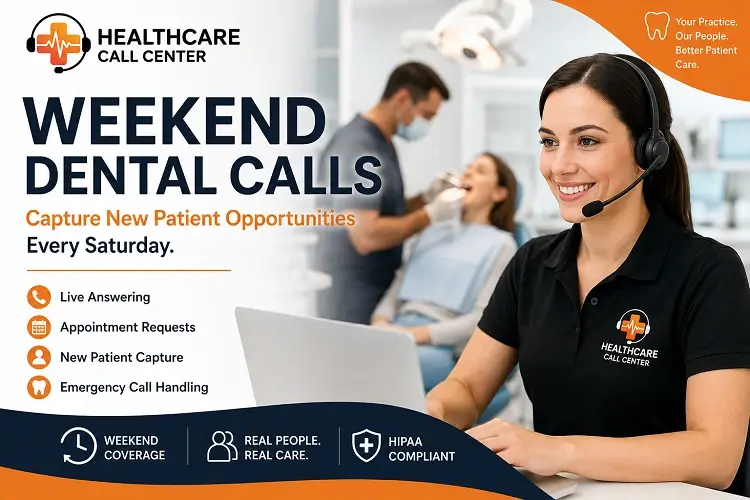
Dental practices lose some of their best new patient opportunities on Saturdays. Weekend callers often have dental pain, an urgent concern, or free time to finally book treatment, and most reach voicemail because the front desk is closed.
A dental answering service with weekend coverage answers those calls live, captures the appointment request, and turns Saturday phone time into scheduled production instead of Monday mystery voicemails.
For many dental practices, the weekend is a gap between when patients need help and when the front desk is available. That gap can mean missed appointment requests, unanswered questions, and patients choosing another practice simply because someone answered their call.
With the right weekend coverage, practices can stay accessible when their team is away while giving every caller a clear path to the next step.
Why Do Patients Call Dental Offices On Weekends?
Weekend calls are not random. They follow the rhythm of real life. People notice a cracked molar on Saturday morning. A parent spots a swollen gum after a Friday soccer game. Someone with a toothache finally has a day off to deal with it. Insurance questions and second opinions pile up on the days patients actually have time to make them.
These callers share one trait. They are ready to act now. A person who calls a dental office on a Saturday is not browsing. They have a need and a phone, and they are usually working down a short list of nearby practices. Patient expectations have shifted as well. As the American Dental Association and public health groups publish clearer guidance on what counts as a dental emergency, more patients know that a knocked-out tooth or uncontrolled bleeding should not wait until Monday, and they expect whoever answers to take it seriously.
Weekend callers also tend to be higher intent than weekday callers. A Tuesday call can be a shopper price-checking three offices between meetings. A Saturday call with pain attached is usually someone who wants this handled now, by the first competent practice that picks up. The willingness to call on a weekend is itself a signal of readiness to book, which is exactly why the voicemail default is so expensive.
What Kind Of Calls Come In On Saturday?
- Dental pain and swelling that cannot wait until Monday. Severe toothaches, facial swelling, and post-op complications dominate weekend lines, and patients often check emergency guidance through resources like MouthHealthy by the American Dental Association before they call.
- Broken or knocked-out teeth from weekend sports and accidents. Kids and weekend athletes supply a steady stream of fractures, and a fast response can decide whether a tooth is saved.
- New patient inquiries from people who finally have time to call. Saturday is when the nine-to-five workforce does its homework, compares practices, and books.
- Reschedule and confirmation requests ahead of Monday. Patients planning their week adjust appointments when they have a minute, and a missed reschedule quietly becomes a no-show.
- Insurance and treatment cost questions from patients planning care. Weekend planners price out crowns, implants, and cleanings before committing.
Appointment availability questions. Some patients are ready to schedule but want to know whether the practice has an appointment available before deciding whether to call again on Monday.
Notice how many of those lead directly to chair time. Emergency visits become same-day or Monday morning slots. New patient inquiries convert at their highest rate because the caller chose you. Even a reschedule is production protected. None of them can be handled by a voicemail box.
What Happens When A Weekend Caller Hears Voicemail?
Most callers do not leave a message. They hang up and dial the next practice on the list, which is exactly where your weekend new patient calls go. When a patient needs help on a Saturday, reaching a live person gives an available practice an important opportunity to schedule the dental patient appointment before the caller contacts another office.
The caller who reaches a warm live voice feels reassured before the appointment is even booked. The caller who reaches a dental practice’s voicemail feels dismissed at the exact moment they needed help, and that dismissal is what they remember when a friend asks for a dentist recommendation next month. Weekend call handling is not just missed production. It is reputation, quietly compounding in either direction.
Voicemail Versus Live Weekend Coverage
You do not have to guess at the difference. Put the two options side by side for the same Saturday call.
| What the caller experiences |
Voicemail only |
Live weekend coverage |
| First contact |
Recorded message and voicemail prompt |
Live person answers the call |
| New patient capture |
Only if the caller leaves a message |
Name, callback number, reason for calling, and preferred appointment times can be captured |
| Emergency handling |
Caller hears instructions and may call another office |
Urgent calls follow your defined protocol |
| Caller feeling |
May feel dismissed or left without help |
Reassured and assisted by a live person |
| Monday workload |
Voicemail backlog to untangle |
Organized weekend call information |
| Missed opportunity |
Caller may contact another practice |
Practice has an opportunity to capture the caller |
The pattern is consistent. Voicemail loses the patients who are most ready to book, and it loses them silently, because a caller who hangs up leaves no record that the call ever happened.
The Monday Morning Voicemail Problem
There is a second, quieter loss on Monday morning. When weekend calls pile into voicemail, the front desk starts the week in recovery mode. Messages are vague, numbers are garbled, and half the callers left no callback at all. Staff spend the first hours chasing ghosts instead of confirming appointments.
By the time they reach the messages that matter, the Monday schedule is already behind, and the Saturday caller with the cracked molar may have booked elsewhere out of simple impatience. Live weekend coverage removes that entire recovery phase. Monday begins with complete intake notes and a call list that converts, because the capture already happened while the patient was on the line.
How Can A Dental Answering Service Cover Weekends?
Weekend coverage works the same way practices already trust for evenings. A trained agent answers with your practice name, follows your protocols, and treats the caller with calm, friendly attention. Emergency calls follow your urgent path and reach the right person, whether that is your on-call dentist or a designated clinical contact. Appointment requests, including new patient details and reason for visit, are captured completely and delivered to your scheduling system or Monday morning queue.
Because agents work from your instructions, weekend coverage fits the practice rather than forcing a generic script. A pediatric office can route a knocked-out baby tooth differently than a prosthodontist would route a broken crown on an implant. That flexibility is the difference between a partner delivering dental call center service provider and a generic answering pool reading from a card.
Practices that struggle to return Monday calls often combine weekend coverage with an after-hours dental answering service so nothing falls through between Friday evening and Monday morning. The handoff between the two is invisible to patients, who simply reach a knowledgeable human every time they call.
What Should Weekend Coverage Include?
- Live answer within a few rings, every Saturday and Sunday, with no menus to navigate.
- Your practice greeting and tone, so callers trust they reached the right office.
- Emergency triage to your on-call dentist or urgent protocol, using your rules, not the service’s.
- Full new patient capture, including name, callback number, concern, insurance, and preferred times.
- Clear delivery to your team before the Monday morning huddle, in the format your scheduler actually uses.
Is Weekend Dental Answering Worth It?
For practices that receive meaningful weekend call volume, live answering can help capture appointment requests, urgent calls, and new-patient inquiries that would otherwise reach voicemail. The best way to determine whether it is worthwhile is to compare your weekend call volume, appointments booked, and patient value with the cost of coverage.
How Weekend Coverage Feeds Your Monday Schedule
The real payoff of Saturday coverage shows up Monday at 8 AM. Instead of an empty schedule with a voicemail backlog, your front desk opens a prepared queue. New patient requests are already documented with callback numbers and insurance details. Emergencies from the weekend are triaged into the first open chairs. Reschedules are logged, so the schedule you see is the schedule that is real.
A prepared Monday changes the whole week. Chairs fill earlier. The team starts in execution mode instead of triage mode. Production that used to leak out through the weekend now arrives pre-captured, and the only task left is confirmation calls that take seconds because the patient already expects them.
What Is One Saturday Of Missed Calls Actually Worth?
Run the numbers for your own chairs. A single new patient crown and hygiene visit often carries four figures of production. A root canal case carries more. Implant consultations run higher still. These are not hypothetical cases. They are the exact calls that come in on Saturdays from patients with pain or free time to plan treatment.
Now consider what those missed calls could mean over an entire year. If two weekend callers each month choose another practice, that represents 24 potential new-patient opportunities that your practice never had the chance to convert. The actual revenue impact will depend on your average patient value, treatment mix, and conversion rate, but even a small number of missed opportunities can add up.
Practices that answer weekends do not just recover calls. They recover treatment plans that would have quietly belonged to someone else.
Is Weekend Coverage Right For Every Practice?
Solo practices benefit fastest, because one missed emergency can define the whole month. When a single Saturday caller with a broken tooth becomes a crown, an overlay, and two recall visits. For some practices, even a small number of recovered weekend calls can make the cost of coverage worth considering.
Multi-location and group practices gain something different, which is consistency. Every branch answers with the same greeting, the same protocols, and the same message format, so weekend performance no longer depends on which location the caller dialed. And for practices that already offer extended hours, weekend coverage closes the final gap: the phones are live whenever a patient in pain needs them, without asking anyone on the team to give up a Saturday.
Weekend coverage is easier to launch than most practices expect. You approve the greeting, the urgent protocol, and the message format. The service handles the phones starting the next Saturday. Nothing about your weekday operations changes, and you can review message quality in the first weeks to fine-tune the script.
Your chairs do not need to sit empty on Monday. Book a free consultation and see how weekend call coverage would work for your practice.
Frequently Asked Questions
1. Do Dental Patients Really Call On Weekends?
Yes. Weekends bring dental emergencies, sports injuries, and new patient inquiries from people who cannot call during work hours. Many practices see steady weekend call volume even with no one there to answer.
2. What Happens To Weekend Calls We Miss?
Most callers hang up and call another practice. A small number leave voicemails that staff return Monday, when the caller may already be booked elsewhere.
3. Can A Weekend Answering Service Reach Our On-Call Dentist?
Yes. Emergency calls follow the urgent protocol you define, which can include reaching your on-call dentist or following specific after-hours instructions.
4. Will The Answering Service Know Dental Terminology?
Agents trained for dental practices understand common concerns like broken teeth, swelling, pain levels, and post-op questions, and they follow your scripts for anything clinical.
5. How Do We Get Weekend Messages?
Messages and new patient details are delivered your way, by email, SMS, or directly into your scheduling workflow, so Monday morning starts with everything organized.
6. Can Weekend Coverage Start With Just Saturdays?
Yes. Many practices begin with Saturday-only coverage and add Sundays or evenings once they see call volume and message quality. Coverage scales with your schedule, not a package.
by Erika Sanchez | Aug 29, 2026 | Chiropractor Answering Services
Running a chiropractic clinic means constant motion.
Providers are with patients on the table. The front desk is checking people in, collecting insurance details, answering questions about treatment plans, and processing payments. The phone keeps ringing while everyone is already busy.
When the front desk is mid-checkout with one patient, the incoming call often goes unanswered. Multiply that by a full schedule, and a busy clinic can miss a surprising number of chiropractic appointment calls every week.
A hipaa compliant chiropractic answering service gives clinics a way to answer those calls with a live, trained voice instead of voicemail, so new patient requests, reschedules, and important messages are captured instead of lost.
This blog explains what a chiropractic answering service does, why busy-hours and after-hours calls matter so much for chiropractic growth, and what clinics should look for when choosing support.
Why Chiropractic Calls Are High-Intent Calls
Most people do not call a chiropractor casually.
They call because their back went out. Because a headache will not go away. Because a car accident left them stiff and a lawyer or physician told them to get evaluated. Because they finally decided to do something about the pain that has been building for months.
In other words, when someone calls a chiropractic clinic, they are usually ready to act. The three most common high-intent callers are:
- New patients in pain who want the earliest available appointment
- Auto accident and workers’ compensation cases that need documentation and careful intake
- Existing patients who need to reschedule, rebook, or ask about their treatment plan
Each of those calls has value. New patient calls are the growth engine of the practice. Personal injury cases can become long treatment plans. Reschedule calls protect the schedule from empty slots.
When those calls go to voicemail during busy hours, the caller does not always leave a message. Many simply call the next clinic on the list. For a competitive local market, that is real lost revenue, not just a missed message.
The Busy-Hours Problem in Chiropractic Clinics
Front desk overload in a chiropractic office follows the schedule.
The busiest phone windows usually match the busiest patient windows: early morning before the first adjustments, lunch hour, and the after-work rush between 4 PM and 6 PM. Those are also the exact hours when the front desk has the least time to answer.
That is the core problem a chiropractor answering service solves: it covers the phone exactly when the team cannot, so chiropractor front desk overflow does not turn into missed patient calls. Only a dedicated after-hours chiropractic answering service can help you manage your after-hours calls.
Common busy-hours patterns include:
- Two or three calls arriving at once during morning check-in
- The desk blocked during payment and insurance conversations
- Short-staffed days when one person runs the entire front office
- Marketing or referral surges that create sudden call spikes
- Wellness events or promotions that bring a wave of new caller questions
None of these situations means the clinic is poorly run. They mean demand is higher than the front desk can absorb at peak moments. Overflow answering is built for exactly those moments.
What a Chiropractor Answering Service Actually Does
A chiropractor answering service is live call answering and message handling, built around the clinic’s own workflow.
Depending on how the clinic sets it up, trained agents can:
- Answer calls with a clinic-specific greeting
- Capture new patient inquiries with name, number, and reason for calling
- Document appointment request and callback details
- Take reschedule and cancellation messages
- Record auto accident or workers’ compensation intake notes for staff review
- Route messages to the right person or location
- Escalate time-sensitive messages using clinic-approved rules
- Send structured message summaries for next-day follow-up
For clinics that want broader coverage across scheduling, intake, and reporting, a full chiropractic call center services provider setup can handle more of the patient communication workflow end to end.
One important boundary: agents do not give medical advice, discuss treatment, or decide what is urgent. They follow the clinic’s instructions, capture information accurately, and route messages by the rules the clinic approves. That keeps the service safe, simple, and predictable.
New Patient Calls: The Growth Engine Worth Protecting
Every chiropractic practice grows through new patients, and the phone is still where most new patients start.
A new caller is often in pain, comparing two or three clinics, and ready to book with whoever helps them first. The first clinic that answers with a friendly, competent voice has a real advantage.
When the call goes to voicemail:
- Many callers hang up without leaving a message
- Some call a competitor within minutes
- Others plan to call back later and forget
- Referral patients lose momentum waiting for a callback
Live answering changes that outcome. The caller reaches a calm human voice, hears that the clinic will get their message, and knows what happens next. That single interaction protects the new patient relationship before the first visit ever happens.
Clinics that want a deeper look at the model can read the companion guide on choosing a call center for chiropractic clinics, which walks through the full evaluation process.
Chiropractic Appointment Calls and Schedule Protection
Chiropractic schedules live and die on rebooking consistency. Missed and delayed appointment calls create gaps that are hard to fill on short notice.
A common pattern: an existing patient realizes at 7:30 PM that they cannot make tomorrow morning’s appointment. If their only option is voicemail, several things can go wrong:
- The message is unclear or incomplete
- The front desk sees it late the next morning
- The slot goes unused because there was no time to fill it
- The patient feels their effort to notify the clinic was ignored
Live answering captures the change immediately, documents it clearly, and gets it to the right place. The clinic can fill the slot, and the patient feels heard. Better message quality also means the front desk spends less time chasing clarification and more time caring for patients.
After-Hours Chiropractor Calls Still Convert
Pain does not follow office hours. Many patients first decide to seek help in the evening, on weekends, or early in the morning before work.
An after-hours healthcare answering service covers those hours, so evening and weekend callers still reach a live voice instead of a recording.
This matters for two reasons.
First, after-hours callers are often ready to book. They have finally admitted the pain is not going away, or they just got a referral, or they made the decision with a family member at dinner. Reaching voicemail at that exact moment of motivation is the worst possible timing.
Second, after-hours coverage protects the front desk. Instead of starting the day with a pile of unclear messages, the team starts with structured summaries they can act on immediately.
Chiropractic Clinics in Competitive Local Markets
Local competition shapes call behavior. In high-growth states, clinics often benefit from coverage designed for their market, such as a Florida chiropractor answering service that understands the call volume and patient expectations in that region.
Local search makes this even more important. When a patient searches for a chiropractor nearby, they usually call the top two or three results. If the first clinic does not answer, the second one gets the patient. Fast, reliable answering converts more of the local search traffic the clinic already earns.
The same logic applies to referrals from physicians, attorneys, gyms, and wellness partners. Those referral sources notice which clinics respond quickly, and responsiveness strengthens the referral relationship over time.
What to Look for in a Chiropractic Answering Provider
Not every answering service understands chiropractic workflows. When comparing providers, clinics should check for:
- Healthcare call experience and HIPAA-conscious message handling
- Custom greetings and scripts instead of generic templates
- Clear intake fields for new patient and personal injury calls
- Routing rules that match the clinic’s staff and locations
- Escalation rules the clinic controls and approves
- US-based agents who understand local patient expectations
- Structured message delivery the front desk can act on quickly
- Simple reporting so the clinic can see call outcomes
The goal is support that feels like part of the clinic, not an outside vendor reading a script.
How Healthcare Call Center Helps Chiropractic Clinics
Healthcare Call Center provides live answering support built for healthcare practices, including chiropractic clinics that need help during busy hours, after hours, or both.
Support includes:
- Live patient call answering with trained, US-based agents
- New patient inquiry capture with clinic-approved intake fields
- Appointment request, reschedule, and cancellation message handling
- Front desk overflow coverage during peak hours
- After-hours and weekend coverage
- Message routing by provider, location, or department
- Escalation based on rules the clinic approves
- HIPAA-conscious documentation workflows
If your clinic is losing calls during busy hours, book a free consultation and we will review where patient calls are leaking and how live answering can close the gap.
Final Takeaway
A busy chiropractic clinic does not have a people problem. It has a coverage problem.
The front desk cannot answer every call while checking in patients, handling payments, and keeping the schedule moving. The phone keeps ringing anyway, and the callers on the other end are often new patients ready to book.
A chiropractor answering service closes that gap with live, trained, clinic-aligned call handling during the exact windows where calls are lost. New patient inquiries get captured. Reschedules arrive with clear context. After-hours callers reach a human voice. The front desk starts each day with organized messages instead of a voicemail backlog.
For clinics that want to grow without adding front desk hours, better call coverage is one of the fastest, most practical wins available.
FAQ
What is a chiropractor answering service?
A chiropractor answering service answers patient calls for chiropractic clinics with live, trained agents. It captures new patient inquiries, appointment requests, reschedules, and messages, and routes them using the clinic’s approved workflow.
Can an answering service help with new patient calls during busy hours?
Yes. Busy-hours overflow answering is one of the most common uses. When the front desk is checked in or mid-payment with another patient, live agents answer incoming calls so new patient inquiries are captured instead of lost to voicemail.
Does a chiropractic answering service work after hours and on weekends?
Yes. After-hours coverage answers evening, weekend, and early morning calls, documents messages clearly, and routes anything time-sensitive using escalation rules the clinic approves.
Will agents give medical advice to patients?
No. Agents do not diagnose, recommend treatment, or decide what is urgent. They follow the clinic’s scripts and routing rules, capture information accurately, and escalate according to approved instructions.
Is this only for large multi-location clinics?
No. Single-location practices use answering support to protect new patient calls and reduce front desk pressure, while multi-location groups use it to standardize routing and coverage across offices.