by Erika Sanchez | Jul 1, 2026 | Fertility & IVF Clinic Answering Service
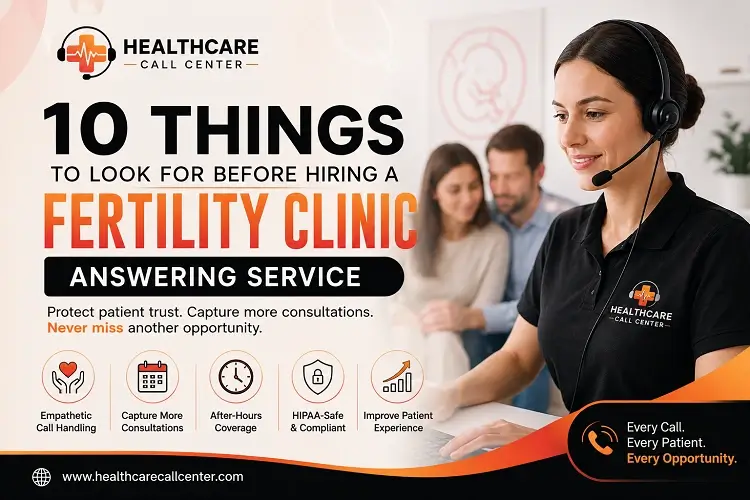
Choosing a fertility clinic answering service is not a simple vendor decision. For fertility and IVF practices, the first phone call can carry more emotional weight than almost any other step in the patient journey. A caller may be exploring IVF after years of trying to conceive. They may be asking about egg freezing, donor options, insurance, financing, appointment availability, or whether your clinic can help with a situation that feels deeply personal.
That is why a fertility clinic answering service needs to do more than answer calls. It needs to protect trust, capture patient intent, support appointment momentum, and give your in-office team clear information for follow-up.
A generic call center may be able to take a name and number. But fertility patients often need a calmer, more thoughtful experience. They want to feel like the clinic understands the sensitivity of the decision they are making. If the call goes to voicemail, feels rushed, or results in a vague handoff, the patient may continue searching and contact another fertility clinic before your team ever calls back.
This article explains what fertility clinics should look for before hiring an answering service, what questions to ask, and how to compare providers before choosing one.
Why fertility clinic calls are different from general medical calls
Fertility calls are different because the patient journey is different. A dermatology patient may call to ask for the next available appointment. A dental patient may call to schedule a cleaning or discuss pain. A fertility patient may call after months of private research, emotional stress, and major financial planning.
That caller is often not just looking for a time slot. They are listening for signs that your clinic is organized, kind, responsive, and capable of guiding them through a complicated process.
That makes the first call a trust signal. If a caller reaches voicemail, waits too long, or receives a cold response, it can create doubt. They may wonder whether the clinic will be responsive later in treatment, whether the staff will be supportive, or whether another practice may be easier to work with.
A strong fertility answering service understands that every call is part of the patient experience. It does not treat fertility inquiries like routine message-taking. It helps callers feel heard while capturing the details your team needs.
Patients are already comparing clinics
This is where the patient started comparing clinics because the person searching for a fertility clinic answering service is usually not learning what call coverage is for the first time. They may already know their clinic has a phone coverage problem. They may be comparing providers. They may be trying to decide whether a specialized healthcare call center is worth it compared with a cheaper generic answering service.
At this stage, the right question is not “Do we need someone to answer phones?”
The better question is “Can this provider protect our patient experience and help us capture more consultation opportunities?”
Fertility clinics have a high-value patient journey. A missed or poorly handled call may not be a small administrative issue. It may represent a potential consultation, a treatment inquiry, or a patient who is ready to take the next step. When those calls are not handled carefully, the practice can lose opportunities before they ever become visible in the schedule.
1. Look for empathy, not just availability
The first thing to evaluate is tone. Many answering services can provide availability. Fewer can provide empathy.
Fertility patients may be emotional, nervous, hopeful, private, or overwhelmed. They may not know exactly what to ask. They may need a calm person to gather information and guide them toward the right next step.
When comparing fertility answering services, ask how calls are handled.
Are agents trained to slow down and listen?
Do they understand that fertility calls can be sensitive?
Can they speak with warmth without giving medical advice?
Do they know how to make a caller feel supported rather than processed?
Empathy matters because patient trust starts before the consultation. A caller who feels rushed or dismissed may not book. A caller who feels heard is more likely to continue the process.
2. Make sure the service captures consultation intent
A fertility clinic answering service should not only collect basic contact information. It should help identify why the patient is calling and what kind of next step they may need.
For example, a caller may be asking about IVF, egg freezing, fertility testing, second opinions, donor options, financing, insurance, or new patient consultation availability. Your clinic does not need the answering service to diagnose or advise. But your team does need a useful handoff.
A weak handoff says: “Patient called. Please call back.”
A stronger handoff says: “New patient inquiry. Interested in IVF consultation. Asked about insurance and next available appointment. Prefers afternoon callback.”
That second version gives your team context. It helps the follow-up feel personal. It can also reduce back-and-forth and help your staff prioritize high-intent inquiries.
3. Ask how after-hours fertility calls are handled
Many fertility patients research clinics outside normal business hours. They may call after work, during lunch, in the evening, or on weekends. If your practice is only reachable during office hours, you may be missing high-intent patients when they are most ready to act.
An after-hours fertility answering service should do more than take a message. It should capture the caller’s reason for calling, explain the next step according to your clinic’s instructions, and route the information clearly.
This is especially important for clinics that invest in SEO, Google Business Profile, paid ads, social media, or referral partnerships. If marketing creates demand but the phone experience breaks down after-hours, the clinic may pay to generate interest and then lose the patient at the first call.
4. Confirm the provider understands HIPAA-safe workflows
Fertility calls can involve sensitive information. Patients may mention treatment history, diagnoses, timing, medications, insurance, or personal circumstances. Your answering service should understand healthcare privacy expectations and use workflows that are appropriate for patient communication.
Before hiring any provider, ask how patient information is documented, where messages are stored, who receives them, and how access is controlled. Ask whether the team understands what should not be discussed in unsafe channels. Ask how they avoid casual handling of sensitive details.
A fertility clinic should avoid any provider that treats patient information like ordinary consumer lead data. Fertility communication requires more care.
5. Look for customized scripts, not generic call center language
Generic scripts often sound wrong for fertility clinics. A caller can usually tell when someone is reading a cold script that was not built for the practice.
The right fertility answering service should be able to customize call flows around your clinic’s services, tone, hours, locations, provider availability, scheduling process, and escalation rules.
A good script should guide the conversation without sounding robotic. It should help the agent capture the right details while still sounding human. It should also set the right expectation for what happens next, such as whether the clinic will call back, when follow-up usually occurs, or how new patient inquiries are routed.
6. Ask about escalation rules and boundaries
An answering service should not pretend to be a clinician. It should not give medical advice, interpret symptoms, or make promises about treatment. For fertility clinics, boundaries are important.
Before hiring a provider, define what should happen for different call types. New patient inquiry. Existing patient message. Appointment change. Billing question. Urgent concern. Medication question. Lab-related question. After-hours issue.
Your provider should follow your rules. They should know what to document, what to escalate, and what to route for the next business day. This helps protect both the patient experience and the clinic’s workflow.
7. Evaluate the handoff quality
The handoff is where the value of a fertility clinic call center becomes visible. If your team receives unclear, incomplete, or delayed information, the answering service becomes another operational burden.
Ask to see a sample message or call summary. Does it include patient name, phone number, reason for calling, service interest, urgency, callback preference, and any relevant notes? Is it easy for your front desk or intake coordinator to understand? Does it help the team follow up with confidence?
A good handoff should make your team faster. It should not force staff to start the conversation from zero.
8. Make sure reporting is included
A fertility clinic answering service should help you understand what is happening with your calls. At a minimum, you should be able to see call volume, call reasons, after-hours demand, missed-call risk, and captured opportunities.
Reporting matters because call coverage is not just a cost. It is part of your patient acquisition and patient access system. If you know when calls are coming in, what patients ask about, and where follow-up is needed, you can improve scheduling, staffing, marketing, and patient communication.
Without reporting, you are guessing.
9. Compare specialized healthcare support against generic answering services
A generic answering service may be cheaper, but cheaper is not always better for fertility practices. The question is whether the provider can protect the patient experience and support your clinic’s revenue-producing patient journey.
A specialized healthcare call center is more likely to understand privacy, empathy, escalation rules, appointment intent, and the importance of clear documentation. A generic service may be fine for basic message-taking, but fertility clinics usually need more than that.
When comparing providers, do not only compare price. Compare the quality of the patient experience, handoff clarity, healthcare knowledge, and ability to support high-intent consultation inquiries.
10. Use this checklist before hiring a fertility answering service
Before choosing a provider, ask these questions:
- Do you have experience with fertility, IVF, or specialty healthcare practices?
• How do you train agents to handle sensitive patient calls?
• Can your scripts be customized to our clinic’s services and tone?
• How do you document new patient inquiries?
• How quickly are call summaries sent to our team?
• How do you handle after-hours and weekend calls?
• What information do you capture for consultation inquiries?
• How do you protect sensitive patient information?
• Can you follow our escalation rules?
• What reporting do we receive?
• How do you help our team identify high-intent patient opportunities?
If a provider cannot answer these questions clearly, they may not be the right fit for a fertility clinic.
Why is a Healthcare Call Center built for fertility practices
Healthcare Call Center supports fertility clinics with real human call coverage, healthcare-aware workflows, and clear handoffs. The goal is not to replace your clinical team. The goal is to make sure patient calls are answered with warmth, documented properly, and routed in a way your staff can act on.
For fertility clinics, this matters because the phone call is often the first moment a patient decides whether your practice feels trustworthy. A strong answering service helps protect that moment.
If your clinic is comparing fertility answering services, start by reviewing the dedicated fertility clinic answering service page: https://healthcarecallcenter.com/fertility-clinic-answering-service/
Final Thoughts
The right fertility clinic answering service should feel like an extension of your practice. It should help patients feel heard, help your staff receive better information, and help your clinic protect high-intent consultation opportunities.
Before you hire a provider, look beyond basic availability. Ask about empathy, handoff quality, after-hours coverage, privacy workflows, escalation rules, customization, and reporting.
Fertility patients are not just calling for information. Many are looking for reassurance that they are choosing the right clinic. Your call coverage should support that trust from the first ring.
Frequently Asked Questions
What is a fertility clinic answering service?
A fertility clinic answering service provides call coverage for fertility and IVF practices when the in-office team is busy, unavailable, or closed. It helps answer calls, capture patient intent, and route information back to the clinic.
Why do fertility clinics need a specialized answering service?
Fertility patients often have sensitive questions and high emotional urgency. A specialized answering service can help callers feel heard while capturing the details the clinic needs for follow-up.
Can a fertility answering service help with after-hours calls?
Yes. A fertility answering service can help capture after-hours inquiries, document the caller’s reason for calling, and send a clear handoff to the clinic for follow-up.
What should fertility clinics look for before hiring an answering service?
Fertility clinics should look for empathy, healthcare experience, HIPAA-safe workflows, customized scripts, clear handoffs, after-hours coverage, escalation rules, and reporting.
Is a generic answering service enough for an IVF clinic?
A generic answering service may handle basic message-taking, but IVF and fertility clinics usually need a more specialized approach because calls are sensitive, high-intent, and often tied to consultation decisions.
by Erika Sanchez | Jun 30, 2026 | dentist call center services
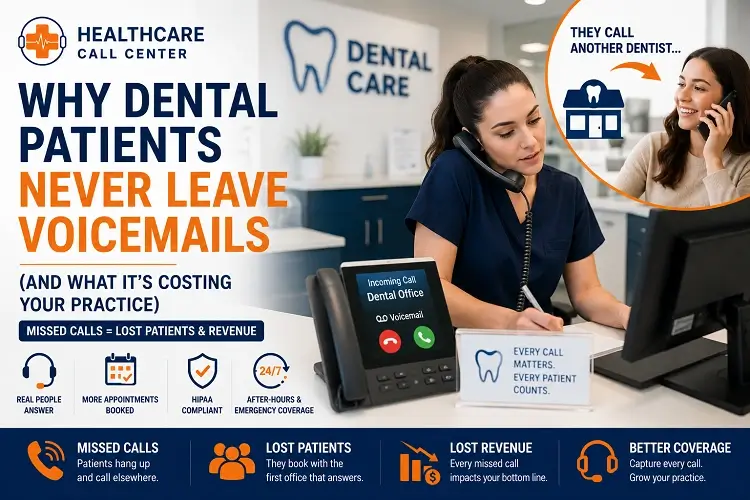
When a dental patient calls your office and hears a voicemail greeting, what do they do next?
Most practice owners assume the patient leaves a message and waits for a callback. That is rarely what happens.
According to multiple studies on consumer call behavior, up to 80% of callers who reach voicemail hang up without leaving a message. For dental practices, that statistic is even more painful because a missed call often represents a patient ready to book treatment.
They do not wait. They do not leave a message. They call the next dentist on Google Maps.
If your front desk is busy at lunch or off the clock, those calls are going to voicemail. And those patients are going somewhere else.
This blog explains why dental patients do not leave voicemails, how much revenue each missed call costs your practice, and what you can do to stop losing patients to the office down the street. This is where a 24/7 dental answering service comes in to bring your revenue back.
The Problem with Voicemail in Dental Practices
Most dental practices are not intentionally ignoring calls. The front desk is handling check-ins, insurance verification, treatment plan discussions, payments, and patient questions all at the same time. When two calls come in at once, one goes to voicemail.
After hours, the situation is worse. If your office closes at 5 PM and a patient calls at 5:47 PM because they cracked a tooth while eating dinner, that call goes to voicemail. That patient is in pain. They are not going to wait until morning.
They are going to call the next dental office that answers.
Here is the hard truth: voicemail does not capture new patients. It captures messages from existing patients who already trust you. New patients, referrals, and high-value treatment inquiries rarely leave voicemails because they have no loyalty to your practice yet.
What a missed dental call actually costs
Let us break down the math for a typical dental practice.
If your office misses 5 calls per day (a conservative estimate for a busy practice), that is 25 missed calls per week or about 100 per month.
If even 15% of those calls were new patient inquiries with treatment plans averaging $1,500 to $3,000, you are looking at $22,500 to $45,000 in potential revenue walking out the door every month.
Now consider after-hours calls. If 40% of patient calls come in before 8 AM or after 5 PM, and your office is closed, those calls hit voicemail every single time.
That is not a front desk problem. That is a coverage problem.
5 Reasons Dental Patients Will Not Leave a Voicemail
1. They are comparing offices
When a patient searches “dentist near me” on Google, they typically call 2 to 3 offices before choosing one. If you do not answer, they move to the next result. They are not invested in your practice yet. Voicemail feels like a dead end to someone comparison shopping.
2. They are in pain or anxious
Dental callers often have a specific problem. A cracked crown. A child with a toothache. A sudden tooth sensitivity that scares them. When someone is anxious or in pain, hearing a recorded message does not feel reassuring. They want to hear a human voice that says, “We can help you.”
3. They expect immediate answers
Patients today are used to instant responses from food delivery apps, retail stores, and service providers. When they call a dental office and get voicemail, their expectation shifts. If your office cannot answer the phone, they wonder how responsive you will be as their healthcare provider.
4. They assume you are too busy
A ringing phone that goes to voicemail sends a signal. Whether it is accurate or not, the patient thinks, “This office is too busy for me.” For a new patient evaluating where to spend their healthcare dollars, that perception matters.
5. They have already been told to call elsewhere
Many dental insurance directories list multiple in-network providers. If the first office does not answer, the patient simply calls the next provider on the list. Your competitor answers, books the appointment, and you never even knew the patient called.
What a Dental Answering Service Actually Does
A dental answering service is not just a call center that takes messages. It is a dedicated layer of call coverage designed specifically for dental practices.
Here is what that looks like in practice.
Answers every call, every time
When your front desk is checking in a patient and two calls come in at once, the answering service picks up immediately. No busy signal. No voicemail. The patient hears a friendly, professional voice and gets the help they need.
Captures new patient inquiries
When a new patient calls after hours to ask about Invisalign, implants, or a second opinion, the answering service captures their name, contact details, reason for calling, and insurance information. Your front desk gets the lead first thing in the morning, ready to follow up.
Handles after-hours emergencies
When a patient calls at 9 PM with a dental emergency, the answering service follows your protocol. They document the issue, reassure the patient, and route the call to your on-call dentist if needed. The patient feels cared for. Your practice protects its reputation.
Supports overflow during busy periods
During peak hours, lunch breaks, staff meetings, or hygiene checks, the answering service handles the overflow. Your in-office team can focus on the patient standing in front of them without feeling guilty about the phone ringing in the background.
Why a Generic Answering Service Does Not Work for Dental Offices
You might be thinking, “Can I just use any answering service?”
The short answer is no. Here is why.
Dental calls are different from generic business calls. Patients ask specific questions about insurance networks, treatment costs, appointment availability, post-op care, and dental anxiety. A generic answering service operator reading a script cannot handle these questions with confidence.
A specialized dental call center understands:
- Dental terminology (crowns, bridges, implants, root canals, perio charting)
- Insurance concepts (PPO, in-network, deductibles, annual maximums)
- Appointment urgency (a broken tooth is not the same as a routine cleaning)
- Patient anxiety and empathy (many dental callers are nervous)
- HIPAA-compliant information handling
When a patient calls your dental office, they should feel like they reached your team. Not a call center. Not a robot. A real person who knows what they are talking about.
How to Choose the Right Answering Service for Your Dental Practice
If you are considering an answering service for your dental practice, here are the key questions to ask.
Do they understand dental workflows?
Ask whether their agents are trained on dental-specific call flows. Can they handle new patient intake? Do they understand the difference between a hygiene recall and an emergency? Do they know what to ask when a patient calls about a broken crown?
Is it HIPAA-compliant?
Any service handling patient calls, insurance details, or appointment information must be HIPAA-compliant. Ask about their training, their data handling, and whether they sign Business Associate Agreements.
Can they follow your custom protocols?
Every dental practice handles calls differently. Some want emergencies routed to a cell phone. Others want all messages sent by email before 8 AM. Your answering service should build the workflow around your preferences, not force you into a rigid script.
Do they offer 24/7 coverage?
Dental patients call at all hours. Before work, after dinner, on weekends. If your answering service only covers business hours, you are still missing calls. Look for true 24/7 coverage, including weekends and holidays.
Are the agents real people?
Some services use AI bots or automated systems to handle calls. For dental patients, who are often anxious or in pain, talking to a robot makes the experience worse. Look for a service where real humans answer every call.
What Happens When You Stop Missing Dental Calls
When every call gets answered, three things change quickly.
- New patient numbers go up. You capture the callers who were previously going to voicemail and moving on. Even capturing 5 extra new patients per month at an average of $1,500 per treatment plan adds $7,500 in monthly revenue.
- Front desk stress goes down. Your team is no longer torn between the patient at the desk and the phone ringing. They can focus on in-office patient care knowing the phones are covered.
- Online reviews improve. Patients who reach a helpful, friendly person on the first call are more likely to leave positive reviews. Patients who hit voicemail are more likely to leave frustrated feedback or no review at all.
The Bottom Line for Dental Practices
Every missed call is a patient who wanted your help and did not get it.
Some of those patients are new. Some are existing patients with emergencies. Some are referrals from other patients who trust you.
When those calls go to voicemail, you lose the patient, the revenue, and the relationship.
A dental call center that answers every call with empathy, captures every inquiry, and follows your protocols is one of the most cost-effective ways to grow a dental practice without adding more front desk staff.
If your office is missing calls, the question is not whether you can afford an answering service. The question is: how many patients are you losing this week because nobody picked up the phone?
We will tell you how many patients you are losing monthly.
Frequently Asked Questions
How much does a dental answering service cost?
Pricing depends on call volume, coverage hours, and the complexity of your call workflow. Most dental practices find that recovering even 2 to 3 missed new patient calls per month covers the entire cost of the service.
Will patients know they are talking to an answering service?
No. A quality dental answering service answers with your practice name and follows your scripts. The goal is to feel like a seamless extension of your front desk.
Can the answering service schedule appointments directly?
Yes, depending on your setup. Some practices prefer the answering service to capture inquiry details and let the front desk call back. Others connect the service directly to their scheduling software for real-time booking.
What about after-hours dental emergencies?
Your answering service follows your emergency protocol. They document the issue, reassure the patient, and contact your on-call provider based on the rules you set. Patients get immediate help. You get documented, organized information.
by Erika Sanchez | Jun 29, 2026 | Expert Advice
If your front desk is doing everything right but still drowning in calls, the problem may not be your people. It may be your call volume.
Most growing medical practices reach a point where the phone becomes too much for the in-office team to manage alone. Patients call during lunch. New leads call after work. Existing patients call with questions while your team is checking someone in, collecting paperwork, talking to insurance, or helping the provider stay on schedule.
That is usually when the question comes up:
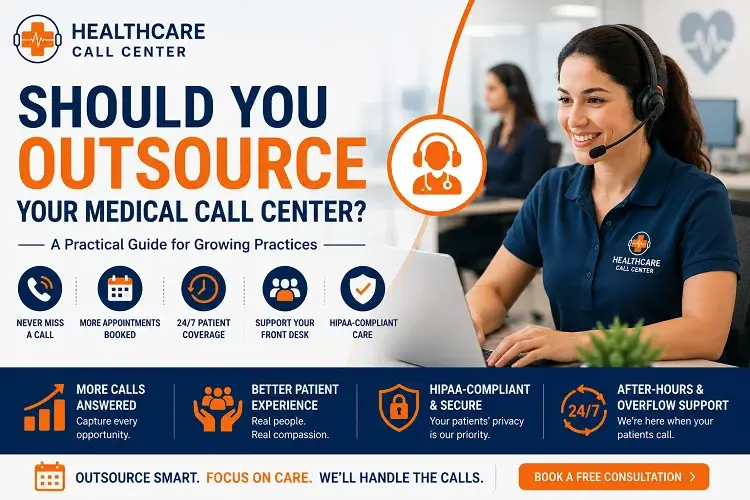
Should we outsource our medical call center?
For some practices, the answer is yes. For others, it may be too early. The key is knowing when outsourcing helps patient access and when it creates more confusion.
This guide explains what it means to outsource a medical call center, when it makes sense, what to look for in a partner, and how to avoid the common mistakes that make patients feel like they are talking to a script instead of a real person.
What Does It Mean to Outsource a Medical Call Center?
To outsource your medical call center means using an outside healthcare call center partner to handle patient phone calls, appointment requests, follow-ups, after-hours inquiries, or overflow call volume.
This does not always mean replacing your front desk.
In many practices, outsourced call coverage works best as an extension of the in-house team. Your front desk still handles in-office patients, clinical workflows, payments, provider support, and complex internal tasks. The outsourced medical call center helps make sure calls are answered when your team is busy, unavailable, or closed.
A medical call center partner may support:
- New patient calls
- Appointment scheduling requests
- After-hours inquiries
- Overflow calls during busy times
- Missed call recovery
- Basic patient questions
- Call routing
- Front desk backup
- Lead intake for high-value services
- Follow-up workflows
The goal is simple: fewer patient calls fall through the cracks.
For healthcare practices, this matters because a missed call is rarely just a missed call. It may be a patient trying to book, a nervous caller comparing providers, a parent trying to find help, or someone who finally decided to schedule after weeks of hesitation.
If nobody answers, they may not wait.
Why Growing Medical Practices Start Considering Outsourcing
Most practices do not wake up one day and decide to outsource because they want another vendor. They consider it because the current system starts breaking under pressure.
The front desk is busy. The phone keeps ringing. Patients are waiting in person. Providers need support. Calls go to voicemail. Staff feel rushed. New patient opportunities get delayed.
At first, it feels manageable. Then it becomes normal.
That is the danger.
When missed calls become part of the daily routine, patient access starts to suffer. A growing practice may still be generating demand, but the team may not have enough call coverage to convert that demand into scheduled appointments.
Here are common signs your practice may be ready to outsource medical call center support.
1. Your Front Desk Is Constantly Interrupted
Your front desk team may be excellent with patients. But even a great team can only do so much at once.
They may be checking in a patient while the phone rings. They may be helping someone with paperwork while another caller waits. They may be handling insurance questions while a new patient call goes to voicemail.
This is not a staff quality issue. It is a capacity issue.
When the front desk is forced to handle every walk-in, every phone call, every scheduling request, and every in-office interruption, something eventually gets missed.
Outsourcing helps by creating a backup layer. Calls can be answered even when your in-office team is busy giving attention to the patient standing in front of them.
2. New Patient Calls Are Going to Voicemail
Voicemail may be useful for internal messages, but it is weak for new patient conversion.
A new patient calling for the first time may not have loyalty to your practice yet. They may be comparing options. They may be anxious. They may be calling from a search result and ready to book if someone answers.
If they reach voicemail, they may move to the next provider.
This is one of the strongest reasons practices outsource call coverage. The goal is not just answering more calls. The goal is to answer the right calls at the right moment.
For specialties like fertility, plastic surgery, dental, OB-GYN, medical weight loss, and behavioral health, that first conversation matters. The patient may be nervous, embarrassed, price-sensitive, or unsure if they are a good fit.
A real human conversation can keep that opportunity alive.
3. Calls Spike During Lunch, Peak Hours, and After Work
Many practices think of call coverage as an after-hours problem. But missed calls also happen during normal business hours.
Common pressure points include:
- Monday mornings
- Lunch breaks
- End of day
- Staff meetings
- Provider delays
- Short-staffed days
- High-volume campaign periods
- Seasonal demand spikes
Patients do not always call when it is convenient for your team. They call when they have a break, when symptoms worry them, when they finally find time, or when they are ready to schedule.
An outsourced healthcare call center can help cover these gaps without forcing the practice to hire, train, and manage extra staff for every busy window.
4. Your Team Is Spending Too Much Time on Basic Calls
Not every phone call requires your most experienced in-office staff member.
Some calls are simple but still important:
“Are you accepting new patients?”
“What are your hours?”
“Can I book an appointment?”
“Where are you located?”
“Do you offer this service?”
“Can someone call me back?”
When your front desk spends all day answering repetitive calls, they have less time for the patients already in the office.
A good outsourced medical call center can handle the first layer of call intake and scheduling support. That allows your internal team to focus on higher-value work that truly needs their attention.
5. You Are Spending Money on Marketing but Losing Calls
If your practice is investing in SEO, paid ads, social media, direct mail, referral campaigns, or local marketing, call coverage becomes even more important.
Marketing creates demand. Call answering captures it.
If a patient clicks an ad, visits your website, reads a service page, and calls your office, that call is one of the most valuable moments in the funnel.
But if the call is missed, the marketing spend does not convert.
This is why medical call center outsourcing should not be viewed only as an operations decision. It is also a growth decision.
If patient acquisition matters, call coverage matters.
In-House vs Outsourced Medical Call Center: Which Is Better?
There is no universal answer for in-house Vs outsourced medical call centers to find the best. The best choice depends on your practice size, call volume, staffing, budget, specialty, and patient expectations.
In-house call handling works well when:
Call volume is low or predictable
Your team has enough capacity
Patients need highly specific clinical guidance
The practice has strong internal scheduling coverage
You can hire and retain trained front desk staff
Outsourced medical call center support works well when:
Calls are being missed
Staff are overloaded
New patient calls need a faster response
The practice needs after-hours support
Marketing is generating more inbound demand
You need overflow coverage without hiring full-time staff
You want consistent call handling across multiple locations
For many growing practices, the best answer is not either-or. It is both.
Your in-house team handles the practice. The outsourced call center protects access when your team is busy, closed, or overloaded.
What Should an Outsourced Medical Call Center Handle?
A strong medical call center partner should not feel disconnected from your practice. Patients should feel like they are talking to someone who understands the basics of your services, your tone, and your scheduling process.
Depending on your workflow, an outsourced medical call center may handle:
New patient intake
This includes collecting basic details, understanding why the patient is calling, and guiding them toward the right next step.
Appointment scheduling support
For many practices, scheduling is the highest-value call center function. A call center should understand your scheduling rules, appointment types, available locations, and handoff process.
After-hours call answering
After-hours support helps patients reach a real person instead of voicemail when the office is closed.
Overflow call coverage
During busy hours, overflow support can keep calls from being abandoned or missed.
Missed call follow-up
If a call is missed, a quick follow-up can help recover patients before they contact another provider.
Call routing
Some calls need the front desk. Some need billing. Some need a clinical callback. A trained call center can route calls appropriately based on your rules.
Basic patient communication
The right partner can answer common non-clinical questions and help patients feel heard without overstepping into clinical advice.
What to Avoid When Outsourcing a Medical Call Center
Outsourcing can help, but only if the partner understands healthcare communication. A poor call center can create frustration for both patients and staff.
Here are the biggest red flags.
1. Script-Only Conversations
Patients can feel when someone is just reading from a script.
Healthcare calls often involve emotion. A patient may be nervous about symptoms, worried about cost, embarrassed to ask questions, or frustrated because they have already called multiple offices.
A script may keep the call organized, but it cannot replace listening.
Look for a call center that trains agents to sound human, ask smart questions, and respond with empathy.
2. Weak HIPAA Awareness
A medical call center must understand privacy and patient information handling. If a vendor creates, receives, maintains, or transmits protected health information on behalf of a healthcare organization, HIPAA responsibilities may apply, and a Business Associate Agreement may be needed.
This is not a small detail.
Before outsourcing, ask how the call center handles patient information, access controls, call recordings, notes, systems, and privacy expectations.
3. Poor Scheduling Handoffs
Answering the phone is only part of the job.
If the call center does not know how to schedule correctly, capture the right details, or pass information back to your team, the practice may end up with more cleanup work.
The handoff must be clear.
Before choosing a partner, ask:
Can they schedule directly into our system?
Can they follow our appointment rules?
Can they identify urgent vs non-urgent requests?
Can they tag new patient opportunities?
Can they document call outcomes clearly?
4. No Understanding of Your Specialty
A dental office, fertility clinic, OB-GYN practice, behavioral health provider, medical weight loss clinic, and plastic surgery practice do not receive the same types of calls.
Each specialty has different patient concerns.
For example:
Fertility patients may be emotionally sensitive and time-aware
Plastic surgery callers may have consultation and cost questions
OB-GYN patients may need reassurance and clear scheduling guidance
Dental patients may call with pain, anxiety, or treatment concerns
Behavioral health patients may need especially careful communication
The outsourced call center does not need to replace clinical staff, but it should understand the tone and patient expectations of your specialty.
5. Offshore Feel Without Patient Empathy
Not every offshore call center is bad, and not every domestic call center is good. But healthcare practices need to be careful with patient experience.
Patients calling a medical practice often want clarity, warmth, and patience. If the call feels rushed, robotic, or disconnected, trust can drop quickly.
For HCC, this is why the human element matters. Patients should feel like someone is listening, not just processing a ticket.
What to Look for in a Medical Call Center Partner
If you are considering outsourcing, do not choose based on price alone. Choose based on fit, training, workflow, and patient experience.
Here is a practical checklist.
1. Healthcare-specific experience
General call centers may not understand patient expectations. Look for a partner that works with healthcare practices and understands medical call workflows.
2. HIPAA-compliant processes
Ask about privacy, security, PHI handling, call recordings, system access, and Business Associate Agreement requirements.
3. Human, empathetic call handling
The agents should sound warm, calm, and patient. This matters especially for sensitive healthcare calls.
4. Scheduling support
If scheduling is part of the service, make sure the call center can follow your rules and capture the details your team needs.
5. Clear reporting
You should be able to understand what happened with your calls. Useful reporting may include answered calls, missed calls, appointment requests, opportunities, and call outcomes.
6. Overflow and after-hours coverage
Make sure the call center can cover the exact gaps your practice needs, not just general call answering.
7. Specialty alignment
The call center should adapt to your specialty, not force every practice into the same script.
8. Smooth handoff process
Your staff should not have to chase down unclear notes. The call center should document calls clearly and route next steps correctly.
How Outsourcing Supports Patient Access
Patient access is not just about having appointments available. It is about whether patients can actually reach someone when they are ready to take action.
A practice may have great providers, strong reviews, and available appointments. But if patients cannot get through on the phone, access breaks down.
Outsourced medical call center support can improve patient access by:
Reducing missed calls
Helping patients reach a real person faster
Supporting appointment scheduling
Covering after-hours and peak-hour gaps
Reducing front desk overload
Capturing new patient opportunities
Creating a more consistent call experience
This is especially important for practices that rely on inbound calls for new appointments.
A patient who gets a warm answer is more likely to continue the conversation. A patient who reaches voicemail may keep searching.
When You Should Not Outsource Yet
Outsourcing is not always the right first step.
You may not need an outsourced medical call center if:
Your call volume is very low
Your front desk answers nearly every call quickly
You do not have clear scheduling rules yet
You cannot provide a call center with accurate workflows
You do not have someone internally to manage the relationship
Before outsourcing, your practice should know what problem you are trying to solve.
Are you missing new patient calls? Are calls backing up during lunch? Are after-hours inquiries going unanswered? Are staff overwhelmed? Are marketing leads not converting?
The clearer the problem, the easier it is to build the right call coverage solution.
Questions to Ask Before You Outsource Your Medical Call Center
Before hiring a partner, ask these questions:
Do you specialize in healthcare calls?
How do you train agents for patient communication?
How do you handle HIPAA and patient information?
Can you sign a Business Associate Agreement if needed?
Can you schedule appointments or only take messages?
Can you handle overflow calls during business hours?
Can you answer after-hours calls?
How do you document call outcomes?
What reporting do we receive?
How do you handle specialty-specific scripts and workflows?
How quickly can updates be made to call instructions?
What happens if a patient has an urgent concern?
A good partner should answer these clearly. If the answers feel vague, keep looking.
Why Human Call Answering Still Matters
Automation has its place. Online forms, reminders, routing tools, and AI systems can support a practice. But healthcare calls are still deeply human.
Patients call because they need help, reassurance, clarity, or action.
A patient may not know which service they need. They may be worried about symptoms. They may be embarrassed to ask about cost. They may have had a bad experience with another office. They may be calling after hours because it is the only time they had privacy.
That kind of call should not feel like a transaction.
A strong outsourced medical call center gives patients a real person who can listen, respond calmly, and guide them to the next step.
That is where call coverage becomes more than operations. It becomes part of the patient experience.
So, Should You Outsource Your Medical Call Center?
You should consider outsourcing your medical call center if your practice is missing calls, overloading staff, losing new patient opportunities, or struggling to provide consistent call coverage during busy hours and after hours.
The right partner can help your practice answer more calls, support patient access, and reduce pressure on your in-office team.
But the partner matters.
Do not choose a call center that treats patients like tickets. Choose one that understands healthcare, protects patient information, follows your workflow, and speaks to callers with warmth.
For growing practices, outsourcing is not about replacing your team. It is about supporting them.
Your front desk should not have to choose between the patient in front of them and the patient calling for help.
A well-run outsourced healthcare call center helps you serve both.
Need Help Answering More Patient Calls?
Healthcare Call Center helps medical practices answer patient calls with human, empathetic call coverage designed for healthcare workflows.
If your practice is missing calls, struggling with after-hours coverage, or asking too much from your front desk, we can help you review your call flow and identify where opportunities are being lost.
Frequently Asked Questions
What is medical call center outsourcing?
Medical call center outsourcing means using an outside healthcare call center partner to handle patient calls, appointment requests, after-hours inquiries, overflow calls, or other call-related workflows for a medical practice.
When should a medical practice outsource call answering?
A medical practice should consider outsourcing when calls are being missed, staff are overloaded, new patient calls go to voicemail, after-hours inquiries are not answered, or marketing leads are not being captured quickly.
Is an outsourced medical call center the same as an answering service?
Not always. A basic answering service may only take messages. A healthcare call center may provide broader support, such as appointment scheduling, call routing, new patient intake, overflow coverage, and reporting.
What should I look for in an outsourced medical call center?
Look for healthcare experience, HIPAA-compliant processes, empathetic agents, scheduling support, clear reporting, after-hours coverage, and a strong handoff process with your in-office team.
Can outsourcing help reduce front desk burnout?
Yes. Outsourced call coverage can reduce pressure on the front desk by handling overflow calls, repetitive questions, after-hours inquiries, and new patient calls while your in-office team focuses on patients in the clinic.
by Erika Sanchez | Jun 26, 2026 | Human Vs AI in Call Answering
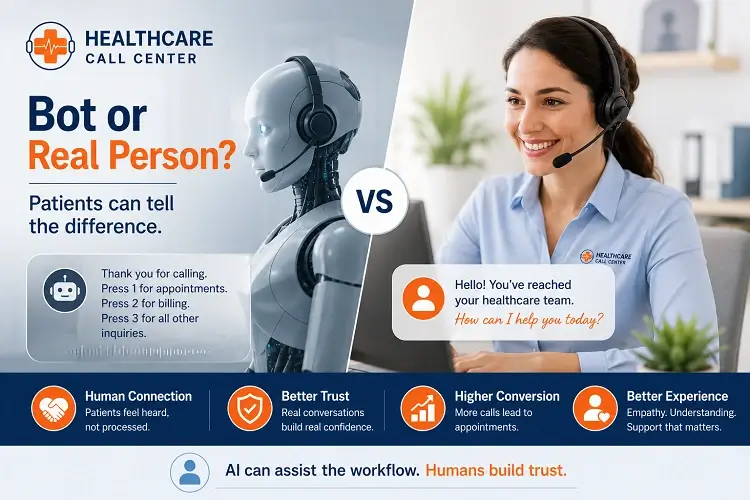
“Are You a Bot or a Real Person?”
That is becoming one of the first questions patients ask when calling a healthcare practice.
They ask because they have been burned before. They have navigated phone trees. They have listened to robotic voices repeat options. They have waited on hold only to reach someone who sounds disengaged. They have left voicemails that never got returned.
So when a patient calls a healthcare practice and hears a real human voice, something changes.
They slow down. They explain what they need. They feel heard.
That moment is not a small thing. In healthcare, trust starts on the phone. And right now, the gap between AI call answering and human call answering is becoming one of the biggest competitive advantages a practice can have.
The Problem with AI-Only Call Answering in Healthcare
AI voice technology has improved significantly. Many practices are testing AI receptionists, automated schedulers, and chatbot-based intake systems.
These tools can handle basic tasks:
- routing calls
- answering frequently asked questions
- sending reminders
- collecting basic information
But healthcare calls are rarely basic.
A patient calling about a delayed test result is anxious. A patient calling about fertility treatment is emotional. A patient calling about post-surgery pain needs reassurance. A parent calling about a child’s fever needs someone who can listen carefully and act quickly.
AI cannot do that.
AI can process words. It cannot read tone. It cannot pause when a patient is upset. It cannot adjust its language when someone is confused. It cannot make a nervous caller feel like they are in good hands.
And when patients realize they are talking to a bot, the conversation often changes direction entirely. They become shorter. They ask fewer questions. They hang up and call the next practice. This is where an empathy-based medical answering service comes in.
What Happens When Patients Reach a Real Person
When patients reach a trained human agent, their behavior shifts in measurable ways:
- They explain their situation in more detail
- They ask follow-up questions
- They share concerns that they would not share with a bot
- They are more likely to book or confirm an appointment
- They feel more confident about the practice they call
This is not a guess. Call center teams hear it every day.
Patients say things like:
- “Thank you for actually answering.”
- “I thought this was going to be an automated system.”
- “I am so glad I got a real person.”
That relief is not just a nice moment. It is a conversion signal. When patients feel heard, they are more likely to take the next step. When they feel processed, they are more likely to hang up and look elsewhere.
Where AI Fits in Healthcare Communication
This does not mean AI is useless. In fact, AI plays an important role behind the scenes.
AI can support:
- call routing
- transcription
- sentiment analysis
- automated reminders
- data entry
- scheduling optimization
- reporting dashboards
These are operational tools. They help the practice and the call center team work more efficiently.
All of these systems should operate within HIPAA-compliant workflows to ensure patient data remains secure and protected.
But the patient should not feel like they are talking to a machine.
The best healthcare call centers use AI to support their human agents, not replace them. AI handles the background work. Humans handle the conversation.
This combination gives practices the efficiency of automation with the empathy of real human interaction.
Why Human Agents Still Convert Better
Healthcare is not like ordering a ride or booking a restaurant. The stakes are higher. The emotions are real. The decisions are personal.
When a patient calls a healthcare practice, they are often:
- anxious about a symptom
- confused about insurance
- worried about costs
- frustrated by long wait times
- uncertain about next steps
- calling after hours because they could not call during the workday
An AI bot cannot navigate those emotions. A trained human can.
A trained human can:
- Listen to what the patient is not saying
- Adjust tone based on the caller’s mood
- reassure without overpromising
- follow practice-specific escalation rules
- capture details that a bot would miss
- make the patient feel like the practice cares
This is why human call answering still outperforms AI in patient satisfaction, conversion, and retention.
The Hidden Cost of AI-Only Patient Communication
Practices that switch to AI-only call answering often see short-term savings but long-term losses.
The American Medical Association has also highlighted both the opportunities and limitations of AI in healthcare, particularly around patient communication, trust, and clinical decision support.
Here is what typically happens:
- The practice installs an AI answering system
- Call volume appears to be handled
- But patient complaints increase
- Online reviews mention “robot voices” and “frustrating phone trees”
- New patient inquiries drop because callers do not feel welcomed
- The practice realizes too late that the phone experience is part of their brand
In healthcare, the phone is still the primary connection point between patient and practice. If that experience feels cold, rushed, or automated, the patient forms an opinion about the entire practice.
What a Human-First Healthcare Call Center Actually Does
A human-first medical call center does not mean old-fashioned. It means the patient always reaches a real person, supported by smart systems.
Here is how it works:
Step 1: Call Flow Review
The call center reviews how calls currently flow into the practice. They identify peak hours, missed-call windows, after-hours patterns, and common call reasons.
Step 2: Custom Scripts and Escalation Rules
The call center builds scripts that match the practice’s voice, specialties, and patient communication standards. Urgent calls are escalated based on practice-approved rules.
Step 3: Trained Human Agents
Agents are trained on the practice’s procedures, appointment types, insurance intake, and patient communication expectations. They follow the practice’s rules, not a generic script.
Step 4: Reporting and Visibility
The practice sees call reasons, missed-call patterns, appointment opportunities, and agent performance. The system runs on smart technology, but the patient experience stays human.
Why Our Stay-at-Home Mom Model Works
Healthcare Call Center uses trained stay-at-home moms as its call agent team. This is not just a staffing decision. It is a positioning decision.
Stay-at-home moms bring qualities that are hard to train:
- patience
- empathy
- multitasking
- calm communication under pressure
- genuine care for the person on the other end of the call
These qualities matter most in healthcare, where patients are not just customers. They are people dealing with real concerns, real emotions, and real decisions.
When a patient calls and reaches someone who sounds warm, patient, and present, it changes how they feel about the practice.
How to Decide What Your Practice Needs
If your practice is evaluating call coverage options,
ask these questions:
- Are patients reaching a real person when they call?
- Are after-hours calls going to voicemail or a human agent?
- Is the current phone experience building trust or creating frustration?
- Are new patient inquiries being captured consistently?
- Does the call handling feel like an extension of the practice or a separate vendor?
If any of these answers feel uncertain, the phone experience may be costing the practice more than it realizes.
The Bottom Line: AI Supports, Humans Build Trust
AI can support a healthcare practice. But it should not be the first thing a patient hears.
Patients still want a human voice. They still want someone who listens, responds, and helps them take the right next step.
In a world where everything is becoming automated, the practices that keep the phone experience human will stand out. Not because they are old-fashioned. Because they understand that healthcare is personal.
AI can assist the workflow. But when patients call, a real human voice still builds trust fastest.
by Erika Sanchez | Jun 25, 2026 | Fertility & IVF Clinic Answering Service
A fertility patient does not usually contact one clinic and wait patiently for a reply. She researches. She compares. She reads reviews. She checks success stories. Then she reaches out to the clinics that feel most trustworthy.
At that moment, speed matters.
Not because fertility care should feel rushed. Not because patients want a sales pitch. Speed matters because the first clinic that responds with clarity, empathy, and confidence often becomes the clinic the patient trusts first.
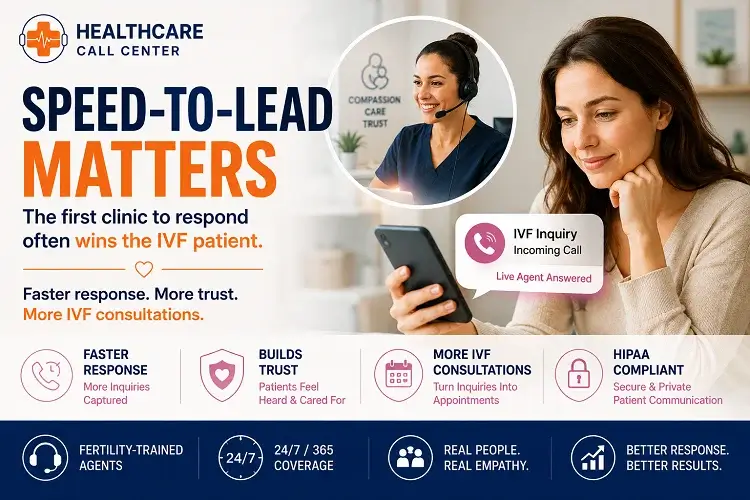
For fertility clinics, speed-to-lead is not just a marketing metric. It is a patient acquisition advantage.
A new IVF inquiry may represent a treatment journey worth thousands of dollars. But before that patient ever books a consultation, she has to feel that your clinic is responsive, organized, and emotionally safe. If her first call hits voicemail, if her message waits overnight, or if she gets a rushed callback from a busy front desk, the trust gap begins immediately.
That is why a fertility clinic answering service is not simply about answering the phone. It is about protecting the first moment of trust.
What Speed-to-Lead Means in Fertility Marketing
Speed-to-lead is the time between a patient inquiry and your clinic’s first real response. In simple terms, it measures how fast your clinic responds after someone fills out a form, calls the office, clicks an ad, or asks for an appointment.
In many industries, speed-to-lead is treated as a sales performance metric. In fertility care, it is more personal. A patient who contacts an IVF clinic may be anxious, hopeful, overwhelmed, or already disappointed by previous treatment experiences. That patient is not just looking for information. She is looking for reassurance.
A fast response tells her three things:
- This clinic is organized.
- This clinic takes patient inquiries seriously.
- This clinic may be safe to trust with something deeply personal.
A slow response tells a different story, even if that story is unfair. It suggests the clinic is too busy, too disorganized, or not ready to prioritize her needs. That impression can form before she ever speaks to a doctor.
Why Fertility Patients Compare Multiple Clinics
Most fertility patients are not casual shoppers, but they are careful researchers. IVF is expensive, emotional, and life-changing. Patients often compare multiple clinics before deciding where to book their first consultation.
They look at success rates. They read reviews. They compare physicians. They ask friends or online communities. Then they contact the clinics that make the shortlist.
Here is the important part: the first response can shape the entire decision.
If one clinic answers live, explains next steps, shows empathy, and offers a consultation time, that clinic creates momentum. If another clinic sends the call to voicemail or replies the next day with a generic message, the patient may already be emotionally committed elsewhere.
This is why speed-to-lead matters more in fertility than in many other medical specialties. The patient is not only choosing clinical expertise. She is choosing the team that feels most present when she first reaches out.
Your Front Desk Is Part of the Fertility Conversion Funnel
Many fertility clinics think of the front desk as an administrative function. It is not. Your front desk is part of your conversion funnel.
Every Google Ads click, organic search visit, referral, and social media impression eventually has to become a real patient conversation. If that conversation does not happen quickly and smoothly, your marketing spend leaks revenue.
A fertility clinic may invest heavily in SEO, paid ads, reputation management, and physician branding. But if the first call goes unanswered, those investments do not convert at the rate they should.
This is the hidden leak in fertility marketing. The problem is not always traffic. The problem is often response time.
A fertility call center helps close that gap by making sure inquiries are answered quickly, routed properly, and handled with the sensitivity the patient expects.
Why Generic Answering Services Fail IVF Clinics
Fertility calls are different from routine medical calls. Generic answering services often fail where a specialized medical answering service succeeds for fertility practices.
Fertility patients may ask about consultation availability, insurance questions, treatment timelines, prior failed cycles, donor options, financing, lab access, or next steps after an online inquiry. Even when the agent cannot provide clinical advice, the way the call is handled matters.
A good IVF answering service should know how to:
- Respond with empathy without overpromising clinical outcomes.
- Collect the right intake information.
- Route urgent or sensitive calls based on clinic protocol.
- Schedule consultations or pass qualified inquiries quickly to the clinic.
- Protect patient privacy through HIPAA-compliant workflows.
- Represent the clinic’s tone with calm, clear communication.
This is why fertility clinics need more than a basic message-taking service. They need call coverage built around patient experience and conversion.
Speed Does Not Mean Pressure
One mistake clinics make is assuming faster response means more aggressive sales behavior. That is not what fertility patients need.
Speed-to-lead does not mean rushing the patient. It means being present when the patient is ready to talk.
A strong first response should feel calm, human, and helpful. The goal is not to push the patient into treatment. The goal is to make the next step feel simple.
For example, the difference between these two responses is huge:
Cold response: ‘Someone will call you back later.’
Better response: ‘I understand this is an important decision. I can help get your information to the right team and see what consultation times are available.’
Both responses may take less than a minute. But only one builds trust.
Where Fertility Clinics Lose Speed
Most fertility clinics do not lose leads because nobody cares. They lose leads because the front desk is overloaded.
Common gaps include:
- Calls during lunch hours when staff are short-handed.
- After-work calls from patients who cannot call during business hours.
- Weekend inquiries from patients doing research at home.
- Google Ads calls that arrive when staff are handling in-office patients.
- Web form submissions that sit too long before follow-up.
- Voicemails that get returned after the patient has contacted another clinic.
These are operational gaps, but they create marketing losses. The clinic may never see them clearly unless call tracking and response time are measured.
What a Fertility Clinic Answering Service Should Do
The right fertility clinic answering service should do more than answer phones. It should support the entire patient inquiry process.
That includes:
- Live answering during office hours, overflow periods, evenings, weekends, and holidays.
- Consultation scheduling based on your clinic’s rules.
- HIPAA-compliant intake and message handling.
- Escalation protocols for sensitive or urgent calls.
- Clear documentation so your internal team knows what happened.
- Reporting on missed calls, answered calls, and booked opportunities.
When this system works, your clinic does not need to choose between patient care and lead response. Your front desk can focus on in-office patients while trained support captures new inquiries before they go cold.
How Faster Response Times Improve IVF Conversions
In fertility marketing, speed creates trust. Trust creates momentum. Momentum creates booked consultations.
When a patient reaches your clinic and hears a calm human voice, the decision process changes. She is no longer just comparing websites. She is having a real experience with your brand.
That first experience can make your clinic feel accessible, organized, and emotionally supportive. It can also make the next step clear: book the consultation, submit intake information, or speak with the right team member.
This is where speed-to-lead becomes a conversion strategy. It is not only about answering fast. It is about answering well while the patient is still actively deciding.
How to Improve Speed-to-Lead Without Burning Out Staff
Improving response time does not always mean hiring more front desk staff. It means designing a better call coverage system.
Start with these steps:
- Audit your call logs for missed calls, peak call windows, and after-hours inquiries.
- Track how long it takes to respond to forms, voicemails, and missed calls.
- Separate urgent patient calls from new consultation inquiries.
- Create clear scripts for IVF inquiries, financing questions, and appointment scheduling.
- Use a fertility-trained call center for overflow and after-hours support.
- Review weekly reporting to see which inquiry sources convert into booked consultations.
The goal is not more activity. The goal is a faster, calmer, more consistent patient response.
For clinics handling sensitive IVF inquiries, IVF appointment scheduling support can help capture patient intent before the caller loses momentum.
Final Thought: Speed Builds Trust
Fertility patients are making one of the most personal decisions of their lives. They are not only evaluating your doctors, technology, or success stories. They are evaluating how your clinic makes them feel from the first interaction.
If your clinic responds quickly, clearly, and compassionately, you create trust before the first appointment. If your clinic responds slowly, that trust may go to another practice.
Speed-to-lead is not just a marketing concept for fertility clinics. It is a patient experience standard.
Healthcare Call Center helps fertility clinics answer patient inquiries quickly, route calls properly, and protect every high-value IVF opportunity with HIPAA-compliant, empathy-first support.
Book a free consultation to see how many fertility patient inquiries your clinic may be missing and how to recover them.
Frequently Asked Questions
Why does speed-to-lead matter for fertility clinics?
Speed-to-lead matters because fertility patients often compare several clinics before booking. A fast, empathetic response helps build trust while the patient is still actively deciding where to schedule an IVF consultation.
What is a fertility clinic answering service?
A fertility clinic answering service provides live call coverage for IVF and fertility practices. It helps answer patient inquiries, collect intake details, schedule consultations, route urgent calls, and support HIPAA-compliant communication.
How is fertility call handling different from general medical answering?
Fertility calls are often emotional, time-sensitive, and high-value. Agents need to communicate with empathy, avoid clinical overpromising, follow escalation protocols, and understand the sensitivity of IVF patient inquiries.
Can a fertility call center help with after-hours inquiries?
Yes. A fertility call center can answer calls after hours, on weekends, during lunch breaks, and during overflow periods so patient inquiries do not sit in voicemail while the patient contacts another clinic.
Is the fertility clinic’s call answering HIPAA compliant?
A reputable fertility clinic answering service should use HIPAA-compliant workflows, trained agents, secure systems, and a signed Business Associate Agreement when handling patient information.
How quickly can a fertility clinic improve response time?
With the right call coverage partner, setup can happen in up to 2 weeks. That includes call flow planning, script setup, escalation rules, and agent training based on the clinic’s process.